
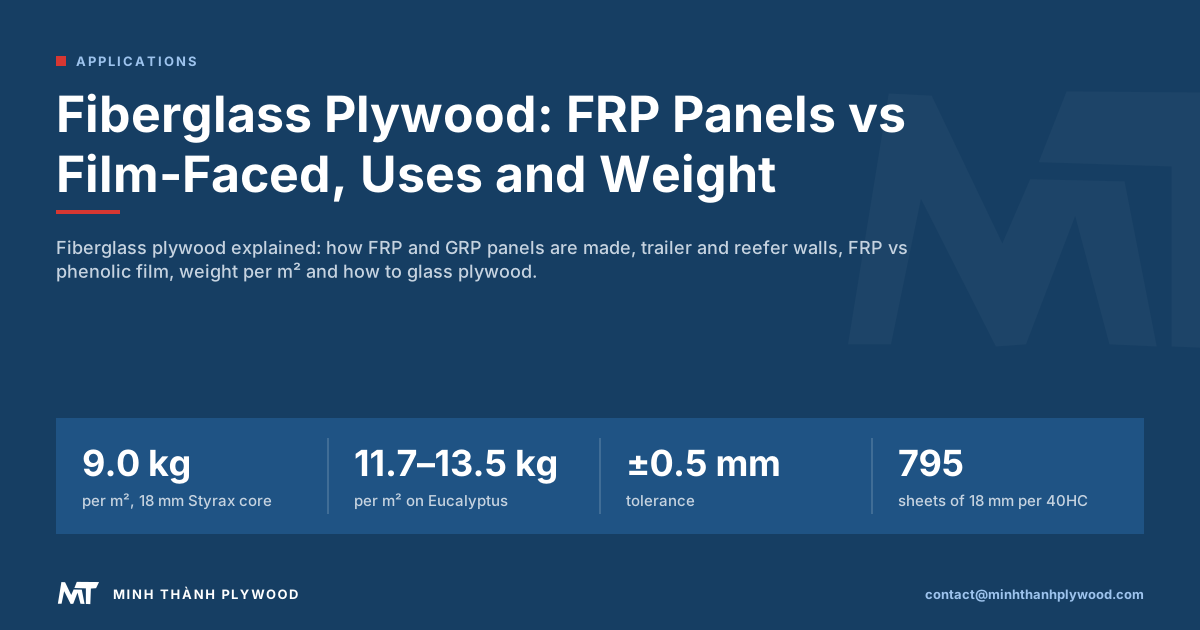
Fiberglass plywood is plywood bonded to a skin of glass-fibre reinforced plastic (FRP, also called GRP) on one or both faces. The skin makes the panel waterproof, washable and impact-resistant, which is why it lines trailer walls, truck bodies and cold rooms. This guide compares FRP with phenolic film and explains weights and coating. Minh Thanh Plywood makes the film-faced and WBP-bonded plywood often specified instead.
What is fiberglass plywood?
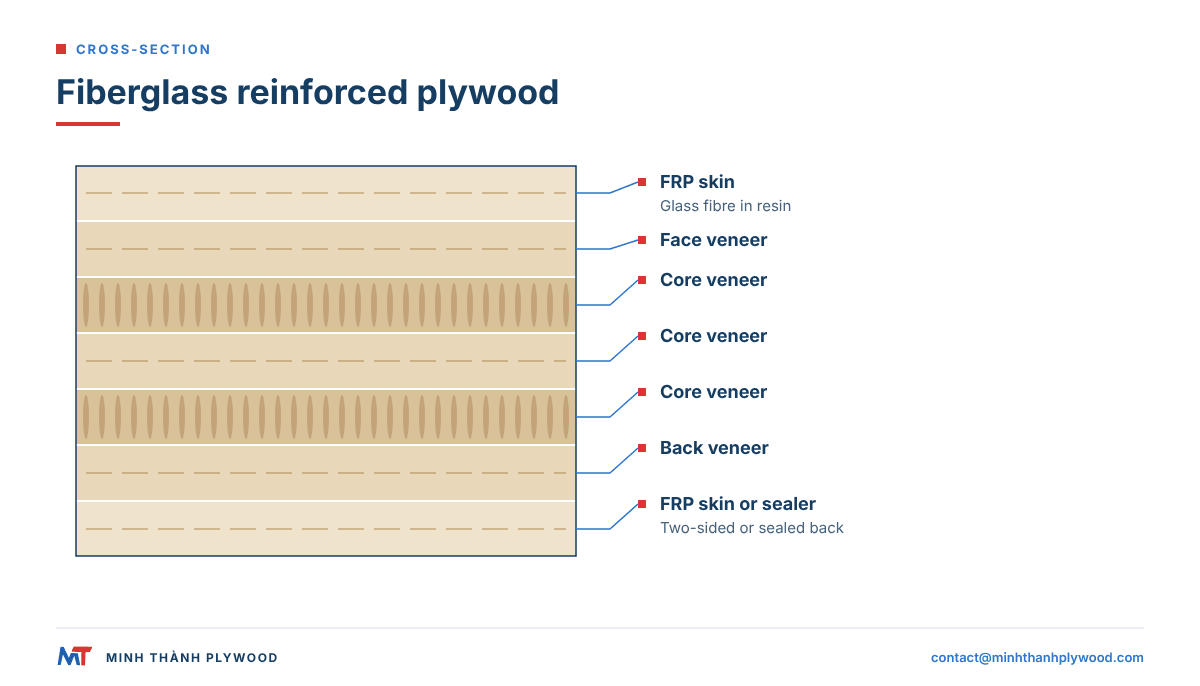
Fiberglass plywood is plywood with a skin of glass-fibre reinforced plastic (FRP, or GRP for glass-reinforced plastic) bonded to one or both faces. The plywood gives stiffness and screw holding; the FRP skin gives a waterproof, washable, impact-resistant surface.
- Core: hardwood or softwood plywood, usually with a phenolic (WBP) bond.
- Skin: glass fibres in polyester or epoxy resin, smooth or textured, often white.
- Faces: one side (lining panels) or both sides (partitions, doors).
- Names: FRP plywood, GRP plywood panels, fiberglass reinforced plywood and FRP-faced plywood are the same product.
The panel combines what each material does best. Plywood alone takes water at the surface; FRP alone is flexible and hard to fix to.
How fiberglass plywood panels are made
Fiberglass plywood panels are made by laminating a cured FRP sheet onto plywood with an adhesive, or by laying glass and resin directly onto the panel and curing it in a press. Factory lamination gives the even, smooth faces seen on trailer walls.
- Prepare the plywood: sanded, dry, flat and free of voids.
- Make or buy the FRP sheet: glass fibres in resin, usually a few millimetres or less thick.
- Apply adhesive to the plywood face.
- Lay the FRP sheet and press it in a cold or hot press.
- Trim and seal the edges of the finished panel.
What are the specifications of FRP plywood?
FRP plywood panels are specified by sheet size, core thickness, skin thickness and ply count. A ranking panel maker lists 1220 × 2440 mm sheets, 10–30 mm plywood cores, 0.7–5 mm FRP skins and 3–11 plies, all customisable.
| Specification | Typical FRP plywood panel | The core we supply |
|---|---|---|
| Sheet size | 1220 × 2440 mm, or custom | 1220 × 2440 or 1250 × 2500 mm; custom such as 1220 × 2500 mm |
| Plywood core thickness | 10–30 mm | 3–40 mm, sanded, ±0.2–0.3 mm |
| FRP skin thickness | 0.7–5 mm | Applied by the laminator |
| Plies in the core | 3–11 | Set by core thickness |
| Skin weight | 1.5–2.5 kg/m² per mm of skin | Not applicable |
| Glue in the core | Water-resistant | Phenolic WBP or MR to order |
A thin skin of 1 mm adds about 1.5–2.5 kg/m², while a thick 5 mm skin adds about 7.5–12.5 kg/m²: glass-reinforced plastic has a density of 1,500–2,500 kg/m³.
A sanded, calibrated plywood core is what makes the skin flat. Core gaps and thickness steps telegraph through a thin skin as dents and lines.
FRP vs phenolic film-faced plywood
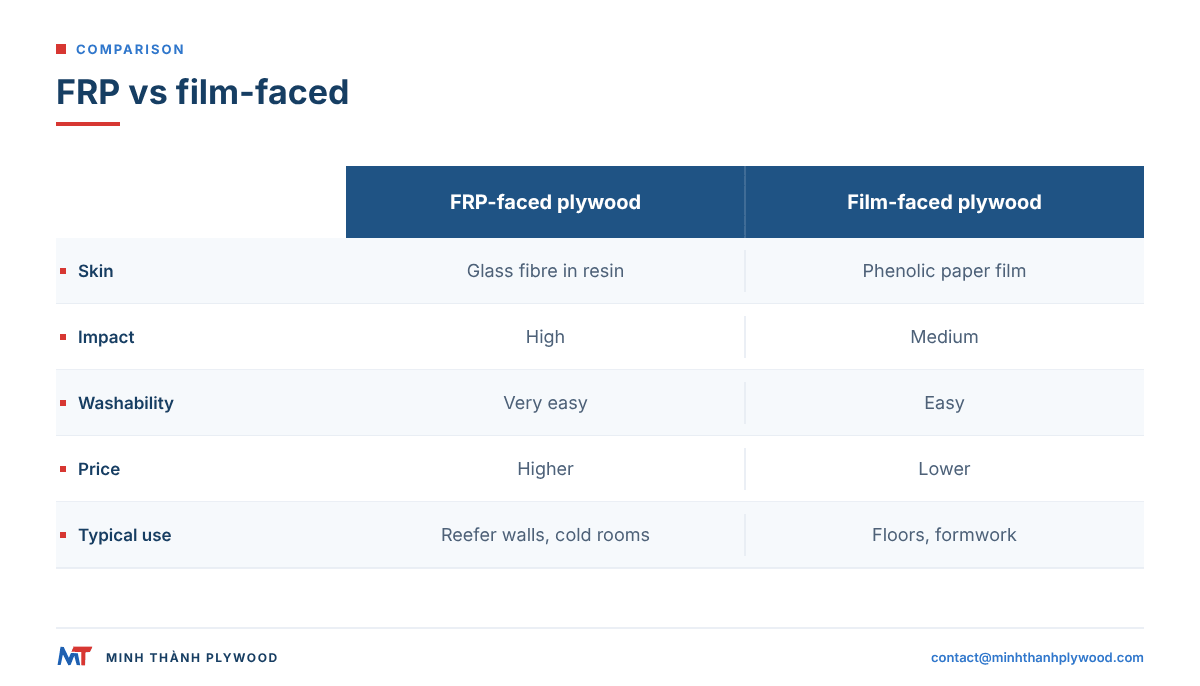
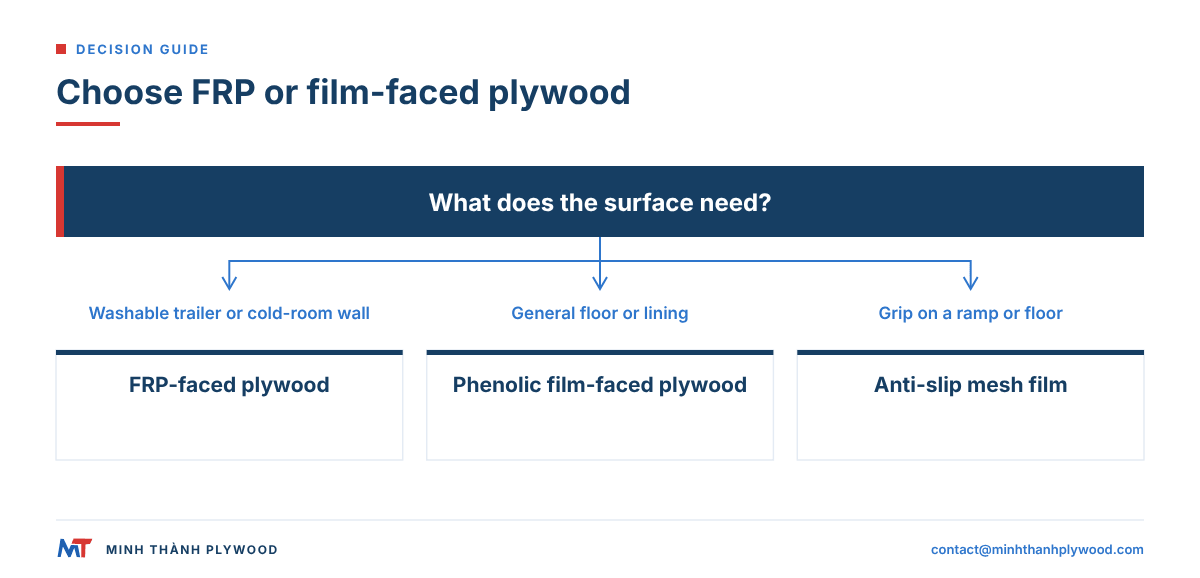
FRP-faced plywood has a thicker, tougher and more washable skin than phenolic film-faced plywood, at a higher price; phenolic film is the cost-effective choice for floors, formwork and many linings. The table compares them.
| Property | FRP-faced plywood | Phenolic film-faced plywood |
|---|---|---|
| Skin | Glass fibres in polyester or epoxy resin | Resin-impregnated paper film |
| Skin thickness | Thicker | Thin |
| Impact and scuff resistance | High | Medium |
| Washability | Very easy, smooth and sealed | Easy |
| Colour | Usually white, also grey and others | Usually brown or black |
| Repair | Glass cloth and resin | Re-seal or replace |
| Price | Higher | Lower |
| Typical use | Reefer and food walls, cold rooms, truck bodies | Floors, formwork, dry van linings |
Where the surface only needs to be waterproof and hard-wearing, not food-grade washable or bright white, phenolic film-faced plywood does the job for less.
What is FRP plywood used for?
FRP plywood is used where a stiff panel needs a waterproof, washable and tough surface: trailer and truck walls, refrigerated linings, cold rooms, food processing areas and recreational vehicles. The skin protects the plywood core, while the panel keeps the stiffness and the lower cost of plywood.
| Application | Why FRP | Panel note |
|---|---|---|
| Dry van trailer walls | Scuff-resistant, smooth for loading | One side faced, thick core |
| Refrigerated (reefer) linings | Washable, hygienic, moisture-proof skin | Combined with insulation |
| Truck and delivery bodies | Light, tough, easy to repair | Both sides faced for doors |
| Cold rooms and food plants | Washable walls and ceilings | White skin |
| RV and caravan walls | Weatherproof outer skin | Thin core, light |
| Boat interiors and decks | Sealed against water | Epoxy-glassed plywood |
| Animal trailers and kennels | Easy to hose down | Textured skin |
Fiberglass reinforced plywood trailer panels are the largest single use, because the skin takes forklift and cargo scuffs that would wear through bare plywood.
Fiberglass reinforced plywood trailer panels
Fiberglass reinforced plywood trailer panels line the inside walls of dry vans and truck bodies, fixed to posts so the smooth skin faces the cargo. They resist scuffs, are easy to clean and are repaired panel by panel.
- Thickness: thick cores for walls that take cargo impact; thinner for linings.
- Skin: one side faced towards the cargo, the back sealed.
- Bond: phenolic (WBP) plywood, because trailer walls see condensation and washing.
- Fixing: screws or rivets to posts, with sealed holes.
Floors are a different job: trailer and container floors take wheel loads and are usually thick hardwood plywood with a phenolic film or an anti-slip mesh face. For floors, read plywood for trailer flooring and container flooring plywood.
Thickness and weight of fiberglass plywood
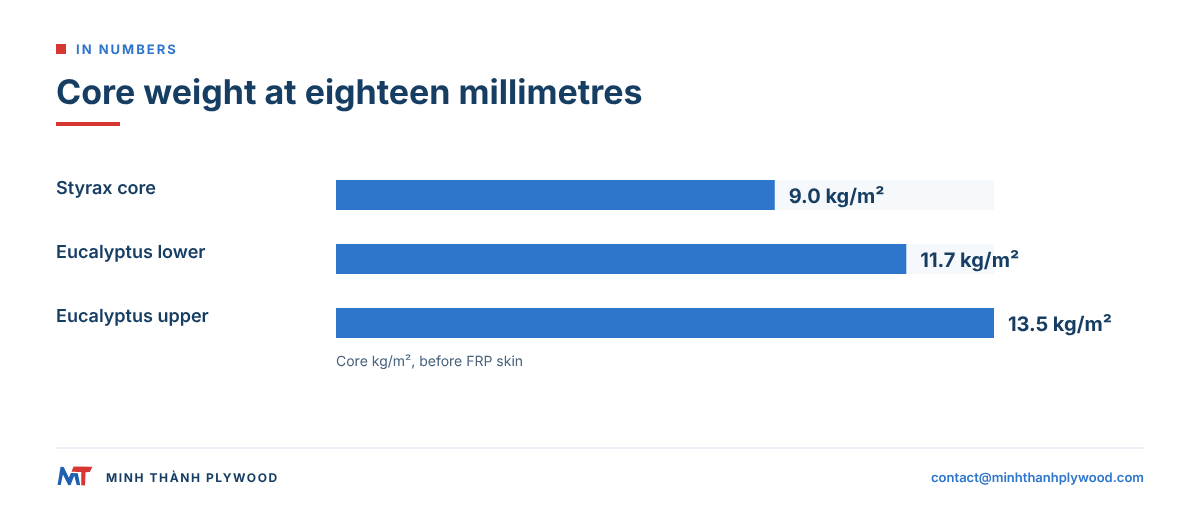
Most of the weight of a fiberglass plywood panel is in the plywood core, so the core species and thickness set the panel weight. The table uses our reference core densities, before the FRP skin.
| Core thickness | Styrax core, 500 kg/m³ | Eucalyptus core, 650–750 kg/m³ |
|---|---|---|
| 9 mm | about 4.5 kg per m² | about 5.9–6.8 kg per m² |
| 12 mm | about 6.0 kg per m² | about 7.8–9.0 kg per m² |
| 15 mm | about 7.5 kg per m² | about 9.8–11.3 kg per m² |
| 18 mm | about 9.0 kg per m² | about 11.7–13.5 kg per m² |
Calculation: 0.018 m × 500 kg/m³ = 9.0 kg per m². The FRP skin adds about 1.5–2.5 kg/m² for every millimetre of skin. A 12 mm Styrax core with a 1.5 mm skin on one face therefore weighs about 8.3–9.8 kg/m², and the same core with a 1.5 mm skin on both faces about 10.5–13.5 kg/m². Ask the laminator for the measured skin weight of the finished panel.
A light Styrax core suits linings and RV walls where every kilogram counts, and it keeps a long trailer wall within the axle weight the body builder planned. A harder Eucalyptus core suits walls that take impacts and screws close to the edge.
Choosing the plywood core for GRP plywood panels
The plywood core for FRP faces must be flat, calibrated, free of voids and bonded with a water-resistant glue. The skin is thin; every flaw in the core shows through it or opens later.
- Bond: phenolic (WBP) or MR (melamine-fortified), made to the customer’s specification.
- Void-free core: our core layers are stitched both horizontally and vertically, which closes gaps between core veneers.
- Flat and calibrated: panels pressed twice, core board first, then face and back.
- Even thickness: sanded panels hold ±0.2–0.3 mm; film-faced panels ±0.5 mm.
- Dry: veneers and finished panels at 8–12 % moisture content at dispatch, which helps the adhesive bond.
We do not make FRP-faced panels; we make plywood cores, film-faced and anti-slip plywood that laminators and body builders use.
How to fiberglass plywood yourself
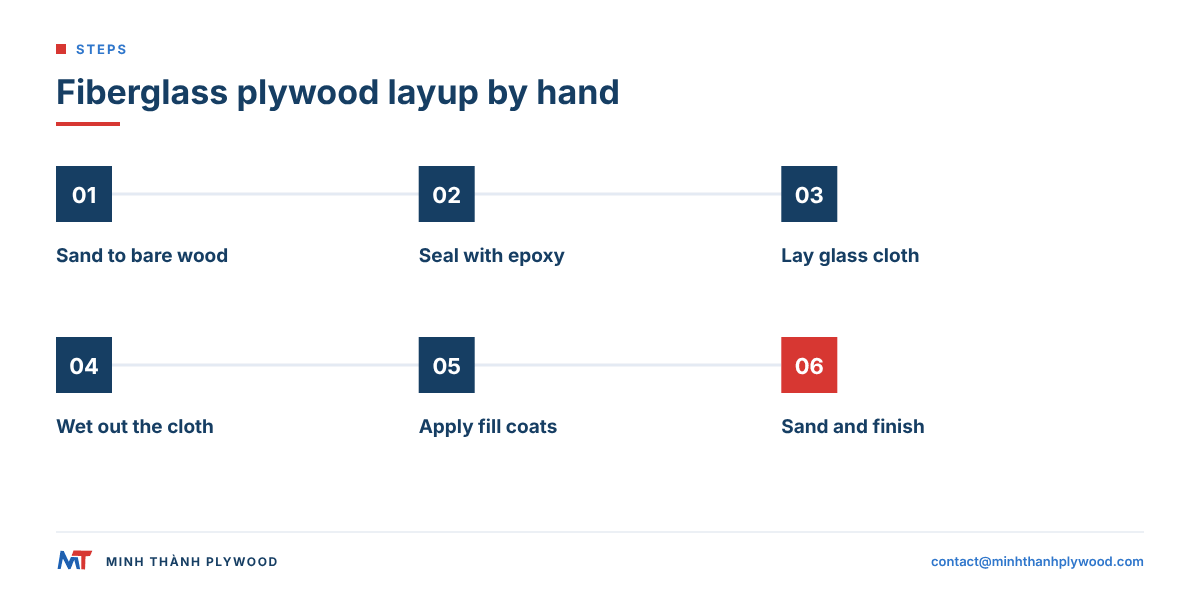
To fiberglass plywood yourself, seal clean bare wood with epoxy, lay glass cloth into wet resin, add fill coats and sand. Boat builders and van converters use this to waterproof decks and floors.
- Sand to bare wood: remove paint, oil and dust; round sharp edges so cloth can wrap them.
- Seal coat: brush thin epoxy into the wood and let it go tacky.
- Lay the cloth: smooth the dry glass cloth onto the tacky surface.
- Wet out: roll or squeegee epoxy through the cloth until it turns clear.
- Fill coats: two or three coats to fill the weave.
- Sand and finish: sand smooth and paint or varnish to protect the epoxy from sunlight.
Which resin and cloth should you use? Use epoxy on plywood: a boat-design forum contributor notes that polyester resin on plywood is “usually a false economy in the long run”.
A boat-repair guide lays polyester resin with 1.5 oz/ft² chopped strand mat (about 458 g/m²) and 1708 biaxial glass, after pre-coating the plywood with resin, because skipping the pre-coat risks a dry layup and delamination. For sealing and waterproofing, one light plain or twill cloth of 200–300 g/m² (about 6–9 oz/yd²) is enough; for a transom or other load area, builders add a biaxial layer of 400–600 g/m².
Can glass let you use thinner plywood? Not for stiffness. The stiffness of a panel rises with the cube of its thickness, so a 6 mm panel has about one-eighth the stiffness of a 12 mm panel, and glass skins on 6 mm plywood need far more material to catch up. Keep the core thickness the design calls for and use the glass to protect it.
How to cover plywood with fiberglass on edges: wrap the cloth over rounded edges, or use glass tape on corners. Sealed edges matter as much as the faces.
How many layers of fiberglass over plywood?
One layer of light glass cloth in epoxy is enough to waterproof plywood and resist scuffs; two or more layers, or a heavier cloth, are used where the surface takes impacts, foot traffic or abrasion.
| Use | Layers | Note |
|---|---|---|
| Waterproofing a panel, shelves | One light cloth | Main job is sealing |
| Boat decks and cabin tops | One or two layers | Foot traffic |
| Van and trailer floors | Two layers or a heavier cloth | Wheel and cargo wear |
| Hulls and impact zones | Several layers | Designed by the builder |
More glass adds strength and weight. For most panels, the plywood carries the load and the glass protects the surface.
Can you fiberglass over painted plywood?
You cannot fiberglass reliably over painted plywood, because the resin bonds to the paint, not the wood, and the skin lifts when the paint lets go. Sand or strip the paint back to clean, bare wood.
- Remove paint, varnish and oil completely from the area to be glassed.
- Sand with a coarse grit to open the wood surface for the resin.
- Clean off dust before the seal coat.
- Use epoxy, which bonds better to wood than polyester resin.
The same applies to film-faced plywood: resin does not bond well to phenolic film without heavy abrasion, so start from sanded plywood.
Fiberboard vs plywood under a skin
Plywood is the standard core under FRP and film skins because it is stiffer for its weight and holds screws far better than high-density fiberboard (HDF) or MDF. Fiberboard is smoother but heavy and weak when wet.
| Property | Plywood | High-density fiberboard (HDF) |
|---|---|---|
| Stiffness for its weight | High | Lower |
| Screw holding | Good, also near edges | Poor at edges |
| Moisture | Good with a WBP bond | Swells when wet |
| Surface | Grain under a thin skin | Very smooth |
| Weight for the same thickness | Lower | Higher |
| Typical use under a skin | Trailer walls, truck bodies, floors | Interior panels, door skins |
For panels that see water, impact or screws, use plywood. Fiberboard edges soak up water like a sponge once the skin is cut or drilled, while a phenolic-bonded plywood edge stays sound when sealed. HDF suits dry interior parts where a perfectly smooth face matters most.
Film-faced plywood as the lower-cost alternative for floors
For floors and many wall linings, phenolic film-faced plywood is the lower-cost alternative to fiberglass plywood: it gives a hard, water-resistant surface on a WBP-bonded panel, and anti-slip mesh faces add grip for walking and loading.
- Film-faced plywood: smooth phenolic film, for linings, formwork and floors with mats.
- Anti-slip plywood: a mesh pattern pressed into the film, made on order, for floors and ramps.
- Thickness tolerance: ±0.5 mm on film-faced panels.
A 40HC holds 795 sheets of 18 mm Eucalyptus-core panels in 15 packs of 53, at about 34.8 kg per sheet. Read buffalo board for anti-slip floors in trailers.
Fire, hygiene and cold-room rules
FRP-faced plywood used in food plants, cold rooms and passenger vehicles may face fire and hygiene rules, which differ by country and by the type of building or vehicle. The project’s specification sets which test results the panel needs.
- Hygiene: smooth, non-absorbent, washable surfaces in food areas.
- Fire: reaction-to-fire class required by the building or vehicle rule.
- Cold rooms: panels combined with insulation and vapour control.
Strength tests to ask for: a flexural test report and a compression test report that state the specimen size, the load and the method. Panel makers publish specimens such as 300 × 100 × 14 mm for flexural and 60 × 60 × 14 mm for compression, so a report on a different specimen is not comparable.
For fire, US vehicle interiors fall under FMVSS 302, which limits the burn rate of materials in the occupant compartment to 102 mm per minute. US building interiors are usually asked for an ASTM E84 surface-burning report. For food plants, the FDA’s plant-and-grounds rule is 21 CFR 117.20. Ask the FRP laminator for the fire and hygiene test results of the finished panel. For the glass-fibre material itself, see the fibre-reinforced plastic entry (read 20 October 2026).
What this means for your order
If you laminate FRP yourself, or need film-faced panels instead, order plywood by bond, core and flatness. Send these lines with your request:
- Application: core for FRP lamination, trailer walls, or film-faced floors and linings.
- Core: white Styrax for light linings, Eucalyptus for walls and floors.
- Glue: phenolic (WBP) or MR bond.
- Face: sanded for lamination, phenolic film-faced, or anti-slip.
- Thickness and size: 9 to 18 mm or thicker, 1220 × 2440 or 1250 × 2500 mm.
- Packing and quantity: from one 40HC, mixed specifications by agreement.
Production takes 15–45 days after the deposit, and free samples are available. See film-faced plywood and anti-slip plywood, and read industrial plywood.
Buyer questions, answered
Can fiberglass let me use thinner plywood?
Not for stiffness. Panel stiffness rises with the cube of thickness, so halving a 12 mm core to 6 mm leaves about one-eighth of the stiffness, and glass skins cannot recover that cheaply. Keep the designed core thickness.
What is FRP plywood used for?
FRP plywood is used for trailer and truck body walls, refrigerated van linings, cold rooms, food plants, RV walls and boat interiors: places that need a waterproof, washable and tough surface on a stiff panel.
How many layers of fiberglass over plywood?
One layer of light cloth sealed in epoxy protects plywood from water and scuffs. Two or more layers, or a heavier cloth, are used where the surface takes impacts or foot traffic.
Can you fiberglass over painted plywood?
No. Resin bonds to the paint, not the wood, and lifts with it. Sand or strip the paint back to bare, clean wood first.
Is epoxy or polyester resin better for fiberglassing plywood?
Epoxy bonds better to wood and is more water-resistant, so it is preferred over plywood. Polyester resin is cheaper and is used in factory-made FRP sheets and on glass-fibre moulds.
Is FRP plywood waterproof?
The FRP skin is waterproof, but the plywood edges are not. Cut edges and fixings must be sealed, and the plywood should have a phenolic (WBP) bond.
What is the difference between FRP and phenolic film-faced plywood?
FRP plywood has a thicker glass-fibre plastic skin that is tougher and easier to clean, at a higher price. Phenolic film-faced plywood has a thin resin-impregnated paper film that is cost-effective for floors, formwork and dry van linings.
Is high-density fiberboard better than plywood?
High-density fiberboard (HDF) is smoother and more uniform, but heavier and much weaker at screws and when wet. Plywood is stiffer for its weight and the standard core for trailer and FRP panels.
How heavy is FRP plywood?
The plywood core sets most of the weight: an 18 mm core weighs about 9.0 kg per m² on a Styrax core and about 11.7–13.5 kg per m² on a Eucalyptus core, before the FRP skin is added.
Can FRP plywood be repaired?
Yes. Small cracks and holes in the skin are ground back, filled and covered with fresh glass cloth and resin. Larger damage is repaired by replacing the panel between posts.