
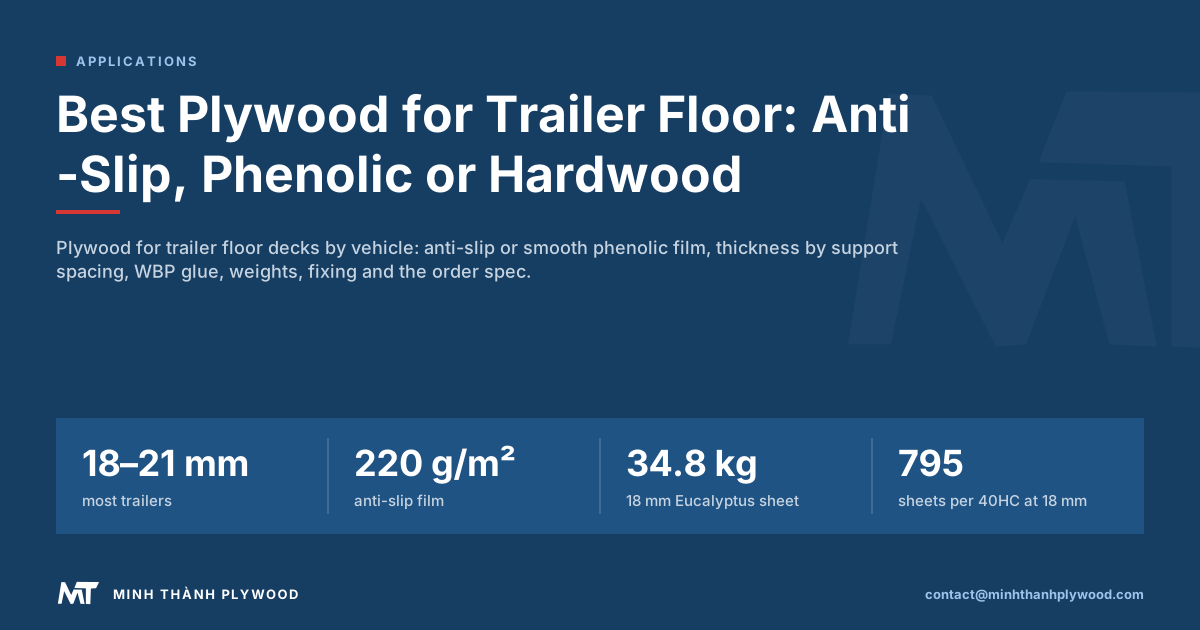
The best plywood for trailer floor decks is film-faced hardwood-core plywood with phenolic WBP glue: an 18–21 mm sheet with a 220 g/m² hexagonal or mesh anti-slip face for open, livestock and ramp floors, or a smooth phenolic face where pallet trucks roll. Seal every cut edge. Minh Thanh Plywood makes these panels on Eucalyptus and Acacia cores, 12–21 mm, for vehicle and trailer floors.
What does trailer floor plywood cost in the UK, and which standard should it carry?
UK buyers pay about £54 for a standard 8 × 4 sheet. Cleveland Timber lists a Buffalo-type anti-slip phenolic board, 2440 × 1220 × 18 mm, at £53.99, with 12 mm and 9 mm versions. HM Wood sells trailer flooring as its own category. A container FOB price per cubic metre is a different basis: compare face, glue and standard, not sheet price alone.
The label to look for on a UK sheet is the one Cleveland Timber prints: EN 314-2 class 2 or class 3 for the bond, EN 636-2S or 636-3S for the service class. EN 13986 covers the construction-products declaration. Plywood sold for construction works in the EU carries CE marking to EN 13986 under the Construction Products Regulation (EU) 305/2011 (UKCA or CE in Great Britain); a trailer floor itself is not a construction product. Class 3 is the one for open trailers. A sheet marked only “WBP” or “marine” without a class gives a buyer nothing to test against.
For a UK importer, the useful questions on a quote are the glue (phenolic), the film weight, the bond class, whether all four edges are sealed, and the sheet size. Minh Thanh Plywood quotes the standard 1220 × 2440 and 1250 × 2500 mm, plus custom sizes such as 1220 × 2500 mm, and cuts to the floor plan.
What is the best plywood for a trailer floor?
The best plywood for a trailer floor is film-faced plywood on a dense hardwood core, bonded with phenolic WBP (weather and boil proof) glue. The film carries the wear and the water, the glue keeps the plies together when the floor gets wet, and the core takes the point loads from wheels, hooves and jacks.
Within that family, three choices decide the order:
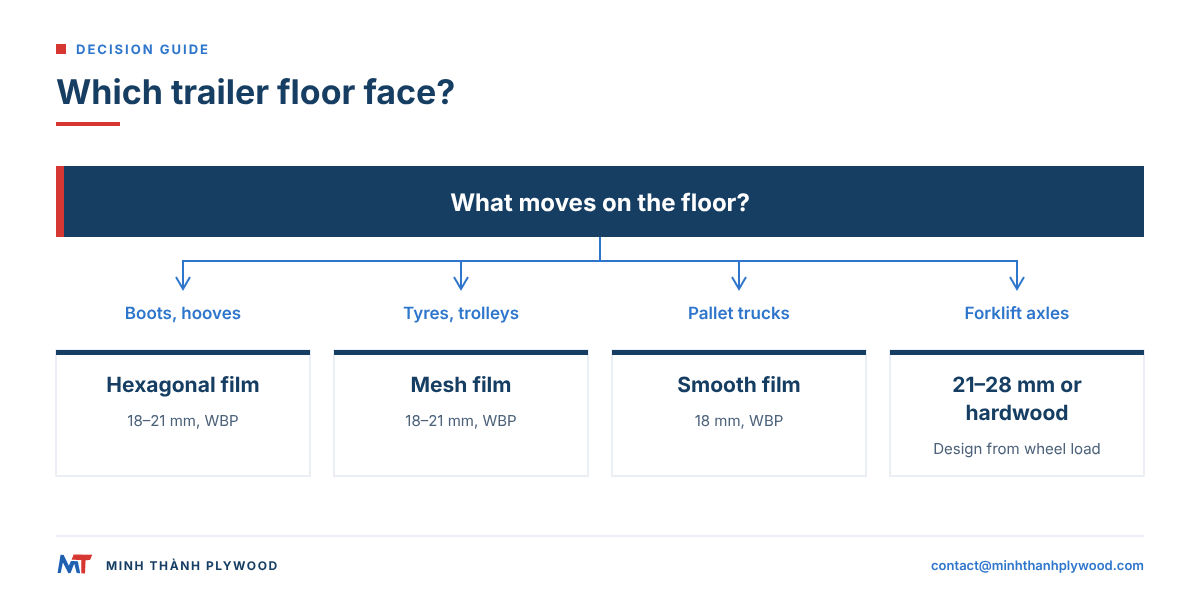
- Face: a hexagonal or mesh anti-slip film where people, animals or tyres need grip; a smooth phenolic film where pallet trucks and trolleys roll.
- Thickness: 18 mm for most car, utility and enclosed trailers; 21 mm or more for wide cross-member spacing or forklift traffic; 12–15 mm for supported van liners.
- Core: Eucalyptus for the hardest, stiffest floor; Acacia when a lighter sheet matters; birch where the buyer’s drawing names it.
A trailer floor fails at its weakest point, which is almost never the face. It is the cut edge that was never sealed, the drilled hole that lets water into the core, or a glue line that was never meant to get wet. Every section of this guide comes back to those three points.
Which trailer plywood suits each vehicle?
Each vehicle type asks for a different face and thickness, because the load, the wheels and the water differ. The table is the starting point most builders use; the vehicle drawing, support spacing and wheel loads finalise it.
| Vehicle | Face | Thickness | Glue | Why |
|---|---|---|---|---|
| Open flatbed or utility trailer | Hexagonal or mesh anti-slip film | 18–21 mm | Phenolic WBP | Rain, mud and boots on an open deck |
| Car transporter and plant trailer | Mesh anti-slip film | 21 mm or more | Phenolic WBP | Tyre grip and point loads on ramps |
| Enclosed cargo trailer | Smooth phenolic film | 18 mm | Phenolic WBP | Pallet trucks roll, the floor wipes clean |
| Box truck and van body | Smooth or mesh film | 18–21 mm | Phenolic WBP | Daily loading, forklift on the tail |
| Panel van floor liner | Mesh anti-slip film | 12–15 mm | Phenolic WBP or melamine-fortified | Supported by the steel floor, weight matters |
| Horse and livestock trailer | Hexagonal anti-slip film | 18–21 mm | Phenolic WBP | Hoof grip, urine and wash-down |
| Bus and coach floor | Smooth film under a vinyl covering | 12–18 mm | Phenolic WBP | Covered floor, low weight, fixed seats |
| Motorcycle and ATV trailer, ramps | Hexagonal anti-slip film | 18 mm | Phenolic WBP | Wet-tyre and boot grip on a slope |
Heavy dry-van semi-trailers are the one case where many fleets choose laminated hardwood flooring instead of plywood: strips of oak or tropical hardwood glued into thick boards built for forklift axle loads. Plywood still lines the walls of those trailers and floors the lighter rigid bodies.
What thickness plywood for a trailer floor?
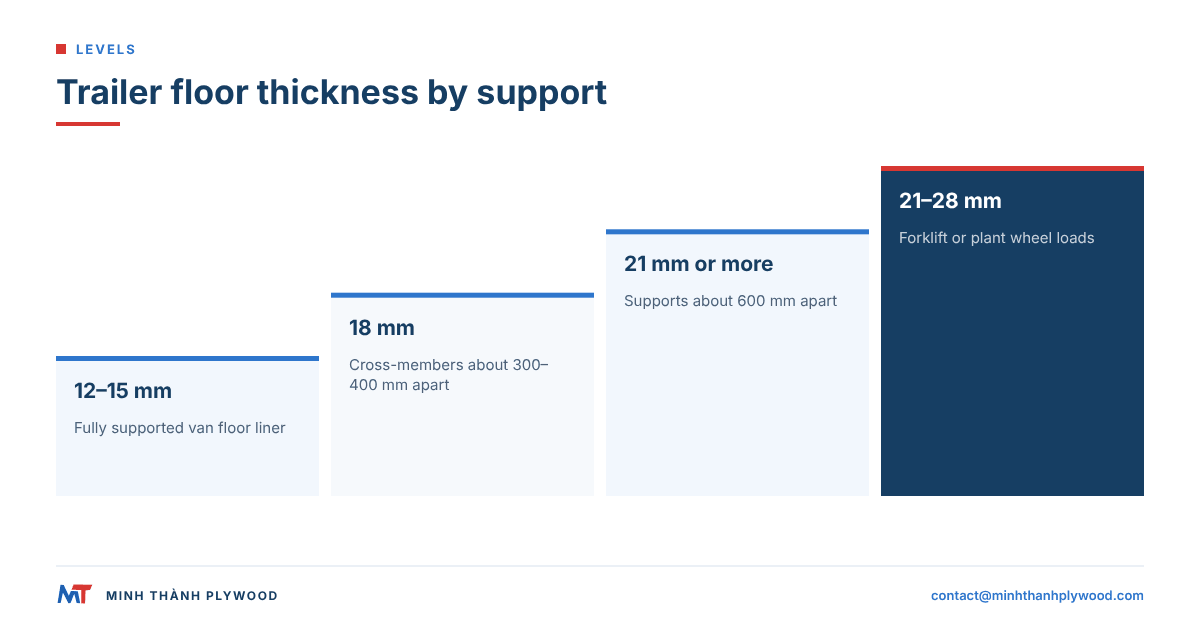
Use 18 mm plywood for a trailer floor on cross-members about 400 mm (16 in) apart, and step up to 21 mm or more when supports sit wider or forklifts drive on the deck. Thinner 12–15 mm sheets only work where a steel floor or close framing carries them.
| Support and load | Typical thickness | Typical use |
|---|---|---|
| Fully supported on a steel floor | 12–15 mm | Van floor liners, bus floors under vinyl |
| Cross-members about 300 mm (12 in) apart | 18 mm | Livestock floors, motorcycle trailers, ramps |
| Cross-members about 400 mm (16 in) apart | 18 mm | Car, utility and enclosed cargo trailers |
| Cross-members about 600 mm (24 in) apart | 21 mm or more | Wider-spaced chassis, heavier cargo |
| Forklift or plant wheels on the deck | 21–28 mm, or laminated hardwood | Box truck tails, plant and machinery trailers |
Two rules move a floor up one step. A deck that sees road salt, wash-down or wet cargo every week should go one thickness heavier than the dry-cargo minimum. A deck where a concentrated wheel load lands between supports, such as a pallet truck or a tracked machine, should be designed from that wheel load, not from the cargo weight spread over the floor.
Imperial buyers order the same panels by nominal size: 3/4 in matches 18 mm, 7/8 in sits near 21 mm, and 1-1/8 in sits near 28 mm. Name the metric thickness and tolerance on the order so the panel and the fixings match.
Anti-slip, smooth phenolic, marine or hardwood: which face is best?
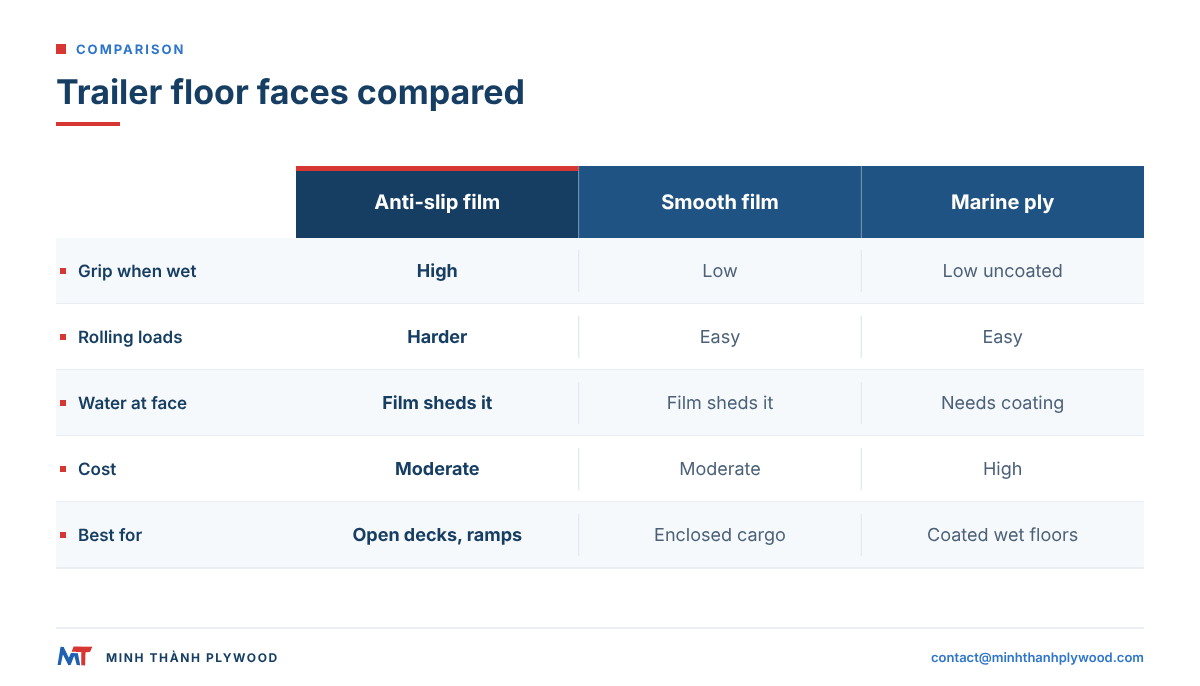
Anti-slip film is the best face for wet, open and walked-on decks; smooth phenolic film is best for rolling loads; marine plywood and hardwood floors each win one narrow case. The comparison below sets out the trade-off per metric.
| Metric | Anti-slip film-faced | Smooth film-faced | Marine plywood (BS 1088) | Laminated hardwood floor |
|---|---|---|---|---|
| Surface | Hexagonal or mesh phenolic film | Smooth phenolic film | Sanded hardwood veneer | Solid hardwood strips |
| Grip when wet | High | Low | Low unless coated | Moderate |
| Wheels and pallet trucks | Harder to push | Easy | Easy | Easy |
| Water at the face | Film sheds it | Film sheds it | Needs a coating | Needs a coating |
| Edge sealing needed | Yes | Yes | Yes | Yes |
| Cost per sheet | Moderate | Moderate | High | High, sold as floor kits |
| Best for | Open decks, ramps, livestock | Enclosed cargo, box trucks | Boat trailers, coated show floors | Heavy dry-van semi-trailers |
Verdict by use: order anti-slip film for anything walked or driven on outdoors; order smooth film for enclosed floors where loads roll; keep marine plywood for floors that will be coated and stay wet; leave laminated hardwood to heavy forklift trailers. Construction sheathing such as CDX belongs on none of them, because its glue line is not built for a floor that is wet from below every winter.
Hexagonal or mesh: which anti-slip trailer decking plywood?
Hexagonal film is the better trailer decking plywood face for foot and hoof traffic, and mesh film is the better face for wheeled traffic. Both are phenolic film of about 220 g/m², pressed onto the working face with a smooth film on the back.
How the two patterns behave:
- Hexagonal (hexa): raised six-sided cells give grip in every direction and drain and wash out easily. Horse floors, ramps, stages, walkways and motorcycle trailers use it.
- Mesh (wire mesh or rice pattern): a finer, regular texture that tyres and trolleys cross with less resistance and that holds less dirt. Van floors, car transporters and box bodies use it.
- Both sides textured: order a reversible deck when a worn wheel path should be turned over instead of replaced.
The film weight matters more than the pattern. Anti-slip floor film at about 220 g/m² is much heavier than the 120–135 g/m² film used on formwork panels, and that extra resin is what wears down slowly under boots and tyres. A floor specification that names only “anti-slip” without a film weight invites a thin formwork film with a pattern pressed into it.
Where a slip rating is written into the contract, it names a method: the pendulum test (EN 16165 Annex C; some data sheets quote EN 13036-4) or the ramp test behind the German R9–R13 ratings (DIN 51130). The UK Health and Safety Executive explains floor slip resistance and the pendulum test. Minh Thanh arranges SGS testing to the method the buyer names, on the construction it ships.
Which glue and core does trailer flooring plywood need?
Trailer flooring plywood needs phenolic WBP glue and a dense hardwood core. Phenolic glue is the bond made for repeated wetting and drying; the core sets the floor’s stiffness, screw holding and resistance to wheel dents.
| Specification | Choice for trailer floors | Why |
|---|---|---|
| Glue | Phenolic WBP | Survives road spray, wash-down and boil testing |
| Glue, covered floors | Melamine-fortified (MR) | Acceptable for van liners and bus floors under covering |
| Core species | Eucalyptus, 650–750 kg/m³ | Hard, stiff, good screw holding |
| Core species, lighter | Acacia, about 580 kg/m³ | Lighter sheet, still a hardwood core |
| Core build | Stitched, gap-free core veneers | No voids under a wheel path |
| Face | Phenolic film, about 220 g/m² | Wear surface and water barrier |
| Thickness tolerance | ±0.5 mm | Flat joints between sheets |
Phenolic bonds are tested by boiling. The EN 314 bond-quality test for class 3, the exterior class, boils samples for four hours, dries them, boils them again and then shears the glue lines. A floor bought for outdoor service should name that class or the buyer’s own boil test on the order.
UF glue, the standard for furniture plywood, does not belong under a trailer. It is the right glue for a wardrobe and the wrong glue for a floor that is wet from below.
Birch or hardwood core for a plywood trailer deck?
A birch core and a dense tropical-hardwood or Eucalyptus core both make a good plywood trailer deck; the choice comes down to price, weight and what the vehicle drawing names. Birch film-faced plywood is the long-standing European specification and has many thin, even plies. Eucalyptus and Acacia cores from Vietnam give a hard, stiff floor at a lower price per sheet.
What changes between them:
- Ply count: birch builds use thin plies, so an 18 mm birch sheet has more glue lines than most hardwood-core sheets of the same thickness. More plies spread a wheel load more evenly.
- Hardness at the face: Eucalyptus is a hard core that resists dents from small wheels and jack feet.
- Weight: Acacia is the lighter hardwood core; Eucalyptus is the heavier one.
- Price: hardwood-core panels from Vietnam cost less than imported birch of the same face and glue.
Both cores fail the same way if the edges stay open. The core choice changes stiffness and price; the edge sealing changes the life.
How heavy is truck deck plywood?
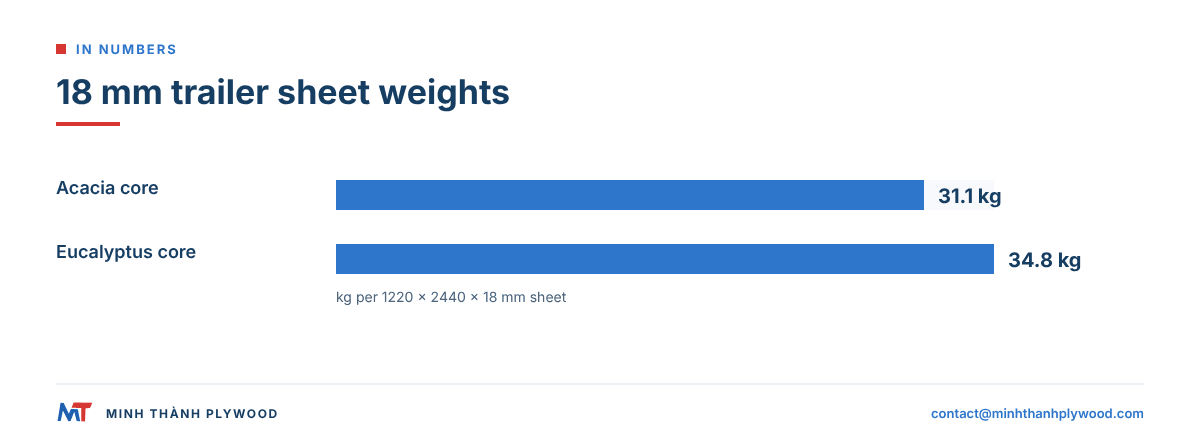
A 1220 × 2440 × 18 mm truck deck plywood sheet weighs about 34.8 kg on a Eucalyptus core and 31.1 kg on an Acacia core. The weight comes from the core density times the sheet volume; the film adds little.
| Thickness, 1220 × 2440 mm | Eucalyptus core (650 kg/m³) | Acacia core (580 kg/m³) |
|---|---|---|
| 12 mm | 23.2 kg | 20.7 kg |
| 15 mm | 29.0 kg | 25.9 kg |
| 18 mm | 34.8 kg | 31.1 kg |
| 21 mm | 40.6 kg | 36.3 kg |
Weight matters twice. A floor of twelve 18 mm Eucalyptus sheets adds about 418 kg to the trailer’s own weight, which comes off the payload. And a 40.6 kg sheet at 21 mm is a two-person lift on the workshop floor.
On a container, the same weight sets the load. A 40HC of 18 mm Eucalyptus-core sheets ships about 795 sheets in 15 packs of 53, about 43 m³; at 21 mm the plan is 675 sheets in 15 packs of 45, capped by the container’s payload.
Floor or wall: which panel goes where in a trailer body?
Floors take a thicker, textured or smooth film-faced panel on a hard core; walls and ceilings take a thinner, lighter panel. Putting floor panels on the walls wastes payload; putting wall panels on the floor wastes the trailer.
| Position | Typical panel | Notes |
|---|---|---|
| Floor | 18–21 mm film-faced, anti-slip or smooth | Hardwood core, phenolic WBP glue |
| Ramp and tailgate | 18 mm hexagonal anti-slip | Grip on a slope, sealed edges |
| Wall lining | 9–12 mm smooth film-faced | Wipe-clean, resists load strikes |
| Kick plate, lower wall | 12–15 mm film-faced | Takes pallet and boot impacts |
| Ceiling, roof lining | Thin plywood or composite | Weight first |
Horse and livestock trailers often take the anti-slip floor panel a short way up the walls as a kick board, so a hoof that slips lands on a surface that grips and wipes clean.
How do you fix and seal a plywood trailer deck?
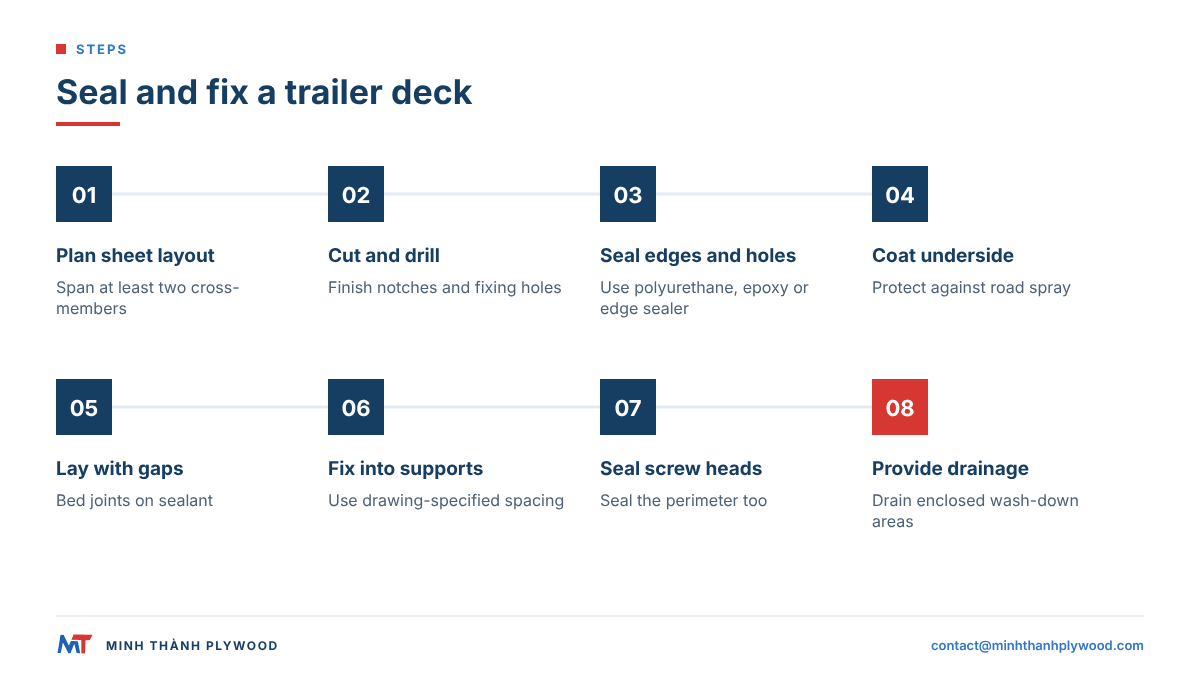
Fix a plywood trailer deck with countersunk or pan-head self-drilling screws into every cross-member, and seal every cut edge, hole and the underside before the first trip. The order of work matters more than the product used.
- Plan the layout so each sheet spans at least two cross-members, with the long direction of the sheet across the supports and end joints staggered.
- Cut and drill first. Make every cut, wheel-arch notch and fixing hole before sealing.
- Seal the edges and every hole with an edge sealer, polyurethane or epoxy until the end grain stops absorbing.
- Coat the underside with a bitumen or polyurethane undercoat; road spray reaches the floor from below.
- Lay the sheets with a small expansion gap at the joints and the walls, and bed the joints on sealant.
- Fix with screws about 1.75 to 2 times the panel thickness long, through the face into the steel, at the spacing the body builder’s drawing gives.
- Seal the screw heads and the perimeter joint.
- Drill drain holes at the lowest points of enclosed trailers so wash-down water leaves.
Countersunk heads must sit flush or just below the film; a proud screw head tears boots, tyres and the film around it. Re-check fixings after the first few hundred kilometres, when the floor has settled on the chassis.
Why do trailer floors fail, and how long do they last?
Most trailer floors fail at an unsealed edge or hole, through standing water, or because fixings work loose; the face itself rarely wears through first. A film-faced WBP floor that is sealed and maintained lasts many years of road service.
The common failures and their causes:
- Edge swelling and delamination: water wicks into open end grain and the outer plies lift. Cause: edges cut and never sealed.
- Soft spots around screws: the core rots around a fixing. Cause: holes drilled after sealing, or screws without sealant.
- Rot at the front wall: water from a roof seam runs down the wall and sits where wall and floor meet. Cause: the roof, not the floor.
- Pull-through and cracking: the panel flexes over supports set too wide, and screws work loose. Cause: thickness chosen for the cargo, not the span.
- Worn wheel paths: the film wears smooth where loads always roll. Cause: normal wear; turn a reversible panel or replace that sheet.
Livestock floors add urine and wash-down. A sealed film face sheds both, but rubber mats that trap liquid against the floor need lifting and drying regularly, and edges need re-sealing at each inspection.
Can you overlay an existing trailer floor?
You can overlay an existing trailer floor only when the old deck is dry, flat and firmly fixed; a soft, swollen or rotten floor has to come out first. An overlay over a moving floor moves with it and fails at the screws.
When an overlay works:
- Sound old floor, worn surface: screw a 9–12 mm film-faced or anti-slip sheet through the old deck into the cross-members, with sealed edges and staggered joints.
- Old floor too thin for a new load: remove it and fit the right thickness; stacking two thin sheets does not make one stiff floor.
- Wet or delaminated floor: remove it, dry and treat the frame, then lay a new sealed floor.
The overlay adds weight and raises the floor height at the door and ramp, so check door clearances and the trailer’s plated weight before choosing one.
Is anti-slip plywood from Vietnam good enough for trailer bodies?
Yes: Vietnamese anti-slip plywood is good enough for trailer bodies when the order names phenolic WBP glue, the film weight, a dense hardwood core and sealed edges. Minh Thanh Plywood makes anti-slip panels on order to exactly that specification.
What Minh Thanh supplies for vehicle and trailer floors:
- Faces: hexagonal or mesh phenolic film, about 220 g/m², with a smooth film back; texture on both sides for reversible decks.
- Cores: Eucalyptus (650–750 kg/m³) or Acacia (about 580 kg/m³), with core layers stitched both horizontally and vertically so no gaps sit under the film.
- Glue: phenolic WBP for outdoor floors, melamine-fortified for covered floors.
- Thickness and size: 12–21 mm, ±0.5 mm, in 1220 × 2440 or 1250 × 2500 mm sheets, or cut to the vehicle’s floor plan.
- Checks before packing: pattern depth, film adhesion, sealed edges and thickness on every sheet.
Trade terms are the same as for the rest of the range: one 40HC as the minimum order with mixed thicknesses by agreement, production in 15–45 days after the 30% deposit, FOB Hai Phong, CFR or CIF, and free samples with the quotation. Every shipment is photographed and filmed before loading, so the buyer sees the packs before they sail.
What to write on a trailer floor plywood order
Write the panel, the vehicle and the checks on the order, so every sheet arrives ready for the floor. A trailer builder’s specification line usually reads like this:
Anti-slip film-faced plywood for trailer floors, 18 mm ±0.5 mm, 1220 × 2440 mm, hexagonal phenolic film about 220 g/m² face / smooth film back, Eucalyptus core, phenolic WBP glue, edges sealed, 795 sheets in one 40HC, FOB Hai Phong.
The checklist behind that line:
- Vehicle and position: floor, ramp, wall or kick plate, and the trailer type.
- Face and back: hexagonal, mesh or smooth; one or both sides textured.
- Film weight: about 220 g/m² for floors.
- Thickness and tolerance: from the support spacing and wheel loads.
- Core and glue: Eucalyptus or Acacia; phenolic WBP or melamine-fortified.
- Size: full sheets or cut to the floor plan, with drawings.
- Tests: slip method or bond class if the contract names one.
- Packing and quantity: sheets per pack, packs per container, destination port.
Send the drawing and the specification to Minh Thanh Plywood for a quotation and free samples of the hexagonal and mesh faces.
Buyer questions, answered
What is the best plywood for trailer floors?
Film-faced hardwood-core plywood bonded with phenolic WBP glue. Choose an anti-slip hexagonal or mesh face for open trailers, ramps and livestock, and a smooth phenolic face for enclosed cargo floors where pallet trucks roll.
What thickness plywood for a trailer floor?
18 mm is the common choice for car, utility and enclosed trailers on cross-members about 400 mm apart. Use 21 mm or more for wider spacing, forklift traffic or heavy point loads, and 12–15 mm only for supported van-floor liners.
Is marine plywood good for trailer floors?
It works, because marine plywood uses waterproof glue and a void-free core, but it costs more and has a smooth sanded face that is slippery when wet. Film-faced WBP plywood gives the same bond with a wear and grip surface built in.
Do I need anti-slip plywood for a trailer?
Yes for anything people, animals or tyres walk or climb on in the wet: ramps, livestock floors, motorcycle and ATV trailers, open flatbeds. Enclosed cargo floors used with pallet trucks are better with a smooth phenolic film, because wheels roll more easily on it.
How long does a plywood trailer floor last?
A film-faced WBP floor with sealed edges and an undercoated underside commonly lasts many years of road service. Unsealed cut edges, standing water and loose fixings shorten it most, so the edge sealing on day one decides the life.
Can I overlay an existing trailer floor instead of replacing it?
Only if the old floor is dry, flat and solidly fixed. A 9–12 mm film-faced overlay screwed through into the cross-members renews the surface; a soft, delaminated or rotten floor must come out first, because the overlay will move with it.
What type of plywood is used for truck decks?
Box trucks and van bodies use film-faced hardwood-core plywood, smooth or anti-slip, bonded with phenolic WBP glue. Heavy dry-van semi-trailers often use laminated hardwood flooring instead, with plywood on the walls and in lighter bodies.
How heavy is an 18 mm anti-slip plywood sheet?
A 1220 × 2440 × 18 mm sheet weighs about 34.8 kg on a Eucalyptus core and 31.1 kg on an Acacia core, at reference densities of 650 and 580 kg/m³.
Is anti-slip plywood from Vietnam good enough for trailer bodies?
Yes, when the order names the parts that matter: phenolic WBP glue, a 220 g/m² film, a dense hardwood core, ±0.5 mm thickness and sealed edges. Minh Thanh Plywood makes trailer floor panels to that specification and sends free samples with the quotation.
Should trailer floor plywood be painted?
The film face needs no paint. Paint or seal only the cut edges, drilled holes and the underside, using an edge sealer or a polyurethane or bitumen undercoat, so road spray cannot reach the core.
Which way should trailer floor sheets run?
Run the face grain, which is the long direction of a 1220 × 2440 mm sheet, across the cross-members so each sheet spans at least two supports. Stagger the end joints so they never line up across the floor.