
Phenolic plywood used for construction is plywood whose face film, glue line or both are phenolic resin. It goes into concrete formwork, trailer and van floors, stage decks and exterior panels, anywhere a panel meets water, wear or concrete. The name covers two things, a phenolic film on the face and a phenolic glue line inside, and the right order names both. Minh Thanh Plywood builds film-faced and exterior panels with phenolic WBP glue on Eucalyptus or Acacia cores.
What is phenolic plywood used for?
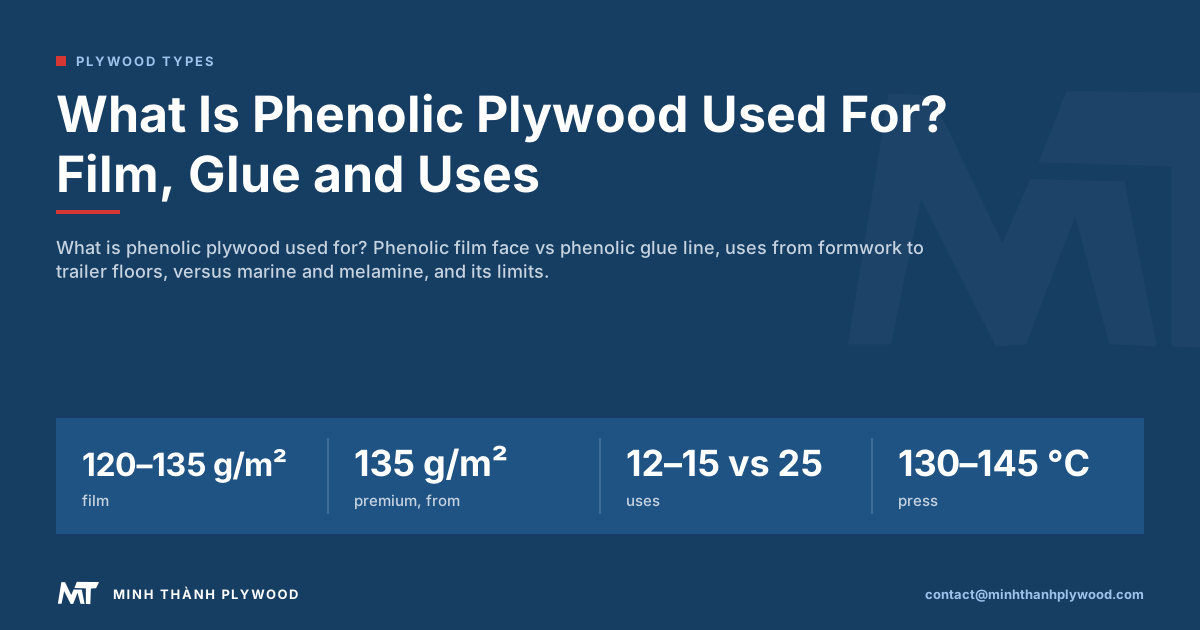
Phenolic plywood is used where plywood meets water, wear or wet concrete: formwork and shuttering, trailer and van floors, stage decks, walkways, exterior sheathing, stair treads and hard-wearing work surfaces. The phenolic resin gives it a water-resistant bond, a hard face, or both.
| Use | What the phenolic does | Usual build |
|---|---|---|
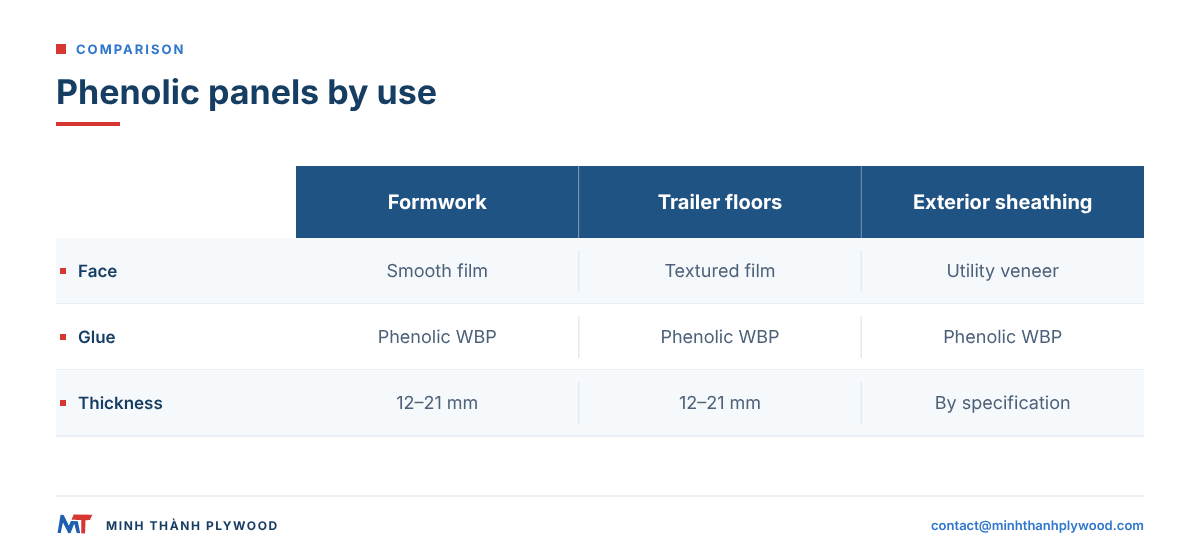
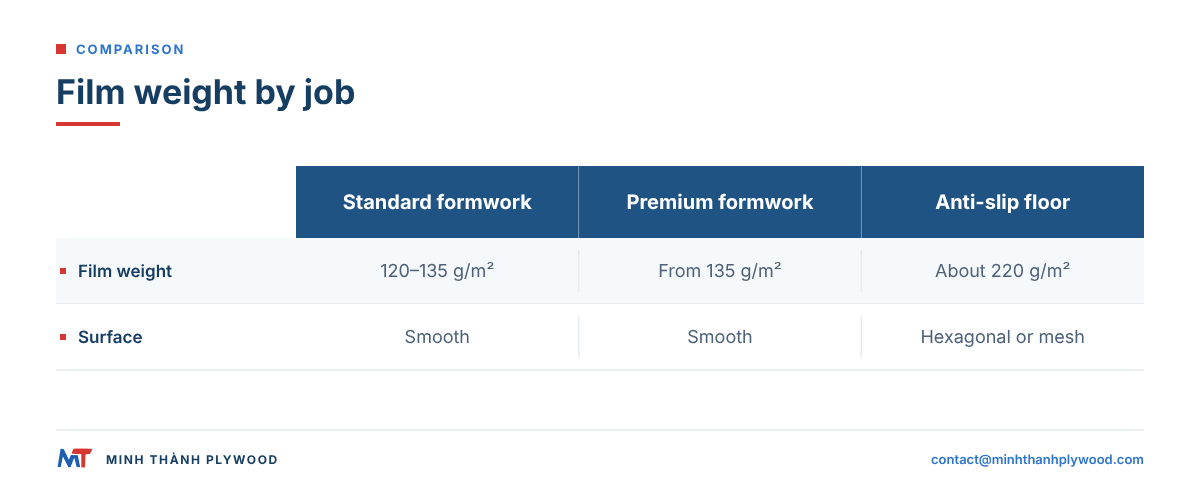
| Concrete formwork and shuttering | Smooth film releases concrete; glue survives wet pours | Smooth phenolic film, 120–135 g/m² or premium from 135 g/m², phenolic WBP glue, 12–21 mm |
| Trailer and van floors | Textured film grips; glue holds when wet | Hexagonal or mesh film about 220 g/m², phenolic WBP glue, 12–21 mm |
| Stage and event decks | Textured, washable, hard-wearing face | Hexagonal film, textured one or both sides |
| Walkways and platforms | Grip in wet weather | Hexagonal or mesh film, phenolic WBP glue |
| Exterior sheathing and stair treads | Water-resistant bond under rain | C/D faces, phenolic WBP glue, no film |
| Workshop benches and jig tops | Hard, smooth, easy-clean face | Smooth phenolic film |
One word covers two parts of the panel. The next section separates them, because a buyer who orders “phenolic plywood” without saying which part can receive a panel that only meets half the need.
Phenolic film vs phenolic glue: two different things
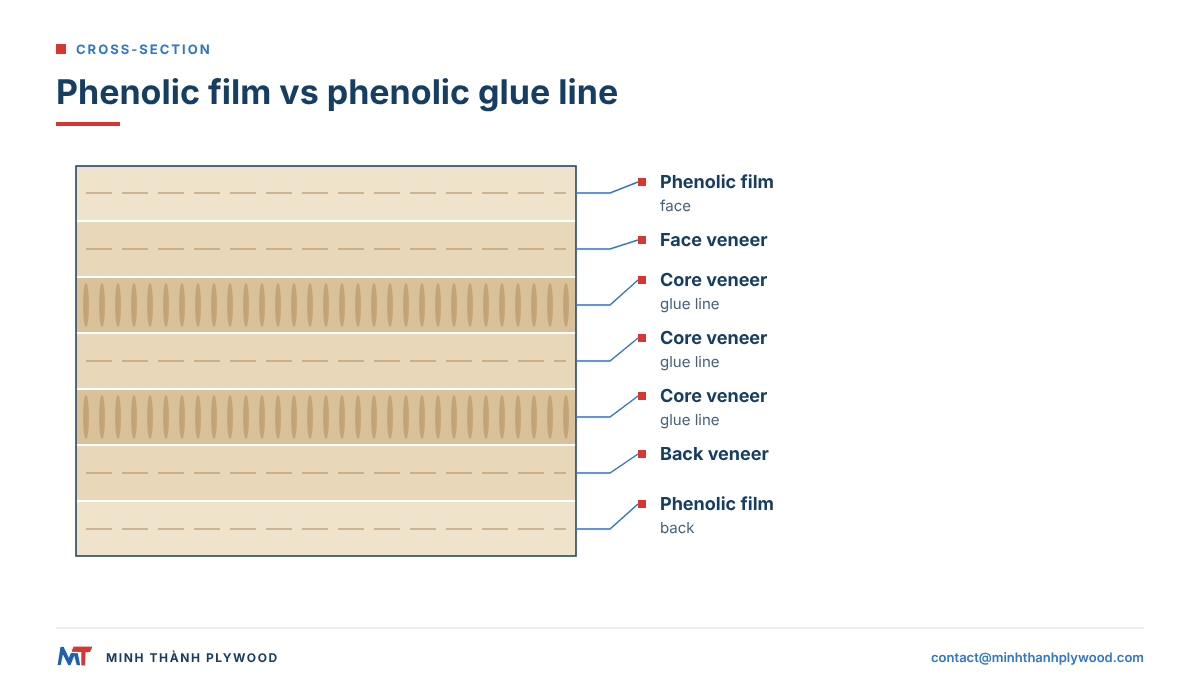
Phenolic film is a resin-impregnated paper pressed onto the face of the panel; phenolic glue is the resin that bonds the veneers inside it. One protects the surface, the other holds the panel together in water.
| Point | Phenolic film (face) | Phenolic glue (glue line) |
|---|---|---|
| Where it is | On the outside faces | Between every veneer |
| What it does | Hard, smooth or textured, water-shedding face | Bond that holds when wet or boiled |
| Seen as | Dark brown or black surface | Dark glue line at the edge |
| Typical spec | Film weight in g/m², colour, smooth or textured | WBP phenolic, EN 314-2 Class 3 bond |
| Without the other | A phenolic film on a melamine-fortified glue line | Phenolic glue under a veneer face, no film |
All four combinations exist. A premium formwork panel has both: phenolic film and phenolic WBP glue. A cost-effective formwork panel can have phenolic film over a melamine-fortified glue line. An exterior sheathing panel can have a phenolic glue line and plain veneer faces. Write both lines on the order: “film: phenolic, 135 g/m², brown” and “glue: phenolic WBP”.
What is phenolic formaldehyde resin?
Phenolic formaldehyde resin, also called phenol-formaldehyde or PF resin, is a thermosetting resin made by reacting phenol with formaldehyde. In the hot press it cures into a hard, dark solid that does not soften again with heat or water.
That chemistry explains how phenolic plywood behaves:
- Water resistance. The cured resin does not dissolve or swell in water, so the bond holds through wet and dry cycles.
- Heat to cure. Phenolic glue presses hotter than interior glue: about 130–145 °C, against 110–120 °C for UF and melamine-fortified glue.
- Colour. The glue line shows as a dark line at the edge, and phenolic film is brown or black.
- Formaldehyde. Cured phenolic resin releases very little formaldehyde in service, but emission class is still a separate line on the order.
Urea-formaldehyde (UF) resin is the interior glue of furniture plywood. Melamine-fortified resin sits between UF and phenolic in water resistance. The choice between them is the glue line of the specification.
Is phenolic plywood the same as film-faced plywood?
Usually, but not always: film-faced plywood describes the face, while phenolic describes the resin, so a film-faced panel can be phenolic on the face and melamine-fortified in the glue line. In trade talk the two names are often used for the same panel.
Film faced phenolic plywood is the strict case: phenolic film on both faces and phenolic WBP glue inside. It is the panel for repeated wet formwork. At Minh Thanh, film-faced plywood is made in 12–21 mm on Eucalyptus or Acacia cores, with standard film of 120–135 g/m² or premium film from 135 g/m², and either melamine-fortified or phenolic WBP glue.
The glue line changes the life of the panel on site. With proper handling, release agent and edge sealing, melamine-fortified film-faced panels give about 12–15 uses and phenolic WBP panels up to about 25. Compare quotes on cost per pour, not cost per sheet.
Phenolic plywood vs marine plywood
Phenolic plywood is not marine plywood: marine plywood is defined by its veneers and core as well as its glue, for example under BS 1088:2018, which specifies standard and lightweight marine plywood classes, while phenolic plywood only tells you the resin. A phenolic glue line is necessary for marine use, and far from sufficient.
| Point | Phenolic plywood | Marine plywood |
|---|---|---|
| Defined by | Resin in the glue or film | A standard covering species, veneer quality, core gaps and glue |
| Core | Commercial hardwood core, gaps limited by grade | Solid core with tight limits on gaps and overlaps |
| Faces | Film, or utility veneer | Graded hardwood veneer, no film |
| Typical use | Formwork, floors, decks, exterior sheathing | Boat building, marine joinery |
| Proof | EN 314-2 Class 3 bond test for WBP phenolic | Certification to the marine standard |
Boil tests add to the confusion. A 72-hour boil test is a traditional bond test on samples; on its own it does not prove marine quality or EN 314-2 Class 3. When a project needs marine plywood, specify the standard and buy it from a mill certified to it.
Phenolic plywood vs melamine-faced plywood
Phenolic-faced plywood is a hard-wearing construction surface; melamine-faced plywood is a decorative furniture surface. Both are resin-paper overlays, made for different jobs.
| Point | Phenolic-faced | Melamine-faced |
|---|---|---|
| Surface | Brown or black film, smooth or textured | Coloured or woodgrain decorative paper |
| Main use | Formwork, floors, decks | Cabinets, shelving, wardrobes, shop fitting |
| Water | Sheds water; built for wet service | Indoor; edges banded |
| Glue line | Melamine-fortified or phenolic WBP | Usually UF at an E0 or E1 emission class |
| Judged by | Pours, grip, wear | Colour, pattern, scratch resistance |
The two often come from different mills. Minh Thanh’s main line is furniture and interior plywood with UF glue at E0 emission, sanded and UV-ready for lamination or coating; film-faced, anti-slip and exterior panels are made next to it with water-resistant glue.
Where a project needs a named bond, write “phenolic WBP, EN 314-2 Class 3” on the order; that is the European bond class for exterior conditions. BS EN 314-2:1993 is the requirements standard for the bonding quality of plywood. For emission, name the class separately: E1 under EN 13986 for the European market, or CARB P2 / TSCA Title VI for the United States, where Minh Thanh holds the certificate.
What glue is used in Vietnamese plywood: MR, MUF, WBP or phenolic?
Vietnamese plywood uses four glue families, chosen by product line: UF glue for furniture and interior panels, melamine-fortified glue (MR or MUF) for humid service and cost-effective formwork, and phenolic WBP glue for wet service and premium formwork.
| Glue | Also called | Water resistance | Typical line in Vietnam |
|---|---|---|---|
| UF (urea-formaldehyde) | Interior glue | Dry use | Furniture and interior plywood, at E0 emission |
| MR (melamine-fortified UF) | MUF, melamine glue | Humid, short wetting | Commercial plywood, film-faced panels, kitchen and bathroom parts |
| WBP melamine | Melamine WBP | Wetter service | Film-faced and exterior panels |
| Phenolic (PF) | WBP phenolic | Wet, exterior, repeated wetting | Premium film-faced, anti-slip and exterior panels |
Two notes keep orders clear. WBP is a trade term for weather- and boil-proof bonds, so write “phenolic WBP” or “melamine WBP” rather than WBP alone. Emission class, such as E0, E1 or CARB P2, is a separate line from the glue type. Minh Thanh’s furniture panels use UF glue at E0 emission and are certified to CARB P2 / TSCA Title VI. The US regulatory framework is explained in the EPA formaldehyde standards for composite wood products.
Which glue should you specify for formwork plywood?
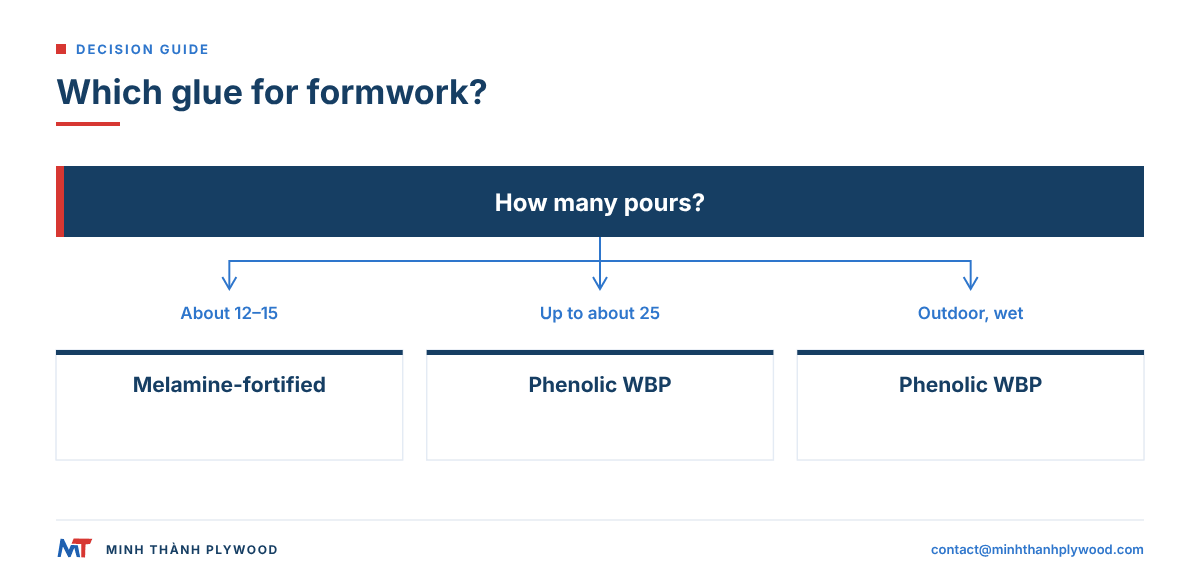
Specify phenolic WBP glue for formwork that is poured many times, and melamine-fortified glue when the job needs fewer pours at a lower price. The choice is the same in the UAE, Belgium or Canada; climate and site handling change the number of pours, not the logic.
- Count the pours the panel must give on your job.
- Pick the glue: about 12–15 uses with melamine-fortified glue, up to about 25 with phenolic WBP, both with proper handling, release agent and edge sealing.
- Pick the film: 120–135 g/m² standard, premium from 135 g/m² for more pours and a cleaner finish.
- Pick the core: Eucalyptus at 650–750 kg/m³ for stiffness, Acacia at about 580 kg/m³ for a lighter panel.
- Pick the thickness: 12 mm for supported light forms, 15 mm for slab soffits, 18 mm for walls and columns, 21 mm for heavier forms.
Hot climates add one point: panels stored in the sun dry and move, so keep stacks covered and flat between pours. Wet climates add another: reseal every cut and drilled hole the day it is made.
Phenolic panels for floors, trailers and stages
Phenolic panels for floors carry a textured phenolic film, about 220 g/m², pressed with a hexagonal or wire-mesh pattern, over a phenolic WBP glue line. The texture gives grip; the heavy film keeps it for years.
Hexagonal cells suit stages, walkways and floors that are washed down; wire mesh suits trailer and van floors with wheeled traffic and gritty loads. Floor panels usually run 12–15 mm for supported van liners and 18–21 mm for trailer floors and decks. Our guide to hexagonal vs wire mesh anti-slip plywood compares the two patterns row by row, and the anti-slip plywood page lists the options.
Phenolic glue plywood without film: exterior and structural uses
Phenolic glue plywood without a film is the exterior panel: veneer faces, often utility C/D grade, bonded with phenolic WBP glue for outdoor and damp uses. It is used for wall sheathing, roof decks under cladding, stair treads and temporary structures.
The glue line is what lets it stay outside. Faces are chosen for the job: C/D utility faces for sheathing that will be covered, better faces where the panel stays visible. At Minh Thanh, exterior plywood is made with melamine-fortified or phenolic WBP glue, with face grades matched to the order sample.
Exterior use is not the same as structural rating. Where a building code calls for structural plywood to a named standard, the drawing must name it and the panel needs that certification. See uses of plywood in construction for the main building uses.
Black vs brown phenolic film
Black and brown phenolic films perform the same when the film weight, glue and core are the same; the colour is a market habit and a site preference. Brown and black are both standard formwork colours, and many sites keep to one.
What to compare instead of colour:
- Film weight: 120–135 g/m² standard, from 135 g/m² premium, about 220 g/m² on anti-slip floors.
- Film brand, chosen with the sample.
- Glue: melamine-fortified or phenolic WBP.
- Edge sealing: painted edges, resealed after every cut.
Some contractors use one colour per job or per supplier to keep stock apart on site. That is a good reason to choose a colour; performance is not.
What are the limits of phenolic plywood?
Phenolic plywood has four limits: unsealed edges take in water, sunlight dulls and darkens the film, a phenolic panel is not automatically marine or structural, and it is not a decorative surface. Each one has a simple fix in the order or on site.
- Edges and holes. The film covers the faces only. Seal every cut edge and drilled hole on the day it is made, or water enters the core and the panel swells at the edge.
- UV. Long exposure to sunlight darkens and dulls phenolic film. Store panels covered and stacked flat between uses.
- Standards. Marine or structural use needs the named standard and its certificate, not only phenolic glue.
- Looks. A dark film is a working surface. For visible furniture, use a sanded veneer face or a melamine-faced panel.
Handled with these in mind, a phenolic WBP film-faced panel gives up to about 25 pours, and a textured floor panel gives years of service.
How to specify phenolic plywood from Vietnam
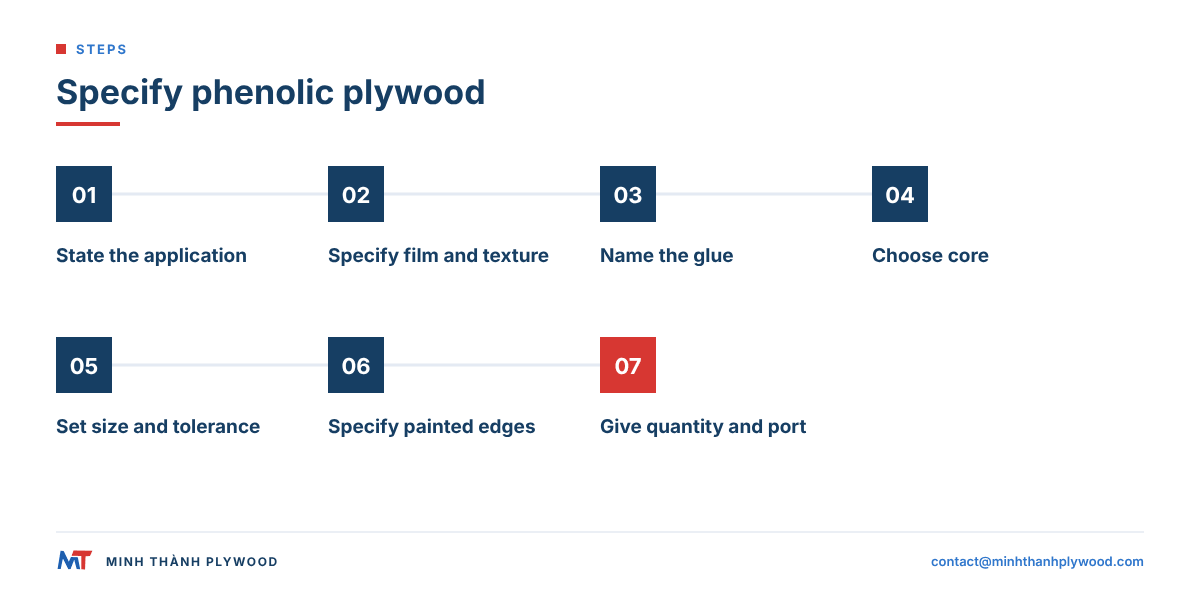
To specify phenolic plywood from Vietnam, write the film and the glue as separate lines, then the core, thickness, size and quantity. A complete line gets an exact quotation in one reply.
- Use: formwork, floor, deck, exterior.
- Film: phenolic, weight in g/m², colour, smooth or textured, one or both sides.
- Glue: phenolic WBP or melamine-fortified.
- Core: Eucalyptus or Acacia.
- Thickness and size: 12–21 mm; 1220 × 2440 mm or 1250 × 2500 mm.
- Tolerance: ±0.5 mm on film-faced panels.
- Edges: painted.
- Quantity and port: sheets per thickness and destination.
A 40HC of film-faced panels carries about 43 m³ on Eucalyptus cores or 47 m³ on Acacia. Production runs 15–45 days after the deposit, and sea transit from Hai Phong is added by route.
Phenolic plywood price FOB Vietnam (October 2026)
Phenolic plywood from Vietnam is priced per m³ FOB, and the build sets the price: film weight, glue (melamine-fortified or phenolic WBP), core, thickness and the colour of the film. At Minh Thanh, commercial plywood starts from US$250/m³ and furniture and interior plywood from US$350/m³ (October 2026); film-faced and anti-slip panels are quoted on the exact build.
For a market reference, another Vietnamese maker publishes FOB ranges for 18 mm panels (Kosmex, checked on 21 October 2026):
| 18 mm phenolic build | Published FOB range (US$/m³) |
|---|---|
| Film-faced, 220 g/m² brown | US$290–340/m³ |
| Film-faced, 300 g/m² black | US$330–380/m³ |
| Anti-slip mesh | US$320–370/m³ |
| Birch phenolic-faced, B/BB, WBP | US$380–430/m³ |
Freight, duty and port charges come on top. What the same page says about film weight matches the site rule: a 120 g/m² film gives about 8–12 reuses on formwork, a 220 g/m² film about 20–30. Compare mills on cost per pour with the same film and glue written on both quotes.
Hot climates and the Gulf. In the UAE and the rest of the Gulf, formwork sees high heat and fresh concrete. Kosmex describes fresh concrete as strongly alkaline (pH 12 to 13) and phenolic film as resistant to that alkalinity (Kosmex, checked on 3 November 2026). Choose the finished panel for its specified heat and outdoor exposure conditions. Keep stacks covered and reseal edges.
What this means for your order
For your order, decide where the phenolic must be: on the face for wear and concrete, in the glue line for water, or both. Then the rest of the panel follows the job.
A spec line for repeated formwork reads: Film-faced plywood, phenolic film 135 g/m² brown both sides, phenolic WBP glue, Eucalyptus core, 18 mm, 1220 × 2440 mm, ±0.5 mm, painted edges. For a trailer floor, change the face to a hexagonal or wire-mesh phenolic film of about 220 g/m² with a smooth back.
Minh Thanh Plywood makes film-faced, anti-slip and exterior panels next to its furniture range in Ha Hoa, Phu Tho. The minimum order is one 40HC with mixed specifications by agreement, and free samples go out with the quotation. Send your spec line to contact@minhthanhplywood.com, or see the construction plywood range.
Buyer questions, answered
What is phenolic plywood?
Phenolic plywood is plywood that uses phenol-formaldehyde resin, either as a film pressed onto its faces, as the glue between its veneers, or both. The resin makes the face hard-wearing and the bond water-resistant.
What is phenolic plywood used for?
Concrete formwork and shuttering, trailer and van floors, stage and event decks, walkways, exterior sheathing and stair treads, and workshop surfaces that see water, wear or concrete.
Is phenolic plywood the same as film-faced plywood?
Usually, but not always. Film-faced plywood names the face; phenolic names the resin. A film-faced panel can have a phenolic film with a melamine-fortified glue line, so ask for both the film and the glue.
Is phenolic plywood waterproof?
Its film sheds water and its phenolic WBP glue line holds when wet, which makes it suitable for wet service. Cut edges and holes still take in water and must be sealed.
Is phenolic plywood the same as marine plywood?
No. Marine plywood is a separate build defined by veneer quality and core rules, such as BS 1088. A phenolic glue line alone does not make a panel marine plywood.
What glue is used in Vietnamese plywood?
UF glue at E0 emission for furniture panels, UF or melamine-fortified (MR, MUF) glue for commercial and packing panels, and melamine-fortified or phenolic WBP glue for film-faced and exterior panels.
Which glue should I specify for film-faced formwork plywood?
Phenolic WBP for repeated wet pours: up to about 25 uses with proper handling, release agent and edge sealing. Melamine-fortified glue gives about 12–15 uses at a lower price.
What is phenolic formaldehyde resin?
Phenol-formaldehyde (PF) resin is a thermosetting resin made from phenol and formaldehyde. It cures in the hot press into a hard, dark, water-resistant solid used for plywood glue lines and overlay films.
Black or brown phenolic film: which is better?
Colour does not decide performance. Film weight, glue, core and edge sealing do; choose the colour your site or customer uses.
Can phenolic plywood be used outdoors in sunlight?
Yes, for years with a phenolic glue line, but the film darkens and its surface dulls under long UV exposure. Seal edges and keep panels flat and drained.