
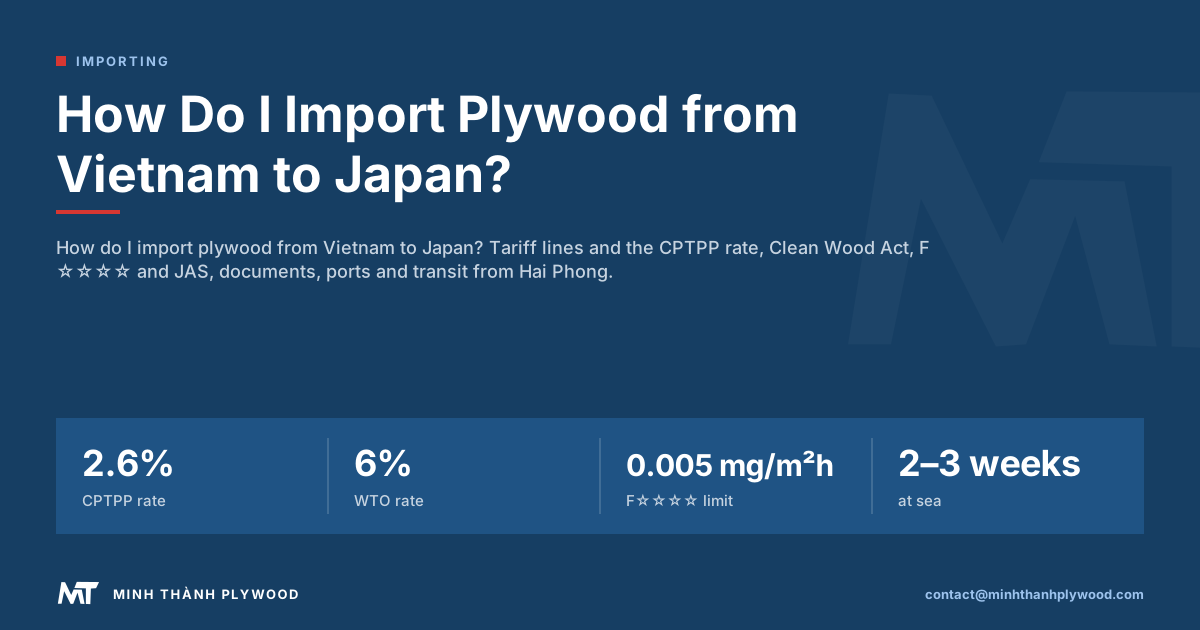
Importing plywood from Vietnam to Japan comes down to four decisions: classify the panel under heading 4412, choose the trade agreement with the lowest rate (the CPTPP rate for Vietnam on most temperate-hardwood plywood is 2.6% against 6% WTO), confirm legality under the Clean Wood Act, and match the formaldehyde evidence to the use. Minh Thanh Plywood ships from Hai Phong, about 2–3 weeks by sea to Japan.
How do I import plywood from Vietnam to Japan, step by step?
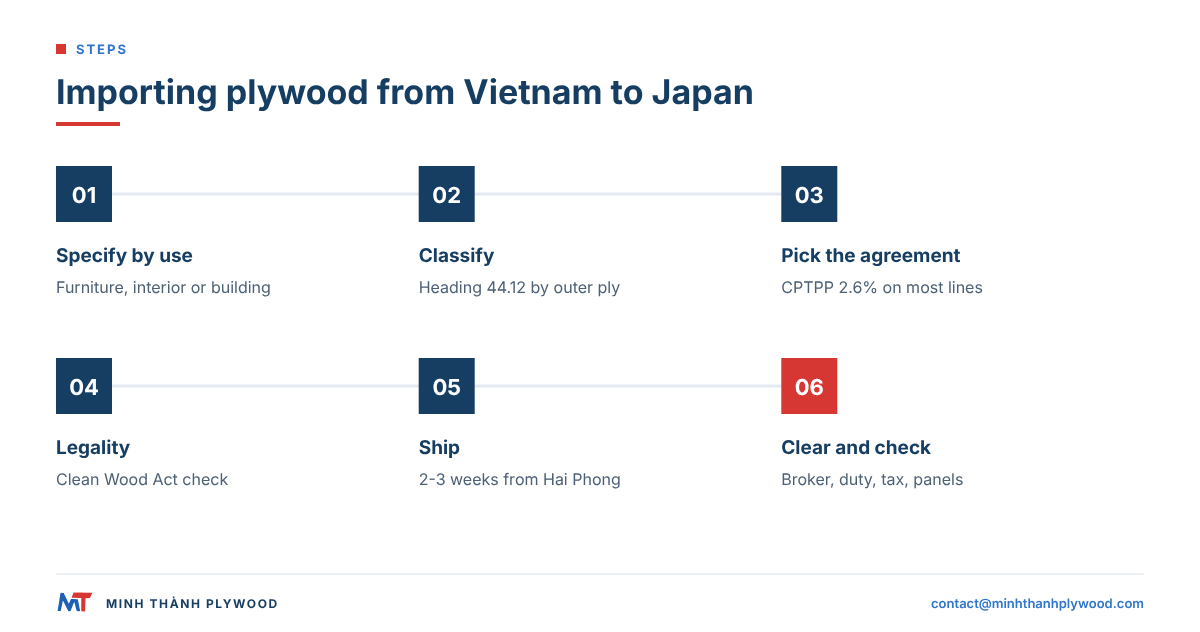
To import plywood from Vietnam to Japan, agree the panel specification and sample, classify the goods, choose the trade agreement and prepare its origin proof. Complete the Clean Wood Act check and match the formaldehyde evidence to the intended use before arranging shipment, customs clearance and arrival checks.
- Define the use and specification: furniture, interior fit-out or building, then face and back species and grade, core, glue, thickness, size and quantity.
- Approve a free sample against the written specification.
- Classify the panel under heading 4412 of Japan’s tariff schedule, by outer ply species and thickness.
- Choose the trade agreement with the lowest rate for that line and ask the exporter for the matching origin document.
- Confirm legality under the Clean Wood Act with species, harvest country and supplier data.
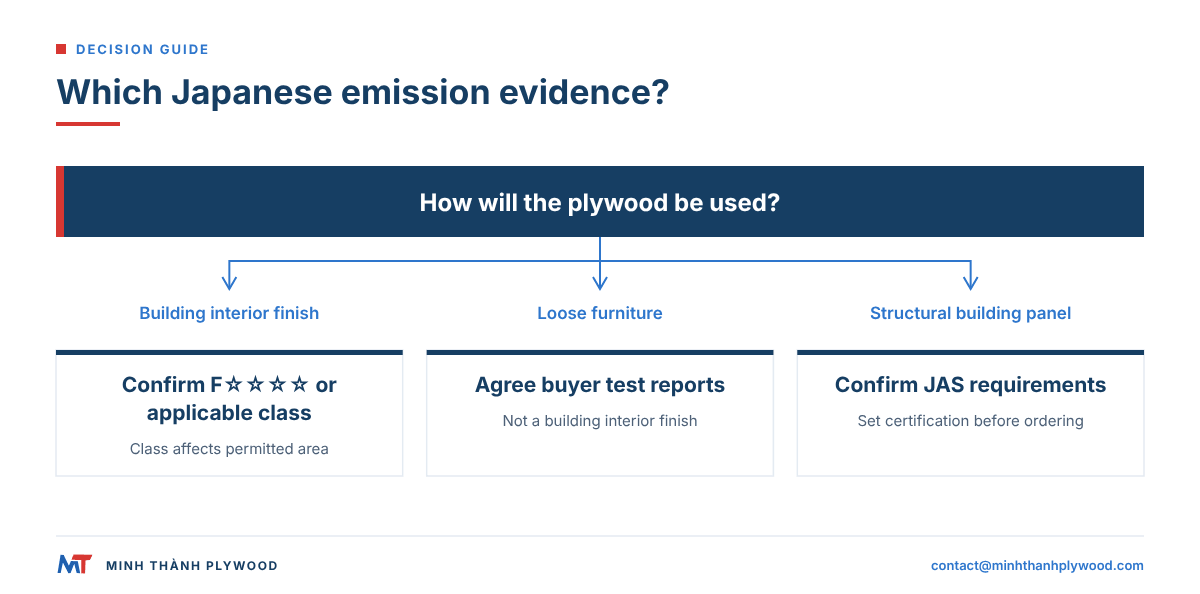
- Match the formaldehyde evidence to the use: test reports for furniture, an F☆☆☆☆ class or JAS mark where building rules apply.
- Sign the proforma invoice and pay the 30% deposit; production takes 15–45 days.
- Approve pre-loading photos, receive the shipping documents, and let the ship sail about 2–3 weeks to Japan.
- Clear customs through a licensed customs broker, pay the duty and consumption tax, and check the panels on arrival.
The general process for every destination is in our guide to importing plywood from Vietnam. This page covers what changes for Japan.
Which tariff line does Vietnamese plywood take in Japan?
Vietnamese plywood takes a 9-digit statistical code under heading 44.12 of Japan’s tariff schedule, decided by the species of the outer plies, whether the surface is worked, and the thickness. The core does not decide the line.
| Outer ply | Japanese subheading | Example statistical codes (unworked surface) |
|---|---|---|
| Birch, poplar, eucalyptus, beech, oak and other listed temperate hardwoods | 4412.33 | 911 to 912 below 6 mm; 991 to 993 at 6 mm and over |
| Other non-coniferous hardwood | 4412.34 | 911 to 912 below 6 mm; 991 to 993 at 6 mm and over |
| Meranti, lauan, okoumé and the other named tropical species | 4412.31 | 911, 921 below 6 mm; 931 to 951 at 6 mm and over |
| Both outer plies coniferous | 4412.39 | 910 below 6 mm; 991 to 992 at 6 mm and over |
Varnished, printed, grooved or overlaid surfaces take their own codes in each subheading. The thickness bands, below 6 mm, 6 to under 12, 12 to under 24, and 24 mm and over, are separate codes with the same rates in most rows.
What import duty does Japan charge on Vietnamese plywood?
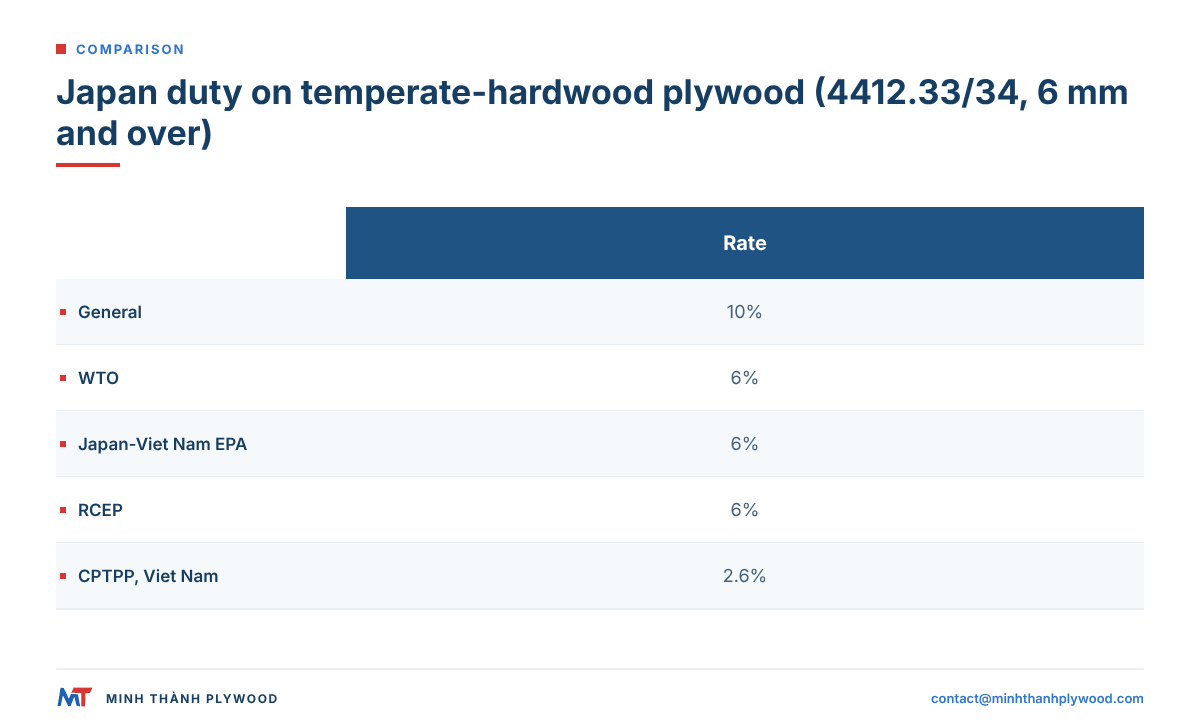
On plywood with birch, poplar, eucalyptus or other temperate hardwood faces (4412.33 and 4412.34), Japan’s schedule of 8 August 2026 shows a WTO rate of 6% and a CPTPP rate for Viet Nam of 2.6%. The Japan-Viet Nam EPA, the ASEAN-Japan agreement and RCEP show 6% on these lines, so the CPTPP rate is the one to claim.
| Line | General | WTO | Japan-Viet Nam EPA | CPTPP (Viet Nam) | RCEP |
|---|---|---|---|---|---|
| 4412.33, unworked, 6 mm and over | 10% | 6% | 6% | 2.6% | 6% |
| 4412.34, unworked, 6 mm and over | 10% | 6% | 6% | 2.6% | 6% |
| 4412.31 named tropical species, unworked, 6 mm and over | 10% | 8.5% | 8.5% | See schedule | 8.5% |
Panels below 6 mm carry a 15% general rate but the same 6% WTO and 2.6% CPTPP rates on the temperate-hardwood lines. Import consumption tax is then charged on the customs value plus duty. Japan’s customs value is the CIF value, so freight and insurance are part of the duty base; the cost layers are worked through in our landed cost guide.
How do you claim a preferential rate for Vietnamese plywood?
You claim a preferential rate by declaring it on the import declaration and holding the origin proof the agreement asks for. Each agreement has its own document:
- CPTPP: a certification of origin, which the exporter, producer or importer can complete, with the data fields set out in the agreement.
- Japan-Viet Nam EPA: a certificate of origin issued in Vietnam.
- ASEAN-Japan (AJCEP) and RCEP: their own certificate of origin forms, or an origin declaration where the agreement allows.
The goods must meet the agreement’s origin rule for plywood and travel to Japan without processing on the way. Agree with the exporter which agreement you will claim before the order, because the document has to be prepared with the shipping papers.
Minh Thanh supplies the certificate of origin with the shipping documents, and the commercial invoice names face, back and core species so that the tariff line and the origin claim match the panel. The certificate of origin guide explains the forms in more detail.
What does the Clean Wood Act require from a plywood importer?
The Clean Wood Act, in force since 20 May 2017, promotes the use and distribution of wood and wood products harvested in compliance with the laws of Japan and the countries of origin. Plywood is a wood product under the Act. Since the amended Act took effect on 1 April 2025, businesses that first handle wood brought into the Japanese market, importers included, must confirm its legality, record the result and pass the information to their buyers.
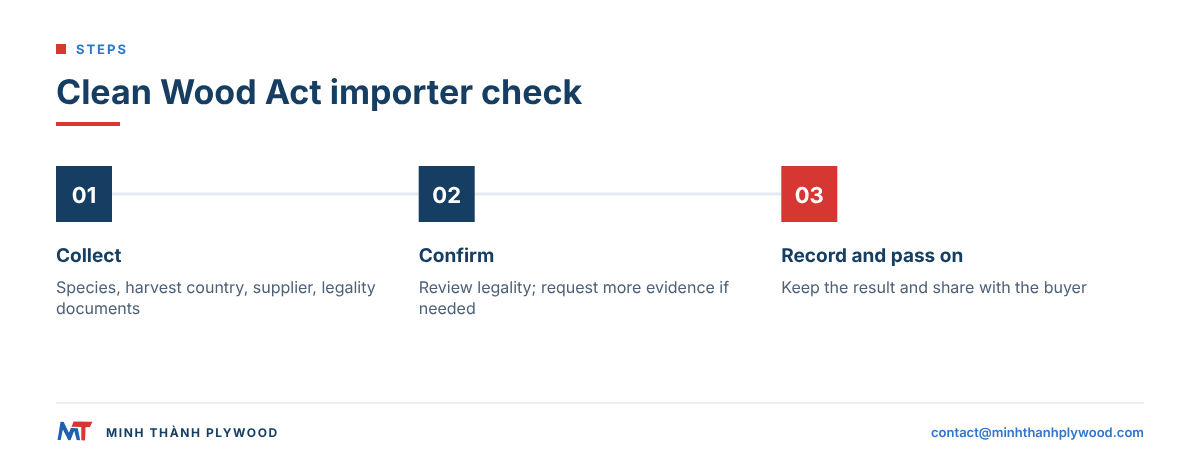
For an importer the work has three parts:
- Collect the species, the country of harvest, the supplier and documents showing legal harvest for each wood layer.
- Confirm legality from that information, asking for more where the risk is higher.
- Record and pass on the result with the goods to the next buyer.
Plywood has several species in one panel, so each layer counts. For a Minh Thanh panel the file names the face species and the core species, white Styrax or eucalyptus grown as plantation timber around our factory in Ha Hoa, Phu Tho, with the harvest origin. The same data we prepare for EU buyers, the EUDR compliance dossier with origin records and geolocation files, also supports a Clean Wood Act check.
What is F☆☆☆☆, and does your plywood need it?
F☆☆☆☆ (F four-star) is the lowest formaldehyde class under Japan’s Building Standard Law, for building materials emitting no more than 0.005 mg/m²h at 28 °C and 50% relative humidity. Interior finishing materials with F☆☆☆☆ can be used without area limits, while higher-emitting classes are limited or prohibited (MLIT technical criteria).
| Class under the Building Standard Law | Emission rate | Use as interior finishing |
|---|---|---|
| Type 1 formaldehyde-emitting material | Over 0.12 mg/m²h | Prohibited |
| Type 2 (F☆☆) | Over 0.02 up to 0.12 mg/m²h | Limited area |
| Type 3 (F☆☆☆) | Over 0.005 up to 0.02 mg/m²h | Limited area |
| F☆☆☆☆ | Up to 0.005 mg/m²h | No restriction |
The class matters when plywood is an interior finishing material of a building: walls, ceilings, built-in fittings. Plywood bought to make loose furniture is not an interior finishing material under this law, though a Japanese furniture maker may still write the F☆☆☆☆ level into its purchase specification. Decide the use first, then the evidence.
How do E0 chamber results relate to Japanese emission classes?
Chamber results in ppm cannot be converted into a Japanese class, because the test methods and units differ. They show how low the panel’s emission is; the Japanese class needs a test to the Japanese method or a certified mark.
Minh Thanh’s furniture plywood uses UF glue at E0 emission as standard. Six ASTM D6007 chamber tests between April 2025 and June 2026, three by Shanghai Hongjun and three by ICTT Vietnam, on 9, 15 and 18 mm panels, averaged 0.014–0.032 ppm against the 0.05 ppm CARB Phase 2 / TSCA Title VI limit; our CARB P2 / TSCA Title VI certification is held through ICTT, mill no. 23024. Third-party testing to the buyer’s method is arranged through SGS on request, so a Japanese buyer can order a test to the method its customer names.
For furniture and cabinet buyers in Japan these reports, together with the E0 testing we run every three months, are usually the evidence asked for. The formaldehyde emission page explains E0, E1 and the test methods.
When is JAS-marked plywood required in Japan?
JAS-marked plywood is expected where Japanese building rules call for a certified structural or interior panel, such as structural plywood in timber-frame construction. The Japanese Agricultural Standard for plywood sets grades, bond quality and formaldehyde classes, and only a manufacturer certified by a registered certifying body may apply the JAS mark, including overseas factories.
For furniture components, shelving, cabinet carcasses and interior joinery made in a factory, buyers order to their own specification instead: species, grade pairs, thickness tolerance, glue and emission evidence. That is the market Minh Thanh’s panels are built for. If a project needs JAS-marked panels, settle it at the specification stage, because the mark comes from the certification of the producing factory, not from a document added at shipment.
Which documents does a plywood shipment to Japan need?
A plywood shipment to Japan needs the core shipping documents, the origin proof for the agreement you claim, and the Clean Wood Act file the importer keeps.
| Document | Provided by | Purpose in Japan |
|---|---|---|
| Commercial invoice | Minh Thanh | Customs value, species, construction and quantity |
| Packing list | Minh Thanh | Packs, sheets, m³ and weights; checked on arrival |
| Bill of lading | Carrier | Release of the container |
| Certificate or certification of origin | Exporter or importer, per agreement | CPTPP, EPA, AJCEP or RCEP rate |
| Insurance certificate | Minh Thanh under CIF, or your insurer | Cover for the sea leg |
| Legality file | Importer, with supplier data | Clean Wood Act confirmation and record |
| Emission and test reports | Minh Thanh, on order | Chamber tests, certificates, SGS tests on request |
Plywood is processed wood and needs no phytosanitary certificate. Solid sawn-wood pallets or bearers under the packs are wood packaging and must meet ISPM 15 with the heat-treatment mark. The plywood import documents guide lists every document by market.
How does customs clearance work in Japan?
Customs clearance in Japan is an import declaration filed electronically, usually by a licensed customs broker, with the invoice, packing list, bill of lading and origin proof. Customs reviews the declaration, may inspect, and issues the import permit once duty and import consumption tax are paid.
Two points save time. First, give the broker the exact panel construction, so the 9-digit code is right on the first filing; an invoice without the face species invites a query. Second, decide before shipment which agreement you will claim and have the origin document ready on arrival.
Which ports and transit times apply from Hai Phong?
Sea time from Hai Phong to Japan is about 2–3 weeks, by carrier and route. The main container ports for plywood are Tokyo and Yokohama for the Kanto region, Nagoya for Chubu, and Osaka and Kobe for Kansai; choose the port nearest your warehouse with a regular service from northern Vietnam.
From the deposit, plan 15–45 days of production, then the sailing, then clearance: roughly four to ten weeks to a Japanese warehouse for a standard order. Minh Thanh sells FOB Hai Phong, CFR or CIF; with CIF we book the vessel to your Japanese port and insure the sea leg for your benefit.
How do you specify plywood for the Japanese market?
Specify plywood for Japan by use, size, face and tolerance, and write each item as a number. Japanese buyers check panels closely, so the specification is also the acceptance standard.
- Size: Japanese building panels are often 910 × 1820 mm; furniture makers also use 1220 × 2440 mm. We produce 1220 × 2440 and 1250 × 2500 mm and quote custom sizes.
- Thickness and tolerance: sanded furniture panels hold ±0.2–0.3 mm, down to ±0.2 mm; commercial panels ±0.5 mm.
- Faces: birch faces are graded D+, D and E and quoted as pairs such as D+/D, comparable to the European birch ladder; poplar and eucalyptus faces are quoted A/A, A/B or B/B and matched to the approved sample.
- Core and build: white Styrax or eucalyptus core, stitched in both directions, pressed twice for a flat panel.
- Moisture: 8–12% at dispatch, the normal range for furniture plywood.
- Surface: sanded and polished, with both faces UV-ready for the buyer’s own coating line.
How does Vietnamese plywood compare for Japanese buyers?
For Japanese buyers, Vietnamese plywood is mostly a plantation-hardwood product: cores of fast-grown species such as Styrax, eucalyptus and acacia, with faces chosen for the look ordered. Indonesian and Malaysian mills have long supplied tropical-hardwood plywood to Japan. The choice depends on use: tropical faces for some construction and concrete-form uses, plantation cores with sanded faces for furniture and interior work.
On quality, compare the measurable points: thickness tolerance, flatness, face grade against a sample, glue and emission evidence, moisture and packing. On price, compare offers per m³ on the same construction, then add freight and duty: the CPTPP rate for Viet Nam on temperate-hardwood lines is 2.6%. The market numbers behind that choice are in the next section.
How big is Japan’s plywood market, and where does Vietnam rank?
Japan imported 862,086 m³ of plywood between January and May 2025, and Vietnam was the fourth-largest supplier at 150,567 m³, up 12.5% on the same months of 2024 (APKINDO, 1 July 2025). Vietnam is the one major supplier growing at double digits while China fell.
| Supplier, Jan–May 2025 | Volume | Change on 2024 |
|---|---|---|
| Indonesia | 278,851 m³ | -1.3% |
| Malaysia | 238,369 m³ | +0.1% |
| China | 185,911 m³ | -11.1% |
| Vietnam | 150,567 m³ | +12.5% |
Hardwood plywood was about 592,760 m³, nearly 69% of the total, and the 12–24 mm band alone took 330,160 m³ against 156,312 m³ for 6–12 mm. That is the thickness range of Minh Thanh’s furniture and interior panels, so a Japanese buyer comparing mills is shopping in the biggest band of the market.
What does Vietnamese plywood cost per m³ for Japan?
Vietnamese plywood is quoted FOB Hai Phong from about US$220 to US$600 per m³ depending on construction and grade (Fomex Group). Minh Thanh’s indicative starting prices in October 2026 are US$250/m³ for commercial plywood and US$350/m³ for furniture and interior plywood, with the final price set by species, grade, thickness and pack plan.
Japan’s standard consumption tax rate is 10%, calculated on the customs value plus duty and any applicable excise taxes (Japan Customs).
For the 2.6% CPTPP and 6% WTO lines shown in the tariff table above, our worked example uses US$1,000 of CIF value. Duty is US$26 with qualifying CPTPP origin or US$60 at the WTO rate; consumption tax is then US$102.60 or US$106.00 respectively. The duty saving is US$34, or 3.4% of CIF value, for those tariff lines. Confirm the classification and origin proof before using that rate.
What should you check when the container arrives in Japan?
Check the seal, the packs and the panels against the packing list and the sample before you accept the delivery, and document every difference.
- Seal and doors: photograph the seal number before opening.
- Packs: count packs and compare their labels with the packing list and our pre-loading photos.
- Thickness and size: caliper sheets from several packs; measure length and width against ±2 mm.
- Flatness and faces: lay sheets flat and compare faces with the approved sample.
- Moisture: measure a sample against the ordered range.
- Report: send photos, pack numbers and measurements to us the same week.
Every Minh Thanh container is photographed and filmed before loading, so both sides compare against the same record.
How do you get a plywood quote for delivery to Japan?
A Japanese quote starts from the use and the port. Tell us whether the panels go into furniture, interior fittings or building work, then the construction, and we price it per m³ with the packing plan and a production date:
18 mm furniture plywood, 1220 × 2440 mm, birch face/back D+/D, white Styrax core, UF glue at E0 emission, sanded both sides, 1×40HC, CIF Yokohama, CPTPP origin documents.
One 40HC is the minimum, mixed specifications are arranged by agreement, and samples are free, so a Japanese buyer can test the panel on its own line first. Write to [email protected] or use the contact form, and browse the furniture plywood range for faces and cores.
Buyer questions, answered
How do I import plywood from Vietnam to Japan, step by step?
Write the specification, approve a free sample, classify the panel under heading 4412, pick the trade agreement with the lowest rate, confirm legality under the Clean Wood Act, then clear the container through a customs broker with the origin document and pay consumption tax.
What is the import duty on plywood from Vietnam to Japan?
For plywood with birch, poplar, eucalyptus or other temperate hardwood faces, the WTO rate is 6% and the CPTPP rate for Viet Nam is 2.6% in Japan's tariff schedule of 8 August 2026. Listed tropical faces such as meranti carry 8.5% WTO above 6 mm.
Does Japan's Clean Wood Act apply to plywood imports?
Yes. Plywood is a wood product under the Act. Since the amended Act took effect on 1 April 2025, importers as first handlers must confirm the wood's legality, record the result and pass the information on to their buyers.
What is F☆☆☆☆ for plywood in Japan?
It is the lowest formaldehyde class under Japan's Building Standard Law, for emission up to 0.005 mg/m²h, and interior finishing materials with it can be used without area limits. The mark is given under JAS or JIS or by ministerial approval.
Can ASTM D6007 test results be converted to F☆☆☆☆?
No. ASTM D6007 measures ppm in a small chamber, while the Japanese classes use other test methods and units. Use the chamber results as evidence of low emission and test to the Japanese method when the use requires the class.
Does plywood need plant quarantine in Japan?
Plywood is processed wood and does not need a phytosanitary certificate. Solid wood pallets and bearers under the packs must meet ISPM 15 and carry the heat-treatment mark.
How long does shipping plywood from Vietnam to Japan take?
About 2–3 weeks at sea from Hai Phong to the main Japanese ports, after 15–45 days of production from the deposit. Customs clearance in Japan usually follows within days when the documents are complete.
What sizes of plywood do Japanese buyers order?
Japanese building panels are often 910 × 1820 mm, while furniture makers also use 1220 × 2440 mm. Minh Thanh produces 1220 × 2440 and 1250 × 2500 mm and quotes custom sizes on request.
How much plywood does Japan import from Vietnam?
Vietnam supplied 150,567 m³ of plywood to Japan in January to May 2025, up 12.5% on 2024 and fourth after Indonesia, Malaysia and China, in a total import market of 862,086 m³.
What does Vietnamese plywood cost per m³ for Japan?
Vietnamese plywood is quoted from about US$220 to US$600/m³ FOB Hai Phong depending on grade. Minh Thanh starts at US$250/m³ for commercial and US$350/m³ for furniture plywood, and the CPTPP rate of 2.6% keeps the duty low.
Is Vietnamese plywood good for the Japanese market?
For furniture and interior work, yes: panels pressed twice, ±0.2–0.3 mm thickness tolerance on sanded panels and chamber-tested low emission. For structural building use, Japan expects JAS-marked plywood, which is a separate certification.