
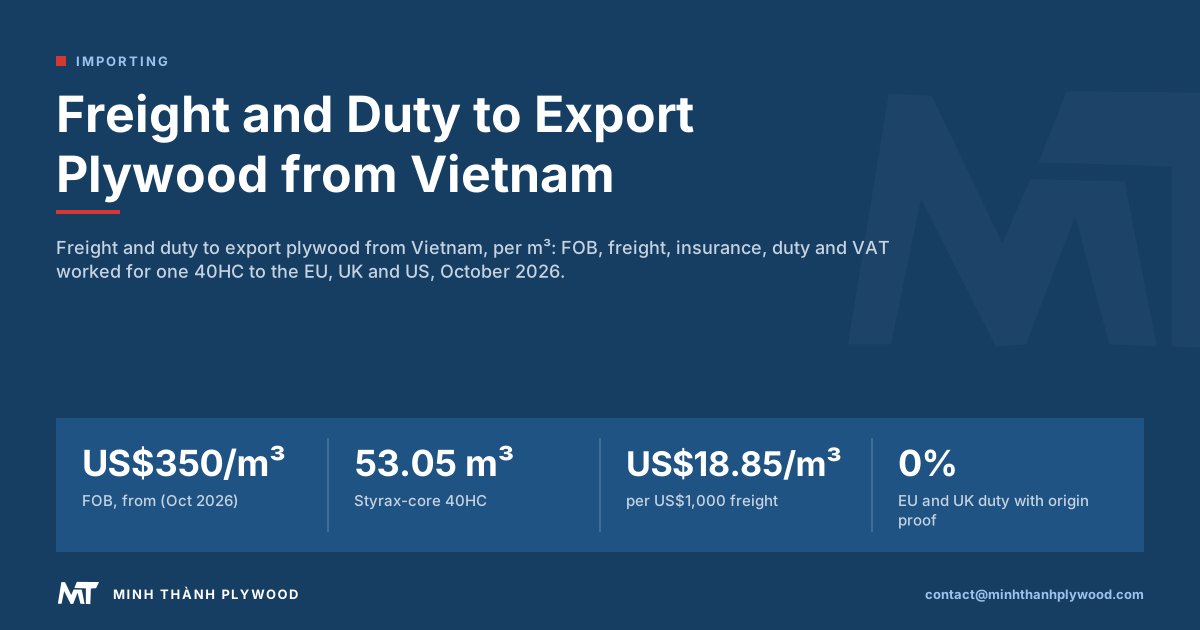
Vietnam charges 0% export duty and 0% export VAT on plywood in 2026, so the duty to export is nil and the cost that follows is freight, insurance and the importing country's duty. Freight and duty to export plywood from Vietnam add a predictable layer on top of the FOB price: ocean freight divided by the cubic metres in the box, about 0.3% for insurance, then duty and import VAT on the customs value. Minh Thanh Plywood quotes furniture plywood from US$350/m³ FOB Hai Phong (October 2026); with Vietnamese origin proof the EU and UK duty on most plywood lines is 0%.
Freight and duty to export plywood from Vietnam: what do they add?
Freight and duty to export plywood from Vietnam add five layers to the FOB price: ocean freight, cargo insurance, import duty, import VAT and the costs at the destination port. Freight is a fixed amount per container. It becomes a cost per m³ only when you divide it by what the container holds. Duty and VAT are percentages of a customs value, and the market decides which value.
| Cost layer | How it is charged | EU | UK | United States |
|---|---|---|---|---|
| FOB price | Per m³, set by the mill | From US$350/m³ furniture, from US$250/m³ commercial (Minh Thanh, October 2026) | Same | Same |
| Ocean freight | Per container | Quote from forwarder or mill | Same | Same |
| Insurance | % of insured value | About 0.3% in our example | Same | Same |
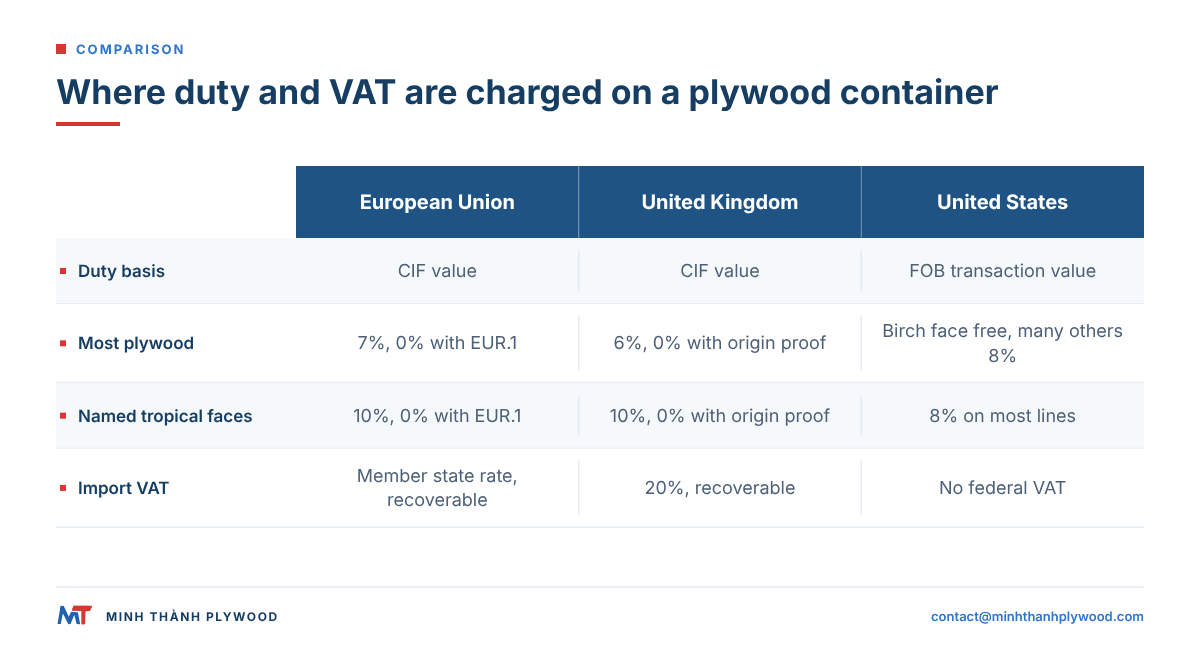
| Customs value | Basis for duty | CIF | CIF | FOB transaction value |
| Duty, most plywood lines | % of customs value | 7% third-country, 0% EVFTA | 6% third-country, 0% UKVFTA | Free for birch faces (4412.33.06), 8% for many others |
| Okoumé, meranti and other species named in 4412 31 10 | % of customs value | 10%, 0% EVFTA | 10%, 0% UKVFTA | 8% for most lines |
| Import VAT | % of value plus duty | Country rate, recoverable | 20%, recoverable | None at federal level |
EU and UK rates are from the UK Trade Tariff for Great Britain and Northern Ireland ; the Northern Ireland schedule applies the EU tariff. US rates come from the Harmonized Tariff Schedule, all read on 20 October 2026. Anti-dumping and countervailing duties are a separate line in the US and are covered in our US duty guide.
What export duty and export VAT does Vietnam charge on plywood?
Vietnam charges 0% export duty and 0% export VAT on plywood under heading 4412 in 2026 (HP Toan Cau export guide), so the FOB price carries no Vietnamese export tax and the costs that follow are freight, insurance and the duty of the importing country. The 0% VAT rate on exports means the mill recovers its input VAT instead of passing it on.
The Vietnamese export clearance still needs a file, which the seller prepares and which is part of the FOB price:
| Export document | Purpose |
|---|---|
| Commercial invoice and packing list | Declared value, species and quantity |
| Customs declaration | Export clearance at the Vietnamese port |
| Certificate of origin (C/O) | Form D, B or E, depending on the destination, for the preferential rate |
| Legal forest product records | Evidence of legal sourcing, requested by many importers |
| Container handover record | Full-container shipments |
Under FOB, CFR and CIF terms Minh Thanh handles the Vietnamese export clearance, so a buyer sees no Vietnam-side duty line on the quotation.
What does imported plywood really cost per m³?
Imported plywood costs the FOB price plus about US$55–75 per m³ in our examples before local charges, when freight of US$3,000 is spread over a 40HC and duty is 0%. That range comes from freight alone: US$56.55/m³ on a 53.05 m³ Styrax-core load and US$70.43/m³ on a 42.60 m³ eucalyptus-core load of 18 mm sheets.
Two numbers move the answer more than any other. The first is the FOB price, which depends on face, core, glue, thickness, size and quantity. Minh Thanh starts at US$250/m³ for commercial plywood and US$350/m³ for furniture and interior plywood (October 2026). The second is how many cubic metres the container really carries, which depends on the core density and the weight limit of your booking.
A third number only matters without origin proof: the duty rate. On a CIF value of about US$408/m³, a 7% EU duty adds US$28.54/m³. With a valid EUR.1 that line is zero.
How does a plywood landed cost calculation work?
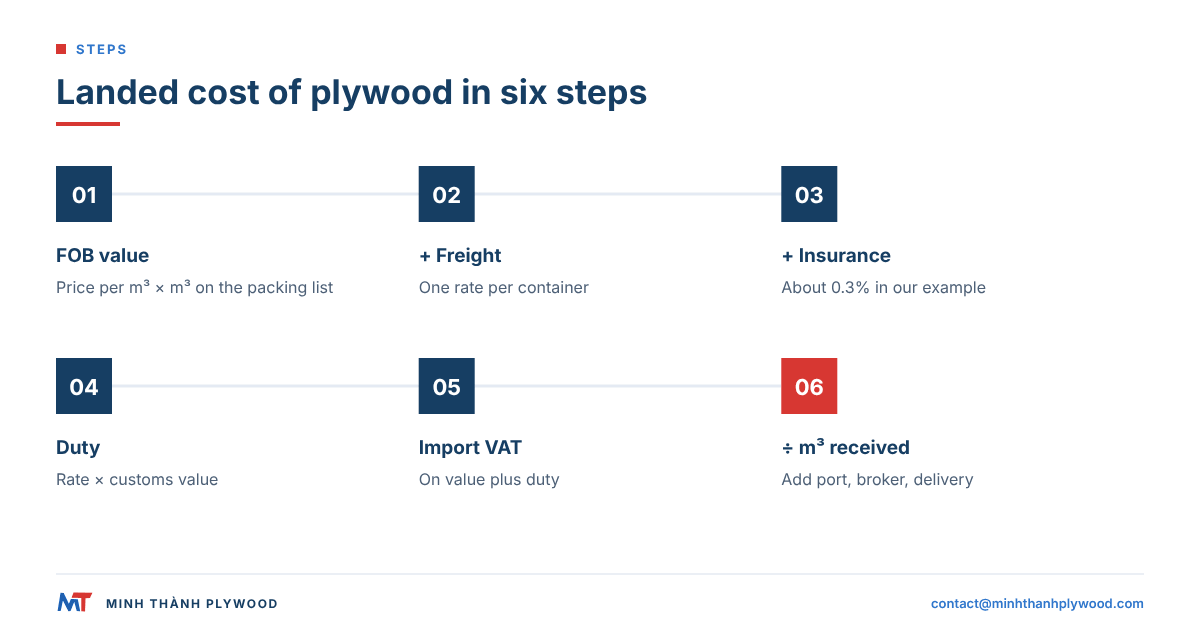
A plywood landed cost calculation runs in six steps. Each step uses a value you can check on a document:
- FOB value = FOB price per m³ × m³ on the packing list.
- CFR value = FOB value + ocean freight for the container.
- CIF value = CFR value + the insurance premium.
- Duty = duty rate × customs value (CIF in the EU and UK, the FOB transaction value in the US).
- Import VAT = VAT rate × (customs value + duty + charges to the destination the law adds), recoverable for VAT-registered importers.
- Landed cost = CIF value + duty + destination port charges + customs broker + inland delivery, divided by the m³ received.
Keep the m³ from the packing list, not from a rule of thumb. A sheet of 1220 × 2440 × 18 mm holds 0.0536 m³, so 990 sheets are 53.05 m³; the same box of 795 sheets is 42.60 m³. If the packing list and the invoice disagree, customs uses the invoice, so they must match line by line (plywood import documents).
Worked example: one 40HC of 18 mm furniture plywood to the EU
One 40HC of 18 mm furniture plywood on Styrax core, 990 sheets or 53.05 m³, lands at an EU port at about US$408/m³ duty-free in this example. The inputs are the Minh Thanh starting price and two stated example values: US$3,000 freight for the container and an insurance premium of 0.3% of the CFR value.
| Step | Calculation | US$ | US$/m³ |
|---|---|---|---|
| FOB Hai Phong | 350 × 53.05 m³ | 18,567.50 | 350.00 |
| Ocean freight (example) | per 40HC | 3,000.00 | 56.55 |
| CFR value | FOB + freight | 21,567.50 | 406.55 |
| Insurance (example, 0.3% of CFR) | 0.003 × 21,567.50 | 64.70 | 1.22 |
| CIF value | CFR + insurance | 21,632.20 | 407.77 |
| Duty with EUR.1 (EVFTA) | 0% | 0.00 | 0.00 |
| Duty without origin proof | 7% of CIF | 1,514.25 | 28.54 |
| Landed at port, EVFTA | CIF + 0% duty | 21,632.20 | 407.77 |
Import VAT is then charged at the rate of the member state where the goods are released. It is calculated on the CIF value plus duty and the transport costs to the first destination in the EU. A VAT-registered business recovers it in its VAT return. Unloading, terminal handling, customs brokerage and delivery to your yard are quoted by your forwarder and added per container, so they too fall per m³ when the container is fuller.
The EU-Vietnam rate for Vietnamese plywood is 0% from 1 January 2025 on the main lines. They include birch-faced (4412 33 10), other temperate hardwood faces such as poplar and eucalyptus (4412 33 20 to 4412 33 90, 4412 34 00), coniferous faces (4412 39 00) and tropical faces (4412 31). The third-country rate is 7%, or 10% when an outer ply is okoumé, meranti, sapelli or another species named in 4412 31 10.
Worked example: the same container to the United Kingdom
The same 53.05 m³ container lands in a UK port at the same US$407.77/m³ CIF value under the UK-Vietnam Free Trade Agreement. That rate is 0% from 1 January 2025. Without origin proof the UK Global Tariff adds 6% on most plywood lines: US$1,297.93, or US$24.47/m³, on this container. It adds 10% where an outer ply is one of the tropical species named in 4412 31 10, such as okoumé or meranti.
Import VAT in the UK is 20%. On the duty-free CIF value of US$21,632.20 it is US$4,326.44, payable at import or accounted for through postponed VAT accounting on your VAT return. It is a cash-flow line for a VAT-registered importer and a real cost for anyone who cannot recover it.
The UK steps, documents and timber rules are in our UK import guide.
Worked example: the United States, where duty is on the FOB value
In the United States duty is charged on the transaction value, which for an FOB sale excludes the ocean freight and insurance. Birch-faced plywood under HTSUS 4412.33.06 enters free of ordinary duty. Many other faces, including poplar and eucalyptus under 4412.33.32 and other hardwoods under 4412.34.32, pay 8%: on 53.05 m³ at US$350/m³ FOB that is US$1,485.40, or US$28.00/m³.
US entries also carry the merchandise processing fee and the harbor maintenance fee, both a percentage of the entered value, plus the customs bond. Hardwood and decorative plywood from Vietnam is the subject of a 2025–2026 anti-dumping and countervailing duty case. Whether a cash deposit applies depends on the product’s scope and the case status on your entry date. Our US duty guide sets out the dates, the scope and the documents an importer keeps.
How much does ocean freight add per m³ and per sheet?
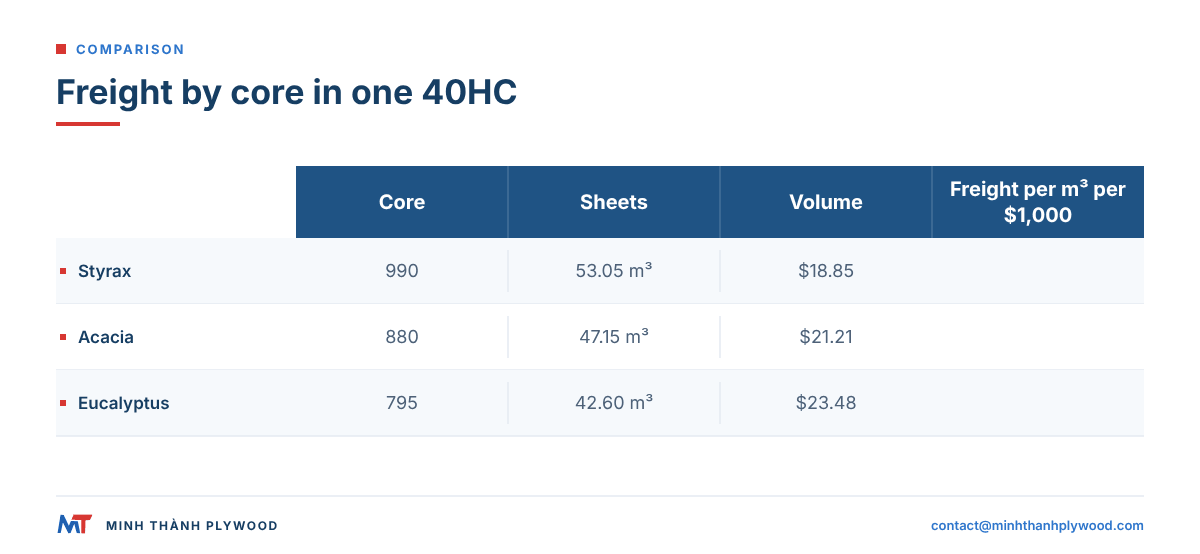
Ocean freight adds the container rate divided by the m³ loaded, so the same quote costs more per m³ on a heavy core. The table uses the Minh Thanh 40HC plan for 18 mm, 1220 × 2440 mm panels and shows the effect of each US$1,000 of freight.
| 18 mm load in one 40HC | Sheets | m³ | Gross panel weight | Freight per m³ per US$1,000 | Freight per sheet at US$3,000 |
|---|---|---|---|---|---|
| Styrax core, 18 packs × 55 | 990 | 53.05 | 26,532 kg | US$18.85 | US$3.03 |
| Acacia core, 16 packs × 55 | 880 | 47.15 | 27,368 kg | US$21.21 | US$3.41 |
| Eucalyptus core, 15 packs × 53 | 795 | 42.60 | 27,666 kg | US$23.48 | US$3.77 |
The panel weights come from sheet volume × reference density (Styrax 500, Acacia 580, Eucalyptus 650 kg/m³) and stay inside a planning payload of 28,000 kg. A booking with a lower weight cap reduces the sheet count before the box is full by volume, and that raises freight per m³ again. Run your own thickness and core in the container packing calculator.
Why does the core species change the landed cost?
The core species changes the landed cost because it sets the panel weight, and weight, not volume, usually stops the loading first. A white Styrax core at about 500 kg/m³ lets one 40HC carry 18 packs of 18 mm sheets, while a eucalyptus core at about 650 kg/m³ stops at 15 packs. The container rate is the same, so the eucalyptus load pays about 25% more freight per m³.
Choose the core for the use, then price it. Styrax is the standard furniture core at Minh Thanh, with a flat, light panel for cabinets and interior work. Eucalyptus gives a harder, heavier panel that some buyers want for screw holding and edge strength. When the use allows either, a lighter core lowers both freight per m³ and handling cost at your end.
Packs are about 1,000 mm high, so sheets per pack equal 1,000 divided by the thickness, rounded down and then capped by weight. Thin panels fill the box with more sheets and hit the weight limit later; thick panels on a dense core hit it early. Our container loading process shows how the packs sit: 16 lying and 2 upright on a Styrax-core load.
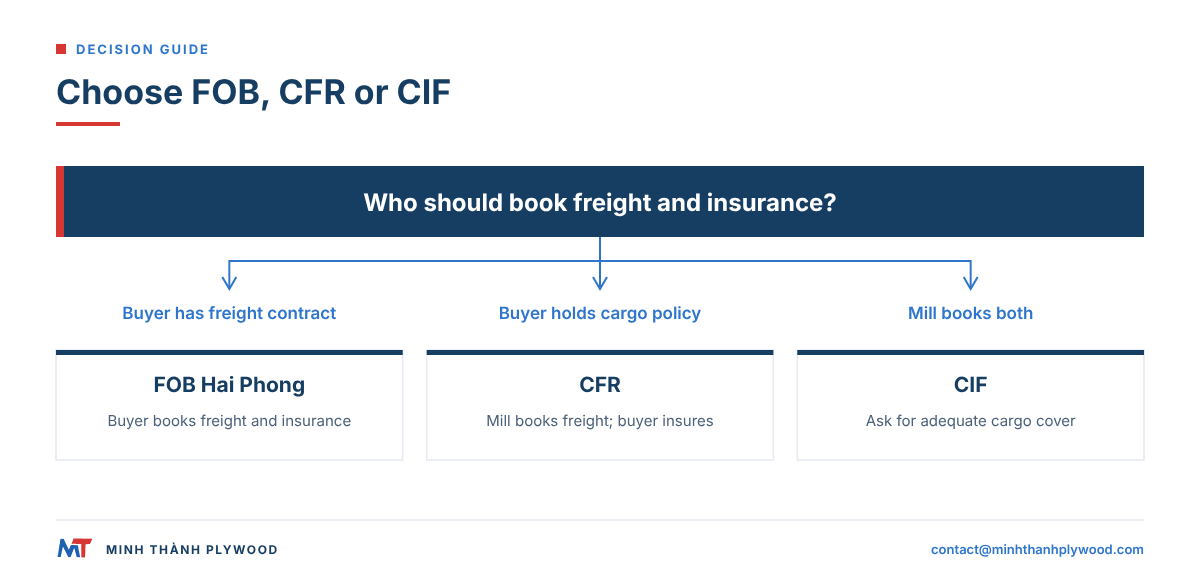
FOB, CFR or CIF: which term gives the lower landed cost?
FOB Hai Phong gives the lower landed cost when your forwarder has a contract rate below the rate the mill can book. CFR or CIF saves time and is simpler when it does not. The panels and the EU and UK duty basis do not change with the term. Customs adds freight and insurance to an FOB price to reach the CIF value anyway.
| Term | Who books the ship | Who insures the sea leg | Best for |
|---|---|---|---|
| FOB Hai Phong | Your forwarder | You | Importers with a forwarder and a freight contract |
| CFR | Minh Thanh | You | Importers who hold an annual cargo policy |
| CIF | Minh Thanh | Minh Thanh, for your benefit | A first container or an importer without a forwarder |
Minh Thanh sells FOB Hai Phong, CFR or CIF. The production terms are the same: 30% deposit, 15–45 days of production, and the 70% balance against the scanned bill of lading or an irrevocable L/C at sight (trade terms).
What does cargo insurance add, and what does CIF cover?
Cargo insurance adds a small percentage of the insured value, about 0.3% of CFR in our example or US$1.23/m³. Under Incoterms 2020, CIF obliges the seller to buy only the minimum cover, Institute Cargo Clauses (C), for at least 110% of the contract value. Clauses (C) cover major casualties such as fire, sinking or stranding, while Clauses (A) cover all risks except the listed exclusions.
For plywood the gap between (C) and (A) matters most for water damage and handling damage, which (C) does not cover. If you buy CIF, ask for Clauses (A) on the invoice terms or keep your own policy. If you buy FOB or CFR, your own cargo policy starts when the goods are on board at Hai Phong. Claims under any clause need evidence of the condition at loading, and every Minh Thanh container is photographed and filmed before loading, with the files sent to the buyer.
Which duty rate applies, and how do you get the 0% rate?
The duty rate depends on the outer plies of the panel, not on the core, and the 0% rate depends on a valid origin document. The face species decides the subheading. Birch faces go to 4412 33 10, poplar or eucalyptus faces to 4412 33 20 to 4412 33 90, other temperate hardwoods to 4412 34 00, coniferous faces to 4412 39 00, and tropical faces to 4412 31, split between 4412 31 10 for the named species such as okoumé and 4412 31 90 for other tropical faces such as bintangor.
To claim the preference, the importer presents origin proof with the declaration: a EUR.1 for the EU, or the origin document the UK-Vietnam agreement accepts for the UK. Minh Thanh supplies the certificate of origin with the shipping documents, together with the commercial invoice, packing list and bill of lading. Without it, the third-country rate applies.
The face and back named on the invoice must match the panel. A buyer who orders a poplar face over a Styrax core should see “poplar face/back, Styrax core” on the invoice. That line supports both the tariff line and, for the EU, the species field of the EUDR dossier we supply with orders.
What local costs come after the container arrives?
After arrival, expect four local lines per container: terminal handling and port charges, customs brokerage, inland transport to your warehouse, and unloading. They are quoted by your forwarder or broker in local currency and do not depend on the plywood price, so they fall per m³ as the container gets fuller.
Two avoidable costs belong here too. Demurrage and detention start when the container stays at the terminal or outside it beyond the free days, often because a document is missing at clearance. Storage charges follow customs holds. Send the broker the invoice, packing list, bill of lading and certificate of origin before the ship arrives. Agree the HS subheading from the full construction in advance.
How can you reduce the cost of importing plywood from Vietnam to the EU?
You reduce the cost of importing plywood from Vietnam to the EU by removing duty, filling the container and buying the specification you need rather than a heavier one. In order of effect:
- Claim 0% duty. A valid EUR.1 under the EU-Vietnam agreement saves 7% of CIF on most plywood lines, US$28.54/m³ in our example.
- Load to the weight limit. Ask for the packing plan in sheets, packs and kilograms against your booking’s payload. An extra pack on a Styrax-core load spreads the same freight over more m³.
- Match core to use. A Styrax core carries about 25% more m³ than a eucalyptus core in the same 18 mm 40HC plan. Freight per m³ falls by about one fifth.
- Mix specifications in one container. One 40HC with two or more thicknesses, agreed in advance, avoids buying a second container for a small line.
- Compare FOB with CIF. Ask your forwarder for an FOB Hai Phong rate and compare it with the mill’s CIF price for the same container.
- Specify tolerance, not just grade. A sanded furniture panel at ±0.2–0.3 mm thickness saves calibrating and sanding time in your plant and cuts offcut waste.
How does the landed cost compare with Chinese plywood?
A Chinese factory’s own 2026 comparison puts Vietnamese FOB prices about 8–12% above Chinese prices for 18 mm commercial plywood, with 40HQ freight to Los Angeles of US$3,400 against US$2,800 (Liyuan Plywood). Duty is what closes that gap. Taking our EU example, a Chinese panel 10% cheaper at FOB (US$318.18/m³) lands at about US$375.9/m³ CIF and pays the 7% third-country duty, US$26.31/m³, for about US$402.2/m³. The Vietnamese panel at US$350/m³ FOB lands at US$407.77/m³ with 0% duty.
So the Vietnamese price is within about US$6/m³ of the cheaper origin before you count what a buyer also gets: a mill that supplies the origin certificate, the EUDR dossier and emission test reports with the order.
Two specification premiums belong in any comparison. WBP phenolic glue adds 5–10% over MR glue, and E0 emission grade adds 5–10% over E1, in the same source. Ask every supplier to quote the same glue and emission class on the same line; a price that is 20% below the market range usually means a cheaper core, glue or grade.
What should you send for a landed-cost quote?
Send the panel specification, the destination port and the term, and we return a price per m³ with the packing plan that sets your freight per m³. A complete request reads like this:
18 mm furniture plywood, 1220 × 2440 mm, poplar face/back B/B, white Styrax core, UF glue at E0 emission, sanded both sides, 1×40HC, CIF Rotterdam, EUR.1 required.
Change the face, core, thickness or port and the quote changes with it. Free samples come before the order, and the price is confirmed on the proforma invoice. Send your line to [email protected] or through the contact form, or see the furniture plywood range first.
Buyer questions, answered
What does imported plywood really cost per m³?
In our worked example, 18 mm furniture plywood at US$350/m³ FOB reaches an EU port at about US$408/m³ duty-free with US$3,000 freight on a 53.05 m³ container. Port charges, inland delivery and import VAT come on top.
Is there import duty on Vietnamese plywood in the EU?
The EU third-country duty on most plywood is 7%, or 10% with an outer ply of okoumé, meranti or another species named in 4412 31 10. Under the EU-Vietnam agreement the rate has been 0% since 1 January 2025 for plywood with valid Vietnamese origin proof.
What is the UK duty on plywood from Vietnam?
The UK Global Tariff is 6% for most hardwood and softwood plywood and 10% with an outer ply of okoumé, meranti or another species named in 4412 31 10. The UK-Vietnam agreement rate is 0% from 1 January 2025 with an origin document; import VAT of 20% still applies.
Does the US charge duty on freight for plywood imports?
No. US duty is charged on the transaction value, which normally excludes international freight and insurance. Birch-faced plywood under 4412.33.06 enters free; many other faces pay 8%, plus any AD/CVD that applies.
How much does ocean freight add per m³ of plywood?
Divide the freight by the cubic metres loaded. Every US$1,000 of freight adds US$18.85/m³ on a 53.05 m³ Styrax-core load and US$23.48/m³ on a 42.60 m³ eucalyptus-core load of 18 mm panels.
Is CIF or FOB cheaper for plywood?
Neither term changes the panels; it changes who books the ship. FOB Hai Phong is cheaper when your forwarder has a better contract rate; CIF is simpler for a first container because the mill books the vessel and insures the cargo.
How is import VAT calculated on plywood?
Import VAT in the EU and UK is charged on the customs value plus duty and certain costs to destination. A VAT-registered importer normally recovers it, so it affects cash flow more than the final cost.
How can I reduce the cost of importing plywood from Vietnam to the EU?
Claim the 0% EVFTA rate with a valid EUR.1, fill the 40HC to its weight limit, choose a lighter core where the use allows, and compare FOB with your own forwarder against the mill's CIF price.
Does Vietnam charge export duty on plywood?
No. Vietnam charges 0% export duty and 0% export VAT on plywood under heading 4412 in 2026. The export side needs a customs declaration, invoice, packing list and a certificate of origin for the preferential rate.
Is Vietnamese plywood cheaper than Chinese plywood once duty is counted?
Close. Vietnamese FOB runs 8-12% above Chinese; in our EU example a 10% cheaper Chinese panel lands about US$6/m³ below Vietnamese plywood at 0% duty, before the origin file, EUDR dossier and test reports.
What is the minimum order for a landed-cost quote?
Minh Thanh quotes from one 40HC container, with mixed specifications by agreement. Production takes 15–45 days after the 30% deposit, and the balance is paid against the scanned bill of lading.