
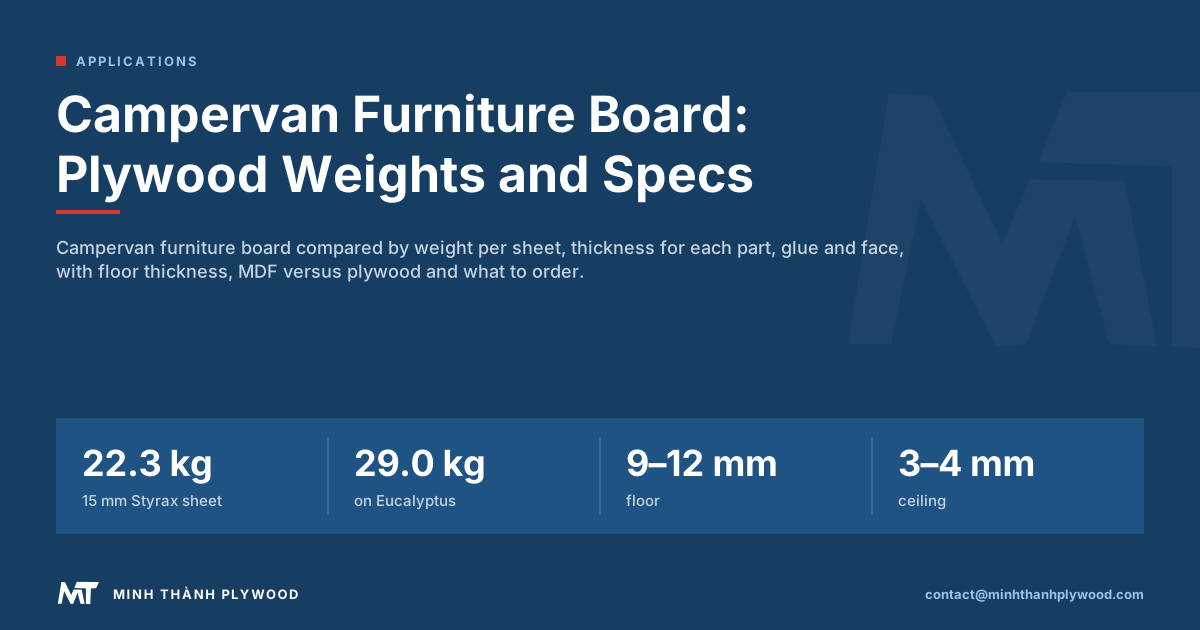
The best campervan furniture board is a light, flat plywood with a paint- or laminate-ready face: poplar or birch faces over a white Styrax core weigh about 22.3 kg per 1220 × 2440 × 15 mm sheet, against 29.0 kg on a Eucalyptus core. Use 12–15 mm for carcasses and doors, 3–6 mm for backs and linings and 9–12 mm for the floor. Minh Thanh Plywood makes these panels in Vietnam for converters and panel distributors.
Faced campervan furniture board: decors, edge trim and UK prices
In the UK, “campervan furniture board” usually means a factory-faced lightweight board, 15 mm thick, sold by the sheet in matt, gloss and woodgrain decors for about £137–194. What a converter or distributor pays for the raw board underneath is far lower, and Minh Thanh supplies that raw board: sanded, square-edged, laminate-ready poplar-faced plywood on a Styrax core.
| UK retail listing, 1220 × 2440 mm | Price per sheet | What it is |
|---|---|---|
| 15 mm Italian black roughcast / black gloss | £136.80 | Decor-faced lightweight board |
| 15 mm Italian matt cashmere | £155.40 | Decor-faced lightweight board |
| 15 mm Italian white roughcast / white gloss | £162.00 | Decor-faced lightweight board |
| 15 mm pear gloss, lightweight ilomba plywood | £193.54 | Decor-faced lightweight board |
| 3 mm pear gloss, lightweight ilomba plywood | £90.00 | Decor-faced thin board |
| 18 mm phenolic hexa construction board | £26–90 by size | Floor and construction board |
Prices are from UK Leisure Parts (97 faced boards listed, trade prices behind a login) and Clearcut Conversions, read on 21 October 2026. DeadSound lists a 15 mm 9-ply poplar board at approximately 25 kg per full sheet and sells full sheets for collection only; the same size on our Styrax core is about 22.3 kg.
What the converter pays for the raw board and its journey:
- Board: a 15 mm sheet gives an illustrative US$15.63 when its exact volume is multiplied by an assumed US$350/m³. Use the confirmed quotation for the specified face, core, glue and delivery term; add only separately quoted charges.
- Sea freight: Far East to Felixstowe 40ft rates ran about £3,300–3,600 in late summer 2026; spread over a 40HC of 15 mm Styrax-core board (1,188 sheets) that is about £2.78–3.03 per sheet. Typical time at sea from Hai Phong to Northern Europe is 30–40 days.
- Duty: the UK third-country duty on poplar-faced plywood (commodity code 4412 33 20) is 6 %. Vietnam-origin goods enter at 0 % under the UK-Vietnam free trade agreement, from 1 January 2025, with proof of origin.
- VAT: 20 % on the customs value plus any duty.
A converter or distributor therefore buys the raw 15 mm board by the container, sends it to a laminator for matt, gloss or woodgrain decor faces, and sells the finished sheet against the retail prices above.
What is laminate-ready board, and what does the decor face need?
Laminate-ready means the plywood is sanded and calibrated on both faces to ±0.2–0.3 mm, so decor paper, HPL or vinyl bonds evenly in a press. We do not sell decor-faced sheets; a laminator or the converter applies the decor. For the colours UK buyers list (cashmere, graphite, sage, woodgrain) the laminator chooses the paper; we supply poplar faces on a light Styrax core in A/A, A/B or B/B grades.
Which edge trim goes with 15 mm faced board?
Faced board needs matching edge trim on every visible cut: ABS or aluminium U-trim pushed over the 15 mm edge, or iron-on edge banding. The converter buys trim from the decor supplier so the colour matches; see our veneer edge banding guide for the options and the glue line each needs.
Can you order samples before a container?
Yes. Free samples are available: ask for 15 mm poplar-faced board on Styrax core, a 4 mm five-ply lining and a 12 mm floor panel, and press your own decor on them before you order a container.
What is the best campervan furniture board?
The best campervan furniture board is a light, flat, sanded plywood with a face ready for paint, lacquer or laminate. For most builds that means poplar or birch faces over a white Styrax core, 12–15 mm thick for cupboard carcasses and doors.
Three things decide the choice inside a van, and none of them matter as much in a kitchen at home:
- Weight. Every kilogram of furniture comes off the payload you have left for water, people and gear.
- Screw holding under vibration. Hinges, drawer runners and catches are loaded on every bumpy road, for years.
- Moisture. Cooking, breathing and drying clothes put condensation on cold metal and on the boards fixed to it.
A light-core plywood answers all three. Styrax core veneers give a panel of about 500 kg/m³. The core layers are stitched both along and across the sheet. The bond is chosen per part: UF glue at E0 emission for dry furniture, melamine-fortified MR near water and phenolic WBP for the floor.
Our poplar-faced plywood is the panel most furniture makers order for painted and laminated work; birch faces are the choice when the natural pale grain stays visible.
How much does camper van plywood weigh?
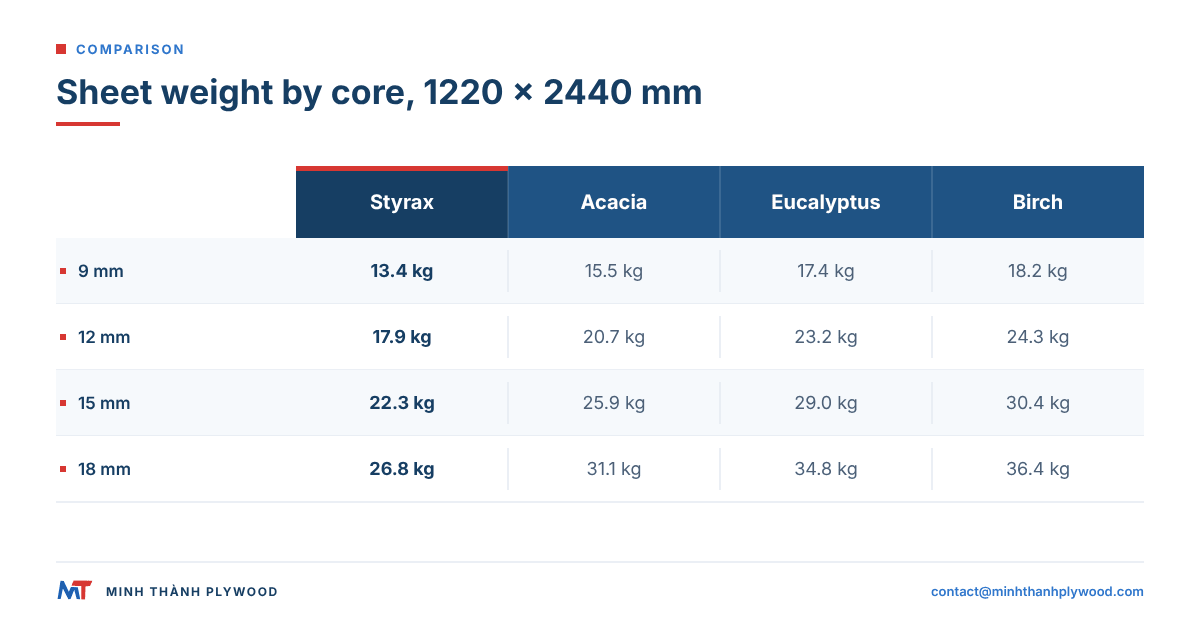
Camper van plywood weighs density × volume: a 1220 × 2440 mm sheet on a white Styrax core weighs about 13.4 kg at 9 mm, 17.9 kg at 12 mm, 22.3 kg at 15 mm and 26.8 kg at 18 mm. Denser cores and birch add 16–36 % to every sheet.
The table compares the cores Vietnamese plywood is made on with birch plywood. Sheet weights are calculated for a 1220 × 2440 mm sheet from the reference densities; a real sheet varies a little with moisture and face.
| Thickness | Styrax core (about 500 kg/m³) | Acacia core (about 580 kg/m³) | Eucalyptus core (about 650 kg/m³) | Birch plywood (about 680 kg/m³) |
|---|---|---|---|---|
| 3 mm | 4.5 kg | 5.2 kg | 5.8 kg | 6.1 kg |
| 6 mm | 8.9 kg | 10.4 kg | 11.6 kg | 12.1 kg |
| 9 mm | 13.4 kg | 15.5 kg | 17.4 kg | 18.2 kg |
| 12 mm | 17.9 kg | 20.7 kg | 23.2 kg | 24.3 kg |
| 15 mm | 22.3 kg | 25.9 kg | 29.0 kg | 30.4 kg |
| 18 mm | 26.8 kg | 31.1 kg | 34.8 kg | 36.4 kg |
The birch density is the figure given for birch plywood in the Handbook of Finnish Plywood (Finnish Forest Industries Federation). Styrax, Acacia and Eucalyptus are the reference densities we use to plan container loads.
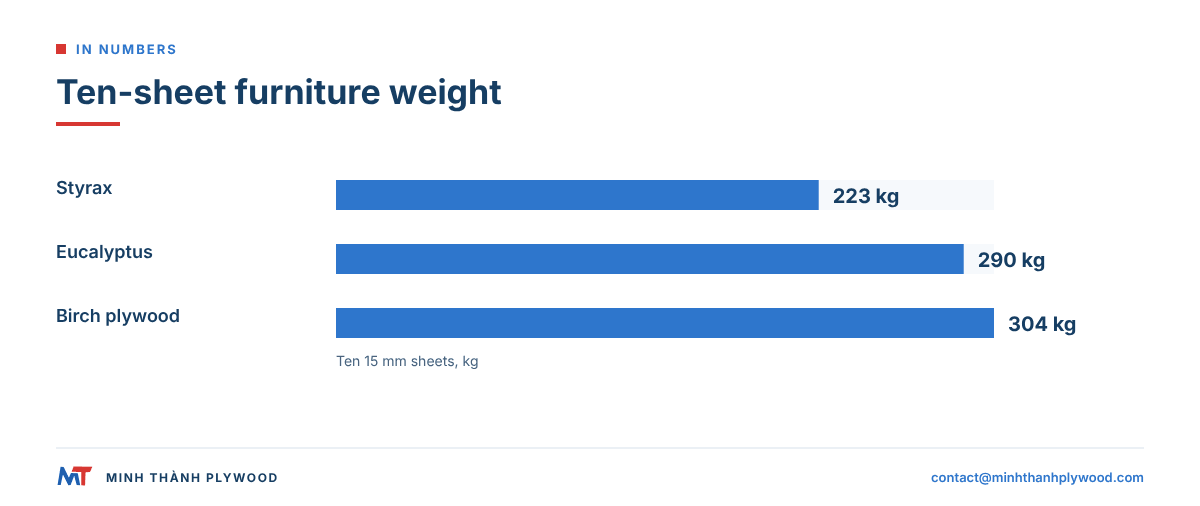
A typical panel van build uses about ten sheets of 15 mm board for the furniture. On a Styrax core that is about 223 kg of board; on Eucalyptus about 290 kg, and in birch plywood about 304 kg. The 67 kg to 81 kg difference is the weight of a full fresh-water tank and a passenger’s luggage. Our plywood weight calculator gives the figure for any size and thickness.
Why does board weight matter so much in a van?
Board weight matters because a van has a fixed maximum mass, and furniture is permanent load. In the UK a standard car licence (category B) covers vehicles up to 3,500 kg maximum authorised mass, as GOV.UK explains; a fitted-out panel van can come close to that line.
What is left after the van, the conversion and the driver is the payload for water, fuel, people, bikes and food. Furniture board is permanent weight in that sum, alongside batteries, the water system and insulation.
Three ways to save weight with plywood, in order of effect:
- Choose the core. A Styrax core saves about 6.7 kg per 15 mm sheet against Eucalyptus, with the same face.
- Step thickness down by part. Backs, drawer bottoms and wall linings do not need 12 mm; 4–5 mm in five plies is stiff enough when it sits in a groove or on battens.
- Use frames and face panels. A 12 mm carcass with 15 mm only where a worktop, sink or fridge sits saves more than any face choice.
What thickness should each part of the conversion be?
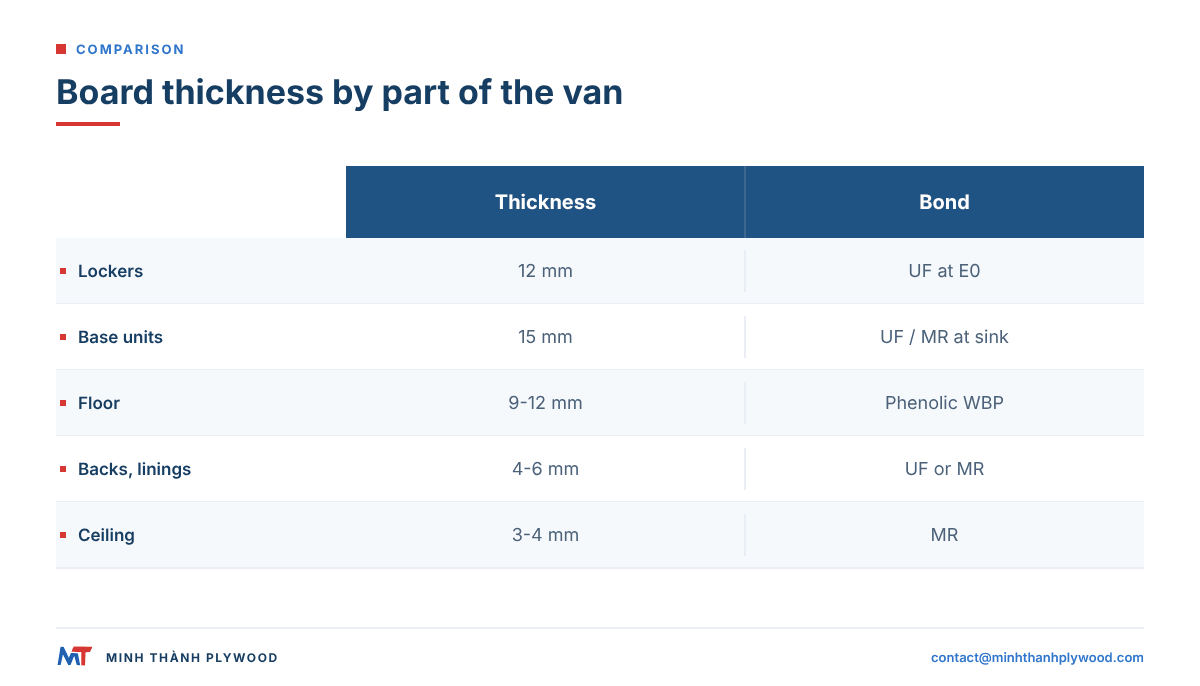
Each part gets the thinnest board that still carries its load and holds its fixings: 12–15 mm for cupboard carcasses and doors, 15–18 mm for worktops and bed platforms, 9–12 mm for the floor and 3–6 mm for backs, linings and the ceiling.
| Part | Thickness | Core and bond to order | Why |
|---|---|---|---|
| Overhead lockers, wall cupboards | 12 mm | Styrax, UF at E0 | Light; holds hinge and catch screws |
| Base units under a worktop | 15 mm | Styrax, UF at E0 (MR at the sink) | Carries worktop, sink or fridge |
| Cupboard doors | 12–15 mm | Styrax, faces sanded both sides | Flat doors that close true |
| Drawer bottoms, carcass backs | 4–5 mm, five-ply | Styrax, UF at E0 | Sit in grooves; very light |
| Worktop substrate | 18 mm | Styrax or Eucalyptus, MR | Takes laminate; holds sink cut-out |
| Bed platform | 15–18 mm | Eucalyptus or Acacia for stiffness | Spans between supports |
| Floor | 9–12 mm | Eucalyptus or Acacia, phenolic WBP | Condensation and wet boots |
| Wall lining | 4–6 mm | Styrax, MR | Fixed to battens |
| Ceiling | 3–4 mm, five-ply | Styrax, MR | Follows the roof curve |
Our thin plywood is five-ply in every thickness from 3 mm to 5 mm, which keeps thin linings and drawer bottoms flat and gives the screws more than one glue line to bite through.
What thickness plywood for a camper floor?
A camper floor is usually 9 mm or 12 mm plywood laid over battens and insulation. Choose 12 mm where seat bases, bed legs or cabinet plinths are screwed straight into the floor, and 9 mm where the floor only carries foot traffic between fixed furniture.
The floor is the one part where the bond matters more than the core. It sits on cold metal, gets wet boots and spilled water, and is the first place condensation collects. Order it with phenolic WBP glue, or melamine-fortified MR as a minimum, and seal the cut edges before laying.
Heavier floors rarely help. An 18 mm floor across a long-wheelbase load area adds about four sheets of 26.8 kg or more, and the vinyl or carpet on top hides the difference. For a hard-wearing finish without a covering, an anti-slip plywood with a textured film face is the panel used for vehicle floors and ramps. Our guide to subfloor plywood explains the grades and bond classes for floors in more detail.
How should campervan cupboards be built from plywood?
Campervan cupboards are built as light plywood boxes, 12 mm for wall units and 15 mm for base units, glued and screwed at every joint and fixed to the van’s ribs or to battens bonded to the body. Doors need positive catches so they stay shut on the road.
What the board itself contributes to a cupboard that lasts:
- Stitched core. Core layers are stitched horizontally and vertically; inspect the sample core and trial the hinge or runner screws at the intended fixing positions.
- Flatness. Furniture panels are pressed twice: the core board is pressed and calibrated first, then the face and back are pressed on. Doors made from double-pressed board hang flat and close against the frame.
- Thickness tolerance. Sanded furniture panels are held to ±0.2–0.3 mm, down to ±0.2 mm, so a 4 mm back or drawer bottom slides into a routed groove without packing or forcing.
- Moisture at dispatch. Panels leave the factory at 8–12 % moisture, the normal range for furniture plywood, which keeps them stable after fitting.
For drawer boxes, 12 mm sides with a 4–6 mm bottom in a groove are light and strong. For lift-up bed lids and table tops, add a perimeter frame rather than going thicker. The same component logic is set out for houses in our kitchen cabinet plywood guide.
MDF or ply for a campervan?
Plywood is the better choice for a campervan: it is lighter for the same stiffness, holds screws better under constant vibration and copes better with condensation. MDF is denser than a light-core plywood, swells at cut edges when wet and loses grip around hinge screws as the van flexes.
| Metric | Light-core plywood (Styrax) | Standard MDF |
|---|---|---|
| Weight | About 500 kg/m³ panel | Denser than light-core plywood |
| Screw holding in faces | Good; cross-laminated plies | Good in the face, weaker near edges |
| Screw holding in edges | Workable with pilot holes | Poor; edges split |
| Vibration over years | Joints stay tight | Screws loosen in fibre |
| Condensation and splashes | MR or WBP bond to order | Swells at cut edges unless sealed |
| Paint finish | Sanded face; poplar takes paint evenly | Very smooth |
| Best use in a van | Carcasses, doors, floor, linings | Small decorative parts kept dry |
MDF has a place for small, dry, decorative parts that carry no fixings. For the structure, plywood wins. Our full plywood vs MDF comparison covers furniture outside vans.
Birch or poplar camper van plywood?
Choose birch faces when the natural pale grain stays visible and a fine edge is part of the design; choose poplar faces when the furniture is painted, lacquered or laminated. Both can sit on the same light core, so the choice is about the face, not the weight.
Birch face grades are named D+, D and E in Vietnam and quoted as face/back pairs such as D+/D or D/E. They compare with the European birch grade ladder: D+ is close to B, D to BB and E to CP/C, so a D+/D sheet is close to B/BB. Poplar faces are quoted as A/A, A/B or B/B: A/A for two visible sides, A/B where one side faces the wall.
One point many buyers ask about: a birch face over a Vietnamese Styrax core has a pale, even edge, but it is not the many-ply, all-birch edge of Baltic birch plywood. If an exposed multi-ply edge is the design, say so on the order so face and edge are agreed against a sample. If the edges are banded, painted or hidden, a birch or poplar face on Styrax gives the look at a lower weight.
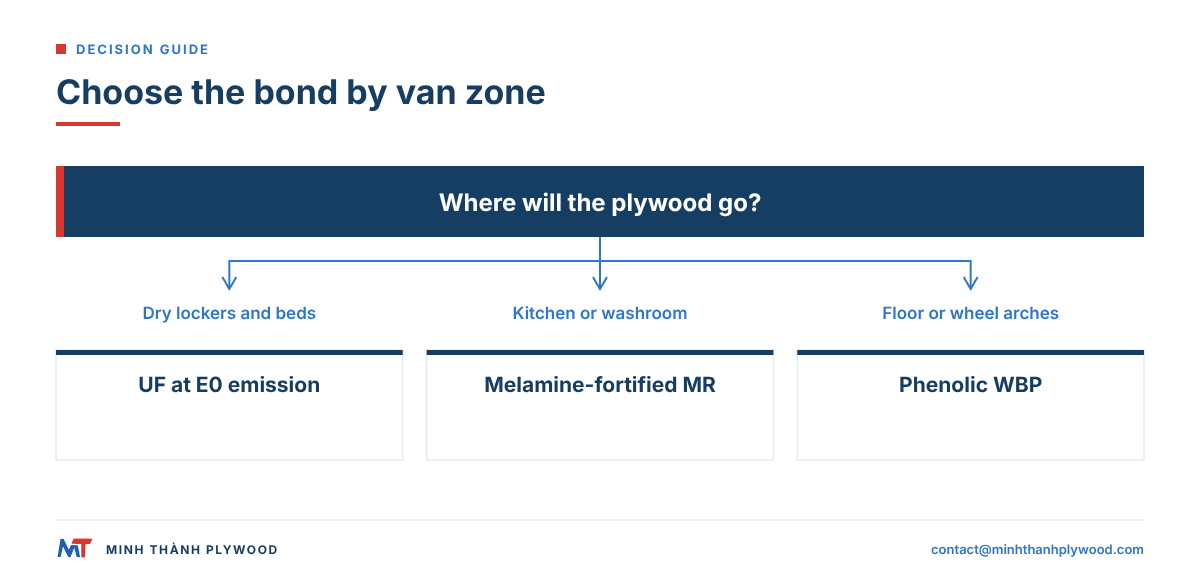
Which glue and emission class suits a small living space?
For dry furniture in a van, order UF glue at E0 emission. A campervan is a small, closed room heated by the sun, so low formaldehyde emission matters more than in most kitchens. Glue type and emission class are separate lines on the order: write both. Bonding quality is classed under BS EN 314-2.
Our furniture panels carry CARB Phase 2 / TSCA Title VI certification (ICTT mill no. 23024). Six ASTM D6007 chamber tests between April 2025 and June 2026, on 9, 15 and 18 mm panels, averaged 0.014–0.032 ppm against the 0.05 ppm limit for veneer-core hardwood plywood; three were run by Shanghai Hongjun and three by ICTT Vietnam. EPA lists a 0.05 ppm limit for veneer-core hardwood plywood, and our quality and certificates page shows our factory evidence.
By zone:
- Dry furniture (lockers, wardrobes, bed bases): UF glue at E0 emission.
- Kitchen and washroom units: melamine-fortified MR glue, edges sealed.
- Floor, wheel arches, anything near the door: phenolic WBP glue.
Which faces and finishes work in a van interior?
Faces that are sanded and ready to finish work best, because a van interior is painted, oiled, lacquered or laminated after fitting. Our furniture panels are sanded and polished on both faces and UV-ready, so a coating line or a spray booth can finish them without further sanding.
Common finishes and the face that suits each:
- Painted furniture: poplar A/A or A/B; the plain cream grain takes paint evenly.
- Clear lacquer or oil: birch D+/D or poplar A/A, matched to the approved sample.
- High-pressure laminate or melamine paper: poplar or EV faces as a flat substrate; the laminate is applied by the builder.
- Vinyl or carpet linings: B/B faces on thin five-ply panels; the face is covered.
Seal every cut edge, including the inside of hinge and handle holes, before finishing. Our guides to finishing plywood and cutting plywood cleanly cover the workshop side.
What should campervan ceiling panels and walls be?
Campervan ceiling panels are usually 3–4 mm five-ply plywood and wall linings 4–5 mm, fixed to battens over the insulation. Thin five-ply panels are light enough to hold overhead and flexible enough to follow the curve of a van roof.
- Ceiling: 3 mm at about 4.5 kg per sheet on a Styrax core, or 4 mm at about 6.0 kg. Run the face grain along the van so the sheet bends across its face grain when the roof curve is tight, and trial one sheet on the battens before cutting the full set.
- Walls: 4–6 mm. Use 6 mm where hooks, rails or light fittings are screwed through, or add a batten behind them.
- Wheel arches and lower walls: 6–9 mm with an MR or WBP bond; this zone takes knocks and wet gear.
Thin panels are where five plies matter most. A 3 mm sheet built from one core veneer, two cross-band veneers and two face veneers stays flatter and splits less at fixings than a three-ply sheet of the same thickness. The plywood wall panels guide covers wall lining in buildings, and the caravan and RV plywood guide covers thin wall and ceiling panels for caravan builders.
What should a converter or distributor write on the order?
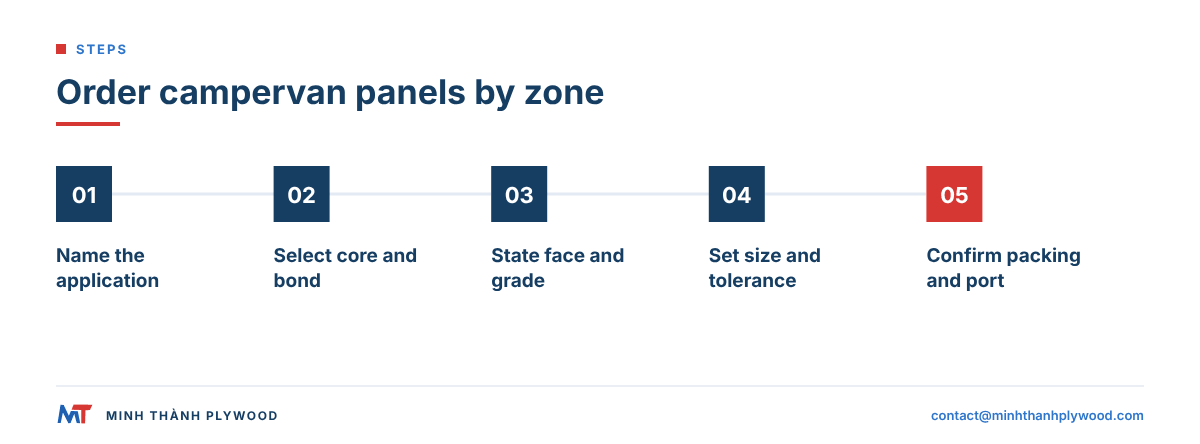
Write one line per specification: application, core, glue and emission, face and back grade, thickness and tolerance, size, quantity and packing. A clear line gets a precise quotation and the right sample.
An example for a conversion workshop or a panel distributor supplying van builders:
Campervan furniture board: poplar A/B over white Styrax core, stitched core, pressed twice, UF glue at E0 emission, sanded and polished both faces, 15 mm ±0.2–0.3 mm, 1220 × 2440 mm, moisture 8–12 %; plus 4 mm five-ply poplar B/B on Styrax for backs and linings; plus 12 mm Eucalyptus core with phenolic WBP glue for floors. FOB Hai Phong.
How it ships: our minimum order is one 40HC, usually with one or two specifications per container and up to six by agreement. A 40HC holds 18 packs of Styrax-core board, about 990 sheets at 18 mm or about 5,994 sheets at 3 mm, each plan capped by weight at a 28,000 kg planning payload or the lower limit of your booking. Production takes 15–45 days after the 30% deposit, with the 70% balance against the scanned B/L.
Free samples are available. Send the specification line, or ask for a sample of the face and core you are considering, through our quotation page.
Buyer questions, answered
What is the best plywood for campervan furniture?
A poplar- or birch-faced plywood on a light core, 12–15 mm thick for carcasses and doors. On a white Styrax core a 1220 × 2440 × 15 mm sheet weighs about 22.3 kg, so a full build stays light without giving up screw holding.
What thickness plywood for a camper floor?
9 mm or 12 mm over battens and insulation suits most van floors. Choose 12 mm where furniture, seat bases or bed legs are screwed into the floor, and use a melamine-fortified or phenolic WBP bond because floors see condensation and wet boots.
Is MDF or ply better for a campervan?
Plywood. It is lighter for the same stiffness, holds hinge and cabinet screws better under constant road vibration, and copes better with condensation. Keep MDF for small decorative parts that never get wet or carry fixings.
How much does a sheet of campervan plywood weigh?
A 1220 × 2440 mm sheet weighs about 13.4 kg at 9 mm, 17.9 kg at 12 mm, 22.3 kg at 15 mm and 26.8 kg at 18 mm on a Styrax core, calculated at about 500 kg/m³.
What thickness plywood for campervan cupboards?
12 mm for wall cupboards and overhead lockers, 15 mm for base units that carry a worktop, a sink or a fridge, and 4–6 mm for backs and drawer bottoms that sit in grooves.
Is birch plywood worth it in a camper van?
Birch faces give the pale, fine-grained look many builders want, but birch is heavier than a light-core panel. A birch face over a Styrax core keeps the look on the visible side and the lower weight of the core.
Which glue should campervan plywood have?
UF glue at E0 emission suits dry furniture in a small living space. Use melamine-fortified MR glue near the sink and shower, and phenolic WBP for the floor and any part that can get wet.
Can I bend thin plywood for a van ceiling?
Yes. 3–4 mm five-ply panels follow the gentle curve of a van roof when fixed to battens. Bend across the face grain when the radius is tight, and trial one sheet before cutting the full set.
How much does faced campervan furniture board cost in the UK?
A 15 mm decor-faced lightweight board of 1220 × 2440 mm sells for about £137–194 a sheet at UK retailers in October 2026, and an 18 mm phenolic hexa floor board for £26–90 by size. A converter importing raw laminate-ready board by the container adds its own facing.
Can a converter order plywood direct from a factory?
Yes, by the container. Our minimum order is one 40HC, usually with one or two specifications and up to six by agreement, so a workshop or panel distributor can combine floor, carcass and lining thicknesses in one load.