
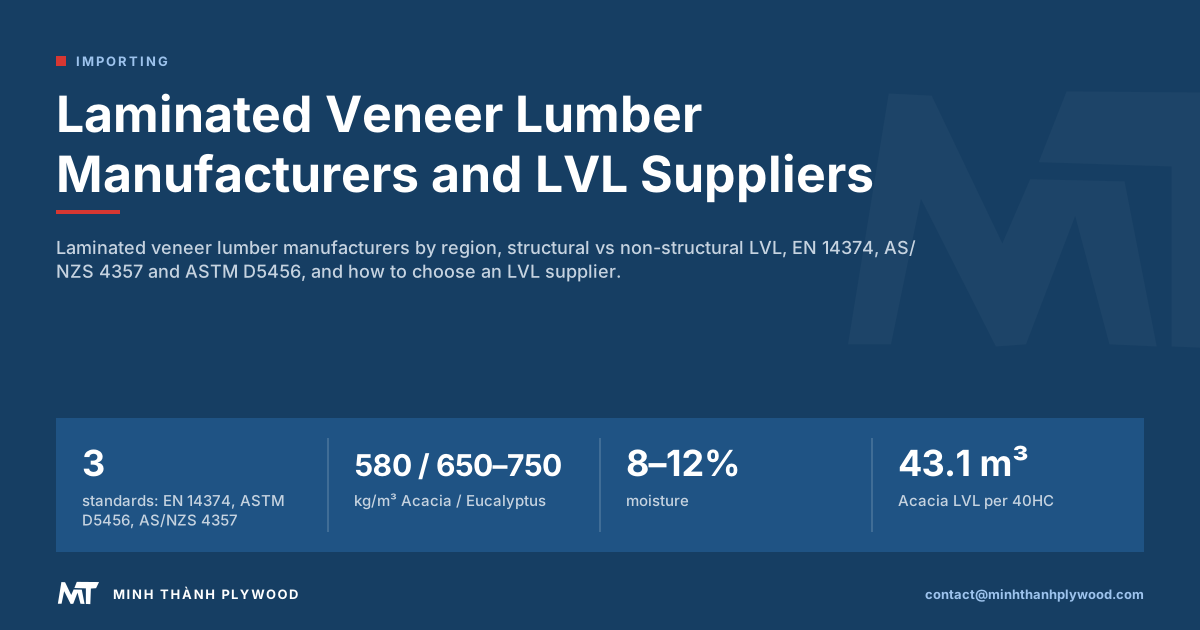
Laminated veneer lumber manufacturers fall into two groups: structural LVL mills in Europe, North America and Australasia that certify beams to EN 14374, ASTM D5456 or AS/NZS 4357, and Asian mills, Vietnam among them, that make LVL for furniture, door and packaging components. Minh Thanh Plywood makes the second kind. Choose the group first, then the supplier.
Who are the main laminated veneer lumber manufacturers?
The main laminated veneer lumber manufacturers are the structural engineered-wood mills of Europe, North America and Australasia, plus a large group of Asian mills making LVL for components. Each region’s mills build on their own forest species and certify to their own standard.
| Region | Examples of LVL producers and product names | Usual species | Main standard |
|---|---|---|---|
| Nordic and central Europe | Metsä Wood (Kerto LVL), STEICO (STEICO LVL), Pollmeier (BauBuche), Stora Enso (LVL) | Spruce, pine, beech | EN 14374 |
| North America | Weyerhaeuser (Microllam), Boise Cascade (Versa-Lam), LP (SolidStart), Roseburg (RigidLam), Murphy | Douglas fir, southern pine, poplar | ASTM D5456 |
| Australia and New Zealand | Wesbeam, Nelson Pine Industries, Carter Holt Harvey (hySPAN) | Radiata pine | AS/NZS 4357 |
| China | Many mills, often poplar or pine | Poplar, pine | Mill or buyer specification |
| Vietnam | Plywood and LVL mills on plantation timber, including Minh Thanh Plywood | Acacia, eucalyptus | Buyer specification for components |
The first three groups make LVL as a structural product: beams, headers, rafters and the flanges of I-joists, sized by engineers from published design values. Asian mills mostly make LVL as an engineered timber for furniture, doors, window frames and packaging.
Which LVL mills have the largest capacity?
The European mills with the highest published capacity each press 120,000–190,000 m³ a year, and Metsä Wood has the highest combined capacity, with three Kerto LVL sites in Finland. The figures below are the mills’ own published capacities.
| Producer and mill | Country | Published LVL capacity | Source, date |
|---|---|---|---|
| Metsä Wood, Punkaharju (Kerto LVL) | Finland | 190,000 m³ a year after a 65,000 m³ line added in 2019 | Metsä Group, 2017 |
| Metsä Wood, Lohja (Kerto LVL) | Finland | 120,000 m³ a year | Metsä Group, 2017 |
| Metsä Group, Äänekoski (new Kerto LVL mill) | Finland | About 160,000 m³ a year, a EUR 300 million investment; test production started in 2025 | Metsä Wood, 2025 |
| STEICO, Czarna Woda (STEICO LVL) | Poland | About 160,000 m³ a year on two lines | EUWID, 2017 |
| VMG Lignum Construction | Lithuania | 120,000 m³ of LVL and 15 million metres of I-joists a year | Market Research Future, 2025 |
North American structural makers such as Weyerhaeuser, Boise Cascade, LP, Roseburg, West Fraser and Murphy run several LVL plants each and sell mostly into their home framing market. Component LVL mills in Vietnam and China work at a smaller scale per plant and cut to order; Minh Thanh Plywood’s LVL comes off a plywood plant with 50,000+ m³ of annual capacity.
Structural vs non-structural LVL: which do you need?
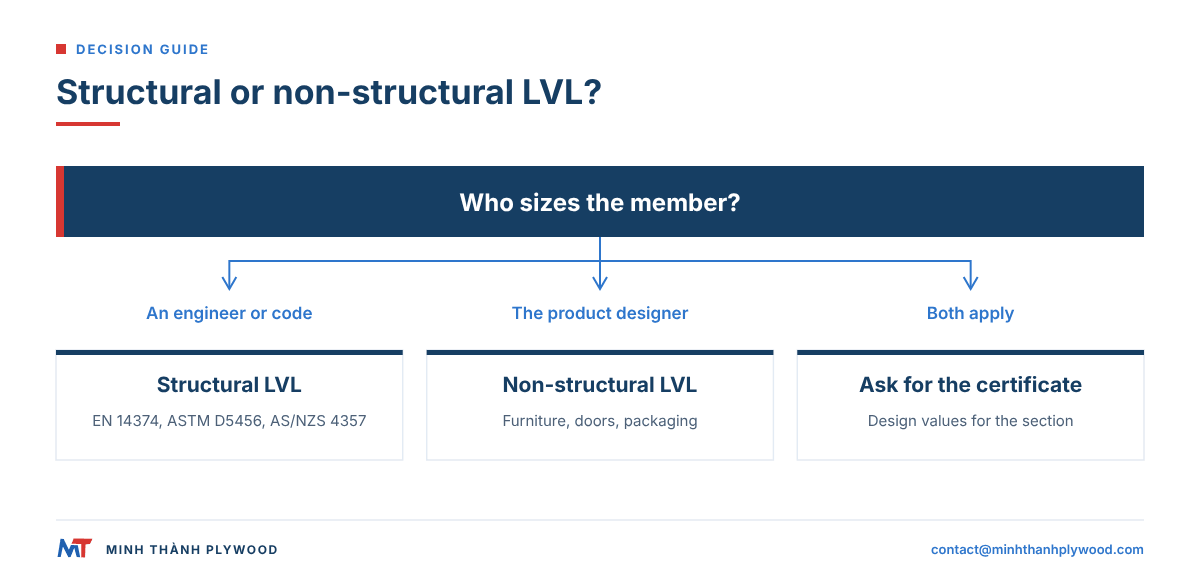
You need structural LVL when an engineer or a building code sizes the member from design values, and non-structural LVL when the member is a component judged by fit, finish and the product’s own tests. The two are bought from different suppliers at different prices.
| Point | Structural LVL | Non-structural LVL |
|---|---|---|
| Typical uses | Beams, lintels, rafters, I-joist flanges, posts | Furniture frames and rails, door and window components, bed and sofa frames, packaging runners |
| Proof | Certificate and design values to EN 14374, ASTM D5456 or AS/NZS 4357 | Specification, sample and the buyer’s own tests |
| Bond | Exterior-type, usually phenolic | UF at E0 or E1 for interiors; melamine-fortified or phenolic for damp uses |
| Species | Spruce, pine, Douglas fir, radiata pine, beech | Acacia, eucalyptus, poplar, pine |
| Who sizes it | The engineer, from design values | The product designer, from the drawing |
Many buyers searching for an LVL supplier need the second kind. A furniture plant replacing solid timber rails, or a packaging plant replacing sawn runners, gets straight, stable members from non-structural LVL without paying for a structural certificate it does not use. Our LVL vs plywood guide explains how the lay-up differs.
LVL standards and grades by market
Each market certifies structural LVL to its own standard: EN 14374 in Europe, AS/NZS 4357 in Australia and New Zealand and the Japanese Agricultural Standard in Japan. North America uses ASTM D5456. A grade name means something only under the standard that defines it.
| Market | Standard | What it covers |
|---|---|---|
| European Union | EN 14374 (structural LVL requirements), EN 14279 (definitions and classification) | CE marking of structural LVL under the Construction Products Regulation (EU) No 305/2011 |
| United States and Canada | ASTM D5456 | Evaluation of structural composite lumber, with grades such as 1.9E and 2.0E |
| Australia and New Zealand | AS/NZS 4357 | Structural LVL, with design properties per product |
| Japan | JAS for LVL | Structural and non-structural LVL grades |
E-grades such as 1.9E and 2.0E in North America, and product classes in Europe and Australasia, describe stiffness and strength for design. The number is the modulus of elasticity in million psi: 2.0E means 2.0 × 10⁶ psi. Ask any structural supplier for the certificate in the producing mill’s name and the design values for the exact section. Our LVL strength guide covers the properties.
What the leading US structural makers publish, and where Minh Thanh LVL sits:
| Supplier and product | Grades | Thickness | Depth or width | Length | Proof document |
|---|---|---|---|---|---|
| Murphy Plywood LVL | 2.1E, 2.2E | 1-1/2, 1-3/4, 3-1/2, 5-1/4 and 7 in | 3-1/2 to 24 in | 8 to 72 ft | APA Product Report PR-L283 |
| West Fraser LVL | Structural E-grades per product | 1-1/2, 1-3/4 and 3-1/2 in | 5-1/2, 7-1/4, 9-1/4, 9-1/2, 11-1/4, 11-7/8, 14, 16, 18 and 24 in | Long lengths from the mill | Code evaluation report per product |
| Common North American beam grades | 1.9E, 2.0E, 2.1E, 2.2E | 1-3/4 in plies, built up to 3-1/2, 5-1/4 or 7 in | 5-1/2 to 24 in for beams and headers | 8 to 72 ft at the longest | ASTM D5456 evaluation (APA, ICC-ES or CCMC) |
| Minh Thanh LVL (non-structural) | No E-grade: ordered by species, bond, moisture and surface | Cut to your drawing | Cut from 1220 × 2440 or 1250 × 2500 mm billets | Up to the billet format | Specification, sample, photos and video before loading; third-party tests through SGS on request |
The last row is the line a component buyer needs: Minh Thanh LVL is not sold with design values for building structures. It is specified like a furniture material, and any test the buyer’s method calls for, such as density, moisture or bond quality, is arranged through SGS.
LVL beam manufacturers: what they certify
LVL beam manufacturers certify each beam product to a structural standard and publish span tables and design values for it, so an engineer or builder can size the beam. A beam without that certificate is not a structural LVL beam, whatever it is called on an invoice.
The beam suppliers in each market are mostly the structural mills listed above and their distributors. They sell beams in long lengths from continuous presses, in depths matched to local framing, often with treatment for termites or exterior exposure where the market asks for it.
For a beam in a building, buy from a certified beam manufacturer and follow its span tables. For a beam-shaped member in a product, such as a bed frame, a sofa rail, a door stile or a crate runner, non-structural LVL cut from a billet is the cost-effective choice. Read more in LVL beams and wood I-joists.
Why buy LVL from Vietnam?
Vietnam makes LVL from plantation acacia and eucalyptus grown close to its mills, which gives a straight, stable engineered member at a lower cost than sawn hardwood. Vietnamese LVL is bought mainly for furniture, door and packaging components.
Minh Thanh Plywood, in Ha Hoa, Phu Tho, makes LVL from locally grown Acacia or Eucalyptus plantation veneers. Ha Hoa’s local plantation timber and skilled workforce let the mill offer high-grade quality at a better price than comparable mills. The same plant makes furniture, commercial, packing and film-faced plywood, with 50,000+ m³ of annual capacity and over 20 years of plywood-making experience.
For European buyers, Vietnam is classified low risk under the EUDR by Implementing Regulation (EU) 2025/1093, and Minh Thanh Plywood supplies the EUDR compliance dossier, with origin records and geolocation files, with orders.
How LVL is made
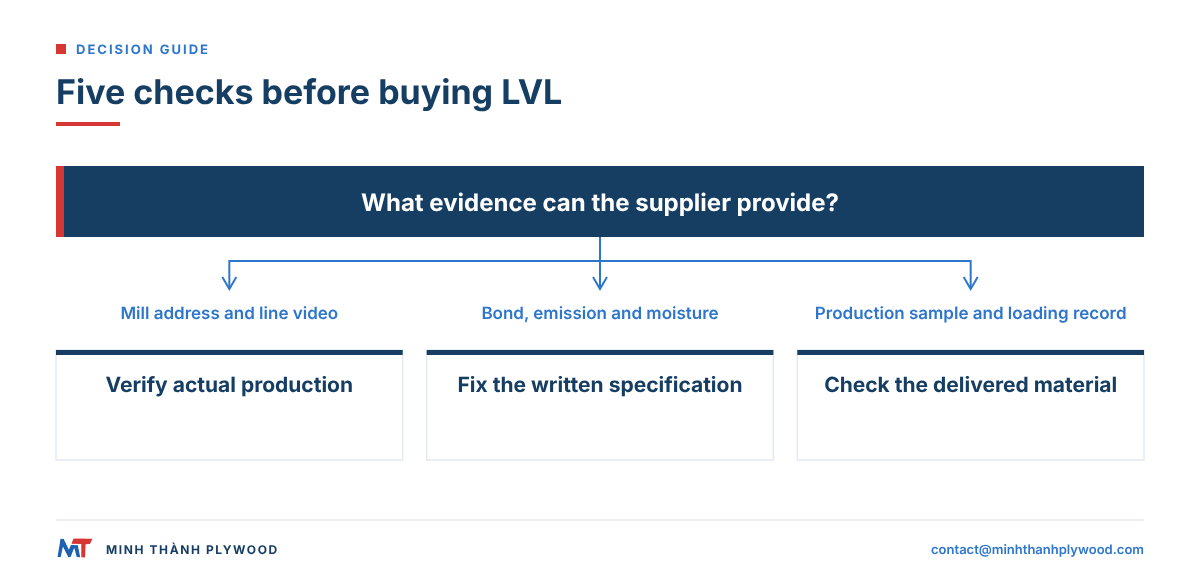
LVL is made by peeling logs into veneer, drying and grading it, then gluing the veneers with their grain running mainly along the length and pressing them into a billet. The billet is then cut into the ordered sections.
- Peel. Logs are rotary-peeled into continuous veneer sheets.
- Dry. Veneers are dried; Minh Thanh LVL ships at 8–12% moisture.
- Grade. Veneers are sorted so defects are spread through the billet.
- Lay up. Veneers are glued with the grain along the member and joints staggered, so no weak point lines up.
- Press. Heat and pressure bond the lay-up into a billet.
- Cut and finish. The billet is sawn into sections and lengths from the component drawing, and calibrated where the buyer needs it.
Structural mills often use continuous presses that make very long billets. Component mills press billets in panel formats and cut them to the buyer’s sections. See how LVL is made for the press types.
Laminated veneer lumber suppliers: manufacturer or trader?
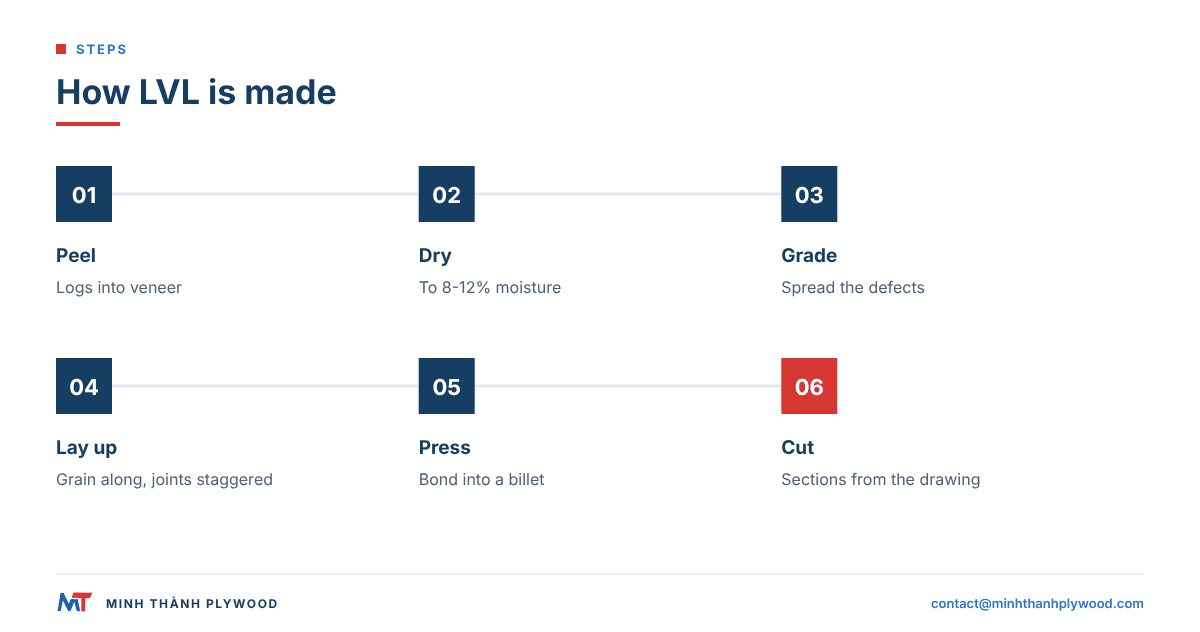
For a regular order, laminated veneer lumber suppliers work best when they are the mills that press the billets themselves, because they control the veneer, the glue and the moisture. Traders can help with mixed sourcing, but the specification must still trace back to one named mill.
Five checks separate a manufacturer from a reseller:
- The mill’s own address and video of its veneer, glue and press lines.
- Glue and emission in writing: bond type (UF, melamine-fortified, phenolic) and emission class.
- Moisture at dispatch and how it is measured.
- A sample cut from a production billet, not a showroom piece.
- Photos and video before loading of the actual bundles.
Every Minh Thanh shipment is photographed and filmed before loading, and buyers get the photos and video. Our guide plywood factory or trading company applies the same checks to plywood.
LVL vs plywood vs solid timber
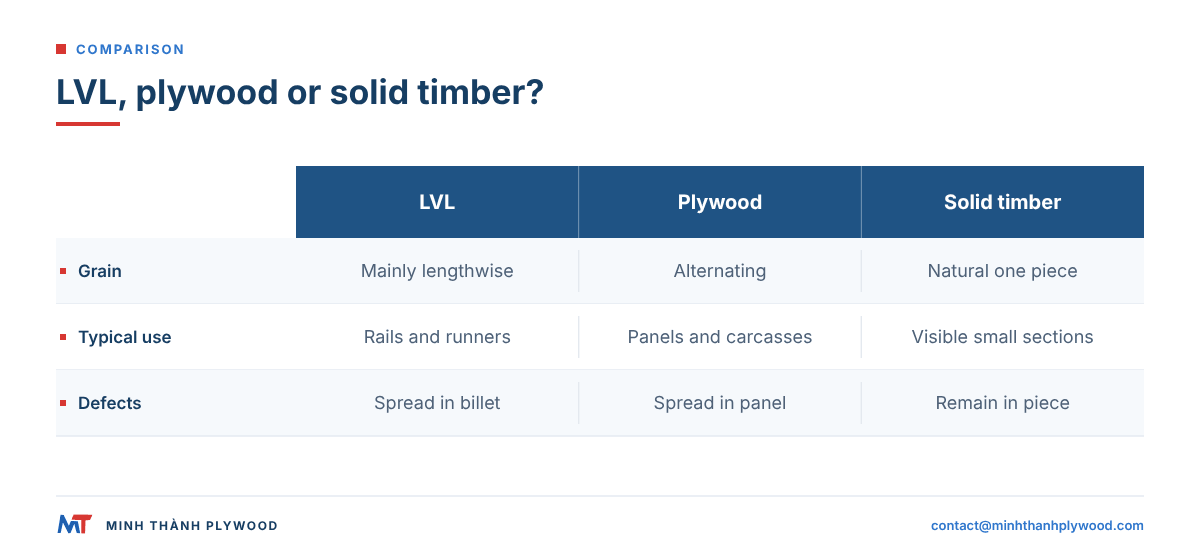
LVL runs the veneer grain along the member for strength in one direction; plywood alternates the grain for stability in two directions; solid timber keeps the tree’s natural defects in one piece. Choose by the load path.
| Point | LVL | Plywood | Solid timber |
|---|---|---|---|
| Grain | Mainly along the member | Alternating ply by ply | Natural, one piece |
| Best for | Beams, rails, frames, runners | Panels, sheets, carcasses | Small sections, visible solid wood |
| Defects | Spread through the billet | Spread through the panel | Knots and splits stay in the piece |
| Straightness | High, little twist | Flat in both directions | Can bow, twist and check |
| Sizes | Cut from billets to any section | Sheets 1220 × 2440 or 1250 × 2500 mm | Limited by log size |
A furniture rail in LVL stays straight after machining, where a solid rail can move. A carcass side in plywood stays flat, where LVL would be weaker across its width. Many furniture plants buy both from one mill. Compare them further in LVL vs plywood.
Which wood species are used in LVL?
LVL is made from the fast-peeling species of each region: spruce, pine and beech in Europe, Douglas fir, southern pine and poplar in North America, radiata pine in Australasia, and poplar, pine, acacia and eucalyptus in Asia. The species sets weight, stiffness and appearance.
| Species | Region | What it gives LVL |
|---|---|---|
| Spruce and pine | Nordic Europe | Light, stiff structural members |
| Beech | Central Europe | Very high strength in small sections |
| Douglas fir, southern pine | North America | Structural beams and headers |
| Radiata pine | Australia, New Zealand | Structural and treated LVL |
| Poplar | China, North America | Light members for furniture and frames |
| Acacia | Vietnam | About 580 kg/m³: stiff, stable components |
| Eucalyptus | Vietnam | 650–750 kg/m³: heavy, hard components |
Minh Thanh LVL uses Acacia or Eucalyptus. Our pine LVL vs hardwood LVL guide compares the softwood and hardwood options.
LVL sizes: billets, sections and lengths
LVL is supplied as billets that are cut into sections, and the billet format limits the longest piece. Minh Thanh Plywood presses LVL in 1220 × 2440 and 1250 × 2500 mm billet formats and cuts sections and lengths from your component drawing.
Put four things on the drawing so the cutting plan follows the component:
- Finished thickness, width and length of each member.
- Grain direction: along the member, with any cross-bands specified separately.
- Visible faces and machining allowance, so the veneer selection matches the finish.
- Quantity per section, so pieces and total volume appear on the quote.
Structural beams in long lengths come from structural mills with continuous presses. Component lengths up to the billet format are the efficient range for a component mill.
Store LVL the way the structural mills tell their builders to. West Fraser’s site rules are a good baseline for any LVL (West Fraser LVL):
- Off the ground, on stickers aligned one above the other and spaced no more than 8 ft (about 2.4 m) apart.
- Bundles no higher than 10 ft (about 3 m).
- Covered, with the wrap kept on until use, and cut ends sealed.
- No notching or drilling of structural members beyond what the maker’s guide allows.
Minh Thanh LVL ships at 8–12% moisture, and the same rules keep it at that moisture until machining.
LVL for furniture, doors and packaging
LVL for furniture, doors and packaging replaces sawn timber where a straight, stable member matters more than a solid-wood look. Minh Thanh Plywood supplies LVL for furniture frames, door components and industrial packaging.
- Furniture frames and rails. Sofa and bed frames, chair rails and cabinet frames that stay straight after machining. Mark the visible surfaces so the veneer is chosen for the finish.
- Door and window components. Stiles, rails and frame blanks with even density for machining and hardware.
- Packaging runners and frames. Crate runners and frame members sized from the packaging design.
Choose the bond for the exposure: UF glue at E0 emission for interior components, E1 as an option, and MR / melamine-fortified or phenolic WBP bonds for damp or covered outdoor use. Keep cut ends protected and members under cover before installation. Our guide can LVL be used outside covers exposure.
How much LVL fits in a 40HC?
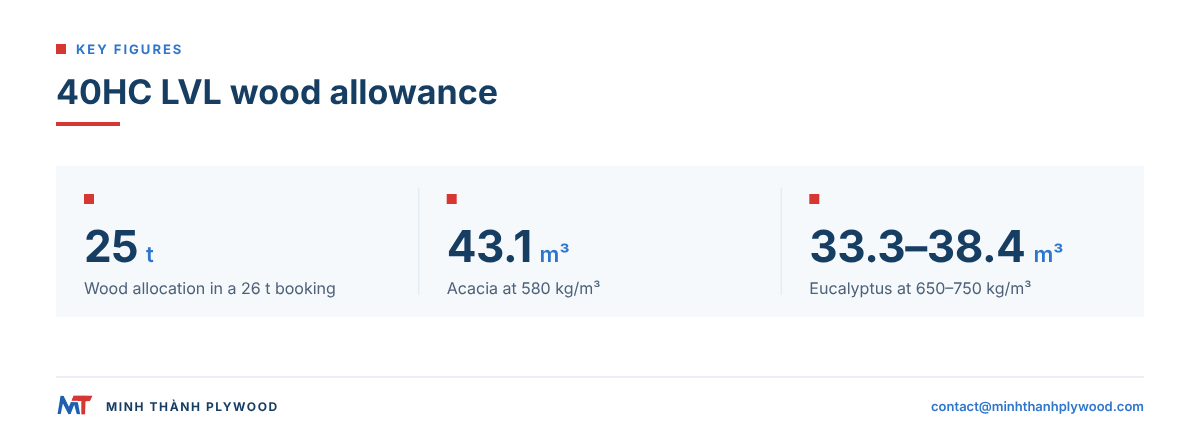
For a 40HC booking capped at 26 t, with 25 t allocated to wood and 1 t to packaging, the plan allows about 43.1 m³ of Acacia LVL at 580 kg/m³, or 33.3–38.4 m³ of Eucalyptus LVL at 650–750 kg/m³. Weight, not space, sets the load for LVL.
The piece count then follows your section and length schedule. A dense eucalyptus member puts fewer cubic metres in the box than acacia, so the species choice also moves freight per cubic metre. The final load uses the booking payload and weighed bundles, and every shipment is photographed and filmed before loading.
What drives the price of LVL?
The price of LVL is driven by the species, the bond, the grade of the visible surfaces, the section and cutting plan, and the quantity. Structural certification adds its own cost on top.
| Price driver | Effect |
|---|---|
| Species | Eucalyptus and acacia price differently; imported structural species cost more |
| Bond and emission | Phenolic WBP and E0 cost more than MR and E1 |
| Surface grade | Visible, finish-ready faces cost more than concealed members |
| Section and cutting | Many small sections and tight tolerances add cutting cost |
| Certification | Structural certification and design values add cost |
| Quantity and term | A full 40HC and FOB Hai Phong give the lowest unit price |
Compare LVL offers per cubic metre of finished member, on the same species, bond and surface grade. Our LVL price guide gives the detail.
What Minh Thanh Plywood supplies
Minh Thanh Plywood supplies non-structural laminated veneer lumber for furniture, door and packaging components, made from Acacia or Eucalyptus plantation veneers in Ha Hoa, Phu Tho, Vietnam.
- Species: Acacia, about 580 kg/m³, or Eucalyptus, 650–750 kg/m³.
- Moisture: 8–12% at dispatch.
- Glue and emission: UF glue at E0 emission for interiors, E1 as an option; MR / melamine-fortified or phenolic WBP bonds for the application.
- Formats: billets of 1220 × 2440 and 1250 × 2500 mm, cut to your sections and lengths.
- Documents: EUDR compliance dossier with origin records and geolocation files; commercial invoice, packing list, B/L and certificate of origin.
- Terms: MOQ one 40HC with mixed specifications by agreement; 15–45 days after the 30% deposit; 70% against the scanned B/L or an irrevocable L/C at sight; FOB Hai Phong, CFR or CIF; free samples.
See laminated veneer lumber from Vietnam for the full specification.
What to send for an LVL quote
Send the component, the build and the delivery port, and we reply within hours with a quote per cubic metre and per piece.
- Application: furniture frame, door component, packaging runner or other member.
- Species: Acacia or Eucalyptus.
- Glue and emission: UF at E0 or E1, melamine-fortified or phenolic WBP.
- Sections and lengths: thickness, width, length and quantity per section, with visible faces marked.
- Finish: calibrated or sawn, and any machining allowance.
- Packing and quantity: bundles, containers per month, destination port, FOB, CFR or CIF.
Write to contact@minhthanhplywood.com or WhatsApp +84 988 586 601 (Lisa), Monday–Friday, 08:00–17:00 Vietnam time.
Buyer questions, answered
Who makes LVL?
Structural LVL is made by large engineered-wood mills in Finland, Germany, the United States, Canada, Australia and New Zealand. Non-structural LVL for furniture, doors and packaging is made widely in Asia, including Vietnam and China.
Which company has the largest LVL capacity?
In Europe, Metsä Wood has the highest combined published LVL capacity of the producers we list, with Kerto LVL mills at Punkaharju (190,000 m³ a year) and Lohja (120,000 m³ a year) and a third mill of about 160,000 m³ a year at Äänekoski, in test production since 2025. STEICO in Poland and VMG in Lithuania follow.
What is the difference between structural and non-structural LVL?
Structural LVL is certified to a standard such as EN 14374, ASTM D5456 or AS/NZS 4357 and carries published design values for beams and lintels. Non-structural LVL is made for components such as furniture rails, door frames and packaging runners, where no engineer sizes it from design values.
Are there LVL manufacturers in Vietnam?
Yes. Vietnamese mills make LVL from plantation acacia and eucalyptus veneers for furniture frames, door components and industrial packaging. Minh Thanh Plywood makes LVL in Ha Hoa, Phu Tho.
Can I use Vietnamese LVL for beams?
Use LVL as a beam only when it carries a structural certificate and design values accepted where it is built. For furniture, door and packaging components, Vietnamese LVL is the cost-effective choice.
What sizes does Minh Thanh LVL come in?
Minh Thanh Plywood presses LVL in 1220 × 2440 and 1250 × 2500 mm billet formats and cuts sections and lengths from your component drawing.
What wood is LVL made from?
European LVL is mostly spruce, pine or beech; North American LVL is Douglas fir, southern pine or poplar; Australasian LVL is radiata pine. Minh Thanh LVL uses Acacia or Eucalyptus plantation veneers.
What glue is used in LVL?
Structural LVL uses a phenolic or similar exterior-type bond. Minh Thanh LVL is made with UF glue at E0 emission for interior components, E1 as an option, or MR / melamine-fortified or phenolic WBP bonds for the application.
How much LVL fits in a 40HC container?
For a 40HC booking capped at 26 t, with 25 t for wood and 1 t for packaging, the plan allows about 43.1 m³ of Acacia LVL or 33.3–38.4 m³ of Eucalyptus LVL.
What is the MOQ for LVL from Vietnam?
Minh Thanh Plywood's MOQ is one 40HC, with mixed specifications by agreement, and production takes 15–45 days after the 30% deposit.
How do I check an LVL supplier?
Ask for the mill address and production video, the glue and emission specification, moisture at dispatch, a sample cut from a real billet, and photos before loading. For structural LVL, ask for the certificate and design values in the mill's own name.