
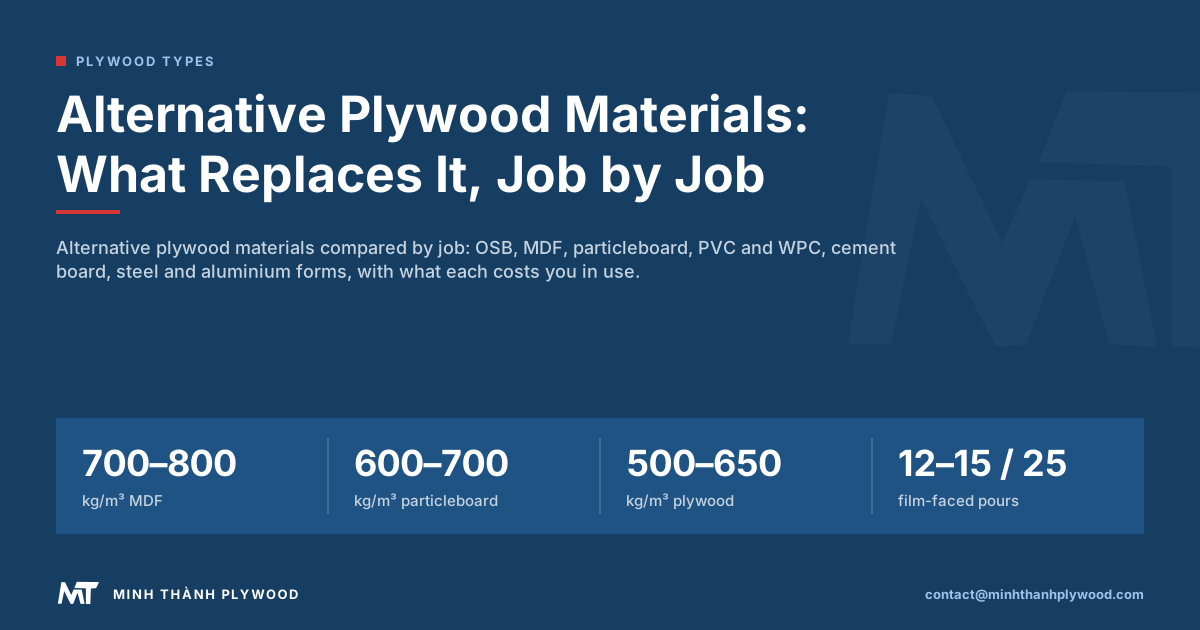
The best alternative to plywood depends on the job: MDF for painted furniture fronts, particleboard for cheap flat-pack carcasses, OSB for wall and roof sheathing, fibre cement for wet walls, and steel or aluminium forms for repeated concrete pours. Each one gives up something plywood does well. Minh Thanh Plywood, a furniture plywood manufacturer in Vietnam, sets out the trade-offs job by job.
What can replace plywood? The short answer by job
Plywood can be replaced in almost every job, but each replacement gives up one of its strengths: stiffness for its weight, screw holding, resistance to edge swelling or the ability to be cut on site. The right substitute depends on what the panel has to do.
| Job | Best alternative to plywood | What you gain | What you lose |
|---|---|---|---|
| Painted furniture fronts and routed doors | MDF | Smooth, grain-free paint surface; clean routed profiles | Weight, screw holding at edges, swelling when wet |
| Flat-pack carcasses on a tight budget | Particleboard (chipboard), melamine faced | Lowest material cost per sheet | Stiffness, screw holding, edge swelling |
| Wall, roof and floor sheathing | OSB | Lower price per sheet in structural grades | Edge swelling, rougher face, weight |
| Wet walls, tile backer, outdoor soffits | Fibre cement board | Does not rot; non-combustible | Weight, brittleness, needs special fixings |
| Repetitive concrete pours | Steel, aluminium or plastic forms | Hundreds of reuses | High capital cost; no on-site cutting |
| Signs, displays, wet trims | PVC foam board or WPC | No rot, no painting | Low stiffness, heat creep, higher price |
| Floors, door skins, drawer backs needing a hard thin board | HDF (high-density fibreboard) | Hard, dense face; thin sheets stay flat | Heavy, swells when wet, poor screw holding |
| Boats, RVs, trailers, lightweight panels | Polyurethane foam board (marine and trailer grades) | Rot-free, light, does not absorb water | Price, low screw holding without inserts |
| Boat hulls, tanks, cladding | GRP (glass-reinforced plastic) | Waterproof and corrosion-proof | Brittle edges, glass fibre handling, cannot be cut and fixed like wood |
| Food-contact and marine surfaces, wet-area partitions | HDPE sheet | Does not rot or absorb water, easy to clean | Flexes under load, expensive, hard to glue |
| Furniture, interiors where a bamboo look is wanted | Bamboo plywood | Renewable, dense, good look | Price, heavier than plantation-core plywood, fewer sizes and builds |
| Heavy export crates | No direct substitute; OSB or steel for some loads | OSB is cheaper | Plywood panels need no ISPM 15 treatment; regulated solid-wood components still do |
The newer boards in the table (polyurethane foam, GRP, HDPE and bamboo plywood) are specialist products: they win on water, weight or look in one job and cost more than plywood across the rest. The table is the verdict; the sections below give the reason for each line and the cases where plywood stays the better buy. For the plywood types themselves, see types of plywood.
Why look for substitutes for plywood at all?
Buyers look for substitutes for plywood for four reasons: price, weight, a specific surface, or a property plywood cannot give, such as non-combustibility. Each reason points to a different answer, so start from the reason before you change the material.
- Price. Particleboard and OSB cost less per sheet than plywood. A cheaper plywood build, such as a commercial grade or an engineered-veneer face, often closes most of the gap without changing the design.
- Weight. PVC foam and honeycomb panels are lighter for displays. For furniture, the lightest wood panel is usually plywood itself on a low-density core.
- Surface. MDF gives the best paint finish. Film-faced plywood or plastic forms give the smoothest concrete face.
- A property plywood lacks. Fibre cement and gypsum board are non-combustible; PVC and WPC do not rot.
A furniture plant that wants a lower price but keeps plywood’s screw holding should first compare plywood builds. Two offers with the same name can differ in core species, glue, face grade and tolerance, and that difference is where most of the price sits.
Plywood vs OSB: the sheathing alternative
Oriented strand board (OSB) is the main alternative to plywood for wall, roof and floor sheathing. It is made from large wood strands laid in cross-oriented layers and pressed with resin, so it carries structural loads at a lower price per sheet in covered applications.
OSB works where the panel is hidden and kept dry after the building is closed. It loses to plywood in three places:
- Edge swelling. OSB edges swell when wet and often stay swollen after drying. Plywood with a water-resistant bond swells less and recovers better.
- Surface. The strand face shows through paint and cannot be sanded to a furniture finish.
- Weight and fixings. OSB is denser than a plantation-core plywood, and screws near the edge pull out more easily.
For sheathing, our exterior plywood uses C/D utility faces with melamine-fortified or phenolic (WBP) glue, the build that competes directly with OSB. The full comparison is in plywood vs OSB.
MDF and particleboard: the furniture alternatives
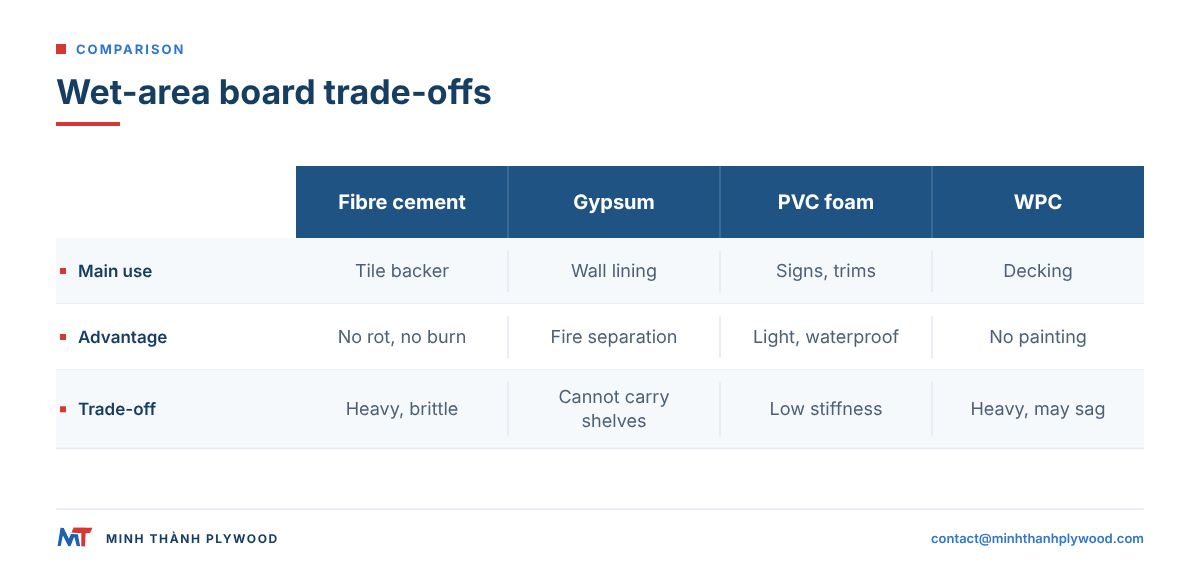
MDF (medium-density fibreboard) and particleboard are the two common alternatives to plywood in furniture. Both are made from wood fibres or particles bonded with resin, so they have no grain direction and a uniform surface, but both are heavier and weaker in screw holding than plywood.
| Property | Furniture plywood | MDF | Particleboard |
|---|---|---|---|
| Typical density | 500–650 kg/m³ on Styrax to Eucalyptus cores | 700–800 kg/m³ | 600–700 kg/m³ |
| Surface for paint | Good after sanding; grain can show | Best, grain-free | Needs a laminate or foil |
| Screw holding in faces and edges | Good in both | Good in face, weak in edge | Weak, needs inserts |
| Stiffness for shelves | Highest for its weight | Lower; long shelves sag | Lowest |
| Behaviour when wet | Depends on glue; MR or WBP resist humidity | Swells at edges | Swells and crumbles |
| Typical use | Carcasses, shelves, drawer boxes, frames | Painted doors, routed fronts | Flat-pack carcasses, worktop cores |
Formaldehyde rules apply to all three. In the US, the EPA’s TSCA Title VI formaldehyde standards cover hardwood plywood, MDF and particleboard with separate limits. Minh Thanh’s furniture plywood is CARB P2 / TSCA Title VI certified (ICTT mill no. 23024). Our chamber tests on 9, 15 and 18 mm panels averaged 0.014–0.032 ppm against the 0.05 ppm limit for veneer-core hardwood plywood.
Many cabinet plants mix the materials: MDF doors, plywood carcasses and particleboard for hidden parts. See plywood vs MDF and particleboard vs plywood for the detailed comparisons.
Cement board, gypsum and PVC: alternative material for wood in wet or fire-rated places
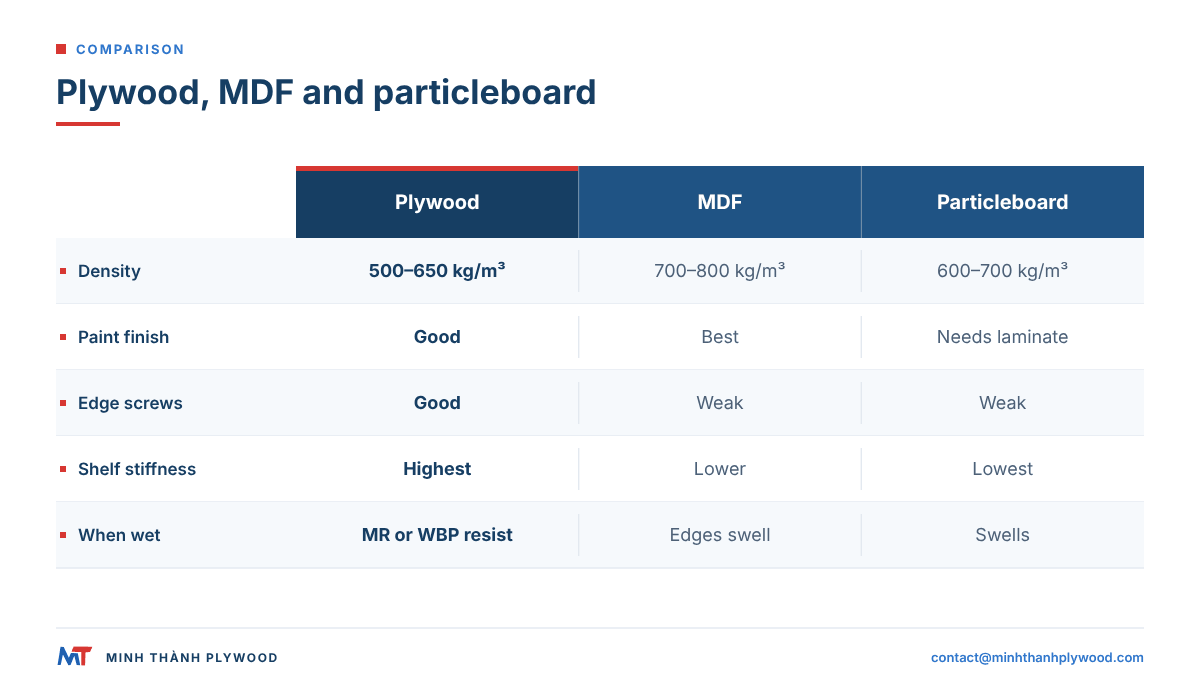
Fibre cement board, gypsum board, PVC foam board and wood-plastic composite (WPC) are the alternative materials for wood where rot or fire decides the choice. None of them is a wood panel, so each brings a property plywood cannot match and loses plywood’s strength for its weight.
- Fibre cement board does not rot and does not burn. It is used as tile backer, soffit lining and external cladding. It is heavy, brittle at edges and needs special screws or nails.
- Gypsum board (drywall) is the standard wall and ceiling lining for fire separation and smooth paint. It cannot carry shelves or cabinets without studs or anchors. Our plywood vs drywall guide covers walls and ceilings in detail.
- PVC foam board is light and waterproof, used for signs, displays and wet trims. It softens in heat and has low stiffness.
- WPC boards mix wood flour and plastic for decking and cladding. They do not need paint but are heavy and sag over long spans.
For a wet wall or a fire-rated line, use the non-wood board. For a wall that must hold weight, plywood behind or instead of the lining is usually the answer.
Steel, aluminium and plastic: substitutes for wood in formwork
Steel, aluminium and plastic formwork systems are the substitutes for wood on construction sites with many identical pours. They are reused hundreds of times, so on a tall building with the same floor plate repeated, their cost per pour falls below film-faced plywood.
Film-faced plywood keeps three advantages:
- Low entry cost. A project buys panels, not a rental system.
- On-site cutting. Plywood is cut to any shape on site; metal systems come in fixed modules.
- Weight. A 1220 × 2440 mm plywood panel is handled by two workers without a crane.
Reuse depends on glue and handling. With proper handling, release agent and edge sealing, melamine-bonded film-faced plywood reaches about 12–15 pours and phenolic-bonded panels about 25. Our film-faced plywood is made in both bonds. For complex shapes, one-off structures and medium projects, plywood is still the cheaper form face.
Plywood vs plastic, cardboard and metal for packing
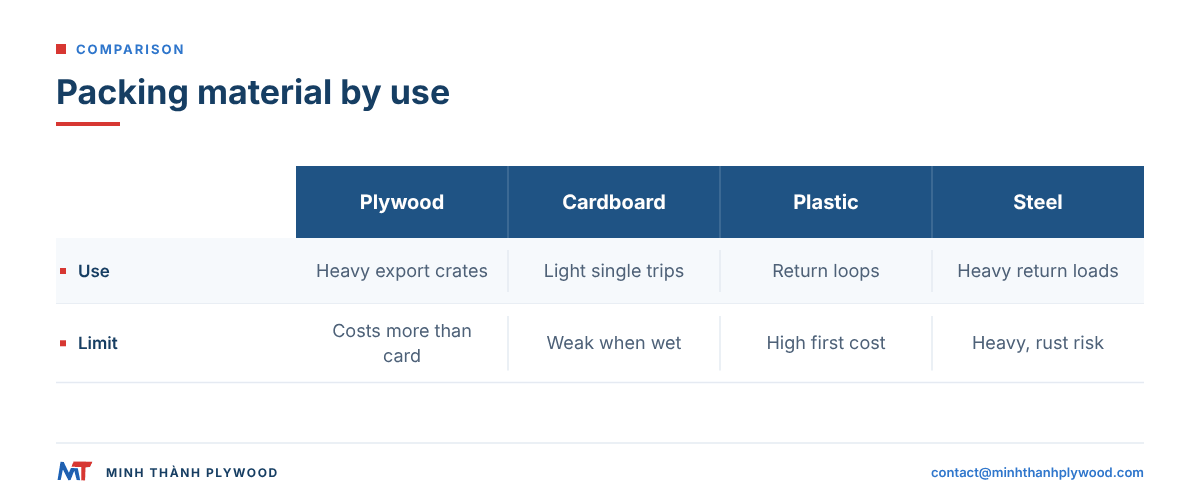
For packing, plywood competes with corrugated cardboard, plastic and steel. Plywood is the choice for heavy and export crates; cardboard wins for light goods; plastic and steel win where the same container returns many times.
| Packing material | Best for | Main limit |
|---|---|---|
| Packing plywood | Heavy machinery, export crates, pallet tops | Higher price than cardboard |
| Corrugated cardboard | Light goods, single trips | Fails when wet or stacked heavy |
| Plastic crates and pallets | Closed loops with returns | High first cost, cannot be cut to size |
| Steel frames | Very heavy or returnable loads | Weight, cost, rust |
A crate made wholly from processed wood such as plywood is outside ISPM 15. If it includes regulated solid-wood runners or framing, those components need approved treatment and the assembled packaging unit needs a compliant mark (GOV.UK). Our packing plywood is made with a packing tolerance of ±0.5–1.0 mm, which is all a crate needs.
Cheaper alternatives to plywood, and cheaper plywood
The cheapest alternatives to plywood are particleboard for furniture carcasses and OSB for sheathing. Before switching material, compare a cheaper plywood build: changing the core, the face or the grade usually saves more than buyers expect and keeps plywood’s screw holding and stiffness.
Ways to lower the price of plywood without leaving plywood:
- Choose the right segment. Commercial plywood from Minh Thanh starts from US$250/m³ and furniture plywood from US$350/m³ (indicative, October 2026). Packing and utility parts rarely need furniture grade.
- Change the face. Poplar or engineered veneer (EV) faces cost less than birch and still take paint, laminate or veneer.
- Change the core. A white Styrax core is lighter than Eucalyptus or Acacia, so more cubic metres fit under the container’s weight limit.
- Grade the faces by use. Order A/B or B/B where only one side shows, instead of two premium faces.
- Use cut-to-size. We cut one panel into 4, 6 or 8 pieces before shipping, which removes waste and cutting time in your plant.
The lightweight alternative to plywood
The lightest alternatives to plywood are PVC foam board, honeycomb panels and aluminium composite panels, used for displays, caravans and boat interiors. Among wood panels, plywood on a low-density core is a lightweight option for furniture.
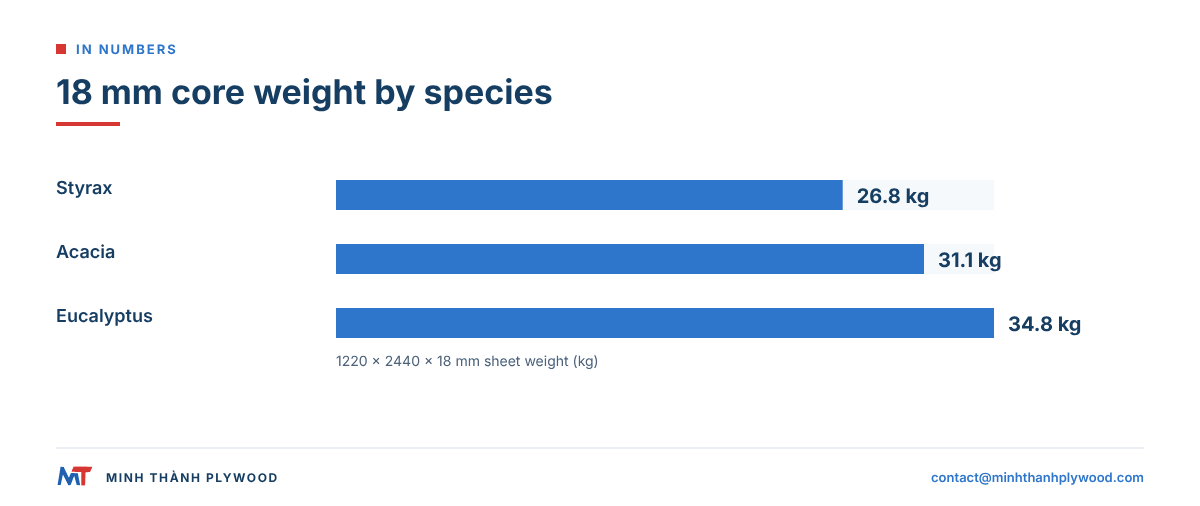
Weight is set mostly by the core species. At our reference densities, a 1220 × 2440 × 18 mm panel weighs about 26.8 kg on a Styrax core, 31.1 kg on Acacia and 34.8 kg on Eucalyptus. MDF of the same size is heavier than all three. For furniture that ships flat or hangs on walls, a Styrax-core panel saves weight without giving up screw holding.
Thin plywood is another answer. Our 3–5 mm panels are always five plies, so a 4 mm back panel or drawer bottom stays flat at a fraction of the weight of a thicker board.
A cheap and strong alternative to birch plywood
The common alternatives to full birch plywood are poplar-faced and engineered-veneer plywood on a plantation hardwood core, and birch-faced plywood on a Styrax or Eucalyptus core. All three give a flat, strong furniture panel at a lower price than solid birch through the thickness.
| Option | Look | Strength and flatness | When to choose it |
|---|---|---|---|
| Birch-faced on plantation core | Birch face, graded D+/D or D/E | Pressed twice, calibrated core | Visible birch faces at a lower cost |
| Poplar-faced plywood | Pale, even face, A/A to B/B | Weight depends on the core; calibrated for flatness | Painted, laminated or veneered parts |
| EV-faced plywood | Engineered veneer in a chosen colour and grain | Uniform repeat from panel to panel | Visible faces that must match across a run |
| Eucalyptus-faced plywood | Denser, warmer face | Depends on the specified core and panel construction | Shelves and tops under load |
Birch faces from Vietnam are graded D+, D and E, comparable to the European birch ladder: D+ about B, D about BB, E about CP/C. A cabinet maker who changes from Baltic birch should approve a sample with the face grade and core they want, then order to that sample. Our birch plywood page shows the builds.
Is Vietnamese plywood an alternative to Chinese plywood?
Yes. Vietnamese mills make the full range, from packing and film-faced plywood to top-grade furniture panels, and buyers in Europe, the Middle East and Australia order from Vietnam for the same products they buy elsewhere. The choice should rest on the mill and the build, not the country.
What to compare between any two mills:
- Core species and grade. Styrax and Eucalyptus cores are standard for our furniture panels; Acacia and Pine on order.
- Glue and emission. UF glue at E0 emission for furniture; MR or phenolic (WBP) for humid and exterior use.
- Tolerance. Sanded furniture panels at ±0.2–0.3 mm, down to ±0.2 mm.
- Documents. CARB P2 / TSCA Title VI, ISO 9001:2015, and the EUDR compliance dossier (origin records and geolocation files) that we supply with orders.
Transit from Hai Phong is typically 15–25 days to the Middle East and 30–40 days to Northern Europe, by carrier and route. Our guide to Vietnamese plywood for Europe covers the buying steps.
When plywood is still the right choice
Plywood stays the right choice when a panel must be stiff for its weight, hold screws in faces and edges, resist humidity and be cut to shape on site. That covers most furniture carcasses, shelving, drawer boxes, crates, formwork on non-repetitive jobs and any visible wood face.
Plywood’s cross-laminated layers spread defects and stop the panel splitting along the grain. A double-pressed panel with a calibrated core stays flat, and a stitched core closes gaps between core veneers. These are the reasons furniture plants that tried particleboard or MDF for structural parts often return to plywood for carcasses and keep the fibre boards for doors.
What this means for your order
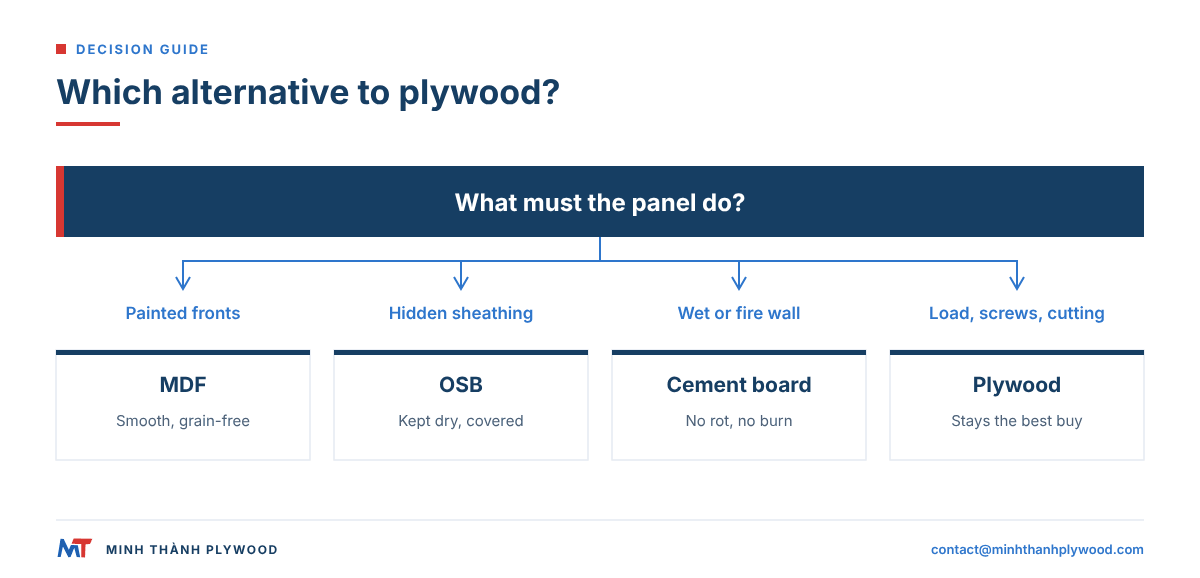
If you are replacing plywood, decide by job: MDF for painted fronts, OSB for hidden sheathing, cement board for wet or fire-rated walls, metal forms for repetitive pours. If the reason is price or weight, ask for a different plywood build before you change material.
A request that lets us quote the right plywood build in one reply:
Furniture carcasses and shelves, Styrax core, UF glue at E0 emission, poplar A/B faces, 1220 × 2440 × 18 mm, sanded ±0.2 mm, export packs, 1×40HC to [your port].
We supply free samples, quote within hours and ship one 40HC minimum, 15–45 days after the 30% deposit. Send your current material and the job it does, and we will propose the plywood build that replaces it or tell you it should stay as it is.
Buyer questions, answered
What is alternate plywood?
Alternate plywood usually means any sheet material used in place of plywood, such as OSB, MDF, particleboard, PVC foam board or fibre cement board. In trade it can also mean a cheaper plywood build, for example a poplar or engineered-veneer face instead of birch.
What is a cheaper alternative to plywood?
OSB for structural sheathing and particleboard for flat-pack carcasses are the cheapest sheet materials. Within plywood, a commercial or packing grade costs far less than furniture grade: Minh Thanh's commercial plywood starts from US$250/m³ against US$350/m³ for furniture plywood (October 2026).
What is the best lightweight alternative to plywood?
PVC foam board and honeycomb panels are lighter for signs, displays and caravan interiors. Within wood panels, a Styrax-core plywood at about 500 kg/m³ is a lightweight furniture option and lighter than the MDF and particleboard ranges compared below.
What is a cheap and strong alternative to birch plywood?
Poplar-faced or engineered-veneer plywood on a Styrax or Eucalyptus core, pressed twice and calibrated, gives a flat, strong furniture panel at a lower price than full birch. Birch-faced plywood on a plantation core is the middle option when the birch look matters.
Can OSB replace plywood?
Yes, for wall, roof and floor sheathing where the panel is covered. No, for visible furniture, cabinets or formwork faces, because OSB has a coarse strand surface, swells at cut edges and holds screws near edges less well.
Is MDF better than plywood for furniture?
MDF is better for painted, routed doors and fronts because it has no grain and machines cleanly. Plywood is better for carcasses, shelves and any part that carries load or takes screws, because it is lighter, stiffer and holds fixings.
What can replace plywood for concrete formwork?
Steel, aluminium and plastic formwork systems replace plywood on repetitive pours such as columns, walls and slabs on tall buildings. Film-faced plywood stays cheaper for one-off shapes, smaller projects and any job where the panel must be cut to fit on site.
What replaces plywood in packing crates?
Oriented strand board, corrugated cardboard, plastic and steel are used, depending on load and reuse. Plywood is useful for heavy export crates because the processed panels need no ISPM 15 treatment; if a crate includes regulated solid-wood components, those components need approved treatment and the assembled packaging unit needs a compliant mark.
Is Vietnamese plywood a good alternative to Chinese plywood?
Yes, for buyers who specify the build. Vietnamese mills make the full range, from packing panels to furniture plywood, on plantation cores; compare mills by core species, glue, tolerance and documents, not by country.
Are wood alternatives such as WPC or PVC better outdoors?
PVC and wood-plastic composite boards do not rot and need no paint, so they suit decking, cladding and wet trims. They are heavier, sag under heat and cost more per square metre than exterior plywood.