
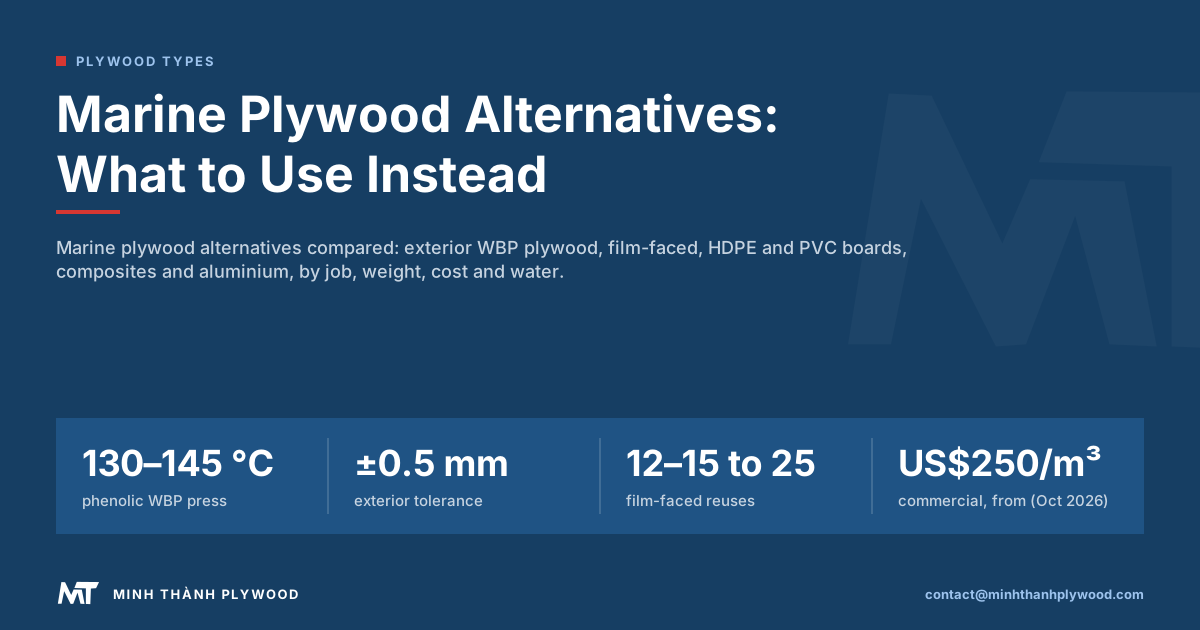
The best marine plywood alternatives depend on how wet the job gets. Exterior plywood with phenolic WBP glue replaces marine plywood for sheathing, stairs, sheds and outdoor joinery; film-faced plywood for formwork and trailer floors; plastic, composite or aluminium panels for parts that stay wet. Minh Thanh Plywood supplies the exterior and film-faced options from Vietnam.
What are the best marine plywood alternatives?
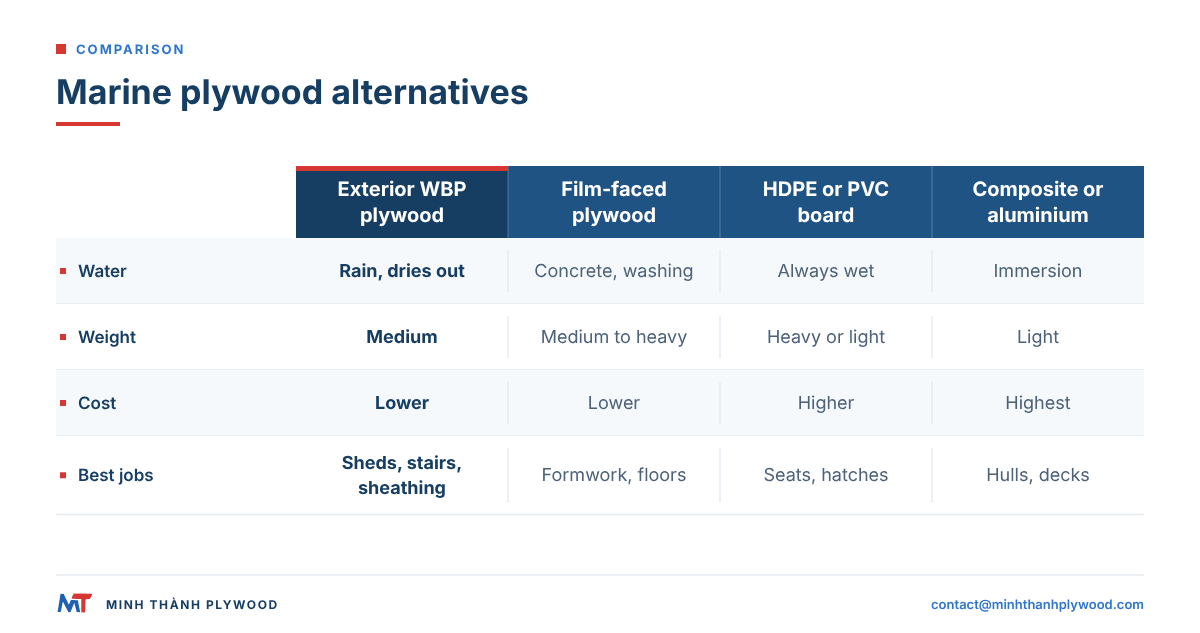
The best marine plywood alternatives are exterior plywood with phenolic WBP glue, film-faced plywood, plastic boards (HDPE and PVC foam), composite panels and aluminium. Which one fits depends on how long the part stays wet, the load it carries and the budget.
| Alternative | Water exposure it handles | Density | Relative cost | Best jobs |
|---|---|---|---|---|
| Exterior plywood, phenolic WBP glue | Rain and splash, dries out between wettings | 450–650 kg/m³ | Lower | Sheathing, stairs, sheds, outdoor joinery, signs |
| Film-faced plywood | Wet concrete, rain, washing | 450–650 kg/m³ | Lower | Formwork, trailer and stage floors, hoardings |
| Phenolic hardwood plywood (dense core) | Heavy wear and wetting | 650–750 kg/m³ | Medium | Truck floors, docks above water, workbenches |
| HDPE marine board | Constant wetting, salt water | About 950 kg/m³ | Higher | Boat seats, hatches, cutting boards, transom covers |
| PVC or polyurethane foam board | Constant wetting | 240–450 kg/m³ for the 15–28 lb/ft³ boat boards, up to about 60% lighter than plywood | Medium | Boat interiors, signage, cabinets |
| Composite panels (fibreglass, foam or honeycomb core) | Immersion | Foam core 60–200 kg/m³ before skins | Highest | Hull and deck repairs, boat floors |
| Aluminium sheet or panel | Immersion, salt with care | 2,700 kg/m³ solid, light as thin sheet | Higher | Boat floors, hatches, docks |
Verdict by use: keep marine plywood for hulls and approved structures; use phenolic WBP exterior plywood for wet outdoor jobs above water; switch to plastic, composite or aluminium when the part never dries.
Is marine plywood waterproof, and what do Australian standards say?
No. Marine plywood is water-resistant, not waterproof: the phenolic glue line survives soaking and boiling, but the wood still swells and rots if bare edges stay wet. Australian suppliers make the same point, because exterior and marine plywood can share the same glue.
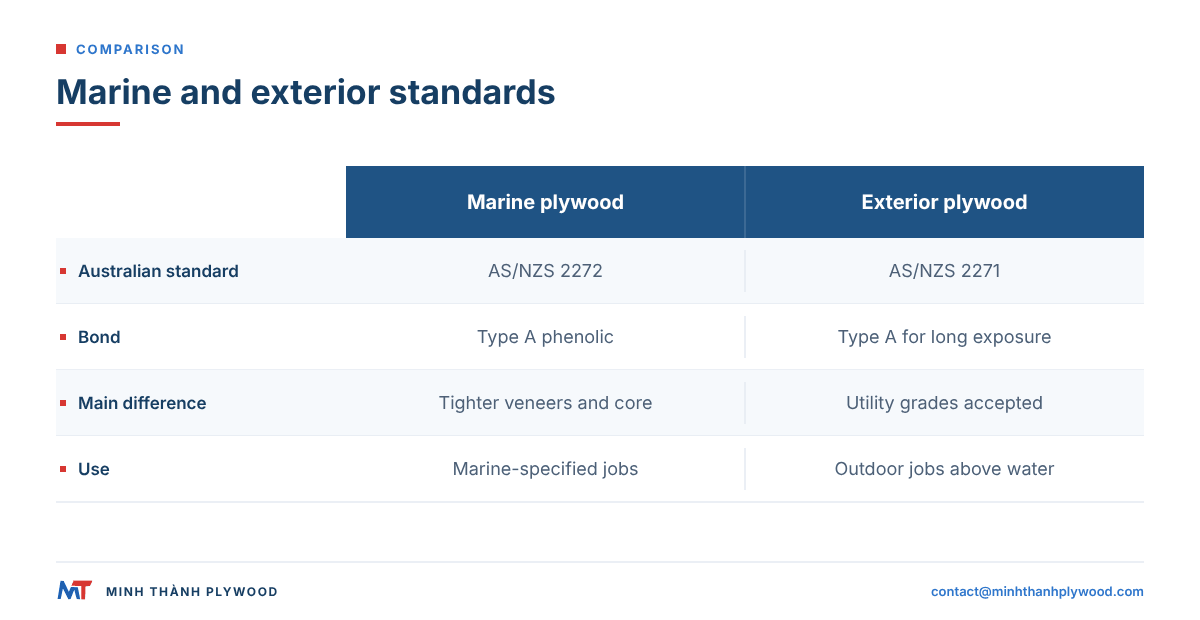
In Australia marine plywood is bonded with Type A phenolic glue, often called A-bond. AS/NZS 2272 covers marine plywood, with A and O face grades and tighter core veneers. AS/NZS 2271 covers exterior plywood, where Type A bond is specified for long-term exposure and Type B for up to two years of exposure.
| AU question | Answer |
|---|---|
| Marine plywood standard | AS/NZS 2272 |
| Exterior plywood standard | AS/NZS 2271 |
| Bond for long exposure | Type A (A-bond), phenol formaldehyde |
| What separates marine from exterior | Bond specification, veneer grade and core construction |
| Marine sheet price, 18 mm, 2400 × 1200 mm | about A$110–180 per sheet incl. GST (October 2026) |
An imported panel sold as marine is not a substitute for AS/NZS 2272 where the job names that standard; use exterior plywood for sheds, stairs, sheathing and signs, and a stamped marine panel for hulls. Australian chandlers and timber yards sell sheets at the prices above. An importer or builder buying by the container works from FOB Hai Phong, so ask for the glue, core and face on the quotation.
Why marine plywood, and what makes it different?
Marine plywood is a premium plywood made for boats and permanent wet use: durable hardwood veneers, phenolic WBP glue and no gaps or overlaps in the core. It is made to a marine standard such as BS 1088, and its price reflects the selected veneers.
- Glue: phenolic WBP, boil-resistant, the same bond type used in good exterior plywood.
- Veneers: durable species, such as okoume or meranti, selected for few defects.
- Core: no gaps where water can collect and rot can start.
- Faces: clear, sanded faces for painting and varnish.
Buyers look for alternatives when marine plywood is costly, hard to find, too heavy for the job, or more than the job needs. The marine plywood buying guide covers grades and standards.
What can be used instead of marine plywood?
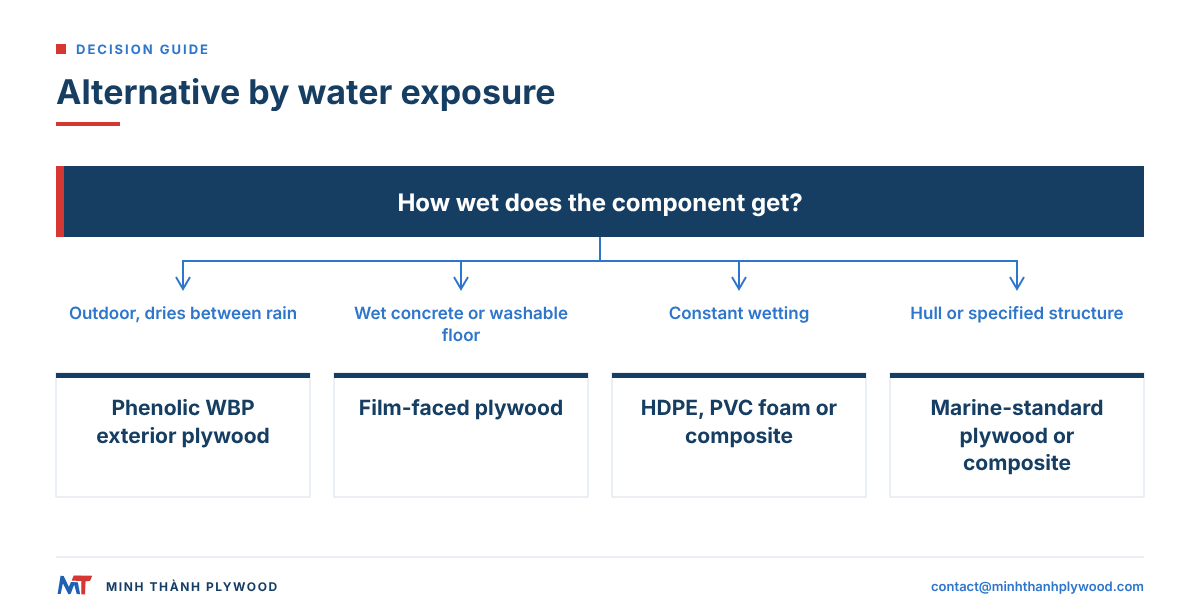
Exterior plywood with phenolic WBP glue can be used instead of marine plywood for most outdoor work that dries out between wettings. For parts that stay wet, a plastic, composite or aluminium panel replaces it. Choose by how long the part stays wet and whether it carries load.
- Exterior plywood (phenolic WBP): sheds, garden furniture, outdoor signs, stair treads, wall sheathing, roof decks under membrane.
- Film-faced plywood: concrete formwork, trailer and stage floors, site hoardings.
- Dense hardwood plywood with phenolic glue: truck beds, workbenches, dock surfaces above water.
- HDPE board: boat seats, hatches, fish-cleaning tables.
- PVC foam board: light boat interiors and cabinets.
- Composite and aluminium panels: decks, floors and parts below the waterline.
Water decides the choice: the longer a part stays wet, the further down this list it moves.
Exterior plywood: the honest alternative for outdoor jobs
Exterior plywood is the closest plywood alternative to marine plywood: it can carry the same phenolic WBP bond, at a lower price, because it accepts utility faces and standard core veneers. It is the right panel for outdoor jobs above water.
Minh Thanh supplies exterior and CDX-type plywood with utility C/D faces, white Styrax or Eucalyptus cores and water-resistant glue:
| Line | Exterior / CDX-type plywood from Minh Thanh |
|---|---|
| Faces | C/D utility face and back, matched to the order sample |
| Core | White Styrax or Eucalyptus |
| Glue | Melamine-fortified MR, pressed at 110–120 °C, or phenolic WBP, pressed at 130–145 °C |
| Thickness | 3–40 mm |
| Tolerance | ±0.5 mm thickness, ±2 mm length and width |
| Sizes | 1220 × 2440 mm, 1250 × 2500 mm, custom formats |
| Uses | Stair treads, wall sheathing, roof decks, sheds, outdoor joinery |
Order phenolic WBP glue for exterior exposure, and seal every cut edge and drilled hole. The CDX plywood vs ACX and BCX guide explains the face grades.
What is a cheaper alternative to marine plywood?
The cheapest sound alternative to marine plywood is exterior plywood with phenolic WBP glue. It keeps the bond that resists boiling water and saves on the face and core veneers, which are most of a marine panel’s price.
- Exterior plywood with phenolic glue: the best saving where the part dries out between wettings.
- Exterior plywood with melamine-fortified glue: lower again, for damp and humid uses rather than direct weather.
- Film-faced plywood: good value where a hard, washable face is needed.
Minh Thanh’s indicative starting price for commercial plywood is from US$250/m³ (October 2026); the final price depends on face, core, glue, thickness, size, quantity and delivery term. Savings stop where the job needs a marine panel: a hull or structure that must pass a marine standard.
What is a lightweight marine plywood alternative?
The lightweight marine plywood alternatives are PVC foam board, foam- or honeycomb-cored composite panels and aluminium. They cut weight in boat interiors, hatches and fit-out, where every kilogram counts.
- PVC foam board: light, rot-proof, easy to cut; less stiff, so it needs closer supports.
- Composite panels: fibreglass skins over foam or honeycomb; light and stiff, the costliest choice.
- Aluminium panels: light and strong; needs isolation from other metals in salt water.
- Light-core plywood: for dry cabin joinery, a white Styrax-core panel at about 500 kg/m³ weighs 26.8 kg for a 1220 × 2440 × 18 mm sheet; seal every edge.
Use the light-core plywood option only where the part stays dry; anything that takes spray or bilge water needs a plastic, composite or marine panel.
What is the best plastic alternative to marine plywood?
The best plastic alternative to marine plywood is marine-grade HDPE (high-density polyethylene) board for wet, exposed parts, with PVC foam board where weight matters more than strength.
| Property | HDPE marine board | PVC foam board | Marine plywood |
|---|---|---|---|
| Rot and delamination | Never | Never | Resists with sealed edges |
| Weight | Heavy | Light | Medium |
| Stiffness | Low, flexes on spans | Low | High |
| Gluing | Poor, fix mechanically | Good with the right adhesive | Good |
| Painting | Not needed, hard to paint | Paints well | Paints and varnishes well |
| Heat | Softens and moves with heat | Moves with heat | Stable |
Plastics win where water never leaves, such as seat lids, hatch covers and transom caps. Plywood wins where the panel must be stiff, glued into a structure or repaired on site.
What is better than marine plywood?
For permanent immersion with no maintenance, composites, HDPE and aluminium last longer than marine plywood. For stiffness per kilogram, ease of repair and cost, marine plywood still wins in hull and deck building.
- Composite panels: better for weight and immersion; cost far more and need skilled repair.
- Aluminium: better for impact and longevity; needs isolation against corrosion.
- HDPE: better for wet wear parts; worse for stiffness.
- Marine plywood: better for building and repairing structures with glue and epoxy.
“Better” depends on the job: a boatbuilder chooses marine plywood for the hull and a plastic or composite panel for the parts that never dry.
Substitute for marine plywood by job
The right substitute for marine plywood is set by the job, the water and the budget. This table gives the usual choice for common jobs.
| Job | Substitute for marine plywood | Notes |
|---|---|---|
| Garden sheds and outdoor storage | Exterior plywood, phenolic WBP | Paint faces, seal edges |
| Stair treads and outdoor steps | Exterior or anti-slip plywood | Anti-slip made on order |
| Wall and roof sheathing | Exterior / CDX-type plywood | Cover with cladding or membrane |
| Concrete formwork | Film-faced plywood | Phenolic glue, sealed edges |
| Trailer and stage floors | Film-faced or anti-slip plywood | Hard, washable face |
| Outdoor signs and hoardings | Film-faced or exterior plywood | Painted or printed face |
| Boat cabin joinery (dry) | Furniture plywood, sealed | Light Styrax core |
| Boat seats, hatches (wet) | HDPE or PVC foam board | Fix mechanically |
| Hull, transom, deck structure | Marine plywood or composite | Follow the boat’s standard |
| Docks above water | Dense phenolic plywood or composite | Treat and seal |
For decks and docks in ground or water contact, also read marine vs pressure-treated plywood.
Film-faced plywood: the alternative for formwork and floors
Film-faced plywood replaces marine plywood wherever a hard, washable, water-resistant face is needed: concrete formwork, trailer floors, stage floors and hoardings. Its phenolic film and water-resistant glue resist wet concrete and washing.
- Film: phenolic film, usually 120–135 g/m² for standard panels.
- Glue: melamine for standard reuse, phenolic for more pours.
- Reuse: set by the glue and site care; melamine panels are often reused about 12–15 times and phenolic panels up to about 25 times, with proper handling, release agent and edge sealing.
- Edges: painted at the mill; reseal after every cut.
- Tolerance: ±0.5 mm on film-faced panels.
For joinery, film-faced plywood on birch or eucalyptus faces gives a coloured, washable surface; the film colour is agreed against a sample before the order. Minh Thanh supplies film-faced plywood on order. Anti-slip plywood, with a textured film for floors, is also accepted on order.
Are there standards for marine and exterior plywood?
Yes. Marine plywood is made to marine standards such as BS 1088 in the UK. In the EU, CE marking is governed by the Construction Products Regulation (EU) No 305/2011. Exterior plywood in Europe is classed under EN 636. EN 636-3 covers exterior conditions, and CE-marked structural panels fall under EN 13986.
- BS 1088: marine plywood with durable veneers and no core gaps.
- EN 636-3: plywood for use in exterior conditions.
- EN 314-2 Class 3: the bond quality class for exterior plywood.
- Boil tests: check bond durability on the tested sample; they do not by themselves make a panel marine.
Name the standard the job needs on the order. Minh Thanh quotes the adhesive, core, face grade and bond test explicitly; CE is available*.
*Supplied directly or through qualified partner mills.
How do you protect a plywood alternative outdoors?
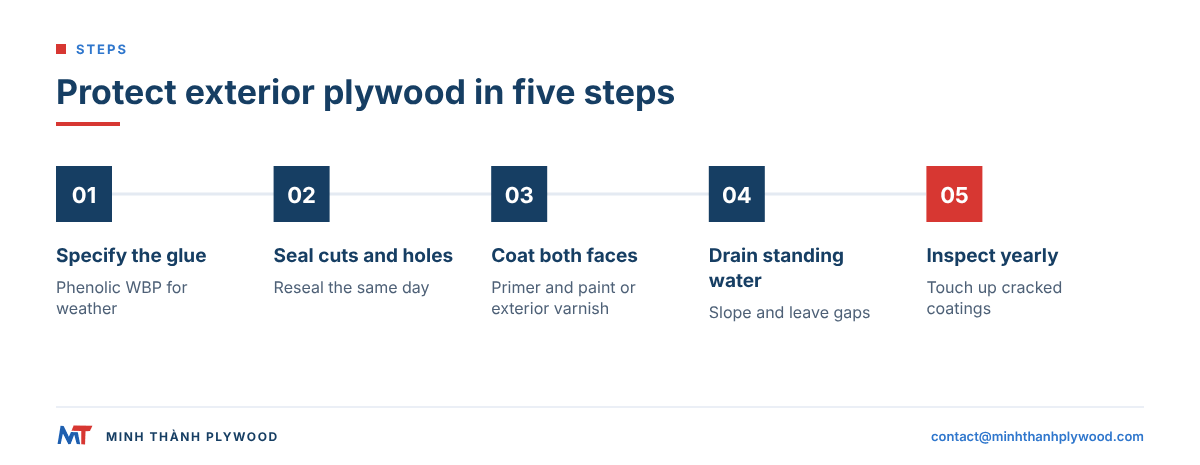
Seal every edge, hole and face, and keep water from standing on the panel; the glue protects the bond, and the finish protects the wood. These five steps add years to any exterior plywood.
- Order the right glue: phenolic WBP for weather, melamine-fortified MR for damp interiors.
- Seal cut edges and holes: paint, epoxy or edge sealer the same day the panel is cut.
- Coat both faces: primer and paint, or exterior varnish, on face and back.
- Shed water: slope surfaces, leave gaps for drainage and keep panels off the ground.
- Inspect yearly: touch up cracks in paint before water reaches the veneer.
Panels leave the mill at 8–12 % moisture content, so prime them soon after delivery.
How to order exterior plywood as a marine plywood alternative
Send six lines, and Minh Thanh Plywood replies within hours with a quotation and a free sample offer.
- Application and exposure: sheathing, stairs, sheds, formwork or floors, and how wet it gets.
- Core: white Styrax or Eucalyptus.
- Glue: phenolic WBP or melamine-fortified MR, with the bond test the job needs.
- Face and back: C/D utility faces, film or anti-slip film.
- Size and thickness: 1220 × 2440 mm or 1250 × 2500 mm, 3–40 mm.
- Packing and quantity: sheets per pack, total sheets or m³, and the destination port.
The minimum order is one 40HC; production takes 15–45 days after the 30% deposit, FOB Hai Phong, CFR or CIF. Send the lines to contact@minhthanhplywood.com or see exterior plywood from Minh Thanh.
Buyer questions, answered
What can be used instead of marine plywood?
Exterior plywood with phenolic WBP glue for outdoor jobs that dry out between wettings; film-faced plywood for formwork and floors; HDPE, PVC foam or composite boards and aluminium for parts that stay wet or sit below the waterline.
What is a cheaper alternative to marine plywood?
Exterior plywood with phenolic WBP glue. It has the same boil-resistant bond type at a lower price, because it accepts utility faces and standard core veneers instead of selected marine veneers.
Is exterior plywood the same as marine plywood?
No. Both can use phenolic WBP glue, but marine plywood adds selected durable veneers, no core gaps and a marine standard such as BS 1088. Exterior plywood suits outdoor work above water, not boat hulls.
What is a lightweight marine plywood alternative?
PVC foam board, honeycomb or foam-cored composite panels and aluminium are lighter than marine plywood for boat interiors and fit-out. For dry interior joinery on a boat, a light furniture plywood with sealed edges also works.
What is the best plastic alternative to marine plywood?
Marine-grade HDPE (high-density polyethylene) board for wet, exposed parts such as seats, hatches and transom covers. It never rots or delaminates, but it is heavier and less stiff than plywood and cannot be glued well.
Is marine plywood waterproof?
No. It is water-resistant: the phenolic glue survives soaking and boiling, but bare edges still take in water. In Australia marine plywood (AS/NZS 2272) uses Type A phenolic glue, while exterior plywood (AS/NZS 2271) can use Type A or Type B bonds; veneer grade and core construction also distinguish the products.
What is better than marine plywood?
For permanent immersion and no maintenance, composites, HDPE and aluminium last longer. For strength per kilogram, ease of repair and cost, marine plywood is hard to beat in boat hulls and decks.
Can I use exterior plywood for a boat?
Not for the hull or any part under the waterline. Exterior plywood can serve dry interior joinery and cabinets on a boat if all edges and holes are sealed.
Is film-faced plywood waterproof?
The film and the specified glue resist water well, which is why it is used for concrete formwork. Cut edges must be sealed, because water enters the core through bare edges.
Does Minh Thanh sell marine plywood?
Minh Thanh supplies exterior plywood with melamine-fortified or phenolic WBP glue and film-faced plywood. Order marine plywood to BS 1088 when a boat hull or marine approval calls for it.