
Curved ply, or molded plywood, is made by gluing thin veneers and pressing them in a shaped mould until the glue cures, so the part keeps the curve without kerfs or steam. Chairs, seat shells and curved panels are made this way. To order, send drawings, a mould plan, veneer and glue spec, and tolerances. Minh Thanh Plywood supplies the flat furniture panels that go with them.
What is molded plywood (curved ply)?
Molded plywood, also called curved ply or moulded plywood, is plywood pressed into a curved or three-dimensional shape in a mould while its glue cures. Once cured, the part holds the curve by itself: no kerfs, no steam and no fixings.
It is made from the same materials as flat plywood: thin wood veneers and a glue, laid in layers with the grain crossed where strength is needed. The difference is the press. Flat plywood is pressed between flat platens; curved ply is pressed between a male and a female mould, or with a membrane over a former, in the shape of the part.
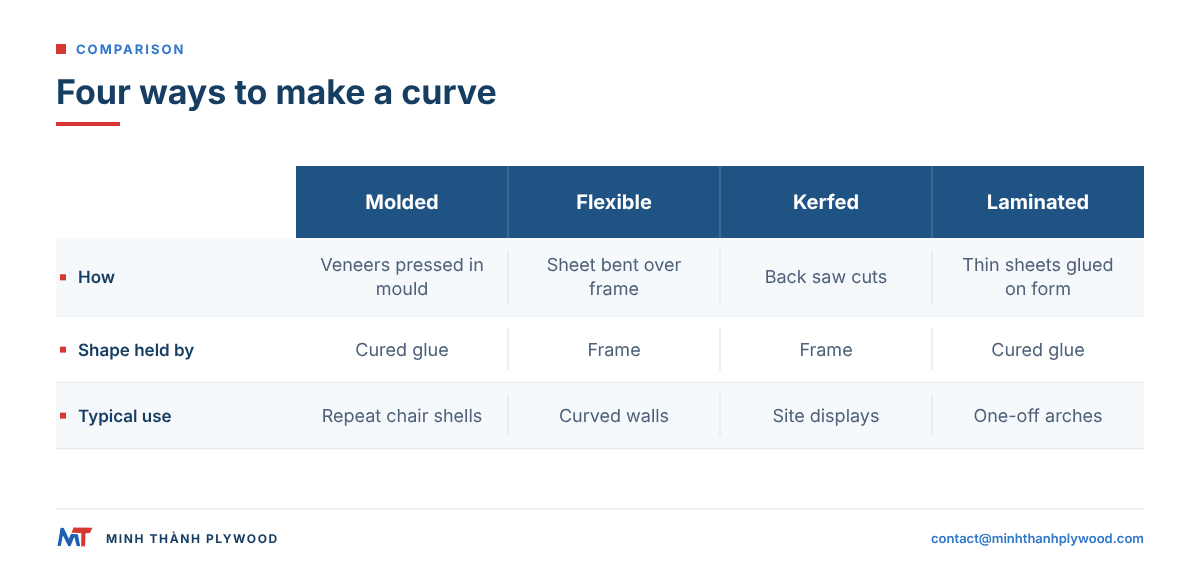
| Form | How it is made | Shape it holds | Typical uses |
|---|---|---|---|
| Molded plywood (curved ply) | Veneers glued and pressed in a mould | Fixed, repeatable curve or 3D shape | Chair seats and shells, backs, curved fronts, cases |
| Flexible plywood bent in place | Thin flexible sheet bent over a frame | Curve held by the frame | Curved walls, counters, columns |
| Kerfed plywood | Saw cuts across the back of a flat sheet | Curve held by the frame | Site work, displays |
| Laminated on a form | Several thin sheets glued on a former | Fixed curve | One-off parts, arches |
Curved ply is the right form when a furniture brand needs the same curve hundreds or thousands of times. The other forms suit site work and one-off shapes. See how to bend plywood for site methods.
Curved ply sheets: sizes, thickness and bend radius
If you need one curve or a few, buy flexible ply (flexi ply) by the sheet. UK merchants stock it as full 2440 × 1220 mm boards, in 5 mm and 8 mm, with the face grain either long or across the sheet; you bend it over ribs or a former and fix it there. Choose the grain by the direction of the bend, and order a sample first.
| Flexi ply sheet (2440 × 1220 mm) | Minimum radius quoted | Indicative UK price per sheet, ex VAT |
|---|---|---|
| 5 mm, long grain or cross grain | about 50 mm | about £22–£34 |
| 8 mm, long grain or cross grain | about 80 mm | about £35–£49 |
Radius and price depend on the supplier and lay-up, so treat the table as a guide and bend your own sample. The thinner sheet bends tighter. Flexi ply is not waterproof by default: ask for the glue type, and seal edges and faces before outdoor or bathroom use. Glue and screw it to the former at close spacing, with a second skin glued over it where the curve must be stiff. Delivery adds a flat fee in the UK, and a sample costs a few pounds.
Need the same curve 500 times or more? A sheet bent by hand will not repeat. Press it as molded plywood: the sections below cover moulds, veneers, tolerances and how to order.
How are molded plywood parts pressed?
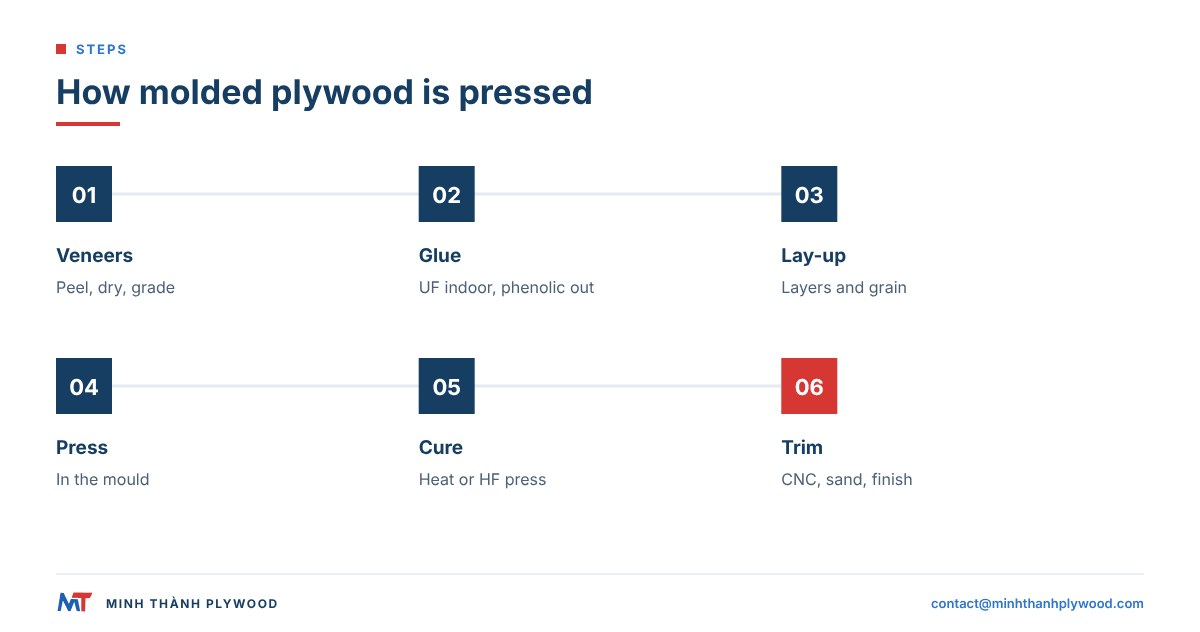
Molded plywood parts are pressed in six stages: veneer preparation, gluing, lay-up, pressing in the mould, curing and trimming. The list below breaks them into eight steps, with conditioning and sanding and finishing shown separately. Each step decides a property of the finished part.
- Veneer preparation. Veneers are peeled or sliced thin, dried and graded. Thin veneers follow the curve without cracking; the face veneers are chosen for the look.
- Gluing. Glue is spread on the inner veneers. Indoor furniture usually uses a urea-formaldehyde (UF) glue; exterior parts a phenolic or melamine-fortified glue.
- Lay-up. Veneers are stacked to the planned layer count and grain direction: crossed for stiffness, parallel along tight bends.
- Pressing. The stack goes into the mould and the press closes, holding the veneers to the shape under pressure.
- Curing. Heat cures the glue, from heated moulds or a high-frequency (radio-frequency) press that heats the glue line directly.
- Conditioning. Parts rest so moisture and stress even out before machining.
- Trimming and machining. A CNC router or trimming jig cuts the outline, holes and edges.
- Sanding and finishing. Parts are sanded, then lacquered, painted or upholstered.
The mould is the most expensive and slowest item in the first order. After it is approved, the same mould makes every repeat part.
Moulds: types, tooling and who owns them
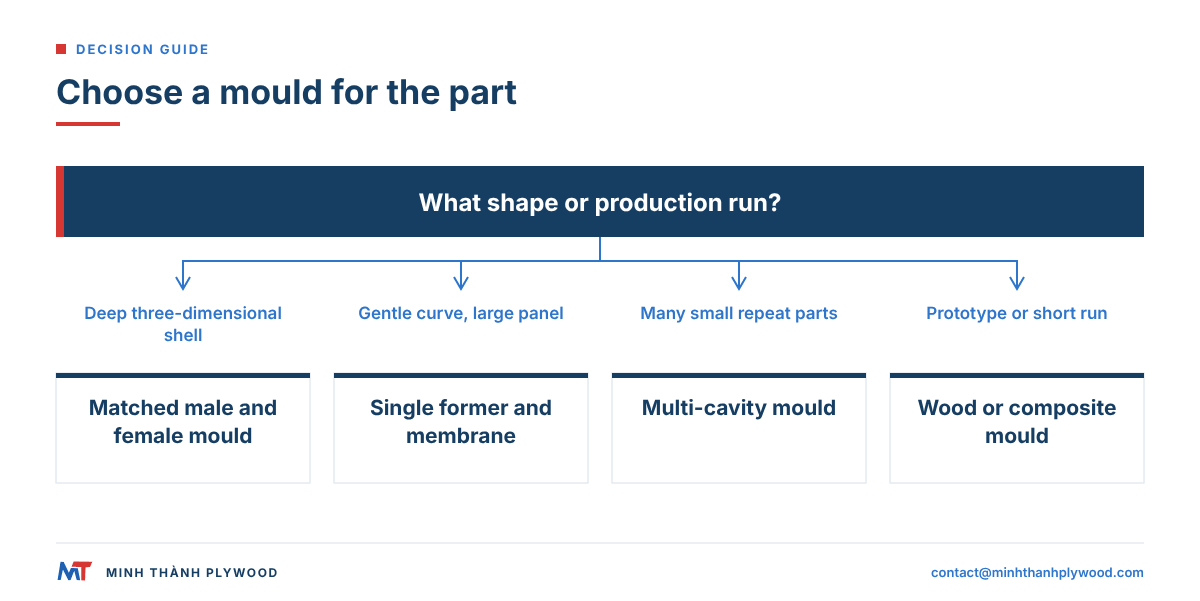
The mould decides the shape, the accuracy and part of the price of every molded plywood part. Most moulds are a matched male and female pair; some use one rigid former and a pressure membrane.
| Mould type | Best for | Notes |
|---|---|---|
| Matched male and female mould | Seat shells, backs, deep 3D parts | Most accurate, highest tooling cost |
| Single former with membrane or bag | Gentle curves, larger panels | Lower tooling cost |
| Multi-cavity mould | High volumes of small parts | Several parts per press cycle |
| Heated aluminium or steel mould | Fast cycles, long runs | Durable, costly |
| Wood or composite mould | Prototypes, short runs | Cheaper, wears faster |
Agree three points in writing before tooling: who pays for the mould, who owns it, and where it is kept between orders. A mould you own can move with you if you change supplier.
Veneer, glue and grain in curved ply
The veneer count, grain layout and glue decide how stiff, light and stable a curved ply part is. Thin veneers bend more easily; more layers add stiffness; crossed grain stops the part splitting along the curve.
- Veneer species. Beech and birch are classic for chair shells; poplar is lighter. Faces can be any decorative veneer the look needs, from oak to engineered veneer.
- Grain layout. Layers crossed at right angles give stiffness both ways. Layers parallel to a tight bend follow it without cracking.
- Balance. The build is symmetric about its middle layer, so the part does not twist after release.
- Glue. UF glue for indoor furniture, phenolic or melamine-fortified for exterior use. UF glue at E0 emission is the low-emission interior choice.
- Moisture. Veneers dried to a controlled moisture content keep the part’s shape after release. For flat furniture plywood, 8–12 % at dispatch is the normal range.
Glue and emission class are two separate lines on a specification: UF is the resin, E0 the emission class. Bond quality is set in EN 314-2, and EN 636 covers plywood for dry, humid or exterior conditions. Ask for the resin and the emission class, and for chamber test results if the part is sold in the US or the EU.
Bent plywood furniture: chairs, seats and shells
Bent plywood furniture uses molded plywood for the parts that carry the curve: chair seats and backs, seat shells, lounge chair frames, curved legs and armrests. A molded plywood chair is light and stiff because its shell is a curved laminate.
| Part | Typical shape | What to specify |
|---|---|---|
| Seat and back of a bent plywood chair | Single or double curve | Layer count, face species, edge finish |
| Molded plywood chair shell | Deep 3D shell | Matched mould, veneer thickness, upholstery fixings |
| Lounge chair frame | Long curves | Layer count, glue, test load |
| Curved legs and runners | Tight single curves | Grain parallel to the bend |
| Curved cabinet fronts and doors | Gentle curve | Face veneer match with flat panels |
Strength is proven on the finished part, not by the species. Ask the moulder for load test results on the part itself, to the standard your market uses for seating.
Curved plywood furniture vs flat plywood shaped by CNC
Curved plywood furniture gets its curve from the mould; flat plywood furniture gets its curves from cutting. Many ranges combine both: moulded seats and backs on CNC-cut flat frames, tables and cabinets.
- Molded parts: curves in the thickness of the part, a light shell, mould cost up front.
- CNC-cut flat parts: curves only in the outline, no mould, fast to change.
- Stacked or laminated flat parts: thick curved forms cut from glued-up flat plywood, with visible layers as a design feature.
For flat CNC-cut furniture, the sheet’s calibration, closed core and edge look matter most. See best plywood for furniture for the flat-panel choices.
Can plywood be curved? How to curve plywood on site
Yes, plywood can be curved: on site, use flexible plywood over curved ribs, laminate thin sheets over a form, or kerf the back of a flat sheet. Standard flat plywood cracks if it is bent tighter than its thickness and build allow.
How to curve plywood, by method:
- Flexible plywood. Choose a long-grain or cross-grain flexible sheet for the direction of the bend, and bend it over ribs or studs set close together. See flexible plywood.
- Laminating thin sheets. Bend two or three thin plywood sheets one over another on a curved form, with glue between them, and clamp until cured.
- Kerfing. Cut parallel saw kerfs across the back of a flat sheet so it closes around the curve; fill or cover the back.
- Wetting and bending. Thin sheets bend further when damp, then dry on the form; this suits gentle curves only.
How to frame a curved wall with plywood: cut the curved top and bottom plates from plywood, set studs close together along the curve, then bend flexible plywood or two thin layers over the studs with staggered joints. How to cut curves in plywood: use a jigsaw or band saw with a fine blade, or a CNC router for repeated shapes, and sand the edge smooth.
Tolerances and quality checks for molded parts
Molded plywood parts are checked against the mould, not against a flat-sheet tolerance: shape, thickness, layer bond, face quality and moisture. Agree each check and its limit with the moulder before the first order.
| Check | How it is done | What to agree |
|---|---|---|
| Shape | Part placed on a checking fixture or measured against the 3D drawing | Allowed deviation at key points |
| Thickness | Caliper at marked points | Nominal thickness and tolerance; sanded furniture panels hold ±0.2–0.3 mm, other grades ±0.5 mm |
| Bond | Visual check of edges, boil or soak test for exterior glue | Test method and pass criteria |
| Spring-back | Shape measured after conditioning | Allowed change after release |
| Face | Visual check under even light | Face grade, allowed defects, colour match |
| Moisture | Moisture meter on parts | Range at dispatch, for example 8–12 % |
| Emission | Chamber test for the market | Method and limit: E0 under EN 717-1 on request, CARB P2 / TSCA Title VI for the US |
Approve a first batch of parts on these checks, keep reference parts at both ends, and inspect each later batch against them.
How to choose a molded plywood manufacturer
Choose a molded plywood manufacturer on its moulds, presses and finished parts in your product type, not on its flat-panel price list. A short checklist separates real moulders from traders:
- Own presses and moulds: heated or high-frequency mould presses on the factory floor, seen on a video call or visit.
- Parts like yours: seat shells, backs or curved panels already in production, with photos and samples.
- Mould workshop: in-house or a named mould maker, and a clear tooling quote.
- Glue and emission documents: the glue used, its emission class and test reports for your market.
- Test results on parts: load tests on seating, bond tests on exterior parts.
- Finishing: sanding, lacquer or upholstery fixings in-house or arranged.
- Packing: nested or separated parts, protected edges, packs that survive a container.
For the flat panels in the same range, a specialist flat-panel mill gives the best calibration and face match. See how to choose a plywood supplier in Vietnam.
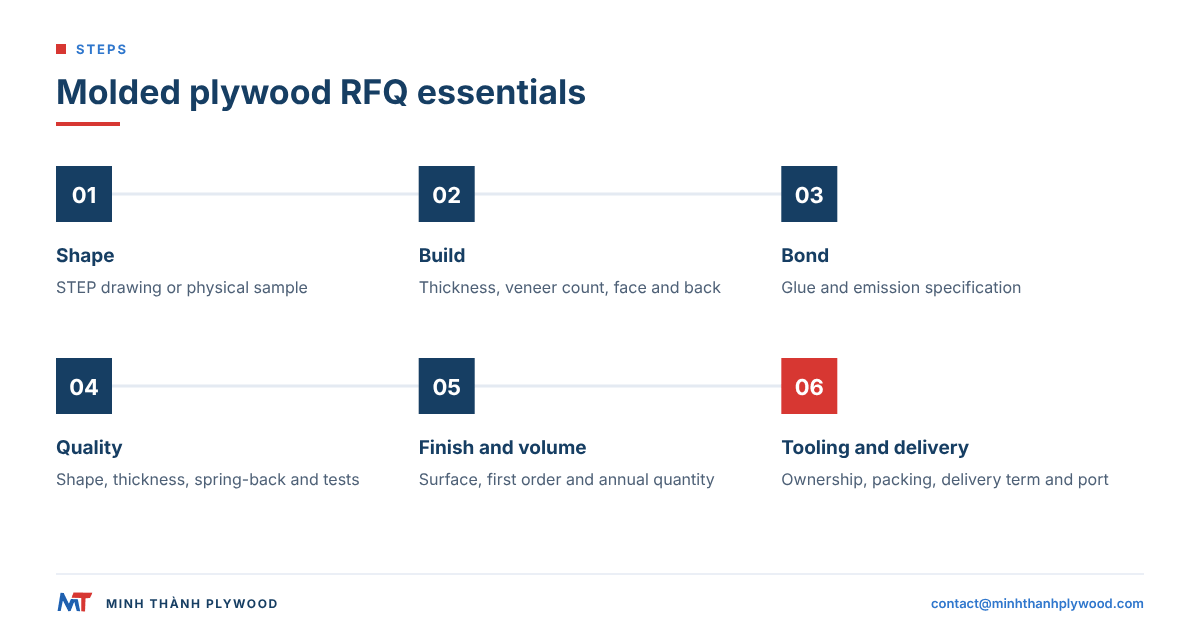
What a furniture brand sends for a molded plywood RFQ
A molded plywood manufacturer can quote only from a complete RFQ: the part’s shape, build, finish and volume. Send these with your request:
- 3D drawings (STEP or similar) or a physical sample of the part.
- Part thickness and preferred number of veneers.
- Face and back: species, cut and grade; colour match to flat panels if the range has them.
- Glue and emission: for example UF glue at E0 emission for indoor furniture, phenolic for exterior.
- Tolerances: shape, thickness and spring-back limits.
- Finish: raw sanded, lacquered, painted or upholstered.
- Volumes: first order and annual quantity, which decides the mould type.
- Mould ownership: who pays, who owns, where it is stored.
- Tests and documents: load tests, emission reports, origin documents for EU or US import.
- Packing and delivery: parts per carton or pallet, delivery term and port.
A complete RFQ gets a comparable quote from every moulder you ask, so price differences show the real build and tooling.
Terms, samples and lead times for molded parts
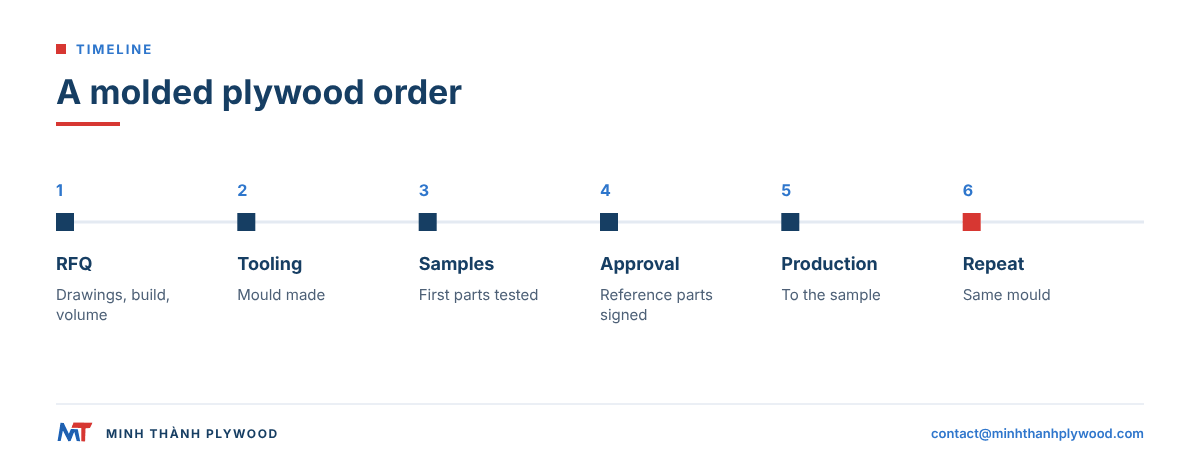
Molded plywood orders have one more step than flat-panel orders: the mould. The first order covers tooling, sample parts and approval; repeat orders run from the approved mould.
| Stage | What happens | What to agree |
|---|---|---|
| Quote | Part price and tooling price | Price per part by volume, tooling separately |
| Tooling | Mould made to your drawings | Mould ownership and storage |
| First samples | Parts pressed from the new mould | Number of samples, test plan |
| Approval | Samples checked and tested | Signed reference parts |
| First order | Production to the approved sample | Payment terms, inspection before loading |
| Repeat orders | Same mould, same build | Shorter lead time than the first order |
For flat furniture plywood in the same range, Minh Thanh’s terms are one 40HC minimum with mixed specifications by agreement, production in 15–45 days after the 30% deposit, and the 70% balance against the scanned B/L or an irrevocable L/C at sight.
Flat furniture plywood that goes with molded parts
A molded chair range usually needs flat panels too: table tops, cabinets, benches, frames and backs. Minh Thanh Plywood makes the flat furniture plywood for that side of the range, built for top-grade furniture with Europe as its main market.
- Faces: 10+ face veneers, most produced engineered veneer (EV), poplar, birch, okoume and pine; bintangor, eucalyptus, gurjan, sapele and others on request. Faces are chosen for the look the buyer orders, so flat panels can match the moulded parts.
- Cores: white Styrax or Eucalyptus as standard, with core layers stitched both horizontally and vertically.
- Pressing: furniture-grade panels are pressed twice: the core board is pressed and calibrated, then face and back are pressed on.
- Tolerance: sanded furniture panels at ±0.2–0.3 mm, down to ±0.2 mm.
- Glue and emission: UF glue at E0 emission as standard; CARB P2 / TSCA Title VI certified (ICTT mill no. 23024). The limit for veneer-core hardwood plywood is 0.05 ppm under 40 CFR 770.10.
- Thin plywood: 3–5 mm, always five plies, for backs, drawer bottoms and light parts. See thin plywood.
For outdoor furniture frames, exterior plywood uses melamine-fortified or phenolic (WBP) glue.
What this means for your order
For a range that combines molded and flat plywood, order both to one face specification so the parts match on the shop floor and in the showroom. Write these lines for the flat panels:
- Use: furniture carcasses, tops or frames beside molded seats and backs.
- Face and back: species and grade matched to the molded parts, approved on a sample.
- Core: white Styrax or Eucalyptus.
- Glue and emission: UF glue at E0 emission; MR or WBP for damp or exterior parts.
- Thickness and tolerance: for example 18 mm at ±0.2 mm.
- Size: 1220 × 2440 mm, 1250 × 2500 mm, a custom size or cut-to-size pieces.
- Moisture: 8–12 % at dispatch.
Minh Thanh sends free samples of the flat build, so your design team can match faces to the molded parts. Send your specification to [email protected], and read hardwood plywood for face and core choices across the range.
Buyer questions, answered
What is molded plywood?
Molded plywood is plywood pressed into a curved or three-dimensional shape in a mould while the glue cures. The cured part holds its shape without kerfs, steam or fixings.
Can plywood be curved?
Yes, in three ways: press thin veneers in a mould (molded plywood), bend a flexible plywood sheet over a frame, or kerf the back of a standard sheet. Molded plywood holds the tightest, most repeatable curves.
How do you curve plywood at home or on site?
Use flexible (bendable) plywood over curved ribs, laminate two or three thin sheets with glue over a form, or cut kerfs across the back of a sheet. Standard flat plywood cracks if bent tighter than its thickness allows.
How do you frame a curved wall with plywood?
Cut curved top and bottom plates from plywood, fix studs close together along the curve, then bend flexible plywood or two thin layers over the studs. Fix each layer with staggered joints.
What is the difference between molded and bent plywood?
Molded plywood is pressed into shape from veneers in a mould and keeps it after curing. Bent plywood often means a flat or flexible sheet bent into place and fixed there; it springs back if released.
What glue is used for molded plywood?
Urea-formaldehyde (UF) glue is the common choice for indoor furniture, often cured by heat or high-frequency presses. Exterior parts use phenolic or melamine-fortified glues. Glue and emission class are separate specifications.
What do I need to send a molded plywood manufacturer for a quote?
3D drawings or a sample, part thickness and number of veneers, face species and grade, glue and emission class, tolerances, finish, annual volume and who owns the mould.
Are molded plywood chairs strong?
Yes. A molded seat or shell is a curved laminate with cross-grain layers, so it is stiff and light. Strength depends on the layer count, the grain layout and the glue, tested on the finished part.
How long does a molded plywood order take?
The first order takes longest because the mould has to be made and the first parts approved. Repeat orders run from the approved mould and sample.
Can a flat plywood mill supply panels for a molded plywood chair range?
Yes. Seats and backs are moulded, while tables, cabinets and frames in the same range use flat furniture plywood. Order both to the same face species and grade so the range matches.