
Phenolic coated plywood is plywood with a phenolic resin film pressed onto its faces, giving a hard, smooth, water-resistant surface for concrete formwork, floors and work surfaces. Most of the world sells it as film-faced plywood. Minh Thanh Plywood makes it in Vietnam on Eucalyptus or Acacia cores; this guide maps the names, the glue and film choices and the lines to write on your order.
What is phenolic coated plywood?
Phenolic coated plywood is plywood faced on one or both sides with paper impregnated with phenolic resin, pressed on under heat until the resin cures into a hard, smooth film. The film sheds water, resists abrasion and releases concrete cleanly. It is the panel most of the world buys as film-faced plywood.
“Phenolic coated” describes the surface, not the inside of the board. Under the film sits a normal cross-laid plywood: a core of hardwood or birch veneers glued together. The film decides the surface finish and its wear; the core and the glue decide strength, flatness and how long the board survives wetting.
That split matters when you compare quotes. Two sheets with the same brown film can have very different cores and bonds, and so very different service lives. A complete order names the film, the core and the glue on separate lines.
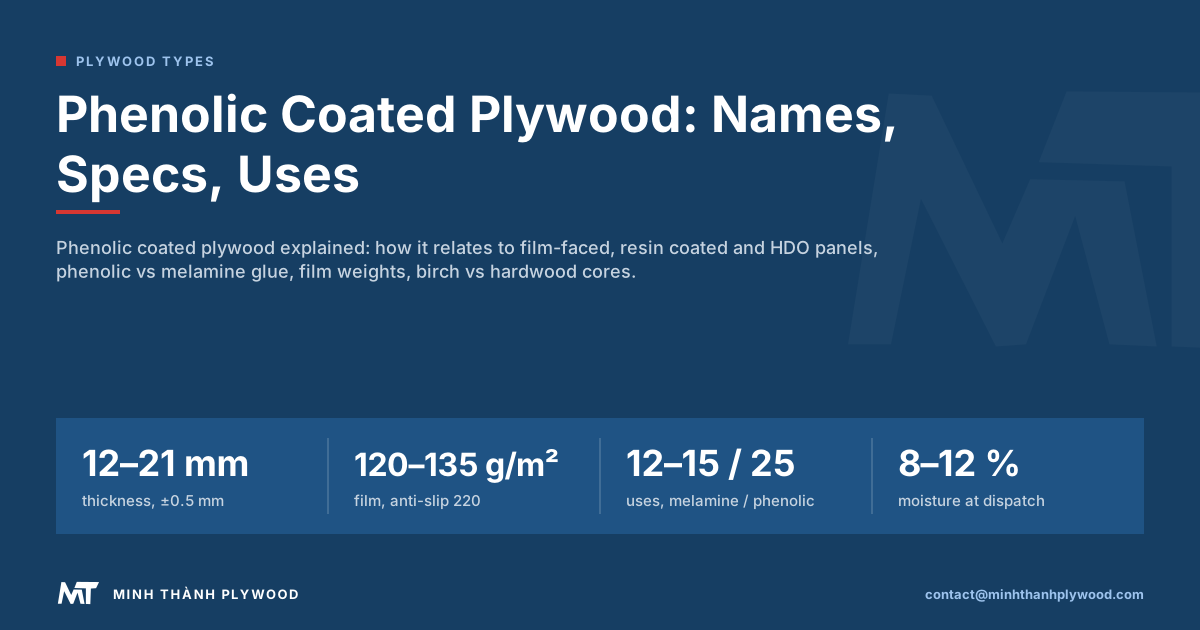
Minh Thanh Plywood makes phenolic coated plywood, sold as film-faced plywood, in Vietnam: 12–21 mm thick, on Eucalyptus or Acacia cores, with a melamine-fortified or phenolic WBP bond.
Phenolic coated, film faced, resin coated, HDO: which names mean the same panel?
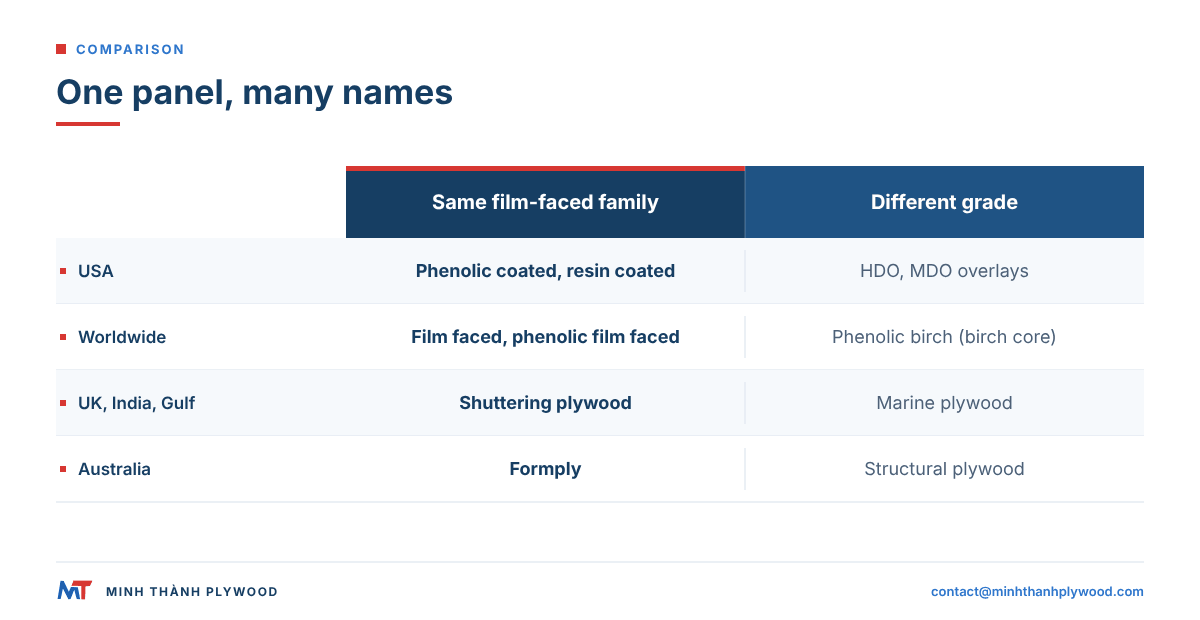
Phenolic coated plywood, phenolic film faced plywood, film faced plywood, shuttering plywood and formply all name one product family: plywood with a phenolic film surface. Resin coated plywood usually means the same. HDO is different: a US overlay grade with resin content set by its own grading rules.
The names change by market, so a buyer in Texas and a buyer in Dubai can be asking for the same sheet. This table maps the common names to one specification.
| Name used | Where you hear it | What it usually means |
|---|---|---|
| Phenolic coated plywood | USA, Canada | Plywood with phenolic film on both faces |
| Phenolic film faced plywood | International trade | Same panel, name stresses the film |
| Film faced plywood | Worldwide | Same panel; the most common export name |
| Resin coated plywood | USA, general trade | Usually the same; check whether film or a sprayed resin coat |
| Shuttering plywood | UK, India, Middle East | Film-faced plywood for concrete shuttering |
| Formply | Australia | Film-faced plywood for formwork, often to a stress grade |
| Concrete form plywood | USA | Formwork panel; can mean film-faced or an HDO or MDO overlay |
| HDO plywood | USA | High-density overlay with a set minimum resin content |
| Phenolic birch, phenolic baltic birch plywood | Europe, USA | Birch-core plywood with phenolic film |
| Siebdruckplatte | Germany | Phenolic-coated plywood with a wire-mesh anti-slip face |
When a request says “concrete coated plywood” or “resin coated plywood sheets”, read it as a formwork or wear panel and confirm three lines: film weight, core species and glue. Our HDO vs MDO plywood guide covers the US overlay grades in detail.
How is phenolic coated plywood made?
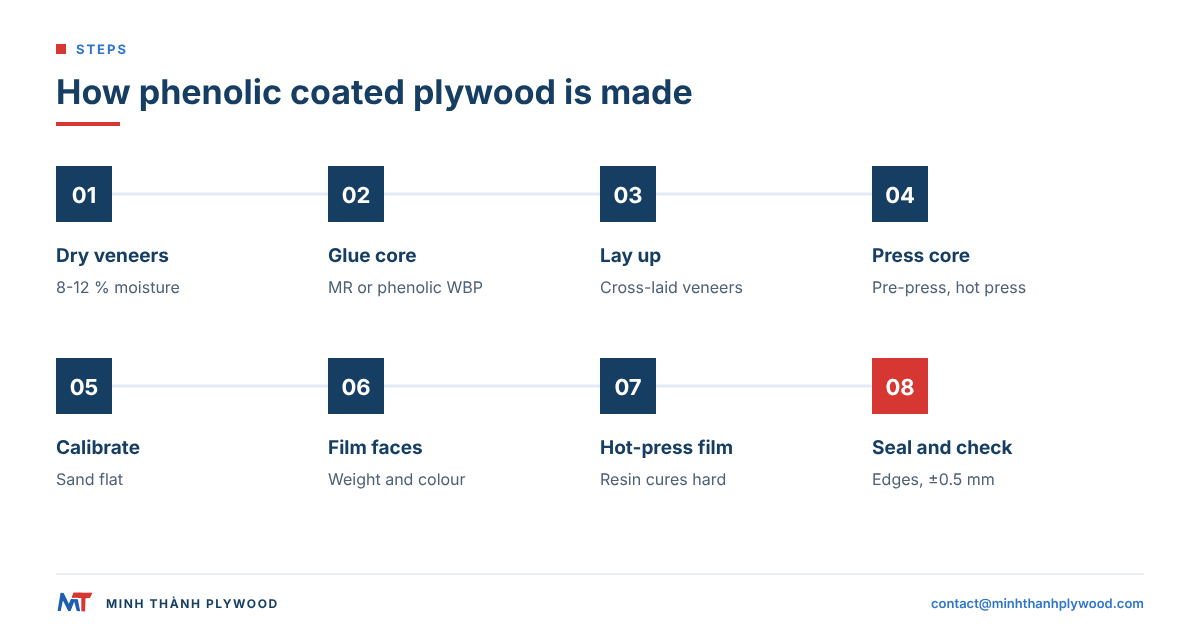
Phenolic coated plywood is made in two stages: first a plywood core board, then the phenolic film pressed onto both faces. The film is a paper sheet already impregnated with resin; heat and pressure cure it into the surface. These are the steps on a film-faced line:
- Dry the veneers to 8–12 % moisture, the normal range before gluing.
- Spread the glue on the core veneers: melamine-fortified or phenolic WBP, as ordered.
- Lay up the core with each veneer at right angles to the next.
- Pre-press and hot-press the core into a solid board.
- Sand and calibrate the core, so the film sits on a flat, even surface.
- Lay the film on face and back, at the ordered weight and colour.
- Hot-press the film, curing the resin into a hard, smooth skin.
- Trim and seal the edges with water-resistant paint.
- Inspect thickness and face before packing; our film-faced panels are held to ±0.5 mm.
The core stage decides most of the quality. A calibrated core gives a film face without dips, so concrete comes out flat; a core with gaps telegraphs through the film and shortens the panel’s life.
Phenolic glue vs melamine glue: which bond goes inside?
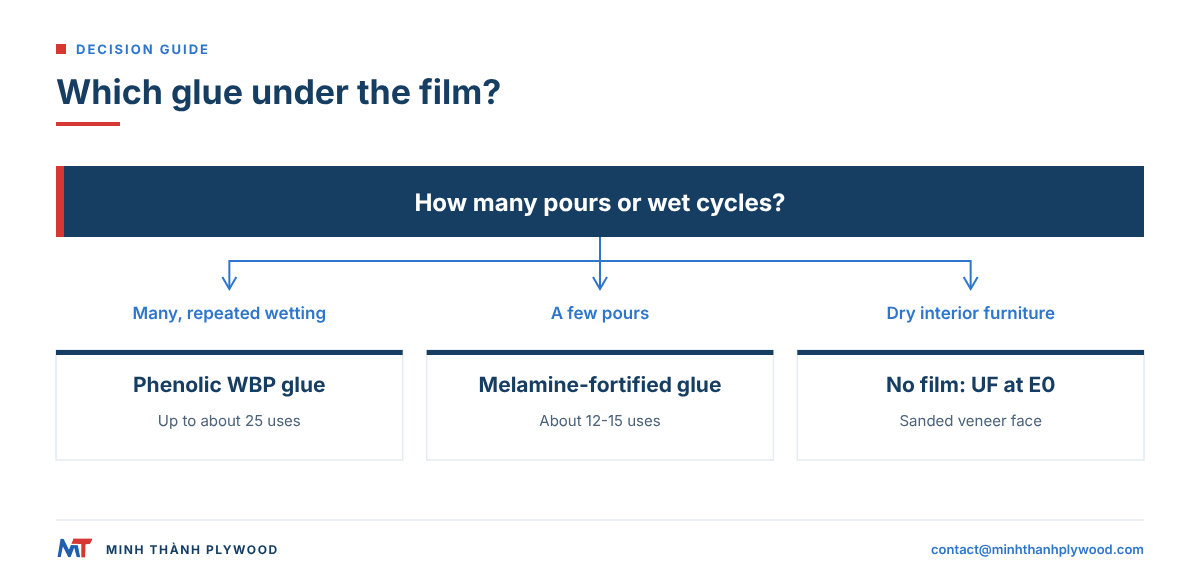
Phenolic glue gives the most water-resistant bond and the most reuses; melamine-fortified glue costs less and suits fewer pours. Both are used under phenolic film. The film is the same either way, so the glue line on the quote tells you which panel you are buying.
| Property | Melamine-fortified glue (MR) | Phenolic glue (WBP) |
|---|---|---|
| Water resistance | Good for humid conditions and limited wetting | Weather- and boil-proof; for repeated wetting |
| Formwork reuse, film-faced | About 12–15 uses | Up to about 25 uses |
| Glue line colour | Light | Dark reddish-brown |
| Cost | Lower | Higher |
| Typical order | Fewer pours, budget projects | Repeated pours, outdoor exposure |
Reuse counts hold with proper handling, release agent and edge sealing. For furniture panels the choice is different: UF glue at E0 emission is our standard for dry interiors, with melamine-fortified and phenolic bonds made to the customer’s specification. Glue type and emission class are two separate lines on the order.
Does phenolic glue make plywood darker?
Phenolic glue makes the glue lines darker: phenolic resin cures a dark reddish-brown, so the edge of a phenolic-bonded panel shows dark lines between the plies. On phenolic coated plywood this does not matter, because the film covers the faces. On clear-finished furniture it can matter.
A thin face veneer over a phenolic glue line can also take on a darker tone, especially with light faces such as poplar or birch. That is one reason furniture makers who want a pale, clear face choose UF glue at E0 emission or a melamine-fortified bond instead.
For a phenolic coated sheet, the dark edge is a quick check: cut a sample and look at the glue lines. A light glue line under a brown film usually means a melamine-fortified bond, which is a valid product but a different one from phenolic WBP.
Why is phenolic glue plywood more expensive than melamine?
Phenolic glue plywood costs more because phenolic resin costs more than melamine-fortified resin, and because phenolic-bonded panels are usually built on better cores for longer service. The buyer pays for more reuses and stronger water resistance, not just for the glue.
The price gap is worth paying when the panel will be wetted many times. On a site that pours the same wall form over and over, a panel that lasts up to about 25 uses can cost less per pour than a cheaper one that lasts about 12–15. On a one-off pour, or a crate that sees one wetting, the melamine-fortified panel is the better buy.
Compare quotes per accepted use rather than per sheet: divide the sheet price by the number of pours you expect from it.
Film weight and colour: what do 120, 135 and 220 g/m² mean?
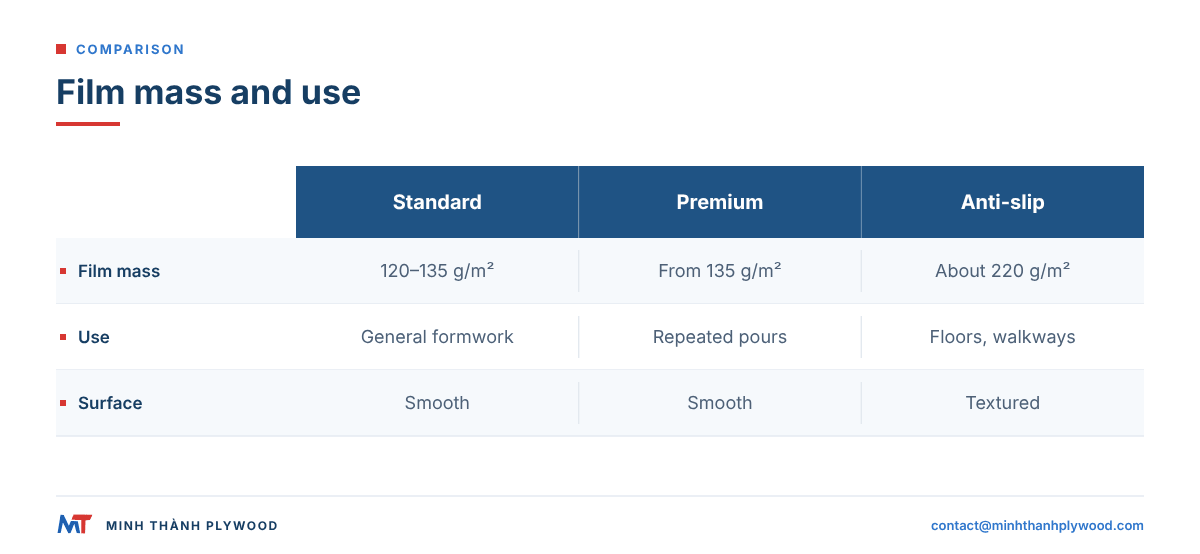
Film weight is the mass of the phenolic paper per square metre of face. Standard film is about 120–135 g/m², premium film starts at 135 g/m², and anti-slip film is about 220 g/m². A heavier film gives a thicker, harder skin and usually more reuses.
| Film | Weight | Typical use |
|---|---|---|
| Standard smooth film | About 120–135 g/m² | General formwork, crates, temporary works |
| Premium smooth film | From 135 g/m² | Repeated pours, fair-faced concrete |
| Anti-slip film (wire-mesh, hexagon, rice grain) | About 220 g/m² | Floors, trailer beds, platforms, walkways |
Colour is an order line, not a grade. Brown and black are the usual colours; other colours are chosen by the buyer for branding or to tell panel types apart on site. The film maker, weight and colour all belong on the order.
Our anti-slip plywood is made on order with a hexagon or rice and mesh film of about 220 g/m² on the face and smooth film on the back.
Phenolic baltic birch plywood vs hardwood-core film-faced plywood
Phenolic baltic birch plywood is birch plywood from the Baltic region with phenolic film on its faces; hardwood-core film-faced plywood uses Eucalyptus, Acacia or mixed hardwood veneers under the same film. Birch cores are denser and stiffer with many thin plies; hardwood cores are the usual choice for concrete formwork.
| Property | Phenolic coated baltic birch plywood | Hardwood-core film-faced plywood |
|---|---|---|
| Core | Birch veneers throughout | Eucalyptus, Acacia or mixed hardwood |
| Typical colours | Brown or black film | Brown or black film |
| Typical uses | Trailer and truck floors, stage decks, playground parts, workshop tops | Wall and slab formwork, beam and column forms, crates |
| Where it is made | Birch-growing regions | Vietnam and other hardwood regions |
| Order from Minh Thanh | Not made: Vietnam has no birch cores | 12–21 mm, Eucalyptus or Acacia core |
Black phenolic baltic birch plywood is popular for stages, displays and vehicle floors where a dark, hard surface looks finished. If the job is formwork, a hardwood-core panel with the right film and phenolic glue does the work. If the job needs a birch-core panel, buy one: no Vietnamese mill makes birch-core plywood, and a Vietnamese panel sold as “birch” will have a birch face on a different core.
We do make birch-faced plywood for furniture, on Styrax or Eucalyptus cores. It is a furniture panel, not a phenolic coated one.
Which jobs suit phenolic coated plywood?
Phenolic coated plywood suits jobs that need a hard, smooth, washable surface that stands up to water: concrete formwork first, then floors, platforms and work surfaces. The film releases concrete, sheds water and takes knocks that would mark a bare veneer.
- Concrete formwork: wall, slab, beam and column forms, where the film face gives smooth concrete.
- Scaffold boards and site platforms, often with anti-slip film.
- Trailer, truck and van floors, usually with anti-slip film on the face.
- Hoardings and site fencing, where a dark film looks tidy and wipes clean.
- Crates and reusable transport packaging for heavy or wet goods.
- Work surfaces and benches in workshops and factories.
For interior furniture, phenolic film is the wrong surface; a sanded veneer face with UF glue at E0 emission is the usual panel. For marine hulls, a marine-standard panel is needed; our comparison of film-faced and marine plywood explains the difference.
How many times can phenolic coated plywood be reused?
Phenolic coated plywood with a melamine-fortified bond gives about 12–15 uses, and with a phenolic WBP bond up to about 25, with proper handling, release agent and edge sealing. The count is a target for the build and the site, not a fixed property of the sheet.
Five things set the real number on site:
- Glue: phenolic WBP survives more wet cycles than melamine-fortified glue.
- Film weight: premium film from 135 g/m² wears more slowly than standard film.
- Release agent: applied before every pour, it stops concrete sticking to the film.
- Edges and holes: cut edges and tie holes must be sealed, or water gets into the core.
- Handling and storage: panels stacked flat, off the ground and covered last longer than panels dropped and left in rain.
A panel retires when the film wears through, the edges swell or the face no longer leaves a clean concrete finish. Writing the expected use on the order lets the mill match glue, film and core to that number.
Which thicknesses, sizes and tolerances can you order?
Order phenolic coated plywood by thickness, sheet size and tolerance on separate lines. We make film-faced plywood 12–21 mm thick in 1220 × 2440 and 1250 × 2500 mm sheets, with ±0.5 mm thickness tolerance and ±2 mm on length and width, at 8–12 % moisture when it leaves the factory.
| Specification | Minh Thanh film-faced plywood |
|---|---|
| Thickness | 12–21 mm |
| Sheet sizes | 1220 × 2440 mm; 1250 × 2500 mm |
| Thickness tolerance | ±0.5 mm |
| Length and width tolerance | ±2 mm |
| Core | Eucalyptus or Acacia |
| Glue | Melamine-fortified or phenolic WBP |
| Film | About 120–135 g/m² standard; premium from 135 g/m²; anti-slip about 220 g/m² |
| Moisture at dispatch | 8–12 % |
| Edges | Sealed with water-resistant paint |
US buyers read the same panel in inches and pounds: a 4 x 8 ft sheet is 1220 × 2440 mm, and the thicknesses convert to 1/2 in (12 mm), 5/8 in (15 mm), 3/4 in (18 mm) and 13/16 in (21 mm). With a Eucalyptus core at about 650 kg/m³ the sheet weights are:
| Thickness | US size | Sheet weight, kg | Sheet weight, lb | Weight per m² |
|---|---|---|---|---|
| 12 mm | 1/2 in, 4 x 8 ft | 23.2 kg | 51 lb | 7.8 kg/m² |
| 15 mm | 5/8 in, 4 x 8 ft | 29.0 kg | 64 lb | 9.8 kg/m² |
| 18 mm | 3/4 in, 4 x 8 ft | 34.8 kg | 77 lb | 11.7 kg/m² |
| 21 mm | 13/16 in, 4 x 8 ft | 40.6 kg | 90 lb | 13.7 kg/m² |
For comparison, a US maker lists a 12 mm hex-film Baltic-birch-type sheet at 34 lb (5.18 kg/m²) and an 18 mm sheet at 57 lb (about 8.7 kg/m²), which are lighter lightweight-core panels; our sheets weigh more and are built for site wear. Small US stock sizes such as 24 x 48 in cut-to-size panels come from US retailers; a 40HC order is full 1220 × 2440 or 1250 × 2500 mm sheets, with indicative commercial plywood from US$250/m³ FOB Hai Phong (October 2026) and the film and glue priced on top.
18 mm is the most common formwork thickness; 12 and 15 mm suit curved or light forms and linings, and 21 mm suits heavy slab work. Our guide to film-faced plywood sizes and thickness covers the regional formats.
Is phenolic coated plywood waterproof?
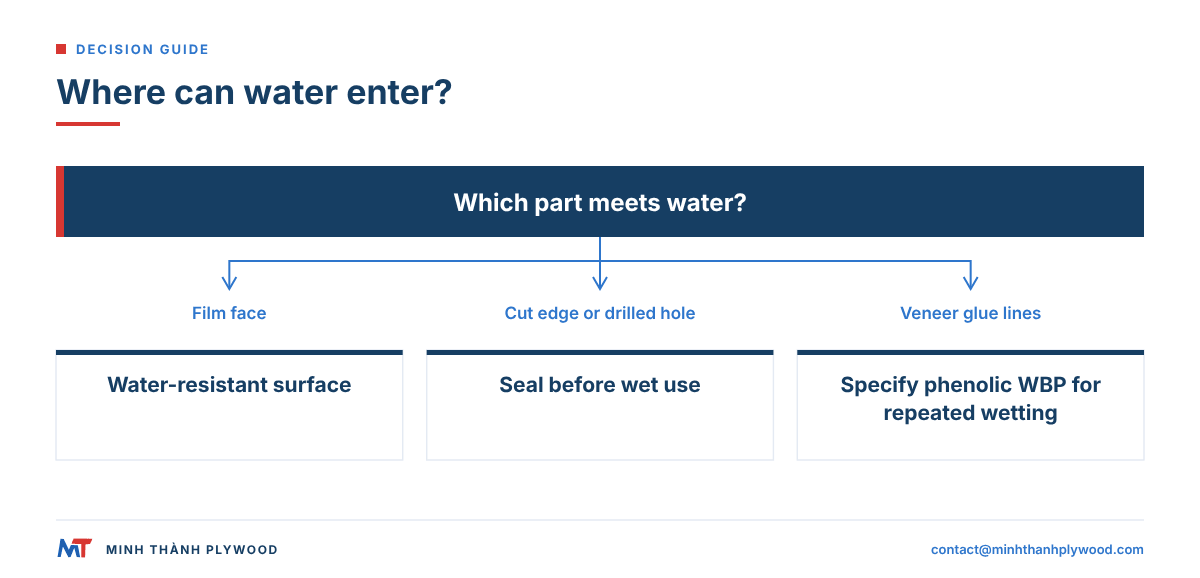
Phenolic coated plywood has a water-resistant surface, but it is not waterproof as a whole panel. The film sheds water and resists wear; the glue decides how well the inner plies hold together when water gets in at an edge or a hole. Cut edges and holes must be sealed every time.
With a phenolic WBP bond, the plies hold through repeated wetting and drying; that is why it is the bond for repeated formwork. With a melamine-fortified bond, the panel handles limited wetting and humid storage but gives fewer uses. In both cases, water that soaks into an unsealed edge makes the core swell and lifts the film.
Store sheets flat on even bearers, off the ground and covered, and keep the factory edge paint intact. Seal every new cut with edge paint before the panel goes into service.
How do you cut, drill and repair phenolic coated plywood?
Cut phenolic coated plywood with a fine-toothed carbide blade, film side up on a table saw and film side down with a hand-held circular saw, so the film is not chipped at the exit side. Drill with a sharp bit and a backing board. Seal every cut edge and hole with edge paint the same day.
The film is hard and brittle compared with bare wood, so blunt tools tear it and leave a ragged edge that lets water in. A scoring cut on the film before the full cut gives the cleanest line on panels with a visible face.
Small knocks and scratches in the film can be filled and sealed between pours, which keeps water out of the core and extends the life of the sheet. A panel whose film has worn through over a large area, or whose edges have swollen, is ready to retire from fair-faced concrete work; it can still serve for blinding, hoarding or packing.
Which HS code and documents go with phenolic coated plywood?
Phenolic coated plywood is classified as plywood under HS heading 4412, which also appears in the product scope of Regulation (EU) 2023/1115, with the subheading set by the panel’s construction, such as the outer veneer species and ply thickness. The film does not move it out of plywood. The importer’s customs broker chooses the final national tariff line from the specification.
Send your broker the cross-section, the face and core species and the thickness with the order. Our shipments carry the commercial invoice, packing list, B/L, certificate of origin (EUR.1 for the EU), phytosanitary and fumigation certificates, and insurance with CIF.
Standards and test results to ask for
| Standard or rule | What it covers | Where it applies |
|---|---|---|
| EN 314-2 class 3 | Bond quality in outdoor, wet conditions | Phenolic bond, EU and UK |
| EN 636-3 | Plywood for exterior use | EU and UK |
| EN 13986 with EN 717 | CE marking and formaldehyde class E1 | EU |
| CARB Phase 2 / TSCA Title VI | Formaldehyde limit for composite wood sold in the US | US |
| Lacey Act declaration | Species and country of harvest for plant-based imports | US |
| BS 1203 (type WBP, hazard H4) and DIN 68705-3 (BFU 100) | Older UK and German bond classes buyers still name | UK and Germany |
Minh Thanh holds CARB P2 / TSCA Title VI certification (ICTT mill no. 23024), arranges third-party testing to the buyer’s method, such as EN 717-1, through SGS on request, and supplies origin records with every order, which also feed a Lacey Act declaration. Name the standard on the order; a panel is not “to EN 636-3” because the supplier says so. The BSI listing for BS EN 636:2012+A1:2015 covers plywood specifications for dry, humid and exterior conditions.
For European buyers, we supply the EUDR compliance dossier (origin records and geolocation files) with orders, under Regulation (EU) 2023/1115. The guide to film-faced plywood HS codes and duties explains the European tariff lines.
What should you check when ordering phenolic coated plywood from Vietnam?
Check the film, the core, the glue and the tolerance on a real sample before the first container. A sample cut in half shows the glue line colour, the core species and any gaps; a caliper shows the thickness against the ±0.5 mm tolerance. Free samples are available from us.
- Film: weight in g/m², colour and smooth or anti-slip pattern.
- Core: Eucalyptus or Acacia, and whether it is calibrated before filming.
- Glue: melamine-fortified or phenolic WBP, written as a separate line.
- Edges: sealed, and in which paint colour.
- Thickness and size: with tolerances written on the proforma.
- Packing: pallets, corner protectors and strapping for the route.
- Documents: the shipping set and the EUDR dossier for Europe.
Our guide on how to select a film-faced plywood supplier gives the full supplier check. Every shipment is photographed and filmed before loading, and buyers get the photos and video.
What should you write on a phenolic coated plywood order?
Write the use first, then film, core, glue, thickness, size, tolerance, edges, packing and quantity. A complete line for a formwork order from Minh Thanh Plywood reads like this:
Phenolic coated (film-faced) plywood, 18 mm, 1220 × 2440 mm, Eucalyptus core, phenolic WBP glue, brown film from 135 g/m² both sides, thickness ±0.5 mm, edges sealed, for wall formwork, one 40HC, CIF destination port.
Change one line for other jobs: melamine-fortified glue for fewer pours, anti-slip film of about 220 g/m² for a floor, 12 or 15 mm for linings and light forms. MOQ is one 40HC, with mixed specifications by agreement. Production takes 15–45 days after the 30% deposit, with the 70% balance against the scanned B/L or by irrevocable L/C at sight, on FOB Hai Phong, CFR or CIF terms.
The film-faced price follows film weight, core, glue, thickness and quantity, and our film-faced plywood price guide shows how each line moves it. Send your specification through the film-faced plywood page and we reply within hours.
Buyer questions, answered
What is phenolic coated plywood?
Phenolic coated plywood is plywood faced with paper impregnated with phenolic resin, pressed on under heat. The film gives a smooth, hard, water-resistant surface. It is the same product most markets call film-faced plywood.
Is phenolic coated plywood the same as film-faced plywood?
Yes, in most quotations. Phenolic coated, phenolic film faced, film faced, shuttering plywood and formply all describe plywood with a phenolic film surface; HDO is a separate US overlay grade with its own resin rules.
Is melamine or phenolic glue better for plywood?
Phenolic glue is better for repeated wetting, outdoor exposure and formwork reuse. Melamine-fortified glue costs less and suits fewer pours and humid interiors. For dry furniture, UF glue at E0 emission is the usual choice.
Does phenolic glue make plywood darker?
Yes. Phenolic resin cures dark reddish-brown, so the glue lines show as dark lines on the edge. On film-faced plywood the film covers the faces; on clear-finished furniture, a lighter glue is usually chosen.
Why is phenolic glue plywood more expensive than melamine?
Phenolic resin costs more than melamine-fortified resin, and panels bonded with it are usually built on better cores for longer service. The price buys more reuses and stronger resistance to water.
How many times can phenolic coated plywood be reused?
Melamine-fortified film-faced panels give about 12–15 uses and phenolic WBP panels up to about 25, with proper handling, release agent and edge sealing. The site, the concrete and the storage decide the real count.
What is phenolic baltic birch plywood?
Phenolic baltic birch plywood is birch plywood from the Baltic region with a phenolic film on its faces, often black or brown. Its dense birch core suits trailer floors, stages and work surfaces; hardwood-core film-faced plywood is the usual choice for formwork.
Is phenolic coated plywood waterproof?
The film is water-resistant and the faces shed water, but cut edges and drilled holes must be sealed. Water resistance through the panel depends on the glue: phenolic WBP for repeated wetting, melamine-fortified for fewer exposures.
What film weights are used on phenolic coated plywood?
Standard film is about 120–135 g/m², premium film from 135 g/m², and anti-slip film with a wire-mesh or hexagon pattern about 220 g/m². A heavier film usually gives more reuses.
What sizes does Minh Thanh make phenolic coated plywood in?
We make film-faced plywood 12–21 mm thick in 1220 × 2440 and 1250 × 2500 mm sheets, with ±0.5 mm thickness tolerance, on Eucalyptus or Acacia cores, with melamine-fortified or phenolic WBP bonds.