
Plastic plywood formwork is plywood with a thick polypropylene skin, used for more pours than standard film-faced plywood. Hollow plastic panels are a different system again: light, modular and washable, but fixed in size. Phenolic film-faced plywood stays the cost-effective, nailable choice for most slabs, walls and columns. This guide compares all three on reuse, repair and cost per pour. Minh Thanh Plywood makes film-faced plywood in Vietnam.
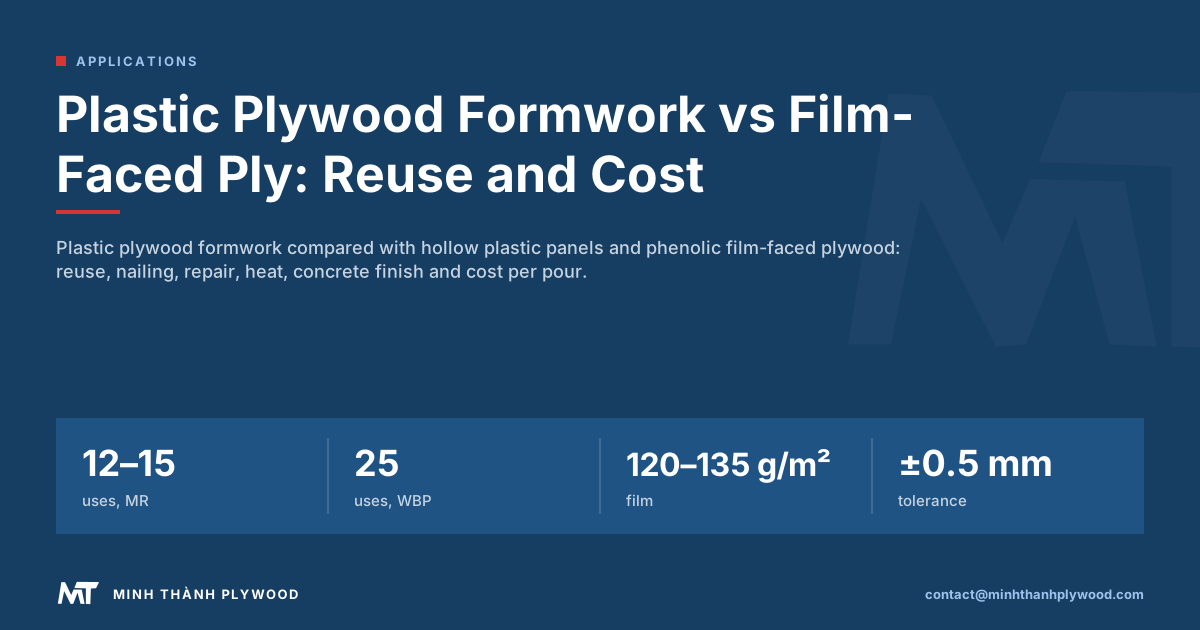
Plastic plywood formwork: the short answer
Plastic plywood formwork lasts more pours than standard film-faced plywood but costs more per sheet; hollow plastic panels last longer still but only fit repeated, modular layouts. For most slabs, walls and columns that change shape, phenolic film-faced plywood gives the lowest cost per pour because it is cut, nailed and repaired on site.
- Plastic-coated plywood: plywood with a polypropylene skin; more reuses, easy to clean, higher first cost.
- Hollow plastic panels: modular panels clipped together; very light, washable, fixed sizes.
- Phenolic film-faced plywood: plywood with a resin-impregnated film; nailable, cut to any size, lowest first cost.
The sections below compare them point by point and end with a verdict by job.
Three products sold as plastic concrete formwork
Three different products are sold as plastic concrete formwork: plywood with a plastic skin, hollow modular plastic panels, and solid plastic or composite sheets. They differ in structure, so they differ in stiffness, fixing and cost.
| Product | What it is | How it is used |
|---|---|---|
| PP plastic-coated plywood | Plywood core with a thick polypropylene face on both sides | Like film-faced plywood: on beams and props, cut and nailed |
| Hollow plastic panels | Moulded or extruded panels, usually polypropylene or ABS, with ribs | Modular walls, columns and slabs, joined with handles or clamps |
| Solid plastic or composite sheets | Polypropylene or composite sheets with a fibre or foam core | Facing for timber or steel frames, lining of forms |
Many search terms mix them up. Before you compare prices, ask which of these three the offer is.
What is PP plastic-coated plywood?
PP plastic-coated plywood is a plywood panel with a thick polypropylene sheet bonded to each face, with the edges sealed, used as a long-life formwork skin. The plastic face replaces the paper-based phenolic film of standard film-faced plywood, so the panel keeps the plywood core and its nailing and cutting on site.
- Core: hardwood or mixed-species plywood, glued with a water-resistant bond.
- Face: polypropylene sheet, often several times thicker than a phenolic film.
- Edges: sealed with paint or plastic.
- Use: slab and wall formwork on timber beams or steel frames.
The plastic skin resists abrasion and does not soak up water, so it cleans easily. The panel still bends and holds loads through its plywood core, so core quality matters as much as with any formwork plywood.
Hollow plastic formwork panels
Hollow plastic formwork panels are modular, ribbed plastic panels that clip together into wall, column and slab forms without nails. They are light enough to be handled by one worker and are washed with water after each pour.
- Modular: a set of standard sizes and corner pieces; odd sizes need filler pieces.
- Light: easy to carry and lift without a crane.
- Fixing: plastic handles, pins or clamps, not nails.
- Repair: damaged panels are often welded or replaced, not patched on site.
They suit repeated layouts such as low-rise housing walls, columns of the same size and small precast-style work. On sites where every wall is different, the fixed module becomes a limit.
Phenolic film-faced plywood
Phenolic film-faced plywood is a cross-laminated veneer panel with a resin-impregnated film bonded to each face and sealed edges, the most used formwork panel worldwide. It is cut to any size, nailed to beams and repaired on site.
Our film-faced plywood is made in 12–21 mm on Eucalyptus or Acacia cores, with melamine-fortified or phenolic WBP glue, in 1220 × 2440 and 1250 × 2500 mm sheets. Standard film is 120–135 g/m² and premium film starts from 135 g/m². Thickness tolerance is ±0.5 mm.
- Melamine-fortified bond: about 12–15 uses, with proper handling, release agent and edge sealing.
- Phenolic WBP bond: up to about 25 uses, with the same care.
- Colour: black or brown film, chosen with the sample.
Bonding-quality requirements for plywood are set in BS EN 314-2. See the film-faced plywood page for the full specification.
Plastic formwork vs plywood: comparison table
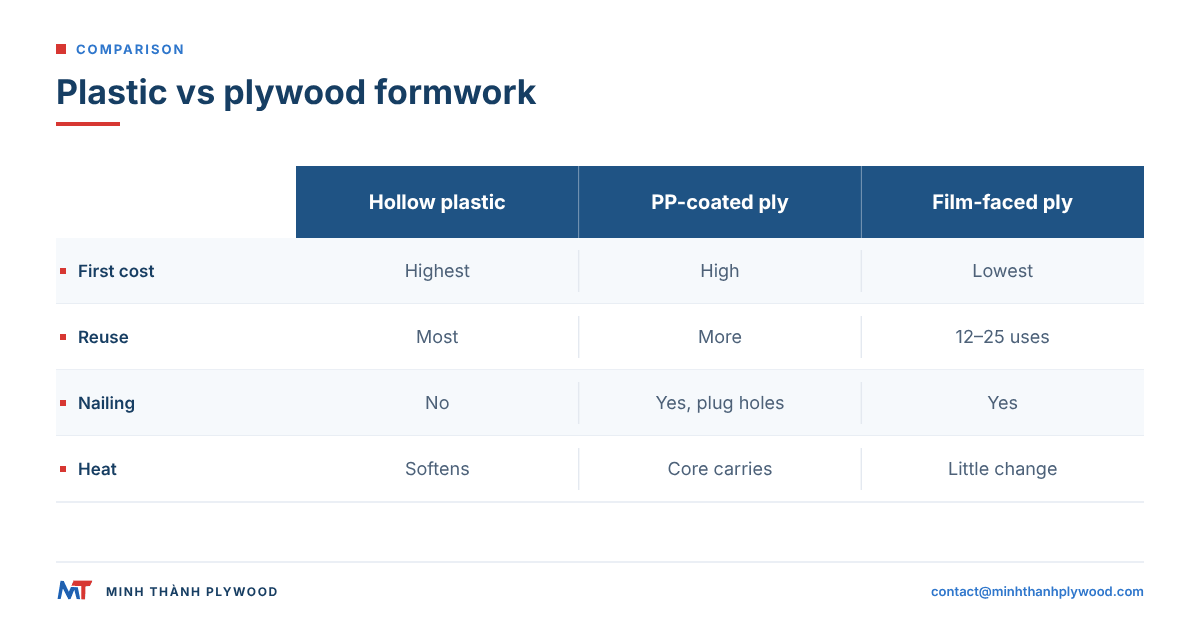
Plastic formwork wins on reuse and cleaning; plywood wins on first cost, nailing, cutting and stiffness in heat. The table compares the three products on one property per row.
| Property | Hollow plastic panels | PP-coated plywood | Phenolic film-faced plywood |
|---|---|---|---|
| First cost per m² | Highest; supplier tiers run US$15–40/m² for hollow PP | High | Lowest |
| Reuse claimed | 50–100 times | 30–50 times | 12–15 (our MR) or up to 25 (our WBP); non-overlaid US Plyform 5–10 |
| Density | 600–900 kg/m³ for PVC foam sheet; hollow panels lighter | Wood core, about 500 kg/m³ (Styrax) to 650–750 kg/m³ (Eucalyptus) | About 580 kg/m³ (Acacia) to 650–750 kg/m³ (Eucalyptus) |
| 18 mm sheet, 1220 × 2440 mm | Hollow panels light; PVC foam sheet about 32–48 kg | Heavier than film-faced | About 31.1 kg (Acacia core) to 34.8 kg (Eucalyptus core at 650 kg/m³) |
| Thickness range | 10–22 mm | 12–21 mm | 12–21 mm |
| Cutting to size | Not intended | Saw, then seal edges | Saw, then seal edges |
| Nailing and screwing | No | Yes, plug the holes | Yes |
| Site repair | Weld or replace | Plastic plugs and filler | Patch and reseal edges |
| Stiffness in heat | Drops | Mostly from the core | Changes little |
| Water absorption | None | Face none; edges need sealing | Face low; edges need sealing |
| Release agent | Little or none | Little | Needed |
| End of life | Recyclable and resaleable | Ply core is hard to separate | Worn sheets reused in hidden work, then chipped or burned as biomass |
| Concrete finish | Smooth when new | Smooth | Smooth, fair-faced |
| Best fit | Repeated modular layouts | Many pours of similar panels | Varied slabs, walls, columns |
Sources for the plastic columns are supplier pages and are claims. Simple wooden structures reuse the panels at least 50 times, with density 0.6–0.9 g/cm³ and up to 22 mm thickness, according to OCM. Over 100 cycles and the price tiers come from an Alibaba buying guide. The 30–50 reuse figure for PP-faced plywood is quoted by Onsun. All three were read on 21 October 2026.
The US plywood reference is APA Plyform: non-overlaid panels commonly give 5 to 10 reuses and HDO-overlaid panels 20 to 50 (checked on 21 October 2026). Sheet weight for PVC foam is computed from the sheet area, the 18 mm thickness and the 600–900 kg/m³ density. The film-faced figures are our own product limits.
The rows describe typical products; a given brand can be better or worse. Ask each supplier for the core, the skin and the bond in writing.
Reuse and cost per pour: how to compare
Compare formwork on cost per usable pour: the delivered price of the panel divided by the number of pours it really gives on your site, plus repair and cleaning. A panel that costs twice as much but lasts three times as long is cheaper per pour.
- Delivered price per sheet or per m², including freight.
- Real uses on your site: from your own records, not the maximum claimed.
- Repairs: plugs, edge sealing and lost panels.
- Cleaning and release agent per pour.
- Cost per pour = (price + repairs + cleaning) ÷ real uses.
Worked example with our film-faced panels: if a phenolic WBP sheet costs P and gives 25 uses, the material cost per pour is P ÷ 25; a melamine-fortified sheet at 0.7 P giving 15 uses costs about 0.047 P per pour, against 0.040 P. The better bond wins when the panels really reach their uses.
Now add a plastic line. A hollow plastic panel at 3 times the price of the WBP sheet (3 P) costs 3 P ÷ 60 = 0.05 P per pour at 60 uses, so it loses to the WBP plywood at 0.040 P. It breaks even only above 75 uses (3 P ÷ 75 = 0.040 P) against WBP plywood, and above about 64 uses against the 0.7 P melamine-fortified sheet (3 P ÷ 64 ≈ 0.047 P). Plastic wins on a repeated layout that really gives 100 pours: 3 P ÷ 100 = 0.030 P.
Use your own site records for the use count and your own quotes for the price ratio, and keep the cost of lost and cut panels in the sum. The stakes are high: concrete formwork represents close to half the cost of a concrete structure, according to APA. Our plywood price for formwork guide covers the price side.
Nailing, cutting and repair on site
Plywood formwork, film-faced or plastic-coated, is cut with a saw and nailed or screwed to timber beams, which is why carpenters prefer it for one-off shapes. Hollow plastic panels are assembled only from their own pieces.
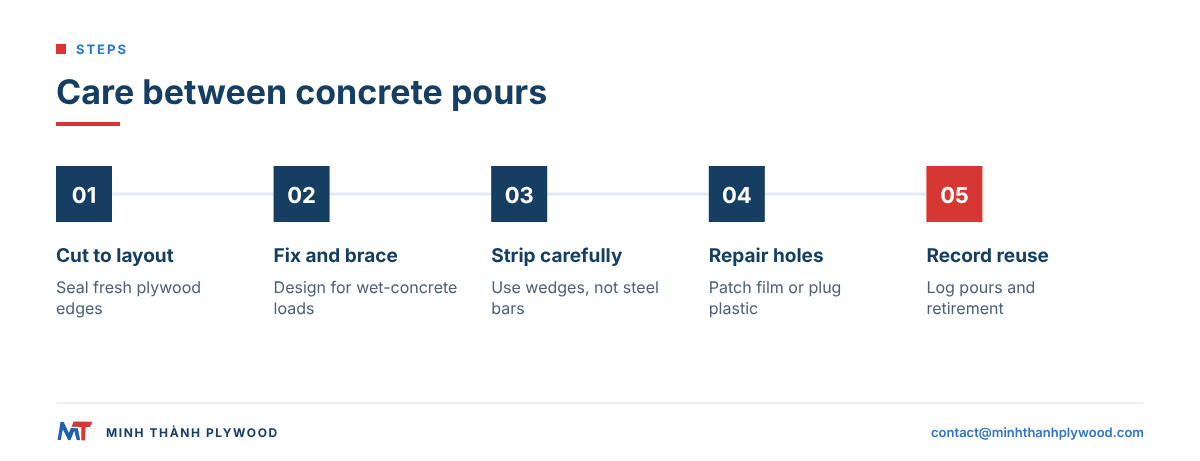
- Cuts: seal every fresh cut edge of plywood with edge paint so water stays out of the core.
- Nail holes: on film-faced plywood, fill or tape before the next pour; on PP-coated plywood, use the maker’s plastic plugs.
- Damage: patch film faces with repair compound; plastic skins can be heat-welded.
- Stripping: use wedges and wooden tools, not steel bars on the face.
A cut and nailed panel loses uses faster. Plan the layout to keep most sheets whole and use small fillers for odd sizes.
Whatever the face, the formwork must be designed and braced for the load of wet concrete. In the US, the OSHA construction rule for cast-in-place concrete requires formwork to be designed, fabricated, erected, supported, braced and maintained so that it supports all vertical and lateral loads expected during placement (OSHA standard 1926.703, checked on 20 October 2026). Panel choice changes the support spacing: a stiffer skin or a thicker plywood sheet can span further between beams, so ask the formwork designer for the spacing with the panel you choose.
For the plywood side of a US job, forming panels are specified under the Voluntary Product Standard PS 1 and APA Plyform grades, and the formwork pressure and panel span are designed to ACI 347; ask the supplier which standard its panel was made to.
Keep a simple record per batch of panels: the date of first use, the number of pours and the reason each sheet was retired. After two or three projects that record gives your real reuse number, which is the figure to put into the cost-per-pour calculation.
Temperature and weather behaviour
Plastic formwork is more sensitive to temperature than plywood: it softens and deflects more in hot sun and becomes stiffer and more brittle in frost. Plywood keeps its stiffness across normal site temperatures because the wood core carries the load.
- Hot climates: shade plastic panels before the pour and check deflection; plastic skins on plywood are less affected because the core carries the load.
- Cold climates: avoid sharp knocks on cold plastic panels.
- Rain and sun between pours: store all panels flat, covered and off the ground.
- Concrete heat: thick sections warm the form face; plastic expands more than wood.
For tropical and Middle East sites, phenolic film-faced plywood with sealed edges is a stable, proven choice.
Concrete finish with each formwork face
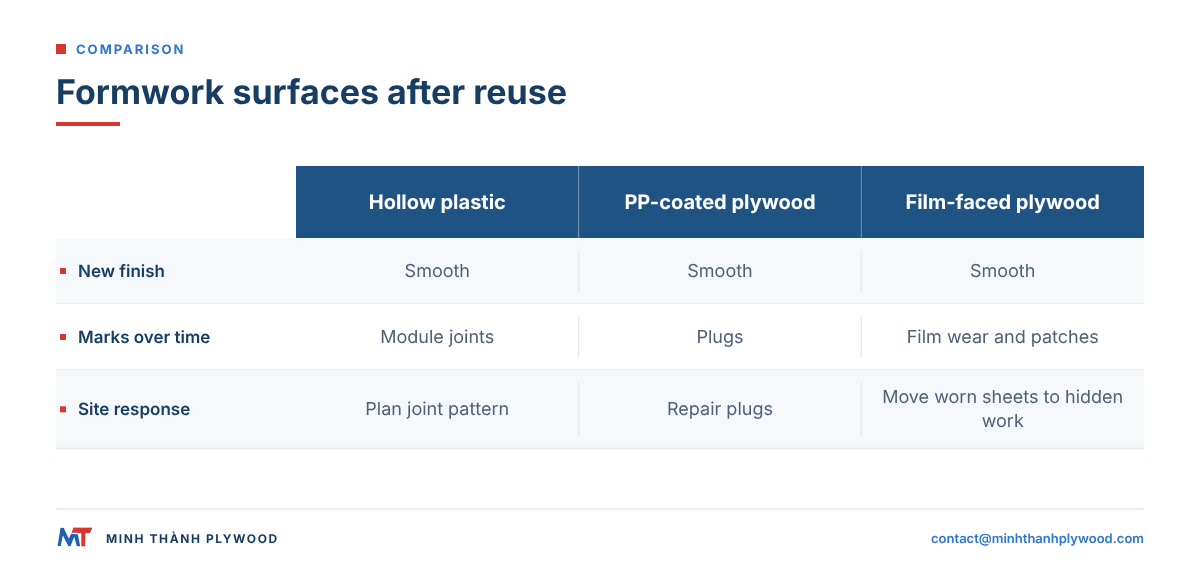
New plastic faces and new phenolic film faces both give a smooth, fair-faced concrete surface. The difference shows after many pours: the face that survives cleaning, nailing and stripping without scratches keeps the finish.
- Plastic panels: joints between modules show on the concrete; plan them as a pattern.
- PP-coated plywood: smooth and even; plugs can show as small marks.
- Film-faced plywood: smooth first pours; film wear and patches show later, so move worn sheets to hidden work.
For decorative timber-grain finishes, neither smooth face is used; see board-formed concrete.
Recycling, resale and end of life
Hollow and solid plastic formwork can be recycled and resold when the job ends, while plywood formwork is mostly cut up for secondary use at the end of its pours. OCM states that PVC formwork is 100 % recyclable and can be resold at a higher price than plywood (OCM, checked on 21 October 2026).
- Plastic panels: collected by plastic recyclers; resale value depends on cleanliness and damage.
- PP-coated plywood: the skin and core are bonded, so the panel is hard to recycle as plastic.
- Film-faced plywood: worn sheets go to hidden work, then temporary hoarding, edge battens or packing; the wood is a renewable material.
Put the end-of-life value into the cost-per-pour sum when you hold the panels for years; for a one-off project it rarely changes the ranking.
PVC shuttering ply and plastic formply: what buyers mean
PVC shuttering ply and plastic formply are trade names for plywood with a plastic face used as concrete shuttering. The names do not say what the plastic is, how thick it is or what core lies beneath, so ask for those three points.
- Skin material: polypropylene, PVC or another plastic.
- Skin thickness on each face.
- Core species and number of plies.
- Bond: phenolic WBP or melamine-fortified.
- Edge sealing.
- Reuse claim and the conditions behind it.
Plywood for dry, humid or exterior conditions is specified in BS EN 636:2012+A1:2015, so quote that standard when you ask for the bond. The same checklist works for film-faced plywood. See our guide to types of formwork materials for steel, aluminium and timber systems too.
Which formwork for which job?
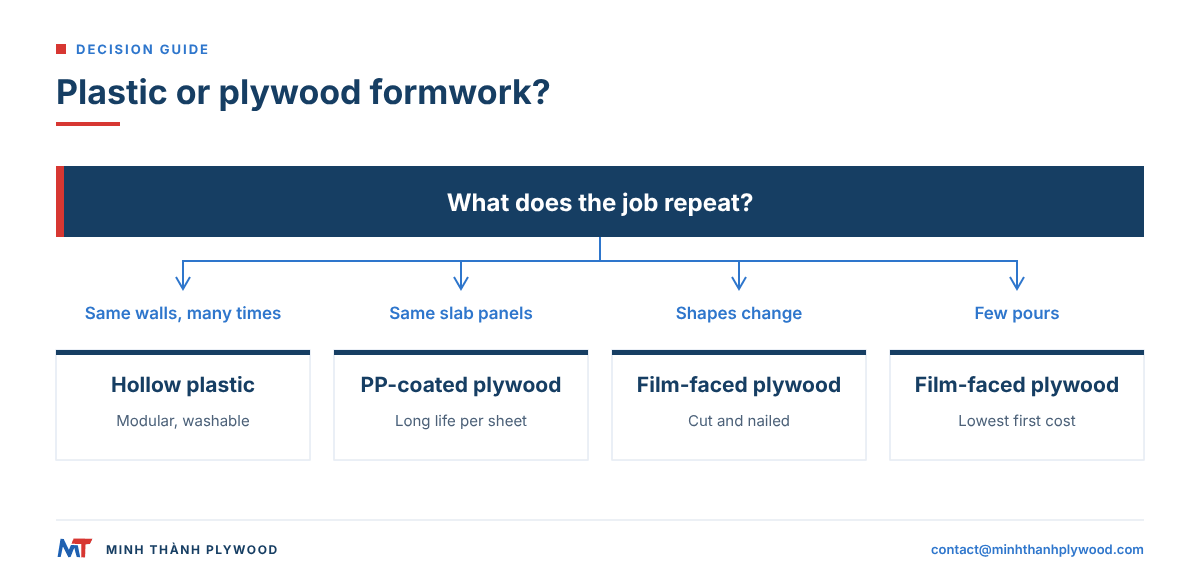
Choose hollow plastic panels for repeated modular walls and columns, PP-coated plywood for many pours of similar panels, and phenolic film-faced plywood for varied slabs, walls and columns where panels are cut and nailed.
| Job | Choose | Why |
|---|---|---|
| Low-rise housing with repeated walls | Hollow plastic panels | Many identical pours, light handling |
| Columns of one size, many floors | Plastic or PP-coated plywood | Repeated shape, easy cleaning |
| Slabs on timber beams and props | Film-faced plywood | Cut to fit, nailed, lowest first cost |
| Walls with openings and changes | Film-faced plywood | Any shape on site |
| Many pours of the same slab table | PP-coated plywood | Longer life per sheet |
| Small one-off structures | Film-faced plywood | Lowest cost for few pours |
| Hot climate, exposed panels | Film-faced plywood | Stiffness holds in heat |
What this means for your formwork plywood order
For film-faced formwork plywood, the core, bond and film decide how many pours you get, so send the full line:
- Application: slab, wall, column or other formwork, with the support spacing.
- Thickness: 12, 15, 18 or 21 mm.
- Core: Eucalyptus or Acacia.
- Bond: melamine-fortified (about 12–15 uses) or phenolic WBP (up to about 25), with proper handling, release agent and edge sealing.
- Film: standard 120–135 g/m² or premium from 135 g/m², black or brown.
- Size and quantity: 1220 × 2440 or 1250 × 2500 mm, from one 40HC.
Production takes 15–45 days after the deposit, and free samples are available. See film-faced plywood, read the pillar on what formwork is, or compare plywood vs steel formwork.
Buyer questions, answered
What is plastic plywood formwork?
Plastic plywood formwork is a plywood panel covered on both faces with a polypropylene or similar plastic skin, sealed at the edges. It is used like film-faced plywood but aims at more reuses and easier cleaning.
Is plastic formwork better than plywood?
Plastic formwork is better for many identical repeated pours, such as housing walls with the same layout, because it is reused many times and washed clean. Plywood is better where shapes change, panels must be cut and nailed, and the first cost must stay low.
How many times can plastic formwork be reused?
Makers of hollow plastic panels and PP-coated plywood claim many more uses than standard film-faced plywood, often dozens of pours, but real reuse depends on handling, cleaning and stripping. Compare the cost per usable pour, not the claimed maximum.
How many times can film-faced plywood be reused?
Our melamine-fortified film-faced panels give about 12–15 uses and our phenolic WBP panels up to about 25, with proper handling, release agent and edge sealing.
Can you nail into plastic formwork?
Hollow plastic panels are not made for nailing; they connect with clamps, handles or pins. PP-coated plywood can be nailed and screwed through the skin, and the holes are plugged with a matching plastic filler.
Does plastic formwork need release agent?
Plastic faces release concrete easily and need little or no release agent in many systems. A light coat still helps in hot weather and keeps the face clean for the next pour.
What is PVC shuttering ply?
PVC shuttering ply is a trade name for plywood or board with a plastic face used for concrete shuttering. Buyers should ask what the skin is made of, how thick it is and what core lies under it.
Is plastic formwork cheaper than plywood?
Per sheet, no: plastic costs more up front. Per pour it only wins when it really gives many more uses; at 3 times the price of a 25-use plywood sheet it must pass about 75 pours to break even.
Is plastic formwork affected by heat?
Yes. Plastic softens in high heat and stiffens in cold, so panels can deflect more in hot sun and become brittle in frost. Plywood stiffness changes much less with temperature.
What is plastic formply?
Plastic formply is plywood formwork with a plastic face instead of a resin-impregnated paper film. The core and bond still decide its stiffness and strength.
Which formwork gives the best concrete finish?
A new plastic face and a new phenolic film face both give a smooth fair-faced finish. The finish after many pours depends on how well the face survives cleaning, nailing and stripping.