
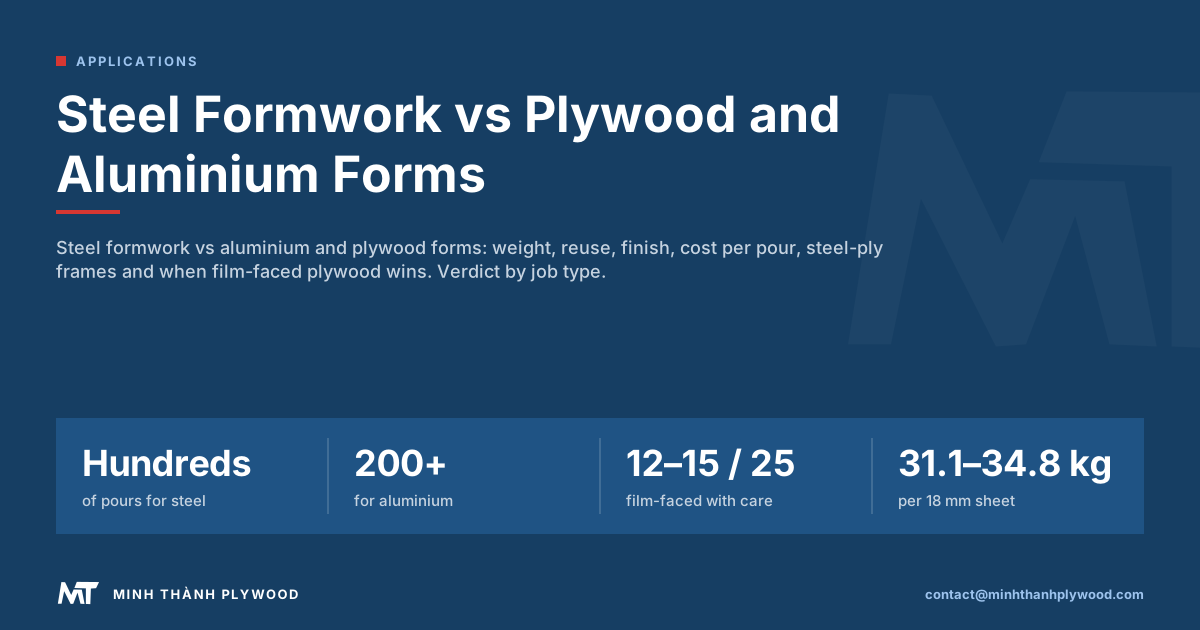
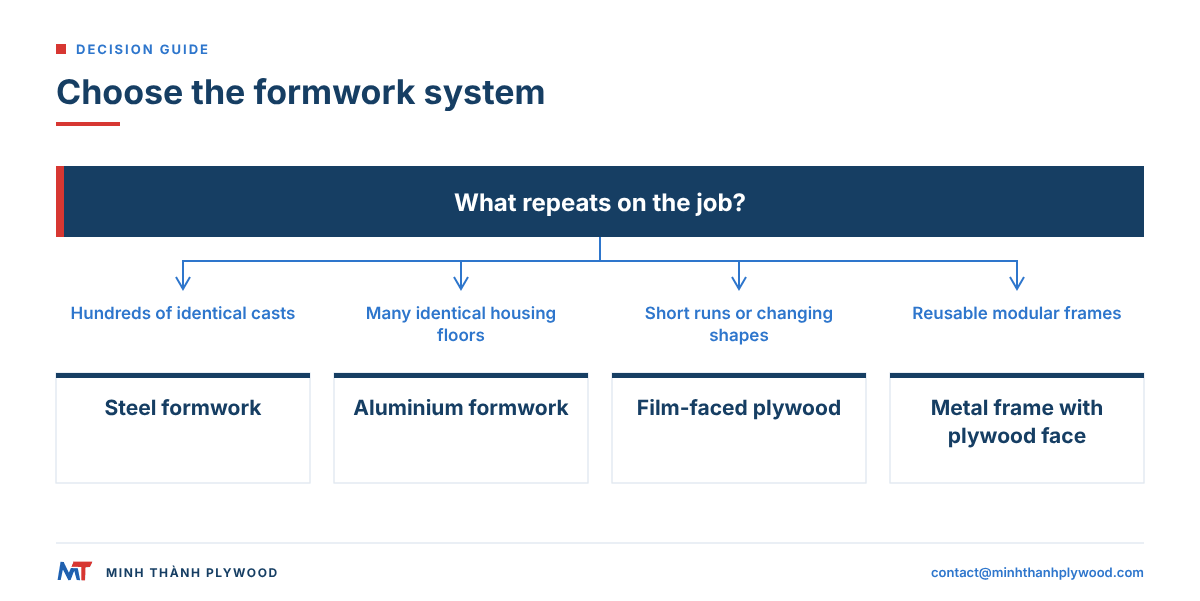
Steel formwork wins when one section repeats hundreds of times; aluminium formwork wins on repetitive housing floors; film-faced plywood wins on short runs, changing shapes and jobs without a crane. Most sites mix them: a steel or aluminium frame carries a plywood face. Minh Thanh Plywood makes that face, and this guide compares all three on cost per pour.
Steel formwork, aluminium formwork or plywood: the short answer
Choose steel formwork for very high repetition of one shape, aluminium formwork for repetitive floor plates in tall housing, and film-faced plywood for everything that changes from pour to pour. The deciding number is cost per pour: the price of the form set, plus repairs and handling, divided by the pours it really gives on your job.
| Job | Best choice | Why |
|---|---|---|
| Precast yard, tunnel lining, bridge piers repeating one section | Steel formwork | Hundreds of identical pours spread the high set cost |
| Tower housing with the same floor plate on every level | Aluminium formwork | Hand-set panels, fast floor cycle, 200+ uses on a maintained set |
| Footings, basements, retaining walls, short runs | Film-faced plywood | Lowest entry cost, cut on site, no crane needed |
| Columns and walls at odd sizes, blockouts, curves | Film-faced plywood | A carpenter cuts the shape on the bench |
| Rented modular wall frames | Steel or aluminium frame with plywood face | Frame stiffness, replaceable face |
Most real sites mix the three. The rest of this comparison sets out the numbers behind each verdict and the plywood face that fits a metal frame. For the full list of materials, see our planned guide to formwork materials.
What is steel formwork?
Steel formwork is a form system with welded steel frames and a steel skin, built as modular panels that bolt or clamp together for walls, columns, piers and tunnel linings. It is made to take high fresh-concrete pressure and hundreds of pour cycles with the same geometry.
Steel formwork in construction appears where the same element repeats: bridge piers, culverts, tunnel segments, precast beams, tanks and cores of towers. A steel formwork system usually includes the panels, couplers, ties, walers and climbing or lifting gear. Makers protect the steel with primers, powder coating or hot-dip galvanising, because a rust spot transfers to the concrete face.
The strengths are stiffness, accurate geometry and long life. The costs are weight, a large capital purchase or hire contract, and poor tolerance for change: a wall that steps, a pipe sleeve or a curved corner needs special panels or a timber infill.
Steel formwork structure, types and grades
A steel form is built from a few parts: a steel skin (the face plate), ribs and flanges that stiffen it, couplers or clamps that join panels, ties and walers that resist the concrete pressure, and lifting or climbing gear. The same parts appear in each type, which is named by the element it casts:
- Wall forms: large panels or girder forms ganged and tied across the wall.
- Column forms: four-sided or round steel shells, often adjustable in section.
- Tunnel and culvert forms: telescopic steel shells moved on rails or by crane.
- Bridge and pier forms: heavy panels with climbing brackets.
- Slab and beam forms: steel-framed tables and trays, often with a plywood face.
Makers specify the steel by grade. Q235 is a low-carbon Chinese structural steel with good weldability for general frames and moderate loads; Q355 (formerly Q345) is a low-alloy, higher-strength steel for larger or heavier forms. The European equivalents are S235 for general work and S355 for heavier loads. A higher grade allows thinner ribs for the same pressure but costs more per tonne.
Design pressure and tie spacing show what a system is rated for. Doka’s steel girder formwork is rated for fresh-concrete pressure up to 1,500 psf (about 72 kN/m²), and a standard 12 ft wide girder form gives 96 sq ft of wall per tie, with no walers needed. Framed systems from Doka and other makers are the usual benchmark; always take the pressure, the pour rate and the tie pattern from the maker’s data sheet for your concrete mix and temperature.
What is aluminium formwork?
Aluminium formwork is a lightweight modular system of extruded aluminium panels that casts walls and slabs of a floor together, designed panel by panel for one building plan. An aluminium formwork system is set by hand without a crane and moves up the building floor after floor.
Suppliers make the panels from aluminium extrusions with a thin aluminium face sheet, then powder-coat them so concrete releases cleanly. One Indian supplier’s 2026 aluminium formwork guide quotes 200 or more repetitions for a maintained set and a floor cycle of 7–10 days once the crew is trained. The design work happens before the first panel is made, so the lead time runs to weeks or months.
Aluminium formwork pays back on mass housing: 20, 30 or 40 identical floors. On a low-rise job, a one-off building or a plan that changes during construction, the set never reaches the pour count that justifies it.
What is steel ply formwork?
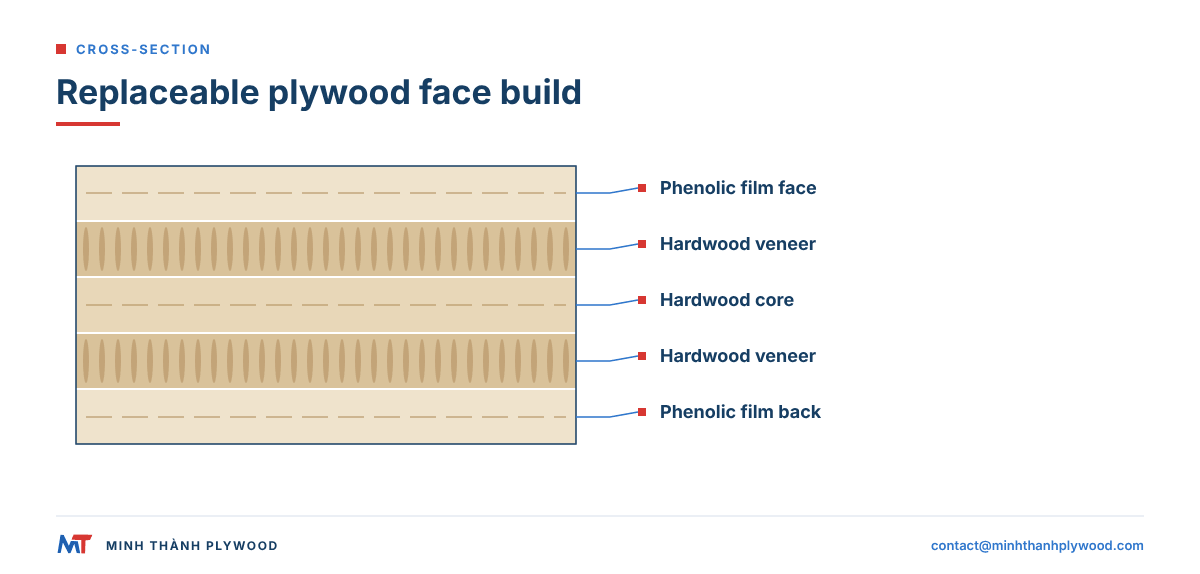
Steel ply formwork is a modular form with a steel frame and a plywood face: the frame gives stiffness and quick connections, and the plywood gives the concrete finish. When the face wears out, the crew replaces the plywood and keeps the frame.
Steel-ply concrete forms became common on North American wall jobs and are still rented and sold in Singapore, the Middle East and elsewhere. Aluminium-frame versions work the same way with a lighter frame. For the plywood buyer, these systems turn the question from “steel or plywood?” into “which face goes on the frame?”
The face has a hard life: it sees every pour, every release agent coat and every strip. A face with phenolic WBP glue, premium film and sealed edges stays flat and keeps its bond longest. Faces cut from 1220 × 2440 mm or 1250 × 2500 mm sheets to the frame’s inside size; we cut panels to size on order and seal the cut edges before packing.
Steel vs aluminium vs plywood formwork: the comparison table
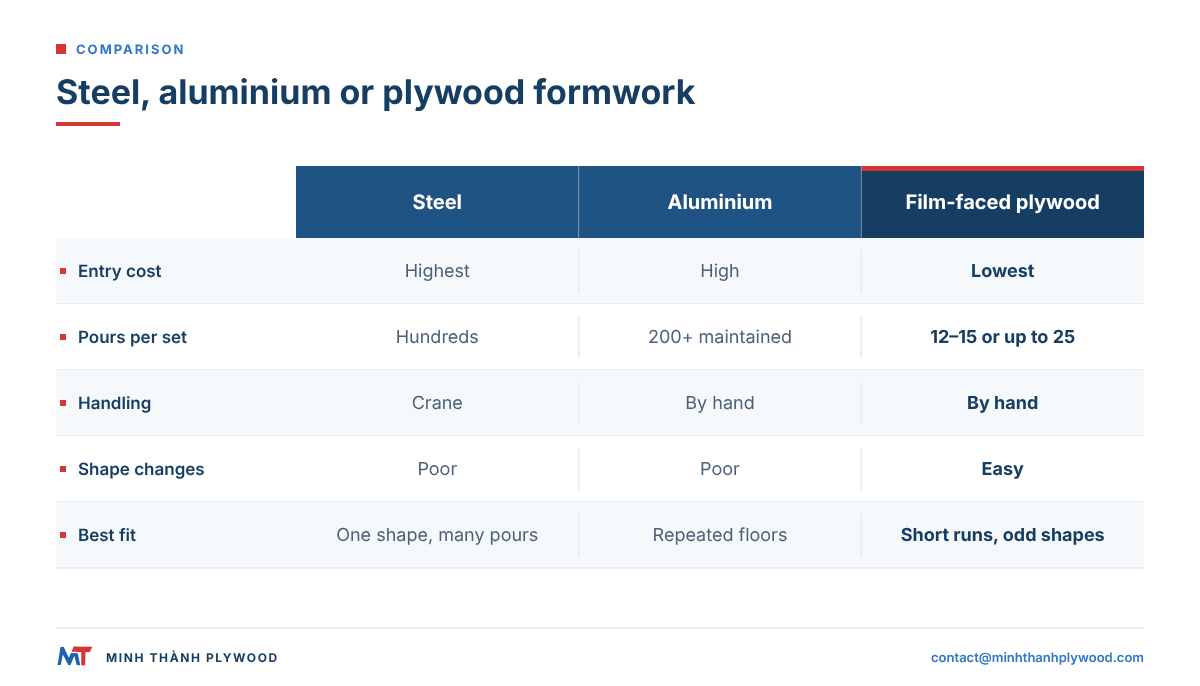
Film-faced plywood has the lowest entry cost and weight per sheet; steel has the highest stiffness and pour count; aluminium sits between them on weight and wins on fast repetitive floors. Each row below compares one metric.
| Metric | Steel formwork | Aluminium formwork | Film-faced plywood forms |
|---|---|---|---|
| Entry cost | Highest: capital purchase or hire contract | High: one designed set per building | Lowest: buy sheets by the container |
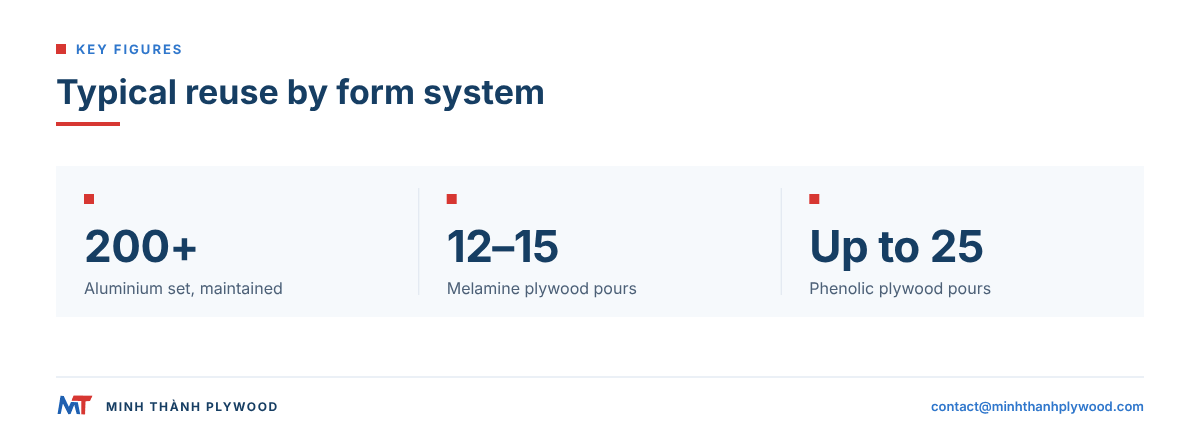
| Pours per set | Hundreds, rated by the maker | 200+ on a maintained set | About 12–15 (melamine) or up to about 25 (phenolic WBP) with proper care |
| Weight to handle | Heaviest; most panels need a crane | Light enough to set by hand | 18 mm sheet about 31.1–34.8 kg |
| Change of shape on site | Poor; special panels needed | Poor; designed for one plan | Easy; cut and drill on the bench |
| Concrete finish | Smooth while clean and coated | Smooth; panel joints repeat | Smooth film; fine sheet joints |
| Damage mode | Dents and rust print on the concrete | Dents, bent ribs | Torn film, swollen unsealed edges |
| Lead time | Stock or fabrication | Weeks to months of design and making | Production 15–45 days after deposit |
| Best fit | Very high repetition of one shape | Repetitive tower floors | Short runs, varied shapes, frame faces |
The weight row matters more than it looks. Two workers carry an 18 mm sheet between them; a steel panel of the same area waits for the crane, and every cycle waits with it when the crane is busy elsewhere.
Cost per pour: how to find the break-even
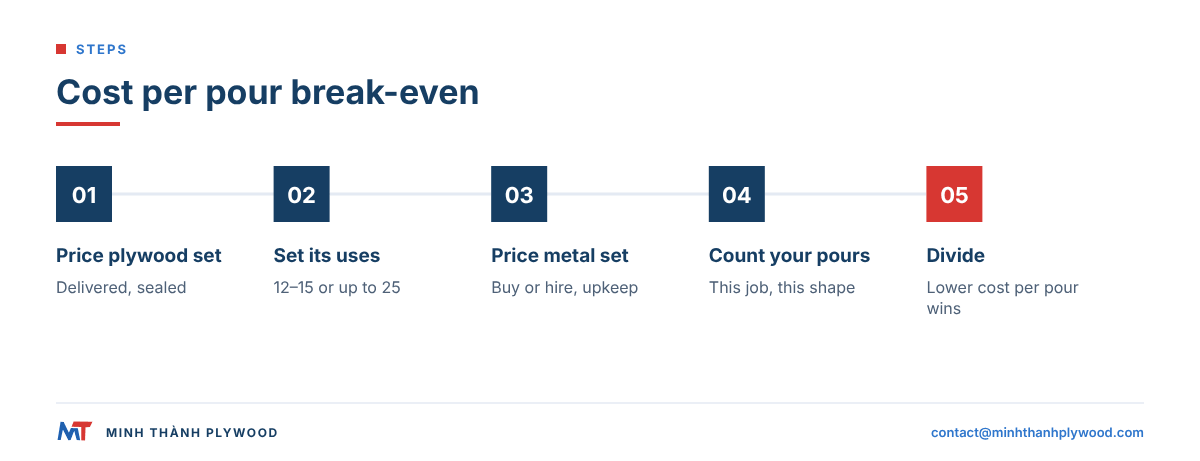
The break-even is the pour count at which a steel or aluminium set’s cost per pour drops below plywood’s. Cost per pour = (set cost + repairs + handling) ÷ pours actually achieved. Compare that figure, not the price per sheet.
- Price the plywood set. Panels for one pour area, delivered, plus edge sealing and release agent.
- Set its pour count. About 12–15 uses for our melamine-fortified panels or up to about 25 for phenolic WBP, with proper handling, release agent and edge sealing.
- Price the metal set. Purchase or hire for the same area, plus coating upkeep and crane time.
- Count the pours your programme has. Not the maker’s rating: the number of times this job will cast that shape.
- Divide and compare. The lower cost per pour wins; check the cash needed on day one too.
A worked ratio shows how it behaves. If a metal set costs ten times a plywood set for the same area, and the phenolic plywood set gives 25 pours, the metal set must cast that shape more than 250 times on this job to come out cheaper. A job with 40 pours of one wall never gets there; a precast yard with 600 casts does.
Indicative plywood prices start from US$250/m³ for commercial plywood (October 2026); our formwork plywood price guide explains how film-faced quotes are built from core, film and glue.
When does steel formwork win?
Steel formwork wins when one element repeats hundreds of times, tolerances are tight and a crane is on the job full time. Typical cases are precast beam and culvert yards, tunnel linings, bridge piers and circular tanks.
In these jobs the pour count is far beyond the life of any plywood face, the geometry never changes, and the crane lifts the same gang form every day. Steel’s stiffness also holds tight tolerances under high concrete pressure from tall, fast pours.
Steel also suits sites where handling is so rough that a plywood face would never reach its rated life. Even there, many contractors use steel frames with a plywood face, because a worn face is cheaper to change than a dented steel skin.
When does aluminium formwork win?
Aluminium formwork wins on high-rise housing with one floor plate repeated many times, where a trained crew sets panels by hand and casts walls and slab together. It beats plywood on speed and beats steel on handling.
The conditions are strict: a fixed design, enough floors to use up the set’s rated cycles and a lead time for design and manufacture before work starts. Change the floor plan after the panels are cut and the savings shrink.
Aluminium frames with a plywood face are a lighter version of the steel-ply idea. Here too the face is a film-faced sheet cut to size, and its bond and edge sealing decide how often it is changed.
When does film-faced plywood win?
Film-faced plywood wins on short runs, changing shapes, small crews and jobs without a dedicated crane. Footings, basements, retaining walls, columns at odd sizes and slab decks on beams and props are its home ground.
Its strengths are practical. Entry cost is low, so a contractor buys a container and starts forming. Panels are cut, drilled and fitted on the bench, so blockouts and pipe sleeves take minutes. A sheet is light enough for two workers, so strip-and-reset does not wait for the crane.
The weakness is life per set: tens of pours, not hundreds. That is why buyers specify the build carefully. Phenolic WBP glue and premium film from 135 g/m² give up to about 25 uses with proper handling, release agent and edge sealing; melamine-fortified panels with 120–135 g/m² film give about 12–15 at a lower price. Our film-faced plywood page lists the full build.
Metal formwork and concrete finish
Metal formwork and film-faced plywood both cast smooth concrete when the face is clean and oiled; they differ in how they fail. Steel prints dents and rust; plywood prints torn film and sheet joints.
A steel skin keeps its finish as long as the coating holds. Once rust starts, it bleeds into exposed walls, and a dent from a dropped panel repeats on every cast that follows. Aluminium panels show their panel grid on the wall, which is accepted on housing that will be skim-coated.
A phenolic film face casts a smooth, even surface through its working life when it is cleaned and lightly oiled. Joints between sheets show as fine lines, kept straight by square cutting: our panels hold length and width within ±2 mm. For exposed architectural concrete, approve a trial panel with the release agent you will use on site.
Weight, crane time and the pour cycle
Weight decides the pour cycle on many sites: an 18 mm film-faced sheet of 1220 × 2440 mm weighs about 31.1 kg on an Acacia core and about 34.8 kg on a Eucalyptus core, light enough to set by hand. Steel panels of wall size need a crane for every move.
Site rules apply to every system: in the US, OSHA standard 1926.703 sets the requirements for cast-in-place concrete formwork and shoring.
On a tight urban site with one tower crane, every steel lift competes with rebar, concrete buckets and deliveries. Plywood forms and hand-set aluminium panels keep moving while the crane works elsewhere. On a large site with a dedicated crane for the gang forms, steel’s weight hardly matters.
Weight also matters in shipping. Plywood forms travel flat-packed: our 40HC plan for 18 mm sheets on a Styrax core carries 990 sheets; on an Acacia core 880; on a Eucalyptus core 795, capped by the payload. Formwork plywood usually ships on Acacia or Eucalyptus cores for density.
Specifying the plywood face for steel or aluminium frames
For a steel-ply or aluminium-frame face, specify film-faced plywood with phenolic WBP glue, premium film from 135 g/m², the frame’s inside dimensions, the thickness the frame takes and sealed edges on every cut. Put film and glue on separate lines.
- Thickness. Match the frame rebate: 12, 15 or 18 mm are usual; our range is 12–21 mm with ±0.5 mm tolerance.
- Glue. Phenolic WBP for frame faces that see many wet pours.
- Film. Premium from 135 g/m², black or brown, film brand named on the order.
- Core. Eucalyptus or Acacia hardwood core for screw holding at the frame.
- Cut size. Finished dimensions and quantity per size; we cut to size and reseal edges.
- Holes. Tie-hole positions on a drawing if the faces are pre-drilled.
For the plywood standard behind a face, the BSI description of BS EN 636:2012+A1:2015 covers plywood for structural and general-purpose use in dry, humid or exterior conditions. In the US, NIST lists DOC PS 1-22 as the current structural plywood standard.
Send the frame drawing with the enquiry. A face that fits tightly and keeps its edges sealed lasts longer in the frame and keeps joints clean on the wall.
Steel ply formwork in Singapore: supply and replacement faces
In Singapore, contractors rent or buy steel-ply and aluminium-frame panel systems from local formwork suppliers and replace the plywood faces as they wear. Replacement faces can come by full container from Vietnam, with typical sea transit of 5–12 days from Hai Phong to South-East Asian ports.
Steel ply formwork rental keeps the frame cost off the balance sheet, but the faces are usually the contractor’s cost. Buying faces cut to the frame size by the container lowers the cost per face and keeps a spare stock on site, so a torn face is changed the same day.
For an importer in Singapore the proof is in the paperwork and the packing: we plan each container sheet by sheet (for example 990 sheets of 18 mm on a Styrax core in one 40HC), send free samples before a first order, check every shipment against the approved sample and send photos and video of the loaded container with the documents. Formwork faces cut to your frame drawing are sealed at the mill and packed in marked bundles per size, so a site can match each bundle to its frame.
Our minimum order is one 40HC, with mixed thicknesses and cut sizes by agreement. Production is 15–45 days after the 30% deposit; payment of the 70% balance is against the scanned B/L, or by irrevocable L/C at sight, on FOB Hai Phong, CFR or CIF terms.
What to send for a formwork plywood quotation
Send the form system, the face size and the number of pours you plan, and we will suggest the build and quote it within hours. A complete line saves a round of emails.
A full specification reads: film-faced plywood faces for steel-frame wall forms, Eucalyptus core, phenolic WBP glue, premium black film from 135 g/m², 18 mm ±0.5 mm, cut to 600 × 2400 mm, all edges sealed, one 40HC, CFR Singapore.
Email contact@minhthanhplywood.com or WhatsApp +84 988 586 601 (Lisa). Free samples go out before a first order, and every shipment is photographed and filmed before loading. Our planned guide to plastic and plywood formwork covers the other face option, and our planned article on plywood in shoring covers slab decks.
Buyer questions, answered
Is steel formwork better than plywood formwork?
Steel formwork is better only when one shape repeats hundreds of times, as in precast yards, tunnels and bridge piers. For short runs and changing shapes, film-faced plywood forms cost less per pour and need no crane for most panels.
What is steel ply formwork?
Steel ply formwork is a modular form with a steel frame and a plywood face. The frame gives stiffness and fast connections; the plywood face gives the concrete finish and is replaced when it wears out.
How many times can steel formwork be reused?
Steel formwork makers rate their panels for hundreds of pours with cleaning and coating upkeep. The number a site gets depends on handling, dents and whether the coating holds against rust.
How many times can aluminium formwork be reused?
Aluminium formwork suppliers quote 200 or more repetitions for a maintained set. The system pays back on tall repetitive housing where every floor uses the same panels.
How many times can plywood formwork be reused?
Our melamine-fortified film-faced plywood gives about 12–15 uses and our phenolic WBP panels up to about 25, with proper handling, release agent and edge sealing.
What are the disadvantages of steel formwork?
Steel formwork is heavy, so most panels need a crane; it is a large upfront purchase or hire; it adapts poorly to odd shapes; and a dent or rust spot prints into every cast that follows.
What are the disadvantages of aluminium formwork?
Aluminium formwork needs a large first order designed for one floor plan, months of lead time and a repetitive building to pay back. Design changes after the set is made are costly.
Which formwork gives the best concrete finish?
A clean coated steel skin and a phenolic film-faced plywood face both cast smooth concrete. Plywood joints show as fine lines; steel shows any dent or rust. The finish class in the specification should choose the face.
What is metal formwork?
Metal formwork is any form system with a steel or aluminium frame or skin. Steel is heavier and stiffer; aluminium is lighter and hand-set. Both often carry a replaceable plywood or plastic face.
Is steel ply formwork available in Singapore?
Yes, contractors in Singapore rent or buy steel-ply panel systems locally and replace the plywood faces as they wear. Replacement film-faced faces can come by container from Vietnam, about 5–12 days at sea.
Which plywood should go on a steel or aluminium frame?
Use film-faced plywood with phenolic WBP glue and premium film from 135 g/m², cut to the frame size with sealed edges. Our range covers 12–21 mm, with 12 to 18 mm usual for frame faces.