
Plywood for curved concrete forms is chosen by radius: thin panels bent across the grain take the tightest curves, two or three thin layers build the thickness back, and kerfing or steaming covers what dry bending cannot. Minh Thanh Plywood supplies thin and film-faced plywood for formwork, and this guide gives the radius table and the build-ups that work.
Plywood for curved concrete forms: the short answer
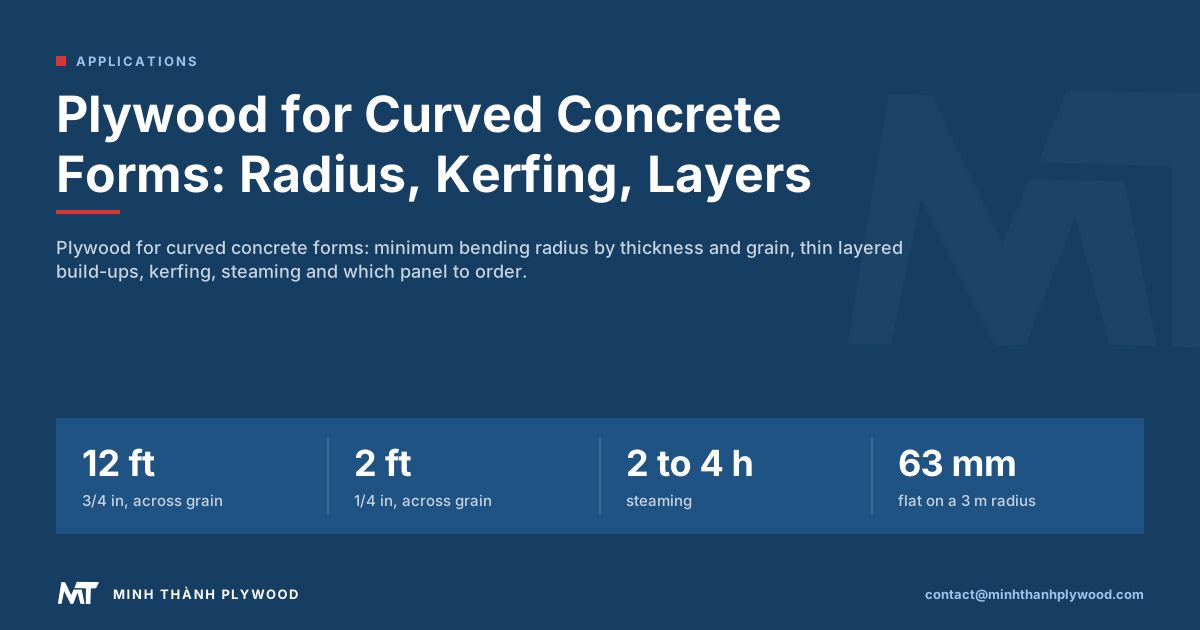
Plywood for curved concrete forms works when the panel is thin enough for the radius, bent in the easier grain direction, and built back up in layers to the stiffness the pour needs. A 3/4 inch (18 mm) sheet bends dry only to about a 12 ft (3.7 m) radius across the grain; a 1/4 inch (6 mm) sheet goes to about 2 ft (0.6 m).
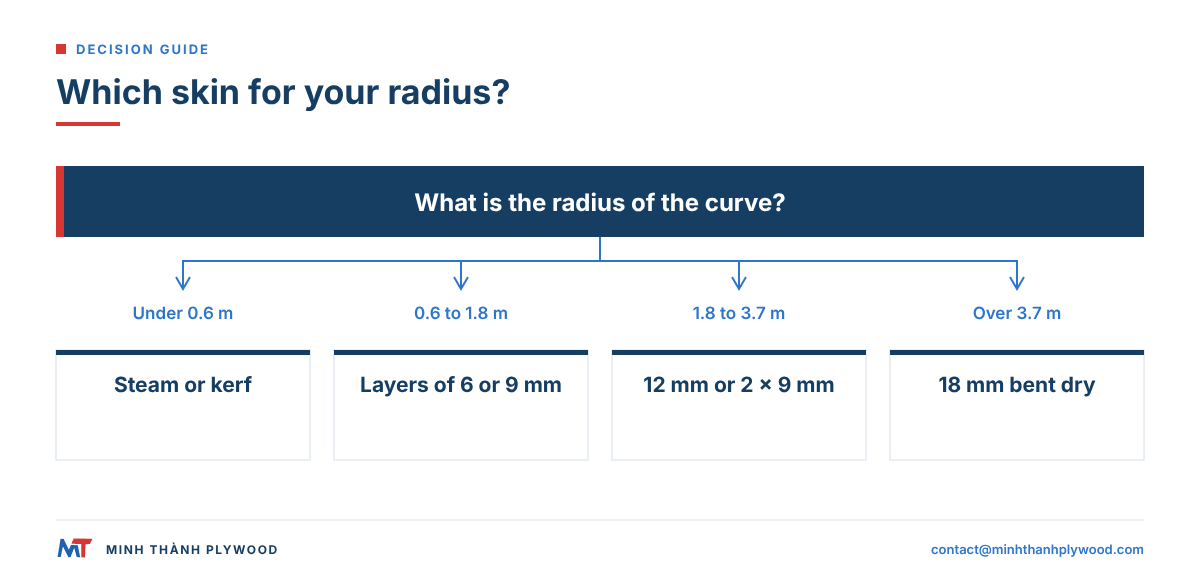
- Tight curves (columns, small tanks): thin layers, bent across the grain, or steamed.
- Medium curves (curved walls, ramps): two or three thin layers, joints staggered.
- Gentle curves: standard 12–18 mm panels bent onto closely spaced ribs.
- Any curve: water-resistant phenolic (WBP) bond, sealed edges, release agent each pour.
The radius table below sets the starting point; the rest of the guide shows how to reach curves the table does not allow.
What is bendable plywood for concrete forms?
Bendable plywood for concrete forms is plywood thin enough, or built to bend, so it follows a curved frame without cracking and moulds the concrete to the curve. It forms the skin of the curved formwork; ribs, walers and ties carry the concrete pressure behind it.
- Thin structural or film-faced plywood: ordinary cross-laminated panels in thin gauges, bent dry or wet.
- Flexible plywood: panels made with most plies running one way so they roll into tight curves.
- Kerfed panels: standard panels with saw cuts on the back so they bend more.
- Layered build-ups: two or three thin layers bent one at a time and fixed together.
Each option trades bend for stiffness and face quality. For an overview of flexible panels outside formwork, see our guide to flexible plywood.
Minimum bending radius by thickness and grain direction
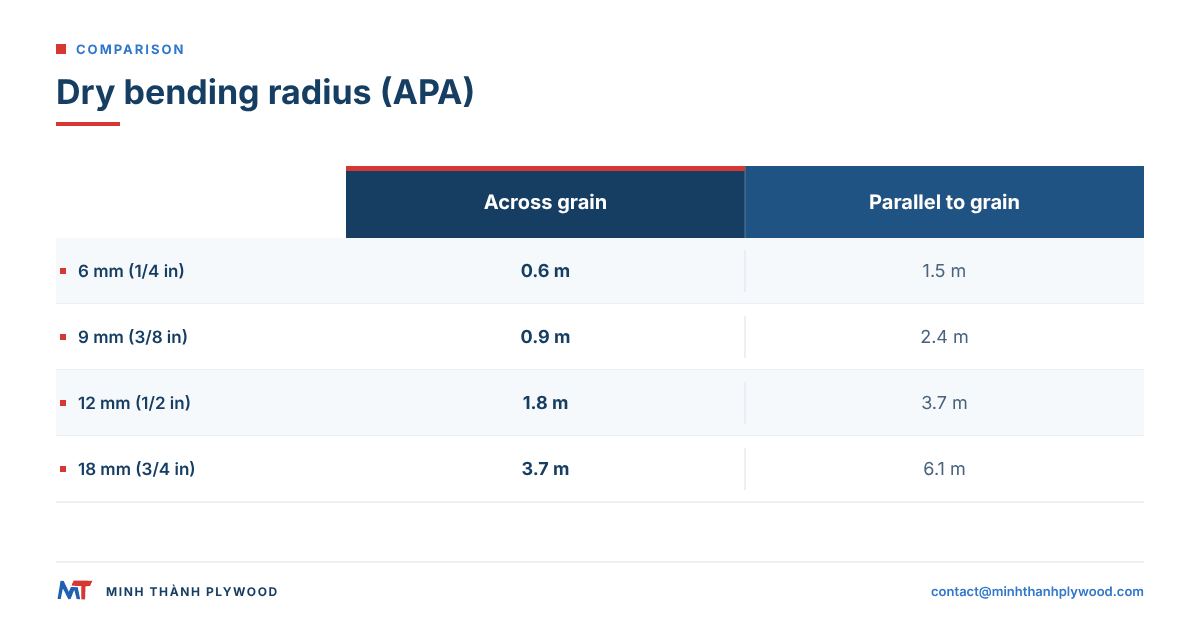
The minimum radius for dry bending grows fast with thickness: APA’s technical note TT-003 gives about 2 ft across the grain for 1/4 inch plywood and 12 ft for 3/4 inch, and roughly double those figures parallel to the grain. These are minimums for mill-run panels bent dry, and APA notes the occasional panel can still crack at them.
| Panel thickness | Nearest metric panel | Radius across grain | Radius parallel to grain |
|---|---|---|---|
| 1/4 in | 6 mm | 2 ft (0.6 m) | 5 ft (1.5 m) |
| 5/16 in | 8 mm | 2 ft (0.6 m) | 6 ft (1.8 m) |
| 3/8 in | 9 mm | 3 ft (0.9 m) | 8 ft (2.4 m) |
| 1/2 in | 12 mm | 6 ft (1.8 m) | 12 ft (3.7 m) |
| 5/8 in | 15 mm | 8 ft (2.4 m) | 16 ft (4.9 m) |
| 3/4 in | 18 mm | 12 ft (3.7 m) | 20 ft (6.1 m) |
Source: APA, Bending Plywood, Form TT-003 (read 20 October 2026); metric values are conversions. Metric panels are slightly thinner than their inch equivalents, so treat the table as a safe starting point and test a sample at the project radius.
Which way should the grain run on a curved form?
Run the face grain parallel to the axis of the curve: vertical on a round column or curved wall, so the sheet bends across its face grain. That direction bends much tighter: APA gives 12 ft instead of 20 ft for 3/4 inch plywood, and 2 ft instead of 5 ft for 1/4 inch.
- Find the curve’s axis: vertical for columns and curved walls, horizontal for barrel vaults and ramps that curve in section.
- Set the face grain along that axis: the sheet’s long edge usually runs with the face grain.
- Order sizes to suit: a 1220 × 2440 mm sheet stood upright puts its grain vertical for a column.
- Mark the grain direction on every cut piece before it goes to the form.
On panels with an odd number of plies, the face and back plies run the same way, so the face direction decides the bend.
Thin layered build-ups: two or three layers instead of one
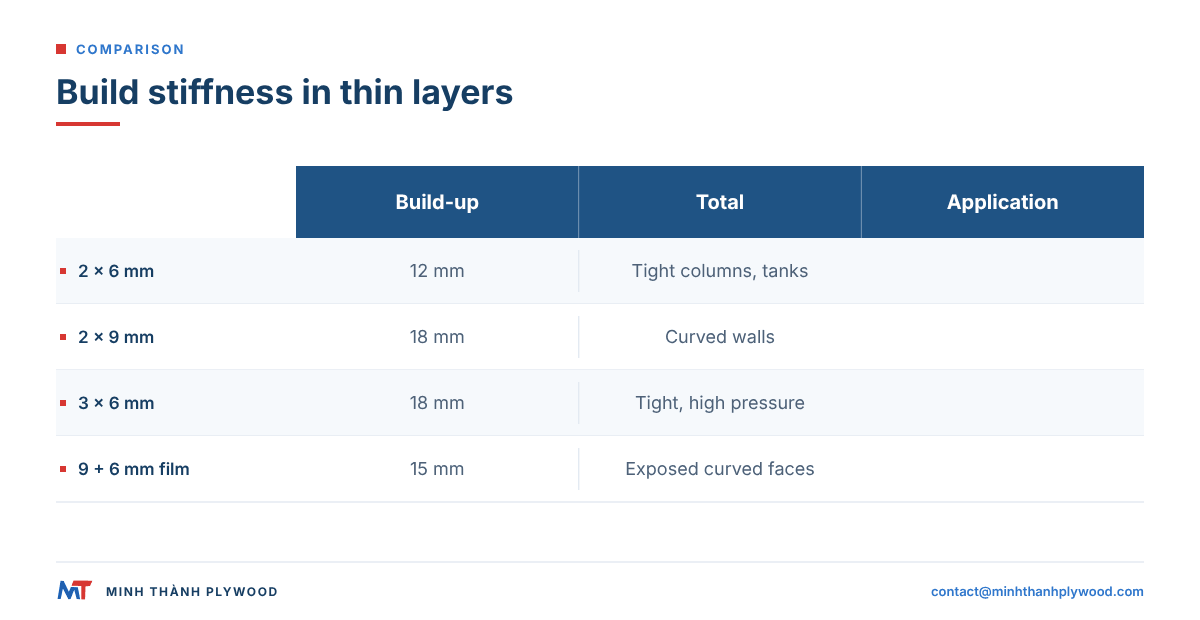
The most reliable way to form a tight curve with a stiff skin is to build it from two or three thin layers: each layer bends easily, and the formwork designer specifies the bonding and fasteners needed for the combined stiffness. Two 9 mm layers reach a curve a single 18 mm sheet cannot.
- Fix the first layer to the curved ribs, bent across the grain, with joints over a rib.
- Seal its edges where they will meet concrete or water.
- Bend the second layer over the first, with joints staggered by at least one rib spacing.
- Screw from the back where possible, so screw heads do not mark the concrete face.
- Add a third layer only if the design needs more stiffness.
- Finish with the face layer: a thin film-faced or smooth phenolic sheet gives the cleanest concrete.
| Build-up | Total thickness | Bends like | Use |
|---|---|---|---|
| 2 × 6 mm | 12 mm | 6 mm sheet | Tight column and tank curves |
| 2 × 9 mm | 18 mm | 9 mm sheet | Curved walls |
| 3 × 6 mm | 18 mm | 6 mm sheet | Tight curves with high pressure |
| 9 mm + 6 mm film-faced face | 15 mm | 9 mm sheet | Exposed curved faces |
| 1/4 in (6 mm) MDF or hardboard bender board, 3-3/8 × 96 in strips | 6 mm per strip | Bends to tight radii | Curved slab edges, one or two pours |
Bender board is the US retail strip for tight curved edges: Home Depot sells it as 1/4 in × 3-3/8 in × 96 in MDF (checked on 21 October 2026). It is cheap and bends easily, but its fibre core swells when it takes water, so it suits a single pour. Strips cut from phenolic (WBP) plywood stand wet concrete and release better and give more reuses on repeated curved edges.
Our thin plywood of 3–5 mm is always five plies, and thin panels can be ordered with a water-resistant bond for formwork layers.
Kerfing: when saw cuts help and when they show
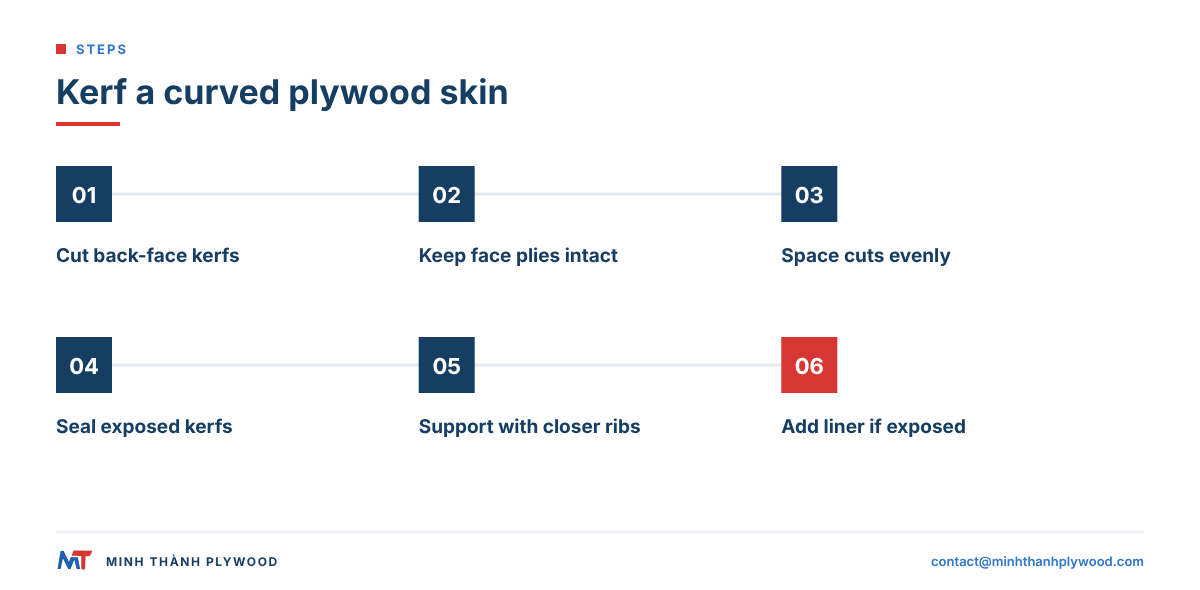
Kerfing means cutting a row of evenly spaced saw cuts across the back of a panel, parallel to the curve’s axis, so the remaining plies bend to a tighter radius. It is quick and needs no special panels, but it weakens the sheet and the cuts can telegraph through to the concrete.
- Cut on the back only: the concrete face stays continuous.
- Leave the face plies intact: cut through the core plies, not the face.
- Space kerfs evenly: closer spacing gives a tighter, smoother curve.
- Seal the kerfs: bare core inside the cuts takes water during the pour.
- Back the curve: kerfed panels need closer ribs because they lose stiffness.
- Use a liner for exposed faces: a thin smooth sheet over the kerfed panel hides the flats between cuts.
Kerfing suits one-off forms and hidden concrete; for repeated or exposed curves, layered build-ups give a better face.
Wetting and steaming plywood for tighter bends
Wet or steamed plywood bends to tighter radii than dry plywood; APA describes soaking the bend area overnight with wet cloths, or steaming it for two to four hours, then bending while the wood is still warm. Only exterior-type plywood, with a waterproof phenolic (WBP) glue line, should be wetted or steamed.
- Choose a WBP-bonded panel; interior glue lines can fail when soaked.
- Wet or steam the bend area until the plies are saturated and warm.
- Fasten the outside edge first, then work from the tightest part of the curve to the flattest.
- Hold it in place until it dries; it will try to spring back if released.
- Seal and oil once dry, before the pour.
Steaming can raise the grain or check the face, which matters on exposed concrete. For film-faced panels, test a sample: the film does not soften like the wood and can craze on tight bends.
Faceted or true curve: how much each panel width flattens the curve
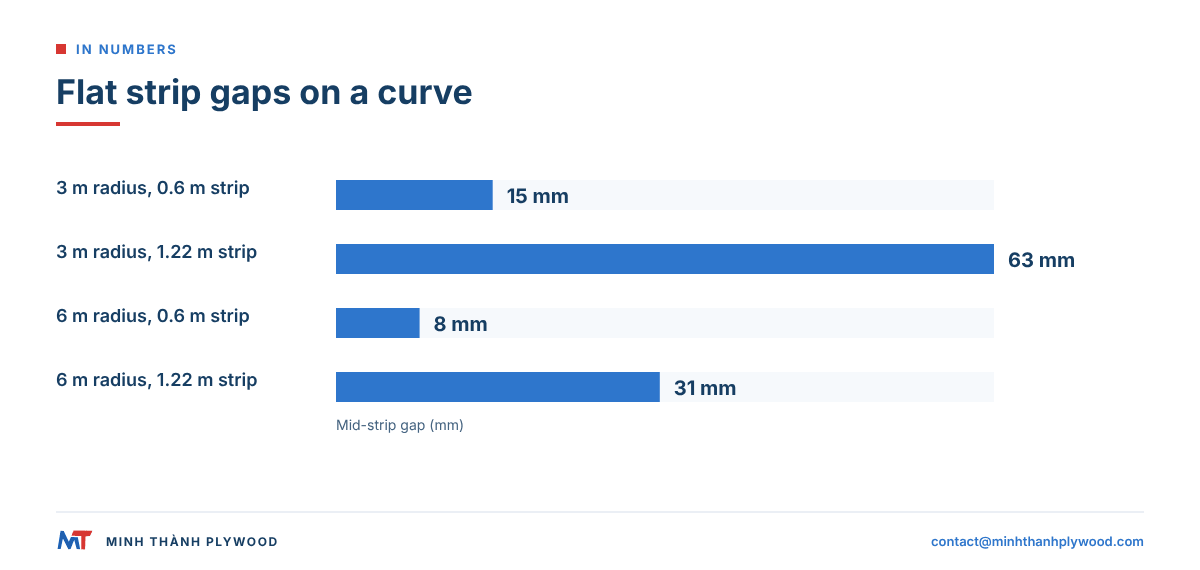
A flat panel spanning a curve leaves a gap at its middle, called the sagitta, and that gap decides whether flat panels are acceptable or the skin must bend. The narrower the panel strip and the larger the radius, the smaller the flat.
| Radius | Strip width | Gap at mid-strip | Read as |
|---|---|---|---|
| 3 m | 0.6 m | 15 mm | Visible facets |
| 3 m | 1.22 m | 63 mm | Clear polygon |
| 6 m | 0.6 m | 8 mm | Slight facets |
| 6 m | 1.22 m | 31 mm | Visible facets |
The gap is radius minus the square root of radius squared minus half the strip width squared. Where a smooth curve is specified, bend the skin to the curve rather than relying on narrow flat strips.
Curved formwork by element: walls, columns, tanks and ramps
Curved formwork for each element combines a frame that holds the curve and a plywood skin that follows it. The frame decides accuracy; the skin decides the finish.
| Element | Frame | Plywood skin | Notes |
|---|---|---|---|
| Round column | Steel or timber rings, vertical battens | Two thin layers, grain vertical | Tight radius; clamp rings at close centres |
| Curved wall | Shaped timber or LVL ribs on walers | 2 × 9 mm or 12 mm bent dry | Ribs cut to the radius on both faces |
| Water tank | Ribs and ring walers | Layered thin panels, WBP bond | High pressure at the base |
| Curved ramp or stair | Shaped bearers | 9–12 mm bent on edge or layered | Curve in plan and in section |
| Curved slab edge | Kerfed or thin edge strips | 6–12 mm strips | Short height, tight radii |
The pillar guide to formwork by element covers each element’s frame in more depth, and our guide to column formwork with plywood covers round and square columns.
Concrete pressure, supports and ties on a curved form
A curved skin carries wet concrete pressure the same way a flat one does, but a thin bent panel is less stiff, so ribs, walers and ties sit closer. The formwork designer sets that spacing from the pour rate, height and concrete mix. In the US, OSHA standard 1926.703 sets the requirements for cast-in-place concrete formwork; in Europe, falsework design follows EN 12812.
- Slab pressure: normal-weight concrete loads a slab form with 12.5 psf per inch of slab thickness, plus live load from workers and equipment, according to APA (checked on 21 October 2026). A curved soffit carries the same dead load per area as a flat one.
- Rib spacing follows the skin’s thickness: thin layers need closer ribs.
- Ties pass through the curve at right angles to its surface.
- Joints sit over ribs, never between them.
- Bending stresses from the curve add to the pour stresses in the skin; the designer allows for both.
- Pressure, deflection and support spacing are worked out together, element by element, by the formwork designer.
A layered skin is stiffer than a kerfed one of the same thickness, which is another reason to prefer layers on tall pours.
Bond, face and edges for curved plywood forms
Curved forms see more water at the edges and more stress in the glue lines than flat forms, so the bond and edge sealing matter even more. Choose phenolic (WBP) for repeated or steamed curves and melamine-fortified for single-use curves on short projects.
| Choice | Option | Why on curves |
|---|---|---|
| Bond | Phenolic (WBP) | Survives wetting, steaming and repeated pours |
| Bond | Melamine-fortified (MR) | Cost-effective for one or two pours |
| Face | Smooth film | Clean exposed concrete, easy release |
| Face | Sanded plywood | Painted or lined forms |
| Edges | Painted after every cut | Bent panels open fine checks at the edges |
US grades for curved forms: Plyform, HDO and MDO
US specifiers name curved-form panels by APA grade, and the same bending radii apply:
| US grade | What it is | Fit for curved work |
|---|---|---|
| Plyform Class I | Group 1 species on the faces, made to PS 1 | The standard concrete-forming panel |
| Plyform Structural I | Group 1 species throughout, for the most load | Engineered forms; face grain parallel to the supports |
| HDO (high density overlay) | Hard phenolic resin surface; APA states up to 200 or more reuses with care | Smoothest finish and most pours |
| MDO (medium density overlay) | Resin-fibre overlay | Good finish, fewer reuses than HDO |
Plyform is made to the US Product Standard PS 1, and NIST lists PS 1-22 as the current structural plywood standard. APA’s Form A236 explains why code-compliant formwork follows PS 1 under ACI 318 and ACI 347, with minimum bending radii in its Concrete Forming Design and Construction Guide, Form V345 (APA concrete forming, checked on 21 October 2026). Where a US project names Plyform, buy APA-trademarked panels; our film-faced plywood suits projects that specify core, glue and film instead.
Panel sizes for curved forms
US panels come in 48 × 96 in, 48 × 120 in and 60 × 96 in sheets (PG Wood Imports, checked on 21 October 2026), with 3 to 15 mm thin sheets used for curves. Metric sheets are 1220 × 2440 mm and 1250 × 2500 mm, so a 48 × 96 in order matches our 1220 × 2440 mm size.
Our film-faced panels carry film of about 120–135 g/m² standard or from about 135 g/m² premium, on Eucalyptus or Acacia cores, with ±0.5 mm thickness tolerance.
How to test a panel at your radius before ordering
Test a sample bent at the project radius before you order a container: the bending table is a guide, and wood, glue and film behave panel by panel. Ask for free samples in the thickness and bond you plan to use.
- Cut a strip the full sheet length, with the face grain as it will run on site.
- Bend it dry over a template at the project radius and leave it for a day.
- Check for cracks on the outside face and splits along the glue lines.
- Check the film on film-faced samples for crazing or lifting.
- Soak an offcut and check the glue lines if the form will be wetted or steamed.
- Record the result with photos before you confirm the order.
What this means for your curved-form order
An order for curved formwork plywood names the radius first and builds the panel around it. Send these lines with your request:
- Application: element, radius, exposed or hidden face, planned pours.
- Build: single panel, layered build-up or kerfed panel; thickness of each layer.
- Bond: phenolic (WBP) or melamine-fortified (MR).
- Face: smooth film (standard or premium mass) or sanded.
- Size: 1220 × 2440 mm or 1250 × 2500 mm, grain direction marked; thickness tolerance ±0.5 mm on film-faced panels.
- Packing and quantity: from one 40HC, mixed thicknesses by agreement; destination port.
Production is 15–45 days after the deposit, FOB Hai Phong, CFR or CIF. See our film-faced plywood page, our guide to LVL formwork timber for straight ribs and bearers, and slab edge formwork for curved edges.
Buyer questions, answered
What plywood is best for curved concrete forms?
Thin plywood with a water-resistant phenolic (WBP) bond, bent across the grain, is best for tight curves; two or three thin layers glued or screwed together give the thickness the form needs. A thin film-faced liner gives the smoothest concrete face.
How tight can you bend 3/4 inch plywood?
Bent dry, 3/4 inch plywood has a minimum radius of about 12 ft (3.7 m) across the grain and 20 ft (6.1 m) parallel to it, according to APA's bending table. Tighter curves need thinner layers, kerfing or steaming.
Which way should plywood grain run on a curved form?
Run the face grain parallel to the axis of the curve, for example vertical on a round column. Bent this way, 3/4 inch plywood reaches about 12 ft instead of 20 ft, according to APA.
What is bendable plywood for concrete forms?
Bendable plywood for concrete forms is thin or specially built plywood that bends to a curve without cracking, used as the skin or liner of curved walls, columns and ramps. It needs a water-resistant bond and sealed edges to survive the pour.
Can film faced plywood be bent?
Thin film-faced plywood bends to moderate curves, and the film stays sound when the radius respects the panel thickness. On tight bends the film can craze, so check a sample at the project radius.
How do you kerf plywood for a curved form?
Cut evenly spaced saw kerfs across the back of the panel, parallel to the curve's axis, to a depth that leaves the face plies intact. Closer kerfs give a tighter curve; keep kerfs on the back, away from the concrete.
Can you steam or wet plywood to bend it tighter?
Yes. Soaking overnight or steaming for two to four hours softens the plies so they bend tighter, according to APA. Use exterior-type plywood with a phenolic bond, and fasten it to the ribs while it is still warm.
How many layers of plywood should a curved form have?
Two or three thin layers are typical: each bends easily on its own, while the combined stiffness depends on the layer bonding and fastener design. Stagger the joints between layers so no seam runs through.
How many times can curved plywood forms be reused?
Fewer than flat forms, because bending, fixings and stripping stress the panels more. Reuse depends on the bond, the film, edge sealing and careful stripping; plan curved liners per project.
What do I send to get a quote for curved formwork plywood?
Send the radius, the element, the face finish you need, the panel thickness or layers, the bond, the size and the quantity. We reply within hours and send free samples to test at your radius.