
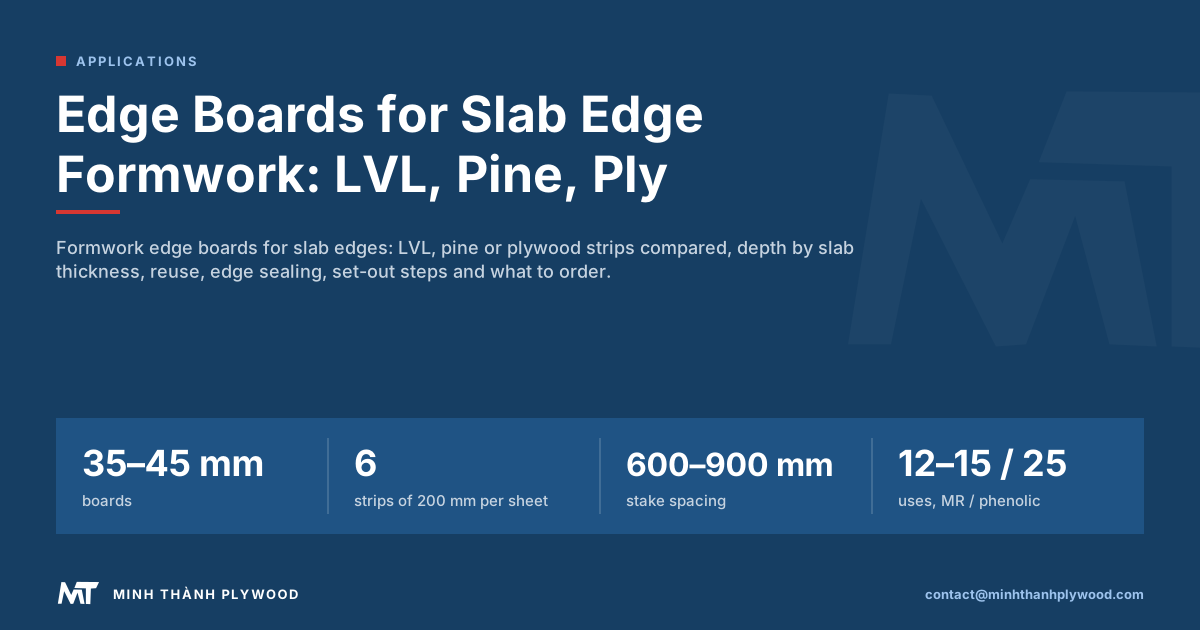
Edge boards are the vertical boards that close the edge of a concrete slab, footing or pool beam and set its finished level. LVL holds a straight line and survives the most pours, sawn pine is the cheapest one-off choice, and film-faced plywood strips give a clean face where the edge stays visible. Minh Thanh Plywood makes the LVL and plywood they are ripped from.
What are edge boards?
Edge boards are the vertical formwork boards that close the edge of a concrete pour and set its finished level. They run around slab perimeters, footings, steps, kerbs, driveways and pool beams, staked or braced from outside, with the top edge set to the finished concrete height so the screed bar slides along it.
Builders and suppliers use several names for the same item: edge boards, edge forms, edgeform, formwork edge boards and slab edge boards. In Australia and New Zealand the common product is “LVL edgeform”, a straight laminated veneer lumber board sold in standard depths. In the UK and Europe the same job is often done with sawn timber or plywood strips, and on high-rise slabs with steel or plastic edge systems.
An edge board does three jobs. It contains the concrete, which presses outwards while wet. It sets the level and line of the finished edge. And it moulds the edge face, which stays visible on exposed slabs, stairs and paths.
Concrete edge boards: sizes in inches, lengths and US names
Concrete edge boards in the US are ordinary dimension lumber, usually 2 × 4 for a 4 in slab and 2 × 6 or deeper for thicker edges, sold in 8, 10, 12 and 16 ft lengths. “Edge boards” can also mean decorative natural-edge wood or cutting boards; this guide is about the boards that hold wet concrete, also called edge forms, form boards, side forms or screed boards.
Nominal lumber sizes are larger than the real ones, so match the board to the actual depth:
| Nominal size | Actual size | Concrete depth it forms | Metric |
|---|---|---|---|
| 1 × 4 | 0.719 × 3.5 in | Light pad up to 3.5 in, curves | 18 × 89 mm |
| 2 × 4 | 1.5 × 3.5 in | A 4 in slab, with the board set 1/2 in into the base | 38 × 89 mm |
| 2 × 6 | 1.5 × 5.5 in | Slabs 4 to 5.5 in | 38 × 140 mm |
| 2 × 8 | 1.5 × 7.25 in | Edge beams, thickened edges to 7.25 in | 38 × 184 mm |
| 2 × 10 | 1.5 × 9.25 in | Footings and deep edges to 9.25 in | 38 × 235 mm |
| 3/4 in plywood strip | 0.719 in (23/32) | Any depth ripped to size, with a back batten | 18 mm |
Home Depot lists a 1 × 4 × 8 ft board at an actual 0.719 × 3.5 × 96 in, and boards are stocked in lengths of 6, 8, 10, 12 and 16 ft, so a run of 40 ft takes five 8 ft boards, or two 16 ft boards and one 8 ft board with fewer joints. Longer boards mean fewer joints in the line. Stake the outside every 32 in, or every 24 in for a 12 in thick edge, as retail guides advise, and use 3/4 in plywood for curves and for ripped strips where a clean face matters.
The US formwork references are the APA concrete forming guide, which covers Plyform Class I panels in 23/32 and 3/4 in, 4 × 8 ft, and the ACI 347 guide to formwork. NIST lists PS 1-22 as the current structural plywood standard (checked on 27 October 2026). Outside the US the same work is done with LVL edge forms, covered below.
Slab edge formwork: what the edge has to do
Slab edge formwork has to hold a straight line and a true level while wet concrete pushes on it, then strip cleanly without damaging the arris. Every material choice below follows from those three demands.
The load on a ground-slab edge is modest because the edge is shallow: fresh concrete weighs about 25 kN/m³, so the pressure at the foot of a shallow board stays low and grows with depth. What usually fails is not the board’s strength but its line: a board that bows between stakes gives a wavy edge, and a board that twists lifts out of level.
Edge formwork on suspended slabs carries extra jobs. It closes the deck at the slab perimeter, often carries a handrail or edge protection, and has to be fixed to the deck plywood or the bearers below. Our guide to slab and beam formwork with plywood covers the deck itself; this article covers the edge.
Edge boards compared: LVL, pine and plywood strips
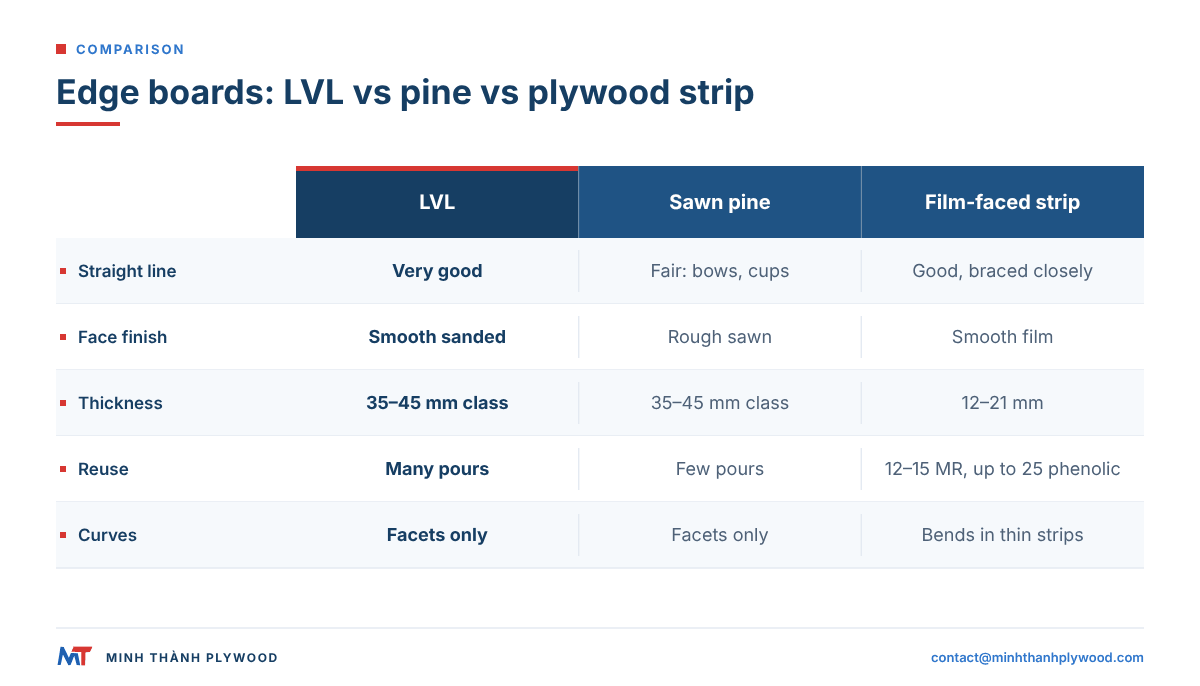
LVL is the best all-round edge board, sawn pine is the cheapest one-off choice, and film-faced plywood strips give the best face where the edge stays visible. The table compares them on the points that decide a builder’s choice.
| What matters | LVL edge board | Sawn pine board | Film-faced plywood strip |
|---|---|---|---|
| Straightness over a long run | Very good: veneers glued with the grain along the board | Fair: bows and cups as it dries | Good when braced closely |
| Dimensional stability when wet | Good, with sealed ends | Fair: swells and splits at nail holes | Good, with sealed edges |
| Concrete face finish | Smooth sanded face | Rough sawn texture transfers to the edge | Smooth film face, the cleanest arris |
| Typical thickness | 35–45 mm class boards | 35–45 mm dressed boards | 12–21 mm strips |
| Reuse | Many pours with cleaning and oiling | Few pours | About 12–15 uses with melamine glue, up to about 25 with phenolic, with proper care |
| Curves | Short facets only | Short facets only | Bends to gentle curves in thin strips |
| Cost per metre | Highest | Lowest | Middle, ripped from sheets |
The choice usually follows the job. A builder pouring the same house slab every fortnight buys LVL once and reuses it. A one-off garden path can use pine. A stair, a visible slab edge or a curved path wants plywood strips.
LVL edge form: why builders choose it
LVL edge form stays straight because every veneer runs along the board, glued under heat and pressure into one member with no large knots or splits. That gives a board that holds a string line between stakes and does not cup as it gets wet and dries again.
Laminated veneer lumber is made from rotary-peeled veneers, the same veneers used in plywood, but laid with the grain parallel instead of crossed. Minh Thanh makes LVL from Acacia and Eucalyptus plantation veneers in billet formats of 1220 × 2440 mm and 1250 × 2500 mm, with MR / melamine-fortified or phenolic WBP bonds for wet use. Edge boards are ripped from the billet to the depths the buyer orders.
Three points to check on any LVL edgeform:
- Bond. Formwork gets wet every pour; ask for a phenolic or melamine-fortified water-resistant bond, never an interior UF bond.
- Moisture. Boards dried to 8–12 % at dispatch stay straighter in transit and on site.
- End and edge sealing. Sealed ends stop water entering the glue lines where the board is cut.
In Europe, CE marking of structural LVL falls under the Construction Products Regulation (EU) No 305/2011. An edge board is temporary works, so for this use the bond class matters more than the mark.
Our LVL product page lists the billet sizes, densities and bonds.
Sawn pine and timber edge boards
Sawn pine edge boards are the cheapest per metre and easy to buy in any yard, which makes them the usual choice for one-off domestic slabs. Their weakness is movement: pine bows, twists and splits at nail holes after a few wet and dry cycles, so the line degrades with each pour.
Pine works best on short, straight runs that are staked closely and stripped early. Pick boards with straight grain and few edge knots, keep them dry before the pour, and do not expect them to come back true after several uses.
Hardwood boards and old floorboards appear on site too. They are strong but heavy, often warped, and their texture prints on the edge face. Where the edge will be seen, a sanded LVL or film-faced strip gives a better finish for little extra cost.
Plywood edge strips: when they make sense
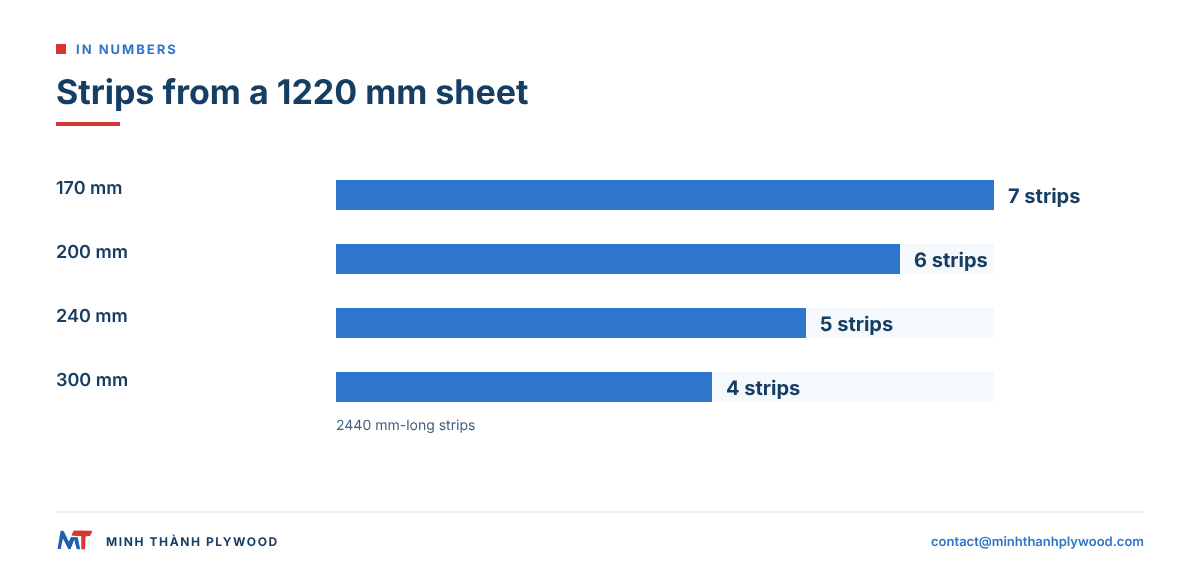
Film-faced plywood strips make sense where the slab edge stays visible, where the edge is curved, or where a contractor already has offcuts from the deck. The smooth film gives a clean arris and releases easily, and one 1220 × 2440 mm sheet rips into several strips of standard depth.
A 1220 mm wide sheet ripped along its length yields, after saw cuts, about:
- 7 strips of 170 mm,
- 6 strips of 200 mm,
- 5 strips of 240 mm,
- 4 strips of 300 mm.
Each strip is 2440 mm long, or 2500 mm from a 1250 × 2500 mm sheet. Order the depths you need as cut-to-size strips and the edges arrive sealed; rip them on site and you must seal them yourself.
Plywood strips are thinner than LVL or pine, so they need closer bracing and a stiffener on deep edges. A strip of 18 mm or 21 mm film-faced plywood with a timber batten screwed along its back stays straight on edges up to the depth of a typical slab.
Minh Thanh presses film-faced plywood from 12 to 21 mm with smooth film of 120–135 g/m², premium from 135 g/m², on Eucalyptus or Acacia cores, with melamine-fortified or phenolic WBP glue. Our film-faced plywood page has the full specification.
What size edge board do you need?
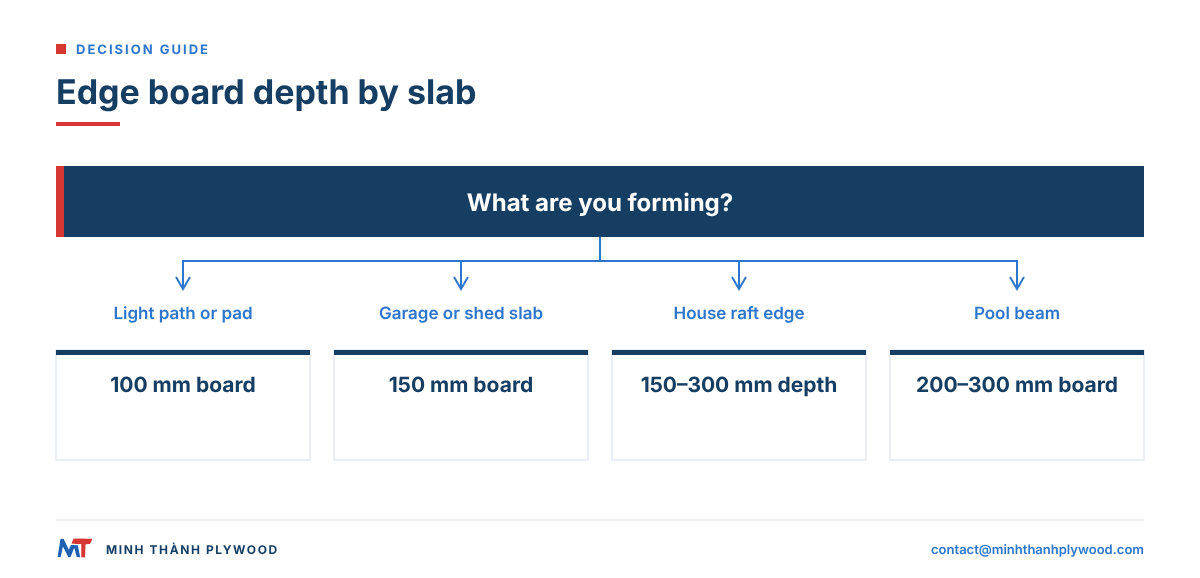
Choose an edge board as deep as the finished concrete at the edge. The top of the board is the finished level; the bottom sits on or slightly into the sub-base. Where a slab has a thickened edge beam, the board must reach the bottom of the beam, either as one deep board or two stacked.
| Slab or element | Typical concrete depth at the edge | Edge board depth to order |
|---|---|---|
| Garden path, light pad | 100 mm | 100 mm |
| Garage or shed slab | 100–150 mm | 150 mm |
| House ground slab, raft edge | 150–300 mm | 150 mm board plus edge beam board, or 300 mm |
| Suspended slab edge | 150–250 mm | Slab depth plus the deck plywood thickness |
| Pool beam or coping edge | 200–300 mm | 200–300 mm, often curved |
Thickness matters less than depth. Boards in the 35–45 mm class are standard for solid timber and LVL; plywood strips of 18 or 21 mm need a back batten on deeper edges. Length follows the run: longer boards mean fewer joints in the line.
How to set out slab edge formwork, step by step
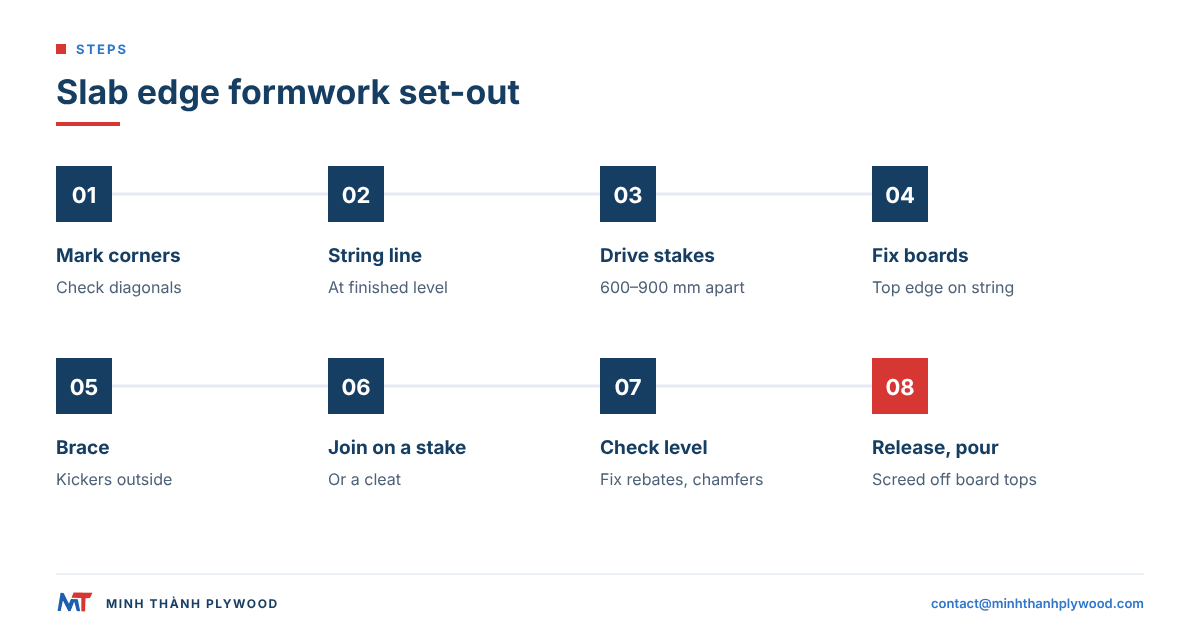
Slab edge formwork is set out from the corners, to a string line and a level, then staked and braced before any concrete arrives. The steps below work for most ground slabs and paths:
- Mark the slab corners from the drawing and check the diagonals are equal, so the slab is square.
- Set a string line at the finished concrete level between corner pegs, allowing for any fall to drains.
- Drive stakes outside the line at the spacing on the drawing, usually about 600 to 900 mm, closer at corners and joints.
- Fix the edge boards to the stakes with their top edge exactly on the string; screw rather than nail where boards will be reused.
- Brace the boards with kickers to stop them leaning out under the concrete.
- Join boards on a stake or with a cleat behind the joint, so the line stays continuous.
- Check level and line along every board with a level and the string, then fix any set-downs, rebates or chamfer strips.
- Apply release agent to the concrete face, thin and even, and keep it off the reinforcement.
- Pour and screed off the board tops, then strip once the concrete can hold its edge, usually the next day.
A rebate for brick or cladding, a set-down for a door threshold, and a chamfer strip for a clean arris are all formed with a fillet fixed to the edge board. Our guide to formwork ties and accessories covers fillets, chamfers and the hardware that holds them.
Pool edge formwork and curved edges
Pool edge formwork follows curves that solid boards cannot, so curved pool beams, spa edges and garden paths are formed with thin plywood strips laminated in layers or with kerfed boards. Two or three layers of thin plywood, bent around closely spaced stakes and screwed together, hold a smooth curve.
Thin plywood bends more easily across the face grain direction, and wetting the strip helps on tight radii. For a tighter curve use more, thinner layers. A pool coping edge is also usually visible, which favours a smooth film face and a chamfer strip.
Our guide to plywood for curved concrete forms covers bending plywood, minimum radii and flexible formwork in more detail.
How to seal the edge of plywood formwork
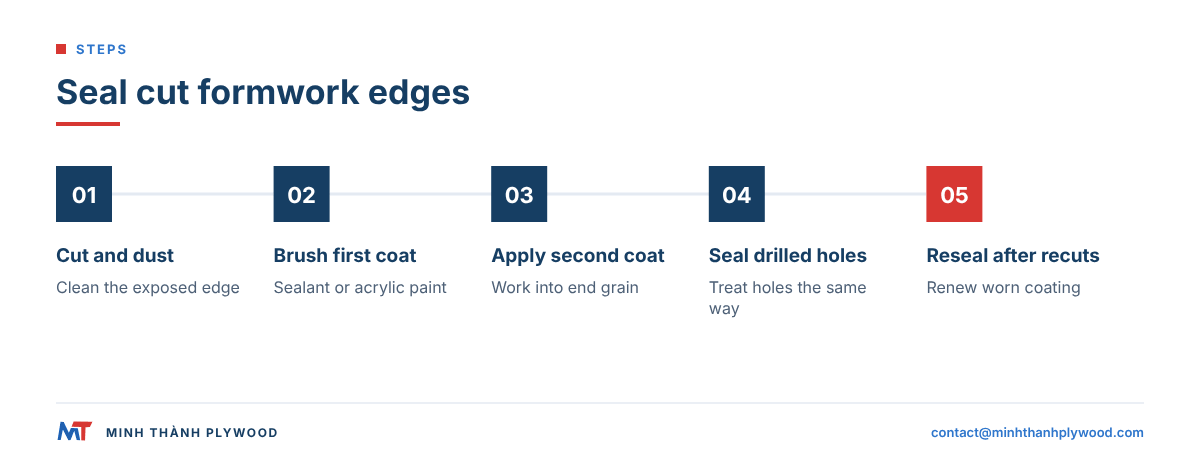
Seal every sawn edge and drilled hole of a plywood or LVL edge board with two brushed coats of a water-resistant edge sealant or acrylic paint before first use. Unsealed edges let water into the core veneers, which swell, open the glue lines at the edge and shorten the board’s life.
The film on a film-faced panel protects its faces, not its edges. Mills paint the factory edges of film-faced sheets; any edge you cut on site is bare wood. The routine:
- Cut the strip and remove dust from the edge.
- Brush on the first coat of sealant or acrylic paint and let it dry.
- Apply a second coat, working it into the end grain.
- Seal every hole drilled for screws, ties or stakes the same way.
- Reseal after every recut and when the edge coat wears through.
Edge banding, the veneer or plastic tape used on furniture panels, is a different product with a different purpose. It is applied with hot-melt glue on edge banders and is not used on formwork; a brushed sealant does the job on site.
Reuse, cleaning and storage of edge boards
Edge boards last longest when they are stripped carefully, cleaned the same day, oiled and stored flat and dry. Most damage happens at stripping: a claw bar levered against the face crushes the film or splits the board’s edge.
Good practice between pours:
- Strip by loosening stakes and braces first, then pull boards away from the concrete rather than prising against it.
- Scrape off set concrete with a plastic or wooden scraper, never a steel blade on a film face.
- Recoat with release agent before the next pour.
- Store boards flat on bearers, off the ground and under cover, sorted by depth.
- Retire boards that have lost their straight edge, because a bowed board spoils every edge it touches.
For film-faced plywood strips, the panel’s reuse figure applies: about 12–15 uses with melamine-fortified glue and up to about 25 with phenolic glue, with proper handling, release agent and edge sealing.
Edge boards on suspended slabs and slab perimeters
On suspended slabs the edge board stands on the deck plywood or on a bearer beyond it, fixed through the deck to the support and braced back to the deck. The board depth is the slab depth plus the thickness of the deck sheet it stands on, if it stands outside the deck.
Two details matter at height. The edge form usually carries or sits next to the edge protection, so its fixing must be checked as part of the temporary works design. The American Concrete Institute’s ACI 347R guide to formwork for concrete is the reference many designers use for loads and tolerances on these edges. In the US, OSHA standard 1926.703 sets the requirements for cast-in-place concrete formwork and shoring. And the edge board often forms the visible slab face of the finished building, which favours film-faced plywood or sanded LVL with a chamfer strip.
Many high-rise contractors use proprietary steel or plastic edge systems on the perimeter. Timber and plywood edges remain the norm on low-rise work, at stairs, at slab steps and around openings.
Common edge board mistakes
Most edge defects come from a few repeated mistakes, and every one of them is avoidable before the pour:
- Stakes too far apart, so the board bows outward under the concrete.
- No bracing, so the board leans and the slab edge flares at the base.
- Unsealed cut edges, so plywood strips swell and the arris breaks out.
- Too much release agent, which stains the edge and leaves surface voids.
- Joints between stakes, which step the line.
- Stripping too early, which breaks the arris while the concrete is still green.
Our guide to concrete surface defects caused by formwork explains bug holes, honeycomb and staining at the edge face.
Ordering edge board stock from a mill
Contractors and distributors who use edge boards in volume buy the stock direct as LVL or film-faced plywood cut to depth. Order by depth and count, with the bond, sealing and packing written in, so the boards arrive ready to use.
Minh Thanh supplies LVL from Acacia or Eucalyptus veneers and film-faced plywood from 12 to 21 mm in one export order. Panels can be cut to size from the standard sheet, and mixed specifications share one 40HC by agreement. Production is 15–45 days after the 30% deposit, FOB Hai Phong, CFR or CIF.
Packing and documents follow the export routine: every shipment is photographed and filmed before loading, and buyers receive the photos and video with the commercial invoice, packing list and B/L.
What to write in your edge board order
Write the specification line so the mill can quote without questions:
Edge boards for slab formwork: film-faced plywood strips, 18 mm, smooth film 135 g/m², phenolic WBP glue, Eucalyptus core; depths 150 mm and 200 mm, length 2440 mm, all edges sealed; quantity per depth; packed on pallets; with 21 mm film-faced sheets 1220 × 2440 mm in the same 1×40HC, CIF your port.
For LVL boards, replace the first line with “LVL, Acacia veneers, phenolic WBP bond, thickness and depths as listed”. Minh Thanh sends free samples and replies within hours: contact@minhthanhplywood.com or WhatsApp +84 988 586 601.
Buyer questions, answered
What are edge boards in concrete formwork?
Edge boards are the vertical boards fixed around the perimeter of a slab, footing, step or pool beam. They hold the wet concrete in place and set the finished height, so the screed runs off their top edge.
What size edge board do I need for a slab?
Choose a board as deep as the slab plus any thickening at the edge. A 100 mm slab takes a 100 mm board, a 150 mm slab a 150 mm board; where the edge beam is deeper, use the beam depth or stack two boards.
Is LVL better than pine for edge formwork?
For repeat work, yes. LVL is straight, dimensionally stable and free of large knots, so it keeps a true line over many pours. Sawn pine costs less per metre but bows, cups and splits sooner.
Can I use plywood strips as edge boards?
Yes. Film-faced plywood ripped into strips gives a smooth face on visible slab edges and stair nosings. Seal every sawn edge and brace the strip more closely than solid timber, because a single strip is thinner.
How do you stop concrete sticking to edge boards?
Apply a thin, even coat of form release agent to the concrete face before the pour, clean off set concrete after stripping and recoat. Film-faced and LVL boards release more cleanly than rough sawn pine.
How do you seal the edge of plywood used in formwork?
Brush two coats of a water-resistant edge sealant or acrylic paint on every sawn edge and drilled hole before first use, and reseal after recutting. Sealed edges stop water swelling the core.
How many times can edge boards be reused?
LVL and film-faced plywood edge boards are reused many times when they are cleaned, oiled and stored flat; film-faced panels give about 12–15 uses with melamine glue and up to about 25 with phenolic glue, with proper handling, release agent and edge sealing.
How do you form a curved slab or pool edge?
Use thin plywood strips laminated in two or three layers, or kerfed boards, bent to the curve and held by closely spaced stakes. Straight LVL or pine boards can only follow a curve in short facets.
How far apart should edge board stakes be?
Follow the formwork drawing; for ordinary ground slabs stakes and braces are usually set about 600 to 900 mm apart, closer at corners, joints and deep edges.
What should I write when ordering edge board stock from a mill?
State the material (LVL or film-faced plywood), thickness, the strip depths and lengths you need, the glue type, edge sealing, the number of pieces per depth and the destination port.