
LVL formwork is laminated veneer lumber cut into bearers, joists, walers and edge boards for concrete forms; the common Australian sections are 95 × 47, 95 × 65, 130 × 77 and 150 × 77 mm, and their spans come from the grade's published table. Minh Thanh Plywood makes LVL from plantation veneers, and this guide sets out sizes, spans and what to specify.
LVL formwork: the short answer
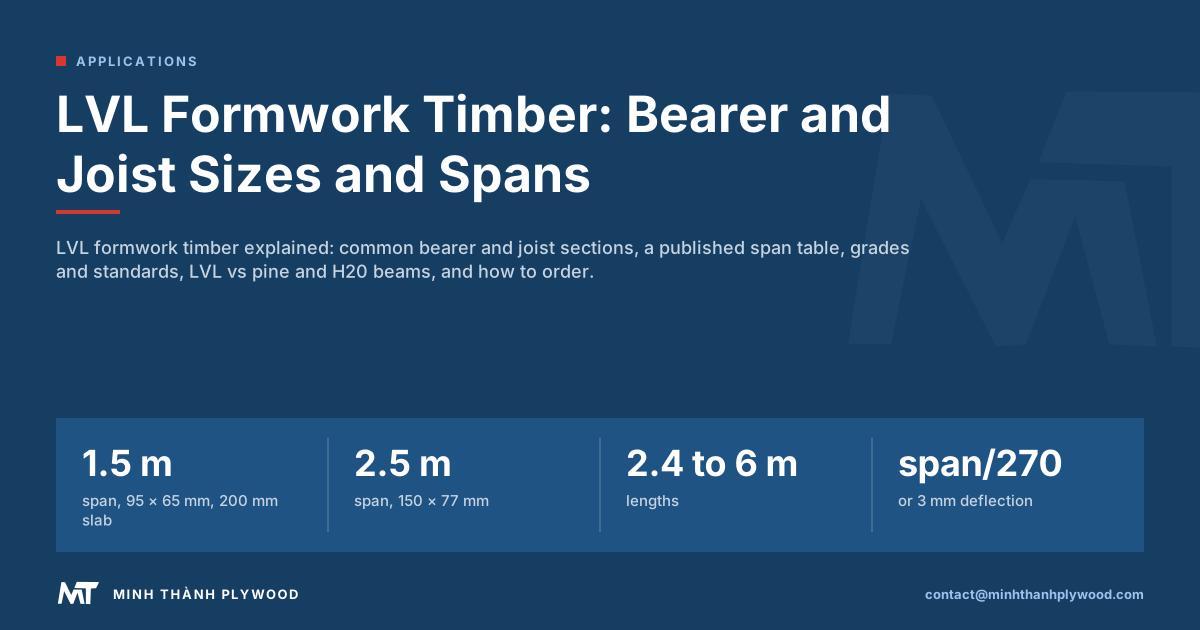
LVL formwork is laminated veneer lumber used for the straight timber members of concrete forms: bearers, joists, soldiers, walers and edge boards. The common sections in Australia are 95 × 47, 95 × 65, 130 × 77 and 150 × 77 mm, in lengths from 2.4 m to 6 m, and each section’s span comes from the published table of the grade you buy.
- Joists under slab soffits: 95 × 65 mm for short spans, 150 × 77 mm for longer ones.
- Bearers carrying the joists: the deeper sections.
- Edge boards: thinner sections such as 100 × 36 mm.
- Spans: set by slab thickness, joist spacing and the grade’s design values.
The sections below give the sizes, a worked span table and the specification lines.
What is LVL formwork timber?
LVL formwork timber is laminated veneer lumber made by bonding thin veneers with their grain running along the member, then cutting it to formwork sections. Because each member is many veneers deep, knots and weak spots are spread through it, so it stays straight and stiff where a sawn timber of the same size may twist, bow or split.
- Veneers: a few millimetres thick each, laid with the grain along the length.
- Glue: phenolic, the weather- and boil-resistant bond needed against wet concrete.
- Finish: arrises (corners) rounded and ends painted to slow moisture uptake.
- Identification: ends are often colour-coded by length so crews pick the right piece.
One supplier’s formwork LVL, for example, is radiata pine veneer 3.5 mm thick with a phenolic bond and about 580 kg/m³ density (formwork LVL guide, PDF, read 20 October 2026).
LVL form work, formwork LVL and form beams: one product, several names
LVL form work, formwork LVL, LVL formwork beams and LVL concrete forms all describe the same thing: LVL members cut for concrete formwork. Searches and price lists use the names interchangeably; the drawing and the grade decide what is actually supplied.
| Name you see | What it usually means |
|---|---|
| LVL formwork, formwork LVL | Formwork-grade LVL members, sold by section and length |
| LVL formwork beams | Bearers and joists in the deeper sections |
| LVL formboards, edge boards | Thin LVL boards for slab and pool edges |
| LVL concrete forms | Forms framed with LVL members and faced with plywood |
| Form ply | The plywood facing, not the LVL frame |
Our guide to LVL vs plywood explains how the two products differ in grain direction and use.
Common LVL formwork timber sizes
The common LVL formwork timber sizes in Australia are four sections, sold in lengths from 2.4 m to 6 m in 600 mm steps. The table gives one supplier’s section, mass per metre and pieces per pack, which also show how heavy a crew’s lift will be.
| Section (depth × width) | Mass per metre | Pieces per pack | Typical use |
|---|---|---|---|
| 95 × 47 mm | 2.6 kg/m | 84 | Light joists, short spans |
| 95 × 65 mm | 3.6 kg/m | 66 | Slab joists, the general section |
| 130 × 77 mm | 5.8 kg/m | 40 | Longer joists, light bearers |
| 150 × 77 mm | 6.7 kg/m | 35 | Bearers and long joists |
Source: formwork LVL product data, PDF (read 20 October 2026). Edge boards are sold separately, for example 100 × 36 mm in 6 m lengths. Other markets use different sections; the design drawing names the one to supply.
LVL formwork span table: joists under a slab
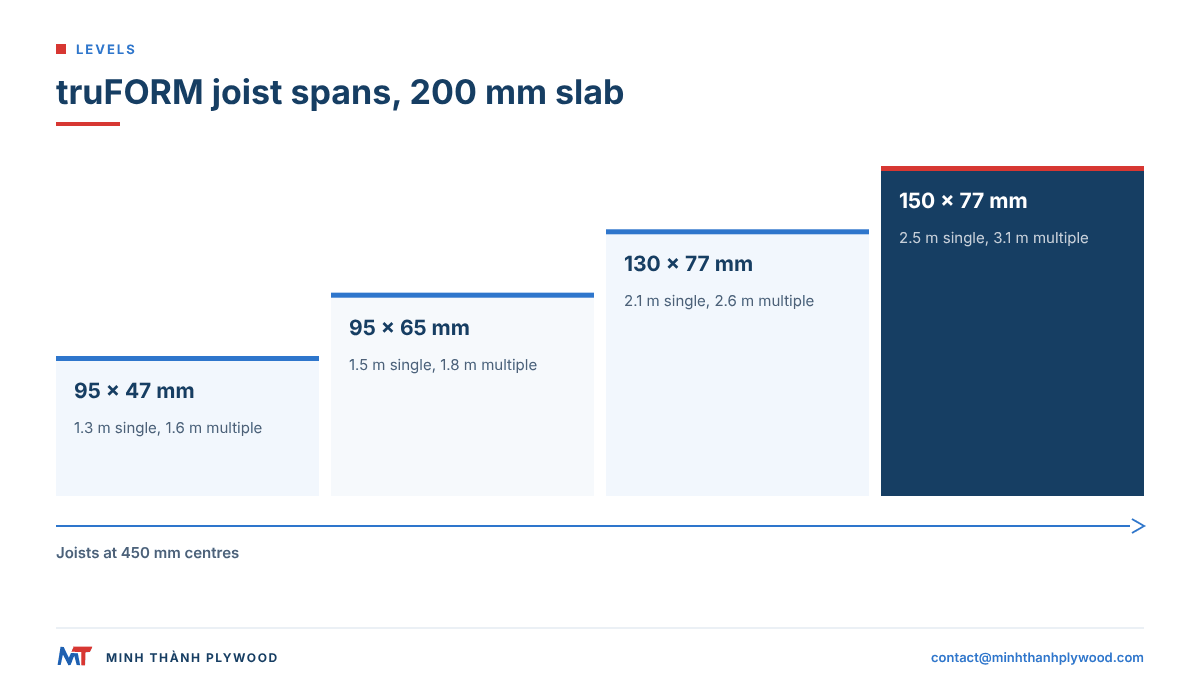
LVL formwork spans depend on the slab thickness, the joist spacing and the grade’s design values; in the June 2012 truFORM table, a 95 × 65 mm joist at 450 mm centres spans about 1.6 m under a 100 mm slab, while a 150 × 77 mm joist spans about 2.7 m. Multiple spans carry further than single spans.
| Section | 100 mm slab, single span | 100 mm slab, multiple span | 200 mm slab, single span | 200 mm slab, multiple span |
|---|---|---|---|---|
| 95 × 47 mm | 1.5 m | 1.8 m | 1.3 m | 1.6 m |
| 95 × 65 mm | 1.6 m | 2.0 m | 1.5 m | 1.8 m |
| 130 × 77 mm | 2.4 m | 2.9 m | 2.1 m | 2.6 m |
| 150 × 77 mm | 2.7 m | 3.4 m | 2.5 m | 3.1 m |
Joists at 450 mm centres. The June 2012 truFORM guide (PDF) uses a deflection limit of the greater of span/270 and 3 mm and includes a 4 kPa allowance for stacked materials. Its multiple-span values assume equal spans carrying equal loads, using the more conservative result for two and three spans. The deflection criterion alone does not guarantee a Class 3 finish under AS 3610. These values apply only to the named truFORM product; use current data for the product you buy, checked by the formwork designer (source read on 3 November 2026).
Bearers, joists, soldiers, walers and edge forms
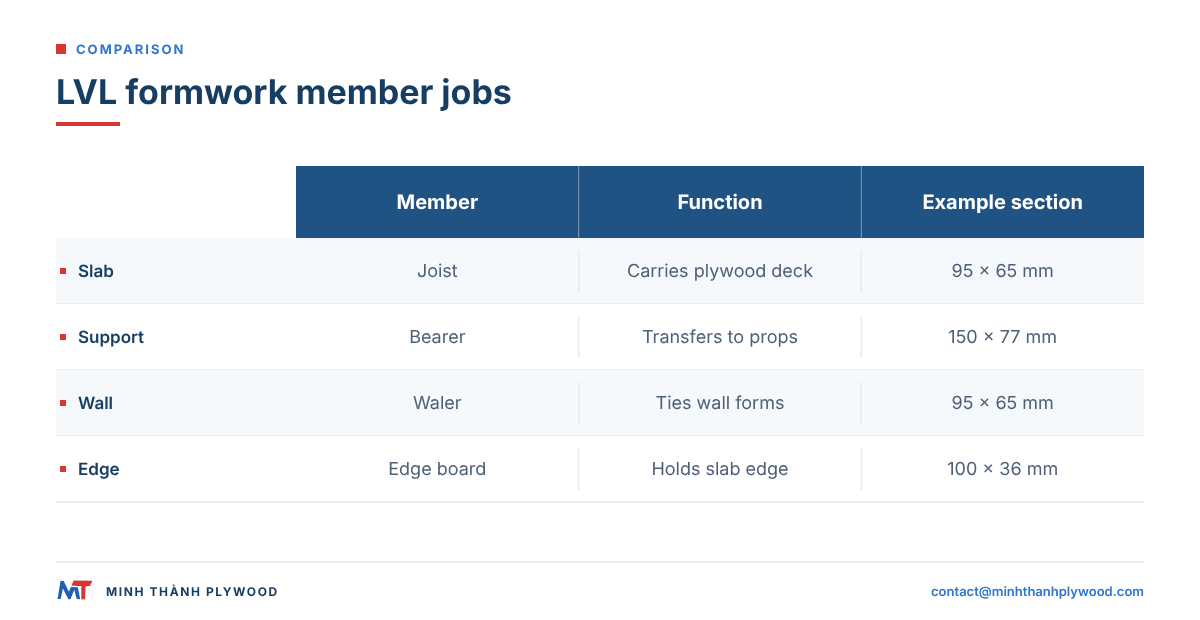
Each LVL member in a form has one job, and the section follows the job. Joists carry the plywood deck; bearers carry the joists to the props; soldiers and walers stiffen wall forms; edge boards hold the slab edge.
| Member | Job | Common LVL section |
|---|---|---|
| Joist | Supports the plywood deck under a slab | 95 × 65 mm or 130 × 77 mm |
| Bearer | Carries joists to props or shores | 130 × 77 mm or 150 × 77 mm, often doubled |
| Soldier | Vertical stiffener on a wall form | Deeper sections, by design |
| Waler | Horizontal member tying wall forms together | 95 × 65 mm and up, often doubled |
| Edge board | Forms the slab or pool edge | Thin boards such as 100 × 36 mm |
For the plywood deck that sits on the joists, see our guide to slab formwork plywood, and for edges, slab edge formwork.
Brands, colour codes, treatment and trade prices in Australia
Australian yards stock formwork LVL under a few names and codes, and the price you compare is per 6 m length or per metre. The codes below are the ones that appear on listings:
| Code on the listing | What it means | Effect on reuse and exposure |
|---|---|---|
| RedEdge | Big River’s LVL edgeboard for concrete formwork, 36 mm thick in 6.0 m lengths | Edge forms for slabs and pool edges |
| Blue end | Colour painted on the ends by the supplier, as on Form Direct’s 6 m formwork LVL | Sorting only; the label gives the section and length |
| H2 or H2S | Termite-resistant treatment for timber used inside, above ground | Protects stored stock; no change to the pour count |
| H3 or H3V | Treatment for external, above-ground use, as on SMART LVL 15 H3 | Weather exposure between pours; no change to the pour count |
| E10, E11, E13, LVL15 | Stiffness class of the LVL | Higher class spans further; check the design table |
For trade price, the 95 × 65 mm section at 6.0 m lists from about A$84 to A$104.50 a length (A$14.00 to A$17.40 per metre), and the 150 × 77 mm section at 6.0 m lists from about A$185 to A$234.80 a length (A$30.80 to A$39.10 per metre). Prices come from Allcon, Auscon, TFX and Jaybro (checked on 21 October 2026), vary with GST treatment and pack quantity, and are the bar an imported LVL competes with.
Sydney yards such as Blacktown Building Supplies stock eight LVL formwork lines and deliver across Sydney, the Blue Mountains and Wollongong.
LVL formwork vs sawn pine and hardwood
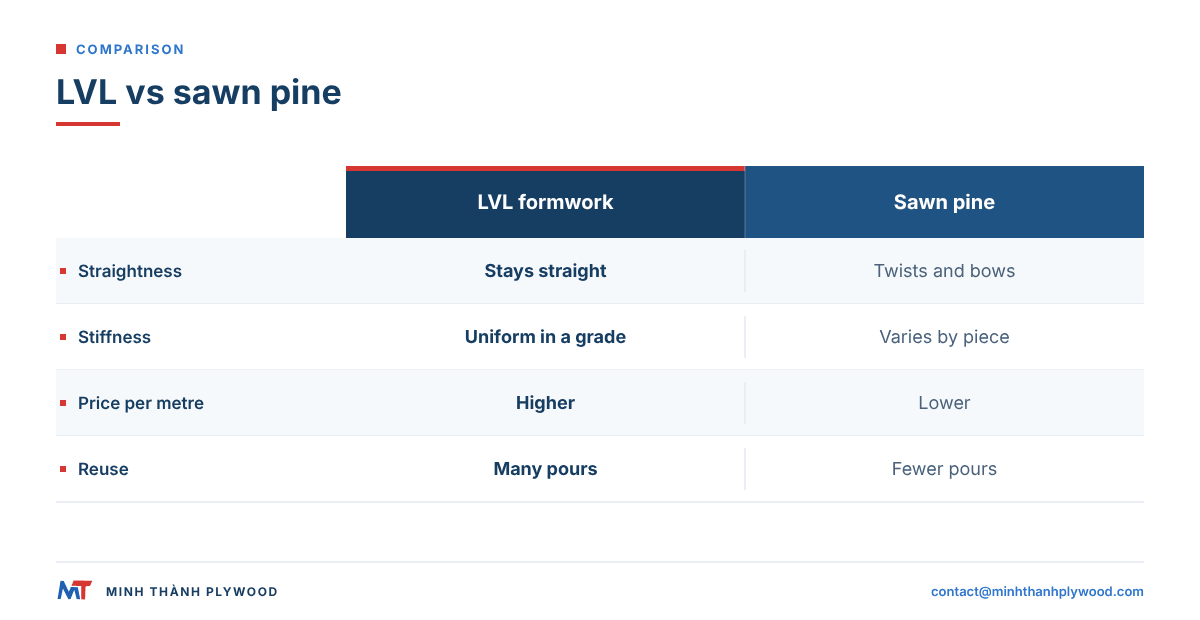
LVL formwork beats sawn pine on straightness and consistency: graded members have more consistent stiffness, so a deck set on LVL joists stays flat over many pours. Sawn pine is cheaper per metre but varies from piece to piece, and it twists, bows and splits as it dries and wets on site.
| Property | LVL formwork | Sawn pine or hardwood |
|---|---|---|
| Straightness | Stays straight when stored well | Twists and bows as it dries |
| Stiffness | Uniform within a grade | Varies piece to piece |
| Knots and splits | Spread through the veneers | Local defects weaken a member |
| Lengths | Long lengths from one piece | Long lengths are scarce |
| Price per metre | Higher | Lower |
| Reuse | Many pours with care | Fewer pours on average |
Over a project, fewer rejects and less re-levelling usually outweigh the higher price per metre.
LVL vs H20 timber beams and aluminium beams
LVL members, H20 timber beams and aluminium beams all carry slab decks; the choice follows span, labour and how often the system is reused. LVL is the simple, solid section that any crew can cut and fix; H20 beams and aluminium beams carry longer spans for their weight but cost more and belong to systems.
| Option | Strength for weight | Cut on site | Best fit |
|---|---|---|---|
| LVL sections | Good | Yes, like timber | Conventional formwork, varied layouts |
| H20 timber beams | High | Not recommended | System slab and wall formwork |
| Aluminium beams | High | No | Large repeated slab areas |
Our guide to H20 timber beams covers the I-beam option in detail.
Grades, standards and what makes formwork LVL structural
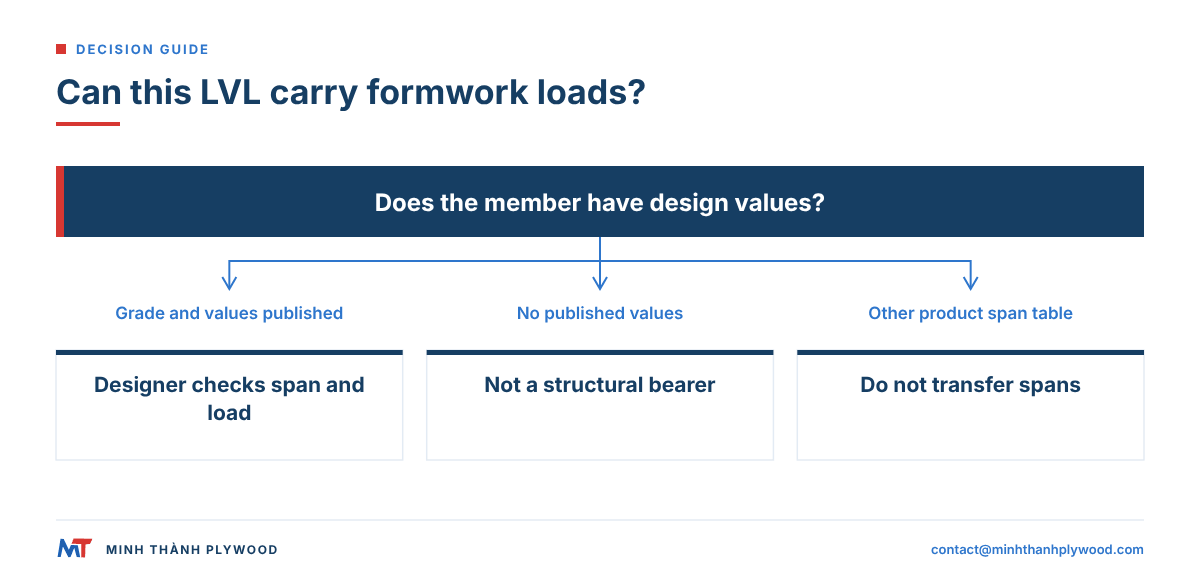
Formwork LVL is structural when it is made, tested and graded to a structural LVL standard and carries the design values the formwork designer uses; in Australia and New Zealand that is AS/NZS 4357, and formwork is designed to AS 3610. A member without published design values is not a structural bearer, however straight it looks.
- AS/NZS 4357: structural laminated veneer lumber, its manufacture and characteristic values.
- AS 3610: formwork for concrete, including the surface finish classes the span tables use.
- United States: OSHA standard 1926.703 sets the requirements for cast-in-place concrete formwork.
- Bond: phenolic, marine-type bond for wet use.
- Product certification: third-party audit of the mill and product, shown on the branding.
The product data used above is one example of a graded formwork LVL with its own tables. When you compare offers, compare the grade, the design values and the certificate along with the section.
Care, storage and reuse of LVL formwork
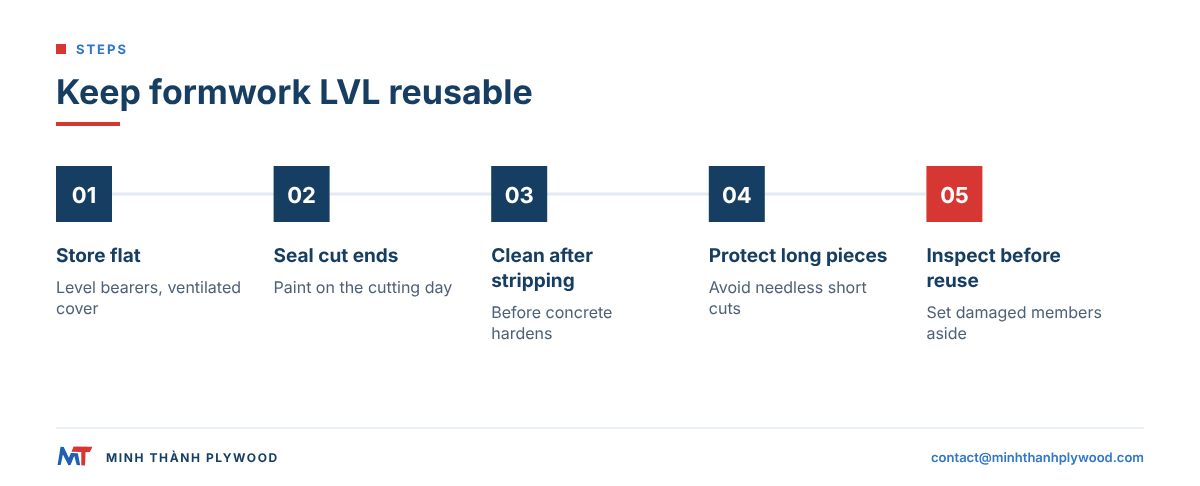
LVL formwork is reused pour after pour when it stays dry between uses, flat in storage and whole. The phenolic glue line resists water, but end grain and fresh cuts still take water in.
- Store flat on level bearers, clear of the ground and under a ventilated cover.
- Seal cut ends with end-grain paint the same day they are cut.
- Clean off concrete after stripping, before it hardens.
- Do not cut long members short for a one-off need when a short piece is in stock.
- Check straightness before reuse; set bowed or damaged members aside for assessment before reuse.
Our guide to film-faced plywood storage and maintenance covers the same routine for the deck panels.
LVL formwork in Singapore, South-East Asia and other markets
Outside Australia and New Zealand, contractors in Singapore and across South-East Asia use LVL members for the same jobs, ordered by section and length to the project engineer’s design. The rule does not change: the span comes from the design values of the grade supplied, not from another market’s table.
- Name the section and length on the drawing.
- Name the grade and design values the engineer used.
- Ask for the bond: phenolic for formwork.
- Plan the freight: typical days at sea from Hai Phong to South-East Asia are 5–12, by carrier and route.
How we supply LVL from Vietnam
We make LVL from locally grown Acacia or Eucalyptus plantation veneers, in billets of 1220 × 2440 or 1250 × 2500 mm, cut to the member section on your drawing. Density is about 580 kg/m³ for Acacia and 650–750 kg/m³ for Eucalyptus, and moisture is 8–12 % at dispatch.
| Line | Our LVL |
|---|---|
| Veneers | Acacia or Eucalyptus plantation timber |
| Billet formats | 1220 × 2440 or 1250 × 2500 mm |
| Density | Acacia about 580 kg/m³; Eucalyptus 650–750 kg/m³ |
| Moisture | 8–12 % at dispatch |
| Bond for formwork | Phenolic (WBP); MR / melamine-fortified on request |
| Documents | Origin dossier, shipping photos and video |
For European orders we supply the EUDR compliance dossier (origin records and geolocation files) required under Regulation (EU) 2023/1115 (read 20 October 2026). Vietnam is listed as low risk in Implementing Regulation (EU) 2025/1093. For members designed to a span table, the order names the grade and design values the engineer requires. See our laminated veneer lumber page for the full specification.
What to write on an LVL formwork order
An LVL formwork order that can be quoted and checked lists each member by its job, section, length and grade. Send these lines with your request:
- Application: slab, wall, column or edge formwork; planned pours.
- Members: joists, bearers, walers or edge boards, each with section and length.
- Grade: the design values or standard the engineer requires.
- Bond: phenolic (WBP) for formwork.
- Finish: rounded arrises, end paint, any colour coding.
- Packing and quantity: from one 40HC, mixed sections by agreement; destination port.
Production is 15–45 days after the 30% deposit, FOB Hai Phong, CFR or CIF, with free samples. Read our guide to plywood for curved concrete forms for curved work, and the film-faced plywood page for the deck.
Buyer questions, answered
What is LVL formwork?
LVL formwork is laminated veneer lumber used as the timber members of concrete formwork: bearers, joists, soldiers, walers and edge boards. Its veneers run along the member, so it is straighter and more uniform than sawn timber of the same section.
What sizes does LVL formwork timber come in?
Common Australian formwork LVL sections are 95 × 47, 95 × 65, 130 × 77 and 150 × 77 mm, in lengths from 2.4 m to 6 m in 600 mm steps. Edge boards are thinner, such as 100 × 36 mm.
How far can a 150 × 77 LVL joist span?
In the June 2012 truFORM table for a 200 mm slab with joists at 450 mm centres, a 150 × 77 mm formwork LVL spans about 2.5 m single span and 3.1 m over multiple spans. The values apply only to truFORM under that guide's stated span and load assumptions.
Is LVL formwork better than pine?
For repeated use, yes in most cases: LVL is straighter, distributes natural defects through its veneers and offers more consistent stiffness, so forms stay true over more pours. Sawn pine costs less per metre but twists and splits sooner.
Can LVL formwork be reused?
Yes. Formwork LVL with a phenolic bond and painted ends is reused pour after pour when it is kept clean, stored flat and not cut into short pieces needlessly.
What standard applies to structural LVL formwork in Australia?
Structural LVL is made and graded to AS/NZS 4357, and formwork is designed to AS 3610. The span table you use must come from the grade and product actually supplied.
Is LVL formwork the same as LVL form work?
Yes. LVL form work, formwork LVL, LVL formwork timber and form LVL all describe the same laminated veneer lumber members used in concrete formwork.
What glue is used in formwork LVL?
Formwork LVL uses a phenolic bond, the weather- and boil-resistant glue line that survives repeated wetting. Interior UF glue is not suitable for concrete formwork.
Can I buy LVL formwork from Vietnam?
Yes. We make LVL from Acacia or Eucalyptus plantation veneers with a phenolic (WBP) bond for wet use, cut from 1220 × 2440 or 1250 × 2500 mm billets to the section on your drawing.
What affects LVL formwork timber prices?
Section size, length, grade and certification, glue, quantity and delivery term set the price. Compare cost per use over the project, not only the price per metre.