
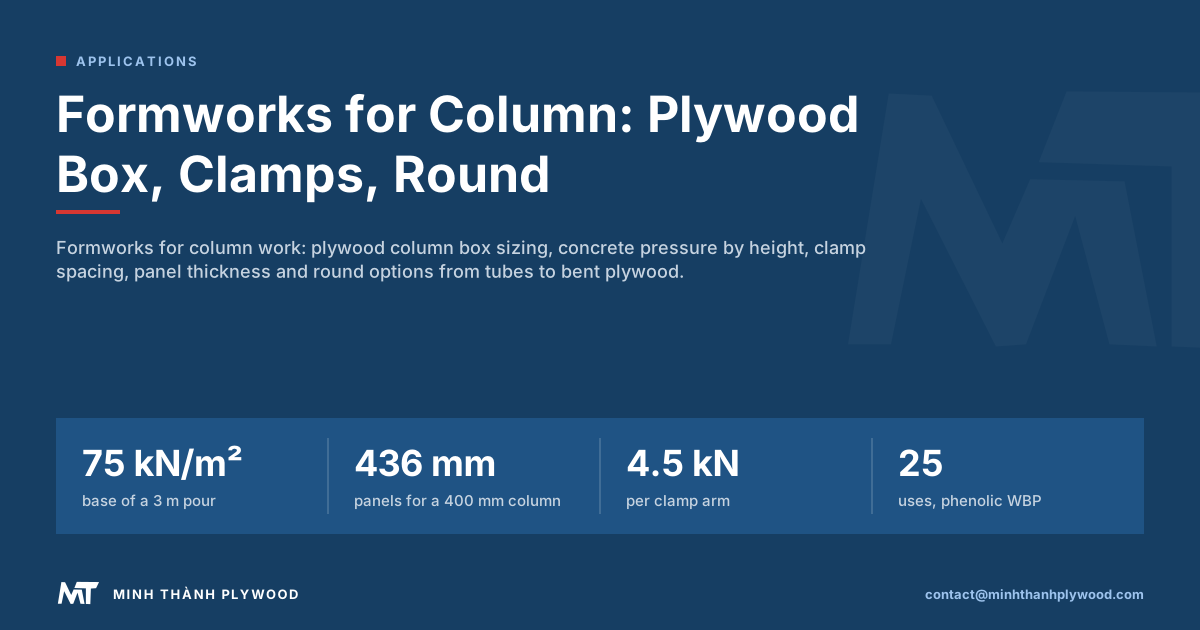
Formworks for column concrete come in three families: plywood boxes held by clamps or yokes for square and rectangular columns, single-use cardboard tubes or steel shells for round columns, and modular steel or aluminium systems for long repeat runs. Plywood boxes win on short runs and odd sizes. Minh Thanh Plywood makes film-faced plywood in Phu Tho for column, wall and slab forms.
Formworks for column concrete: the main types
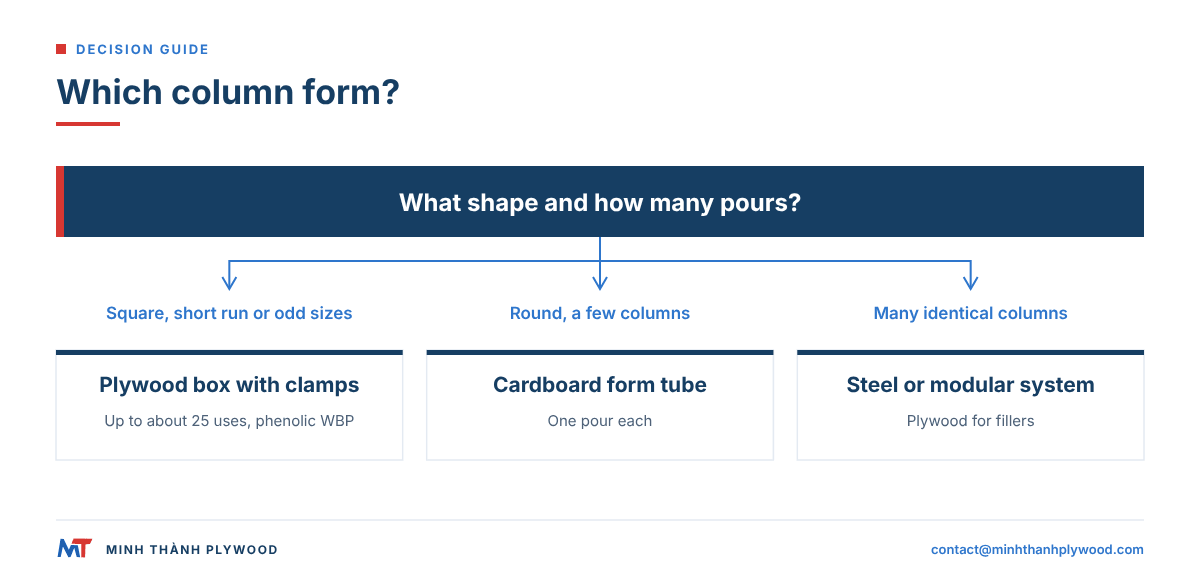
Formworks for column concrete fall into three groups: plywood boxes, round single-use or steel forms, and modular panel systems. The column shape and the number of repeats decide which one pays: plywood boxes suit square and rectangular columns on a few repeats, round forms suit circular columns, and modular systems pay back when the same column size repeats many times.
| Type | Shape | Reuse | Best for |
|---|---|---|---|
| Plywood column box with clamps | Square, rectangular, odd sizes | Up to about 25 uses for phenolic film-faced plywood | Short runs, varied sizes, corner and edge work |
| Cardboard form tube | Round | One pour | Round columns, small numbers |
| Steel shell | Round or square | Many pours | Long runs of one size |
| Modular steel or aluminium | Square, rectangular, adjustable | Many pours | Repeated columns on large jobs |
| Bent plywood on ribs | Round, oval, custom curves | Several pours | Unusual diameters, architectural columns |
| Faceted plywood box | Polygon reading as round | Several pours | Near-round look at low cost |
Reuse counts for plywood assume proper handling, release agent and edge sealing.
Plywood column formwork: how does a column box work?
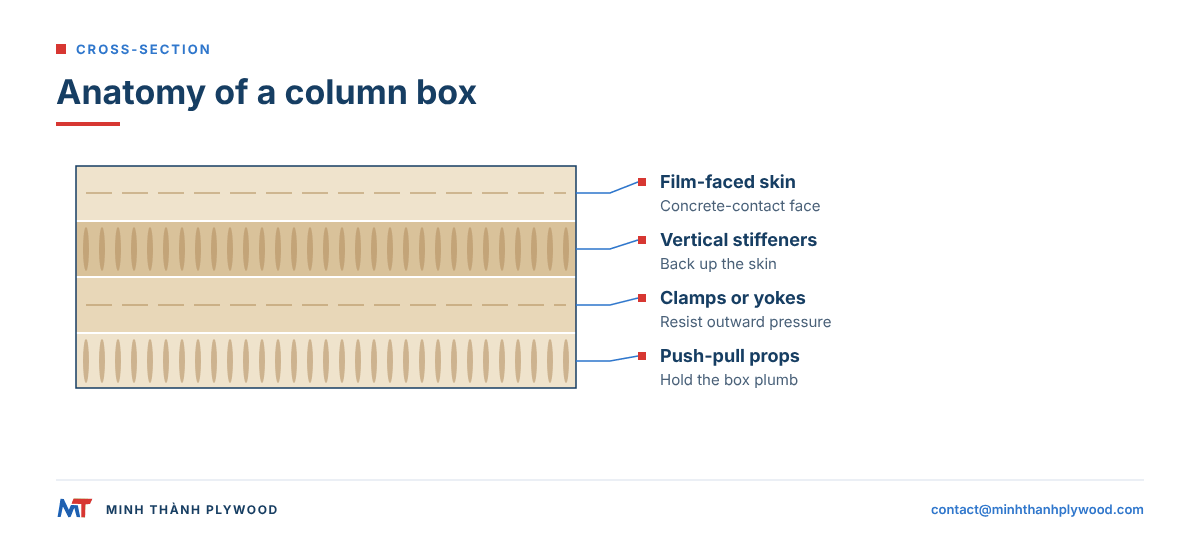
Plywood column formwork is a box of four film-faced panels, held square by clamps or yokes at intervals up its height and braced plumb from the floor. The concrete pushes outward on every face; the clamps take that push.
Parts of a plywood column box:
- Skin: four film-faced panels, the concrete-contact face.
- Stiffeners: vertical timber, LVL or timber beams fixed to the back of each panel.
- Clamps or yokes: steel column clamps, or timber yokes with bolts, round the box.
- Chamfer fillets: triangular strips in the inside corners.
- Kicker and base frame: fixes the box position at the foot.
- Push-pull props: two directions, to hold the box plumb.
- Access: a working platform at the top for the pour.
How do you size a plywood column box?
Size the panels so two opposite faces equal the column width and the other two overlap them by the plywood thickness on each side. That way the box closes tight at the corners with no gap.
Worked example for a 400 × 400 mm column with 18 mm plywood:
| Panel | Width | Count |
|---|---|---|
| Inner faces | 400 mm | 2 |
| Outer faces | 400 + 2 × 18 = 436 mm | 2 |
| Height | Column height plus a little for the pour line | 4 |
For a rectangular column, the long faces and short faces follow the same rule: one pair at the true size, the other pair larger by twice the plywood thickness. Cut from 1220 × 2440 mm or 1250 × 2500 mm sheets, a column up to the sheet length needs no horizontal joint in the skin; a taller column needs a joint backed by a stiffener.
Which way should the face grain run on a column panel?
Run the face grain across the stiffeners, so the stronger direction of the plywood spans between them. On a column box with vertical stiffeners, that means face grain horizontal.
How much pressure does concrete put on a column form?
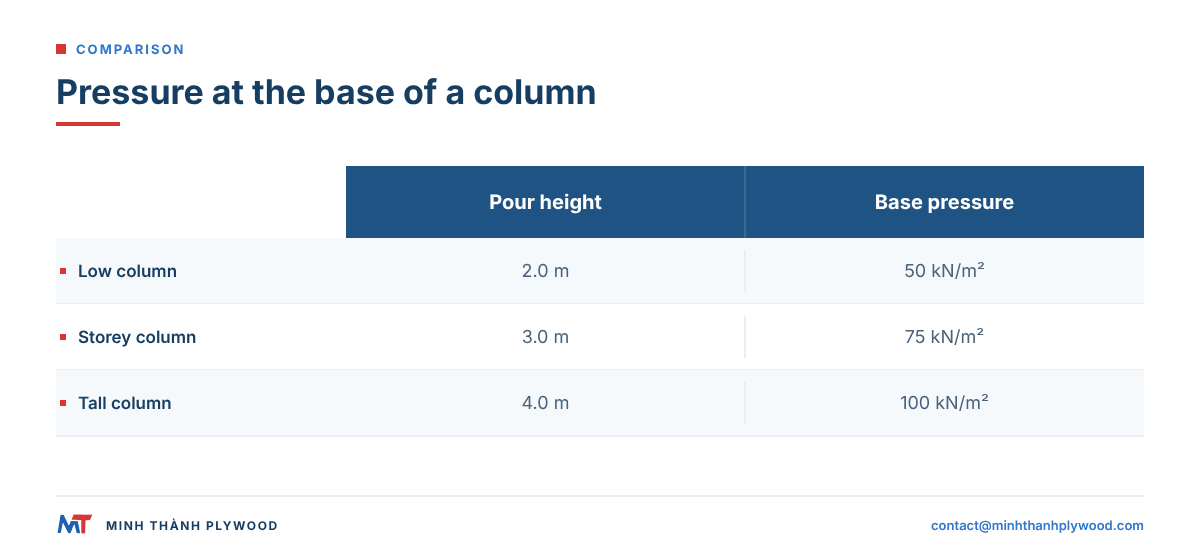
Design a column form for the full liquid head of concrete: about 25 kN/m² for every metre of height. Columns fill fast, so the concrete at the bottom is still fluid when the top is reached.
| Column pour height | Pressure at the base |
|---|---|
| 2.0 m | 50 kN/m² |
| 3.0 m | 75 kN/m² |
| 4.0 m | 100 kN/m² |
Calculation: 25 kN/m³ × height, the full liquid head that the American Concrete Institute formwork guide ACI 347 treats as the upper bound. The pressure falls to zero at the top of the pour, so the base of the box carries the most load. Vibration keeps the concrete fluid, which is one more reason to design for the full head.
UK designers can go below the full head. CIRIA Report 108, Concrete pressure on formwork, calculates a lower design pressure for a slower rise, a retarded mix or a cooler pour, and BS 5975 (clause 17.4.2) lets the temporary works designer use either that method or the conservative 25 times the pour depth. The BSI catalogue lists BS 5975, the code of practice for temporary works procedures and the permissible stress design of falsework. The table above is the safe ceiling; the designer’s figure can only be lower, so plywood and clamps sized to it are never under-designed.
How far apart should column clamps be?
Space column clamps closest at the base and wider towards the top, because pressure falls with height. The spacing comes from the design pressure, the column width and the rated working load of the clamp from its maker.
How the clamp load is worked out:
- Pressure at the clamp level: 25 kN/m³ × depth below the top of the pour.
- Load on one face between clamps: pressure × column width × clamp spacing.
- Load on each clamp arm: half of that, one arm each side of the face.
- Compare with the clamp maker’s rated working load, and reduce the spacing until it fits.
Worked example at the base of a 3.0 m pour, 400 mm wide face, clamps at 300 mm:
| Step | Value |
|---|---|
| Pressure | 75 kN/m² |
| Load on the face between two clamps | 75 × 0.4 × 0.3 = 9 kN |
| Load per clamp arm | 4.5 kN |
How far can an 18 mm plywood skin span between stiffeners?
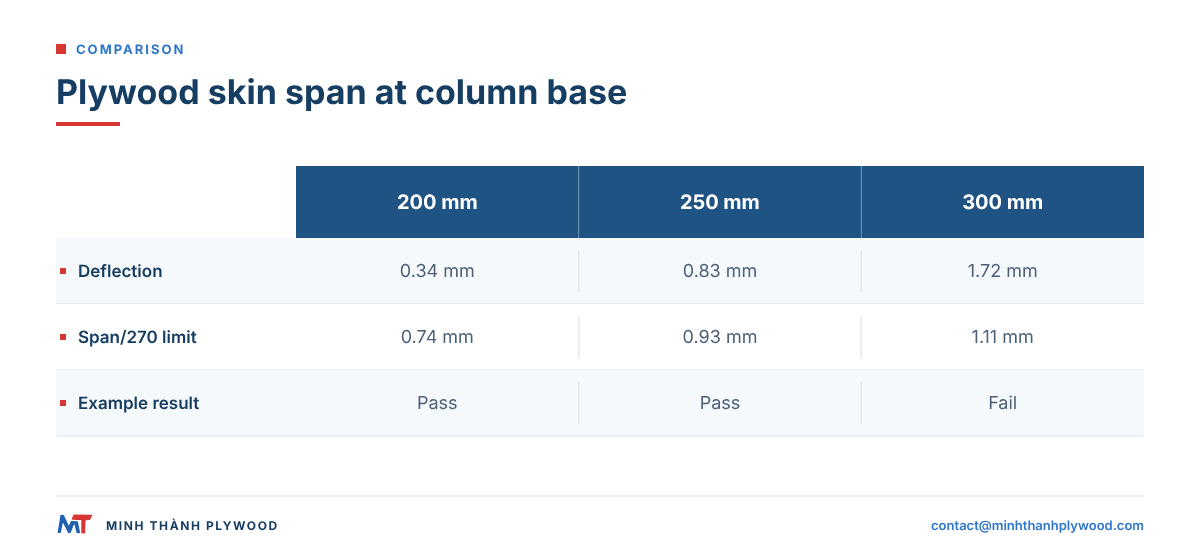
At the base of a 3 m pour, 18 mm film-faced plywood should rest on stiffeners 200 to 250 mm apart. At 300 mm it bulges more than the usual limit allows. Take a 1 m strip of skin over several supports at 75 kN/m², with an assumed stiffness of 5,000 N/mm²:
| Stiffener spacing | Deflection | Limit (span/270) | Result |
|---|---|---|---|
| 200 mm | 0.34 mm | 0.74 mm | Passes, also under 1.5 mm |
| 250 mm | 0.83 mm | 0.93 mm | Passes |
| 300 mm | 1.72 mm | 1.11 mm | Fails |
Calculation: deflection = w × l⁴ ÷ (145 × E × I), with I = 1000 × 18³ ÷ 12 = 486,000 mm⁴ per metre. A fair-faced specification often tightens the limit to 1.5 mm total or less, so check the project specification and the board’s tested stiffness before fixing the spacing. Wider faces need closer stiffeners or a thicker skin. The formwork designer signs off the final layout; ties and clamps are covered in our guide to formwork ties and accessories.
Concrete column formwork step by step
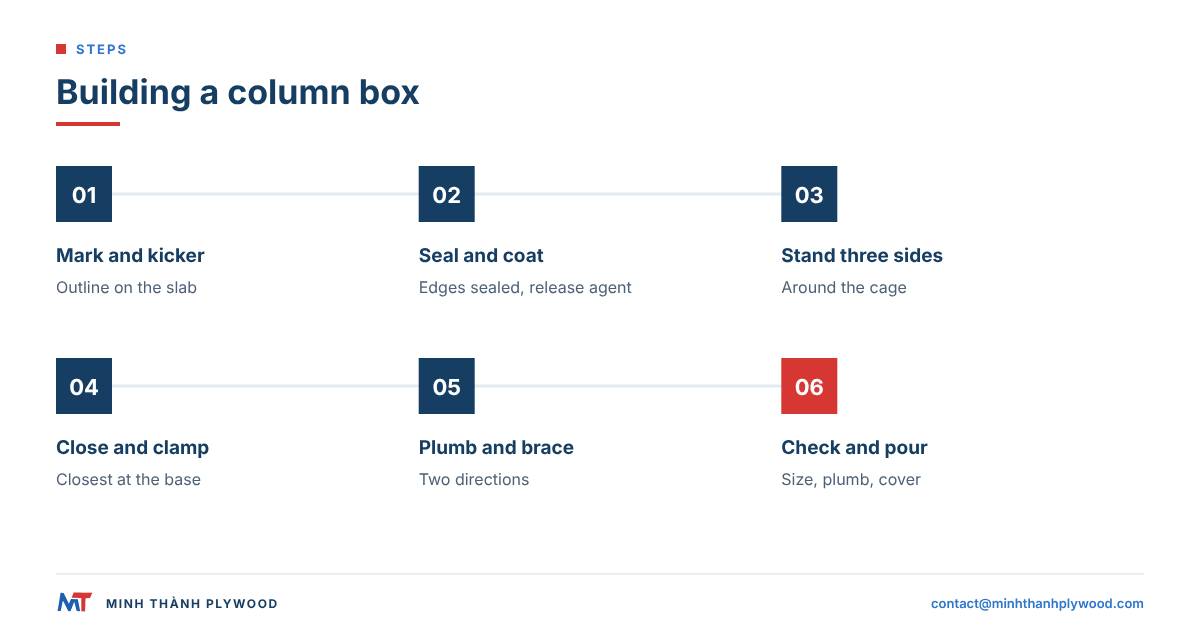
Concrete column formwork goes up around the reinforcement cage, is clamped and plumbed, then checked before the pour. A typical sequence:
- Mark the column outline on the slab and fix a kicker or base frame.
- Seal and coat the panels: cut edges sealed, release agent on the film.
- Fix chamfer fillets in the inside corners if the drawing shows them.
- Stand three sides around the cage, then close the fourth.
- Fit the clamps at the designed spacing, closest at the base.
- Plumb the box in two directions with push-pull props.
- Check size, plumb, clamp tightness, cover to reinforcement and a clean base.
- Pour at the planned rate, with vibration, and watch the box for movement.
- Strip when the engineer allows, opening the clamps and easing the panels off.
In the US, formwork must be designed, fabricated, erected, supported, braced and maintained to carry the vertical and lateral loads of the pour, as OSHA standard 1926.703 requires for cast-in-place concrete.
Which plywood should you buy for column forms?
Buy film-faced plywood with a water-resistant bond, a thickness to suit the face width and a film to suit the finish. Column boxes take hard wear at the corners and tie holes, so the bond and the edges matter most. For the exterior bond, ask for panels specified to BS EN 636, the standard for plywood specifications.
| Decision | Pick | Use it for |
|---|---|---|
| Thickness | 18 mm | Most column boxes |
| Thickness | 21 mm | Wide faces, tall single pours |
| Thickness | 12–15 mm | Small columns, linings in steel forms |
| Film | 120–135 g/m² standard | Normal finishes |
| Film | From 135 g/m² premium | Exposed fair-faced columns |
| Bond | Melamine-fortified | Short runs, about 12–15 uses |
| Bond | Phenolic WBP | Repeat runs, up to about 25 uses |
| Core | Eucalyptus or Acacia | Dense hardwood cores |
Ask for proof with the quote. Check the bond against EN 314-2 Class 3 (the exterior class), the bending strength and stiffness report to EN 310, and the formaldehyde class. Third-party testing to your method, for example EN 717-1, is arranged through SGS on request. Bending stiffness feeds straight into the span check above, so a tested figure beats an assumed one.
Our film-faced plywood is made 12–21 mm thick to ±0.5 mm, in 1220 × 2440 and 1250 × 2500 mm sheets. An even thickness lets the four faces meet flush at the corners, which keeps the column arrises sharp.
Round formwork: formwork tubes, cardboard form tubes or bent plywood?
Round formwork for circular columns comes as cardboard tubes, steel shells, plastic or fibre forms, or plywood bent over ribs. The number of pours and the diameter decide the choice.
| Option | Pours | Finish | Best for |
|---|---|---|---|
| Cardboard form tube | One | Smooth, slight spiral marks unless lined | Few round columns |
| Steel shell | Many | Smooth, joint lines | Many identical columns |
| Plastic or fibre form | Several | Smooth | Small diameters, repeats |
| Bent plywood on ribs | Several | Smooth with a film-faced skin | Unusual diameters, ovals |
| Faceted plywood box | Several | Flat facets | Near-round look, low cost |
How are cardboard tubes used on site?
Formwork tubes of spiral-wound cardboard are light, cut to length on site and stripped by peeling. Each tube forms one column. They suit a handful of round columns where a steel shell would be idle afterwards.
When does bent plywood make sense for a round column?
Bent plywood makes sense for a diameter no tube or shell matches, or an oval or tapered column. Thin film-faced sheets are bent over steel or timber ribs cut to the radius, often in two layers. Our guide on plywood for curved concrete forms covers bending radius and thickness.
Plywood column box vs modular systems
A plywood column box beats a modular system when the columns vary in size, the run is short or the column meets walls and beams at odd angles. A modular system wins on long runs of identical columns.
| Factor | Plywood box | Modular steel or aluminium |
|---|---|---|
| Purchase cost | Low | High, often rented |
| Sizes | Any size cut on site | Adjustable within set modules |
| Pours per set | Up to about 25 with phenolic WBP | Many |
| Labour per pour | More fixing | Faster strip and reset |
| Odd junctions | Easy to fit | Needs fillers, often plywood |
| Finish | Film-faced, renew the skin when worn | Consistent across the run |
Named modular column systems come from the big hire firms: PERI QUATTRO, Doka Framax column, Hünnebeck MANTO column, RMD Kwikform column systems, MEVA’s CaroFalt foldable column formwork and ULMA’s LGR and LGC lightweight column forms. Circular steel moulds are stocked in set diameters, such as 300, 400, 450, 500, 600 and 750 mm, and each diameter needs its own mould.
Many sites combine both: rented clamps and frames with a plywood skin cut to the column size.
What wears out a plywood column form first?
The corners and tie holes wear out first; the film face usually lasts longer. Column boxes are stripped and handled at the corners, and water enters wherever wood is exposed.
How to add pours:
- Seal every cut edge and hole the day it is made, including inside tie holes.
- Use cones and sleeves on any ties through the box, so rods do not tear the face.
- Protect corners during stripping; do not lever at the corner with a bar.
- Clean and recoat the film after each pour.
- Store panels flat and dry between pours.
How many plywood sheets does a column box need?
Add the four panel widths, compare them with the sheet width, and allow for the height. For square columns the count is easy to work out before ordering.
Worked example for 400 × 400 mm columns, 2.4 m pours, 18 mm plywood, cut from 1220 × 2440 mm sheets:
| Step | Value |
|---|---|
| Panel widths | 400 + 400 + 436 + 436 = 1672 mm |
| Sheets across the width | 1672 ÷ 1220 = 1.37, so 2 sheets per box |
| Offcut left | 2440 − 1672 = 768 mm wide, usable for fillers or smaller columns |
| Boxes for 20 columns poured in 4 sets of 5 | 5 boxes, 10 sheets, reused 4 times |
Reusing the same boxes for every set is what makes plywood columns cheap; a box built once and stripped carefully serves many sets.
Fair-faced columns: how do you get a clean finish?
A fair-faced column needs a clean film, tight corners and no grout loss at the base. Most visible defects come from the corners and the foot of the box.
| Defect | Usual cause | Prevention |
|---|---|---|
| Grout runs at corners | Gaps between panels | Overlapping panels, chamfer fillets, foam strip in the joint |
| Honeycombing at the base | Grout lost under the box | Kicker, sealed foot, a mortar bed before the pour |
| Stepped faces | Panels of different thickness | One thickness and tolerance for the set |
| Dull or stained patches | Worn film or too much release agent | New film for exposed columns, thin even coat |
| Bulged faces | Clamps too far apart at the base | Closer clamps where pressure is highest |
What to put on a column formwork plywood RFQ
A column formwork RFQ that states the column sizes, the finish and the pour target gets a precise quote. Send these lines:
| Line to send | What to write |
|---|---|
| Use | Square columns, fair-faced finish |
| Column sizes and heights | 400 × 400 mm and 500 × 600 mm, 3.0 m pours |
| Size | 1220 × 2440 mm or 1250 × 2500 mm |
| Thickness and tolerance | 18 mm, ±0.5 mm |
| Film | From 135 g/m² for fair-faced work |
| Bond | Phenolic WBP for repeat pours |
| Core | Eucalyptus or Acacia |
| Quantity and delivery | Sheets per month, FOB Hai Phong, CFR or CIF |
Orders start at one 40HC, and 15 and 18 mm sheets can share a container by agreement. Production takes 15–45 days after the deposit, and free samples let you try the film and edges on your own clamps first.
Buyer questions, answered
What is the best formwork for columns?
For square and rectangular columns on short runs or odd sizes, a film-faced plywood box with steel clamps is the most flexible choice. Long runs of identical columns suit modular steel or aluminium systems, and round columns suit cardboard tubes or steel shells.
What thickness plywood is used for column formwork?
Film-faced plywood of 18 mm is the usual skin for column boxes, with 21 mm for wide faces or tall single pours. The clamp spacing is then set so the skin does not bulge between clamps.
How far apart should column clamps be?
Closer at the base, wider at the top, because concrete pressure is highest at the bottom of the pour. The spacing comes from the design pressure, the column width and the clamp's rated load from its maker.
How much pressure does concrete put on a column form?
Design column forms for the full liquid head: about 25 kN/m² for every metre of height. A 3 m column pour puts about 75 kN/m² on the bottom of the form.
How do you form a round concrete column?
Use a cardboard form tube for a single pour, a steel shell for many repeats, or a bent plywood form on ribs for an unusual diameter. Faceted plywood boxes with eight or more sides are used where a near-round look is enough.
How many times can a plywood column form be reused?
Melamine-fortified film-faced plywood gives about 12–15 uses and phenolic WBP up to about 25, with proper handling, release agent and edge sealing. Column boxes wear fastest at corners and tie holes, so seal and protect those.
What is a column box?
A column box is a four-sided plywood form, open at the top, held square by clamps or yokes and braced plumb. Concrete is poured in from above and the box is stripped once the column can stand.
Do column forms need ties through the concrete?
Small columns usually do not: clamps around the outside of the box take the pressure. Wide columns may need ties through the middle of the long faces, as wall forms do.
What is a chamfer fillet on a column form?
A chamfer fillet is a small triangular strip fixed in each inside corner of the box. It gives the column bevelled edges that chip less and helps seal the corner joints.