
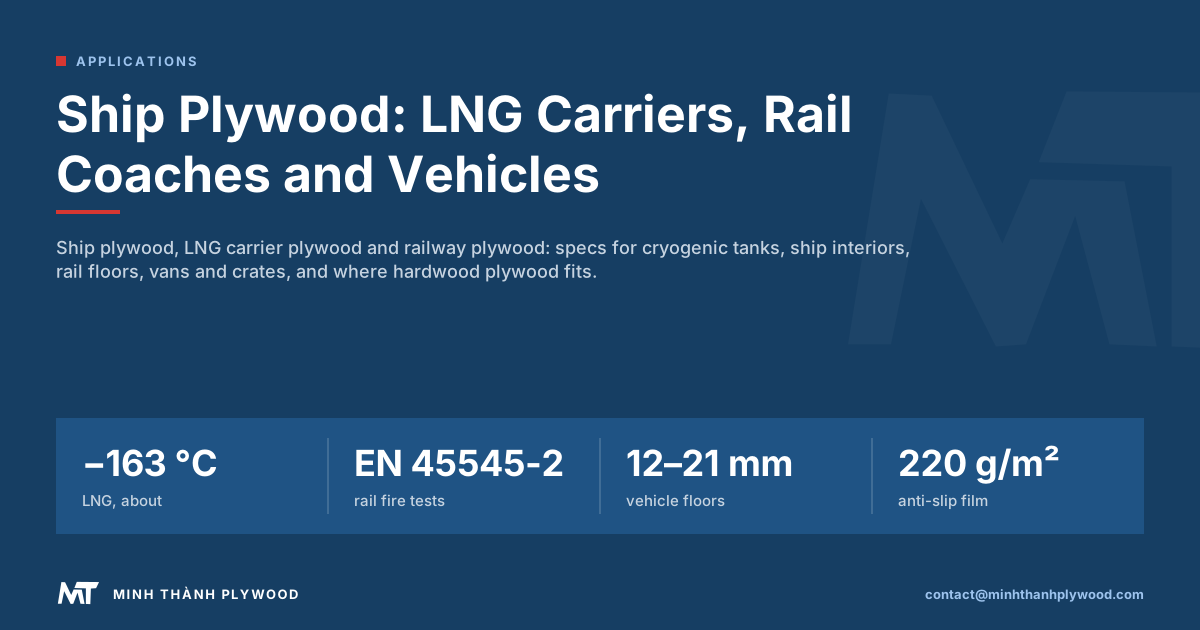
Ship plywood is not one product: LNG carriers use approved birch plywood inside cryogenic tank insulation, ships use fire-retardant panels for cabins and marine plywood for boats, trains use fire-tested floor panels, and vans, trucks and crates use film-faced and packing plywood. Minh Thanh Plywood supplies the vehicle-floor, interior and packing panels; certified LNG and rail panels come from approved specialist mills.
Ship plywood in the UK usually means marine plywood: sizes, standards and prices
UK buyers asking for “ship plywood” want marine plywood, a hardwood panel made to BS 1088 for boats, trailer beds and wet rooms. Ask for the glue and the standard by name: BS 1088 for the panel, EN 314-2 class 3 for the bond and EN 636 part 3 for the service class.
Totem Timber sells Far Eastern BS 1088 marine plywood, 1220 × 2440 mm, in 6, 9, 12, 18 and 25 mm at £35.95 to £93.95 per sheet including VAT, and declares EN 636-3, EN 314-2 class 3 and CE2+. MDF Direct and PLY Direct cut the same 6, 9, 12, 18 and 25 mm range to size, delivered at a flat £25 plus VAT in England and Wales.
| Thickness | Typical marine plywood use |
|---|---|
| 6 mm | Linings, bulkhead skins, curved work |
| 9–12 mm | Cabinets, lockers, shelving, boat interiors |
| 18 mm | Boat and van floors, bathroom subfloors, worktops |
| 25 mm | Decks, transoms, structural frames |
Marine plywood answers water; it is also the dearest board in the rack. Vans, trailers, boat trailers and wet-area floors do not always need that price. A phenolic-glued, film-faced hardwood plywood bonded to EN 314-2 class 3 gives a waterproof floor panel for those jobs, and Minh Thanh Plywood makes it in 12–21 mm on Eucalyptus and Acacia cores. Cut edges still get sealed. Hulls, decks and anything classed for the sea stay with a certified BS 1088 mill.
What is ship plywood?
Ship plywood is plywood made for use on or in ships, and it covers several different products: marine plywood for hulls and decks, fire-retardant plywood for cabins and linings, and approved birch plywood inside the insulation of LNG carrier tanks. Each has its own standard, approval and buyer.
The same is true on land. Railway plywood floors passenger coaches, automotive plywood floors vans and trucks, and packing plywood carries cargo across the sea in crates and containers. One mill rarely makes all of them, because the approvals differ.
What links these uses is the same set of plywood strengths:
- Stiffness for its weight: cross-laminated plies give a stiff panel that is lighter than steel, concrete or solid timber of the same stiffness.
- Stable size: plywood barely moves across its width as humidity changes.
- Easy fixing and machining: it can be cut, drilled, bonded and screwed with ordinary tools.
- Damping: wood absorbs vibration and noise better than metal panels.
Where is plywood used in ships, LNG carriers, trains and vehicles?
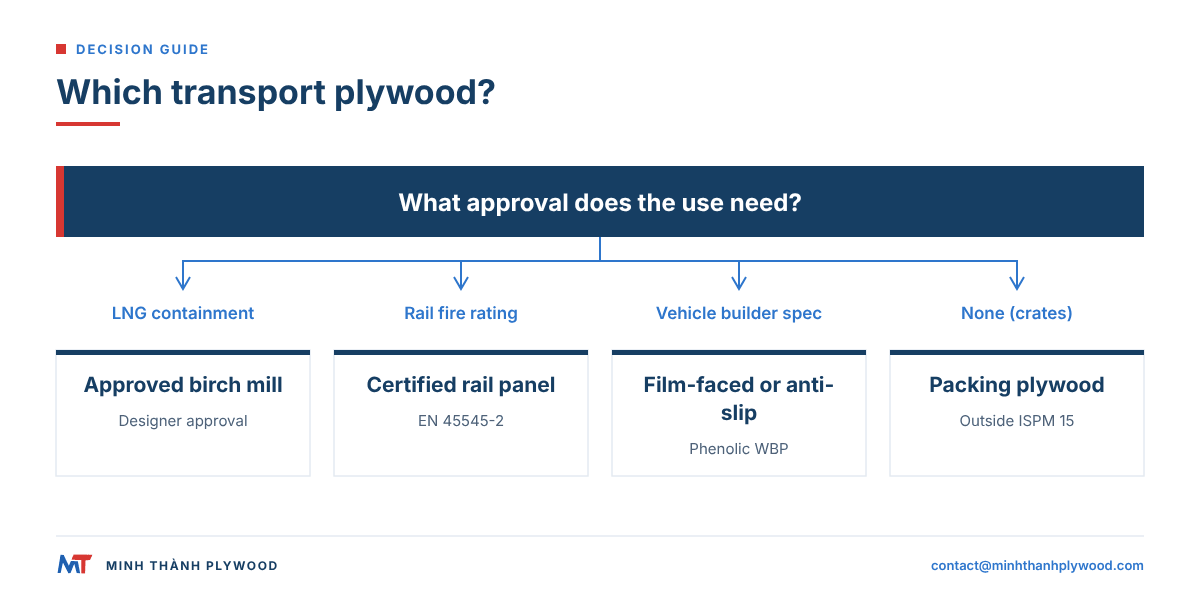
Plywood is used in LNG carrier tank insulation, ship interiors and small boats, rail coach floors and interiors, road vehicle floors and bodies, and sea-transport packaging. The table maps each use to the panel it needs.
| Use | Typical panel | Key requirement |
|---|---|---|
| LNG carrier cargo-tank insulation | Approved birch plywood | Cryogenic strength, tight tolerances, containment-system approval |
| Ship cabins, linings, furniture | Fire-retardant plywood or veneered panels | Fire tests for marine use (IMO FTP Code) |
| Small boats, decks, hulls | Marine plywood (BS 1088 class) | Waterproof bond, durable species, no core gaps |
| Rail coach and tram floors | Birch or hardwood film-faced, often fire-treated | Fire tests (EN 45545-2), low weight, stiffness |
| Rail interiors | Veneered or laminated plywood | Fire tests, appearance |
| Vans, trucks, trailers | Film-faced and anti-slip plywood | Phenolic WBP glue, wear face, grip |
| Buses and coaches | Film-faced plywood under floor covering | Low weight, fixing, moisture |
| Caravans and motorhomes | Light furniture plywood, thin plywood | Weight, screw holding |
| Containers | Hardwood or bamboo container floorboard | Forklift wheel loads |
| Crates, boxes, dunnage | Packing plywood | Strength, cost, ISPM 15 exemption |
Why is birch plywood used in LNG carrier insulation?
LNG carrier plywood is birch plywood built into the insulation that lines the cargo tanks of membrane-type LNG carriers. It is used because it stays strong and stiff at the cargo’s cryogenic temperature, insulates, and can be machined and bonded into precise load-bearing boxes and panels.
Liquefied natural gas is carried at about minus 163 °C. In a membrane tank, a thin metal membrane holds the liquid, and the ship’s hull carries the weight through an insulation layer between the two. That layer has to insulate and carry the load of the cargo at the same time.
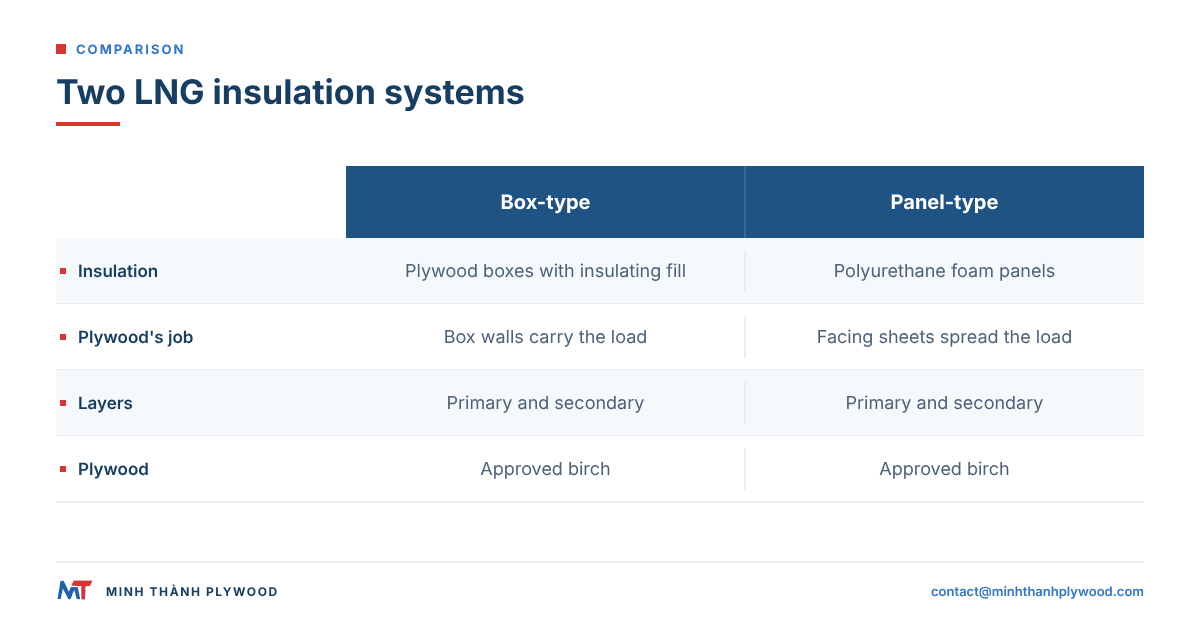
Two main membrane systems use plywood:
- Box-type insulation: plywood boxes filled with insulating material, laid in two layers behind the membranes.
- Panel-type insulation: polyurethane foam panels faced with plywood sheets, which carry the membrane and spread the load into the foam.
Birch plywood suits this better than most other wood panels. Its thin, even plies give the same properties from panel to panel; its strength holds up when cold; it machines to the tight thickness and flatness that thousands of identical parts require. The plywood is supplied by a small number of mills approved by the containment-system designer, to that designer’s specification.
What does LNG carrier plywood have to meet?
LNG carrier plywood has to meet the containment-system designer’s specification and approval, which set the species, construction, glue, thickness tolerance, moisture content and mechanical properties at low temperature. A panel that has not been approved for the system cannot be used, whatever its quality.
What such a specification controls:
| Property | Why it matters in the tank |
|---|---|
| Species and ply build | Even, predictable strength across many identical parts |
| Glue (phenolic) | Bond strength that holds at cryogenic temperature |
| Thickness tolerance and flatness | Boxes and panels must fit without gaps |
| Moisture content | Ice and movement must not form inside the insulation |
| Strength at low temperature | The insulation carries the cargo’s weight |
| Traceability | Every lot must be traceable to its production and tests |
For a buyer outside the LNG supply chain, the lesson is simple: “LNG grade” in a plywood offer means nothing without the containment designer’s approval for that mill. Minh Thanh does not make LNG containment plywood, and a buyer of it should go to the approved mills.
Ship plywood for interiors, decks and boats
Ships use fire-retardant plywood and veneered panels for cabins, linings and furniture, and marine plywood for small boats, decks and joinery exposed to water. Interior panels on seagoing ships must pass the fire tests that the IMO Fire Test Procedures (FTP) Code sets for their position.
Ship interior panels:
- Cabin linings and ceilings: low flame-spread surfaces, tested and approved for marine use.
- Furniture and joinery: veneered or laminated plywood, often with fire-retardant treatment or behind approved surfaces.
- Decks and floors under covering: plywood bonded with phenolic glue, protected by the floor system.
Marine plywood is a different product: a panel with waterproof phenolic glue, durable face and core species and no gaps in the core, classed by standards such as BS 1088. Boat builders use it for hulls, decks, bulkheads and transoms. It is the right board for water, not a fire-tested ship lining.
Minh Thanh’s okoume-faced furniture plywood is an interior panel and is not sold as marine plywood. Buyers who need marine plywood should order it to a marine standard from a mill that certifies it.
Railway plywood for coach floors and interiors
Railway plywood is plywood used in rail vehicles, mainly for passenger-coach, tram and metro floors and some interior panels. In Europe these materials must pass EN 45545-2, the fire-protection standard for railway vehicles, at the hazard level set for the train.
Why rail floors use plywood:
- Weight: a plywood floor is lighter than many metal or composite alternatives, which saves energy over the vehicle’s life.
- Stiffness: spans between the frame members without drumming.
- Noise: wood damps vibration and road noise.
- Fixing: easy to screw and bond to the frame and to fix the floor covering on.
A typical rail floor panel is birch or hardwood plywood with a phenolic film or a bonded floor covering, often with fire-retardant treatment and sealed edges, cut to the floor plan of the coach. Rail panels come with fire test reports for their full build, so the floor covering, adhesive and plywood are tested together.
Minh Thanh does not hold rail fire certification and does not offer certified rail floor panels.
Automotive plywood for vans, trucks, buses and caravans
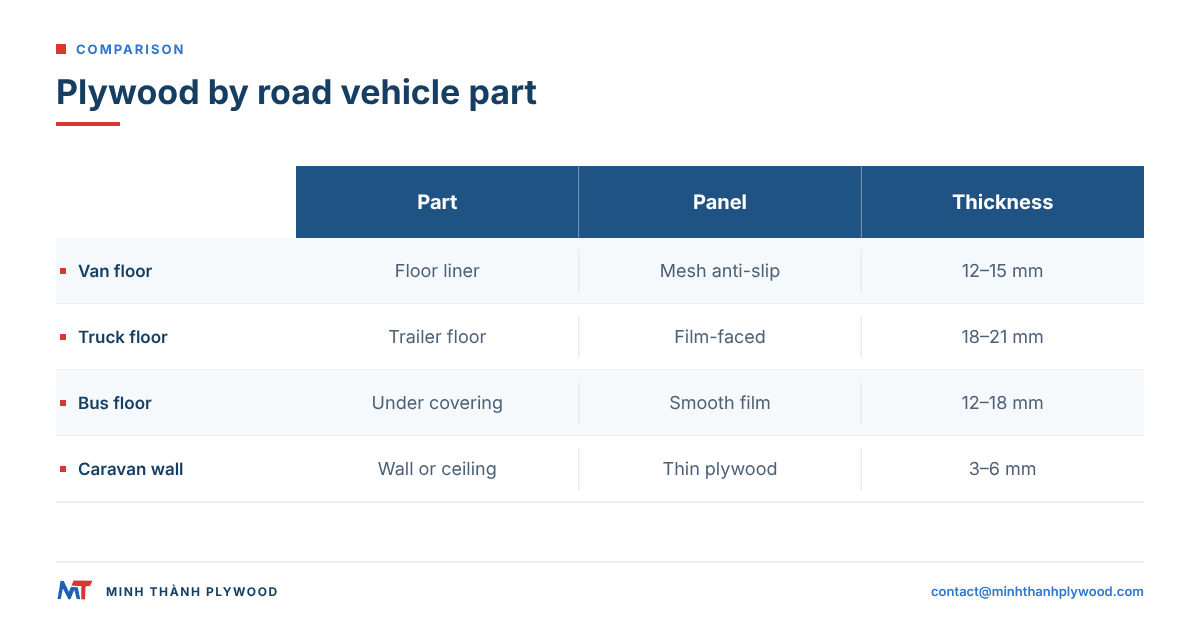
Automotive plywood is plywood used in road vehicles: van floor liners, truck and trailer floors, bus floors and caravan furniture. Floors use film-faced or anti-slip plywood with phenolic WBP glue; furniture and linings use light, flat furniture plywood.
| Vehicle part | Panel | Thickness |
|---|---|---|
| Panel van floor liner | Mesh anti-slip film-faced | 12–15 mm |
| Truck and trailer floor | Anti-slip or smooth film-faced | 18–21 mm |
| Bus floor under covering | Smooth film-faced | 12–18 mm |
| Box body walls | Smooth film-faced | 9–12 mm |
| Caravan furniture | Light-core furniture plywood | 9–15 mm |
| Caravan walls and ceilings | Thin plywood | 3–6 mm |
This is where Vietnamese hardwood plywood fits well. Minh Thanh makes anti-slip plywood on order with hexagonal or mesh phenolic film around 220 g/m², on Eucalyptus or Acacia cores, 12–21 mm at ±0.5 mm, for vehicle and trailer floors. The guide to plywood for trailer floors sets out the choice by vehicle in detail.
Plywood for sea transport: container floors, crates and dunnage
Plywood for sea transport covers the floors of shipping containers, plywood crates and boxes, dunnage and load spreaders. Crates and boxes made wholly of plywood are outside ISPM 15, the international standard for wood packaging, so they need no heat treatment or stamp.
- Container floors: dense hardwood or bamboo floorboards, about 28 mm thick, that carry forklift wheels inside the container.
- Crates and boxes: packing plywood for machinery, parts and furniture, light and strong enough for stacking.
- Dunnage and load spreaders: plywood sheets that spread point loads and separate cargo layers.
- Pallet decks and tops: plywood tops on export pallets.
The IPPC page on ISPM 15 sets out the standard’s scope: it regulates wood packaging made of raw wood, and processed wood materials such as plywood fall outside it. That makes plywood crates simpler to export than solid-timber crates.
Minh Thanh makes commercial and packing plywood for crates, boxes and pallets alongside its furniture range.
Which plywood properties matter in transport uses?
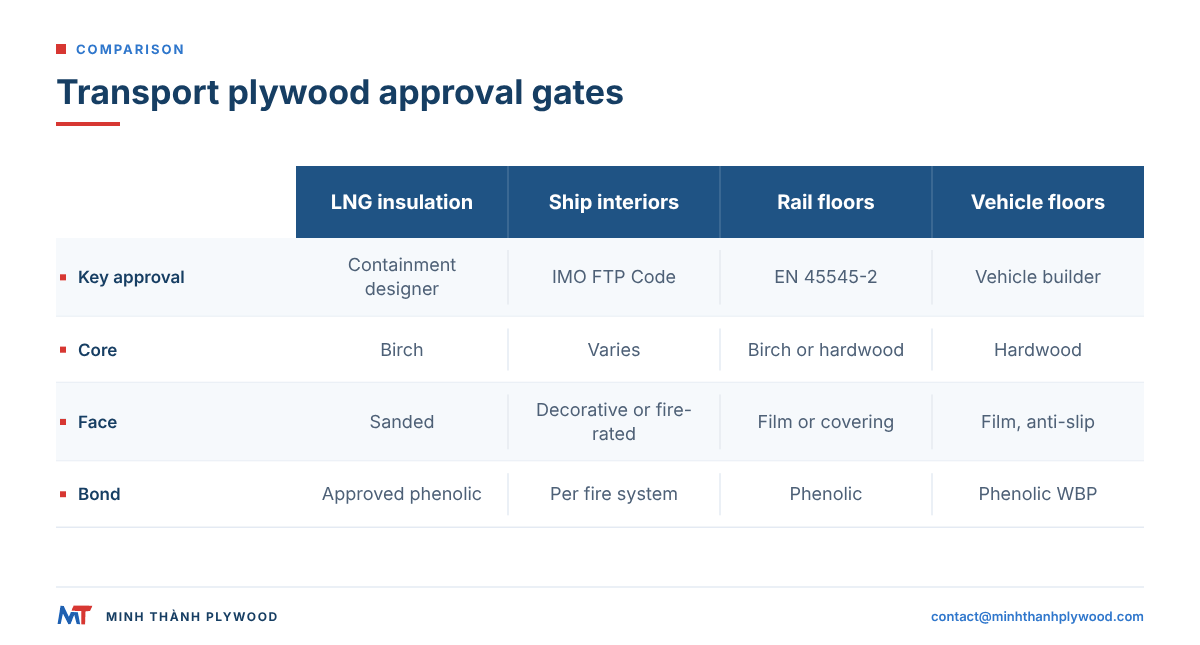
Transport uses rank plywood on glue, core, tolerance, weight, face and fire performance. The weight of each matters differently from one use to the next, which is why one panel never fits them all.
| Property | LNG insulation | Ship interiors | Rail floors | Vehicle floors | Crates |
|---|---|---|---|---|---|
| Glue | Phenolic, approved | Per fire system | Phenolic | Phenolic WBP | UF or MR |
| Core | Birch | Varies | Birch or hardwood | Hardwood | Mixed hardwood |
| Tolerance | Very tight | Normal | Tight | ±0.5 mm | Normal |
| Weight | Secondary | Important | Very important | Important | Secondary |
| Face | Sanded | Decorative or fire-rated | Film or covering | Film, anti-slip | Plain |
| Fire tests | Per system | IMO FTP Code | EN 45545-2 | Not usually | No |
| Approval | Containment designer | Flag and class | Rail operator | Vehicle builder | Shipper |
Birch or hardwood plywood for transport uses?
Birch plywood is the standard where approvals and tight tolerances rule, such as LNG insulation and many rail floors; hardwood-core plywood is the cost-effective choice for vehicle floors, box bodies and crates. Both work when the glue and face match the use.
How they compare:
- Ply build: birch uses many thin, even plies; hardwood-core panels from Vietnam use fewer, thicker core plies of Eucalyptus or Acacia.
- Consistency: birch gives very even properties across a large order, which approvals rely on.
- Hardness: Eucalyptus cores resist dents from small wheels well.
- Weight: Acacia-core panels at about 580 kg/m³ are lighter than Eucalyptus at 650–750 kg/m³.
- Price: hardwood-core panels cost less than imported birch of the same face and glue.
Minh Thanh’s birch plywood is a furniture and interior panel, with birch faces graded D+, D and E and quoted in pairs such as D+/D or D/E. It suits caravan and vehicle interiors and furniture, not LNG or certified rail floors.
Where Vietnamese hardwood plywood fits in transport, and where it does not
Vietnamese hardwood plywood fits vehicle floors, box bodies, caravan and vehicle furniture, and packing for sea transport; it does not fit LNG containment, certified rail floors or fire-approved ship linings unless a mill holds those approvals. The line is set by certification, not by the wood.
| Use | Fit for Minh Thanh plywood | Why |
|---|---|---|
| Van, truck and trailer floors | Yes | Anti-slip and film-faced, phenolic WBP, 12–21 mm |
| Box body walls | Yes | Film-faced, 9–12 mm |
| Bus floors under covering | Yes | Film-faced, phenolic glue |
| Caravan and motorhome furniture | Yes | Light Styrax-core furniture plywood, UF glue at E0 emission |
| Crates, boxes and pallet tops | Yes | Packing plywood, outside ISPM 15 |
| Ship and rail interior furniture | On the builder’s spec | Only where the builder’s fire system allows the panel |
| LNG containment insulation | No | Needs containment-designer approval |
| Rail floors requiring EN 45545-2 | No | Needs fire certification of the full build |
| Marine plywood (BS 1088) | No | Okoume interior plywood is not sold as marine |
Stating this plainly saves both sides time: a buyer of LNG or certified rail panels should go straight to the approved mills, while a vehicle builder or exporter of crated cargo gets a cost-effective, well-made panel from Vietnam.
How long does plywood take to ship from Vietnam?
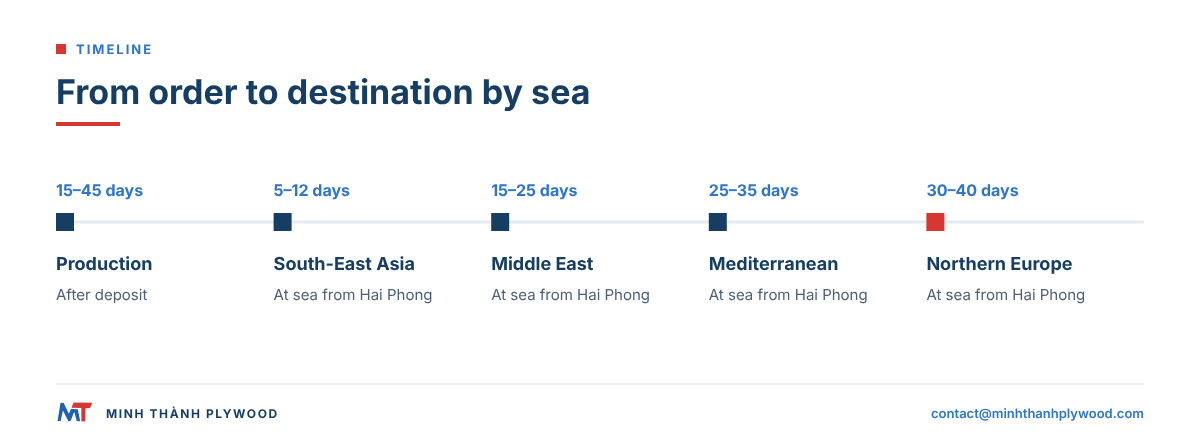
Plywood from Vietnam spends 5–12 days at sea to South-East Asia, 15–25 days to the Middle East, 25–35 days to the Mediterranean and 30–40 days to Northern Europe, from Hai Phong, depending on the carrier and route. Production of 15–45 days after the deposit comes first.
| Destination | Typical days at sea from Hai Phong |
|---|---|
| South-East Asia | 5–12 days |
| Japan and Korea | About two to three weeks |
| Middle East (Jebel Ali and Gulf ports) | 15–25 days |
| US West Coast | 20–30 days |
| Mediterranean | 25–35 days |
| Northern Europe | 30–40 days |
| US East Coast | 35–45 days |
| West Africa | 35–50 days |
Minh Thanh ships FOB Hai Phong, CFR or CIF, to buyers across Europe, the Americas, Asia and Africa, with Europe its strongest market. Every shipment is photographed and filmed before loading.
What to specify for transport plywood orders
Specify the use, the panel build, the tests and the approvals in one order line, so the mill can say at once whether it can supply. For vehicle floors and crates, a line like this is enough:
Anti-slip film-faced plywood for van and trailer floors, 18 mm ±0.5 mm, 1220 × 2440 mm, mesh phenolic film about 220 g/m² face / smooth film back, Eucalyptus core, phenolic WBP glue, edges sealed, one 40HC, CIF destination port.
The checklist:
- Use and position: vehicle floor, wall, furniture or crate.
- Approvals required: none, the vehicle builder’s spec, fire tests, or a containment or rail approval.
- Face: anti-slip, smooth film, sanded veneer or plain packing face.
- Core and glue: Eucalyptus, Acacia, Styrax or birch; phenolic WBP, melamine-fortified or UF glue at E0 emission.
- Thickness and tolerance: 3–40 mm; ±0.5 mm for film-faced, ±0.2–0.3 mm for sanded furniture panels.
- Size: 1220 × 2440 or 1250 × 2500 mm, or cut to the floor plan.
- Quantity, packing and port: sheets per pack, packs per 40HC, Incoterm and destination.
Send the drawing and the use to Minh Thanh Plywood for a quotation and free samples.
Buyer questions, answered
What is ship plywood?
Ship plywood is plywood made for use on or in ships: marine plywood for hulls and decks, fire-retardant plywood for cabins and linings, and approved birch plywood in the insulation of LNG carrier tanks. Each use has its own standard and approval.
Why is birch plywood used in LNG carrier insulation?
Birch plywood keeps its strength and stiffness at the cryogenic temperature of liquefied natural gas, insulates well, machines to tight tolerances and can be bonded into large load-bearing boxes. Thin, even birch plies give consistent properties across thousands of panels.
What temperature does LNG carrier plywood face?
The plywood sits inside the insulation of tanks holding liquefied natural gas at about minus 163 °C. The panels nearest the cargo see temperatures close to that, while outer layers are warmer.
What is railway plywood?
Railway plywood is plywood used in rail vehicles, mainly for coach floors and interior panels. In Europe it must pass the fire tests of EN 45545-2 for the hazard level of the train, and floors are often film-faced or covered with a floor covering.
Is plywood still used in trains?
Yes. Many passenger coaches, trams and metro cars use plywood or plywood-composite floor panels over the steel or aluminium frame, because plywood is light, stiff, quiet and easy to fix. Fire-tested panels are required.
What is automotive plywood?
Automotive plywood is plywood used in road vehicles: van floor liners, truck and trailer floors, bus floors and caravan furniture. Film-faced and anti-slip plywood with phenolic WBP glue is the usual choice for floors.
Do plywood crates need ISPM 15 treatment?
No. ISPM 15 covers wood packaging made of raw wood; packaging made wholly of processed wood such as plywood is outside its scope, so plywood crates and boxes do not need ISPM 15 heat treatment or stamping.
How long does it take to ship plywood from Vietnam to Jebel Ali?
Typical time at sea from Hai Phong to the Middle East, including Jebel Ali, is 15–25 days, depending on the carrier and route. Production of 15–45 days after the deposit comes before that.
Does Minh Thanh supply LNG or rail-certified plywood?
No. LNG containment and certified rail panels come from mills approved for those systems. Minh Thanh supplies film-faced, anti-slip, birch-faced furniture and packing plywood for vehicle floors, interiors and crates.
What is plywood for sea transport?
Plywood for sea transport covers the container floors that carry the cargo, plywood crates and boxes, dunnage and load spreaders, and the floors and linings of the ships themselves. Packing plywood and film-faced plywood are the common grades.
Is marine plywood waterproof?
Marine plywood is water-resistant, not waterproof forever. Its phenolic glue survives repeated wetting and its core has no gaps for water to collect in, so it is the board for hulls, decks and wet rooms, but sealed edges and a coating still decide how long it lasts.
What is the difference between marine plywood and standard plywood?
Marine plywood to BS 1088 uses durable face and core species, a boil-proof phenolic bond (EN 314-2 class 3) and a core with no voids. Standard plywood often uses cheaper species and a bond made for dry or occasionally damp service, so it delaminates faster outdoors.