
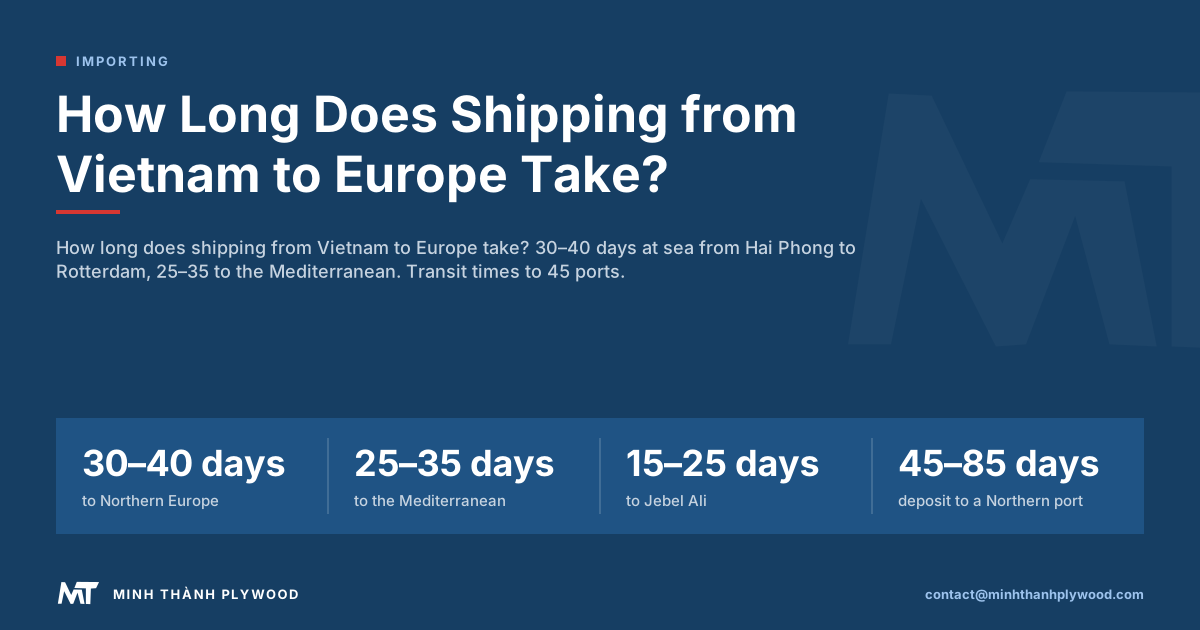
Shipping from Vietnam to Europe takes about 30–40 days at sea from Hai Phong to Northern European ports such as Rotterdam, Hamburg and Felixstowe, and 25–35 days to the Mediterranean, by carrier and route. Add 15–45 days of production after the deposit, and a plywood order from Minh Thanh Plywood reaches a European port 40–85 days after you pay the deposit.
How long does shipping from Vietnam to Europe take?
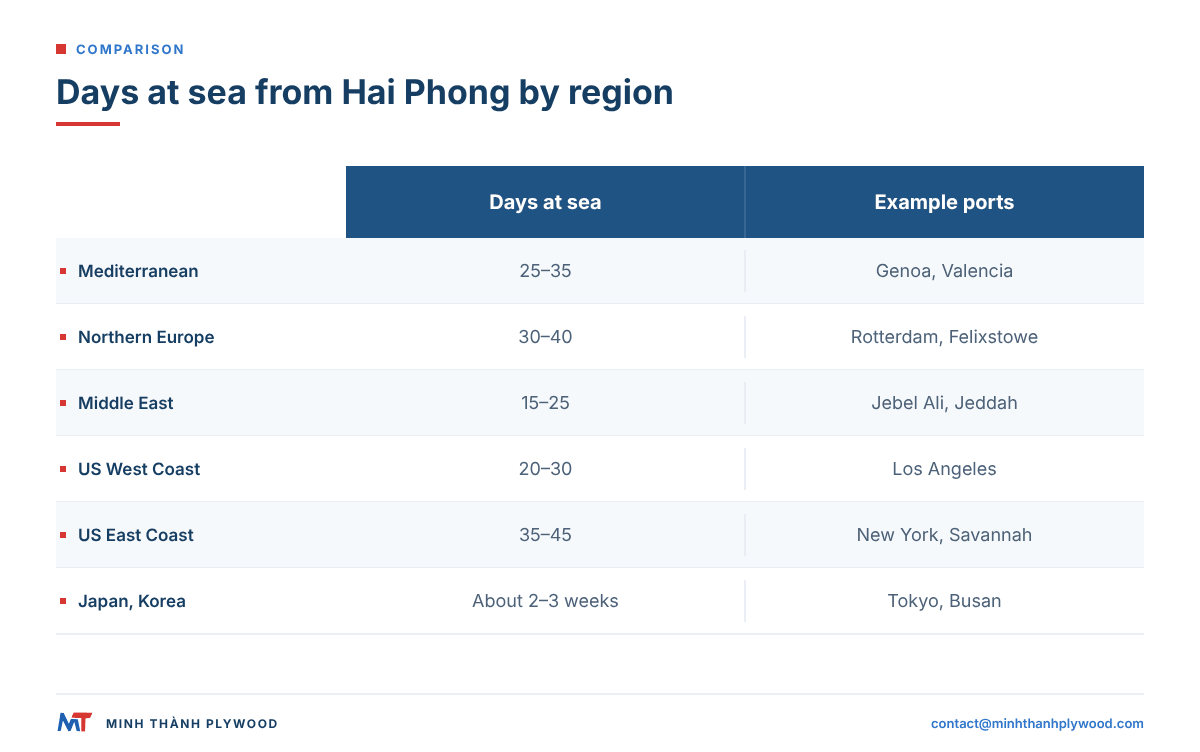
Shipping from Vietnam to Europe takes about 30–40 days at sea from Hai Phong to Northern Europe and 25–35 days to the Mediterranean. These are the typical days at sea on the usual container services from Hai Phong, by carrier and route, not door-to-door times.
| From Hai Phong to | Typical days at sea | Example ports |
|---|---|---|
| Mediterranean | 25–35 | Genoa, Valencia, Barcelona, Piraeus, Koper |
| Northern Europe | 30–40 | Rotterdam, Antwerp, Hamburg, Felixstowe, Gdańsk |
| Middle East | 15–25 | Jebel Ali, Dammam, Jeddah, Sohar |
| US West Coast | 20–30 | Los Angeles, Long Beach, Oakland, Seattle |
| US East Coast | 35–45 | New York and New Jersey, Savannah, Charleston |
| West Africa | 35–50 | Lagos, Tema, Abidjan, Dakar |
| South-East Asia | 5–12 | Singapore, Port Klang, Laem Chabang, Manila |
| Japan and Korea | About 2–3 weeks | Tokyo, Yokohama, Osaka, Busan |
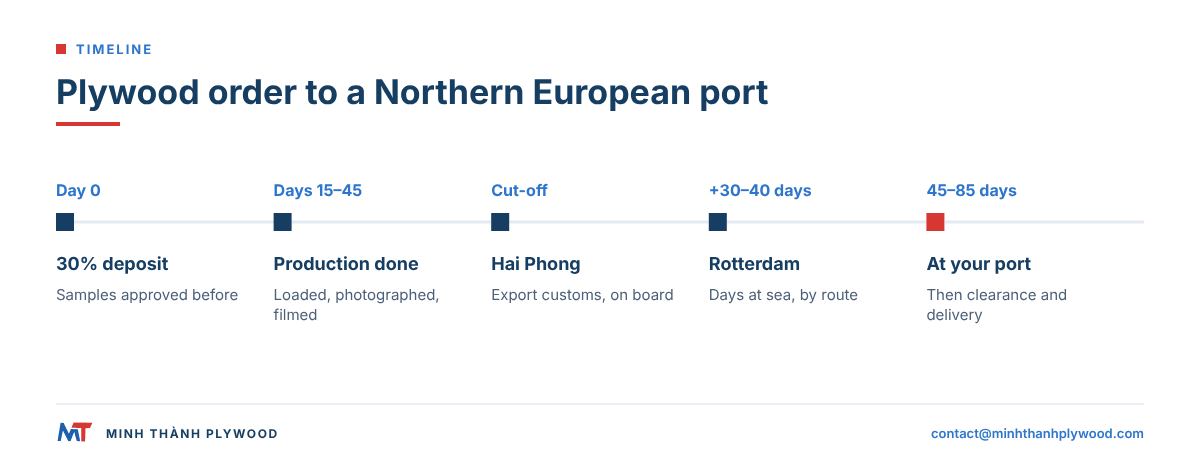
For a plywood order, the sea is only one part of the time. Production at Minh Thanh takes 15–45 days after the deposit, so a container reaches a Northern European port 45–85 days after the deposit and a Mediterranean port 40–80 days after it.
What are the transit times from Hai Phong, port by port?
The table gives the typical days at sea from Hai Phong to 45 ports. Each port takes the range of its region; a direct service sits at the short end, a transshipment or a long routing at the long end.
| Port | Country | Region | Typical days at sea | Usual routing |
|---|---|---|---|---|
| Rotterdam | Netherlands | Northern Europe | 30–40 | Main-line call |
| Antwerp | Belgium | Northern Europe | 30–40 | Main-line call |
| Hamburg | Germany | Northern Europe | 30–40 | Main-line call |
| Bremerhaven | Germany | Northern Europe | 30–40 | Main-line call |
| Le Havre | France | Northern Europe | 30–40 | Main-line call |
| Felixstowe | United Kingdom | Northern Europe | 30–40 | Main-line call |
| London Gateway | United Kingdom | Northern Europe | 30–40 | Main-line call |
| Southampton | United Kingdom | Northern Europe | 30–40 | Main-line call |
| Gdańsk | Poland | Northern Europe | 30–40 | Main-line call or feeder |
| Gothenburg | Sweden | Northern Europe | 30–40, upper end | Feeder from a North Sea hub |
| Aarhus | Denmark | Northern Europe | 30–40, upper end | Feeder from a North Sea hub |
| Dublin | Ireland | Northern Europe | 30–40, upper end | Feeder from a North Sea or UK hub |
| Genoa | Italy | Mediterranean | 25–35 | Main-line call |
| Valencia | Spain | Mediterranean | 25–35 | Main-line call |
| Barcelona | Spain | Mediterranean | 25–35 | Main-line call |
| Piraeus | Greece | Mediterranean | 25–35 | Main-line call |
| Koper | Slovenia | Mediterranean | 25–35 | Main-line call or feeder |
| Fos-sur-Mer (Marseille) | France | Mediterranean | 25–35 | Main-line call |
| Mersin | Türkiye | Mediterranean | 25–35 | Main-line call or feeder |
| Jebel Ali | United Arab Emirates | Middle East | 15–25 | Main-line call |
| Khalifa Port, Abu Dhabi | United Arab Emirates | Middle East | 15–25 | Main-line call or feeder |
| Dammam | Saudi Arabia | Middle East | 15–25 | Main-line call or feeder |
| Jeddah | Saudi Arabia | Middle East | 15–25 | Main-line call |
| Sohar | Oman | Middle East | 15–25 | Main-line call or feeder |
| Hamad Port | Qatar | Middle East | 15–25 | Feeder from a Gulf hub |
| Los Angeles | United States | US West Coast | 20–30 | Main-line call |
| Long Beach | United States | US West Coast | 20–30 | Main-line call |
| Oakland | United States | US West Coast | 20–30 | Main-line call |
| Seattle and Tacoma | United States | US West Coast | 20–30 | Main-line call |
| New York and New Jersey | United States | US East Coast | 35–45 | Main-line call |
| Savannah | United States | US East Coast | 35–45 | Main-line call |
| Charleston | United States | US East Coast | 35–45 | Main-line call |
| Norfolk | United States | US East Coast | 35–45 | Main-line call |
| Lagos (Apapa) | Nigeria | West Africa | 35–50 | Transshipment |
| Tema | Ghana | West Africa | 35–50 | Transshipment |
| Abidjan | Côte d’Ivoire | West Africa | 35–50 | Transshipment |
| Dakar | Senegal | West Africa | 35–50 | Transshipment |
| Singapore | Singapore | South-East Asia | 5–12 | Direct |
| Port Klang | Malaysia | South-East Asia | 5–12 | Direct |
| Laem Chabang | Thailand | South-East Asia | 5–12 | Direct |
| Manila | Philippines | South-East Asia | 5–12 | Direct |
| Tokyo | Japan | Japan and Korea | About 2–3 weeks | Direct or via a regional hub |
| Yokohama | Japan | Japan and Korea | About 2–3 weeks | Direct or via a regional hub |
| Osaka | Japan | Japan and Korea | About 2–3 weeks | Direct or via a regional hub |
| Busan | South Korea | Japan and Korea | About 2–3 weeks | Direct or via a regional hub |
“Main-line call” means the port is a regular call of the large Asia services; “feeder” means the last leg runs on a smaller vessel from a hub port. A CFR or CIF quote from Minh Thanh names the sailing, so the routing and the days for your container are on the quote.
What is the sea freight transit time from Hai Phong to Rotterdam?
Typically 30–40 days at sea. Rotterdam is the first or second call of most Asia–North Europe services, so it sits in the middle of the Northern Europe range. Antwerp, Hamburg and Bremerhaven are on the same services and take the same range.
Shipping time from Hai Phong to Rotterdam port, deposit to arrival
Plan the full chain for a Rotterdam delivery:
| Stage | Time |
|---|---|
| Production after the 30% deposit | 15–45 days |
| Days at sea, Hai Phong to Rotterdam | 30–40 days |
| Deposit to arrival in Rotterdam | 45–85 days |
Customs clearance in the Netherlands and the truck to your warehouse come on top. For an EU import, have the EUDR dossier and the certificate of origin (EUR.1) ready before arrival: Minh Thanh supplies the compliance dossier the EU Deforestation Regulation asks for, origin records and geolocation files, with orders.
How long does shipping take from Hai Phong to the UK?
Typically 30–40 days at sea to Felixstowe, London Gateway or Southampton. These are main-line ports on the Asia–North Europe services, so most sailings reach them without a feeder vessel.
For a UK delivery the chain is the same as for Rotterdam: 15–45 days of production, 30–40 days at sea, then clearance and delivery. Ask for the EUR.1 under the UK-Vietnam Free Trade Agreement on the order, so the preferential duty rate applies at arrival. The UK Trade Tariff lists the Vietnam preferential rate against the third-country rate for plywood (checked on 21 October 2026), when the origin proof is in order.
How long does it take to ship plywood from Vietnam to Jebel Ali?
Typically 15–25 days at sea from Hai Phong to Jebel Ali. The Gulf is one of the shorter long-haul routes from northern Vietnam, and Jebel Ali is a main-line call for most Asia–Middle East services.
| Destination | Days at sea | Deposit to arrival |
|---|---|---|
| Jebel Ali, United Arab Emirates | 15–25 | 30–70 days |
| Dammam, Saudi Arabia | 15–25 | 30–70 days |
| Jeddah, Saudi Arabia | 15–25 | 30–70 days |
| Sohar, Oman | 15–25 | 30–70 days |
Deposit to arrival adds 15–45 days of production to the days at sea. Ports that a feeder serves from Jebel Ali, such as Hamad Port in Qatar, take the same range with the feeder leg at the long end.
How long does shipping take to the Mediterranean?
Typically 25–35 days at sea from Hai Phong to Mediterranean ports such as Genoa, Valencia, Barcelona, Piraeus, Koper and Fos-sur-Mer. Ships from Asia reach the Mediterranean before Northern Europe on the Suez routing, so the range is shorter.
When services avoid the Red Sea and sail around the Cape of Good Hope, Mediterranean ports lose that advantage: the vessel enters through Gibraltar and the voyage lengthens. Check the routing on the quote when timing matters. Our cut-to-size orders, panels cut into 4, 6 or 8 pieces, ship regularly to Italy and other European markets on these routes.
How long does shipping take to the US, Japan and other markets?
From Hai Phong, by carrier and route:
- US West Coast: 20–30 days at sea to Los Angeles, Long Beach, Oakland, Seattle and Tacoma.
- US East Coast: 35–45 days at sea to New York and New Jersey, Savannah, Charleston and Norfolk.
- Japan and Korea: about 2–3 weeks to Tokyo, Yokohama, Osaka and Busan.
- South-East Asia: 5–12 days to Singapore, Port Klang, Laem Chabang and Manila.
- West Africa: 35–50 days to Lagos, Tema, Abidjan and Dakar, usually with a transshipment.
For US orders, the Importer Security Filing data is due before the container is loaded on the vessel; send your filer’s details with the order so the sailing is not missed. For routes outside these regions, such as Australia, South Africa or the Atlantic coast of Morocco, the CFR or CIF quote names the sailing and its days.
Why do transit times from Hai Phong vary?
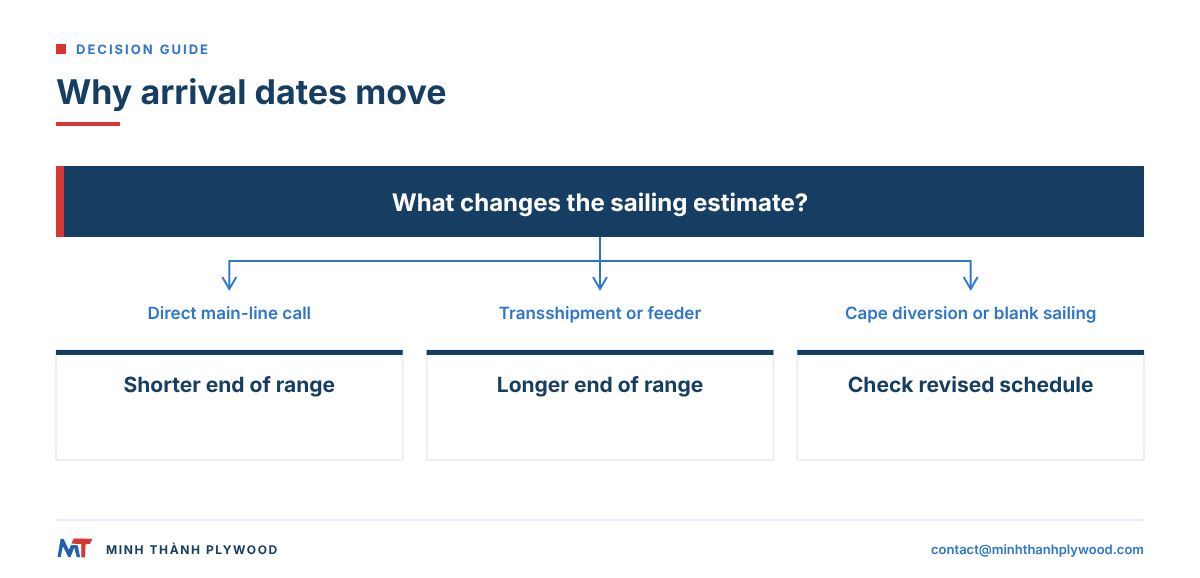
Each carrier runs its own network, so the same port has a range, not one number. The main reasons:
- Direct call or transshipment. A transshipment at a hub such as Singapore, Port Klang or a regional port adds waiting time for the next vessel.
- Port rotation. The first port of call on a service is reached days before the last one.
- Routing. A diversion around the Cape of Good Hope instead of Suez lengthens Asia–Europe voyages.
- Congestion and weather. Waiting at anchor before berthing, or typhoon delays in the South China Sea.
- Blank sailings. A cancelled sailing moves the container to the next vessel on the service.
- Feeder legs. Smaller ports reached by a feeder from a hub, such as Scandinavian or some Gulf ports.
That is why our transit figures are typical ranges, and why a CFR or CIF quote names the sailing you are booked on.
What happens between the deposit and the vessel sailing?
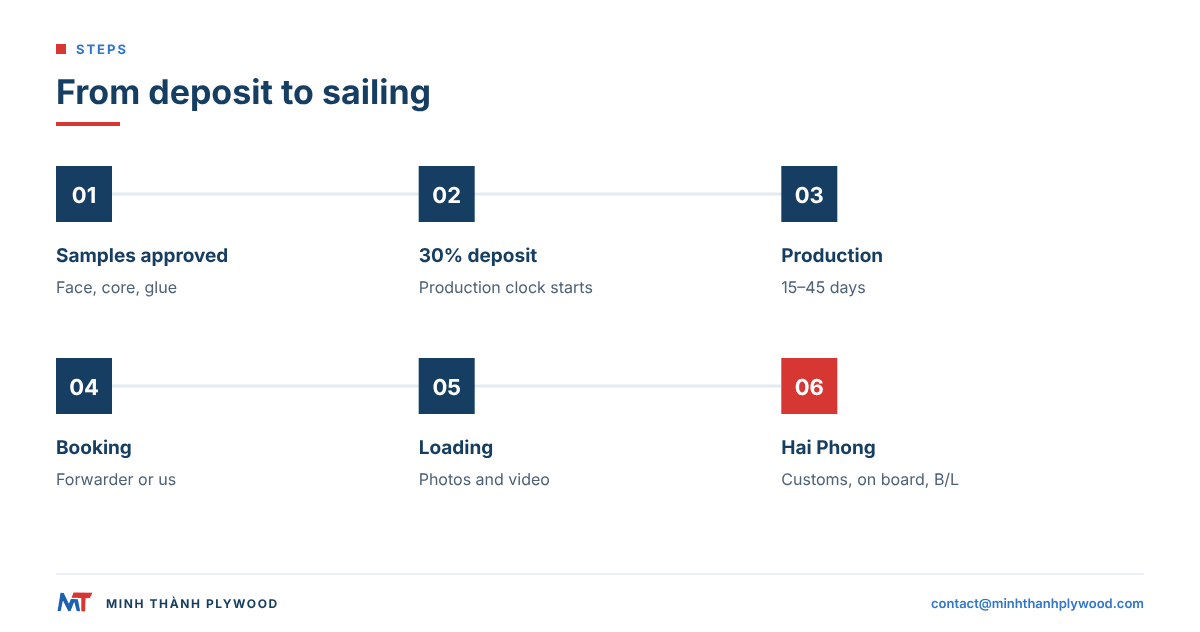
The production side of the timeline runs in a fixed order at Minh Thanh:
- Specification and samples. Free samples first; you approve the face, core and glue before ordering.
- Deposit. 30% deposit; the production clock starts when it arrives.
- Production. 15–45 days, by specification and quantity; thin 4 mm premium panels and custom sizes take longest.
- Booking. Under FOB your forwarder books the vessel and gives us the cut-off; under CFR and CIF we book it.
- Loading. The container is loaded at our factory, photographed and filmed; you receive the photos and video.
- Haulage and export customs. The container goes by road to Hai Phong and is cleared for export there.
- Sailing. The vessel leaves; we send the scanned bill of lading, and the 70% balance is due against it.
The step that most often adds days is the booking: a full vessel in peak season, or a cut-off missed because documents were late. Under FOB, a forwarder who books early keeps your container on the planned sailing.
How do you plan door-to-door delivery time?
Add the stages in order and plan on the upper end for a first order:
- Quotation and samples, before the deposit.
- Production: 15–45 days after the deposit.
- Loading, haulage and export clearance to the cut-off at Hai Phong.
- Days at sea for your region, from the table above.
- Arrival: discharge, customs clearance and any inspection at your port.
- Delivery by truck or rail to your warehouse.
| Destination region | Production + days at sea |
|---|---|
| Mediterranean | 40–80 days |
| Northern Europe | 45–85 days |
| Middle East | 30–70 days |
| US West Coast | 35–75 days |
| US East Coast | 50–90 days |
| West Africa | 50–95 days |
| South-East Asia | 20–57 days |
Steps 3, 5 and 6 depend on the booking, your port and your broker, so add them from your own experience of that route.
How do you track a plywood container from Hai Phong?
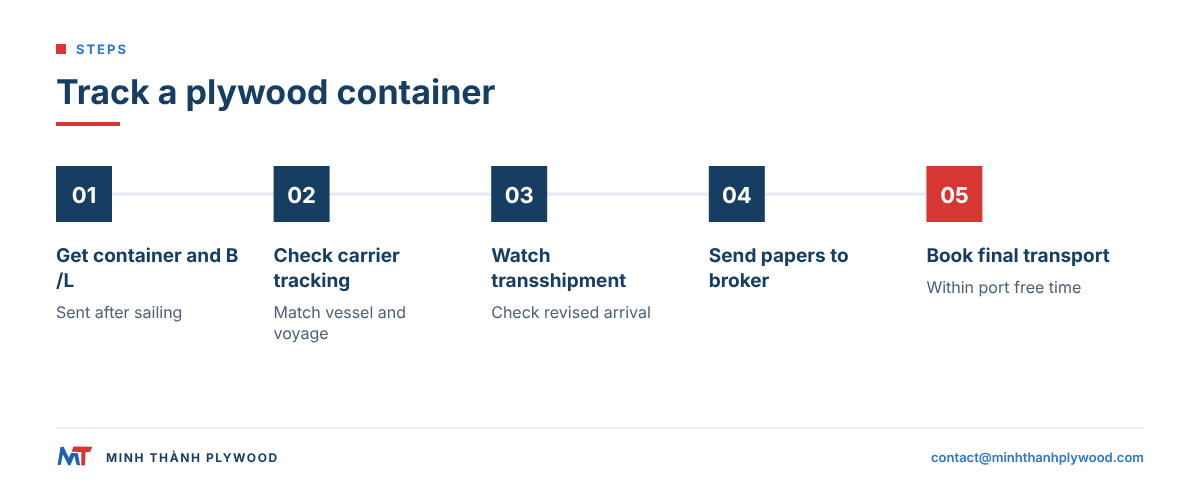
With the container number and the bill of lading number, on the carrier’s own tracking page. Minh Thanh sends both with the scanned B/L once the vessel has sailed. From there:
- Check the vessel and voyage on the B/L against the carrier’s schedule.
- Watch for transshipment at a hub: the container changes vessel and gets a new estimated arrival.
- Send the documents to your broker before the vessel arrives, so clearance can start on arrival.
- Book the truck for the free-time window your carrier gives at the port.
The pack numbers on the packing list match the loading photos and video, so you can check on arrival that each pack in the container is the one loaded at Hai Phong.
How can you shorten the total lead time?
The sea time is fixed by the route; the time before the sailing is not. Five ways to shorten it:
- Approve samples before the deposit, so production starts on the day the money arrives.
- Order standard sizes and faces: 1220 × 2440 or 1250 × 2500 mm on Styrax or Eucalyptus cores run as one press programme.
- Keep a mixed container simple: two or three specifications plan faster than six.
- Book repeat containers ahead. Buyers who order one or more containers a month get press time reserved, which keeps production at the short end of 15–45 days.
- Choose a direct service when time matters more than freight price, and name it in the booking.
What does this mean for your order?
For a first order to Europe, plan on 45–85 days from deposit to a Northern European port, 40–80 days to a Mediterranean port, plus clearance and delivery. For repeat orders, a reserved production slot and a known booking routine bring that close to the short end.
Our terms: MOQ one 40HC with mixed specifications by agreement, production 15–45 days after the 30% deposit, the 70% balance against the scanned B/L or an irrevocable L/C at sight, delivered FOB Hai Phong, CFR or CIF. Send your destination port with your specification, and the CFR or CIF quote names the sailing and its days.
Buyer questions, answered
How long does shipping from Vietnam to Europe take?
About 30–40 days at sea from Hai Phong to Northern Europe and 25–35 days to Mediterranean ports, by carrier and route. Door to door, add the time to load, clear customs at both ends and deliver inland.
How long does sea freight take from Hai Phong to Rotterdam?
Typically 30–40 days at sea, the range for Northern European ports. A direct service sits at the short end; a transshipment through a hub port, or a sailing around the Cape of Good Hope, sits at the long end.
How long does it take to ship plywood from Vietnam to Jebel Ali?
Typically 15–25 days at sea from Hai Phong to Jebel Ali and other Middle East ports. With production of 15–45 days after the deposit, plan 30–70 days from deposit to arrival.
What is the transit time from Hai Phong to Felixstowe?
Typically 30–40 days at sea, the same range as Rotterdam and Hamburg. Felixstowe, London Gateway and Southampton are main-line ports for Asia services, so most sailings reach them without a feeder.
What is the transit time from Hai Phong to Gothenburg?
Plan the upper end of the Northern Europe range, 30–40 days at sea, because Gothenburg and other Scandinavian ports are often reached by a feeder vessel from a North Sea hub such as Rotterdam or Hamburg.
How long does shipping from Vietnam to the US take?
About 20–30 days at sea from Hai Phong to the US West Coast and 35–45 days to the US East Coast, by carrier and route.
How long does shipping from Vietnam to Japan or Korea take?
About 2–3 weeks at sea from Hai Phong to Japanese and Korean ports such as Tokyo, Yokohama, Osaka and Busan.
How long does the whole plywood order take, from inquiry to delivery?
Samples and quotation first, then 15–45 days of production after the 30% deposit, then the days at sea for your region. For Northern Europe, plan 45–85 days from deposit to your port, plus clearance and delivery.
Why are transit times given as ranges?
Each carrier runs its own route: some call direct, others transship at a hub port, and routings change with weather, congestion and diversions. The range covers the usual services from Hai Phong.
How do I track my plywood container?
With the container number and the bill of lading number on the carrier's website. Minh Thanh sends both with the scanned B/L after the vessel sails, together with the loading photos and video.
Can I shorten the lead time on a plywood order?
Yes. Approve samples before the deposit, keep the specification to standard sizes and faces, and book repeat containers ahead: regular buyers get press time reserved, which keeps production at the short end of 15–45 days.