
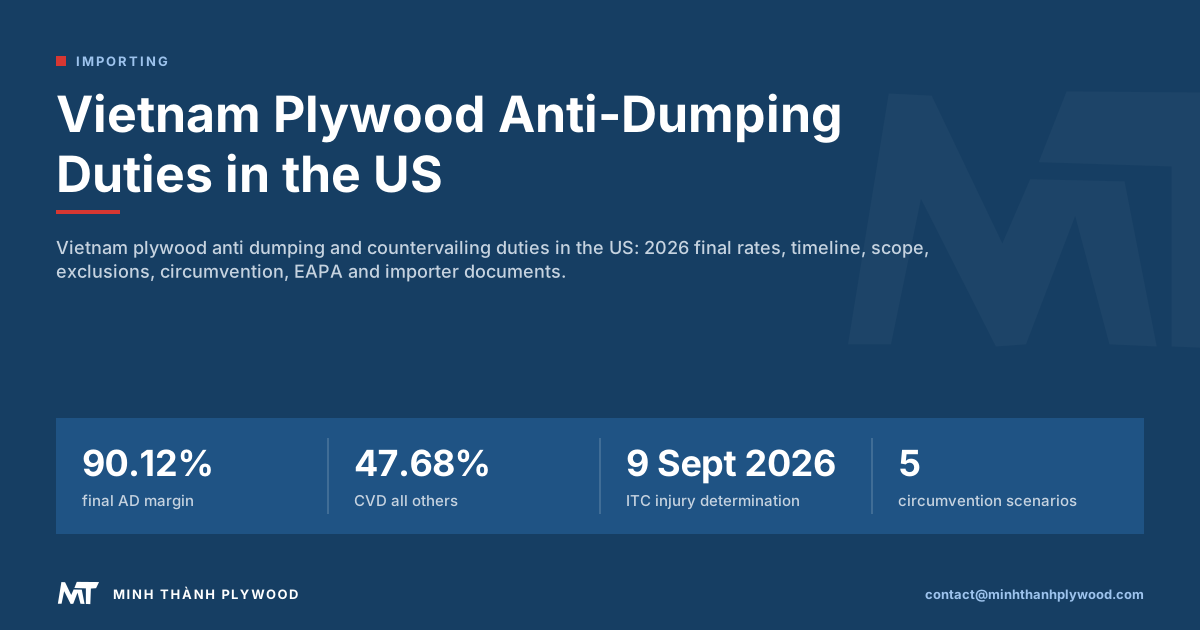
Yes. In July 2026 the US Department of Commerce made final Vietnam plywood anti-dumping and countervailing duty determinations on hardwood and decorative plywood: a 90.12% dumping margin and a 47.68% all-others subsidy rate. The ITC found injury in September 2026. This guide by Minh Thanh Plywood sets out the dates, scope, exclusions and the documents a US importer keeps, as read from the Federal Register on 20 October 2026.
Is there a Vietnam plywood anti-dumping duty in the US?
Yes. The US Department of Commerce issued final affirmative anti-dumping (AD) and countervailing duty (CVD) determinations on hardwood and decorative plywood from Vietnam, published in the Federal Register on 21 July 2026. The US International Trade Commission (ITC) then found that the US industry is materially injured by these imports, in a determination published on 9 September 2026.
| Item | Value | Source |
|---|---|---|
| Case numbers | A-552-851 (AD), C-552-852 (CVD) | Commerce |
| Final AD margin | 90.12% for all listed separate-rate companies and the Vietnam-wide entity | Final AD determination, 21 July 2026 |
| AD cash deposit after export-subsidy offset | 84.95% | Same notice |
| Final CVD all-others rate | 47.68% | Final CVD determination, 21 July 2026 |
| ITC final vote | Material injury; softwood structural plywood terminated as negligible | ITC determination, 9 September 2026 |
| AD and CVD orders | Follow the ITC’s affirmative determination; check the ITA case page for publication | Commerce |
When we read the Federal Register on 20 October 2026, the AD and CVD orders had not yet appeared in our search. The cash-deposit instructions in the final determinations remain the reference until they do. Any duty on a given entry depends on three facts: whether the product is in scope, which producer and exporter made and sold it, and the case status on the entry date.
What are anti-dumping and countervailing duties?
Anti-dumping duty offsets a price found to be below “normal value”, and countervailing duty offsets a subsidy found to benefit the producer. Commerce calculates both rates; the ITC decides whether imports injure the US industry. Both duties are collected by US Customs and Border Protection (CBP) on top of ordinary duty.
The two run as separate cases on the same product. A Vietnamese panel in scope can carry an AD rate and a CVD rate at the same time. Because Vietnam is treated as a non-market economy in AD cases, companies that do not prove independence from the state receive the Vietnam-wide rate. In this case the Vietnam-wide entity and every listed separate-rate company share the same 90.12% margin.
AD and CVD are paid first as cash deposits at entry. The final amount is fixed later, when CBP liquidates the entry, often after an annual administrative review of the actual sales and subsidies in that period.
What is the timeline of the US case on Vietnam plywood?
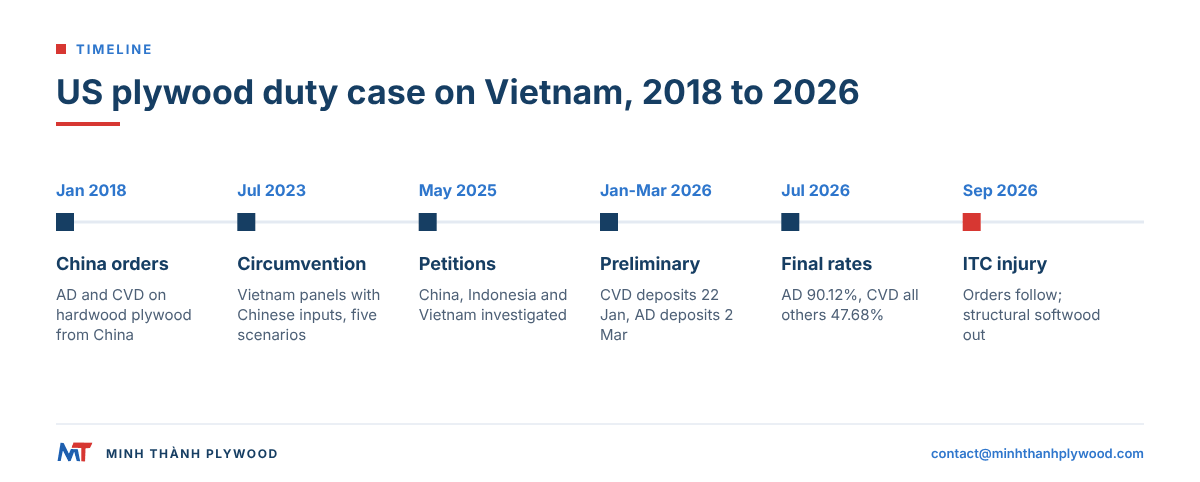
The case has three layers. They are the 2018 orders on hardwood plywood from China, the 2023 finding that some Vietnamese plywood made with Chinese inputs circumvented those orders, and the 2025–2026 investigation of plywood from Vietnam itself.
| Date | Step | What it means for imports from Vietnam |
|---|---|---|
| 4 January 2018 | AD and CVD orders on hardwood plywood from China (83 FR 504, 83 FR 513) | Sets the China rates later used for circumvention |
| 20 July 2023 | Final circumvention finding on plywood completed in Vietnam with Chinese inputs | Five input scenarios fall under the China orders; certification programme for other plywood |
| 22 May 2025 | Petitions filed by the Coalition for Fair Trade in Hardwood Plywood | Investigations of China, Indonesia and Vietnam begin |
| 22 January 2026 | Preliminary CVD determination published | CVD cash deposits from this date |
| 2 March 2026 | Preliminary AD determination published | AD cash deposits from this date |
| 22 May 2026 | Provisional CVD suspension ends (statutory limit) | CVD deposits pause until an order |
| 21 July 2026 | Final AD and CVD determinations published | Final rates of 90.12% AD and 47.68% CVD all others |
| 9 September 2026 | ITC final determination published | Material injury on hardwood and decorative plywood; orders follow |
The CVD notice also records that critical circumstances were found for one company only, so retroactive suspension 90 days before the preliminary determination does not apply to the all-others rate. The AD determination for Vietnam was a final negative on critical circumstances.
Vietnam plywood antidumping rates: what did Commerce set in the final determinations?
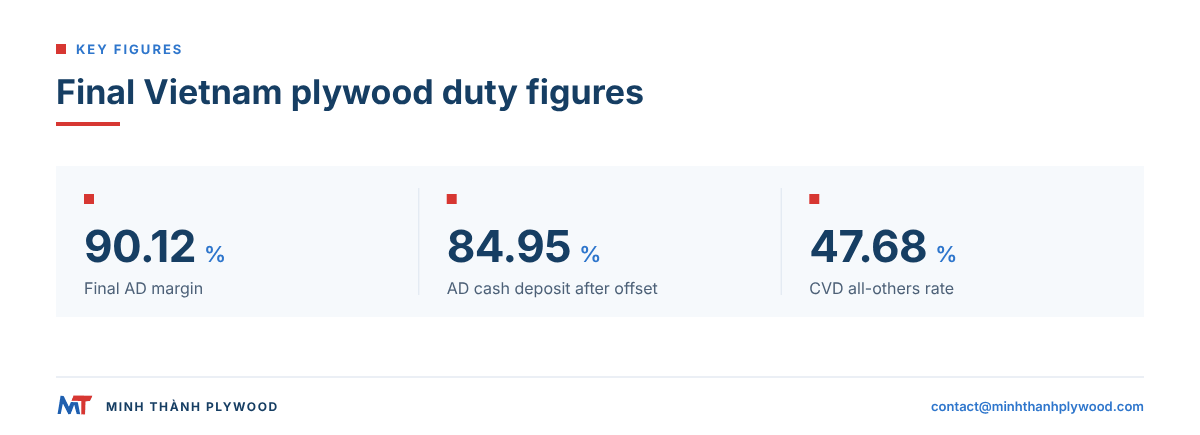
The Vietnam plywood antidumping (AD) result is one rate for the whole country list. Commerce set a single 90.12% weighted-average dumping margin for every Vietnamese producer and exporter combination listed with a separate rate and for the Vietnam-wide entity. The cash deposit rate shown beside it, 84.95%, is the margin adjusted for export subsidies found in the companion CVD case.
In the CVD case the all-others rate is 47.68%, the same as one of the two examined respondents. The other examined company received a rate built on facts available with adverse inferences, which applies only to it.
| Rate | Who it applies to | Value |
|---|---|---|
| AD weighted-average margin | Listed separate-rate combinations and the Vietnam-wide entity | 90.12% |
| AD cash deposit, adjusted for export subsidy offset | Same | 84.95% |
| CVD all-others | Producers and exporters not individually examined | 47.68% |
| China orders via circumvention | Plywood made in Vietnam from Chinese inputs in the five scenarios, without valid certification | 183.36% AD, 22.98% CVD |
A third-country exporter selling Vietnamese plywood takes the rate of the Vietnamese producer and exporter that supplied it, or the Vietnam-wide rate. Rates belong to producer and exporter pairs, so the same mill can sit in more than one row of the Commerce table depending on who exported.
What did the preliminary rates say, and which Vietnamese companies were named?
The preliminary AD determination announced on 25 February 2026 was far higher than the final one: a 196.14% margin and a 193.32% cash deposit for the Vietnam-wide entity and for 72 listed producer and exporter combinations, with two exceptions (ITA preliminary determination). The final margin fell to 90.12% on 21 July 2026, so an importer who budgeted on the preliminary figure over-reserved by more than half.
| Producer / exporter named by Commerce (preliminary) | Margin | Cash deposit |
|---|---|---|
| Junma Phu Tho Co., Ltd. | 196.14% | 194.80% |
| Nhat Duy Production and Trading Co., Ltd. / Trieu Thai Son Co., Ltd. | 196.14% | 191.85% |
| Kangda Board (Vietnam) Co., Ltd. | 196.14% | 193.32% |
| Long Viet Plywood Technology Joint Stock Company | 196.14% | 193.32% |
| Viet Nam Vinh Phu Wood Company Limited, exported by Dai Hong Phat International Trading Company Limited | 196.14% | 193.32% |
| Western Hanoi H2H Forest Products Joint Stock Company | 196.14% | 193.32% |
| Vietnam-wide entity | 196.14% | 193.32% |
The full Commerce table has 72 combinations, and rates attach to the pair of producer and exporter, as the Vinh Phu and Dai Hong Phat row shows. Before you sign an order, ask the supplier for its legal name and the exporter name that will appear on the invoice, and look both up in the final Commerce table. Minh Thanh gives importers the producer and exporter names, the construction and the origin records for each order, so the entry can be matched to the table.
The preliminary countervailing duty rates, announced a month earlier, ran from 4.37% to 26.75% for Vietnam. The other two countries in the same case were treated as follows (Wiley, 26 February 2026):
| Country | Preliminary AD margin | Preliminary CVD |
|---|---|---|
| Vietnam | 196.14% | 4.37% to 26.75% |
| China | 187.27% | 81.34% country-wide |
| Indonesia | 19.98% to 84.94% | 2.40% to 128.66% |
Which plywood products are in scope?
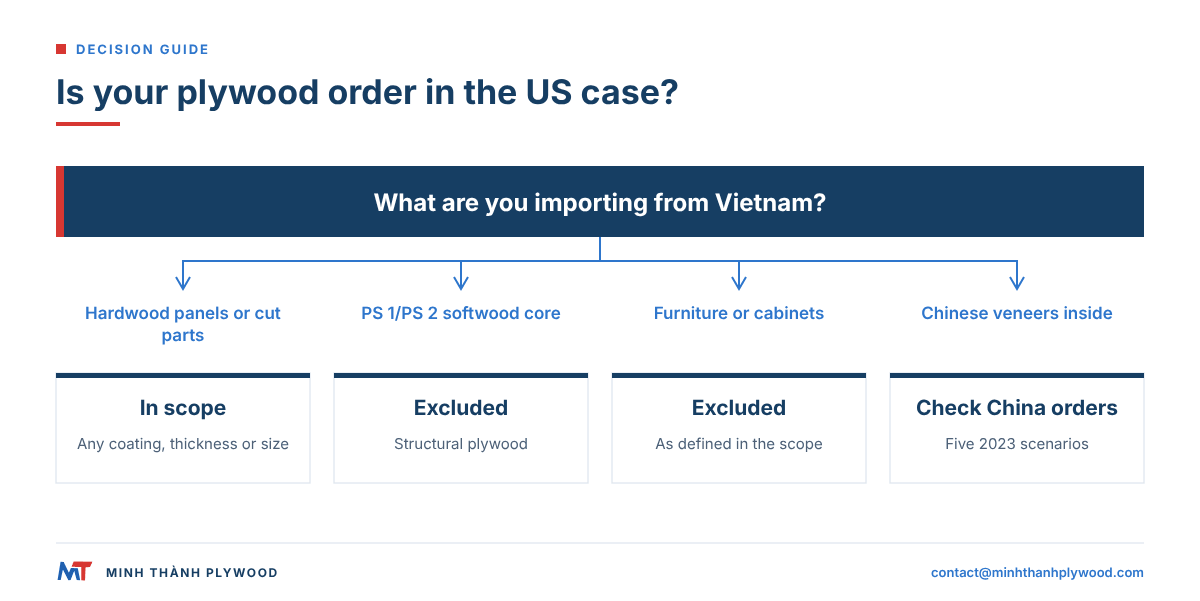
The scope covers hardwood and decorative plywood and certain veneered panels: flat, multi-layer panels of two or more wood veneers, with or without a core, where at least the face or the back veneer is hardwood, softwood or bamboo. The core can be hardwood, softwood, particleboard or MDF.
The scope is wide in four ways that surprise first-time importers:
- Any surface. Panels are in scope whether or not the face is coated: UV-cured or other polyurethanes, wax, paint, stain, paper, aluminium, high-pressure laminate, MDF, MDO or phenolic film.
- Any dimension. Overall thickness, veneer thicknesses, width and length do not matter.
- Minor processing. Trimmed, cut-to-size, notched, punched or drilled panels stay in scope, also when that processing is done in a third country.
- A standard does not exclude. Panels made to ANSI/HPVA HP-1-2024 can be in scope; only the structural standards named in the exclusions take a panel out.
This means a furniture-grade panel with a poplar face over a hardwood core, cut into cabinet parts, is still hardwood and decorative plywood for this case. It leaves scope only when it becomes one of the finished goods in the exclusion list below.
Which products are excluded from the case?
The case excludes structural plywood, a set of finished wood products and a few specific panels. The exclusions in the final determinations are:
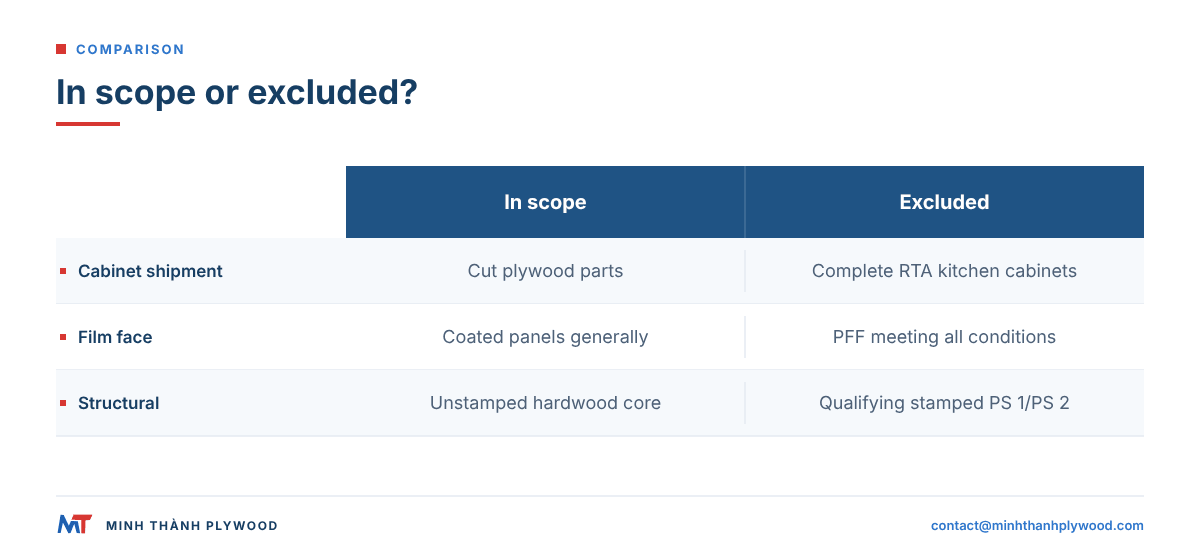
- Structural plywood certified, manufactured and stamped to PS 1-09, PS 1-22, PS 2-09, PS 2-10 or PS 2-18, where the standard sets core species, with a core made entirely of the listed North American softwood species such as Douglas fir, southern pine or spruce.
- Phenolic film-faced plyform (PFF) with an Exterior or Exposure 1 bond, opaque phenolic film of at least 90 g/m² on both face and back, and moisture-resistant coated edges.
- Plywood already under the China orders, and multilayered wood flooring under the China flooring orders, plus bamboo-faced or solid bamboo flooring and products.
- Finished goods: assembled furniture, ready-to-assemble (RTA) furniture packed with all parts and instructions, unassembled bathroom vanity cabinets and linen closets as defined, assembled and RTA kitchen cabinets, finished table tops and finished countertops.
- Other: panels with a cork face and back, non-flat shaped plywood, and certain LVL door and window components.
An exclusion depends on the product as entered. A pallet of RTA kitchen cabinets with every component, fitting and instruction is excluded; the same plywood shipped as flat-packed cut parts without fittings is in scope.
Which HTSUS subheadings does the case list?
The ITC determination lists 35 HTSUS subheadings, from 4412.10.05 (bamboo) through the 4412.31, 4412.33, 4412.34, 4412.39, 4412.41, 4412.42, 4412.51, 4412.52, 4412.91 and 4412.92 groups. The written scope decides coverage, not the subheading: a panel in scope stays in scope under another line, and a listed line does not pull in an excluded product.
For furniture plywood, these lines matter most: 4412.33.06 (birch face), 4412.33.32 (other listed temperate hardwood faces such as poplar and eucalyptus), 4412.34.32 (other non-coniferous faces), and 4412.31 for tropical faces such as okoumé or bintangor. Your customs broker files the AD and CVD case numbers on the entry with the HTSUS line.
How does the 2023 circumvention finding still apply?
The 20 July 2023 circumvention finding applies the China hardwood plywood orders to plywood completed in Vietnam from Chinese components, in five scenarios:
- Chinese face and back veneers with Chinese assembled core components (for example veneer core platforms).
- Fully assembled Chinese veneer core platforms with face and back veneer from Vietnam or a third country.
- Chinese multi-ply panels of glued core veneers combined in Vietnam into core platforms, with any face or back.
- Chinese face and back veneers with Chinese individual core veneers.
- Chinese individual core veneers made into a core platform in Vietnam, with face and back from Vietnam or a third country.
Plywood in these scenarios pays the China-wide AD rate of 183.36% and the all-others China CVD rate of 22.98% unless it is certified outside them. Plywood assembled in Vietnam under any other scenario is not subject to that inquiry, provided the importer and exporter keep the certifications described below. The 2023 notice also lists 37 companies barred from the certification programme.
The 2026 scope excludes plywood covered by the China orders, so a panel is assessed under one case or the other. That is why the origin of each veneer, not only the country of final pressing, is the first question a US importer asks.
What certifications do the importer and exporter keep?
Under the 2023 programme, the exporter completes an exporter certification and the importer completes an importer certification for each entry of Vietnamese hardwood plywood claimed to be outside the Chinese-input scenarios. The importer keeps both, with supporting documents.
The rules in the notice are specific:
- The exporter certification is made by the party that sold to the US, at or before the date of shipment, and a copy goes to the importer.
- The importer certification is made by an official of the importing company at or before the entry summary date. A customs broker cannot sign it for the importer.
- Certifications are not filed with the entry; they are presented to Commerce or CBP on request, and either agency can verify them.
- Both parties keep them for five years from entry, or three years after any related US court case ends, whichever is later.
- Without a certification, CBP collects cash deposits at the China rates.
Supporting documents are what make the certification hold: veneer and core purchase invoices, production records linking veneer lots to finished panels, and the panel construction on the commercial invoice.
When are cash deposits collected, and what changes with an order?
Cash deposits started with the preliminary determinations: from 22 January 2026 for CVD and from 2 March 2026 for AD. Provisional CVD measures stopped for entries from 22 May 2026, because the law limits them to four months, and continued for entries up to 21 May 2026. The final AD determination kept AD deposits at the final rates.
After an affirmative ITC vote, Commerce publishes the AD and CVD orders, reinstates the CVD suspension of liquidation and instructs CBP to collect deposits at the final rates. Had the ITC voted negative, the deposits would have been refunded and the cases ended.
An order then runs for at least five years before a sunset review. Each year, in the anniversary month, interested parties can request an administrative review, which sets the final duty for the entries of that period and the new deposit rate. A producer that did not ship during the original investigation period can ask for a new shipper review. Importers who budget a container should therefore treat the deposit as a cash outflow that may be adjusted up or down at liquidation.
How do you check whether a plywood order is in scope?
Check scope in five steps before the proforma invoice is signed. The answer changes the landed cost of the whole container:
- Read the product, not the HTSUS line. Write down face, back and core species, core material, glue, coating, thickness and whether the goods are flat panels, cut parts or finished goods.
- Test the structural exclusion. Only plywood certified and stamped to PS 1 or PS 2 with a core made entirely of the listed softwood species leaves scope this way; a hardwood or plantation core does not.
- Test the finished-goods exclusions. Assembled or RTA furniture and kitchen cabinets, the defined vanity units, finished table tops and finished countertops leave scope; panels and cut parts do not.
- Test the specific panel exclusions. Phenolic film-faced plyform meeting every element of the definition, cork-faced panels and non-flat shaped plywood leave scope.
- Check the input origin. If any face, back or core component comes from China, check the five circumvention scenarios first; the China orders may apply instead.
Where a product sits on the line, a scope ruling request to Commerce gives a binding answer for that product. Your broker or trade counsel files it with a full description, drawings and samples.
What is a CBP EAPA evasion investigation, and why are plywood containers held?
An EAPA investigation is CBP’s process under the Enforce and Protect Act, set out in 19 CFR Part 165. It decides whether an importer entered goods by evasion, meaning without the AD or CVD they owed. Allegations often concern transshipment, false country of origin or misdescribed products. Several EAPA cases have concerned plywood declared as Vietnamese.
The timeline is short. CBP decides within 15 business days of receiving an allegation whether to open an investigation. Within 90 calendar days of initiation it can impose interim measures, such as suspending liquidation, requiring cash deposits at the AD/CVD rate, or demanding single-transaction bonds. It issues a determination of evasion within 300 calendar days, extendable in complex cases.
Containers are held or deposits demanded when CBP doubts the declared origin or scope. What clears them is the same paper trail Commerce expects: the mill’s production records, veneer and core purchase invoices, the circumvention certifications and photos of the actual panels and packs.
What is the ordinary US tariff on plywood from Vietnam?
The ordinary Vietnam plywood tariff in the US depends on the face species. Birch-faced plywood under HTSUS 4412.33.06 enters free. Panels with other temperate hardwood faces under 4412.33.32 pay 8%, as do other non-coniferous faces under 4412.34.32 and most tropical-face lines under 4412.31 (Harmonized Tariff Schedule, read 20 October 2026).
US duty is charged on the transaction value, which for an FOB sale excludes the ocean freight and insurance. AD and CVD cash deposits are charged on the same entered value. Any additional tariffs under HTSUS chapter 99 in force on the entry date are a separate line your broker checks. The cost layers for one container are worked through in our landed cost guide.
Does the EU or the UK charge anti-dumping duty on Vietnamese plywood?
No. As of 20 October 2026, the EU’s anti-dumping duty on hardwood plywood, set by Implementing Regulation (EU) 2025/2333 at 43.3% for one company and 86.8% for all others, applies to plywood originating in China. The EU tariff lines for plywood show no anti-dumping measure for Vietnam, and Vietnamese plywood with a valid EUR.1 enters at 0% under the EU-Vietnam agreement.
The UK tariff shows no anti-dumping measure on plywood from Vietnam either, and the UK-Vietnam agreement rate is 0% with origin proof. EU and UK customs still check that origin is genuine: a panel pressed in Vietnam from Chinese veneers may not meet the agreement’s origin rules. Our UK import guide covers the UK steps.
Which documents should a US importer keep for each plywood entry?
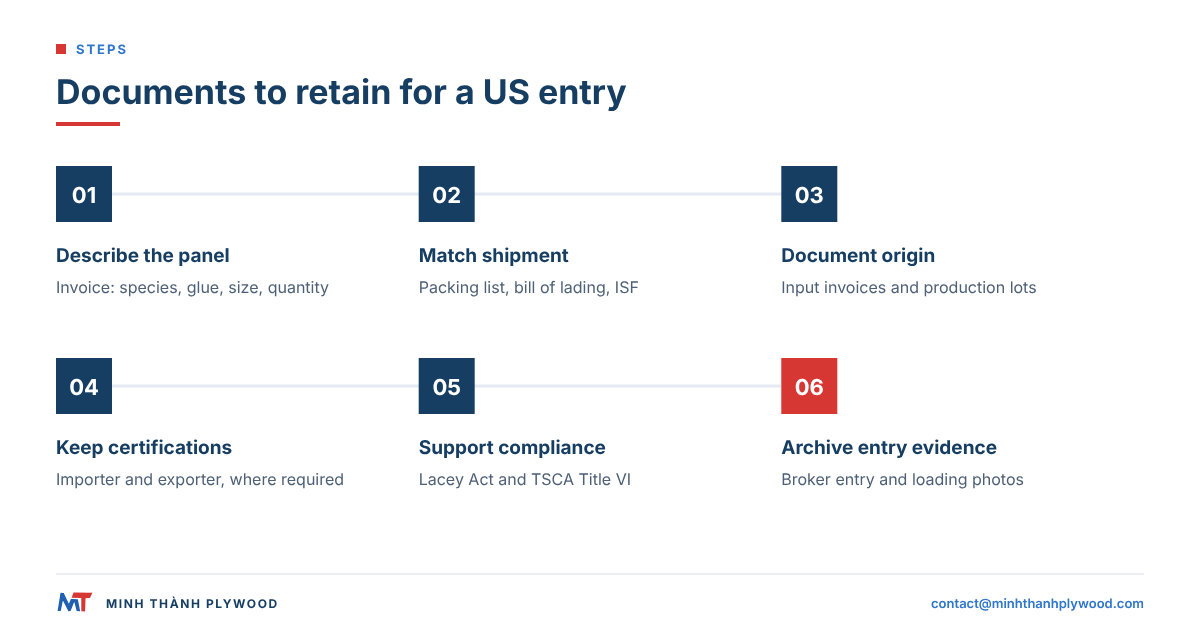
A US importer of plywood from Vietnam should keep one file per entry that answers scope, origin and compliance without a second request. The checklist:
- Commercial invoice naming face, back and core species, thickness, size, glue and quantity in m³ and sheets.
- Packing list with pack numbers, sheet counts and weights that match the invoice.
- Bill of lading and the Importer Security Filing, submitted at least 24 hours before loading at Hai Phong.
- Exporter and importer certifications under the 2023 circumvention programme where the panel is Vietnamese hardwood plywood.
- Production and input records: veneer and core purchase invoices and the lot link to the finished panels.
- Lacey Act declaration data: genus and species and the country of harvest of each wood layer.
- TSCA Title VI label on the panels and the compliance statement on the invoice and bill of lading.
- Entry documents from the broker, including the AD and CVD case numbers where they apply.
- Loading photos and video of the container and packs.
Keep the file for at least five years from entry, the period the certification rules require, and for the full period of any administrative review that covers the entry.
What should a US importer ask a Vietnamese plywood supplier before ordering?
Ask questions that produce documents, not assurances. A supplier who answers these in writing before the deposit makes every later step easier:
- Who is the producer, and who is the exporter? Rates attach to the pair, and the exporter signs the circumvention certification.
- Where does each veneer come from? Face, back and core, by species and country, with purchase invoices for the lot.
- Is the panel pressed in your own factory? A mill that presses the core and the faces itself can link each veneer lot to the finished panels in its production records.
- What is the exact construction? Species, plies, glue and coating as they will appear on the invoice, which decide the HTSUS line and the scope questions above.
- Which formaldehyde documents come with the panels? The TSCA Title VI label, the certifier number and the invoice statement.
- Will you film the loading? Photos and video of packs and container are the first evidence asked for when an entry is questioned.
- How will the invoice describe the goods? The description must match the panels, the packing list and the bill of lading exactly.
A supplier who cannot answer the input-origin question in writing is a risk to the importer, whatever the price.
Where can importers follow the case status?
Follow the case at its primary sources, and date every check. The Federal Register publishes Commerce’s determinations, orders and review results, and the ITC’s votes; search for “hardwood and decorative plywood” and the case numbers A-552-851 and C-552-852. The International Trade Administration’s ACCESS system holds the case record, and CBP’s Cargo Systems Messaging Service sends the cash-deposit instructions brokers apply at entry.
Three dates are worth a calendar entry once the orders are published: the anniversary month in which administrative reviews can be requested, the first review’s preliminary results, and the five-year sunset review. Each one can change the deposit rate on later entries.
Secondary summaries, including this one, can fall behind a new notice. Before a container ships, ask your broker to confirm the deposit rate for your producer and exporter pair on the planned entry date.
What does Minh Thanh supply with a US order?
Minh Thanh supplies the compliance documents a US importer files and keeps, with each order. Panels for US orders carry the TSCA Title VI label with producer, lot, certifier number TPC-43 and “TSCA Title VI compliant”. The commercial invoice and bill of lading state TSCA Title VI compliance, and we supply face and core species with harvest origin for the importer’s Lacey Act declaration.
Our CARB P2 / TSCA Title VI certification is held through ICTT, mill no. 23024, for veneer-core hardwood plywood from 3 to 50 mm. Six ASTM D6007 chamber tests between April 2025 and June 2026, three by Shanghai Hongjun and three by ICTT Vietnam, on 9, 15 and 18 mm panels averaged 0.014–0.032 ppm against the 0.05 ppm limit. Details are on our CARB P2 and TSCA Title VI page.
Every container is photographed and filmed before loading, and the files go to the buyer: the same evidence CBP or Commerce asks for when an entry is questioned. Furniture cores are white Styrax or eucalyptus, grown as plantation timber around our factory in Ha Hoa, Phu Tho.
The duty position of any order is for your customs broker to confirm from the product and the case status on the entry date. It is never a reason in itself to choose a supplier. To start, send a specification line such as:
18 mm furniture plywood, 1220 × 2440 mm, poplar face/back B/B, Styrax core, UF glue at E0 emission, TSCA Title VI label, 1×40HC, CIF Los Angeles.
Send it to [email protected] or through the contact form, and see the furniture plywood range.
Buyer questions, answered
What was the preliminary anti-dumping rate on Vietnamese plywood?
Commerce announced a 196.14% margin and a 193.32% cash deposit for the Vietnam-wide entity on 25 February 2026, with preliminary countervailing rates of 4.37% to 26.75%. The final AD margin fell to 90.12% on 21 July 2026.
Is there an anti-dumping duty on Vietnamese plywood in the US?
Yes, for hardwood and decorative plywood. Commerce's final determination of 21 July 2026 set a 90.12% dumping margin for the separate-rate companies and the Vietnam-wide entity, and the ITC found material injury in its determination published on 9 September 2026.
What is the countervailing duty rate on plywood from Vietnam?
The final countervailing duty determination of 21 July 2026 set an all-others subsidy rate of 47.68%. One individually examined company received a higher rate based on adverse facts available.
Does the case cover structural plywood?
No. Structural plywood certified and stamped to PS 1 or PS 2 with a core of the listed softwood species is excluded, and the ITC terminated the softwood structural plywood investigations as negligible.
Is film-faced plywood from Vietnam subject to the duties?
Phenolic film-faced plyform with an Exterior or Exposure 1 bond, at least 90 g/m² phenolic film on both faces and coated edges is excluded. Other film-faced or coated hardwood panels remain in scope.
Are kitchen cabinets made from Vietnamese plywood covered?
Assembled kitchen cabinets and RTA kitchen cabinets packed with all parts and instructions are excluded, as are assembled and RTA furniture, finished table tops and finished countertops. Cut-to-size plywood panels are still in scope.
What is the normal US import duty on plywood from Vietnam?
Birch-faced plywood under HTSUS 4412.33.06 enters free of ordinary duty; many other hardwood faces pay 8%. Any AD/CVD cash deposit and other additional tariffs in force on the entry date are added on top.
What happens if Vietnamese plywood contains Chinese veneers?
Since the 2023 circumvention finding, plywood completed in Vietnam from Chinese core components, with or without Chinese faces, in five listed scenarios is treated under the China orders, at 183.36% AD and 22.98% CVD unless certified otherwise.
What is a CBP EAPA investigation on plywood?
It is a Customs evasion investigation under 19 CFR Part 165 into whether goods entered without the AD/CVD they owed, for example through transshipment. CBP can apply interim measures within 90 days of initiation.
Does the EU charge anti-dumping duty on plywood from Vietnam?
No. As of 20 October 2026 the EU's anti-dumping duty on hardwood plywood applies to plywood originating in China. Vietnamese plywood with valid origin proof enters the EU at 0% under the EU-Vietnam agreement.
How long must importers keep circumvention certifications?
For five years from the date of entry, or three years after any related US court litigation ends, whichever is later. They are shown to Commerce or CBP on request.
Can duties paid as cash deposits be refunded?
Cash deposits are estimates. The final duty is set when the entries liquidate, often after an administrative review; if the final rate is lower, the difference is refunded with interest, and if higher, the importer pays it.