
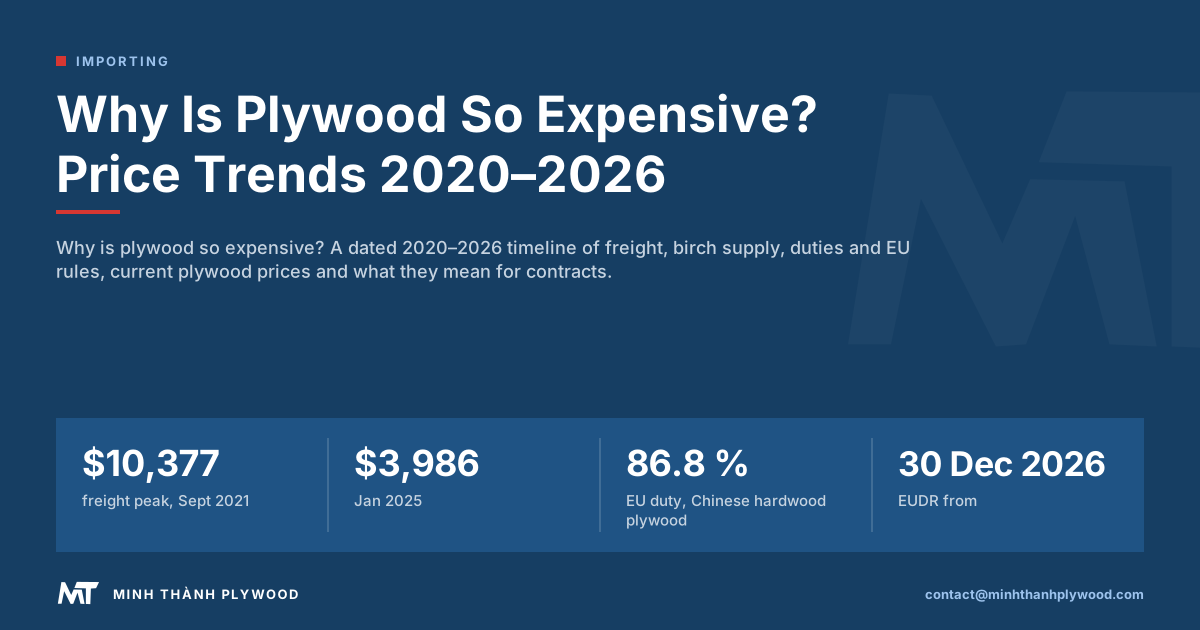
Plywood is expensive because its price carries far more than wood: veneer and glue, pressing energy, sea freight, duties and, since 2022, the cost of replacing Russian birch and of proving where every layer came from. Freight has fallen from its 2021 peak, but duties and EU paperwork have stayed. Here is a dated timeline of what moved prices, where they stand in October 2026, and how Minh Thanh Plywood advises buyers to time contracts.
Why is plywood so expensive? The short answer
Plywood is expensive because its price is a stack of costs beyond the wood: graded veneer, glue, pressing energy, sea freight, duties and the paperwork to prove origin. Between 2020 and 2026, freight spiked and fell back, while birch supply, duties and EU rules added costs that stayed.
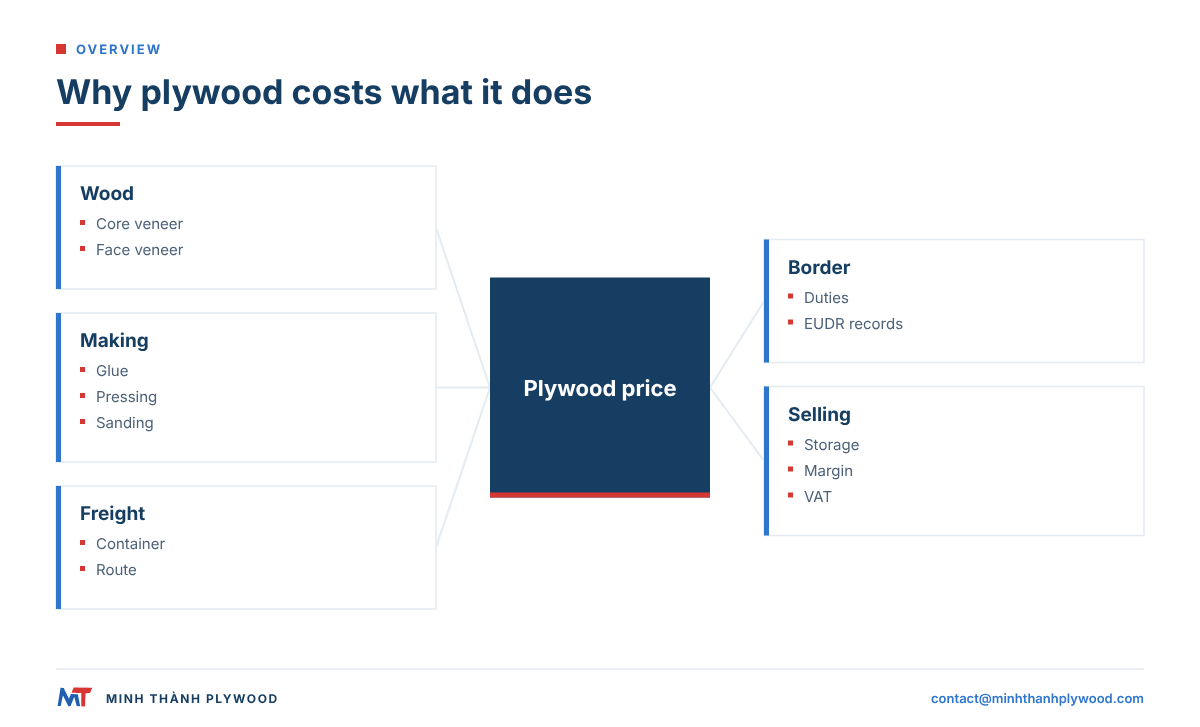
The stack, from mill to buyer:
- Wood: core and face veneers, peeled, dried and graded.
- Glue and pressing: resin, energy and press time; furniture panels are pressed twice.
- Finishing: calibration, sanding and grading against the order.
- Freight: the container from the mill’s port to yours.
- Border costs: duties, clearance and, in the EU from 30 December 2026, due diligence under EUDR.
- Distribution: warehousing, delivery, merchant margin and VAT.
A buyer who sees only the shelf price sees the sum. This guide separates the parts, so you can tell which ones will move and which are here to stay.
Plywood price drivers from 2020 to 2026: a dated timeline
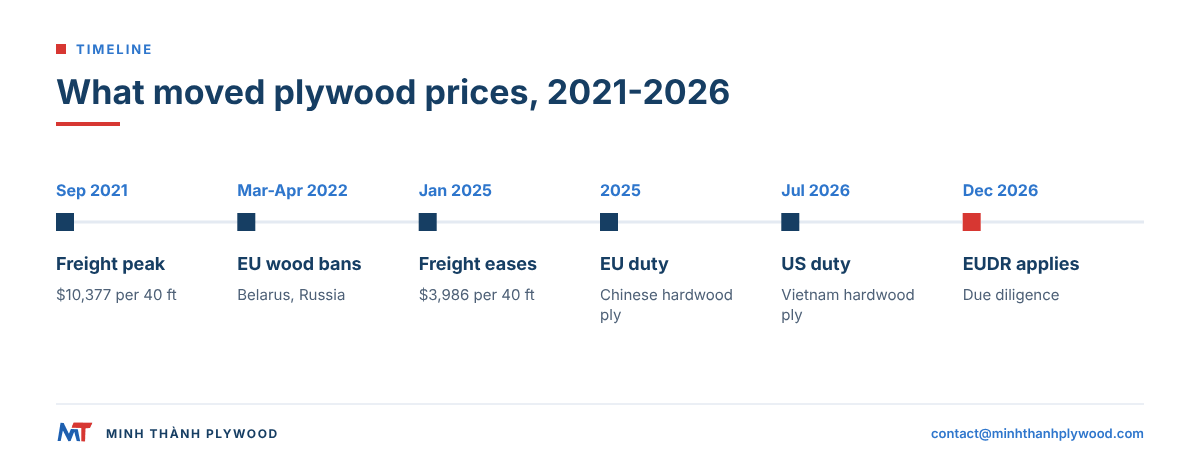
Six events explain most plywood price movement since 2020. Each is dated and sourced below.
| Date | Event | Effect on plywood prices |
|---|---|---|
| September 2021 | Drewry World Container Index peaks at $10,377 per 40 ft, against a 2019 average of $1,420 | Freight per m³ multiplies; landed prices jump |
| March–April 2022 | EU bans wood imports from Belarus (3 March) and Russia (9 April) | Birch plywood supply to Europe falls; birch prices rise |
| January 2025 | Drewry index at $3,986 per 40 ft | Freight eases but stays above 2019 |
| 2025 | EU anti-dumping duty on Chinese hardwood plywood (Reg. (EU) 2025/2333) | Chinese hardwood plywood costs more landed in the EU |
| July–September 2026 | US final AD/CVD determinations on Vietnamese hardwood plywood (21 July), injury vote (19 August; determination published 9 September 2026) | Duty cost for in-scope US imports |
| August–December 2026 | EU REACH formaldehyde limit (6 August), PPWR (12 August), EUDR (30 December) | Compliance and documentation costs for EU trade |
Freight sources: Drewry World Container Index. The readings used are those of 23 September 2021 and January 2025. Legal dates link to the acts in the sections below.
Current plywood prices: where the market stands in October 2026
Current plywood prices in October 2026 sit well above 2019 at the shelf, while factory prices for plantation-core plywood start low. Two dated readings show the gap between the two ends of the chain.
| Reading, October 2026 | Price | Basis |
|---|---|---|
| Irish online merchant, 18 mm hardwood WBP, 2440 × 1220 mm | €44.00 a sheet, about €821/m³ | Retail, listed 2 October 2026 |
| Irish online merchant, 18 mm maple-faced interior | €99.00 a sheet, about €1,848/m³ | Retail, listed 2 October 2026 |
| Minh Thanh commercial plywood | From US$250/m³ | Factory, before freight and duty |
| Minh Thanh furniture and interior plywood | From US$350/m³ | Factory, before freight and duty |
The retail readings come from the woodworkers.ie plywood listing. The per-m³ figures divide the sheet price by 0.0536 m³. The gap between factory and shelf is freight, duty, handling, stock holding, margin and VAT. The plywood prices in Ireland guide breaks one market down in full.
US plywood prices: the producer price index and what a sheet costs at Lowe’s
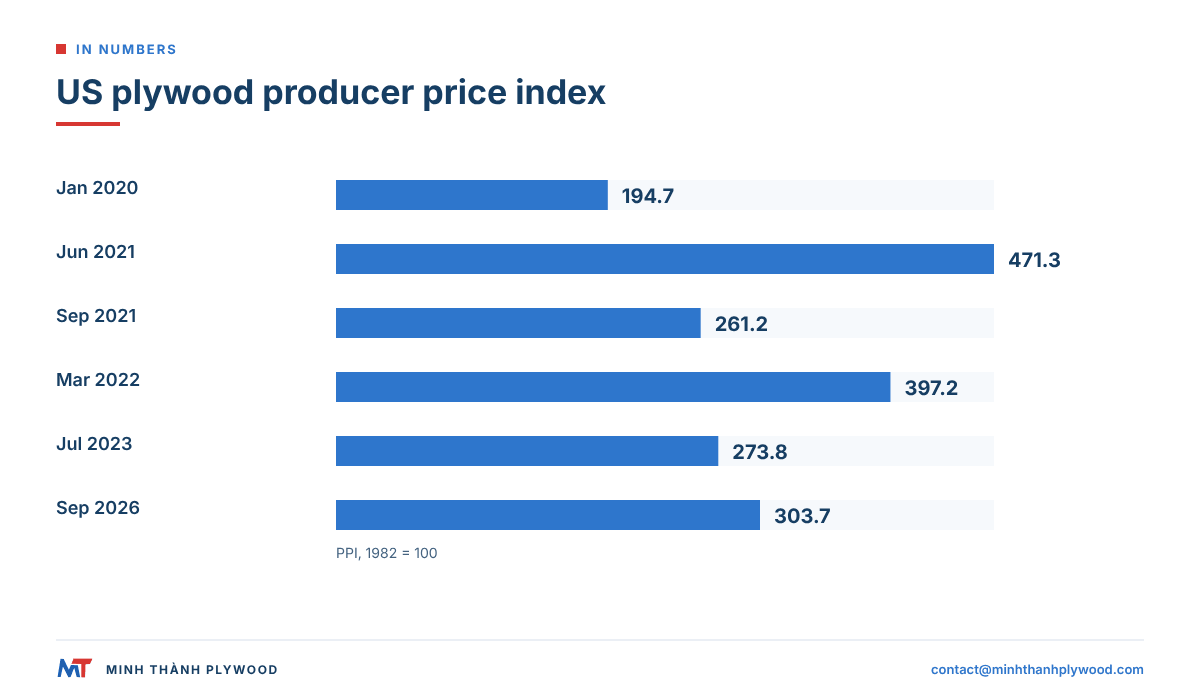
US plywood prices have swung harder than any other market’s: the US producer price index for plywood rose from 194.7 in January 2020 to 471.3 in June 2021, fell to 261.2 by September 2021, spiked again to 397.2 in March 2022, and read 303.7 in September 2026. That is about 56 % above January 2020 and 36 % below the 2021 peak.
| Month | US PPI, plywood (1982 = 100) | Event |
|---|---|---|
| January 2020 | 194.7 | Before the pandemic |
| June 2021 | 471.3 | Peak: DIY demand, mill capacity limits |
| September 2021 | 261.2 | Sharp correction |
| March 2022 | 397.2 | Second spike |
| July 2023 | 273.8 | Low after the correction |
| September 2026 | 303.7 | Rising through 2026 |
Source: US Bureau of Labor Statistics, PPI by commodity, plywood (WPU083), via FRED, monthly, not seasonally adjusted, read in October 2026. The 2021 rise matches the story told by US panel makers: home-improvement demand outran mill capacity.
A US reader also asks what a sheet costs on the shelf. Lowe’s prices for these 4 x 8 ft sheets, checked on 26 August 2026 (Woodworking Advisor):
| Lowe’s, 4 x 8 ft sheet | Price |
|---|---|
| Rated sanded sheathing, 15/32 in | $32.26 |
| CDX sheathing, 23/32 in | $46.57 |
| AC sanded subfloor, 15/32 in | $76.81 |
Hobby woodworkers also note that large chains price alike and that a local yard can undercut them on hardwood plywood, because a yard carries one grade and prices by the sheet. For Vietnamese hardwood plywood in the US, the duty determinations in the table above set the landed price, so compare a mill quotation after duty, not before.
What is the price of plywood today, and what sets it?
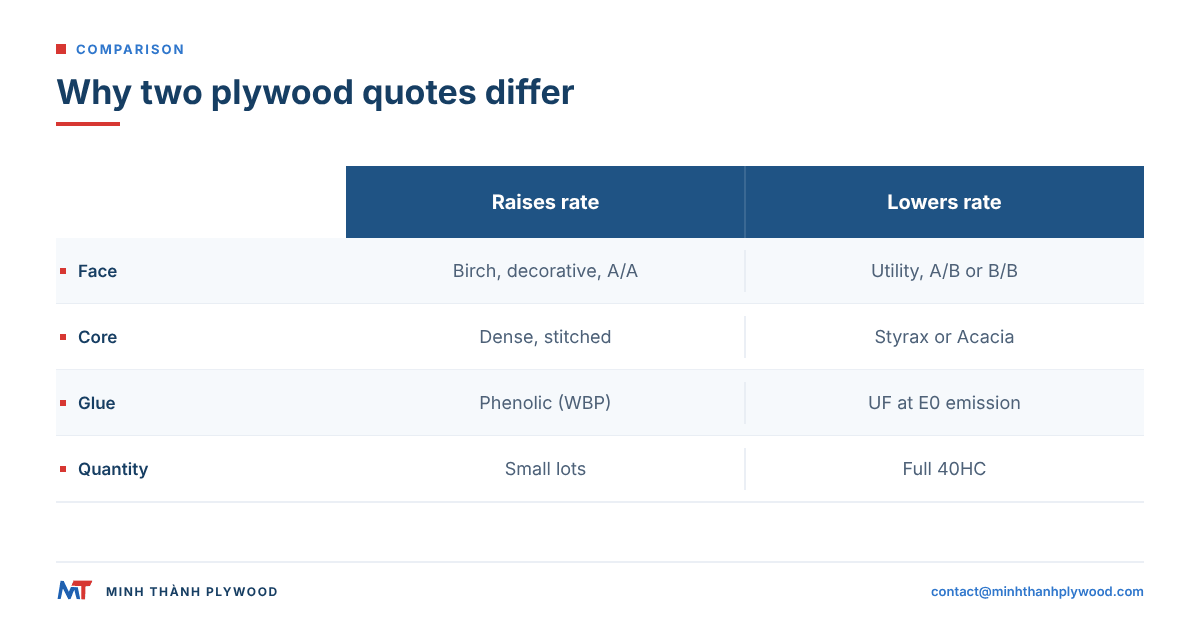
The price of plywood today is set by seven lines of the order, whatever the market: face, core, glue, thickness, size, quantity and delivery term. Market events move all quotes together; these seven lines explain why two quotes differ on the same day.
| Price driver | What raises the price | What lowers it |
|---|---|---|
| Face | Birch, decorative veneer, A grade both sides | Utility face, A/B or B/B pair |
| Core | Dense or all-birch core, stitched | Plantation Styrax or Acacia core |
| Glue | Phenolic (WBP) bond | UF glue at E0 emission for indoor use |
| Thickness | More wood per sheet | Only the thickness the part needs |
| Size | Non-standard sheet | 1220 × 2440 or 1250 × 2500 mm |
| Quantity | Single sheets or small lots | Full 40HC container |
| Delivery term | Delivered to site | FOB Hai Phong or CFR |
A low quote for “18 mm plywood” usually means a different build: a lower core grade, loose cores, no sanding or a looser tolerance. Compare the build first, then the price.
Freight: from the 2021 peak to today
Sea freight was the largest single cause of the 2021 plywood price spike: the Drewry World Container Index reached $10,377 per 40 ft container in September 2021, against a 2019 average of $1,420. By January 2025 it read $3,986, lower than the peak but still well above 2019.
Freight matters more for plywood than for many goods because plywood is heavy and cheap per kilogram. A 40HC carries about 53 m³ of 18 mm furniture plywood on a white Styrax core, or about 43 m³ on Eucalyptus, so the freight bill is spread over a fixed number of cubic metres.
What a buyer controls:
- Core weight: a light Styrax core fits 990 sheets of 18 mm, 1220 × 2440 mm in a 40HC, against 795 on Eucalyptus.
- Term: buying FOB lets you book your own freight; CFR or CIF fixes it in the quote.
- Route: diversions on the Asia–Europe lane since late 2023 have added days to some sailings; Hai Phong to Northern Europe typically takes 30–40 days at sea.
Why is birch plywood so expensive?
Birch plywood is expensive because the EU banned wood imports from Belarus from 3 March 2022 and from Russia from 9 April 2022, and those two countries had supplied much of Europe’s all-birch panels. Remaining birch supply costs more, and buyers turned to birch-faced panels on other cores.
- The measures: Regulation (EU) 2022/355 set the Belarus measure. Regulation (EU) 2022/576 covers wood products under CN chapter 44, which includes plywood; contracts signed before 9 April 2022 could run until 10 July 2022.
- Baltic birch: all-birch plywood, birch in every ply, now comes from fewer mills, which is why Baltic birch plywood is so expensive.
- Birch-faced alternative: birch face and back over a white Styrax or Eucalyptus core, lighter than all-birch and priced below it; the edge shows the core, so it suits banded furniture.
Birch faces at Minh Thanh are named D+, D and E and quoted in pairs such as D+/D; as a buying comparison, D+ is close to European B and D close to BB. See birch plywood price for the build-by-build gap.
Why is marine plywood so expensive?
Marine plywood is expensive because it is built to a stricter standard, such as BS 1088, with selected durable veneers, a waterproof bond and a core almost free of gaps. Each of those steps costs more than standard plywood production.
What the price pays for:
- Veneer selection: durable species and fewer defects in every ply.
- Bond: a fully waterproof glue line.
- Core quality: very few gaps, so water cannot travel inside the panel.
- Testing and marking to the standard.
An okoume-faced interior panel looks similar on the face and costs far less, but it is not marine plywood; Minh Thanh sells okoume-faced plywood as an interior panel only. The marine plywood price guide explains the build and the price gap.
Duties: why plywood costs more at some borders
Duties raise the landed price of plywood for specific origins and products, and two measures matter most in 2026. They change the border cost, not the mill price.
- EU on Chinese hardwood plywood: Implementing Regulation (EU) 2025/2333 sets definitive anti-dumping duties on Chinese hardwood plywood, expressed on the CIF Union border price, customs duty unpaid. The rates are 86.8 % for most Chinese exporters and 43.3 % for one named company. It does not cover Vietnamese plywood.
- US on Vietnamese hardwood and decorative plywood: the final antidumping determination sets 90.12 percent for most listed exporters and the Vietnam-wide entity (final AD determination). The final determinations are dated 21 July 2026, the countervailing duty all-others rate is 47.68 %, and the ITC injury vote followed on 19 August 2026 (published 9 September). Structural PS 1 and PS 2 plywood, phenolic film-faced plyform, flooring and ready-to-assemble furniture are outside the scope.
Read the scope for your exact product. A duty on one origin often raises prices from every origin for a while, as buyers move their orders to the remaining suppliers.
EU rules in 2026: REACH, PPWR and EUDR
Three EU rules took effect or take effect in 2026, and each adds cost through testing, packaging or records rather than through the wood itself.
- REACH formaldehyde, 6 August 2026: Regulation (EU) 2023/1464 limits emissions from furniture and wood-based articles to 0.062 mg/m³ under its chamber conditions, and 0.080 mg/m³ for other articles.
- PPWR, 12 August 2026: Regulation (EU) 2025/40 limits lead, cadmium, mercury and hexavalent chromium in packaging to 100 mg/kg combined.
- EUDR, 30 December 2026: due diligence for large and medium operators and for micro and small firms already under EUTR; 30 June 2027 for other micro and small firms. Vietnam is listed as low risk under Implementing Regulation (EU) 2025/1093.
Minh Thanh’s evidence for these rules: panels meet the emission requirements European furniture buyers ask for, with CARB P2 / TSCA Title VI certification (ICTT mill no. 23024) and SGS testing on request; an SGS test of September 2026 found lead, cadmium, mercury and hexavalent chromium not detected in all four packaging materials; and the EUDR compliance dossier (origin records and geolocation files) comes with orders.
Will plywood prices go down?
Plywood prices are unlikely to return to 2019 levels, because the costs that rose most since 2022 are duties, birch substitution and compliance, and those are permanent. Freight is the part that can still fall or rise with the shipping market.
| Cost | Since 2020 | Outlook for a buyer |
|---|---|---|
| Sea freight | Peaked September 2021, eased by 2025 | Moves with the shipping market and routes |
| Birch supply | Tightened from 2022 | Stays tight while the 2022 measures apply |
| Duties | Added in 2025 (EU, China) and 2026 (US, Vietnam) | Stay while the measures apply; scope matters |
| EU compliance | REACH, PPWR, EUDR in 2026 | Permanent; a cost of records, not of wood |
| Plantation-core panels | Steady supply from Vietnamese plantations | The cost-effective base of furniture plywood |
The practical answer is to buy builds whose costs you control: a light plantation core, the face grade each side needs, full containers, and a supplier who carries the documents.
Plywood prices going up: what pushes them in the short term
Plywood prices go up in the short term when freight jumps, when a new duty shifts orders between origins, or when peak seasons crowd production lines. These moves pass; the structural costs above do not.
- Freight spikes: a route disruption or capacity squeeze raises the cost per container within weeks.
- Order shifts: when a duty hits one origin, buyers move to others, and those mills fill their order books.
- Seasons: furniture production peaks before the end-of-year retail season, and orders crowd into the same weeks.
- Specification creep: an order that adds tighter tolerance, stitched cores or better faces costs more, but that is a different panel, not a price rise.
Separate the first three from the last: a supplier who raises the price because your specification changed is quoting a new build.
Vietnam plywood price trend: what an importer should watch
For Vietnamese plywood, the trend an importer should watch is the landed cost, not just the mill price: freight from Hai Phong, destination duties, and the documents each market now asks for. In October 2026, Minh Thanh’s furniture and interior plywood started from US$350/m³ and its commercial plywood from US$250/m³.
What keeps Vietnamese furniture plywood cost-effective:
- Plantation cores grown near the mills, such as white Styrax around Ha Hoa, Phu Tho.
- A skilled workforce in an established plywood region.
- Light cores that put more cubic metres into each container.
What can change the landed price: the destination’s duties (for US hardwood plywood, the 2026 determinations), freight on the lane, and currency. The Vietnam plywood price guide covers FOB ranges by build.
What rising plywood prices mean for your contracts
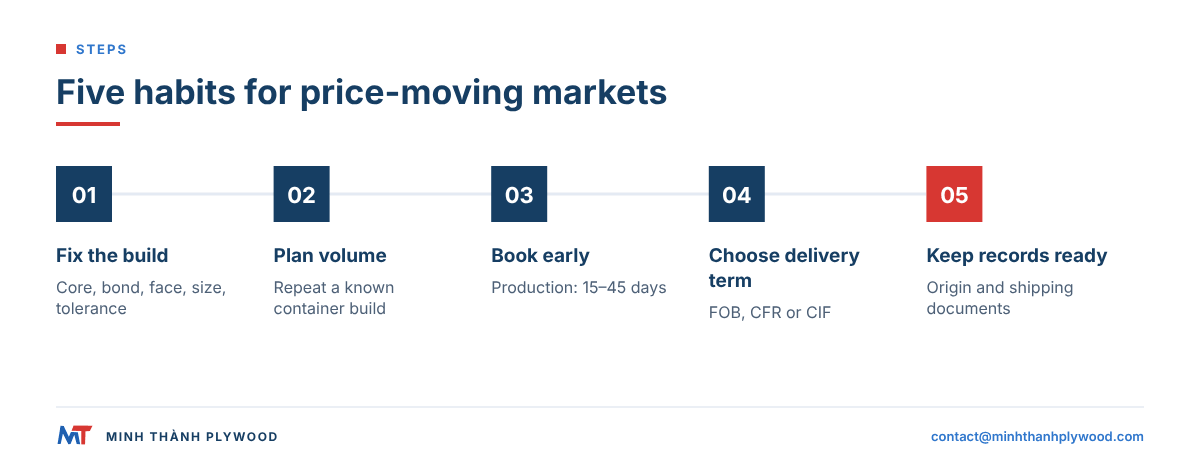
When plywood prices move, the buyers who hold their costs are those whose contracts fix the build and plan the volume. Five habits help:
- Fix the specification: core, glue and emission, face and back grade, thickness, size, tolerance, packing.
- Plan volume: one container a month on a known build lets the mill plan veneer and press time.
- Book early: production takes 15–45 days after the deposit; order before your own busy season.
- Choose the term: FOB if you can book freight better than the mill, CFR or CIF if you want one price.
- Keep the documents flowing: certificates and origin files sent before the order, shipping documents after loading.
Payment at Minh Thanh is a 30 % deposit and 70 % against the scanned B/L, or an irrevocable L/C at sight, and the minimum order is one 40HC with mixed specifications by agreement.
How to get a current plywood price from the factory
A current plywood price comes back fastest when the enquiry carries the build. Six lines are enough:
- Application: furniture, kitchen, packing, construction.
- Core: Styrax, Eucalyptus or Acacia.
- Glue and emission: UF glue at E0 emission, MR, melamine-fortified or phenolic.
- Face and back: species and grade pair.
- Size and thickness: for example 18 mm, 1220 × 2440 mm, ±0.2–0.3 mm.
- Packing, quantity and port: sheets or m³, and destination.
Send them to contact@minhthanhplywood.com or WhatsApp Lisa on +84 988 586 601; replies come within hours, with free samples of the build. The plywood price guide explains how each line moves the price, and furniture plywood from Vietnam shows the standard builds.
Buyer questions, answered
Why is plywood so expensive?
Plywood's price carries veneer, glue, pressing energy, sea freight, duties and handling, and each moved up between 2020 and 2026. Freight has eased since its 2021 peak, but duties, birch substitution and EU traceability costs have stayed.
Why is birch plywood so expensive?
The EU banned wood imports from Russia from 9 April 2022 and from Belarus from 3 March 2022, cutting the largest source of all-birch panels for European buyers. The remaining birch supply costs more, and birch-faced panels on other cores filled part of the gap.
Why is Baltic birch plywood so expensive?
Baltic birch is birch in every ply, and the 2022 EU measures on Russian and Belarusian wood removed much of the supply buyers relied on. All-birch panels now come from fewer mills at higher cost.
Why is marine plywood so expensive?
Marine plywood is built to its own standard, such as BS 1088, with selected durable veneers, a waterproof bond and very few core gaps. Each of those raises the cost per sheet against standard plywood.
Will plywood prices go down?
Freight already fell from its 2021 peak, and the Drewry index read $3,986 per 40 ft in January 2025 against $10,377 in September 2021. Duties and EU compliance rules are permanent costs, so prices are unlikely to return to 2019 levels.
Are plywood prices going up in 2026?
Several rules took effect in 2026: EU REACH formaldehyde limits from 6 August, PPWR from 12 August and EUDR from 30 December, and US final AD/CVD determinations on Vietnamese hardwood plywood were issued on 21 July (orders still pending). These add cost for affected products more than they move mill prices.
What is the price of plywood today?
In October 2026, an Irish merchant listed 18 mm hardwood WBP sheets from €44.00, about €821 per m³. Minh Thanh's commercial plywood started from US$250/m³ and furniture plywood from US$350/m³, factory price before freight and duty.
How much has plywood gone up in the US since 2020?
The US producer price index for plywood rose from 194.7 in January 2020 to 471.3 in June 2021, fell back to 261.2 in September 2021, and read 303.7 in September 2026, about 56 % above January 2020 and 36 % below the peak.
How much does a sheet of plywood cost in the US in 2026?
At Lowe's on 26 August 2026, a 4 x 8 ft sheet cost $32.26 for 15/32 in rated sanded sheathing, $46.57 for 23/32 in CDX sheathing and $76.81 for 15/32 in AC sanded subfloor.
Why do two plywood quotes for the same thickness differ so much?
They are usually two builds: different core grade, joining method, face preparation, glue and tolerance. Compare the specification line by line before comparing the price.
When is the best time to sign a plywood contract?
Fix the specification and volume early, sign before your own busy season, and book production 15 to 45 days ahead of loading. Contracts tied to a clear build are easier to reprice when freight or duty changes.
Does EUDR make plywood more expensive?
It adds due-diligence work and records for importers from 30 December 2026. A mill that supplies origin records and geolocation files with each order keeps that cost low; Minh Thanh supplies the EUDR compliance dossier with orders.