
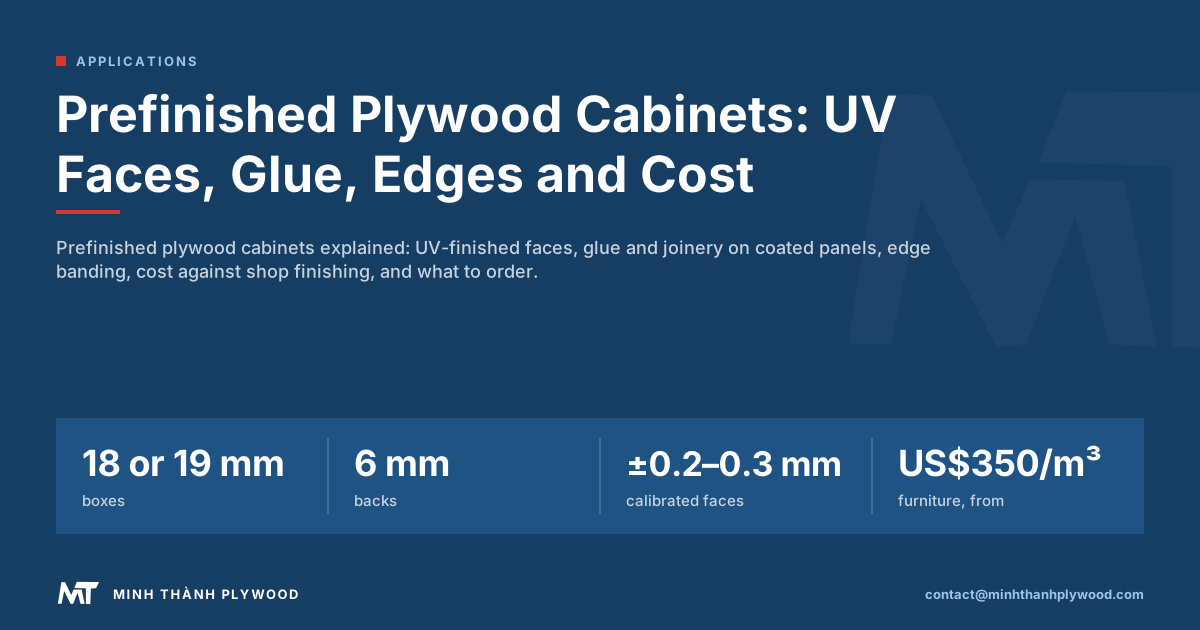
Prefinished plywood for cabinets is hardwood plywood whose faces are coated and cured at the mill or a finishing line, so cabinet boxes need no sanding, sealing or spraying after assembly. Most cabinet panels carry a clear UV-cured finish on birch, maple or poplar faces. Minh Thanh Plywood makes the base panels with UV-ready faces for finishing lines and explains how to build and order prefinished cabinet plywood.
What is prefinished plywood for cabinets?
Prefinished plywood for cabinets is cabinet-grade hardwood plywood with its finish already applied and cured on one or both faces, so the cabinet box needs no finishing after it is built. The finish is usually a clear UV-cured coating; coloured and white coatings are also made.
The panel underneath is ordinary furniture plywood: a sanded hardwood face, a cross-laminated core and a back. What changes is the work the cabinet shop no longer does:
- No sanding of the box interior before finishing.
- No sealer and topcoat sprayed inside carcasses.
- No drying racks filled with half-finished boxes.
- No rework for runs, dust nibs and overspray inside corners.
Cabinet boxes are the main use. Sides, bottoms, shelves, fixed partitions and backs are cut from prefinished sheets; doors, drawer fronts and face frames are usually finished separately to match the room.
Prefinished plywood cabinets vs raw plywood: what changes in the shop
Prefinished plywood cabinets cost more in sheet price and less in labour, floor space and finishing materials than cabinets built from raw plywood and finished after assembly. The table compares the two routes one step at a time.
| Step | Raw plywood, finished in the shop | Prefinished plywood |
|---|---|---|
| Face sanding before finish | Every visible inside face | None |
| Sealer and topcoat | Sprayed after assembly, inside corners | Already cured on the panel |
| Drying and curing | Hours to days, rack space | None |
| Spray booth and extraction | Needed | Not needed for boxes |
| Glue joints | Glue on bare wood anywhere | Glue on edges, dadoes, scuffed areas |
| Handling damage | Sanded out before finishing | Must be avoided or touched up |
| Finish quality inside boxes | Depends on the sprayer | Even, factory-cured film |
| Sheet price | Lower | Higher |
The verdict depends on how the shop works. A shop with a booth, a sprayer on staff and idle rack space can finish raw panels economically. A shop that builds boxes fast, works on site, or has no booth gains most from prefinished plywood.
UV plywood for cabinets: how the UV finish is made
UV plywood for cabinets is plywood whose face coating is cured by ultraviolet light in a few seconds, instead of drying by evaporation. The coating is a liquid that hardens the moment UV lamps strike it, so panels leave the line dry and ready to stack.
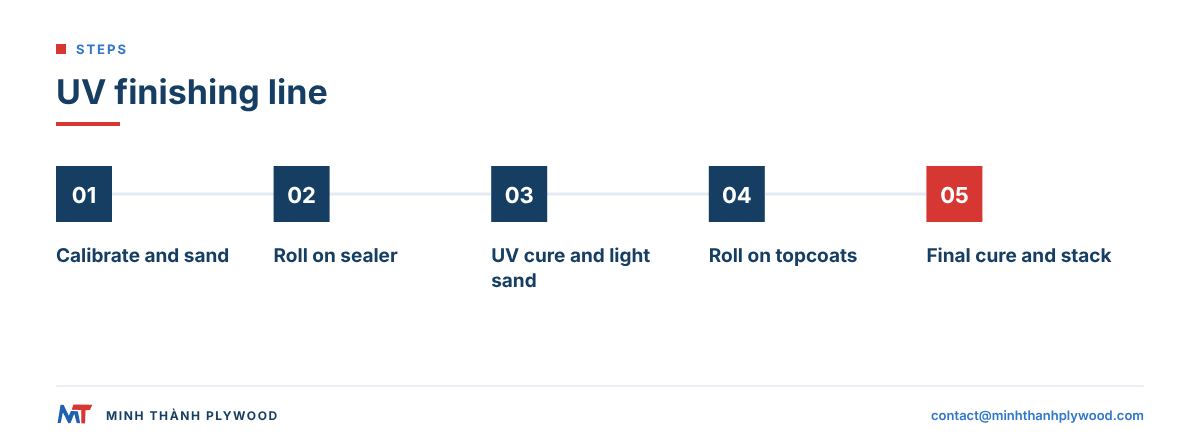
A typical UV finishing line coats each face in this order:
- Calibrate and sand the plywood face to an even, closed surface.
- Apply a sealer by roller coater, which fills the open grain.
- Cure under UV lamps, then sand lightly to remove raised fibres.
- Apply one or more topcoats by roller.
- Final cure and stack, with interleaving where the buyer asks.
The film is hard and contains almost no solvent, so the line releases far fewer volatile organic compounds (VOC) than spraying solvent lacquer in a shop. The quality of the finish depends on the base panel: a UV roller coater copies every dip, open joint and sanding mark of the face, so finishers buy panels that are flat, tightly calibrated and sanded to a closed surface.
Minh Thanh Plywood supplies that base panel. Both faces are sanded and polished UV-ready, to the standard our customers need to apply their own UV coating, and furniture panels are pressed twice: the core board is pressed and calibrated, then face and back are pressed on.
UV birch plywood for kitchen cabinets and other faces
UV birch plywood for kitchen cabinets is the most common prefinished cabinet panel, because birch has a fine, even grain that looks clean under a clear coat. Maple, poplar, engineered veneer (EV) and pine faces are also prefinished for cabinets, each with its own look and price.
| Face | Look under a clear UV coat | Typical cabinet use |
|---|---|---|
| Birch | Pale, fine, even grain | Kitchen and bath boxes, shelving |
| Maple | Very light, tight grain | North American cabinet boxes |
| Poplar | Light, soft figure, some colour streaks | Boxes, painted or white-coated panels |
| EV (engineered veneer) | Uniform colour and grain chosen in advance | Boxes matched to door colour |
| Pine | Warm, visible grain and knots by grade | Rustic and Nordic-style interiors |
Grades matter more on prefinished panels, because nothing is painted over. Our birch faces are named D+, D and E in Vietnam and quoted as face/back pairs such as D+/D or D/E, comparable to the European birch grades: individual D+ is about B, D about BB and E about CP/C. Poplar and pine faces are quoted as A/A, A/B and B/B. For a box seen inside on both faces, order a matched pair such as D+/D or A/B; for backs, a lower back grade saves cost.
Our guide to plywood for kitchen cabinets covers grades, cores and thickness for raw panels in more depth.
Surface options: clear, white and coloured, one or two faces
Prefinished cabinet plywood comes with a clear coat, a white or coloured opaque coat, or a coat on one face only; the choice follows where each panel goes in the cabinet. Most kitchen boxes use clear coat on both faces.
| Option | What it is | Where it fits |
|---|---|---|
| Clear UV, two faces (dealer code G2S, good two sides) | Natural wood seen inside and out | Sides, shelves, partitions |
| Clear UV, one face (G1S, good one side) | Finished face in, raw back out | Backs, drawer bottoms, panels against walls |
| White or coloured UV | Opaque coloured film over the face | Bath vanities, laundry, utility cabinets |
| Sealer only | First UV coat, no topcoat | Panels the shop topcoats to its own colour |
Canadian dealers write these as G1S and G2S, for example clear-coated birch G2S. Specialty prefinished sheets are often special order: a dealer such as HM Lumber brings in 5 or more sheets with a deposit, so plan a kitchen’s panels as one order rather than sheet by sheet.
Gloss level is part of the order: matt and low-sheen coats hide small scratches and fingerprints better than gloss, which is why most cabinet interiors are matt or satin.
Is prefinished plywood worth the extra cost?
Prefinished plywood is worth the extra cost for most cabinet boxes, because the sheet premium is smaller than the labour, materials and space a shop spends finishing raw boxes. The saving grows with volume and shrinks if the shop already runs a spray line every day.
What to count when comparing:
- Labour: sanding, masking, spraying and scuffing between coats, per box.
- Materials: sealer, topcoat, thinner, abrasives, filters.
- Time: drying and curing between coats, which holds boxes on racks.
- Space and equipment: a booth, extraction, air makeup and their running cost.
- Rework: runs, dust and missed corners inside assembled boxes.
- Site work: finished boxes can be built and adjusted on site without spraying.
What a sheet costs in Canada: cabinet-grade and prefinished 4 x 8 ft sheets sit between about C$60 and C$300 depending on species, thickness and face. Dealer listings for 3/4 in UV-prefinished birch run from about C$63 to C$88 a sheet; prefinished Baltic birch is about C$170; West Wind Hardwood’s cabinet-grade plywood range reaches C$300 for premium species. Check each dealer’s current shelf price.
A worked example, with illustrative inputs: say prefinished birch costs C$25 more per sheet than the raw panel, and one sheet makes two cabinet boxes. The premium is then C$12.50 per box. If sanding, sealing, spraying and recoating the inside of a box takes 40 minutes at C$40 per hour, the shop spends about C$27 on labour per box, before sealer, topcoat, abrasives and rack space. On these inputs prefinished panels save about C$14 per box, and the gap widens with every box built on site, where there is no booth.
Where raw panels still win: doors and visible parts finished to a custom colour, short runs in a shop with a booth already running, and pieces that will be painted or laminated anyway.
For volume buyers, the cheapest route is often a raw, UV-ready panel bought factory-direct and coated by a nearby finishing line, rather than finished panels shipped long distance. Our furniture and interior plywood is quoted from US$350/m³ (October 2026); the final price depends on face, core, thickness, size and quantity.
Does wood glue stick to prefinished plywood?
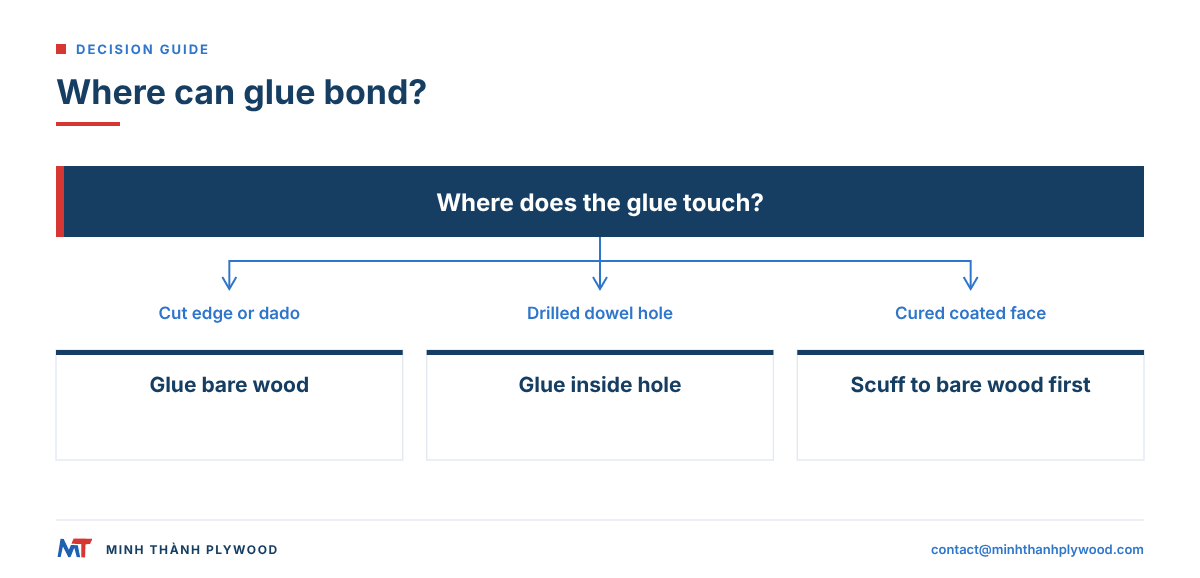
Wood glue does not bond well to cured UV finish, so prefinished cabinets are glued on bare wood: the cut edges, the inside of dadoes and rabbets, and areas where the coating has been scuffed away. Most shops also rely on mechanical fasteners for the box.
Joinery that works with prefinished plywood:
- Dadoes and rabbets: the router or saw removes the finish, so the glue meets raw wood on three faces of the joint.
- Screws and confirmat fasteners: they hold through the coating and need no glue.
- Pocket screws: quick for face frames and fixed shelves; plugs or caps hide the holes.
- Dowels: glue goes into the drilled holes, which are bare wood.
- Biscuits or dominoes: the slots are bare wood; keep glue off the coated face around them.
Where a glue line must sit on a face, mask the joint and scuff the coating through to the wood with fine abrasive. Wipe squeeze-out at once: dried PVA (polyvinyl acetate) glue on a clear coat leaves a dull patch that is hard to remove.
Edge banding prefinished plywood
The exposed edges of prefinished plywood are raw and are covered with edge banding after cutting, usually a prefinished wood veneer, PVC or ABS tape matched to the face. Banding is applied on an edge bander or with an iron-on tape for small shops.
How to get a clean edge:
- Cut first, band second: band each part after it is cut to size.
- Clean, square edges: a chipped or burned edge shows through thin banding.
- Trim without scratching: set the trimmer so it does not cut into the finished face; a scratched face cannot be sanded out.
- Match the face: birch tape for birch faces; clear-coated wood tape blends better than raw tape that needs finishing.
- Solid edging for shelves: a glued hardwood strip stiffens long shelves and survives knocks better than tape.
A dense, even core gives the banding a firm base. Our cores are white Styrax or Eucalyptus with stitched core layers, so a cut edge shows a closed line of plies with few voids for the tape to sink into.
Cutting and handling prefinished panels without chipping
Prefinished plywood is cut with a sharp, high-tooth-count blade and a scoring blade or zero-clearance insert, with the panel supported on both sides of the cut, so the coating does not chip along the edge. The coated face shows every chip and scratch, and nothing can be sanded away without breaking through.
Handling rules for the shop:
- Keep the protective interleaving between sheets until the panels are cut.
- Lift, never slide sheets across each other or across the saw table.
- Use clean, padded supports on carts and tables.
- Score the bottom face on a panel saw, or tape the cut line on a track saw.
- Mark with removable tape, not pencil or marker, on the coated face.
- Store flat and dry, away from direct sun and heaters.
Our guide on how to cut plywood covers saws and blades in detail.
Can you paint over prefinished plywood?
You can paint over prefinished plywood after scuff-sanding the cured coating and applying a bonding primer; paint applied straight onto glossy UV finish peels. Clean the surface first, because cabinet interiors pick up grease.
- Degrease with a cabinet cleaner and let it dry.
- Scuff-sand with fine abrasive until the whole surface is dull.
- Remove the dust with a vacuum and a tack cloth.
- Prime with a bonding primer made for glossy surfaces.
- Paint with two thin coats of cabinet enamel.
If most panels will be painted, buying a raw or sealer-only panel is cheaper than painting over a full clear coat. Our guide on how to finish plywood compares paint, stain, oil and lacquer for raw panels.
How durable is prefinished plywood in a kitchen?
A cured UV coat on cabinet plywood is hard and resists water spots, everyday kitchen cleaners, scuffs from dishes and the wear of shelves being loaded and unloaded. It is the finish of the panel faces; the edges and any cut, drilled or scratched spots are only as protected as the banding or touch-up that covers them.
Where kitchens test the finish:
- Sink base: water at the cut edges, not the coated faces, causes most damage. Band every edge and seal the cut-outs for pipes.
- Dishwasher sides: steam reaches the panel edge nearest the door. Fit the shield the appliance maker supplies.
- Shelves: heavy pots scuff the face. Matt coats hide this better than gloss.
- Cleaners: mild cleaners are fine; abrasive pads dull the coat.
The plywood under the finish matters as much as the coat. Panels leave our mill at 8–12 % moisture content, the normal range for furniture plywood, so boxes stay square when they reach a heated kitchen.
Finished plywood for cabinets: thickness by cabinet part
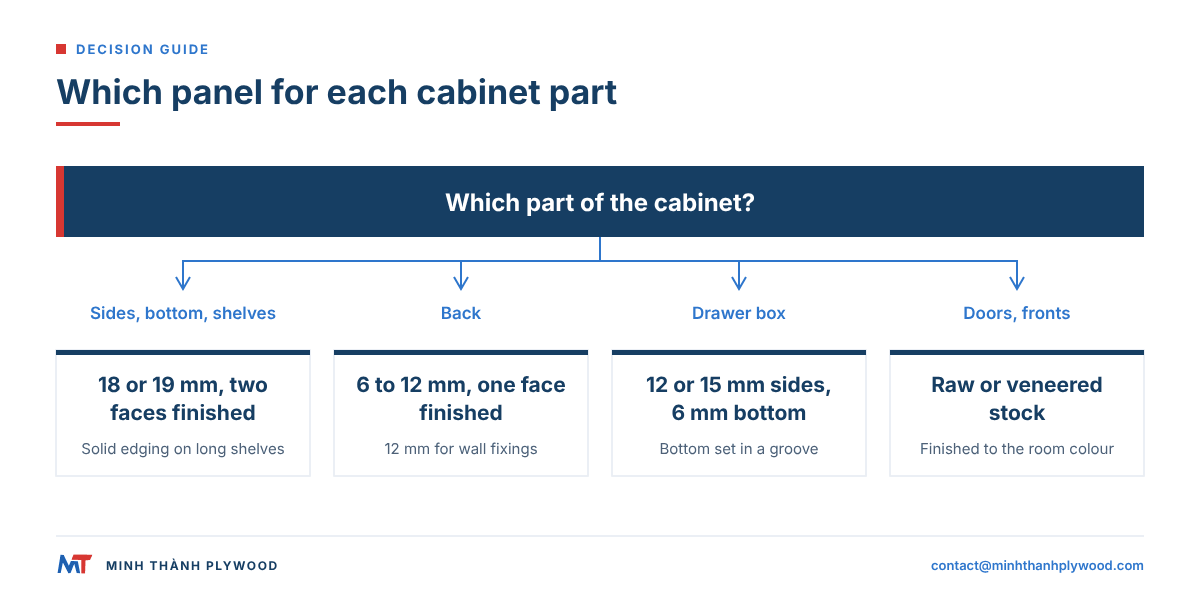
Finished plywood for cabinets is ordered by part: 18 or 19 mm for sides, bottoms and shelves, 6 to 12 mm for backs, and 12 or 15 mm for drawer boxes. The table gives a common specification for kitchen cabinets.
| Cabinet part | Thickness | Faces finished | Note |
|---|---|---|---|
| Sides (gables) | 18 or 19 mm | Two | Visible inside, often outside too |
| Bottom and top | 18 or 19 mm | Two | Carries the load of the box |
| Fixed and adjustable shelves | 18 or 19 mm | Two | Solid edging on long shelves |
| Back | 6, 9 or 12 mm | One | 12 mm where the back carries wall fixings |
| Drawer sides | 12 or 15 mm | Two | Edges banded or left clear-coated |
| Drawer bottom | 6 mm | One | Set into a groove |
Thickness tolerance matters for joinery: dadoes and drawer grooves are cut to the panel, so a panel that varies in thickness gives loose or tight joints. Our sanded furniture panels hold ±0.2–0.3 mm, down to ±0.2 mm. Standard sheets are 1220 × 2440 mm and 1250 × 2500 mm. Our plywood thickness guide lists metric and imperial equivalents.
Prefinished plywood cabinets: mistakes to avoid
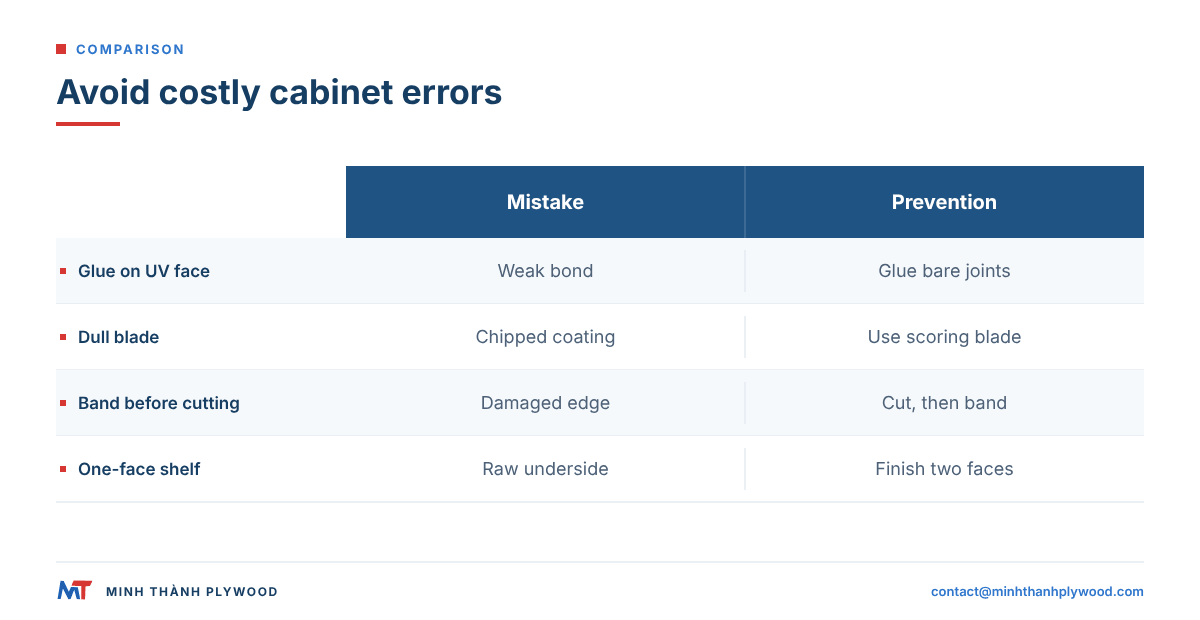
The common mistakes with prefinished plywood cabinets are gluing on the cured coat, cutting with a dull blade, banding before cutting to size and ordering one-face panels for parts seen on both sides. Each one costs a panel or a callback, and most are cheap to avoid.
| Mistake | What happens | How to avoid it |
|---|---|---|
| Glue spread on the coated face | Joint fails or a dull glue mark remains | Glue on bare wood in dadoes, rabbets and holes |
| Dull or low-tooth blade | Chipped coat along the cut | Sharp, high-tooth-count blade with a scoring blade |
| One-face panel for shelves | Raw underside seen from below | Two faces finished for every visible part |
| Banding before final cut | Band chipped or offset | Cut to size first, then band |
| Pencil marks on the coat | Marks hard to remove | Removable tape for layout |
| Mixed face batches in one kitchen | Colour shifts between boxes | Order the whole job in one batch, matched to one sample |
| Storing sheets on edge | Panels bow before cutting | Store flat on bearers, dry and covered |
A finishing line can only coat what the base panel gives it. Ask for a free sample panel, have it coated, and approve the coated sample before the full order; the approved sample then sets the face for every later container.
What this means for your order
An order of base panels for prefinished cabinet plywood names the face, the grade pair, the core, the thickness and the surface standard the finishing line needs. Minh Thanh Plywood makes the panel; the UV coating is applied by the buyer’s finishing line or the coating partner the buyer chooses.
- Use: cabinet boxes for UV finishing, one or two faces.
- Face and grade pair: for example birch D+/D, poplar A/B or EV in the chosen colour.
- Core: white Styrax for a light, even core; Eucalyptus for stiffness and screw holding.
- Thickness and size: for example 18 mm and 6 mm, 1220 × 2440 mm.
- Surface: both faces sanded and polished UV-ready; calibrated to ±0.2–0.3 mm.
- Glue and emission: UF glue at E0 emission for interior cabinets.
- Documents: CARB P2 / TSCA Title VI (ICTT mill no. 23024) for US orders and Canada’s Formaldehyde Emissions from Composite Wood Products Regulations (SOR/2021-148, in force for imports from 7 January 2023) for Canadian orders. US panels are covered by the EPA formaldehyde standards for composite wood products, and the limit for veneer-core hardwood plywood is 0.05 ppm under EPA’s TSCA Title VI requirements. We supply the EUDR compliance dossier (origin records and geolocation files) required by Regulation (EU) 2023/1115 with orders.
- Quantity: sheets per thickness and the number of 40HC containers, with the destination port.
A first container usually starts with a coated sample: we send free samples, your finishing line coats them, and the approved panel sets the face for the order. Minimum order is one 40HC with mixed specifications by agreement, and production runs 15–45 days after deposit. Email your cabinet panel list to contact@minhthanhplywood.com; we reply within hours.
Buyer questions, answered
What is prefinished plywood for cabinets?
It is cabinet-grade hardwood plywood with a clear or coloured finish already applied and cured on one or both faces. Cabinet makers cut, band and assemble it without finishing the box afterwards.
Is prefinished plywood worth the extra cost?
For cabinet boxes it usually is: the panel costs more per sheet, but the shop saves sanding, sealing, spraying, drying space and the rework that dust and runs cause. Shops without a spray booth gain the most.
Does wood glue stick to prefinished plywood?
Not well to the cured finish. Glue the raw edges and cut surfaces, use dadoes and rabbets that expose bare wood, or scuff the coating where a glue line must sit on the face; screws and confirmat fasteners do not depend on the coating.
Can you paint over prefinished plywood?
Yes, after you scuff-sand the cured finish and apply a bonding primer. Paint does not hold on glossy UV coating without that step.
What is UV plywood?
UV plywood is plywood whose face coating is cured in seconds under ultraviolet lamps. The cured film is hard, dry to stack at once and contains almost no solvent.
Is UV-finished plywood good for kitchen cabinets?
Yes. A UV-cured clear coat resists water spots, common kitchen cleaners and scuffs on cabinet interiors, and it stays clear rather than yellowing quickly as some oil-based finishes do.
What thickness of prefinished plywood is used for cabinets?
Cabinet sides, bottoms and shelves are usually 18 or 19 mm, backs 6 to 12 mm, and drawer boxes 12 or 15 mm. Panels prefinished on two faces are the norm for boxes; one face is enough for backs and drawer bottoms.
Can prefinished plywood be used for cabinet doors?
It can, but most shops make doors from raw or veneered stock and finish them to the room colour, because doors are visible and need edges and faces finished as one.
How do you cut prefinished plywood without chipping?
Use a sharp, high-tooth-count blade with a scoring blade or a zero-clearance insert, keep the good face where the teeth enter, and support the offcut so it does not break away.
Do you supply prefinished plywood?
We make the base panels: birch, poplar, EV and other faces sanded to a UV-ready standard on white Styrax or Eucalyptus cores. The buyer's finishing line or coating partner applies the UV finish.