
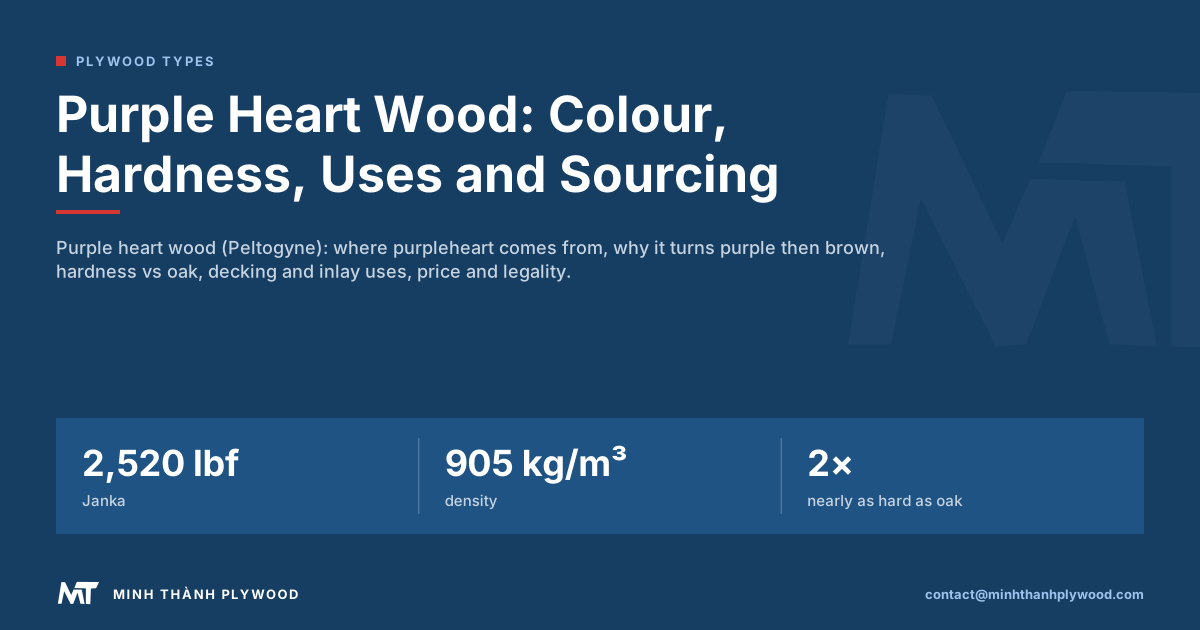
Purple heart wood is the heartwood of Peltogyne trees from Central and South America. It is cut grey-brown, turns purple within days in light and air, then drifts to brown over years. Very hard and durable, purpleheart lumber serves decking, heavy flooring, bridges, boat parts and inlay. This buyer guide from Minh Thanh Plywood covers colour, strength, machining, price, legality and panel alternatives.
What is purple heart wood?
Purple heart wood is the heartwood of trees in the genus Peltogyne, tropical hardwoods of Central and South America whose timber turns purple after it is cut. Purpleheart, purpleheart wood and amaranth are trade names for the same group, and several Peltogyne species are sold together under them.
The trees grow tall and straight in lowland forest, which gives long, clear boards with few knots. The timber is heavy, very hard and very durable, so it sits between decorative and structural uses: the same species turns up in pool cues, inlay and guitar parts and in bridge decks, dock boards and truck beds.
For a buyer the name covers more than one species, so colour, density and working properties vary between shipments. Specify the Peltogyne genus and country of harvest on the order, since both are needed for import records in the US and the EU. The types of hardwood guide places purpleheart among the other tropical timbers.
Where does purpleheart wood come from?
Purpleheart comes from tropical forests stretching from Mexico through Central America to southern Brazil. Most export lumber comes from Guyana, Suriname, French Guiana and the Brazilian Amazon, where trees of the genus Peltogyne grow scattered among other species rather than in pure stands.
Because the trees are scattered, purpleheart is logged selectively, and supply depends on the forest concessions open in each producing country. That links price and availability to export rules in Brazil and the Guianas, not only to demand.
The origin a buyer records is the country and region of harvest, which can differ from the country of sawmilling or export. US importers declare the species and country of harvest under the Lacey Act; EU importers need geolocation and legality evidence under the EU Deforestation Regulation, Regulation (EU) 2023/1115. Ask the supplier for those records before the order, not after shipment.
Why is purpleheart purple, and why does it turn brown?
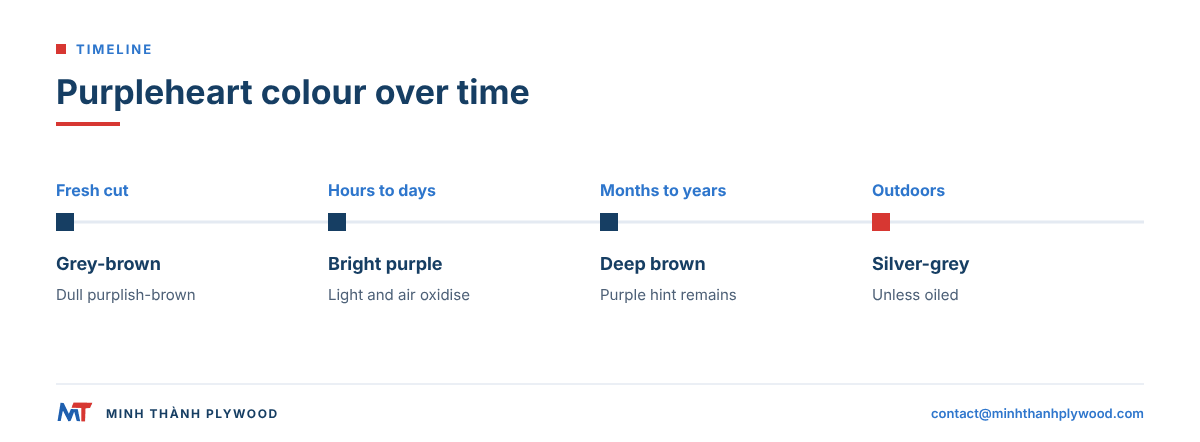
Purpleheart turns purple because compounds in its heartwood oxidise when light and air reach a fresh-cut surface. A newly sawn board is dull grey-brown or purplish-brown; within hours to a few days it develops a bright, eggplant purple. The colour is natural, not dyed.
Exposure keeps working after the purple appears. Over months and years in light, the surface darkens towards a deep brown with a purple cast, and outdoors unprotected purpleheart weathers to silver-grey like other timbers. Sanding removes the altered surface and brings the purple back until the new surface oxidises again.
Heat also changes the colour. Dull blades and fast feed can scorch the surface brown or black, and some woodworkers warm finished pieces to bring out a stronger purple. A common shop tip is to warm a dull board gently in an oven, or leave it in sun, to deepen the purple; keep the heat low, because high heat scorches the surface brown. For a stable colour, use a finish with a UV inhibitor, keep the piece out of direct sun, and approve colour on a sample that has been finished and left in light for a few weeks. The wood colors guide shows how other species shift with light.
Purpleheart wood properties: hardness, density and strength
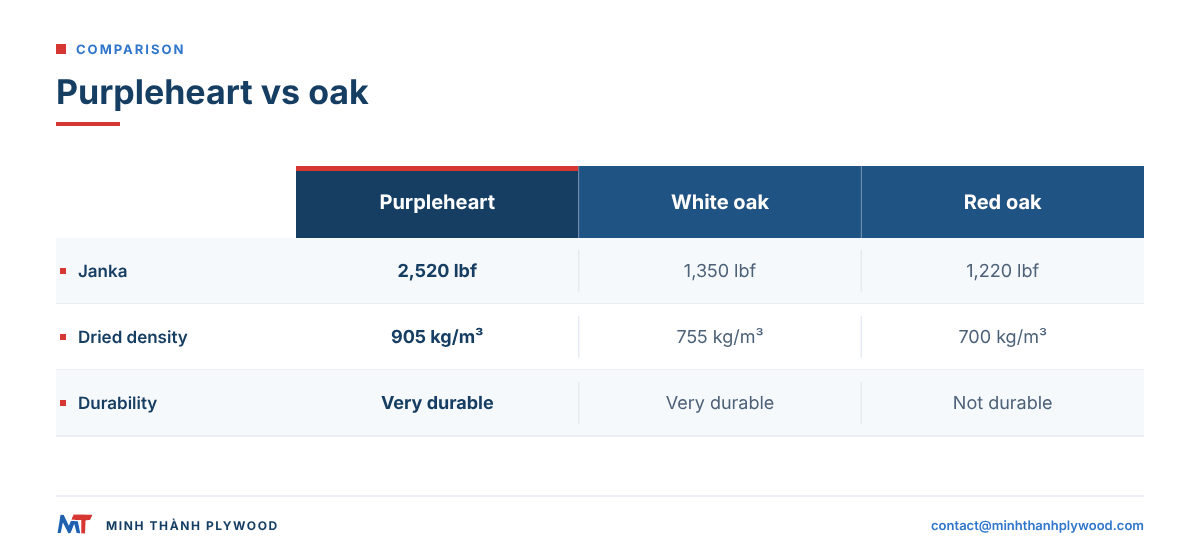
Purpleheart is one of the hardest and stiffest commercial timbers, with a Janka hardness of about 2,520 lbf (11,190 N) and an average dried density of about 905 kg/m³. That is roughly twice the dent resistance of oak and heavier than most timbers used in furniture.
| Property | Purpleheart | White oak | Red oak |
|---|---|---|---|
| Janka hardness | 2,520 lbf (11,190 N) | 1,350 lbf (5,990 N) | 1,220 lbf (5,430 N) |
| Average dried density | 905 kg/m³ | 755 kg/m³ | 700 kg/m³ |
| Heartwood durability | Very durable | Very durable | Not durable |
| Main appeal | Colour, hardness, durability | Strength, grain | Cost, grain |
Its bending strength (modulus of rupture) averages about 151.7 MPa. Values are averages at about 12% moisture content from The Wood Database, checked 20 October 2026. Individual boards vary with species and growth.
More properties from the same source, for engineers and spec writers:
| Property | Purpleheart |
|---|---|
| Specific gravity (basic, 12% moisture) | 0.76 to 0.90 |
| Modulus of elasticity | 20.26 GPa |
| Crushing strength | 83.7 MPa |
| Volumetric shrinkage | 10.6%, with a tangential to radial ratio of 1.7 |
| Tree size | 30 to 50 m tall, trunk 1 to 1.5 m across |
Its dimensional movement is moderate for so dense a wood: tangential shrinkage of 6.4% and radial of 3.8% from green to oven-dry. That stability, with the hardness, is why purpleheart works for flooring and tool handles where lighter woods dent or wear.
Is purple heart wood harder than oak?
Yes. Purpleheart’s Janka hardness of about 2,520 lbf is close to double that of white oak at about 1,350 lbf and red oak at about 1,220 lbf. Janka measures the force needed to press a steel ball halfway into the wood, so it compares dent resistance directly.
The difference shows in use. Purpleheart flooring and stair treads resist heels and furniture legs better than oak, and purpleheart decking resists wear in public walkways. The trade-off is weight, tool wear and harder machining, so purpleheart rarely replaces oak in carcass furniture.
Hardness alone does not decide suitability. For a wide panel or a cabinet side, stability, weight and cost matter more, and a plywood panel with a hard face over a lighter core usually serves better than any dense solid wood. The oak wood guide covers the oak side of the comparison.
How durable is purple heart wood outdoors?
Purpleheart heartwood is rated very durable: it resists decay fungi and most insects, which suits it to decking, docks, bridge decks and boat parts. That durability belongs to the heartwood only; the pale sapwood band is not durable and should be cut out of outdoor parts.
In salt water, marine borers can still attack it, so piles and fenders in sea water need a borer-resistant species or protection. In fresh water and above ground it gives a long service life with no preservative treatment.
Outdoors the purple colour does not last without maintenance. Ultraviolet light and rain turn the surface grey within a season or two. An oil with UV filters slows this, but most purpleheart decks are left to grey and chosen for strength and life rather than colour.
What is purple heart wood used for?
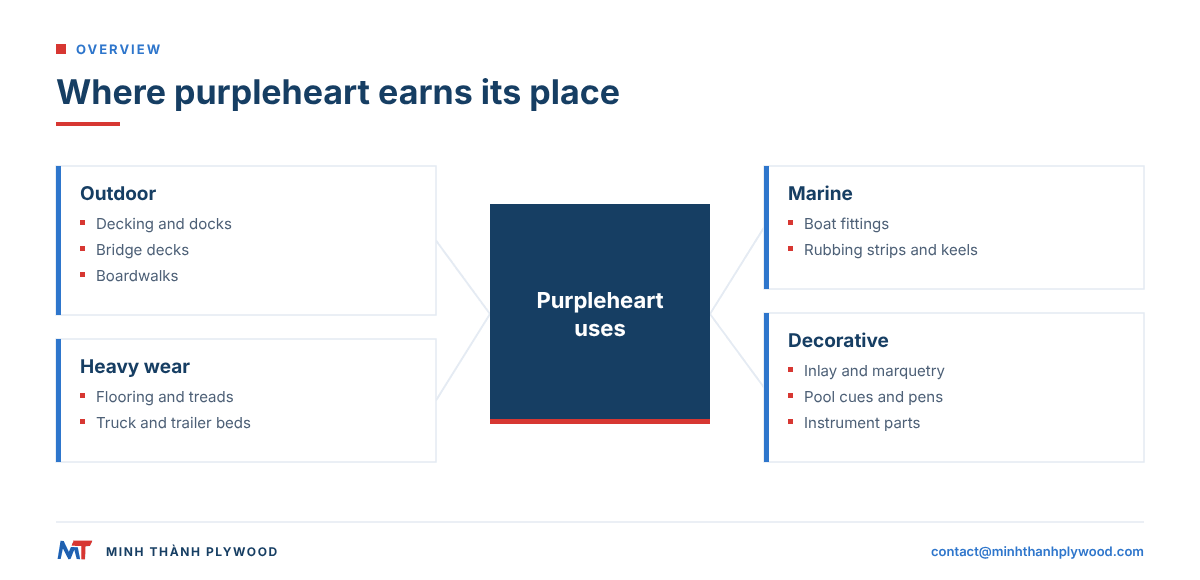
Purpleheart is used where hardness, durability or colour justify a dense imported wood:
- Decking, docks and boardwalks for wear and decay resistance.
- Heavy flooring and stair treads, including truck and trailer beds.
- Bridges and marine structures above the salt-water borer zone.
- Boatbuilding parts such as rubbing strips, keels and deck fittings.
- Furniture accents, inlay and marquetry, where the purple contrasts with pale woods.
- Turned and small items: pool cues, knife handles, bowls, pens and instrument parts.
- Cutting boards in strip patterns, combined with maple and walnut.
Most large uses are structural and outdoor, and most small uses are decorative. Full purpleheart furniture is rare because of weight and machining cost; designers tend to use it as a stripe, edge or inlay. For vehicle floors, an anti-slip plywood panel is the usual alternative to solid hardwood boards; the anti-slip plywood page shows that construction.
How does purpleheart lumber machine and finish?
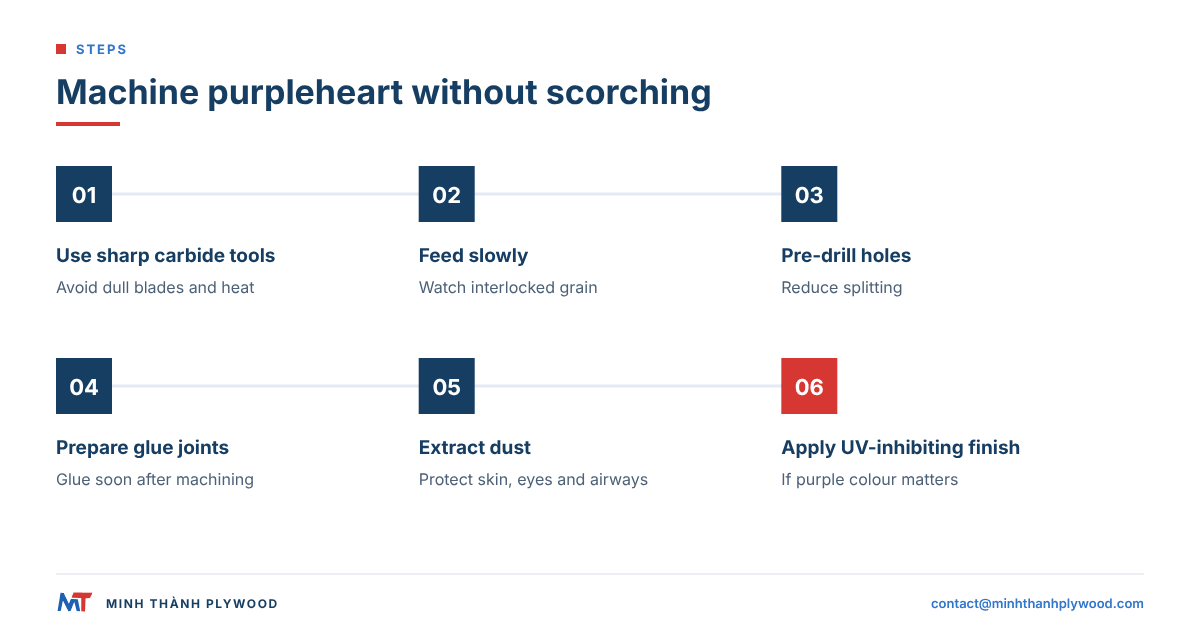
Purpleheart lumber machines cleanly with sharp carbide tools but dulls steel quickly and can tear out where the grain is interlocked. Feed slowly with sharp blades; dull or overheated tools release gum and scorch the wood brown.
Workshop practice that avoids most problems:
- Pre-drill all screw and nail holes, because the wood splits under fasteners.
- Plane at a low cutting angle or use a scraper on interlocked grain.
- Glue soon after machining and wipe joints with a solvent; the oily surface can weaken glue lines.
- Use dust extraction and a mask: the dust is a sensitiser that can irritate skin, eyes and airways.
- Finish with a UV-inhibiting oil or lacquer if the purple matters.
Purpleheart takes most finishes well and polishes to a natural lustre. Oil-based finishes can turn it slightly browner at once; water-based clear coats keep the purple closer to its fresh tone.
Why is purple heart wood so expensive?
Purpleheart costs more than common North American or European hardwoods because it is imported from South America, scattered in the forest, heavy to ship and slow to machine. It is still mid-priced among exotics, cheaper than rosewoods, ebony or bubinga.
The main price drivers are size and grade. Wide, long, clear boards for flooring and decking cost more per volume than short or narrow stock. Kiln-dried boards cost more than air-dried, and planed stock more than rough sawn. Freight is a bigger share of price than for light woods because buyers pay by volume but carriers charge by weight past a load limit.
Legality documents add cost but protect the buyer. Timber with traceable harvest records and the data needed under EUDR in the EU or the Lacey Act in the US is easier to clear and resell. Ask for the documents with the quotation so the comparison is like for like.
Purpleheart sizes and how it is sold in the US
US buyers buy purpleheart by the board foot (144 cubic inches, a board 1 inch thick, 12 inches wide and 1 foot long) in rough quarters, or as small surfaced pieces for turning and craft work.
| Form | Typical size | How it is sold |
|---|---|---|
| Surfaced boards (S2S) | 3/4 in thick x 2, 4 or 6 in wide, tolerance +/- 1/16 in | Packs of 2 to 4 pieces |
| Rough lumber, 4/4 | About 1 in thick, widths 4 to 8 in, random lengths 3 to 6 ft (8 to 12 ft on request) | Packs of 10, 20 or 100 board feet |
| Rough lumber, 8/4 | About 2 in thick, same widths and lengths | Packs of 10, 20 or 100 board feet |
| Turning blanks | 1.5 x 1.5 in and 2 x 2 in squares | Packs of 4 |
| Pen blanks | 3/4 x 3/4 x 5 in | Packs of 5 |
Purpleheart is priced per board foot. It sits in the middle of the exotic range: dearer than oak or maple, well below rosewood or ebony. Wide, long, clear 8/4 boards cost the most per board foot; short narrow 4/4 stock costs the least. Kiln-dried and surfaced boards cost more than rough, and shipping adds to the bill because the wood is dense, so ask for a delivered price.
For a panel buyer, the board is not the only route. A purpleheart veneer face on a plywood core gives the colour on a 4 x 8 ft sheet (1220 × 2440 mm) at a fraction of the weight and wood cost, and Minh Thanh Plywood makes engineered-veneer panels in purple and other exotic colours on request.
Purpleheart wood and legality: CITES, EUDR and Lacey Act
Purpleheart is not listed in the CITES Appendices, so it needs no CITES permit, but it is still subject to legal-harvest laws in the producing and importing countries. Some individual Peltogyne species are assessed as threatened, which makes species and origin records worth keeping.
In the EU, wood and wood products, including sawn lumber, flooring and plywood, fall under Regulation (EU) 2023/1115 (EUDR). The company placing it on the EU market must submit a due diligence statement with geolocation of the harvest plots and evidence of legal harvest. The European Commission EUDR page explains the scope and timing.
In the US, the Lacey Act requires importers of plant products to declare the scientific name and where the plant was harvested; the USDA APHIS Lacey Act page sets out the steps. Supply chains that already record these details for one market usually have them for the other. For plywood we supply, we provide the EUDR compliance dossier (origin records and geolocation files) and the face and core species with Vietnamese harvest origin for the Lacey Act declaration.
Purpleheart vs other purple and red woods
Purpleheart is the only common commercial timber with a true purple colour. Other woods sold for colour are red or orange: padauk is orange-red turning brown, bloodwood is deep red, and amaranth is another name for purpleheart itself, not a separate species.
For a project that needs a stable purple, natural purpleheart is a poor choice because the colour moves. Two routes give a fixed colour: a dyed engineered veneer (EV) face, which is real wood fibre coloured through before slicing, or a stain or coating on a pale face. Both give the same tone on every panel, which natural purpleheart cannot.
For red-brown furniture faces, plywood buyers usually choose bintangor, gurjan or sapele rather than tropical lumber species. Bintangor gives a redder-brown face with a straight interlocked stripe, and gurjan a reddish-brown even grain.
What does purpleheart mean for a panel or furniture order?
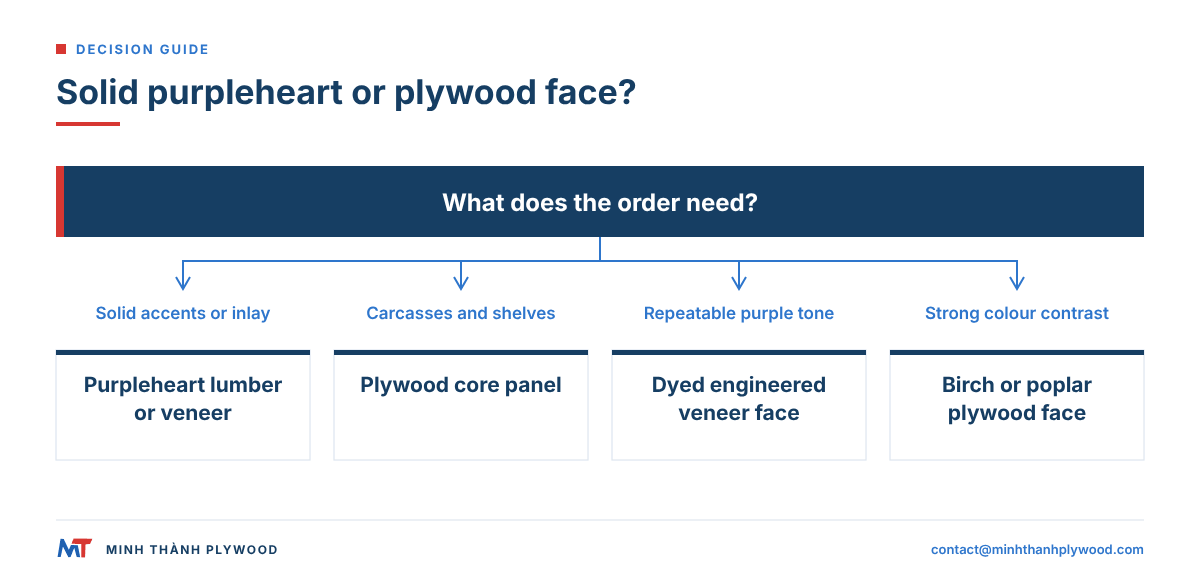
For most furniture and interior orders, purpleheart is an accent material bought as lumber or inlay veneer, while the panels behind it are plywood. The order then has two lines: purpleheart for the solid accents and a plywood specification for carcasses, doors and shelves.
The plywood line should name a face whose colour suits the purple accent. Pale faces such as birch and poplar give the strongest contrast; a dyed EV face can match a purple or dark tone. We press furniture panels twice as standard: the core is pressed and calibrated, then the face and back are pressed on, which keeps the panel flat next to dense solid parts.
Give the plywood line the same details as any furniture panel:
- Face and back: species or EV colour, grade pair.
- Core: white Styrax or Eucalyptus.
- Glue and emission: UF glue at E0 emission for interior furniture.
- Thickness and tolerance: down to ±0.2 mm on sanded furniture panels.
- Size: 1220 × 2440 mm or 1250 × 2500 mm, or cut to size.
- Quantity and destination port.
Send that line with photos of the purpleheart parts and contact Minh Thanh for free samples of the face colours that suit them.
Buyer questions, answered
What is purple heart wood?
Purple heart wood, or purpleheart, is the heartwood of trees in the genus Peltogyne, which grow in Central and South America. It is a very hard, dense tropical hardwood that turns purple after cutting. It is used for decking, heavy flooring, marine work and decorative inlay.
Where does purpleheart wood come from?
Purpleheart comes from tropical forests of Central and South America, from Mexico to southern Brazil. Most export timber comes from the Guiana Shield region and the Brazilian Amazon. Several Peltogyne species are traded under the one name.
Is purple heart wood naturally purple?
Yes, the colour is natural, not dyed, but it develops after cutting. Fresh-cut heartwood is dull grey-brown or purplish-brown and turns vivid purple within hours to days as light and air reach it. Over years in light it darkens towards brown with a purple hint.
Is purple heart wood harder than oak?
Yes, much harder. Purpleheart has a Janka hardness of about 2,520 lbf, against about 1,350 lbf for white oak and 1,220 lbf for red oak. That makes it nearly twice as resistant to denting.
Why is purple heart wood so expensive?
Purpleheart costs more than common hardwoods because it is imported from South America, sold in large clear sizes, slow to machine and hard on tools. Its price per board foot sits in the middle of the exotic range, below rosewoods and ebony.
How durable is purple heart wood?
The heartwood is rated very durable against decay and resistant to most insects, which is why it is used for bridges, docks and decking. It can still be attacked by marine borers in salt water. Sapwood is not durable and should be excluded from outdoor parts.
How do you keep purpleheart purple?
Use a finish with a UV inhibitor and keep the piece out of direct sunlight. Nothing stops the slow shift to brown entirely, but a UV-filtering coat slows it. Sanding back the surface brings the purple back for a time.
Is purpleheart dust toxic?
Purpleheart dust is a sensitiser. It can irritate the skin, eyes and airways and occasionally cause nausea, so use dust extraction and a mask when sawing or sanding it.
Is purpleheart good for outdoor decking?
Yes. Its hardness and decay resistance suit decking, docks and boardwalks. Pre-drill every fastener hole and use stainless steel screws, and expect the colour to weather to grey outdoors unless it is oiled.
Is purpleheart available as plywood?
Purpleheart is rare as a plywood face and is mostly sold as sawn lumber, flooring and veneer for inlay. For a purple accent on furniture panels, a dyed engineered veneer face gives a fixed colour over a standard plywood core.
Is purpleheart a protected or CITES-listed wood?
Purpleheart is not listed in the CITES Appendices. Its trade still needs legal-harvest records, and timber placed on the EU market falls under the EU Deforestation Regulation (EUDR).