
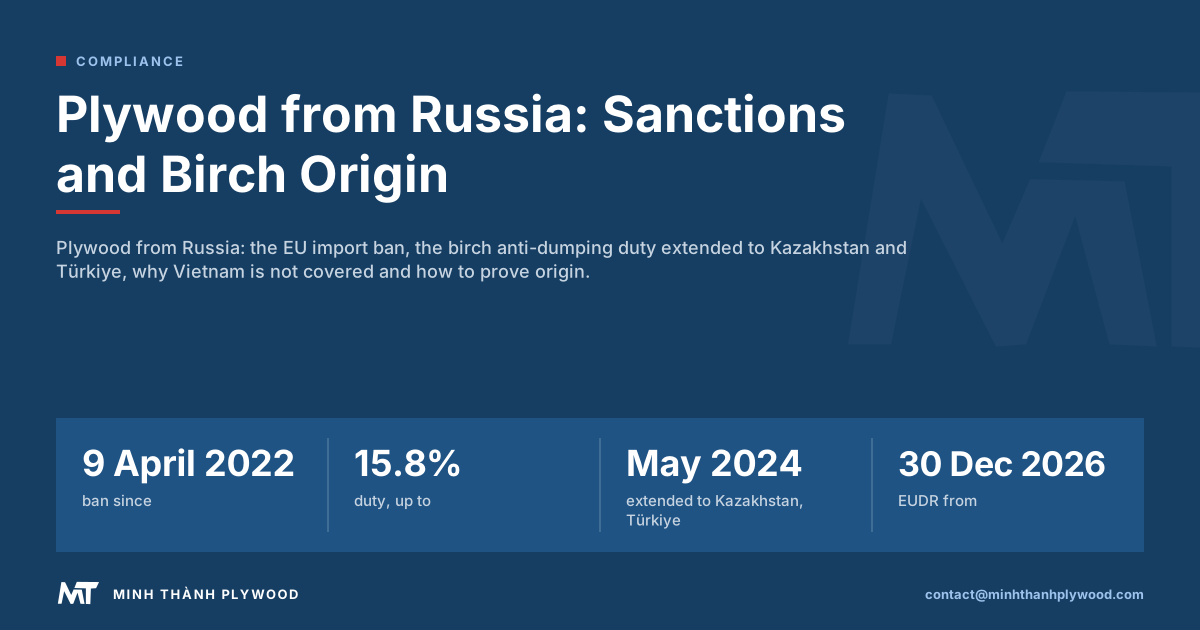
Plywood from Russia cannot be imported into the EU: wood products of CN chapter 44 have been banned since 9 April 2022, and the 2021 anti-dumping duty on Russian birch plywood was extended to Kazakhstan and Türkiye in 2024. Vietnam is named in neither measure. Minh Thanh Plywood ships birch-faced panels with origin records and geolocation files for every layer.
Can you still buy plywood from Russia in the US?
Yes in law, at a much higher duty: there is no US import ban on Russian plywood, but since April 2022 Russia has lost normal trade relations, so birch plywood pays the column 2 rate. For birch-faced plywood of HTS 4412.33.06 (face ply of birch, sheets no thicker than 6 mm) that rate is 50 %, against Free for a normal-trade-relations origin.
Before the change most imported plywood paid 5–8 % and birch-faced plywood paid nothing, and the Environmental Investigation Agency reported that direct imports of Russian birch plywood fell 40 % between March and April 2022 (EIA, 2022).
Three US rules still apply to any birch panel:
- Duty by origin: the 50 % column 2 rate applies to Russian origin only. Finnish, Latvian and Estonian birch plywood enters at the normal rate.
- Lacey Act: every plywood entry must declare each species and its country of harvest, so a birch face from Russia is declared as Russian even when the panel is pressed elsewhere.
- Origin evidence: the EIA recorded Chinese mill managers saying Russian birch is sold with China as the country of origin. Earthsight testing reported by Wood Central found nearly half of birch samples from the UK and US mislabelled. A US buyer should ask for the harvest country on the invoice.
What the shelf looks like: “Baltic birch” is a trade name, not an origin. Some US dealers list Finland and Latvia as sources, others list Russia. Dealer 5 × 5 ft sheets in 3/4 in B/BB cost about US$90 at one dealer in July 2026, and 3/4 in sheets at another dealer, listed at US$59.95, were sold out (Sawdust Journey dealer survey). Dealer pages were checked on 26 July 2026.
| Option for a US buyer | Build | Sheet sizes | Where it comes from |
|---|---|---|---|
| Russian all-birch plywood | Birch face to core, B/BB/CP/C faces | 4 × 8 ft and 5 × 5 ft, 3–25 mm | Russia; 50 % column 2 duty on birch-faced lines |
| Finnish or Latvian all-birch (“Baltic birch”) | Birch face to core | 5 × 5 ft and 4 × 8 ft | Finland, Latvia; normal duty rate |
| Vietnamese birch-faced plywood (Minh Thanh) | Birch face and back, white Styrax or Eucalyptus core, D+/D faces | 1220 × 2440 mm | Vietnam; read the 2026 US trade-remedy findings first |
The Vietnamese row needs one caution. Commerce and the USITC reached final 2026 decisions in antidumping and countervailing duty cases on hardwood and decorative plywood from China, Indonesia and Vietnam (Commerce, 21 July 2026; USITC vote, August 19, 2026). Whether a given birch-faced panel falls inside that scope depends on its construction and exporter; our US plywood market guide explains how to check. If you need an all-birch edge, none of the Vietnamese lines replaces Baltic birch; if the part has banded edges, a birch-faced panel is the lighter and cheaper build.
What is Russian birch plywood?
Russian birch plywood is plywood made in Russia entirely from birch veneers, face, back and every core ply, and before 2022 it was the largest source of birch plywood for Europe. It is often sold in square 1525 × 1525 mm sheets as well as large-format panels, with faces graded B, BB, CP and C.
“Russian plywood” in trade usage means the same all-birch product, because birch is the species Russian mills peel. Two other things are sometimes sold under the name:
- Film-faced birch plywood: birch panels with a phenolic film for concrete formwork and vehicle floors.
- Birch-faced panels made elsewhere: panels with a birch face on another core, sold under a “Russian birch” description they do not deserve.
That second case is why origin, not the name on the invoice, decides how a panel can be traded today.
Plywood from Russia: what the sanctions ban
Plywood from Russia cannot enter the EU. Article 3i of Regulation (EU) 833/2014, inserted by Regulation (EU) 2022/576, prohibits buying, importing or transferring into the Union the goods of Annex XXI “if they originate in Russia or are exported from Russia”, and Annex XXI covers all of CN chapter 44, wood and articles of wood, which includes plywood. The ban took effect on 9 April 2022; contracts concluded before that date could be executed until 10 July 2022.
Belarus has the same ban. Regulation (EU) 2022/355 of 2 March 2022 added wood products to Regulation 765/2006, with contracts concluded before 2 March 2022 allowed until 4 June 2022. (Both acts checked on 20 October 2026.)
The Belarus ban applies from 3 March 2022.
Three points follow for an importer:
- Origin or export route both count. A panel made in Russia is banned; so is a good exported from Russia, whatever its paperwork says.
- Chapter 44 covers the inputs too. Veneer sheets are chapter 44 goods, so Russian birch veneer cannot be imported into the EU on its own either.
- The ban sits above trade defence. Anti-dumping duties only change the price; the sanctions forbid the import.
In the United States there is no matching ban on Russian plywood. Since April 2022 Russian goods have lost normal trade relations and pay the higher column 2 tariff rates, and every species in a plywood entry must be declared with its country of harvest under the Lacey Act.
Is Baltic birch from Russia?
Baltic birch is not automatically from Russia: it is a trade name for all-birch plywood from the Baltic Sea region, which covers mills in Finland, Latvia, Estonia and, before 2022, large volumes from Russia. The name describes a product type, not an origin.
For a buyer the practical rule is simple:
- The label proves nothing. “Baltic birch”, “Russian birch” and “Scandinavian birch” are descriptions, not origin statements.
- The country of harvest proves origin. It sits in the supplier’s records and, for the EU, in the operator’s due diligence.
- Vague origin is a red flag. An offer that says “Baltic region” without a country, or a price well below the EU mills, needs checking before the order.
Baltic birch plywood suppliers explains how buyers now compare the remaining sources.
The EU anti-dumping duty on Russian birch plywood and its extension
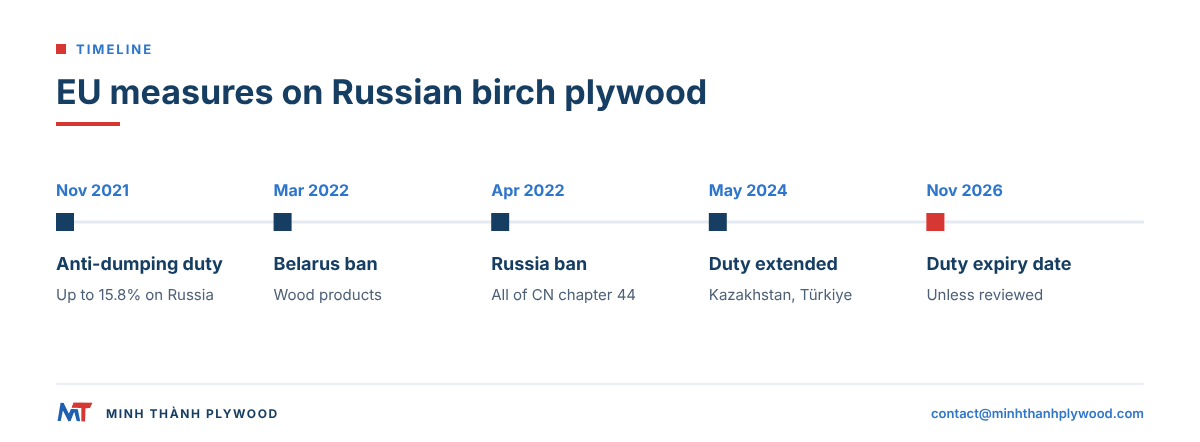
Before the sanctions, the EU had already put anti-dumping duties on birch plywood from Russia, by Implementing Regulation (EU) 2021/1930 of 8 November 2021. In May 2024 it found the duty was being circumvented and extended it to imports consigned from Kazakhstan and Türkiye.
The key dates, all from EU acts and notices:
| Date | Measure | What it does |
|---|---|---|
| 8 November 2021 | Implementing Regulation (EU) 2021/1930 | Definitive duties on birch plywood from Russia, up to 15.8% |
| 3 March 2022 | Regulation (EU) 2022/355 | Import ban on wood products from Belarus |
| 9 April 2022 | Regulation (EU) 2022/576 | Import ban on wood products from Russia, CN chapter 44 |
| 10 July 2022 | End of the Russian wind-down | Last date to execute pre-ban contracts |
| 13 May 2024 | Implementing Regulation (EU) 2024/1287 | Duty of 15.8% extended to birch plywood consigned from Kazakhstan and Türkiye, whether declared as originating there or not |
| 10 November 2026 | Notice of impending expiry, February 2026 | The 2021 duties expire on this date unless an expiry review is opened |
The 2024 extension covers plywood with at least one outer ply of birch, classified under CN ex 4412 33 10. Companies in Kazakhstan or Türkiye that do not circumvent can apply for an exemption. The European Commission’s announcement of 14 May 2024 links the extension to Russian producers looking for other channels after the 2022 ban.
Do EU anti-circumvention birch plywood duties cover Vietnam?
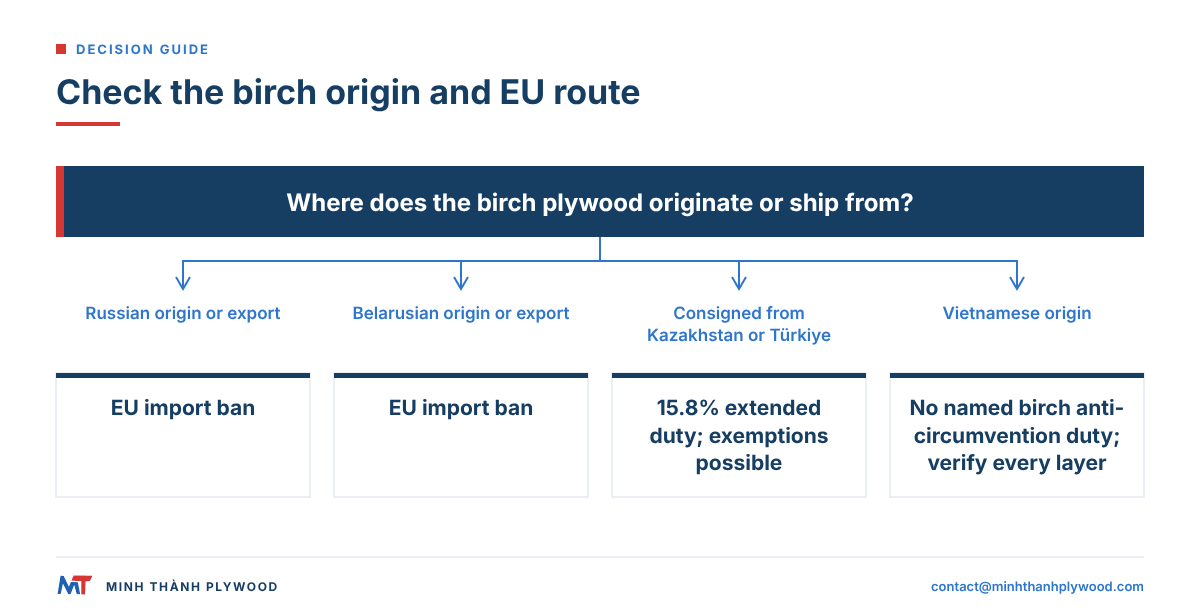
No: the EU anti-circumvention duty on birch plywood applies to imports consigned from Kazakhstan and Türkiye, and Vietnam is not named in it or in any other EU measure on birch plywood, as of 20 October 2026. Vietnamese birch-faced plywood enters under the normal tariff for its CN code and origin.
What applies to birch-faced plywood by where it comes from:
| Origin or consignment | EU sanctions | EU anti-dumping on birch plywood | Other EU duty on plywood |
|---|---|---|---|
| Russia | Import banned since 9 April 2022 | Up to 15.8% (2021/1930) | — |
| Belarus | Import banned since 3 March 2022 | — | — |
| Kazakhstan, Türkiye | — | 15.8% extended (2024/1287), exemptions possible | — |
| China | — | — | Hardwood plywood duty 86.8% for most exporters (2025/2333) |
| Vietnam | — | — | None |
The Chinese measure matters for birch too: Implementing Regulation (EU) 2025/2333 covers plywood with at least one outer ply of tropical or non-coniferous wood, birch included. The duty is 86.8% for all exporters except one named company. In July 2026 the Commission also opened an anti-circumvention investigation into slightly modified hardwood plywood from China.
What keeps a Vietnamese panel clear is its records. The EU bans Russian and Belarusian wood whatever route it takes, so the importer should know where every layer grew, the birch face included.
How sanctioned birch reaches markets through third countries
Sanctioned birch reaches markets through third countries by relabelling: panels or veneers from Russia or Belarus are shipped through, or finished in, a country that does not grow birch, and sold with that country’s papers. The EU found exactly this pattern in Kazakhstan and Türkiye.
Investigators have put a figure on it: Earthsight estimated in 2025 that more than €1.5 billion of Russian and Belarusian birch plywood had entered the EU through third countries since the sanctions began. The warning signs buyers can check are practical:
- No birch forests behind the offer. A country with no birch harvest exporting all-birch plywood in volume.
- Origin given as a region. “Baltic”, “Nordic” or “Eurasian” birch, with no country of harvest.
- Price far below EU mills for all-birch panels of the same grade.
- Documents that do not match. Batch numbers, species and volumes that differ between invoice, packing list and certificate.
- Reused or unverifiable chain-of-custody certificates. Numbers that cannot be found in the issuing body’s public database.
Each sign is a reason to ask for harvest records before paying the deposit, not after the container lands.
EUDR: why Russia and Belarus are high risk
Under the EU Deforestation Regulation (EUDR), Russia and Belarus are classed as high-risk countries, while Vietnam is low risk, by Implementing Regulation (EU) 2025/1093. The class sets how much due diligence an operator must do and how often authorities check.
The EUDR, Regulation (EU) 2023/1115, applies from 30 December 2026 for large and medium operators and for micro and small operators already under the EU Timber Regulation, and from 30 June 2027 for other micro and small operators, as amended by Regulation (EU) 2025/2650. Plywood is ex 4412 and in scope. The due diligence statement needs the species, the quantity, the country of production and the geolocation of every production plot, with coordinates to at least six decimal digits.
For birch-faced plywood that means two plots, not one: where the core grew and where the face grew. A low-risk country for the panel does not make the face low risk if the birch came from elsewhere; simplified due diligence applies only when every commodity in the product comes from low-risk countries. Read more in EUDR traceability.
How to prove the birch face origin, step by step
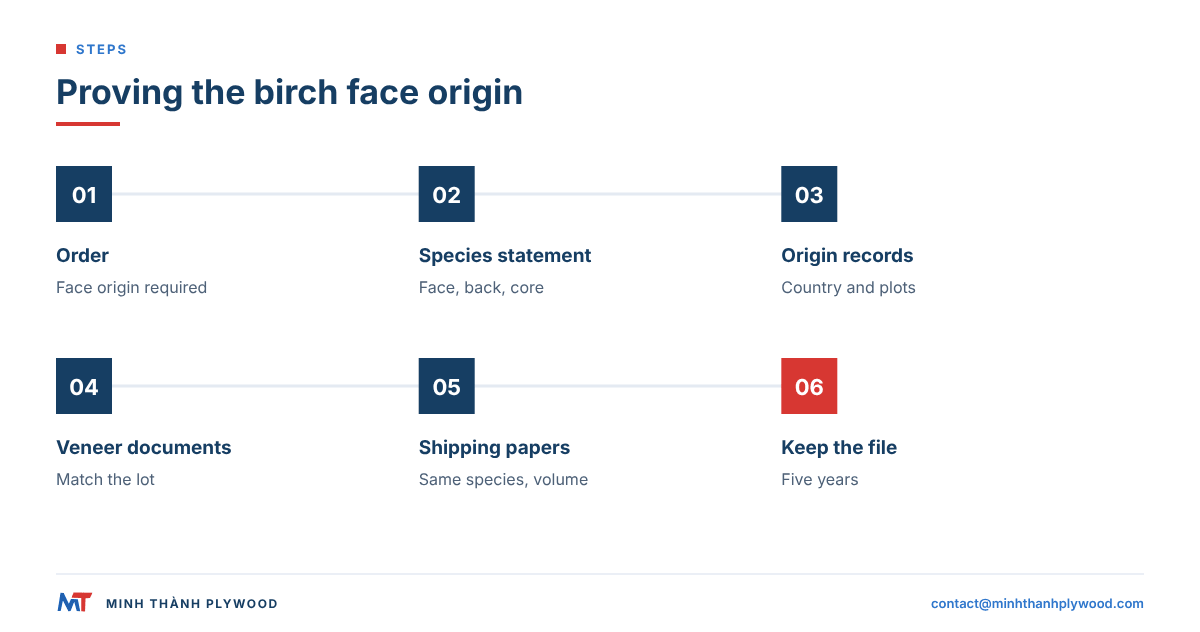
To prove where a birch face comes from, match the mill’s harvest records for the face veneer to your lot, from the purchase order to the shipped panel. Follow these steps for each order:
- Write the face species and origin on the purchase order. “Face/back: birch, country of harvest stated in the origin records”, so the requirement is part of the contract.
- Ask for the species statement for your lot. Face, back and core species, with their genus.
- Ask for the origin records of the face veneer. Country of harvest and the geolocation of the harvest plots, as for the EUDR due diligence statement.
- Check the veneer purchase documents for the lot. Supplier, date and volume should match the face veneer used for your panels.
- Compare against the shipping documents. Species and volumes on the invoice and packing list must match the records.
- Check the panels on arrival. The birch face, the core and the edge should match the description and the approved sample.
- Keep the file. Records, statements, invoice, packing list, photos and the due diligence reference, for five years from placing on the EU market.
Minh Thanh supplies the EUDR compliance dossier, with origin records and geolocation files, with orders, and every shipment is photographed and filmed before loading. Those two records cover steps 3 and 6 in one set.
Vietnamese birch plywood vs Russian birch plywood
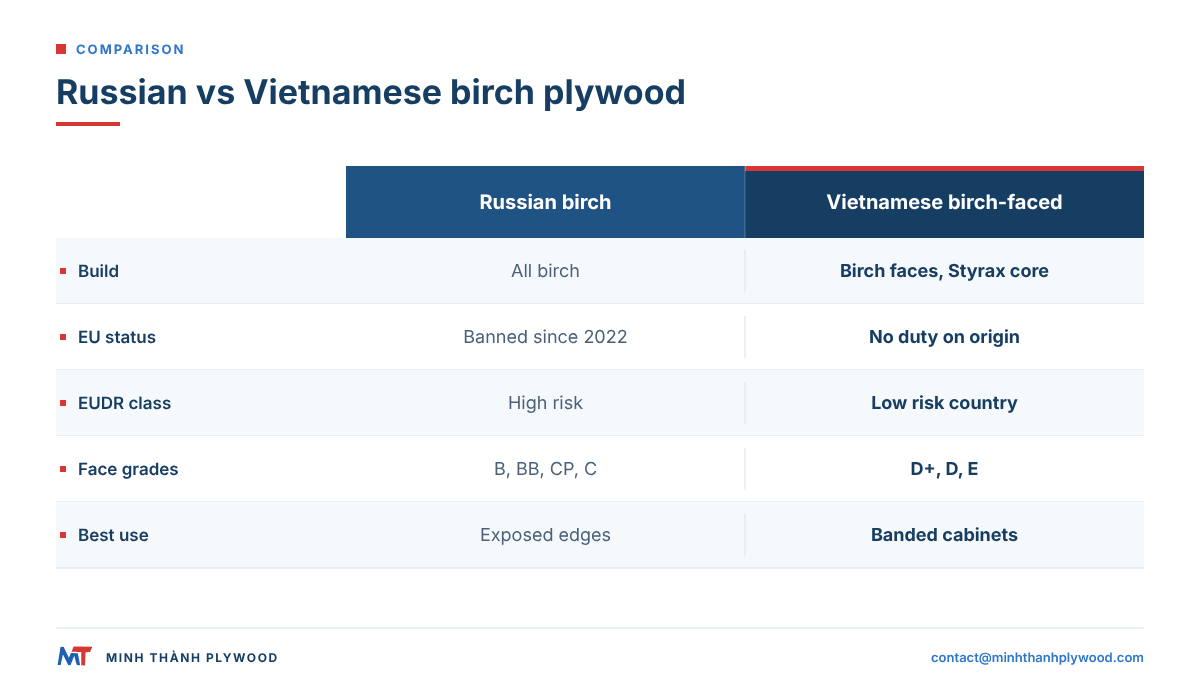
Vietnamese birch plywood is birch-faced, birch face and back on a white Styrax or Eucalyptus core, while Russian birch plywood is birch all through; the difference decides the edge, the weight and the jobs each suits.
| Point | Russian birch plywood | Vietnamese birch plywood (Minh Thanh) |
|---|---|---|
| Build | All birch, face to core | Birch face and back, Styrax or Eucalyptus core |
| EU status | Import banned since 2022 | No sanctions or trade-defence duty on Vietnamese origin |
| EUDR country class | High risk | Vietnam low risk; face per its own origin |
| Face grades | B, BB, CP, C | D+, D, E, quoted as D+/D or D/E |
| Sizes | Often 1525 × 1525 mm and large formats | 1220 × 2440 and 1250 × 2500 mm, custom sizes |
| Core weight at 18 mm | Dense birch core | Styrax about 500 kg/m³; 26.8 kg per 1220 × 2440 × 18 mm sheet |
| Edge | Uniform birch edge | Pale core edge, banded in furniture |
| Best use | Exposed edges, laser work, vehicle floors | Cabinets, furniture, interiors with banded edges |
For a Polish or German cabinet maker, the switch is usually from all-birch to birch-faced for carcasses and doors, with edge banding, keeping all-birch only where the edge shows. Minh Thanh’s birch-faced panels are pressed twice as standard: the core board is pressed and calibrated, then face and back are pressed on, which keeps the thin birch face flat.
Birch face grades: D+/D against B/BB
Birch faces from a Vietnamese mill are graded D+, D and E, and quoted as face/back pairs; the ladder runs close to the European birch grades that buyers of Russian and Baltic birch know. Individually, D+ is about B, D is about BB and E is about CP/C.
| Vietnamese pair | European equivalent | Typical use |
|---|---|---|
| D+/D | About B/BB | Visible cabinet fronts and sides, one best face |
| D/D | About BB/BB | Carcasses, shelving, painted work |
| D/E | About BB/CP | One visible face, utility back |
The final appearance is fixed by an approved sample, not by the letters alone. Faces are sanded, and both faces are UV-ready for buyers who apply their own UV coating. Birch plywood grades covers the acceptance criteria in detail.
What a Vietnamese mill supplies with birch-faced plywood
A Vietnamese mill supplies the documents that show what the panel is made of and where each layer grew, plus the usual shipping set. Minh Thanh sends:
| Document | What it proves |
|---|---|
| EUDR compliance dossier | Origin records and geolocation files for the timber, face and core |
| Species statement | Birch face and back; Styrax or Eucalyptus core |
| Certificate of origin (EUR.1 for the EU) | Vietnamese origin of the finished panel |
| Commercial invoice, packing list, B/L | The shipment, with sheets and volume per item |
| TCVN 11902:2017 certificate (VietCert 141.1-VNC-HC) | Veneer-faced plywood certified to the Vietnamese standard |
| ISO 9001:2015 certificate (KAC25/0185) | Quality management for plywood manufacturing |
| CARB P2 / TSCA Title VI certificate (ICTT mill no. 23024) | Emission certification, for US and European furniture buyers |
| Photos and video before loading | What went into the container |
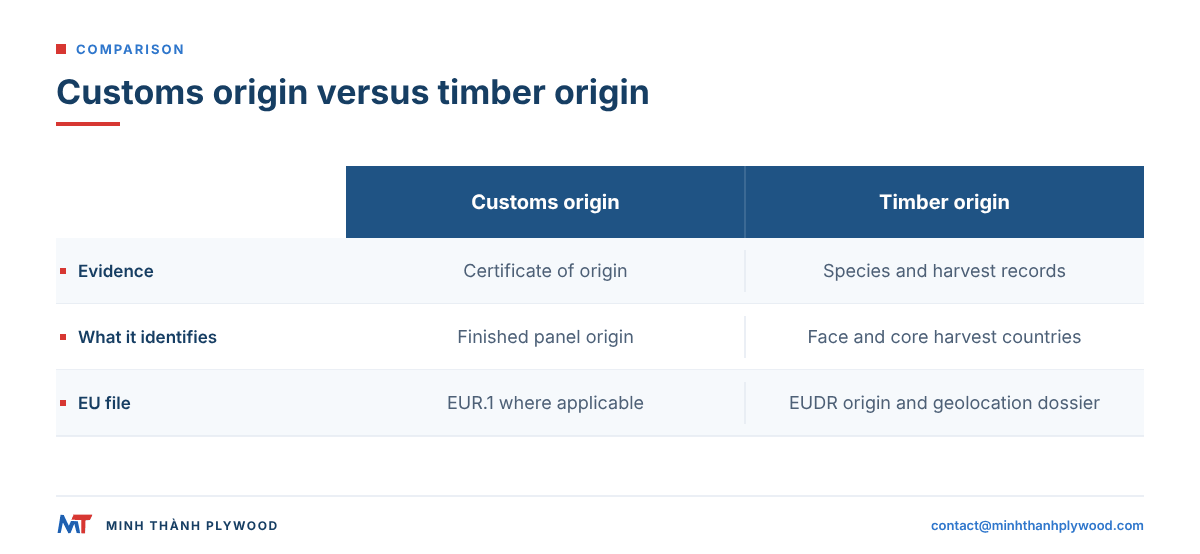
The certificate of origin and the dossier answer different questions: the first is the panel’s customs origin, the second is where each species grew. An EU buyer of birch-faced plywood needs both.
What to write on your RFQ for birch-faced plywood
Write the build, the grade and the origin requirement into the RFQ, so the mill prepares the records with the order. A complete line for an EU cabinet maker reads:
18 mm × 1250 × 2500 mm birch-faced plywood; face/back: birch D+/D, origin records and geolocation for the face veneer; core: white Styrax, stitched, pressed twice; UF glue at E0 emission; sanded, UV-ready; 1×40HC CIF Gdansk; EUDR compliance dossier, species statement and EUR.1 with the documents.
Production takes 15–45 days after the 30% deposit, and Northern Europe is 30–40 days at sea from Hai Phong. Minh Thanh sends free samples of the specified panel first and replies within hours; send the line to contact@minhthanhplywood.com or WhatsApp +84 988 586 601. Birch plywood lists the sizes and grades.
Buyer questions, answered
Can plywood from Russia be imported into the EU?
No. Since 9 April 2022, Regulation 833/2014 as amended by Regulation (EU) 2022/576 has prohibited importing wood products of CN chapter 44, plywood included, that originate in or are exported from Russia. Belarus has a matching ban from 3 March 2022.
Is Baltic birch from Russia?
Not necessarily. Baltic birch is a trade name for all-birch plywood from the Baltic Sea region, which before 2022 included large Russian volumes. The name proves no origin; only the country of harvest in the supplier's records does.
What is Russian birch plywood?
Russian birch plywood is plywood made in Russia entirely of birch veneers, face, back and core, usually in 1525 × 1525 mm and larger formats. It was the largest source of birch plywood for Europe before the 2022 bans.
Does the EU anti-circumvention duty apply to birch plywood from Vietnam?
No. Implementing Regulation (EU) 2024/1287 extends the Russian birch plywood duty only to imports consigned from Kazakhstan and Türkiye. Vietnam is not named in that extension, as of 20 October 2026.
What was the EU anti-dumping duty on Russian birch plywood?
Implementing Regulation (EU) 2021/1930 set definitive duties of up to 15.8% on birch plywood from Russia from November 2021. The duties were due to expire on 10 November 2026 unless an expiry review was opened.
How do I prove the origin of a birch face veneer?
Ask the mill for the face veneer's country of harvest in its origin records, the geolocation of the harvest plots, the veneer purchase documents for your lot and the species statement, and check that they match the invoice and the panel.
Is Russian wood high risk under the EUDR?
Yes. Implementing Regulation (EU) 2025/1093 lists Russia and Belarus as high-risk countries, while Vietnam is low risk. High-risk sourcing faces the strictest due diligence and the highest check rate.
Is Vietnamese birch plywood all birch?
No. Vietnamese birch plywood is birch-faced: birch face and back veneers on a white Styrax or Eucalyptus core. It suits furniture and cabinets with banded edges; exposed-edge work calls for an all-birch panel.
Can the US import plywood from Russia?
There is no outright US ban on Russian plywood, but since April 2022 Russian goods have lost normal trade relations and pay the higher column 2 tariff rates, and the Lacey Act asks for each species' country of harvest.
What birch face grades does a Vietnamese mill offer?
Birch faces are graded D+, D and E in Vietnam and quoted as pairs such as D+/D or D/E. Individually, D+ is about the European B grade, D about BB and E about CP/C, fixed by an approved sample.