
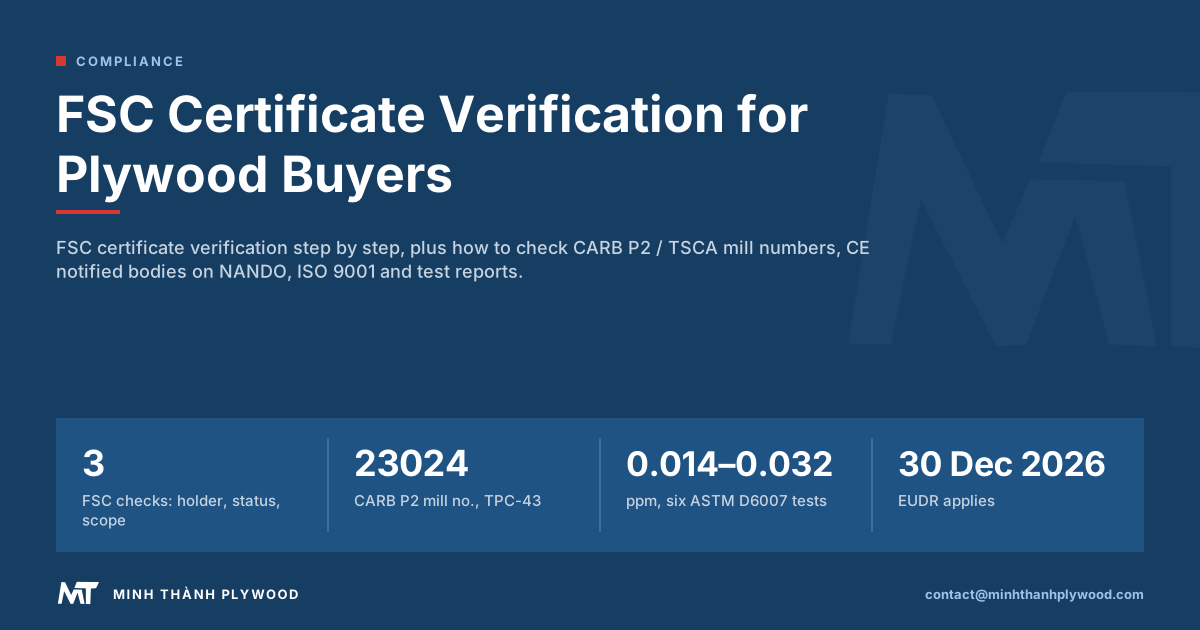
FSC certificate verification takes five minutes on the FSC public certificate database: search the supplier's certificate code, check that the holder's name matches your seller, that the status is valid and that the scope covers plywood. CARB, CE, ISO and test reports have their own public checks. Minh Thanh Plywood shows how, with its own CARB P2 mill number as the worked example.
FSC certificate verification: the short answer
FSC certificate verification is a public check on the FSC certificate database, and any buyer can do it in a few minutes. The checks that matter:
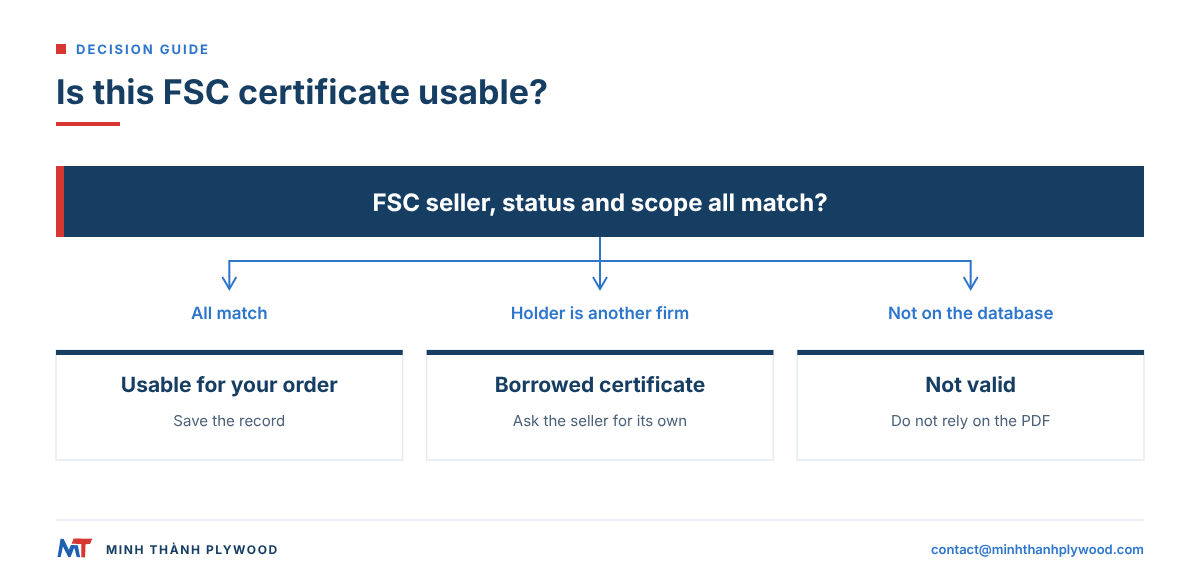
- The holder is your seller. The certificate must be in the name of the company that invoices you.
- The status is valid. Not suspended, terminated or expired.
- The scope covers plywood. The product list must include plywood and the claim you buy (FSC 100%, FSC Mix or FSC Recycled).
- The sales documents carry the claim. Check the FSC claim and seller’s certificate code on the sales documents or clearly linked, certification-body-approved supplementary documents.
If any of the four fails, the panels you receive cannot be sold on as FSC-certified. The same logic of “right holder, valid status, right scope” applies to every other certificate a plywood supplier shows you, as the sections below explain.
How to verify an FSC certificate, step by step
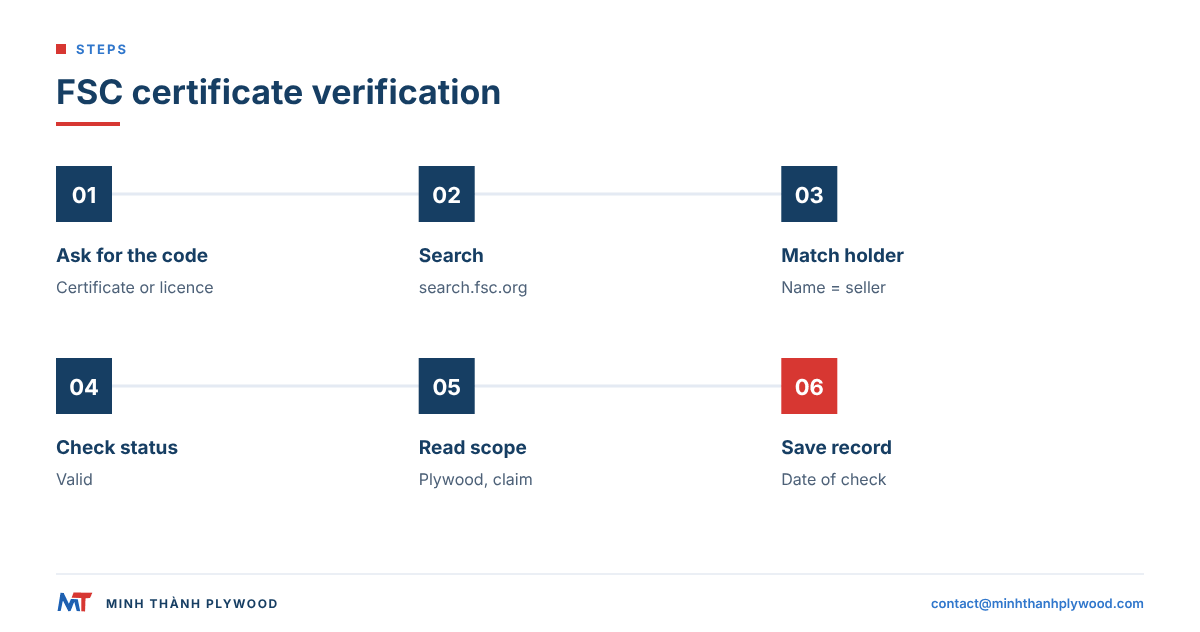
Verify an FSC certificate by asking the supplier for its certificate code, searching that code on the FSC public database at search.fsc.org (the former info.fsc.org), and checking that the status is valid, the product group covers plywood and the holder matches the company on the invoice. The steps:
- Ask for the code. Ask the supplier for its FSC certificate code (for example XXX-COC-000000) or licence code (for example FSC-C000000).
- Search the database. Enter the code on the FSC certificate search. Searching by company name also works, but the code avoids similar names.
- Match the holder. Compare the holder’s name and address with the company on your proforma invoice.
- Check the status. Valid means the certificate can be used; suspended or terminated means no FSC claims can be made.
- Read the product scope. Plywood, with the species and claim types, must be listed.
- Save the record. Download or screenshot the certificate page with the date of your check, and repeat the check before each order.
FSC states that only third-party, accredited certification bodies issue chain of custody certificates and that holders are audited every year (FSC chain of custody). A PDF certificate on its own proves nothing; the database entry does.
Can a valid FSC certificate still accompany a false plywood claim?
Yes. A valid certificate and correct product scope are necessary checks, but they do not authenticate a particular plywood sale. For a birch-plywood shipment, match the seller’s certificate code and the dated invoice or approved linked supplementary documents to the actual product and order.
The FSC public certificate search may show a holder’s historical “No FSC Sales” reporting period. If an invoice with an FSC claim falls inside such a period, ask the certified seller and its certification body to reconcile the records before treating the invoice as certified. FSC explains that a no-sales declaration describes a past reporting period; it does not by itself establish fraud or the seller’s current sales status (FSC advice on historical disclosures).
Also check the exact certificate holder against FSC’s published integrity notices. FSC’s July 2026 birch-plywood investigation documented false claims and blocked holders. A screenshot of an old certificate cannot override current suspension or a mismatch in a transaction’s evidence.
What the FSC certificate scope must show for plywood
The scope of an FSC certificate lists which products the holder may sell with which claims. A valid certificate with the wrong scope does not cover your order.
| Scope item | What to look for |
|---|---|
| Product type | Plywood, or wood panels including plywood |
| Claim | FSC 100%, FSC Mix or FSC Recycled, matching the claim you ordered |
| Species | The face and core species of your panels |
| Sites | The site that makes or ships your goods, for a multi-site certificate |
| Certification body | The body that issued the certificate and audits the holder |
A common gap: the certificate covers sawn timber or furniture but not plywood. Another: the claim on the certificate is FSC Controlled Wood, which cannot be sold as an FSC claim on the finished product. Our guide to what FSC wood is explains the claim types.
FSC plywood documentation from Vietnam: invoices and claims
FSC plywood documentation is the paper trail that carries the claim from mill to buyer. The claim and seller’s certificate code normally appear on the sales documents; clearly linked supplementary documents approved by the certification body are also permitted under the FSC chain of custody standard.
What the FSC documents for a plywood shipment show:
- Sales invoice: the FSC claim for each product line (for example “FSC Mix 70%”) and the seller’s FSC certificate code.
- Delivery documents: the same claim and code, or a reference that links them to the invoice.
- Approved supplementary documents: where used, a clear link to the sales or delivery documents identifying which products carry the FSC claim.
- Pack labels: the product, so the certified goods can be matched to the invoice line.
- The seller’s certificate: valid on the database on the invoice date.
A trading company that takes ownership of the goods needs its own FSC chain of custody certificate to pass the claim on. If your seller is not the mill, check the seller’s certificate, not only the mill’s. Our guide to FSC certification and claims for plywood covers the claim types in more detail.
Mill certified plywood: how to verify CARB P2 and TSCA Title VI
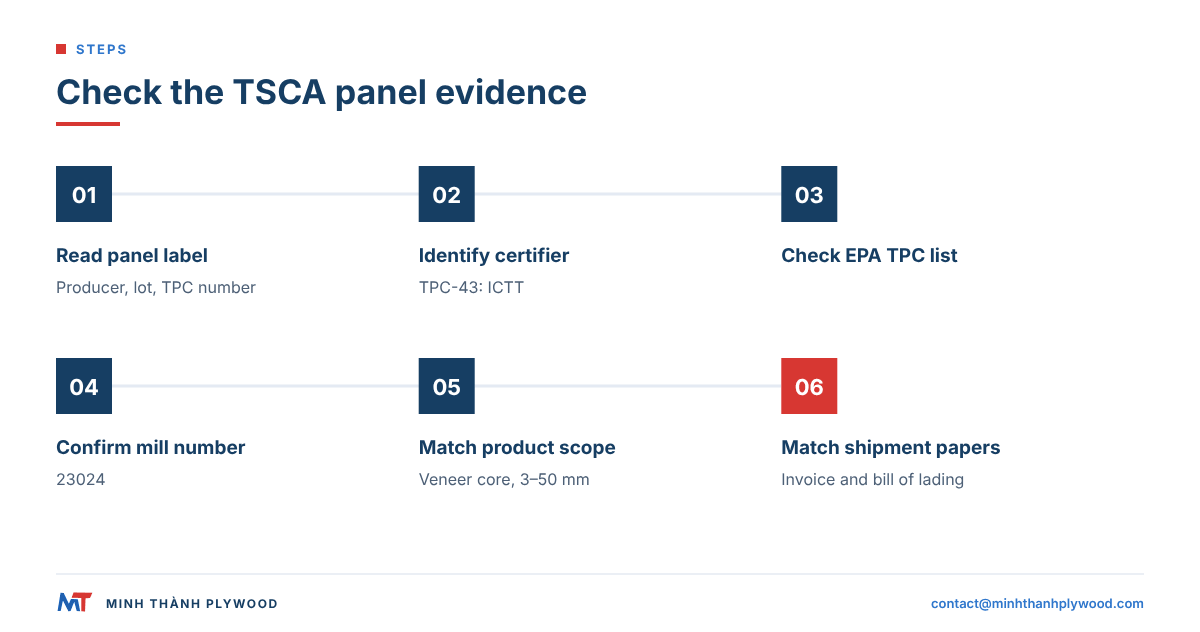
Mill-certified plywood for the US carries a CARB Phase 2 / TSCA Title VI certification issued by a third-party certifier (TPC), and the panel label is the starting point for the check. EPA requires panels to be labelled with the producer, the lot number, the TPC number and the statement “TSCA Title VI compliant” (EPA formaldehyde standards).
The check, using our own certification as the worked example:
| Step | What to check | Worked example: Minh Thanh Plywood |
|---|---|---|
| 1 Read the label | Producer, lot, TPC number, compliance statement | TPC-43, “TSCA Title VI compliant” |
| 2 Identify the certifier | The TPC behind the number | ICTT |
| 3 Check the certifier | The TPC is on EPA’s list of recognised TSCA Title VI certifiers | Check on the EPA list |
| 4 Check the mill number | The certifier confirms the mill number and status | Mill no. 23024 |
| 5 Check the scope | Product type and thickness range | Hardwood plywood, veneer core, 3–50 mm |
| 6 Check the documents | Invoice and bill of lading state TSCA Title VI compliance | Stated on our US order documents |
Then look at the emission evidence. Our six ASTM D6007 chamber tests between April 2025 and June 2026, on 9, 15 and 18 mm panels, averaged 0.014–0.032 ppm against the 0.05 ppm limit for veneer-core hardwood plywood: three by Shanghai Hongjun and three by ICTT Vietnam. Our guide to CARB Phase 2 vs TSCA Title VI explains how the two rules relate.
How to verify CE marking and the notified body on NANDO
CE marking on plywood follows EN 13986, and the check depends on the system of assessment. For structural plywood under system 2+, a notified body certifies the factory production control, and that body can be checked on the European Commission’s NANDO database (NANDO notified bodies).
- Read the declaration of performance (DoP). It names the product, the intended use, EN 13986, the system (2+ or 4) and the declared performance.
- Read the CE label. For system 2+, it carries the notified body’s four-digit number.
- Search the number on NANDO. Check that the body is notified under the Construction Products Regulation for wood-based panels.
- Check the factory production control certificate. Its number usually starts with the notified body’s number; confirm with the body that it is valid and covers the factory that made your panels.
- Match the product. The DoP must describe your panel, not another product of the same group.
System 4 products (non-structural uses) carry a manufacturer’s declaration without a notified body, so there is nothing to search on NANDO. Our guide to EN 13986 and CE marking for plywood explains the systems.
How to verify an ISO 9001 certificate
An ISO 9001 certificate is verified with the certification body and, for accredited certificates, on IAF CertSearch (iafcertsearch.org), the database of the International Accreditation Forum.
What to check:
- The holder and site: the factory you buy from, at its address.
- The scope: plywood manufacturing, not only trading or a different product.
- The certification body: accredited by an accreditation body that is a member of IAF.
- The status: valid on the day of your check.
Our quality management system is certified to ISO 9001:2015 for plywood manufacturing, certificate KAC25/0185. We also hold TCVN 11902:2017 certification for veneer-faced plywood (VietCert 141.1-VNC-HC).
How to read a plywood test report
A test report proves one result, for one sample, by one method. Read it for what it tested, not for its title.
| Field | What it should show |
|---|---|
| Laboratory | Name and address of the testing laboratory |
| Report number and date | A unique number and the test date |
| Client | The company that ordered the test |
| Sample | Product, thickness, core, glue and how the sample was taken |
| Method | For example ASTM D6007 or EN 717-1 for formaldehyde, EN 314 for bond quality |
| Result | The value with its unit, next to the limit it is compared with |
Check that the sample matches your order: a report on 9 mm panels does not cover an 18 mm build with a different glue. If you need a test on your own order, third-party testing to your method (for example EN 717-1) is arranged through SGS on request.
EUDR: a dossier, not a certificate
There is no EUDR certificate. The EU Deforestation Regulation asks the operator who places plywood on the EU market to make a due diligence statement, built on information about where the wood was harvested.
What the supplier provides is a dossier: origin records and the geolocation files of the harvest plots. We supply the EUDR compliance dossier (origin records and geolocation files) with orders. A supplier who offers an “EUDR certificate” is describing something that does not exist; ask for the records instead.
The European Commission states that the regulation applies from 30 December 2026 for large and medium operators and for micro and small operators already covered by the EU Timber Regulation, and from 30 June 2027 for other micro and small operators (European Commission, EUDR, checked October 2026).
Red flags of borrowed or fake certificates
A borrowed certificate is a real certificate used by the wrong company; a fake certificate is a document that does not exist on any database. Both show up in the same checks.
- The FSC seller is not certified. A trader passes on an FSC claim using only the mill’s certificate. CARB/TSCA and CE factory certificates identify the producer, so check them against the mill and product instead.
- The status is suspended or terminated. The PDF looks valid, the database does not.
- The scope leaves out plywood. The certificate covers furniture, sawn timber or another product.
- The label and the certificate differ. The mill number on the panel is not the mill number on the CARB certificate.
- The test report is for another product. Different thickness, glue or company.
- The document has been edited. Fonts, dates or names that do not match the issuer’s format.
- A certificate that cannot exist. An “EUDR certificate”, or a CE mark with a notified body number for a product under system 4.
Checks 1 and 2 catch most borrowed certificates, and both take minutes on the public databases.
Certificate checklist by market
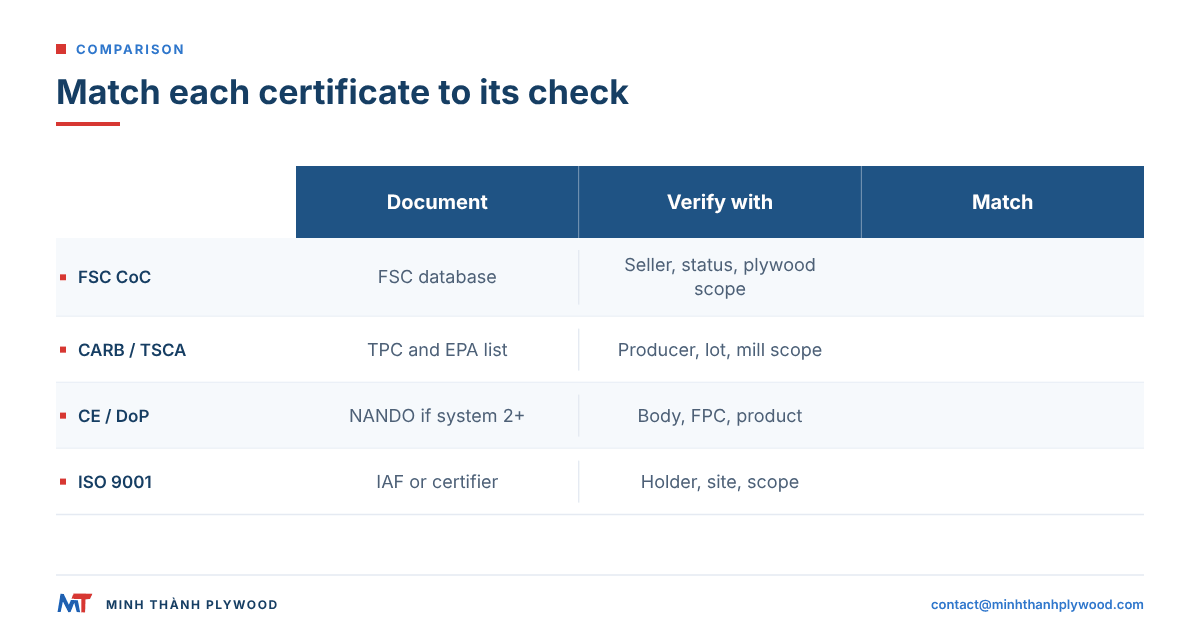
Each market asks for different certificates, and each certificate has its own public check. Use this table before the first order and repeat the checks before repeat orders.
| Certificate or document | Market | Where to check | What must match |
|---|---|---|---|
| FSC chain of custody | Any buyer selling FSC goods | search.fsc.org | Holder = seller, valid, plywood and claim in scope |
| CARB P2 / TSCA Title VI | US | Panel label, the TPC, EPA list of recognised TPCs | Mill number, scope, label text |
| CE / DoP to EN 13986 | EU construction uses | NANDO for system 2+ | Notified body, FPC certificate, product |
| ISO 9001 | Any | IAF CertSearch, certification body | Holder, site, scope |
| Test reports | Any | The laboratory | Sample, method, result, limit |
| EUDR dossier | EU | Origin records and geolocation files | Plots, species, quantities |
PEFC certificates are checked the same way on the PEFC database. Our guide to PEFC vs FSC compares the two schemes.
What certificates does Minh Thanh Plywood provide?
We hold CARB P2 / TSCA Title VI, ISO 9001 and TCVN certification and send the files before the order is confirmed, so you can run the checks above.
| Certificate or file | Status |
|---|---|
| CARB P2 / TSCA Title VI | Held: ICTT mill no. 23024, hardwood plywood veneer core, 3–50 mm |
| ISO 9001:2015 | Held: KAC25/0185, quality management system for plywood manufacturing |
| TCVN 11902:2017 | Held: VietCert 141.1-VNC-HC, veneer-faced plywood |
| Formaldehyde chamber tests | Six ASTM D6007 reports, April 2025 – June 2026, averaged 0.014–0.032 ppm |
| PPWR packaging test | SGS, September 2026, Regulation (EU) 2025/40: lead, cadmium, mercury and hexavalent chromium not detected in all four packaging materials |
| EUDR | Compliance dossier with origin records and geolocation files |
| FSC, CE | Available* |
*Supplied directly or through qualified partner mills.
Every shipment is photographed and filmed before loading, and buyers get the photos and video. To receive the certificate files with a quote, send your specification through the furniture plywood page or read our quality and certificates page.
Buyer questions, answered
How do I verify an FSC certificate?
Search the certificate code or licence code on the FSC public certificate database at search.fsc.org. Check that the certificate holder is your seller, the status is valid, and the scope lists plywood with the claim you are buying.
What is the difference between an FSC certificate code and an FSC licence code?
The certificate code identifies the chain of custody certificate issued by a certification body, for example XXX-COC-000000. The licence code, for example FSC-C000000, identifies the holder's right to use the FSC trademarks. Both find the same holder in the database.
How do I verify the FSC certificate of a Vietnamese plywood supplier?
Ask for the certificate code of the company that will invoice you, search it on search.fsc.org, and check the name, address, status and product scope. Then check the FSC claim and certificate code on the sales documents, or on clearly linked supplementary documents approved by the certification body.
Can a trading company sell FSC plywood without its own certificate?
A company that takes ownership of the goods and passes on the FSC claim needs its own chain of custody certificate. If the seller is not certified, the claim on its invoice is not valid.
How do I check a CARB P2 or TSCA Title VI certification?
Read the panel label for the producer, lot number and third-party certifier number, then confirm the mill number with that certifier and check that the certifier is on the EPA list of recognised TSCA Title VI certifiers.
How do I verify CE marking on plywood?
Read the declaration of performance and the CE label. For structural plywood under system 2+, the label names a notified body number; search that number on the European Commission's NANDO database and check that the factory production control certificate is valid.
How do I verify an ISO 9001 certificate?
Search the certificate on IAF CertSearch or with the certification body, and check that the certification body is accredited and the scope covers plywood manufacturing at the factory you buy from.
What should a formaldehyde test report show?
The laboratory's name, report number and date, the test method such as ASTM D6007 or EN 717-1, the sample description with thickness and glue, and the result with its unit against the limit.
Is there an EUDR certificate for plywood?
No. EUDR compliance is shown with a due diligence dossier: origin records and geolocation files of the harvest plots, which the operator uses for its due diligence statement.
What are the signs of a borrowed or fake certificate?
For FSC, a holder name that is not the seller passing on the claim is a warning sign. For mill certification, match the producer, product scope and panel label; also check certificate status and test-sample identity.