
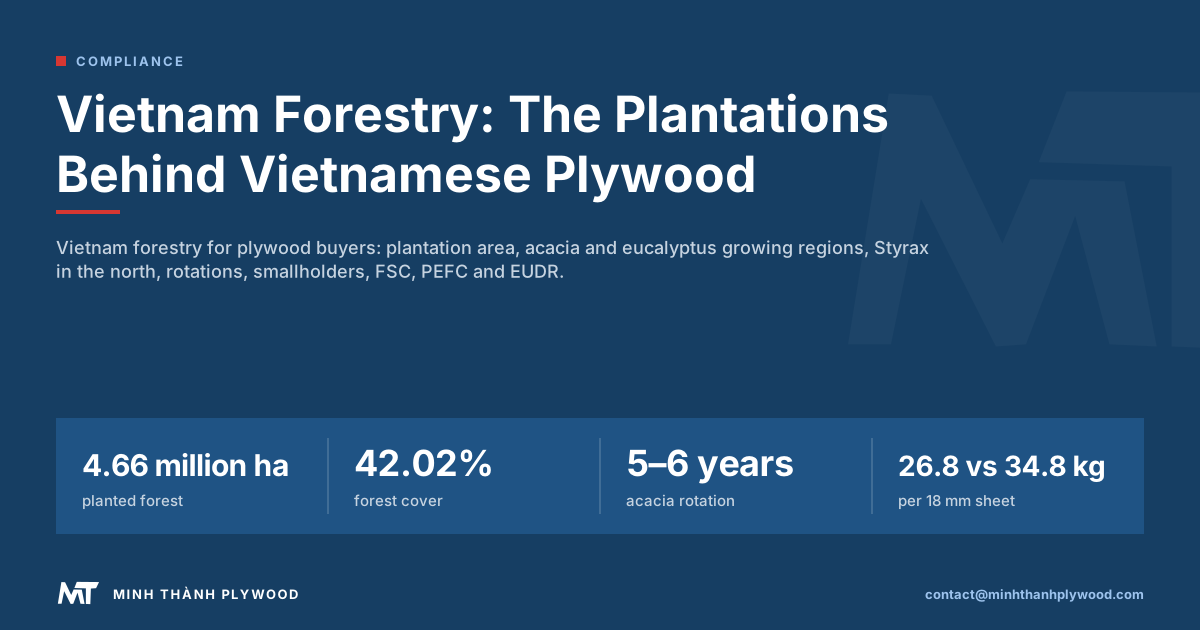
Vietnam forestry supplies plywood mills from planted forests, not natural forest: acacia, eucalyptus and Styrax grown in short rotations, much of it by farming households. Vietnam reported about 4.66 million hectares of planted forest at the end of 2022. Minh Thanh Plywood, in Ha Hoa, Phu Tho, peels its cores from locally grown plantation timber and supplies the EUDR compliance dossier with every order.
What is forestry in Vietnam today, and how much is planted?
Vietnam forestry today is two systems side by side: natural forest that is protected, and planted forest that is grown and harvested like a crop. The plywood trade runs on the planted part.
Vietnam’s Ministry of Agriculture and Rural Development reported 14,790,075 hectares of forest in 2022, of which 4,655,933 hectares was planted forest, and a forest cover of 42.02 percent (Viet Nam Government News, June 21, 2023; Viet Nam News, forest coverage remained at 42.02 per cent in 2022). The planted area grows every year: forestry in Vietnam has spent three decades turning bare hills into short-rotation plantations of fast-growing trees.
For a plywood buyer, that is the starting fact. The core veneers in Vietnamese plywood come from these planted forests, which is why Vietnam can supply large, steady volumes of light hardwood cores.
Which plantation timbers go into Vietnamese plywood?
Four plantation timbers make up nearly all Vietnamese plywood cores: acacia, eucalyptus, Styrax and rubberwood, with pine on a smaller scale. Each has its own region, weight and job in the panel.
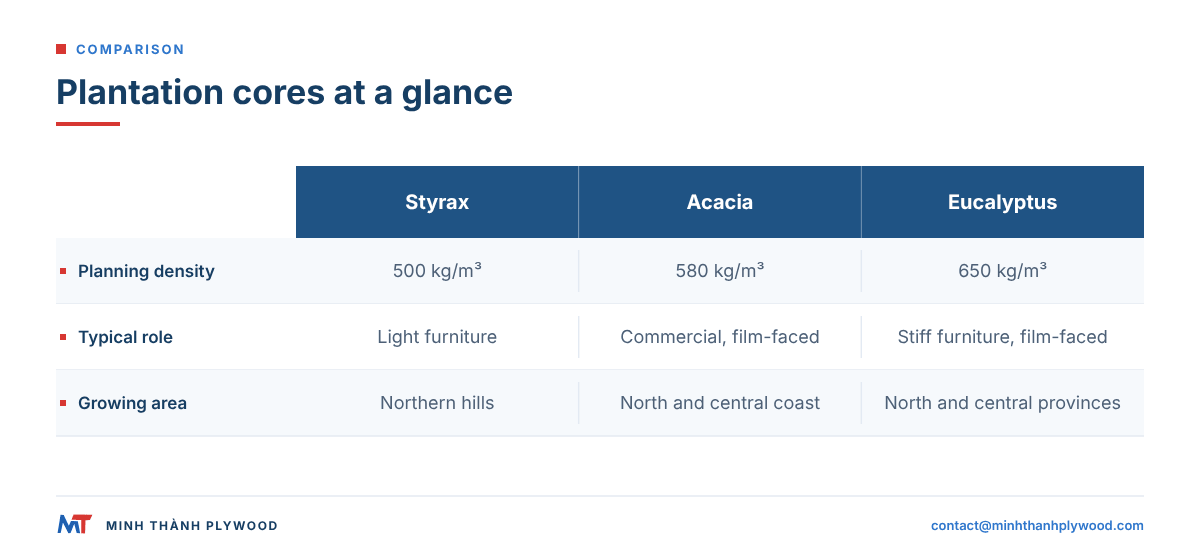
| Timber | Vietnamese name | Where it is grown | Planning density | Role in plywood |
|---|---|---|---|---|
| Acacia (A. mangium, A. auriculiformis and their hybrid) | keo | North, north-central, central coast | 580 kg/m³ | Commercial and film-faced cores, furniture cores on order |
| Eucalyptus | bạch đàn | North and central provinces | 650 kg/m³ | Stiff furniture cores, faces, film-faced cores |
| White Styrax (Styrax tonkinensis) | bồ đề | Northern midlands and mountains | 500 kg/m³ | Light white cores for furniture plywood |
| Rubberwood (Hevea) | cao su | South and Central Highlands | Not a Minh Thanh core | A niche core in southern mills |
| Pine | thông | Upland areas | Made on order | Cores on order |
At Minh Thanh, furniture panels use white Styrax or Eucalyptus cores as standard; Acacia and Pine cores are made on order. The densities above are the planning figures the mill uses for sheet weights and container plans.
Where is plywood timber grown in Vietnam?
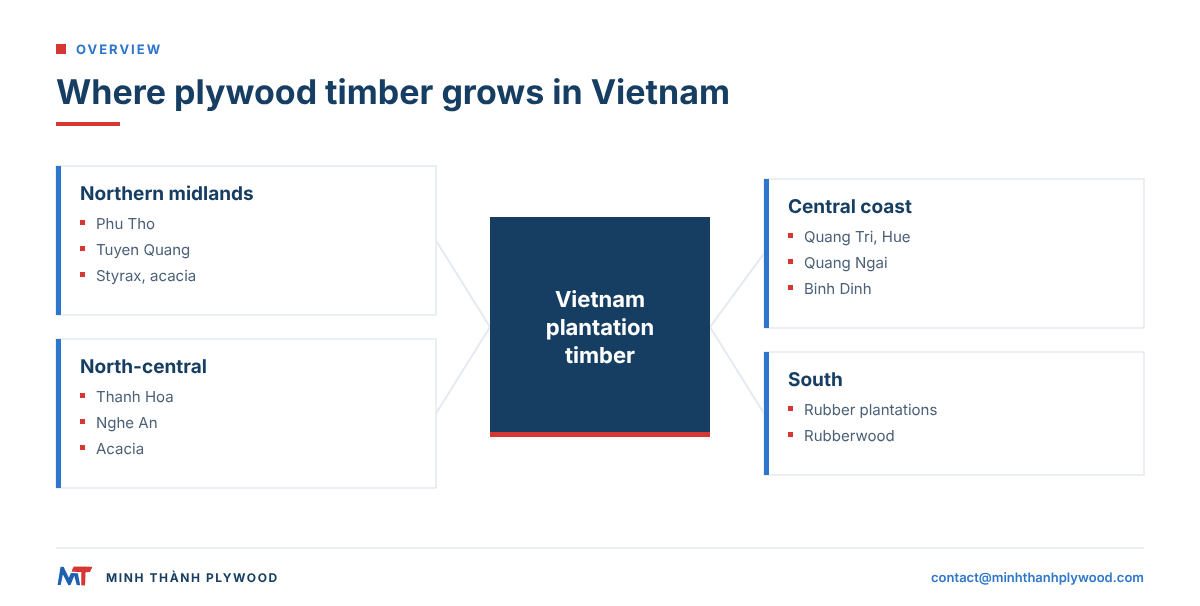
Acacia and eucalyptus are grown in three belts: the northern midlands and mountains, the north-central provinces, and the central coast. These belts hold the hill land that was planted from the 1990s onwards, close to the veneer mills that buy the logs.
Which provinces grow acacia and eucalyptus?
- Northern midlands and mountains: Phu Tho, Tuyen Quang, Yen Bai and Thai Nguyen; acacia, eucalyptus and the Styrax that only grows well in the north. Veneer peeling and plywood mills cluster here.
- North-central provinces: Thanh Hoa and Nghe An; large acacia areas feeding veneer, chip and sawmills.
- Central coast: from Quang Tri and Hue through Quang Nam and Quang Ngai to Binh Dinh; some of the densest acacia plantations in the country.
- South and Central Highlands: rubber plantations, whose trees come out as rubberwood at the end of tapping.
Vietnam merged its provinces on 1 July 2025, so several of these names now sit inside larger provinces: Yen Bai within Lao Cai, Tuyen Quang with Ha Giang, and Binh Dinh within Gia Lai. Origin records name the plot by its coordinates, so the merger does not change what a buyer receives.
Why is Styrax a northern timber, and why does it matter for furniture plywood?
Styrax is a northern timber because the tree grows in the cooler hills of the northern midlands and mountains, the region around Phu Tho. It gives a white, light core, about 500 kg/m³ for planning, that European furniture plants value for light, pale panels.
The weight difference shows in every sheet. At 18 mm, a 1220 × 2440 mm sheet weighs 26.8 kg on Styrax core against 34.8 kg on Eucalyptus. In a 40HC, that is 990 Styrax-core sheets (18 packs of 55) against 795 Eucalyptus-core sheets (15 packs of 53), because the heavier core reaches the 28,000 kg planning payload sooner.
Minh Thanh’s location in Ha Hoa, Phu Tho puts the mill inside the Styrax belt. Locally grown plantation timber for cores and a skilled workforce let it make high-grade furniture panels at a better price than comparable mills. See furniture plywood on Styrax core.
How long do plantation trees grow before harvest?
Most Vietnamese acacia is cut after 5–6 years, and smallholders with 1–5 hectare plots manage nearly half of the country’s acacia plantations, according to research by Germany’s Thünen Institute in central Vietnam (Thünen project brief 2020). Short-rotation logs often go to woodchip; longer rotations give the larger logs that veneer and sawmills want.
What the rotation means for plywood:
- Log size: older trees give wider veneer sheets and fewer joints in the core.
- Veneer grade: larger logs give a higher share of full-sheet core veneer.
- Supply: millions of small plots spread harvests through the year, so mills buy logs steadily.
The same research names the reasons households cut early: cash needs, storm risk, small plots and higher costs of waiting. Government and industry programmes now encourage longer rotations for sawlog and veneer logs.
Who grows the trees: households, companies or the state?
Vietnamese plantation timber is grown by three groups: farming households on small plots, state forestry companies on larger estates, and private companies with their own or contracted land. For plywood, households are the largest single source of logs.
That structure explains two features buyers notice. Supply is broad and local, which keeps core timber available to mills near the plantations. Traceability is built plot by plot, which is why origin records for a container list many small plots rather than one estate. Mills that buy around their own district know their growers and their plots, which makes those records practical to assemble.
What do FSC, PEFC and VFCS certification mean for Vietnamese plywood?
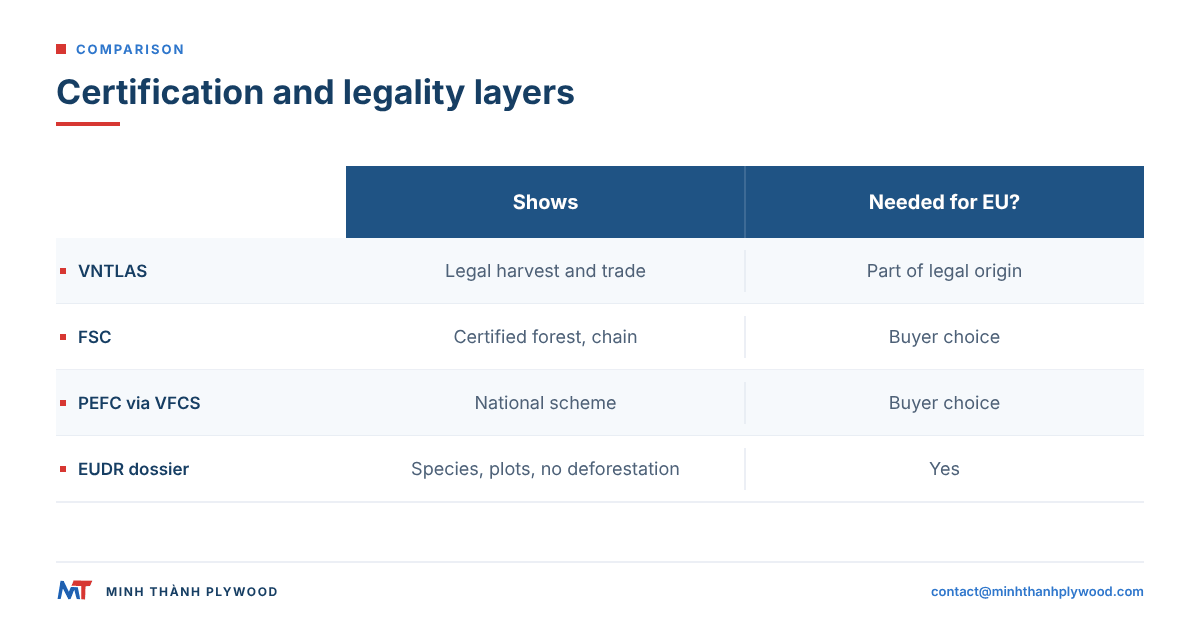
FSC and PEFC are voluntary forest certification schemes: they certify how a forest is managed and, through chain of custody, that certified wood stays separate on its way to the panel. They are a buyer’s choice, separate from the legal checks every import needs.
| Layer | What it shows | Who issues it | Required for EU import? |
|---|---|---|---|
| VNTLAS legality system | The timber was harvested and traded legally in Vietnam | Vietnamese authorities, under the EU–Vietnam Voluntary Partnership Agreement | Part of legal origin |
| FSC | Certified forest management and chain of custody | FSC-accredited certification bodies | No, a buyer choice |
| PEFC through VFCS | Vietnam’s national scheme, endorsed by PEFC | VFCS-accredited bodies | No, a buyer choice |
| EUDR dossier | Species, origin and plot geolocation; no deforestation after 31 December 2020 | The supplier, for the importer’s due diligence | Yes, from the application date |
Vietnam’s national scheme, VFCS, achieved PEFC endorsement, which PEFC announced on 10 March 2021 (PEFC). FSC-certified plywood is available* from Minh Thanh. Is FSC mandatory for EU plywood imports? explains when buyers ask for it.
*Supplied directly or through qualified partner mills.
How does plantation origin support EUDR due diligence?
Plantation origin supports EUDR due diligence because a planted plot has a known location, owner and planting history, so a supplier can show the wood came from land that was not deforested after 31 December 2020. Regulation (EU) 2023/1115 asks for the species, the country of production and the geolocation of every plot.
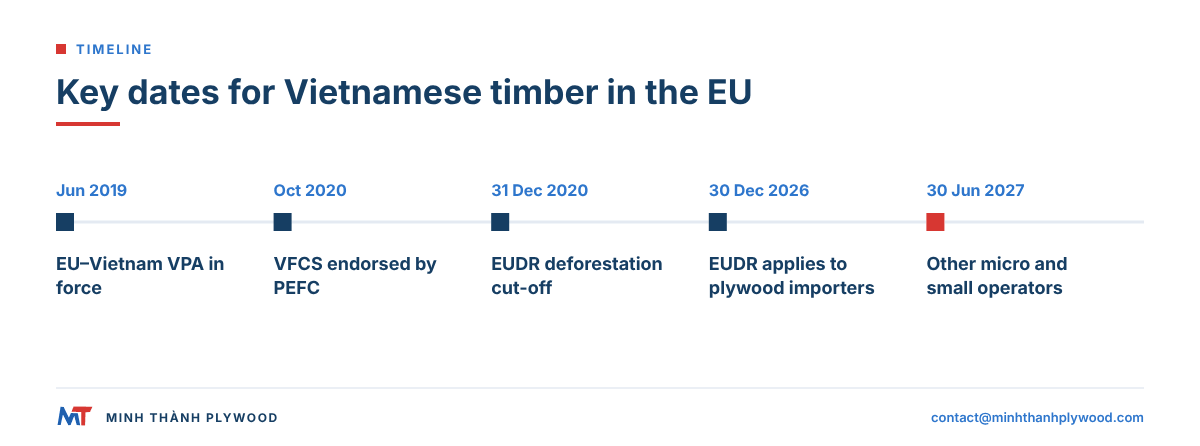
The dates that apply: EUDR obligations start on 30 December 2026 for large and medium operators, and for micro and small operators already covered by the timber regulation, including plywood importers; other micro and small operators follow on 30 June 2027 (European Commission, July 2026). Vietnam is listed as low risk under Implementing Regulation (EU) 2025/1093, which allows simplified due diligence when every commodity in the product comes from low-risk countries.
Minh Thanh supplies the EUDR compliance dossier, with origin records and geolocation files, with orders. Imported faces such as birch and okoume are documented from their own country of origin. See EUDR traceability.
What goes into an EUDR origin record for a plywood container?
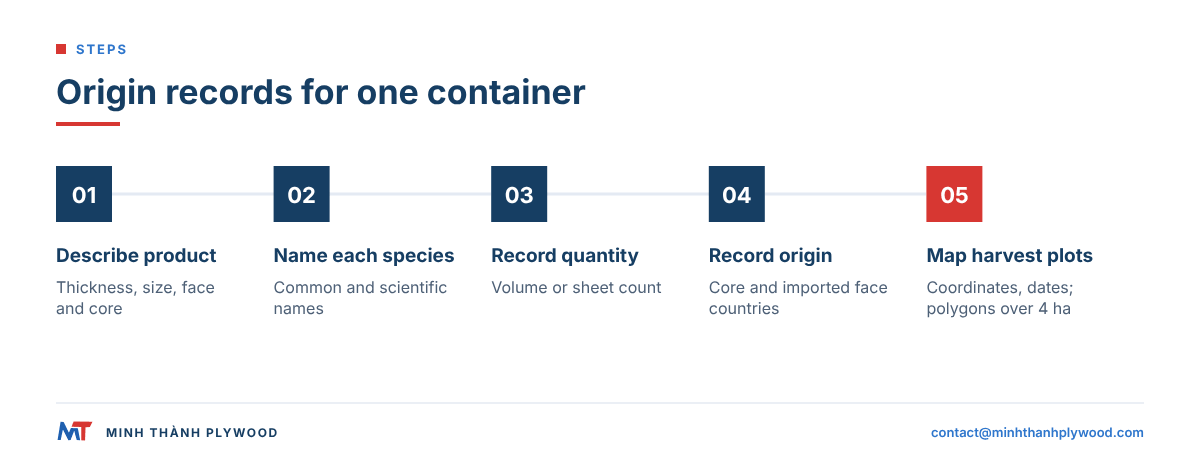
An EUDR origin record for a plywood container covers five items, taken from Article 9 of Regulation (EU) 2023/1115 and matched to the panels in that container.
- Product description: plywood, thickness, size, face and core.
- Species: common and full scientific names for core and faces, for example Styrax tonkinensis or Acacia mangium.
- Quantity: volume or number of sheets.
- Country of production: Vietnam for the core; the face origin where faces are imported.
- Plot geolocation and dates: coordinates for each plot with the harvest date or period; plots over 4 hectares as polygons.
Scientific names are where many supplier files fall short. “Hardwood” or “mixed tropical” does not identify a species; “Styrax tonkinensis” does.
Is Vietnam’s plantation timber legal to import into Europe and the UK?
Yes. Vietnamese plantation timber is legal to import when it carries legal-origin records: Vietnam’s Timber Legality Assurance System (VNTLAS) was set up under the EU–Vietnam Voluntary Partnership Agreement, in force since June 2019, and EU and UK importers still run their own due diligence.
For EU orders from 30 December 2026, the EUDR dossier carries that due diligence. UK importers follow the UK Timber Regulation, and the same species, origin and harvest records serve their checks. In both markets the importer, not the mill, submits the due-diligence statement; the mill’s job is to supply complete records.
What does Vietnam forestry mean for your plywood order?
For a plywood order, Vietnam forestry means three choices: the core species, the certification you need, and the origin records that travel with the container. Each is a line on the specification.
- Core: white Styrax for light furniture panels, Eucalyptus for stiffer parts, Acacia or Pine on order.
- Certification: FSC available* if your customers ask for it.
- Origin records: the EUDR compliance dossier for EU orders, with species and geolocation files.
Write it on the request like this:
Furniture plywood · 18 mm · white Styrax core · UF glue at E0 emission · poplar face B/B · 1220 × 2440 mm · EUDR compliance dossier with geolocation files · 1 × 40HC, CIF your port.
The minimum order is one 40HC, with mixed specifications by agreement, and production takes 15–45 days after the 30% deposit. Hai Phong to Northern Europe is typically 30–40 days at sea.
How does a container of plantation-core plywood leave the mill?
A container of plantation-core plywood leaves the mill with its records and its evidence: the panels, the documents and a photo and video record of the loading.
- Log intake: logs bought from local plantation plots and recorded by origin.
- Peeling and drying: core veneers peeled and dried to 8–12 % moisture content.
- Pressing: furniture-grade panels pressed twice, core calibrated before the faces.
- Packing: packs about one metre high, sheets per pack set by thickness and weight.
- Loading: every container photographed and filmed before loading; buyers receive the photos and video.
- Documents: commercial invoice, packing list, B/L, certificate of origin (EUR.1 for the EU) and the EUDR dossier.
The EU Digital Product Passport for plywood explains how these records may travel with the product in future. Send your specification to [email protected].
Buyer questions, answered
Is Vietnamese plywood made from plantation timber?
Yes. Vietnamese plywood cores and most local faces are peeled from planted acacia, eucalyptus and Styrax, with rubberwood in the south. Natural forest is not the raw material of the plywood trade.
Where is plywood timber grown in Vietnam?
In the northern midlands and mountains, such as Phu Tho and Tuyen Quang, in the north-central provinces such as Thanh Hoa and Nghe An, and along the central coast from Quang Tri to Binh Dinh.
Which provinces grow acacia in Vietnam?
Acacia is planted across the northern midlands and mountains, the north-central provinces and the central coast. Quang Tri, Hue, Quang Nam, Quang Ngai, Binh Dinh, Phu Tho, Tuyen Quang and Yen Bai are well-known acacia areas.
How large is Vietnam's forest area?
Vietnam reported 14,790,075 hectares of forest at the end of 2022, of which about 4.66 million hectares was planted forest, giving a forest cover of 42.02% (MARD decision, June 2023).
How old are plantation trees when they are harvested in Vietnam?
Many smallholders cut acacia after 5–6 years and sell it as woodchip; growers who wait longer produce larger logs for veneer and sawn timber.
What is eucalyptus called in Vietnamese?
Eucalyptus is bạch đàn in Vietnamese, and acacia is keo. Styrax, the light core wood of northern plywood, is bồ đề.
Is plywood a forest product?
Yes. Plywood is a wood-based panel made from peeled veneers, classed under HS 4412, and it falls within EU timber and deforestation rules as a wood product.
Is Vietnamese plywood FSC certified?
FSC-certified Vietnamese plywood is available*, and Vietnam's national VFCS scheme is endorsed by PEFC. Certification is a separate choice from the EUDR dossier, which every EU order needs.
Does Vietnamese plywood meet EUDR requirements?
Yes, with the right records. Vietnam is listed as low risk, and Minh Thanh supplies the EUDR compliance dossier, with origin records and geolocation files, with orders.
Do UK importers need the same origin records?
UK importers of plywood run due diligence under the UK Timber Regulation, and the species, origin and harvest records in a mill's dossier serve that check as well.
Why does Ha Hoa in Phu Tho suit plywood production?
Ha Hoa sits in the northern midlands, where plantation timber for cores is grown locally and the workforce has long plywood experience, so a mill there can make high-grade panels at a cost-effective price.