
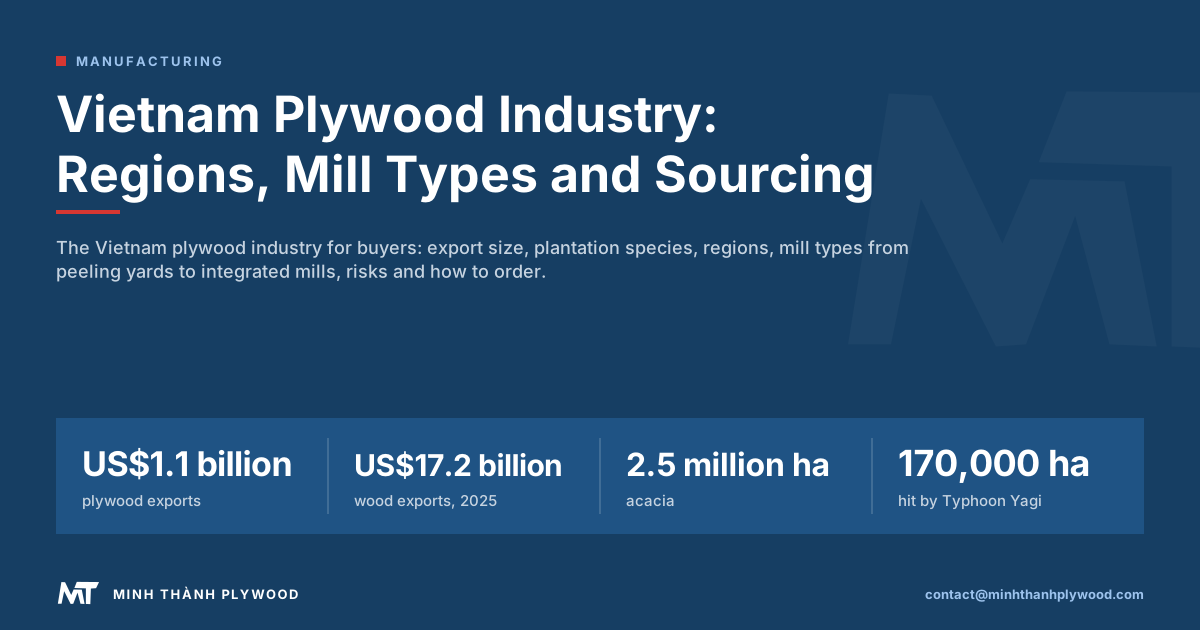
The Vietnam plywood industry is a plantation-based export trade worth about US$1.1 billion a year in plywood alone, inside wood exports of US$17.2 billion in 2025. It runs on Acacia, Eucalyptus and white Styrax grown by smallholders, peeled in village yards and pressed in mills clustered in the north. Minh Thanh Plywood, an integrated furniture-plywood mill in Ha Hoa, Phu Tho, maps the regions, the mill types and the checks that tell them apart.
What is the Vietnam plywood industry?
The Vietnam plywood industry is the chain of plantation growers, veneer peelers, core makers and pressing mills that turns fast-grown Acacia, Eucalyptus and white Styrax into plywood, most of it for export. It is a mid-sized, export-led industry built on smallholder plantations, not on natural forest.
Three facts explain how it works:
- The raw material is planted. Vietnam had about 14.87 million hectares of forest at the end of 2024, of which nearly 5 million hectares were planted forest, according to the Ministry of Agriculture and Environment figures reported by Vietnam Law Magazine. Acacia alone covers about 2.5 million hectares, around 60% of production plantations, and about 80% of it is managed by households (VietNamNet, October 2026).
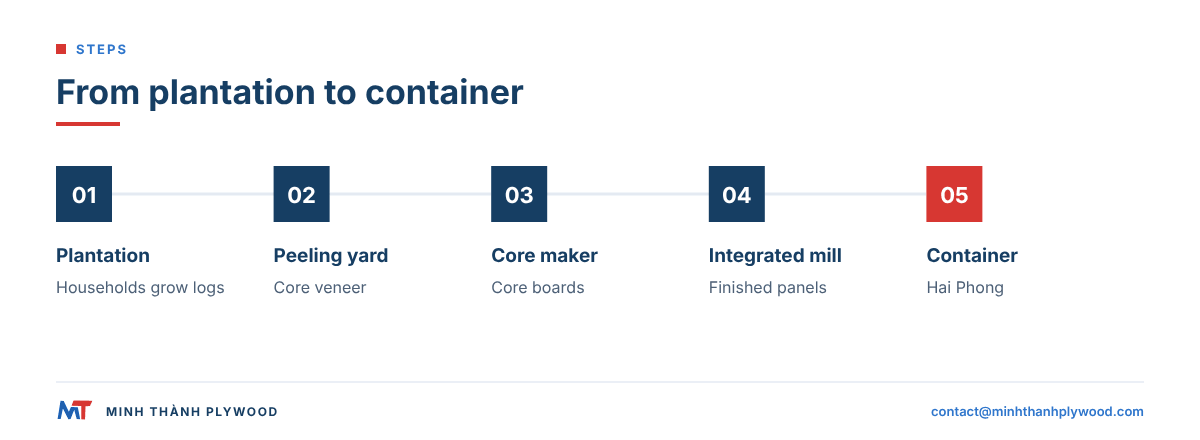
- The work is split. Households grow the trees, village yards peel the logs into veneer, and core makers and integrated mills press the panels. Few countries split the chain this finely.
- The mills specialise. A Vietnamese mill usually serves one segment: furniture plywood, commercial and packing plywood, or film-faced formwork panels. Products look similar across mills; quality, price and certificates differ.
For a buyer, the third point matters most. “Vietnamese plywood” covers everything from a packing panel to a top-grade furniture board, and the mill type decides which one arrives. The sections below map the regions, the business types and the mill segments, then the risks, the rules and the terms a buyer meets when ordering.
How big is Vietnam’s plywood export industry?
Vietnam exports about US$1.1 billion of plywood a year: US$1.1 billion in 2022, up from US$774 million in 2018, according to International Trade Centre data cited by the Vietnam Timber and Forest Products Association (VIFOREST). That places Vietnam among the top five plywood exporters in the world.
Plywood is a small slice of a much larger wood trade. Total exports of timber and wood products reached US$17.2 billion in 2025, nearly 6 per cent more than in 2024, on Vietnam Customs data reported by Viet Nam News in January 2026. Furniture makes up most of that total.
| Measure | Figure | Year | Source |
|---|---|---|---|
| Plywood exports | About US$1.1 billion | 2022 | VIFOREST, ITC data (Viet Nam News, February 2023) |
| Plywood exports | US$774 million | 2018 | Same source |
| US share of plywood exports | About 40% | 2022 | Same source |
| South Korea share of plywood exports | 24% | 2022 | Same source |
| All timber and wood product exports | US$17.2 billion | 2025 | Vietnam Customs (Viet Nam News, January 2026) |
| Wood exports to the US | US$9.46 billion, about 55% | 2025 | Same source |
| Forest area | About 14.87 million hectares, nearly 5 million planted | 2024 | Ministry of Agriculture and Environment |
The markets for plywood differ from those for furniture. The US and South Korea took about two-thirds of plywood exports by value in 2022, with Japan and Malaysia among the other main buyers. Europe buys a smaller share by value, and it is the main market for furniture-grade panels at mills built for that segment, such as Minh Thanh.
The figures above are national totals from published sources. Vietnam’s customs data at company level is not public, which is one reason no audited ranking of individual mills exists.
What wood goes into Vietnamese plywood?
Vietnamese plywood cores are made from four plantation species, Acacia, Eucalyptus, white Styrax and rubberwood, plus mixed cores in commercial grades. There is no poplar core and no birch core in Vietnamese plywood; those names describe the face.
| Core species | Planning density | Where it grows | Main use in plywood |
|---|---|---|---|
| White Styrax (bồ đề) | About 500 kg/m³ | Northern Vietnam only | Light, pale furniture cores |
| Acacia | About 580 kg/m³ | North, centre and south | Commercial, packing and film-faced cores |
| Eucalyptus | 650–750 kg/m³ | North and centre | Stiff furniture cores, film-faced cores |
| Rubberwood | Dense, a niche core | South-east | Higher-priced niche cores |
| Mixed core | Varies by mill | Everywhere | Commercial and packing grades |
The densities are the planning values Minh Thanh uses for container loads. Sheets should be weighed before a load is calculated, because density varies with mill and order.
Faces are a separate choice. Vietnamese mills press more than ten face veneers: engineered veneer (EV), poplar, birch, okoume, pine, bintangor, eucalyptus, gurjan, sapele and others. Birch and okoume faces are imported veneers; gurjan, okoume and bintangor are only ever faces, never cores. Face veneers are 0.2–0.5 mm thick, and European buyers usually ask for about 0.3 mm.
Core veneers are thicker, typically 1.4–2.0 mm. The cheaper the panel, the thicker and fewer its core veneers usually are, which is why ply counts at the same thickness differ between mills; furniture panels at Minh Thanh run 11–13 plies at 18 mm.
Where is plywood made in Vietnam? The region map
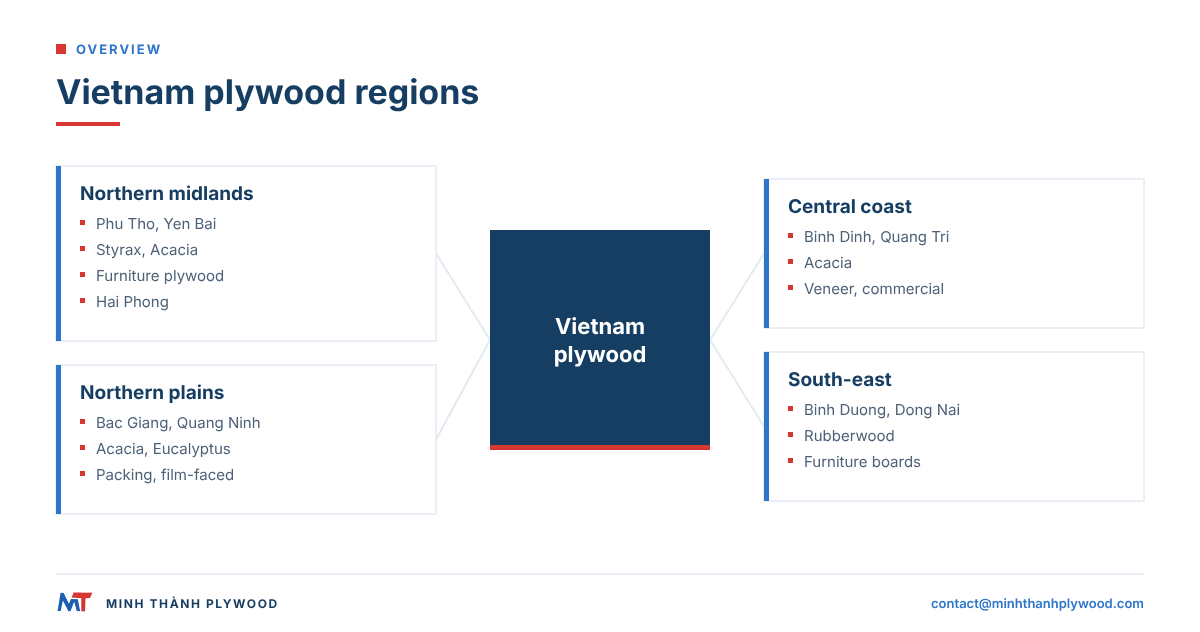
Vietnamese plywood is made in three regions. The northern midlands around Phu Tho, Yen Bai and Tuyen Quang are the main cluster of plywood mills. The central coast around Binh Dinh and Quang Tri is a wood-processing belt on Acacia. The south around Binh Duong and Dong Nai is a furniture hub that leans on rubberwood.
| Region | Main provinces | Core species | Typical products | Main port |
|---|---|---|---|---|
| Northern midlands | Phu Tho, Yen Bai, Tuyen Quang | Styrax, Acacia, Eucalyptus | Furniture plywood, commercial and packing plywood, core veneer | Hai Phong |
| Northern plains and north-east | Bac Giang, Bac Ninh, Hai Duong, Quang Ninh | Acacia, Eucalyptus | Commercial, packing and film-faced plywood | Hai Phong |
| North-central | Thanh Hoa, Nghe An | Acacia | Veneer and primary processing | Nghi Son, Hai Phong |
| Central coast | Binh Dinh, Quang Tri | Acacia | Wood processing, veneer, commercial panels | Quy Nhon, Da Nang |
| South-east | Binh Duong, Dong Nai | Rubberwood, Acacia | Furniture-grade boards, rubberwood panels | Cat Lai, Cai Mep |
Region tells you the likely core species and the export port. It does not tell you the quality, which depends on the mill and the specification.
The northern cluster: Phu Tho, Yen Bai and Tuyen Quang
The northern midlands are the heart of the Vietnam plywood industry: plantation hills of Acacia, Eucalyptus and white Styrax, village peeling yards in every district, and the densest concentration of pressing mills. Logs travel short distances from hill to lathe, and panels travel by road to Hai Phong.
Three things make the north the centre of furniture plywood:
- White Styrax grows only in the north. It is the light, pale core European furniture buyers prefer, so furniture mills sit near it.
- Short supply lines. Logs, veneer and core boards move within a few districts, which keeps raw-material costs down.
- A skilled workforce. Generations of peeling, lay-up and stitching skills are concentrated in the same districts.
Ha Hoa in Phu Tho, where Minh Thanh’s mill stands, sits in the middle of this belt. Locally grown plantation timber supplies the cores and the workforce is skilled, which lets mills here reach high-grade builds at a better price than comparable mills elsewhere. Our guide to plywood factories in Phu Tho covers the cluster around Ha Hoa in detail.
Yen Bai and Tuyen Quang supply much of the region’s veneer and core boards. Many of their yards sell peeled veneer or pressed core boards to mills in Phu Tho and further downstream, which is why the same district can appear on very different products.
Central and southern Vietnam: Binh Dinh, Quang Tri and the south-east
Central and southern Vietnam make plywood too, but the mix is different: the centre is an Acacia wood-processing belt, the south a furniture hub built around rubberwood and imported timber. Both make fewer furniture-grade plywood panels than the north.
The central coast. Binh Dinh, around the port of Quy Nhon, is one of Vietnam’s oldest wood-processing centres, with outdoor furniture, wood chips and veneer. Quang Tri and its neighbours have large Acacia plantations feeding veneer, chips and commercial panels. Styrax does not grow here, so light furniture cores come from the north.
The south-east. Binh Duong and Dong Nai, next to Ho Chi Minh City, are the centre of the furniture-factory belt. Panels there feed cabinet and furniture lines, and rubberwood from ageing rubber plantations supplies a dense, more expensive niche core. Exports load at Cat Lai or the deep-water Cai Mep terminals.
For a plywood buyer this means a simple rule. A southern supplier quoting Styrax-core furniture plywood is buying it from the north, which is fine if it says so and adds cost if it does not.
What types of plywood does Vietnam export?
Vietnam exports six main plywood families: furniture and interior plywood, commercial plywood, packing plywood, film-faced formwork plywood, thin plywood and LVL. Each family has its own core, glue, tolerance and buyer.
| Product family | Typical core | Glue and emission | Tolerance | Typical buyers |
|---|---|---|---|---|
| Furniture and interior plywood | A-grade Styrax or Eucalyptus, stitched | UF glue at E0 emission; E1 or CARB P2 on order | ±0.2–0.3 mm sanded | European, US, Japanese and Korean furniture makers |
| Commercial plywood | AB-grade Acacia, loose or jointed | MR or melamine-fortified, E1/E2 | ±0.5 mm | Distributors, joinery, construction |
| Packing plywood | AB-grade Acacia, loose-laid | MR, often E2 | ±0.5–1.0 mm | Crate, pallet and packaging makers |
| Film-faced plywood | Acacia or Eucalyptus, A or AB | Phenolic or melamine-fortified | ±0.5 mm | Formwork contractors |
| Thin plywood (3–6 mm) | Styrax or mixed, 5 plies (3–5 mm) | UF or MR | Sanded | Furniture backs, drawers, doors |
| LVL | Acacia or Eucalyptus veneers, grain parallel | Phenolic or melamine-fortified | By size | Packaging, frames, shelving |
Furniture plywood is the segment where mills differ most, because it depends on core grade, stitching, double pressing, calibrated sanding and emission control. Packing plywood is the opposite: cost and thickness are what count, and a ±0.5–1.0 mm tolerance is normal for the job.
Faces follow the buyer. Furniture panels carry EV, poplar, birch, okoume, pine and other faces, sanded and polished; commercial panels often carry bintangor or okoume; packing panels carry low-grade faces. Exterior and CDX-type panels use C/D utility faces with melamine-fortified or phenolic glue.
Peeling yards, core makers, integrated mills and traders
The Vietnam plywood industry runs on four types of business. Peeling yards turn logs into veneer, core makers press core boards, integrated mills make finished panels from veneer to container, and traders buy and resell. Knowing which one you are talking to is the first step in sourcing.
| Business type | What it does | What it sells | What it cannot do |
|---|---|---|---|
| Peeling yard | Peels plantation logs on small rotary lathes, sun- or kiln-dries the veneer | Core veneer by the m³ | Press panels, export documents |
| Core maker | Lays up and presses core veneer into unfaced core boards | Core board (matt plywood) for other mills | Faces, sanding to furniture tolerance, export certificates |
| Integrated mill | Buys or makes veneer, grades it, stitches cores, presses twice, sands, grades and packs | Finished plywood by the container | Grow all its own timber; it buys logs and veneer to grade |
| Trader | Buys finished plywood from mills and resells | Any product, from many mills | Control the build, show its own production floor |
The ladder is not a ranking of honesty. Peeling yards and core makers are the base of the industry, and every integrated mill buys from them. What matters is that the company you buy from can control the steps that decide your panel: veneer grading, core lay-up, pressing and sanding.
Traders have a place too, for small mixed orders or for buyers who want one contact across many products. The risk is that the build can change between orders without the buyer knowing, because the trader does not control the press.
How do you tell the mill types apart?
Ask six questions and ask to see the answers on a factory visit or a live video call; a mill answers them from its own floor, a trader answers them from a catalogue. The questions take ten minutes and save a container.
- Where are your presses, and how many lines run? A mill names its own address and shows the hot presses and cold presses running.
- Which core species and grade go into this product? A mill names one species and grade, for example A-grade white Styrax, stitched. “Mixed hardwood” is not a specification.
- Do you press once or twice? A furniture mill presses the core board, calibrates it and presses the faces on. A commercial mill presses once.
- What thickness tolerance do you hold, and how do you measure it? A furniture mill quotes ±0.2–0.3 mm on sanded panels and shows the caliper check.
- Whose name is on the certificates and test reports? The mill’s own name, with a certificate number you can check, for example a CARB P2 / TSCA Title VI mill number.
- Will you photograph and film my panels before loading? A mill does this routinely, from its own warehouse.
Our guide to shortlisting plywood manufacturers in Vietnam turns these questions into a scoring sheet.
The four segments of Vietnamese plywood mills
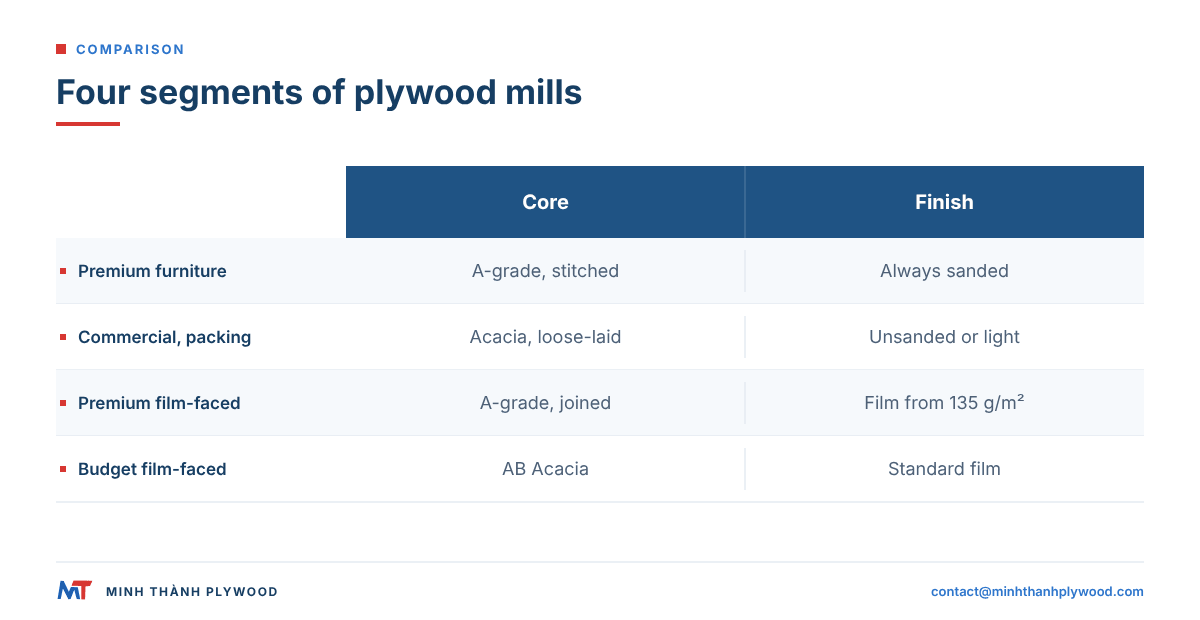
Finished-plywood mills in Vietnam fall into four segments: premium furniture, commercial and packing, premium film-faced, and budget film-faced. Each segment is set up for its own buyers, and a mill rarely does two segments equally well.
| Segment | Core and construction | Glue and emission | Finish | Main markets |
|---|---|---|---|---|
| Premium furniture | A-grade Styrax or Eucalyptus; outer 2–4 layers stitched, all layers on request | UF glue at E0 or E1, CARB P2 | Always sanded, full certificates | EU, US, Japan, Korea, Australia |
| Commercial and packing | Acacia core, loose-laid | E1 or E2 | Unsanded or lightly sanded, few certificates | Asia, Africa, Middle East |
| Premium film-faced | A-grade core, joined | Phenolic or melamine-fortified | Film from 135 g/m² | Formwork contractors in many markets |
| Budget film-faced | AB-grade Acacia, not stitched | Melamine-fortified | Standard film | Price-led construction markets |
The commonest import mistake is comparing two quotes for the same product name from different segments. The two offers are not the same construction: the difference comes from core grade, joining method, face preparation, adhesive system and tolerance.
The right segment is the one that fits the use. A crate maker who buys furniture plywood pays for sanding and stitching nobody sees; a cabinet maker who buys packing plywood gets panels that will not hold a tolerance. Start from the application, not from the product name.
Which is the largest plywood factory in Vietnam?
There is no public, audited ranking of plywood factories in Vietnam by size, so any list of the largest plywood factory in Vietnam is an estimate. Company-level export data is not published, and capacity claims on websites are not verified by any official body.
What you can verify is a mill’s scale for your order:
- Capacity in m³ per year, stated in writing. Minh Thanh’s capacity is 50,000+ m³ per year.
- Press lines you can see running on a visit or video call.
- Containers per month in the segment you buy, not across all products.
- Certificates in the mill’s own name, which cover the panels it makes.
Size is also not the same as fit. A large commercial mill can be the wrong choice for a furniture order, and a mid-sized furniture mill can load your monthly containers on time. Ask how many containers of your exact build the mill ships each month, and how long it has made that build.
Be careful with lists of the “top 10” or “biggest” Vietnamese plywood companies. They are usually compiled from websites and trade-show listings, mix factories with traders, and rank across segments that do not compete with each other: a film-faced specialist, a packing-plywood mill and a furniture mill can each be large in their own segment and irrelevant to your order. A shortlist built on segment, verified capacity, certificates in the mill’s own name and an approved sample is worth more than any ranking.
Raw material: plantations, log size and competition for timber
The industry’s main raw-material risk is competition for plantation logs: most harvested Acacia goes to wood chips and pellets, not to veneer. About 80% of harvested Acacia timber is still used for woodchips and wood pellets, the chairman of VIFOREST said in October 2026 (VietNamNet).
Three supply facts follow from that:
- Log size is small. Household plantations are harvested young, so logs are thin. Small logs peel into narrow sheets that must be jointed, which is why core stitching matters in Vietnamese plywood.
- Prices move with chip demand. When chip and pellet buyers pay more, veneer yards pay more for logs, and core veneer prices follow.
- Quality veneer is scarce. Long, wide, defect-free core sheets are a small share of each log, and premium thin veneer for 4 mm panels is the scarcest of all.
Government policy is pushing towards longer rotations and larger logs, which would give more veneer per hectare. For buyers, the practical answer today is a mill that grades its veneer strictly and accepts a higher reject rate on furniture cores. Our wood veneer guide explains how veneer is cut and graded.
Typhoons and weather: the climate risk to supply
Weather is the second supply risk: typhoons flatten plantations and the rainy season slows veneer drying. Typhoon Yagi in September 2024 was the sharpest recent example.
What Yagi did to northern plantations:
- Scale. About 170,000 hectares of forest across 13 provinces were affected as of 23 September 2024, the Forestry Department estimated, with Quang Ninh and Bac Giang hit hardest (Vietnam Agriculture).
- Planted forest took most of it. In Quang Ninh, over 119,000 hectares of forest were affected by the end of September, including more than 112,400 hectares of planted forest (Viet Nam News, October 2024).
- Supply effect. Fallen trees were salvaged into chips and veneer quickly; after that, logs from the hardest-hit districts became scarcer for the seasons it takes to replant.
The rainy season adds a quieter risk. Village yards that sun-dry veneer cannot dry it in long wet spells, so veneer comes in wetter and slower. Mills with their own veneer dryers keep moisture under control: Minh Thanh dries veneers and finished panels to 8–12 % moisture content at dispatch.
What a buyer can do about weather risk:
- Order ahead of the wet season. Place repeat orders before the summer rains and the typhoon months, when veneer is slowest to dry and logs are hardest to move.
- Ask about drying capacity. A mill with its own veneer dryers is not waiting for sunshine; ask to see them on a video call.
- Check moisture on arrival. A meter reading on the sheet face against 8–12 % shows whether the panels left the mill dry.
- Keep a second specification approved. A sample approved on Eucalyptus as well as Styrax core lets the mill switch cores if one species is short, without a new approval round.
For buyers, the defence is the same in both cases: order ahead of the peak season, and buy from a mill that controls drying and holds stock of graded veneer.
Compliance: EUDR, formaldehyde rules and certificates
Vietnamese plywood can meet every major market’s rules, but compliance is mill by mill, not national. The three rules buyers ask about are the EU Deforestation Regulation, formaldehyde limits for the US and the EU, and legality certificates.
EUDR. Plywood (ex 4412) falls under the EU Deforestation Regulation. It applies from 30 December 2026 to large and medium operators, including plywood importers, and from 30 June 2027 to other micro and small operators (European Commission, July 2026). Vietnam is classed as a low-risk country in Implementing Regulation (EU) 2025/1093, which allows simplified due diligence when every input comes from low-risk countries. The importer still files the due diligence statement. Minh Thanh supplies the EUDR compliance dossier, origin records and geolocation files, with orders.
Formaldehyde. The US limit for hardwood plywood with a veneer core is 0.05 ppm under 40 CFR 770.10 (TSCA Title VI). CARB Phase 2 sets the same limit.
In the EU, REACH entry 77, Regulation (EU) 2023/1464 has limited emissions from furniture and wood-based articles to 0.062 mg/m³ since 6 August 2026, tested in a chamber.
Minh Thanh holds CARB P2 / TSCA Title VI certification as ICTT mill no. 23024; six ASTM D6007 chamber tests between April 2025 and June 2026 averaged 0.014–0.032 ppm, three by Shanghai Hongjun and three by ICTT Vietnam. European buyers accept this evidence, and SGS testing to the buyer’s method, such as EN 717-1, is arranged on request.
Legality and quality certificates. FSC chain of custody, ISO 9001 and the Vietnamese TCVN standard for veneer-faced plywood are the common ones. Minh Thanh holds ISO 9001:2015 (KAC25/0185) and TCVN 11902:2017 (VietCert 141.1-VNC-HC); FSC and CE are available*.
Market marks. Each destination adds its own paper to the same panel:
- European Union and UK: CE marking with a declaration of performance under EN 13986, and the EN 636 bond classes (EN 636-1 dry, -2 humid, -3 exterior) that the project specification names.
- India: Bureau of Indian Standards certification against IS 303 for general plywood or IS 710 for marine plywood.
- Japan: JAS grading for plywood, with the formaldehyde class the buyer orders.
- United States: TSCA Title VI / CARB Phase 2 emissions label, covered below.
*Supplied directly or through qualified partner mills.
Selling Vietnamese plywood into the US: HTS 4412, Lacey Act and duties
The US is the largest buyer of Vietnamese plywood, about 40% of plywood exports in 2022, and a US entry has four layers that a mill’s file should answer before the first container sails.
- Tariff line. Plywood enters under HTS heading 4412. The importer or its broker picks the 10-digit line from the face species, core and construction.
- Lacey Act declaration. Importers declare the genus and species of each plant material and the country of harvest. Since 1 January 2026 APHIS no longer accepts the paper PPQ 505 form: declarations are filed through CBP’s ACE system or APHIS’s LAWGS (APHIS, checked 21 October 2026). The mill supplies the species list for every layer, face included.
- Formaldehyde label. Hardwood plywood with a veneer core meets the 0.05 ppm limit under TSCA Title VI, shown on the label with the third-party certifier’s mark.
- Trade remedies. Commerce’s affirmative final antidumping and countervailing duty determinations on hardwood and decorative plywood from China, Indonesia and Vietnam were published in July 2026, and the US International Trade Commission voted on August 19, 2026 that the US industry was injured, so orders follow; softwood structural plywood was terminated from the case as negligible (Wiley, August 2026). Earlier, Commerce found in a 2023 circumvention ruling that hardwood plywood finished in Vietnam from Chinese inputs could fall under the China orders; the Court of International Trade remanded that finding in January 2026. Rates are company-specific and change at each review, so an importer reads the current scope language and the producer’s rate before ordering.
How a mill proves a Vietnamese panel is Vietnamese: it peels its own logs, builds the core from local Styrax or Eucalyptus veneer rather than imported cores, keeps origin records and geolocation files for the timber, and issues a certificate of origin with each shipment. Ask any supplier for those four documents in writing. Minh Thanh holds CARB P2 / TSCA Title VI certification as ICTT mill no. 23024 and supplies the origin records and certificate of origin with orders.
Trade terms, documents and transit times
Vietnamese plywood trades on a common set of terms: one 40HC minimum, production after a deposit, balance against documents, FOB Hai Phong or CFR/CIF. The table shows the standard terms and what each means for the buyer.
| Term | Standard practice | What it means for you |
|---|---|---|
| Minimum order | One 40HC, mixed specifications by agreement | Usually 1–2 specifications per container, more by agreement |
| Production time | 15–45 days after the deposit | Days in production, not the sailing date |
| Payment | 30% deposit, 70% against the scanned B/L, or irrevocable L/C at sight | Balance paid once the goods are on board |
| Delivery terms | FOB Hai Phong, CFR or CIF | Freight and insurance by you or by the mill |
| Samples | Free samples | Approve the face and build before production |
Shipping documents for each container are the commercial invoice, packing list, bill of lading, certificate of origin (EUR.1 for the EU), phytosanitary and fumigation certificates, and insurance under CIF. Certificate files, such as CARB P2 / TSCA, test reports, the EUDR dossier and the PPWR packaging test, are supplied with the order.
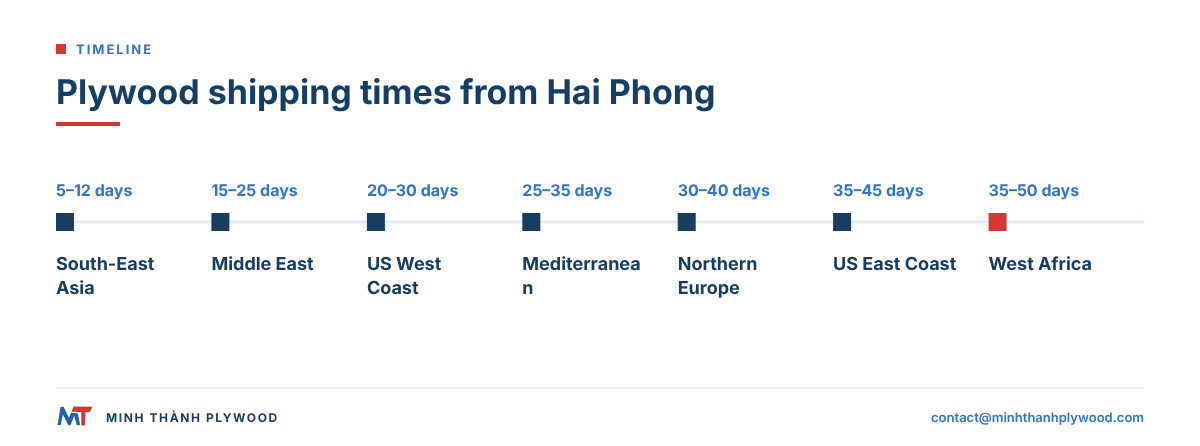
Typical days at sea from Hai Phong, by carrier and route:
| Destination | Days at sea |
|---|---|
| South-East Asia | 5–12 |
| Middle East | 15–25 |
| US West Coast | 20–30 |
| Mediterranean | 25–35 |
| Northern Europe | 30–40 |
| US East Coast | 35–45 |
| West Africa | 35–50 |
Japan and Korea are about 2–3 weeks away. Add production time and booking to get the real lead time.
How to choose a supplier in the Vietnam plywood industry
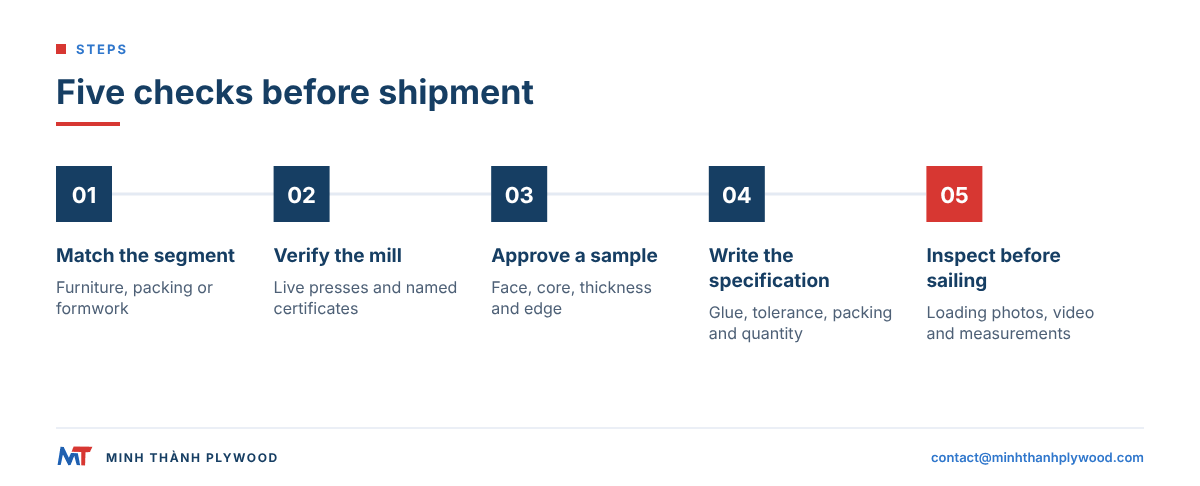
Choose a Vietnamese plywood supplier in five steps: match the segment, verify the mill, approve a sample, agree the specification in writing, and check the first container before it sails. Each step removes one common failure.
- Match the segment to the use. Furniture panels from a furniture mill, packing plywood from a commercial or packing mill, formwork from a film-faced mill.
- Verify the mill. Factory visit or live video call; certificates in the mill’s own name; the presses running.
- Approve a sample. Faces, core, thickness and edge on a real panel; the approved sample fixes the appearance grade for the order.
- Write the specification. Application, core, glue and emission, face grades, size and tolerance, packing and quantity, destination.
- Check before shipment. Photos and video of packs and loading, caliper readings, faces against the sample, or an inspection company of your choice.
Watch for three warning signs: a core named only as “hardwood”, a request for full payment before production from a new supplier, and certificates in a company name that does not match the seller. The full method is in our guide to choosing a plywood supplier in Vietnam, and importing plywood from Vietnam covers duties, documents and logistics.
What does a Vietnamese mill need from you to quote?
A Vietnamese plywood mill needs six answers to quote an exact price: application, core, glue and emission, face, panel size, and packing and quantity. Plywood is not priced off a list; the build sets the price.
| Question | Example answer for a furniture order |
|---|---|
| Application | Kitchen carcasses, indoors |
| Core | White Styrax, stitched |
| Glue and emission | UF glue at E0 emission, CARB P2 / TSCA Title VI |
| Face | Poplar A/B or birch D+/D, sanded, UV-ready |
| Panel | 18 mm, 1220 × 2440 mm, ±0.2–0.3 mm |
| Packing and quantity | Export packs, one 40HC, destination port |
The application alone answers most of the other questions. A crate needs a different panel from a cabinet door. A mill that knows the use can propose a cheaper build that still does the job. Switching a furniture order from Acacia to Styrax cores, for example, gives a paler face, a lighter sheet and more cubic metres per container.
Indicative starting prices in October 2026 were from US$250/m³ for commercial plywood and from US$350/m³ for furniture and interior plywood. The final price depends on face, core, glue, thickness, size, quantity and delivery term.
How has the Vietnam plywood industry changed, and where is it going?
The Vietnam plywood industry has grown from a supplier of core veneer and packing panels into an exporter of finished furniture and construction plywood, and it is now moving towards traceable, higher-grade panels. Plywood exports rose from US$774 million in 2018 to about US$1.1 billion in 2022, on the VIFOREST figures above.
Four shifts explain the change:
- From veneer to finished panels. Village yards still peel and sell core veneer, but more of it is now pressed into finished panels in Vietnam instead of being shipped out as raw material. Minh Thanh does not sell core veneer; it makes finished plywood.
- From commodity to furniture grade. Stitched cores, double pressing, calibrated sanding and E0 emission used to be rare. Furniture mills in the northern cluster now make them routinely for European, US, Japanese and Korean buyers.
- From paper trail to geolocation. EU buyers now ask for plot-level origin data under EUDR, US buyers for TSCA Title VI labels and Lacey Act species and origin data. Mills that keep origin records at log intake can answer; mills that buy mixed veneer on the open market find it harder.
- From short rotations to larger logs. Policy and buyers are pushing for longer rotations, which would give larger logs, wider veneer and less jointing in the core.
What has not changed is the structure: smallholder plantations, a split chain and specialised mills. For a buyer, the questions in this guide stay the same as the industry grows. Which segment is the mill in, which steps does it control, and can it show its build and its documents in its own name?
Where does Minh Thanh fit in the Vietnam plywood industry?
Minh Thanh Plywood is an integrated furniture-plywood mill in Ha Hoa, Phu Tho, in the northern cluster, built for top-grade furniture and interior plywood with Europe as its main market. It grades veneer, stitches cores, presses twice and sands in its own mill, and ships from Hai Phong.
What that means in practice:
- Segment: premium furniture and interior plywood; we also make commercial, packing and film-faced plywood.
- Cores: white Styrax or Eucalyptus as standard; Acacia and Pine on order.
- Faces: more than ten, mainly EV, poplar, birch, okoume and pine; bintangor, eucalyptus, gurjan and sapele on request.
- Build: core layers stitched horizontally and vertically; furniture panels pressed twice; sanded to ±0.2–0.3 mm, down to ±0.2 mm; both faces UV-ready.
- Sizes: 3–40 mm, 1220 × 2440 mm and 1250 × 2500 mm, plus custom sizes such as 1220 × 2500 mm and 1220 × 2280 mm, and cut-to-size panels.
- Capacity: 50,000+ m³ per year, with regular shipments to European buyers and repeat orders into Italy.
- Proof: the certificates and chamber tests listed in the compliance section above, an SGS packaging test under the EU PPWR, and the EUDR dossier; see our certificates.
Every shipment is photographed and filmed before loading, and buyers receive the photos and video. See furniture plywood from Vietnam for builds, and send your six specification lines for a written quote with free samples.
Buyer questions, answered
How big is Vietnam's plywood industry?
Vietnam exported about US$1.1 billion of plywood in 2022, according to the Vietnam Timber and Forest Products Association, which places it among the top five plywood exporters. Plywood sits inside total wood exports of US$17.2 billion in 2025.
What wood is Vietnamese plywood made from?
Cores are plantation Acacia, Eucalyptus and white Styrax, with rubberwood in the south and mixed cores in commercial grades. Faces are chosen by the buyer: poplar, birch, okoume, pine, engineered veneer and others, many of them imported.
Where are most plywood factories in Vietnam?
Most are in the north, in the plantation provinces of Phu Tho, Yen Bai, Tuyen Quang and Bac Giang and around Hanoi, shipping through Hai Phong. The centre has acacia-based wood processing around Binh Dinh and Quang Tri; the south leans on furniture and rubberwood.
Which is the largest plywood factory in Vietnam?
There is no public, audited ranking of Vietnamese plywood factories by capacity. Judge scale by capacity in m³ per year, press lines and containers per month, and check them on a factory visit or video call; Minh Thanh's capacity is 50,000+ m³ per year.
What types of plywood does Vietnam export?
Furniture and interior plywood, commercial plywood, packing plywood, film-faced formwork plywood, thin plywood and LVL. Each is usually made by a mill that specialises in that segment.
Is Vietnamese plywood made in China?
No. Vietnamese mills peel, dry, lay up and press their panels from local plantation cores. Some face veneers, such as birch, are imported; the panel itself is made in Vietnam.
Who supplies packing plywood from Vietnam?
Commercial and packing mills, mostly in the north, make acacia-core packing plywood with a ±0.5–1.0 mm tolerance. Minh Thanh also makes packing plywood alongside its furniture panels, from one 40HC.
Does the US charge anti-dumping duties on Vietnamese plywood?
Commerce issued affirmative final antidumping and countervailing duty determinations on hardwood and decorative plywood from China, Indonesia and Vietnam in July 2026, and the ITC voted on 19 August 2026 that the US industry was injured, so orders follow. Rates are company-specific; softwood structural plywood was dropped from the case.
Is Vietnamese plywood EUDR compliant?
Vietnam is classed as a low-risk country under Implementing Regulation (EU) 2025/1093, but EUDR still applies to each shipment. A mill that keeps origin records can supply the dossier; Minh Thanh supplies the EUDR compliance dossier with origin records and geolocation files.
How did Typhoon Yagi affect Vietnam's plywood industry?
Typhoon Yagi in September 2024 damaged plantation forests across northern Vietnam; Quang Ninh alone reported over 119,000 hectares of forest affected. Fallen timber was salvaged quickly, then log supply tightened in the hardest-hit areas.
What is the difference between a plywood factory and a trading company in Vietnam?
A factory owns its presses and makes the panels; a trading company buys from factories and resells. A factory shows its own production floor, press lines and test reports in its own name on a visit or video call.
What are the payment terms for Vietnamese plywood?
The usual terms are a 30% deposit with the 70% balance against the scanned bill of lading, or an irrevocable letter of credit at sight, FOB Hai Phong, CFR or CIF.
Can I mix plywood types in one container from Vietnam?
Yes, by agreement. A 40HC usually carries one or two specifications; three to six can be mixed when the mill makes all of them.
How long does plywood take to arrive from Vietnam to Europe?
Production takes 15–45 days after the deposit, then about 25–35 days at sea to the Mediterranean or 30–40 days to Northern Europe from Hai Phong. Add a week or two for booking and inland transport.
Does Vietnam export plywood to Saudi Arabia and the Middle East?
Yes. The Middle East is a regular market for Vietnamese plywood, with 15–25 days at sea from Hai Phong. Orders follow the same terms: one 40HC minimum, a 30% deposit and FOB, CFR or CIF delivery.