
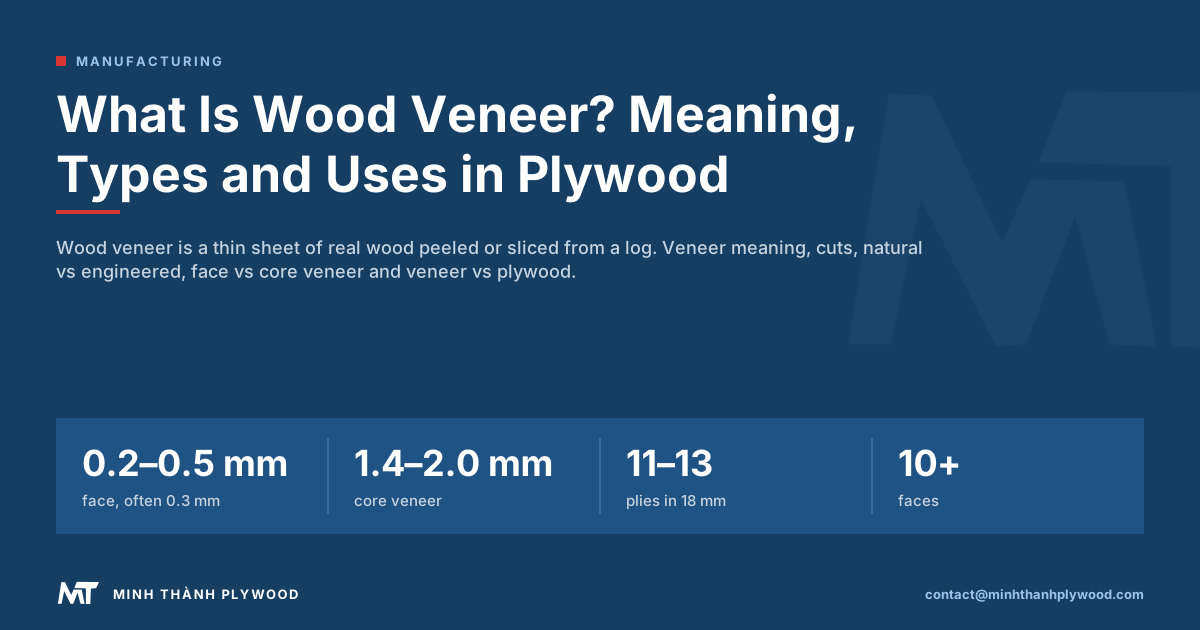
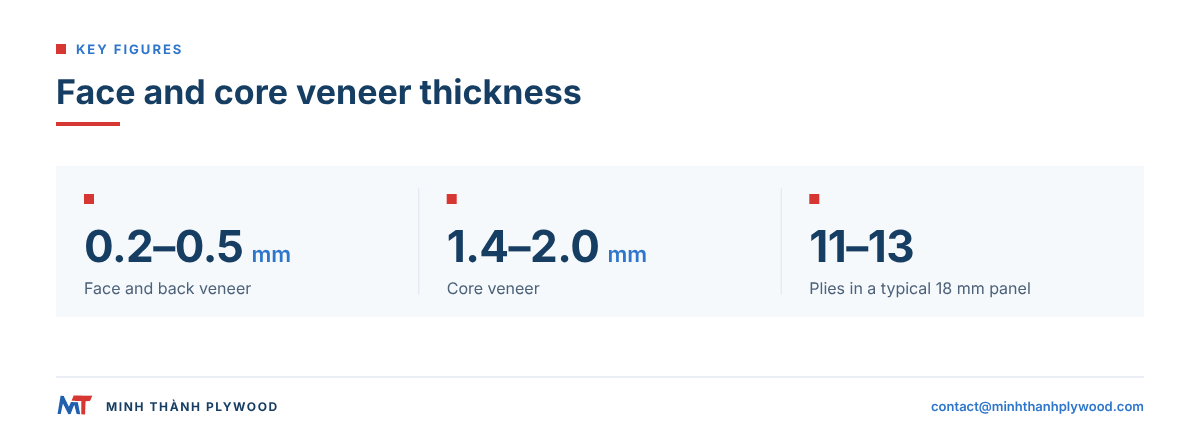
Wood veneer is a thin sheet of real wood, peeled or sliced from a log, that is glued onto a panel or onto other veneers. Faces on furniture plywood are usually 0.2–0.5 mm thick; core veneers inside the panel run about 1.4–2.0 mm. Minh Thanh Plywood cross-laminates these sheets into plywood with EV, poplar, birch, okoume and pine faces.
Veneer meaning: what does veneer mean in woodworking?
In woodworking, veneer means a thin sheet of real wood glued over a base, or glued to other veneers to build a panel. The sheet is cut from a log by peeling it like a roll of paper or slicing it like bread, and is usually well under 3 mm thick.
The word reached English from the German furnieren, itself borrowed from the French fournir, “to furnish”: the veneer furnishes a plain base with a fine wood surface.
Veneering is old. Ancient Egyptians laid rare, costly woods over cheaper timber on furniture and sarcophagi, and the Romans veneered in large quantity. Early veneers were sawn by hand at about 3 mm thick; peeling and slicing machines later cut far thinner sheets, so one fine log now covers many times the area it once did (Wikipedia, wood veneer, accessed 21 October 2026).
Two other meanings share the word:
- Dental veneer: a thin porcelain or composite shell bonded to the front of a tooth. Nothing to do with wood.
- “A veneer of”: a thin outward layer that hides what is underneath. This figurative sense comes from the woodworking one.
In plywood and furniture, “veneer” always means wood. “Veneered” means a panel carries a veneer face, and “veneering” is the work of gluing it on.
Is wood veneer real wood?
Yes, wood veneer is real wood: every sheet is cut from a log and keeps the grain, colour and pores of the tree. What changes from one veneer type to another is how the wood is cut and treated, not whether it is wood.
| Surface | Real wood? | What it is |
|---|---|---|
| Natural veneer | Yes | A slice of one log, with that tree’s own figure |
| Dyed veneer | Yes | Natural veneer coloured through with dye |
| Engineered (reconstituted) veneer | Yes | Fast-growing wood peeled, dyed, glued into a block and re-sliced into a designed grain |
| Melamine paper | No | Printed decor paper soaked in melamine resin |
| HPL (high-pressure laminate) | No | Layers of resin-soaked paper pressed into a hard sheet |
| PVC or foil | No | Plastic film printed with a wood pattern |
A veneered panel therefore has a real wood surface that can be sanded lightly, stained, oiled or lacquered. A melamine or laminate panel has a printed surface that cannot.
How is wood veneer made?
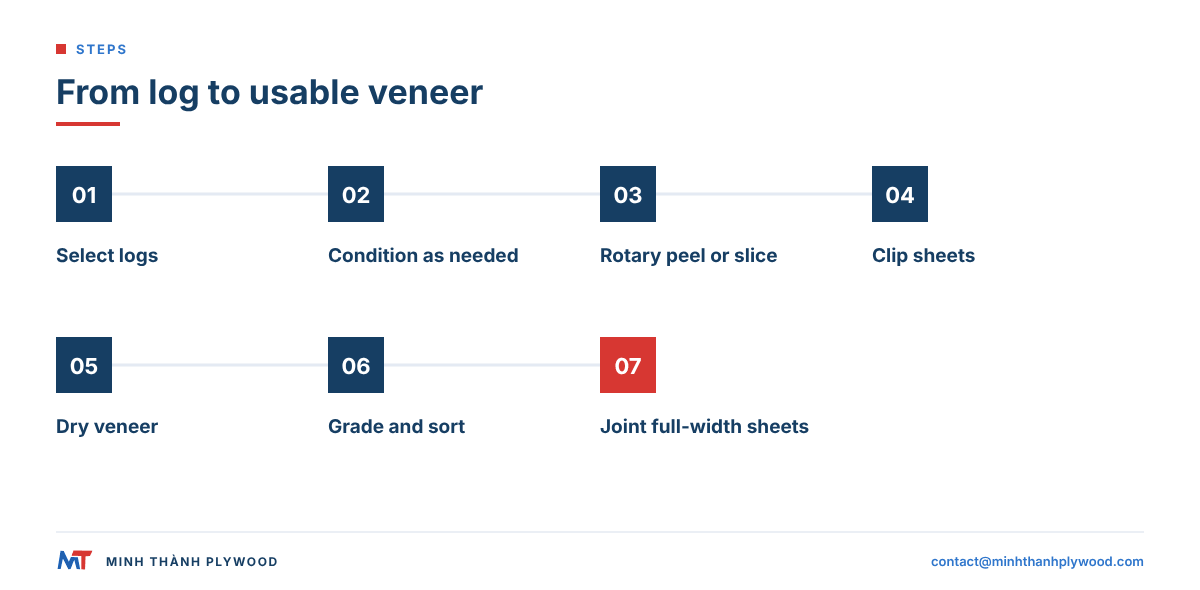
Wood veneer is made by softening a log, cutting it into thin sheets, drying the sheets and sorting them by grade. The steps below are the route a plywood veneer takes from log to lay-up.
- Log selection. Logs are chosen by species, diameter and straightness. Plantation logs (Styrax, Eucalyptus, Acacia) feed core veneer; selected hardwood logs feed decorative faces.
- Conditioning. Logs for sliced faces are often soaked or steamed so the knife cuts cleanly; plantation peeler logs are usually peeled fresh.
- Peeling or slicing. A rotary lathe turns the log against a long knife and unrolls a continuous sheet; a slicer cuts flat sheets across or along the log.
- Clipping. The ribbon of veneer is clipped into sheets and defects are cut out.
- Drying. Sheets go from green wood to a bondable moisture content; for furniture plywood that is 8–12 %. The process is covered in veneer drying for plywood.
- Grading and sorting. Sheets are sorted by appearance and defects; see veneer grading at our factory.
- Jointing. Narrow sheets are edge-glued or stitched into full-width sheets for core and face.
Types of veneer by cut: rotary, crown, quarter and rift
The cut decides the grain pattern and the width of the sheet. Rotary-cut veneer is the workhorse of plywood; sliced cuts are used where the face must show a particular figure.
| Cut | How it is cut | Grain look | Main use |
|---|---|---|---|
| Rotary | Log turned against a knife, veneer unrolled | Wide, wild, wavy figure | All plywood cores; birch, poplar, okoume and eucalyptus faces |
| Flat (crown) | Half-log sliced parallel to its centre | Cathedral arches in the middle, straight grain at the sides | Decorative oak, walnut and ash faces |
| Quarter | Quarter-log sliced across the growth rings | Straight, striped grain | Furniture doors, panelling |
| Rift | Sliced at an angle to the rings | Very straight grain, no ray fleck in oak | High-end oak joinery |
Rotary veneer comes off the log in a continuous ribbon, so it gives the wide, full sheets plywood needs at low cost. Sliced veneer gives narrower leaves that are laid side by side and matched. For the full comparison, read rotary peeled vs sliced veneer.
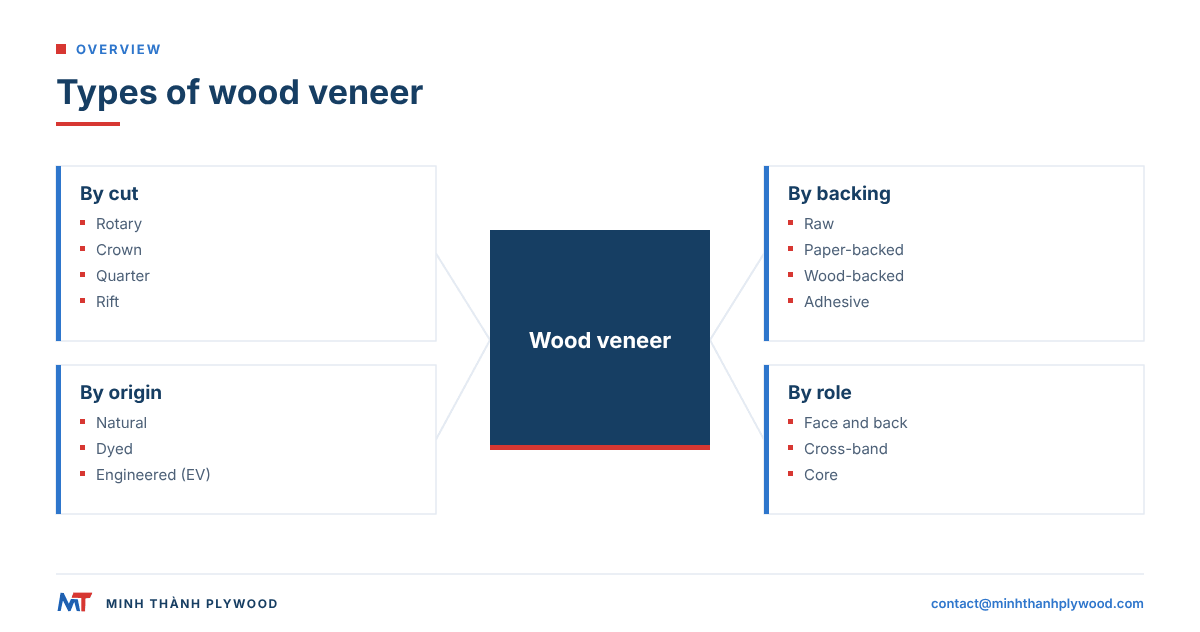
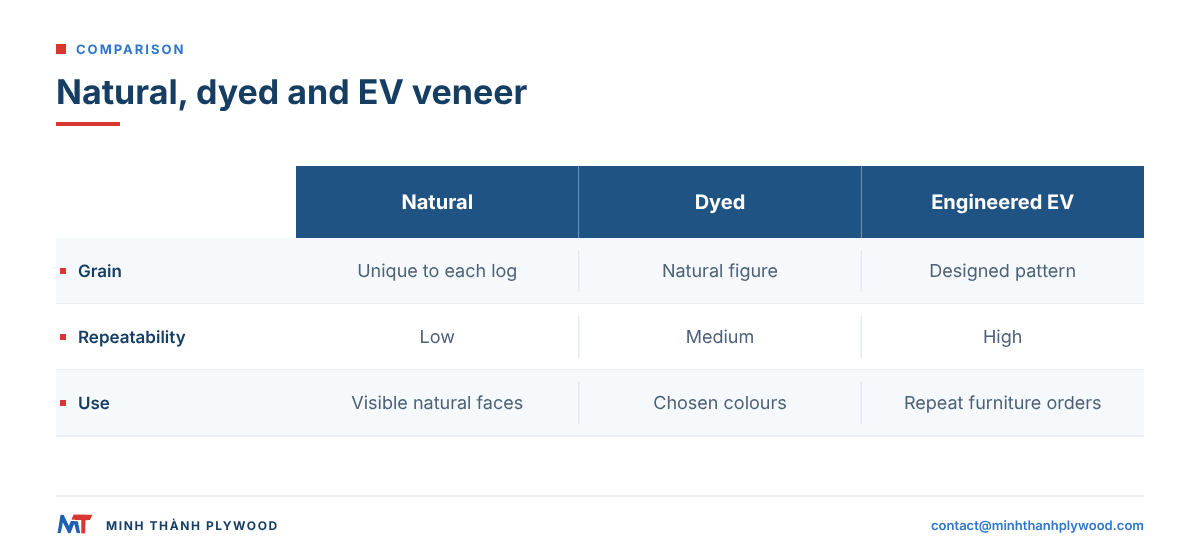
Natural, dyed and engineered veneer
Natural veneer shows one tree’s real figure, dyed veneer keeps that figure in a new colour, and engineered veneer (EV) rebuilds a designed grain from fast-growing wood. All three are wood; they differ in look, repeatability and price.
| Type | Look | Repeatability | Where it fits |
|---|---|---|---|
| Natural veneer | Unique to each log; colour varies sheet to sheet | Low; matched by sorting | Visible faces where natural variation is wanted |
| Dyed veneer | Natural figure in a chosen colour | Medium | Design colours, black or grey faces |
| Engineered veneer (EV) | Designed grain, such as oak, walnut or teak looks | High; same design across orders | Furniture series, hotels, retail fit-outs that need consistent panels |
Engineered veneer suits buyers who reorder the same furniture line and need the tenth container to look like the first. EV plywood is one of the faces Minh Thanh produces most; see EV plywood.
Raw, paper-backed and wood-backed veneer
Raw veneer is a bare sheet of wood; backed veneers are glued to paper, fleece or a second veneer so they are easier to handle. Plywood mills press raw veneer; workshops and fitters often buy backed veneer.
- Raw (unbacked) veneer: used in plywood presses and by joiners with vacuum or hot presses.
- Paper- or fleece-backed: flexible, bends around curves, does not split along the grain.
- Wood-backed (2-ply): a face veneer glued cross-grain to a backing veneer; stiffer and flatter.
- Adhesive-backed (peel-and-stick, iron-on): for small repairs and edge work.
When a project needs many identical veneered panels, buying factory-veneered plywood is faster and flatter than laying backed veneer by hand.
Buying wood veneer sheets in the UK: loose, iron-on and edging
In the UK “wood veneer” is mostly sold by the leaf in shops, not by plywood mills. These are the three formats on offer, with what a buyer pays and when a factory-veneered panel is the better route.
| Format | Typical size | Typical UK price (ex VAT) | Best for |
|---|---|---|---|
| Loose decorative veneer leaves and packs | 0.6 mm nominal; lengths of 8–12 ft; widths of 4–30 in (10–76 cm) by species | £15.95 to £134.25 a pack across 210 species; most packs fall between about £28 and £63 | Marquetry, tabletops, restoration, one-off pieces |
| Pre-glued iron-on sheets | 2500 × 300 mm or 1240 × 300 mm; oak, walnut, cherry, ash, beech, sapele, pine | Sold per sheet; quantity discounts on oak | Covering a shelf, a door or an edge with a domestic iron |
| Iron-on edging rolls | 300 mm wide rolls in real wood | Sold per roll | Hiding the cut edge of a board |
Prices and sizes are from Original Marquetry and Veneers Online, accessed 21 October 2026.
Can you iron on veneer? Yes, on a flat, sanded, dust-free base. Pre-glued veneer carries a heat-activated adhesive: press it down with a domestic iron on a medium-hot setting, then roll the surface while it is warm and trim the edges. It suits a bookshelf or a small door. It does not suit a kitchen run or a hundred wardrobe doors, where the joints, the flatness and the time per panel add up.
When to order veneered plywood instead. A fitter or furniture maker who needs more than a few panels, large flat faces or a consistent look across a batch saves labour by buying factory-veneered board: the face is pressed on at the mill, the thickness is calibrated and the grain is matched to a sample. Minh Thanh Plywood supplies EV, birch and poplar faced panels from US$350/m³ FOB (October 2026), by the 40HC container.
Face veneer vs core veneer: thickness and role
Face veneer is the thin, selected sheet you see; core veneer is the thicker, plainer sheet inside that carries the load. In Vietnamese furniture plywood, faces are usually 0.2–0.5 mm, often 0.3 mm for European orders, and core veneers are about 1.4–2.0 mm.
| Veneer | Typical thickness | Job in the panel | Species at Minh Thanh |
|---|---|---|---|
| Face and back | 0.2–0.5 mm | Appearance, sanding allowance, finish | EV, poplar, birch, okoume, pine; bintangor, eucalyptus, gurjan, sapele on request |
| Cross-band (in thin panels) | Thin, set by the build | Holds the face flat across the grain | Plantation veneer |
| Core | 1.4–2.0 mm | Strength, stiffness, screw holding, weight | White Styrax or Eucalyptus as standard; Acacia on order |
| Core in 4 mm panels | about 1.3 mm | Three core veneers under two faces | White Styrax |
A thicker face leaves more margin for sanding and finishing; a thinner face costs less. Imported birch and okoume faces are pressed on Vietnamese plantation cores: the panel is “birch-faced”, not solid birch. For face and core thickness in detail, read veneer thickness in plywood.
How does veneer become plywood?
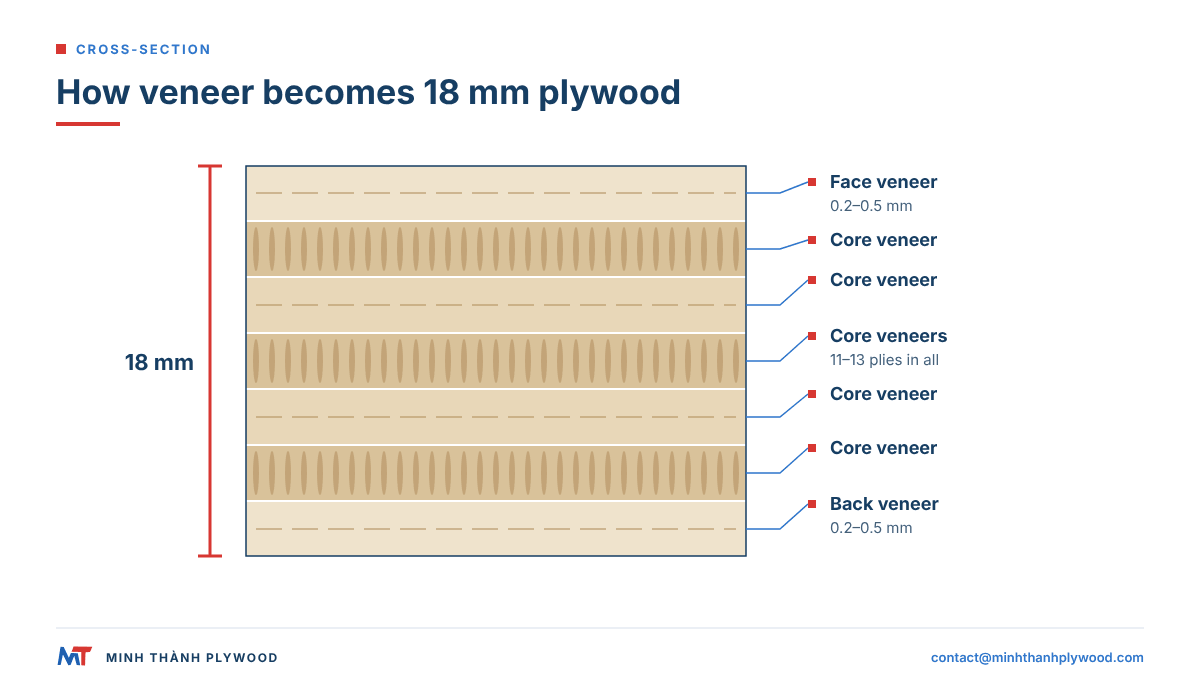
Veneer becomes plywood when an odd number of sheets is glued with the grain of each layer at right angles to the next and pressed hot until the glue cures. Cross-graining cancels most of wood’s movement across the grain, which is why plywood stays flat and stable where a solid board would cup. Plywood for structural and general-purpose use in dry, humid or exterior conditions is covered by BS EN 636:2012+A1:2015.
At Minh Thanh Plywood the route for a furniture panel is:
- Core lay-up. Dried core veneers are laid cross-grain; core layers are stitched both horizontally and vertically so no gaps open.
- First pressing. The core board is hot-pressed with UF glue at E0 emission, or MR or WBP glue to the order.
- Calibration. The core board is sanded to an even, calibrated thickness.
- Second pressing. Face and back veneer are pressed onto the calibrated core.
- Sanding and grading. Faces are sanded and polished; panels are graded against the approved sample.
An 18 mm panel usually has 11–13 plies; thin panels of 3–5 mm are always 5-ply. Pressing twice is standard for furniture-grade panels, because a calibrated core gives a flatter face and tighter thickness, down to ±0.2 mm.
What is the difference between plywood and veneer?
Veneer is one thin sheet of wood; plywood is a rigid panel built from several veneers glued cross-grain. You buy veneer to cover something; you buy plywood to build with.
| Point | Veneer | Plywood |
|---|---|---|
| What it is | A single slice of wood | A panel of 3 or more veneers glued cross-grain |
| Thickness | Usually well under 3 mm | 3–40 mm at Minh Thanh |
| Strength alone | None; it needs a base | Structural; holds screws, spans shelves |
| Grain direction | One | Alternating layer by layer |
| Sold as | Sheets, leaves, rolls | Panels, 1220 × 2440 mm or 1250 × 2500 mm |
| Typical buyer | Joiners, veneer pressers | Furniture plants, fitters, importers |
The two meet in veneered plywood: a decorative face veneer on a plywood core. For a side-by-side guide, see plywood vs veneer.
Veneer vs solid wood vs laminate
Veneer gives a real wood surface on a stable panel; solid wood is wood all the way through; laminate is a printed surface. Each suits a different job.
| Surface on a cabinet door | Real wood surface | Stability across width | Repairable | Relative weight |
|---|---|---|---|---|
| Wood veneer on plywood | Yes | High | Light sanding and refinishing | Low with a Styrax core |
| Solid wood | Yes | Lower; moves with humidity | Deep sanding | Higher |
| Melamine or HPL on a board | No | High | Not refinishable | Depends on the core |
Veneered plywood is the usual choice for furniture panels because it gives the look of the wood at a fraction of the log, with less movement. A full comparison sits in veneer vs laminate.
Common wood veneer species on plywood faces
The face species sets the look and the price of veneered plywood. These are the faces Minh Thanh presses, with how buyers use them.
| Face | Look | Typical use |
|---|---|---|
| EV (engineered veneer) | Designed oak, walnut, teak and other grains | Furniture series, hotel and retail fit-outs |
| Poplar | Pale, even, fine grain | Painted and laminated furniture, drawer sides |
| Birch (imported) | Light, fine, smooth; graded D+, D and E | Visible furniture faces, edges shown |
| Okoume (imported) | Pinkish-brown, mild figure | Furniture and interior panels |
| Pine | Yellow with knots and strong figure | Rustic furniture and interiors |
| Bintangor, eucalyptus, gurjan, sapele | Reddish to brown hardwood looks | On request |
Birch faces are quoted as face/back pairs such as D+/D or D/E, comparable to the European birch grades; individual D+ is about B, D about BB and E about CP/C. Poplar and eucalyptus faces are quoted as A/A, A/B or B/B, matched to the approved sample.
Engineered veneer (EV) plywood from Vietnam: what to check
EV plywood from Vietnam is good quality when the order pins down the face design, the core, the glue and the tolerance, and the first production matches an approved sample. Check these points before you order:
- Face design and sample. Fix the EV design code and approve a physical sample; colour and grain should match it across the order.
- Core. Ask for the core species (white Styrax for light panels, Eucalyptus for denser ones) and a stitched core.
- Pressing. Ask whether the panel is pressed twice; a calibrated core gives a flatter EV face.
- Glue and emission. Two separate lines: for example UF glue at E0 emission. Ask for chamber test reports with the method named.
- Thickness tolerance. ±0.2–0.3 mm for sanded furniture panels.
- Documents for Europe. The EUDR compliance dossier (origin records and geolocation files) comes with Minh Thanh orders. The obligation comes from Regulation (EU) 2023/1115.
Minh Thanh’s emission evidence: six ASTM D6007 chamber tests between April 2025 and June 2026, on 9, 15 and 18 mm panels, averaged 0.014–0.032 ppm. Three were run by Shanghai Hongjun and three by ICTT Vietnam; the reports are listed on the quality and certificates page. The US limit for veneer-core hardwood plywood is 0.05 ppm under 40 CFR 770.10.
EV plywood price is set by the face design, core species, glue and emission class, thickness, size, quantity and delivery term. As a starting point, furniture and interior plywood from Minh Thanh starts from US$350/m³ (October 2026).
What this means for your order
If you are buying veneered plywood, describe the veneer in the order as a face, a grade and a thickness, and describe the core separately. A complete line looks like this:
- Application: for example kitchen carcass, wardrobe door, hotel wall panel.
- Face and back: species or EV design, grade pair (for example birch D+/D, poplar A/B).
- Core: white Styrax or Eucalyptus, stitched, pressed twice.
- Glue and emission: UF glue at E0 emission, or MR or WBP to your use.
- Size and thickness: 1220 × 2440 mm or 1250 × 2500 mm, thickness and tolerance.
- Packing and quantity: sheets per pack, total, destination port.
Minh Thanh Plywood, in Ha Hoa, Phu Tho, Vietnam, makes 50,000+ m³ of plywood a year with 10+ face veneers. MOQ is one 40HC with mixed specifications by agreement, production takes 15–45 days after the 30% deposit, and samples are free. Send the six lines to contact@minhthanhplywood.com for a quotation.
Buyer questions, answered
What is veneer?
Veneer is a thin slice of real wood, usually well under 3 mm thick, cut from a log by peeling or slicing. It is glued to a panel to give it a wood surface, or stacked cross-grain with other veneers to make plywood.
What does veneer mean?
In woodworking, veneer means a thin layer of wood glued over a base material. The word comes from the German furnieren, borrowed from the French fournir, to furnish. In dentistry, a veneer is a thin shell bonded to a tooth: a different meaning entirely.
Is wood veneer real wood?
Yes. Natural wood veneer is real wood cut from a log. Dyed veneer is real wood with added colour, and engineered (reconstituted) veneer is real wood re-glued into a new grain pattern. Melamine paper, laminate and PVC foil are not veneer.
What is the difference between plywood and veneer?
Veneer is a single thin sheet of wood; plywood is a panel made from several veneers glued with the grain of each layer at right angles to the next. Veneer is a material, plywood is a product made from it.
What is veneer plywood?
Veneer plywood is plywood whose outer faces are a chosen decorative veneer, such as birch, okoume, poplar or an engineered veneer design, pressed over a core of plantation veneers. The face sets the look; the core sets weight and strength.
What are the main types of veneer?
By cut: rotary, flat (crown), quarter and rift. By origin: natural, dyed and engineered (reconstituted). By backing: raw, paper-backed, wood-backed (2-ply) and adhesive-backed. Plywood mills mostly use raw rotary veneer for cores and natural or engineered faces.
How thick is wood veneer?
Face veneers on furniture plywood are usually 0.2–0.5 mm, often 0.3 mm for European orders. Core veneers inside the panel are thicker, about 1.4–2.0 mm, and thin 4 mm panels use core veneers of about 1.3 mm.
What is veneering?
Veneering is the work of gluing veneer onto a base panel or onto other veneers. In a plywood mill it is done in a hot press; in a workshop it is done with a vacuum bag, clamps, contact cement or iron-on glue.
How do you apply wood veneer to plywood?
Sand the plywood flat, spread a veneer glue such as PVA or urea glue, lay the veneer with its grain set to balance the panel, and press it evenly until the glue cures. For volume work, ordering factory-veneered plywood is faster and flatter.
Is EV (engineered veneer) plywood from Vietnam good quality?
It can be, when the order fixes the face design, the core, the glue and emission class and the tolerance. EV is one of the faces Minh Thanh produces most, on stitched, twice-pressed cores; approve a face sample before production.
Which is better, veneer or solid wood?
Veneer on plywood is lighter, flatter and more stable across its width than solid wood, and uses a valuable log far more efficiently. Solid wood can be sanded and repaired more deeply. For cabinet and furniture panels, veneered plywood is the standard choice.