
Engineered wood is any wood product made by bonding veneers, strands, particles, fibres or boards with glue into a panel or beam of a set size and strength. Plywood, LVL, MDF, particle board, OSB, glulam and CLT are all engineered wood. Minh Thanh Plywood makes the veneer-based branch, plywood and LVL, in Vietnam; this guide explains the whole family and when each member beats solid wood.
What is engineered wood? The definition
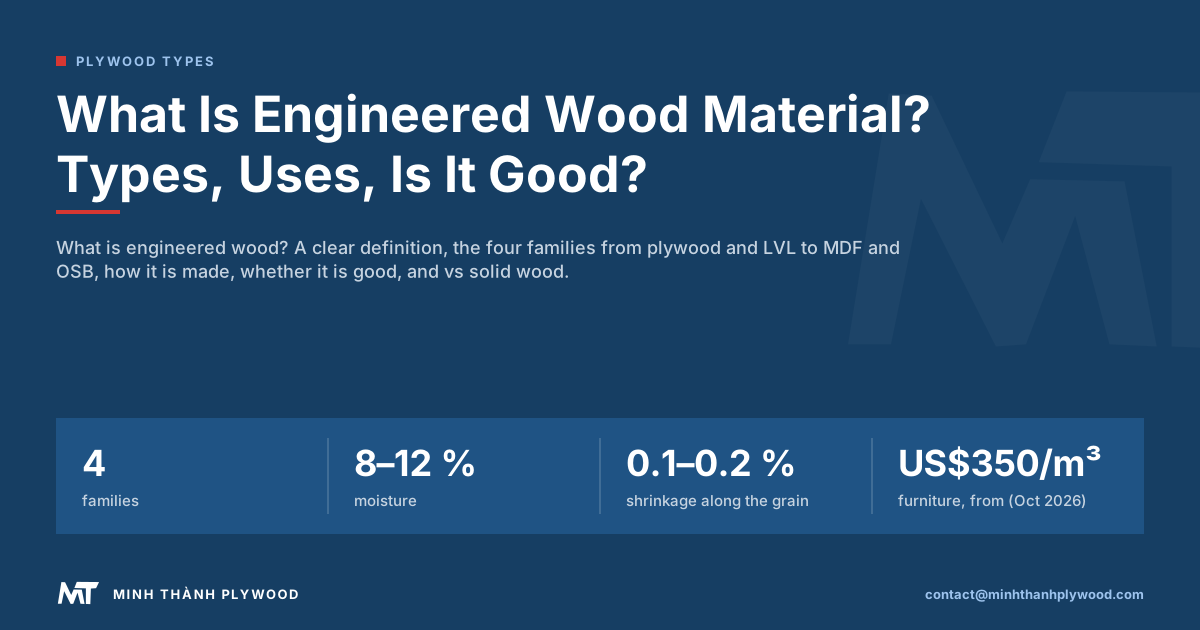
Engineered wood is wood made by bonding pieces of wood, such as veneers, strands, particles, fibres or small boards, with glue into a panel or beam of a set size and strength. Plywood is the best-known type; MDF, particle board, OSB, LVL, glulam and CLT are the others.
Solid wood comes straight from the saw: a board is as wide, long and straight as the tree allowed, and it keeps moving with the weather. Engineered wood breaks the log down and rebuilds it. That lets a factory make sheets of 1220 × 2440 mm and beyond, beams longer than any log, and panels that hardly move with humidity.
It goes by many names: engineered wood material, engineered timber, composite wood, manufactured wood or engineered wood product. They all mean the same family. In flooring, “engineered wood” means something narrower, covered further down this guide.
Engineering wood material: the four families
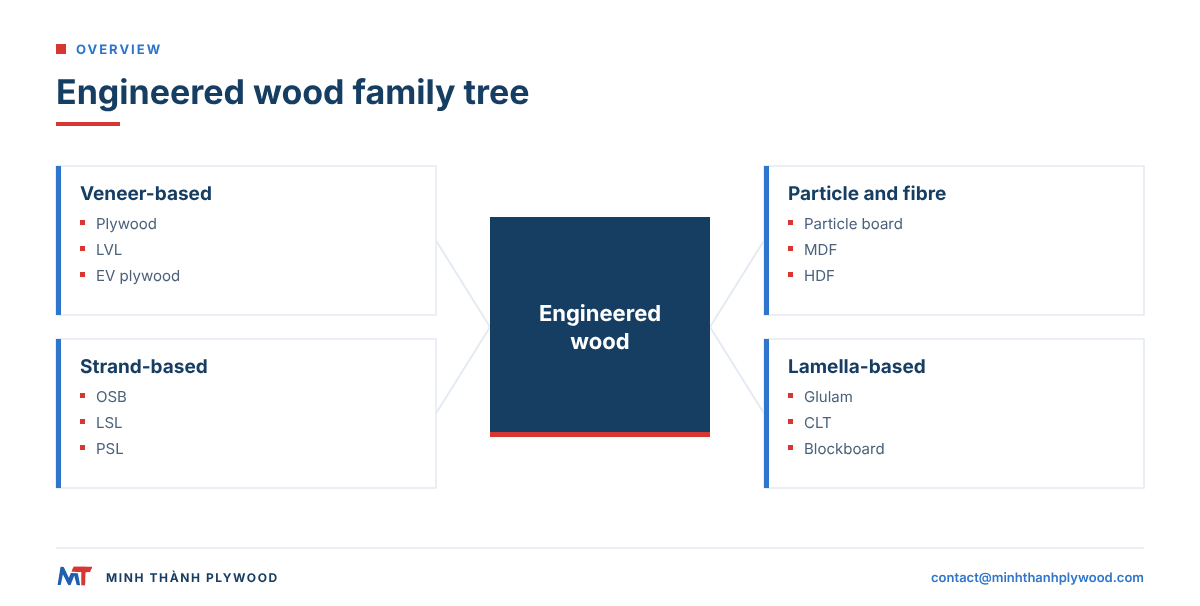
Engineering wood material falls into four families by the wood element it is built from: veneers, strands, particles or fibres, and lamellas (small boards). The element decides strength, smoothness, moisture behaviour and price.
| Family | Built from | Products | Strength | Surface | Typical uses |
|---|---|---|---|---|---|
| Veneer-based | Peeled veneers, 1.4–2.0 mm in plywood cores | Plywood, LVL | High, holds screws | Real wood face | Furniture, cabinets, formwork, beams |
| Strand-based | Long thin strands | OSB, LSL, PSL | Good for sheathing and beams | Coarse | Walls, roofs, subfloors, beams |
| Particle and fibre-based | Chips or wood fibres | Particle board, MDF, HDF, hardboard | Low to medium | Very smooth (MDF) | Carcasses, painted doors, backs |
| Lamella-based | Small sawn boards | Glulam, CLT, blockboard | High along the boards | Solid wood look | Beams, floors, walls, doors |
Veneer-based products keep the most of the tree’s natural strength, because each veneer is a continuous sheet of real wood. Fibre-based products give up strength for a smooth, uniform surface. The family tree in the next sections gives one line for each product.
How is engineered wood made?
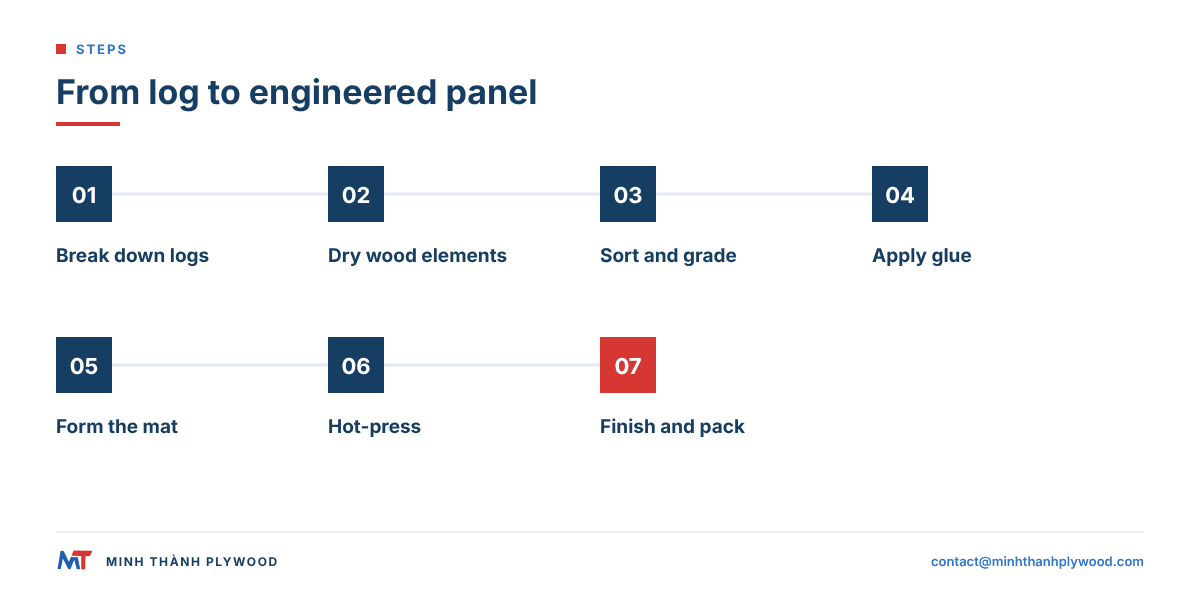
Engineered wood is made by breaking logs into small elements, drying and sorting them, coating them with glue, laying them in a set pattern and pressing them with heat. The steps differ by family, but the order is the same.
- Break down the log: peel veneers (plywood, LVL), cut strands (OSB), chip or grind fibres (particle board, MDF), or saw lamellas (glulam, CLT).
- Dry: bring the wood to a controlled moisture; our plywood veneers and panels leave at 8–12 %.
- Sort and grade: remove defects and grade the elements; in plywood, face and core veneers are graded separately.
- Apply glue: UF, melamine-fortified, phenolic or other resins, chosen for the use.
- Form the mat: cross the veneers for plywood, align them for LVL, orient the strands for OSB.
- Press: hot-press to bond and set the thickness; UF and melamine bonds at about 110–120 °C, phenolic at about 130–145 °C.
- Finish: sand, cut to size, grade and pack.
At Minh Thanh, furniture-grade plywood is pressed twice as standard: the core board is pressed and calibrated, then face and back are pressed on. That second press is what gives a flat face for veneer, paint or UV coating. The full veneer line is on our manufacturing page.
Veneer-based engineered wood: plywood and LVL
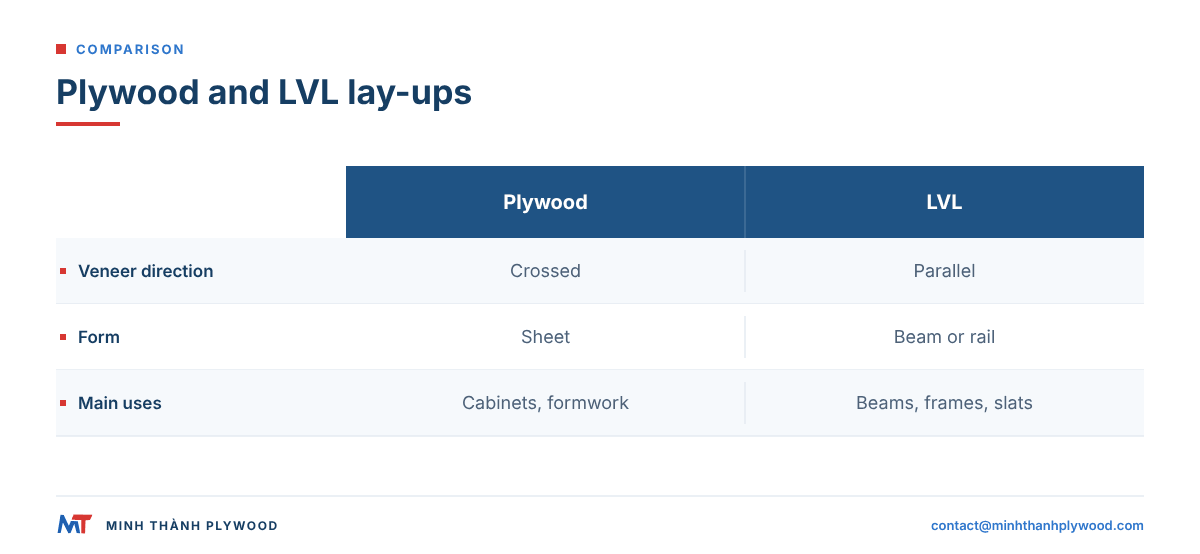
Veneer-based engineered wood is made of peeled veneers glued in layers: crossed in plywood, parallel in LVL. It is the branch Minh Thanh manufactures, and the strongest family for its weight.
| Product | Lay-up | Spec line from our factory | Main uses |
|---|---|---|---|
| Furniture plywood | Crossed veneers; face over white Styrax or Eucalyptus core | 3–40 mm; UF glue at E0 emission; sanded to ±0.2 mm | Furniture, cabinets, interiors |
| Film-faced plywood | Crossed veneers; Eucalyptus or Acacia core; phenolic film | 12–21 mm; melamine-fortified or phenolic WBP; ±0.5 mm | Concrete formwork |
| LVL | Parallel veneers | Cut to beam and rail sizes | Beams, frames, bed slats, packing |
| EV plywood | Crossed veneers with engineered veneer face | Face matched to sample | Decorative panels, doors |
Plywood’s crossed grain makes a stable sheet; LVL’s parallel grain makes a strong, straight member. Read what plywood is for the layer-by-layer build, or see our LVL and EV plywood pages.
Strand-, particle- and fibre-based engineered wood
Strand-, particle- and fibre-based engineered woods are made from wood broken into smaller pieces, so they are cheaper and more uniform than plywood but weaker at edges and more sensitive to water.
- OSB (oriented strand board): long strands laid in crossed directions. Cost-effective for wall, roof and floor sheathing; edges swell if left wet. See plywood vs OSB.
- LSL and PSL: strands or long veneer strips pressed into beams and posts.
- Particle board (chipboard): wood chips pressed with resin. The lowest-cost furniture carcass board, usually melamine-faced. See particle board vs plywood.
- MDF (medium-density fibreboard): fine fibres pressed into a smooth, dense sheet. The standard for painted and routed doors. See plywood vs MDF.
- HDF and hardboard: thinner, denser fibreboards for drawer bottoms, backs and laminate flooring cores.
These panels shine where a smooth face or a low price matters more than strength. For load, screws near the edge or moisture, plywood is the better choice.
Lamella-based engineered wood: glulam, CLT and blockboard
Lamella-based engineered wood is made of small sawn boards glued together: stacked in the same direction for glulam, crossed in layers for CLT, edge-glued between veneers for blockboard. It looks and works like solid timber in much larger sizes.
- Glulam (glued laminated timber): boards glued face to face into long, curved or straight beams for roofs, bridges and halls.
- CLT (cross-laminated timber): layers of boards crossed at right angles into wall and floor slabs for timber buildings. It applies plywood’s crossing principle to whole boards.
- Blockboard: a core of edge-glued wood strips between veneers, used for doors and long shelves; see blockboard vs plywood.
Glulam and CLT are structural building products specified by engineers. For furniture and fit-out, the lamella family is used mainly as finger-jointed and edge-glued panels.
What is engineered lumber?
Engineered lumber is engineered wood made as beams, joists, headers and posts instead of sheets. LVL, glulam, PSL, LSL and wood I-joists are the main products.
Engineered lumber replaces large sawn timbers, which are scarce and often twisted or split. Because it is built from dried, graded elements, it is straight, consistent and stronger for its section than sawn lumber of the same size. Builders use it for long spans, door and window headers, and floor and roof joists.
LVL is the veneer member of this group. Minh Thanh makes LVL alongside its plywood, with every veneer laid in the same direction for strength along its length. Our guide to LVL vs plywood explains when each fits.
Engineered wood vs solid wood: when engineered wood wins
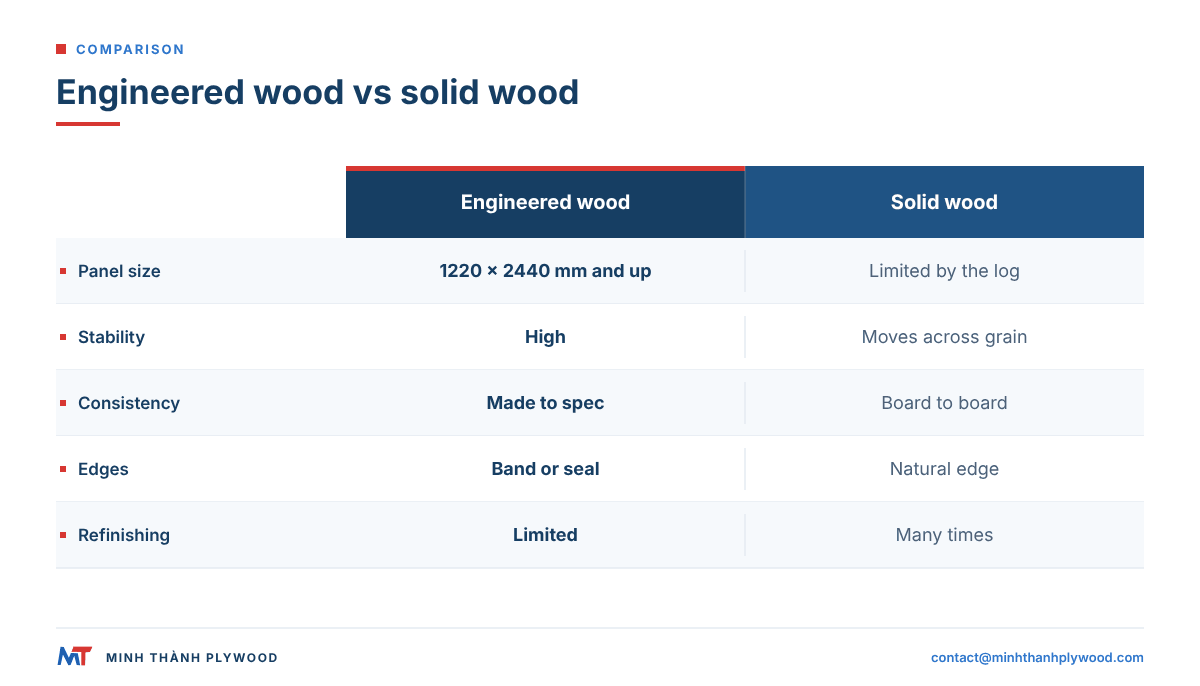
Engineered wood beats solid wood wherever size, flatness, stability or consistency matter; solid wood wins where a visible edge, a carved shape or a thick, repairable surface matters. Most furniture combines both.
| Need | Engineered wood | Solid wood |
|---|---|---|
| Large flat panel | Yes: sheets of 1220 × 2440 mm and 1250 × 2500 mm | Needs edge-gluing, moves with humidity |
| Stability across seasons | High, especially plywood | Moves across the grain |
| Long straight beam | LVL, glulam | Limited by the tree; may twist |
| Consistent quality in a container | High, made to specification | Varies board to board |
| Visible edges and carving | Edge must be banded or covered | Natural edge, carves well |
| Refinishing a worn surface | Limited by veneer thickness | Can be sanded many times |
| Use of the log | High: thin veneers and small logs | Needs large, clear logs |
The biggest practical gain is stability. Wood shrinks very little along its grain, about 0.1–0.2 % from green to oven-dry according to the USDA Forest Products Laboratory’s Wood Handbook, and much more across it. Plywood and CLT lock the cross-grain movement of each layer with the next.
Is engineered wood good? Advantages and disadvantages
Engineered wood is good when the type and glue match the job: it is stable, consistent, made to size and makes efficient use of timber. Its weak points are edges, moisture in low-grade boards and limited refinishing.
Advantages:
- Stable: little warping, cupping or splitting.
- Large and consistent: sheets and beams to a specification, sheet after sheet.
- Strong for its weight: an 18 mm plywood sheet on Styrax core weighs about 26.8 kg at a planning density of 500 kg/m³.
- Uses plantation and smaller logs: veneer peeling turns fast-growing plantation trees into high-grade panels.
- Can be built for the use: interior, humid or exterior glues; smooth, veneered or film faces.
Disadvantages:
- Edges need banding or sealing, and MDF and particle board edges swell when wet.
- Glue and emission must be specified; choose low-emission glues for interiors.
- Surface depth limits how often a veneered face can be sanded back.
- Quality varies by mill: core gaps and weak glue lines are hidden inside the panel.
For furniture, plywood is the engineered wood that keeps most of solid wood’s strength and screw holding, at a fraction of its movement.
Environmental benefits and building codes
Engineered wood stores carbon and uses timber efficiently. Wikipedia reports that mass timber (CLT, glulam and similar) saves around 20 % embodied carbon against steel or concrete, uses up to 15 % less energy to produce, and builds 20–25 % faster, with a 4.2 % saving in capital cost. Plywood itself turns fast-growing plantation logs into large panels, and every sheet keeps its carbon for the life of the building or the furniture.
Codes and standards give buyers a way to check a panel. In the United States, structural plywood is made to Voluntary Product Standard PS 1 and wood-based structural-use panels to PS 2, and the APA rating stamp on a sheet shows the span rating and exposure durability. Mass timber is covered by the International Building Code, which since the 2021 edition allows mass timber buildings up to 18 storeys. For emissions, composite wood sold in the US must meet CARB Phase 2 / TSCA Title VI, which sets 0.05 ppm for veneer-core hardwood plywood under the EPA formaldehyde emission standards.
Minh Thanh holds CARB P2 / TSCA Title VI certification (ICTT mill no. 23024), and six ASTM D6007 chamber tests on 9, 15 and 18 mm panels between April 2025 and June 2026 averaged 0.014–0.032 ppm. Third-party testing to the buyer’s method is arranged through SGS on request.
Sources: Engineered wood, Wikipedia and APA, the Engineered Wood Association, both checked on 21 October 2026.
Is plywood engineered wood, and which is better?
Plywood is engineered wood: it is the veneer-based member of the family. Asking whether engineered wood or plywood is better compares a family with one of its members, so the real question is plywood against MDF, particle board or OSB.
| Compared with plywood | Plywood is better for | The other panel is better for |
|---|---|---|
| MDF | Strength, screw holding, weight, moisture with the right glue | Smooth painted and routed doors |
| Particle board | Strength, edges, moisture, long life | Lowest cost carcasses |
| OSB | Flatness, face quality, furniture use | Lowest cost sheathing |
In furniture sold as “engineered wood”, the panel is usually particle board or MDF. When a seller says “engineered wood”, ask which panel it is. Our engineered wood vs plywood guide goes deeper.
Engineered wood flooring and engineered veneer
Engineered wood flooring is a floorboard made of a real hardwood top layer, the wear layer, glued onto a plywood or HDF base. It looks like solid hardwood flooring but moves less, so it suits underfloor heating and wide boards.
In the US, shops such as Home Depot sort engineered hardwood by thickness, plank width and wear layer, and sell it by the case.
| Spec | Common US formats |
|---|---|
| Thickness | 3/8, 1/2 and 5/8 in |
| Plank width | Narrow 5 in or less, medium 5.1 to 6.9 in, wide 7 in and over |
| Wear layer | About 2 mm to 6 mm of hardwood |
| Joint | Click lock, or tongue and groove (T&G) |
| Sold by | The case, about 20 to 43 sq ft |
The wear layer sets how often the floor can be sanded: roughly one refinish at 2 mm, two to three at 3 mm, three to four at 4 mm and four to five at 6 mm, as retailers estimate, so a thick wear layer behaves like solid hardwood. Against solid hardwood, engineered flooring takes humidity swings, basements and radiant heat better because its cross-layered base resists cupping; solid hardwood can be refinished more often.
A plywood base is the usual choice for a strong, flat floor, and it needs the same checks as furniture plywood: a closed core, a water-resistant glue line and a low-emission glue for the indoor air.
Engineered veneer (EV) is a different product with a similar name. EV is decorative veneer made from plantation wood that is peeled, dyed, laid up into a block and resliced. The result copies oak, walnut, teak or other looks with a consistent colour and grain from sheet to sheet.
We make EV plywood: an engineered veneer face on a white Styrax or Eucalyptus core, pressed twice and sanded. EV colour is matched to the buyer’s approved physical sample, because photos do not show colour reliably. Order EV for decorative interiors, doors and furniture where grain must match across many panels.
Engineered veneer plywood from Vietnam: what to check before ordering
Engineered veneer plywood from Vietnam is good quality from a mill that builds furniture panels and matches colour to a retained sample. Check six things before the first order.
- Sample: approve a physical sample for colour and grain; the mill keeps a matching retained sample.
- Core: white Styrax for light panels, Eucalyptus for stiffness.
- Glue and emission: UF glue at E0 emission for interiors, with the certificate.
- Thickness tolerance: down to ±0.2 mm on sanded furniture panels.
- Size: 1220 × 2440 or 1250 × 2500 mm, or custom sizes.
- Documents: emission test reports, shipment photos and the EUDR dossier for European orders.
Price follows face, core, glue, thickness and quantity; as an indicative start, furniture and interior plywood is from US$350/m³ (October 2026), quoted FOB Hai Phong, CFR or CIF. Minh Thanh’s panels are certified to CARB P2 / TSCA Title VI (ICTT mill no. 23024). The limits are on the EPA formaldehyde standards page. For European buyers we supply the EUDR compliance dossier (origin records and geolocation files) for due diligence under Regulation (EU) 2023/1115.
Uses of engineered wood in furniture and construction
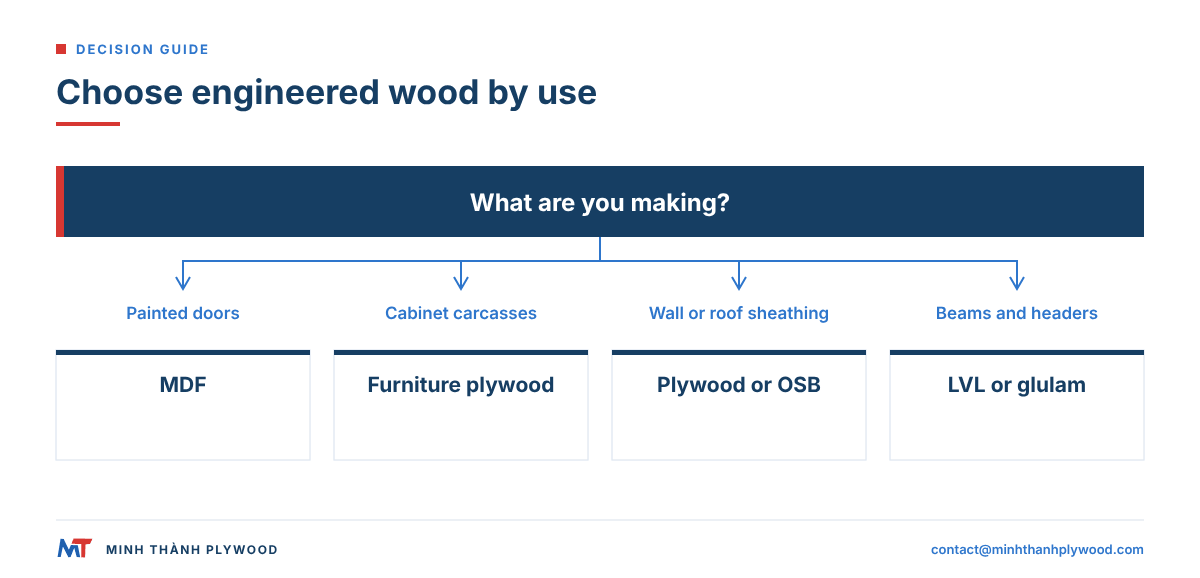
Engineered wood is used for almost every flat or long wooden part in modern furniture and buildings. Each use has a best-fit product.
| Use | Best-fit engineered wood |
|---|---|
| Kitchen and bathroom cabinets | Furniture plywood, melamine-faced board |
| Painted doors and mouldings | MDF |
| Wardrobes and shelving | Plywood, particle board |
| Drawer bottoms and backs | Thin plywood, HDF |
| Floors | Engineered wood flooring, plywood subfloor |
| Wall and roof sheathing | Plywood, OSB |
| Concrete formwork | Film-faced plywood |
| Beams and headers | LVL, glulam |
| Timber buildings | CLT, glulam |
| Crates and pallets | Packing plywood, LVL |
The types of wood boards guide compares the sheet materials side by side, and types of wood covers the solid species they are made from.
What this means for your order
If your engineered wood is plywood, LVL or EV plywood, specify the build layer by layer so offers can be compared. A label such as “engineered wood board” says nothing about strength, glue or emission.
Send these lines with your enquiry:
- Application: furniture, cabinets, decorative panels, formwork, packing or beams.
- Product: plywood, EV plywood, film-faced plywood or LVL.
- Core: white Styrax or Eucalyptus as standard; Acacia or Pine on order.
- Glue and emission: UF glue at E0 emission for interiors; melamine-fortified or phenolic WBP to your specification.
- Face and grade: species or EV colour, matched to your sample.
- Size, thickness and quantity: 3–40 mm, standard or custom sizes, from one 40HC.
Production takes 15–45 days after the deposit, and free samples are available. Email contact@minhthanhplywood.com or message us on WhatsApp. We reply within hours. See our furniture plywood range.
Buyer questions, answered
What is engineered wood?
Engineered wood is wood made by bonding veneers, strands, particles, fibres or boards with glue into panels or beams of a set size and strength. Plywood, LVL, MDF, particle board, OSB, glulam and CLT are the main types.
Is plywood engineered wood?
Yes. Plywood is the oldest and most widely used engineered wood: veneers glued with their grain crossed. It belongs to the veneer-based branch, with LVL.
Is engineered wood the same as plywood?
No. Plywood is one type of engineered wood. Engineered wood also includes MDF, particle board, OSB, LVL, glulam and CLT, which are built from different wood elements.
Which is better, engineered wood or plywood?
The question compares a family with one member. Plywood is the strongest and most screw-holding engineered sheet for furniture and formwork; MDF is smoother for painted doors; particle board is cheaper for carcasses; OSB is cheaper for sheathing.
What is engineered lumber?
Engineered lumber is engineered wood made as beams, joists and posts rather than sheets: LVL, glulam, PSL, LSL and I-joists. It is straighter and stronger for its size than sawn timber of the same section.
Is engineered wood good?
Yes, when the type matches the job. Engineered wood is more stable than solid wood, comes in large flat sheets and long straight beams, and uses plantation timber well. Low-grade boards swell when wet, so choose the glue and type for the use.
Is engineered wood waterproof?
No engineered wood is waterproof, but plywood and LVL made with phenolic WBP glue resist repeated wetting. MDF and particle board swell when water reaches their edges.
How long does engineered wood furniture last?
Plywood furniture lasts as long as solid wood furniture in dry interiors, because the veneers are real wood. Particle board and MDF furniture wear faster at joints and edges, especially where water or repeated assembly reach them.
What is engineered veneer (EV) plywood?
EV plywood is plywood faced with engineered veneer: plantation veneer dyed, layered and resliced to copy woods such as oak, walnut or teak with a consistent colour. Minh Thanh makes EV plywood on Styrax or Eucalyptus cores.
What should I check before ordering EV plywood from Vietnam?
Approve a physical sample for colour and grain, specify core, glue and emission, thickness tolerance and size, and ask for emission certificates and shipment photos. Order colour against the sample, not a photo.