
Black ply is plywood with a black surface, and in most markets it means black film-faced plywood: a plywood panel with a black phenolic resin film on both faces, used for concrete formwork, vehicle floors, staging and signs. Minh Thanh Plywood makes black film-faced plywood in 12–21 mm, and this guide also covers black melamine and stained black plywood.
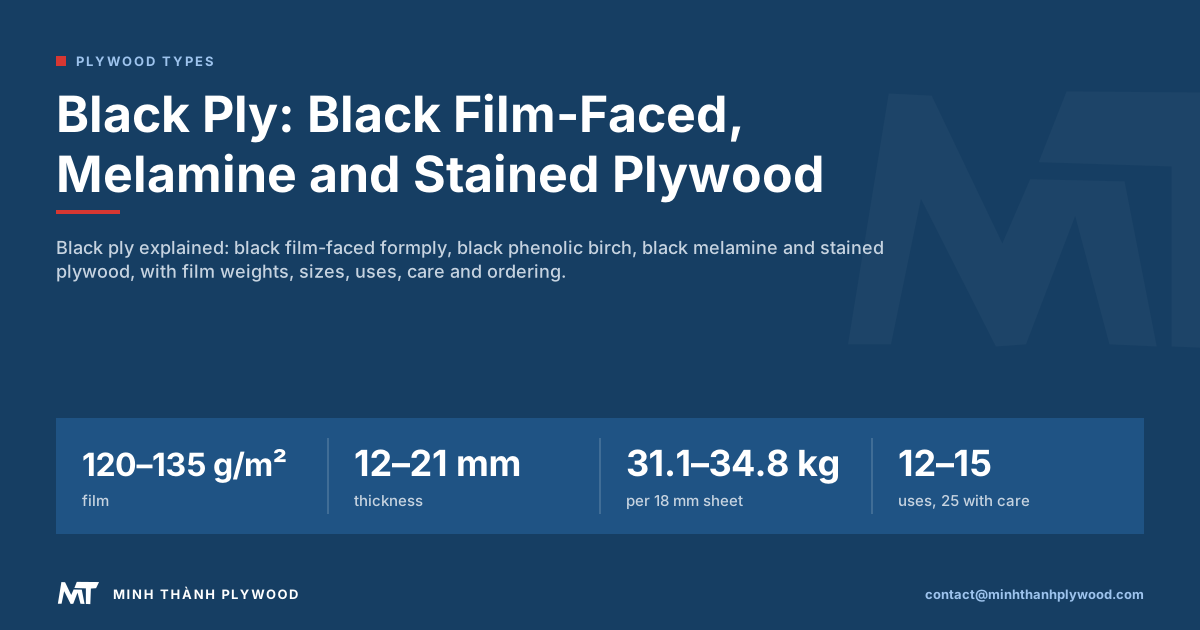
Black ply: the short answer
Black ply is plywood with a black face, and the term usually means black film-faced plywood: a veneer panel with a dark phenolic film pressed onto both faces and its edges painted to seal them. The film gives a smooth, hard, water-resistant surface that releases from concrete and wipes clean.
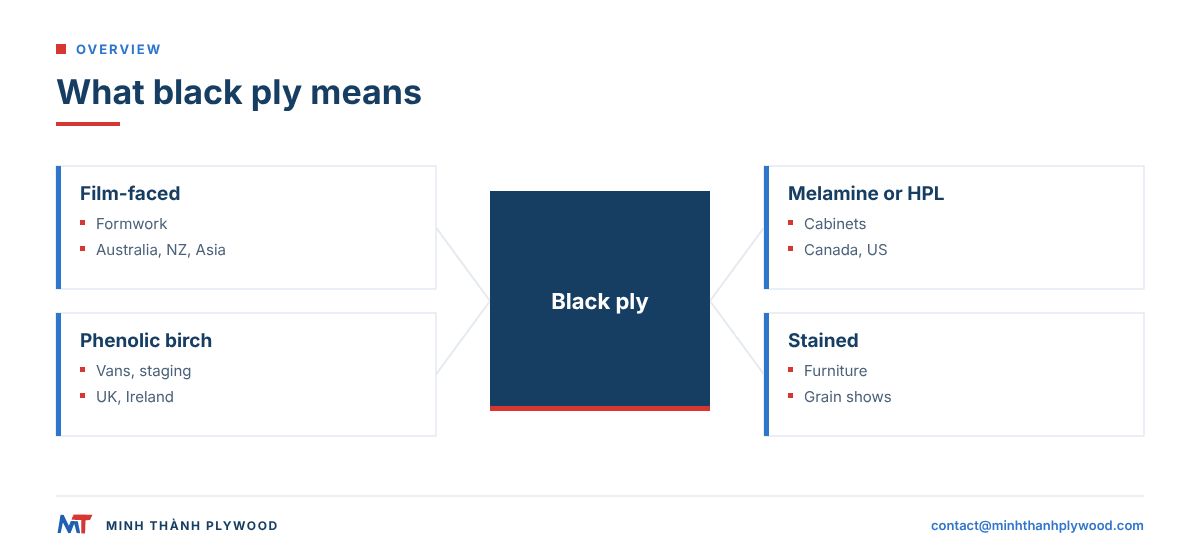
- Black film-faced plywood: formwork, trailer floors, staging; the usual meaning.
- Black phenolic birch: birch plywood with black film, for vehicles, signs and display.
- Black melamine or laminate plywood: decorative black furniture face.
- Stained or painted black plywood: a natural veneer face coloured black.
Minh Thanh Plywood makes black film-faced plywood for concrete formwork in 12–21 mm, on Eucalyptus or Acacia cores.
What “black ply” means in each market
The same words point to different panels by country, so a buyer’s order should name the construction, not only the colour. The table sets out the usual meaning.
| Market | What “black ply” usually means |
|---|---|
| Australia and New Zealand | In these markets “black ply” covers three products: black melamine or stained black birch ply for joinery, the Polytec “Black Ply Woodmatt” plywood-look decor on MDF, and black formply for concrete forms |
| UK and Ireland | Black phenolic birch, film-faced, for vans, staging and signs |
| Canada and the US | Black melamine or black laminate plywood for cabinets, or black film-faced form panels |
| Indonesia, Malaysia, Brunei | Plywood hitam, triplek hitam: black film-faced formwork plywood |
| Middle East and Africa | Black film-faced shuttering plywood for construction |
When a supplier quotes “black ply”, ask for the face (film or decorative), the film weight, the core and the glue before comparing prices.
Black ply in Australia: product, sizes and typical sheet price
In Australia “black ply” usually means a joinery panel, not formwork: black melamine plywood at 2400 × 1200 × 16 mm, black-stained or fingerprint-free black birch at 2440 × 1220 mm, and a plywood-look decor sold on MDF. Black formply for concrete is a separate trade product. The table shows what each costs on a local shelf in October 2026 so an importer can see the margin against a container price.
| Black ply product (Australia) | Typical size | Shelf price seen, October 2026 |
|---|---|---|
| Black stipple melamine plywood (Trademaster) | 2400 × 1200 × 16 mm | about A$81 per sheet incl. GST, shipping from A$29.70 in Sydney metro |
| Black birch plywood: stained, fingerprint-free or HPL faces (Plyonline) | 2440 × 1220 mm, 12 mm and up | priced per sheet by variant |
| Black hexa non-slip birch, exterior (Plyonline) | 1250 × 2500 mm and 1525 × 3050 mm, 12 mm | priced per sheet or pack |
| Polytec Black Ply Woodmatt decor board | 2400 × 1200 mm up to 3600 × 1800 mm panels, 16–33 mm, on MR E0 MDF | per sheet by thickness |
| Film-faced formply, F17 type (Bunnings, non-black film, for comparison) | 2400 × 1200 × 17 mm | about A$95 per sheet |
Polytec’s “Black Ply Woodmatt” is a decorative board with a plywood-edge look, made on moisture-resistant MDF, and it is not plywood at all; a buyer who wants real plywood should ask for plywood in the spec. Our own black film-faced plywood is sold at a raw FOB price per cubic metre, not per sheet: furniture plywood starts from US$350/m³ and commercial plywood from US$250/m³, FOB Hai Phong. A container of one 40HC lands against the A$81 to A$95 shelf sheets above, which is where an importer’s margin comes from.
Australian buyers order by standard: AS/NZS 2269 for structural plywood, AS 6669 for formwork plywood, and the E0 formaldehyde class for interior panels. We arrange third-party testing to the buyer’s method through SGS on request.
Black ply wood vs black plywood: are they the same?
Yes: black ply wood, black plywood, black plyboard and black ply are the same search for the same product family, plywood with a black surface. The names differ by habit, not by construction.
- Black ply board and black plyboard: common in the UK, India and the Middle East.
- Black form plywood and black formply: the formwork panel.
- Black phenolic plywood: the film-faced panel, named after its resin.
- Black plywood sheets: a trade listing for any black-faced sheet.
What changes the product is the face: a resin film, a decorative laminate, or a stain on veneer.
Black film-faced plywood: how it is built
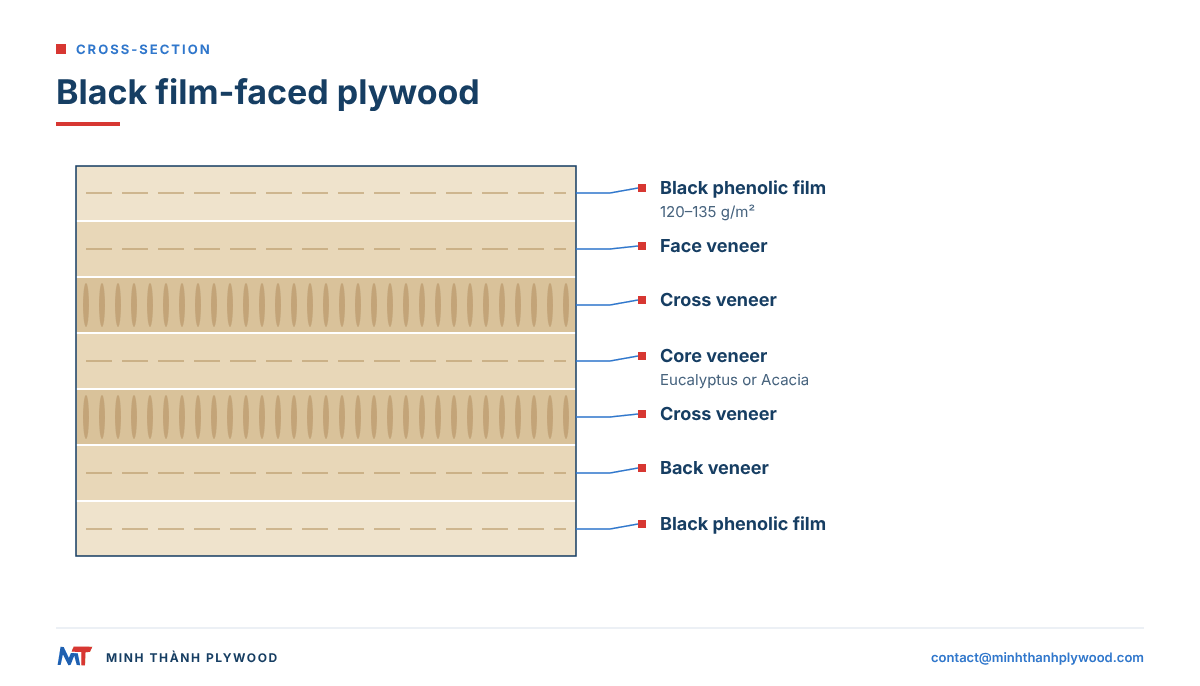
Black film-faced plywood is a cross-laminated veneer panel with a phenolic-resin-impregnated paper film pressed onto each face, and its four edges sealed with paint. The film protects the face; the core and the glue decide the strength and how long it lasts on site.
| Part | What it is |
|---|---|
| Face film | Black or dark brown phenolic film, 120–135 g/m² standard, from 135 g/m² premium |
| Core | Eucalyptus (650–750 kg/m³) or Acacia (about 580 kg/m³) veneers |
| Glue | Melamine-fortified (MR) or phenolic WBP |
| Edges | Sealed with water-resistant paint |
| Thickness | 12–21 mm, ±0.5 mm |
| Sizes | 1220 × 2440 or 1250 × 2500 mm |
These are the lines of our film-faced plywood, the product page with the full specification.
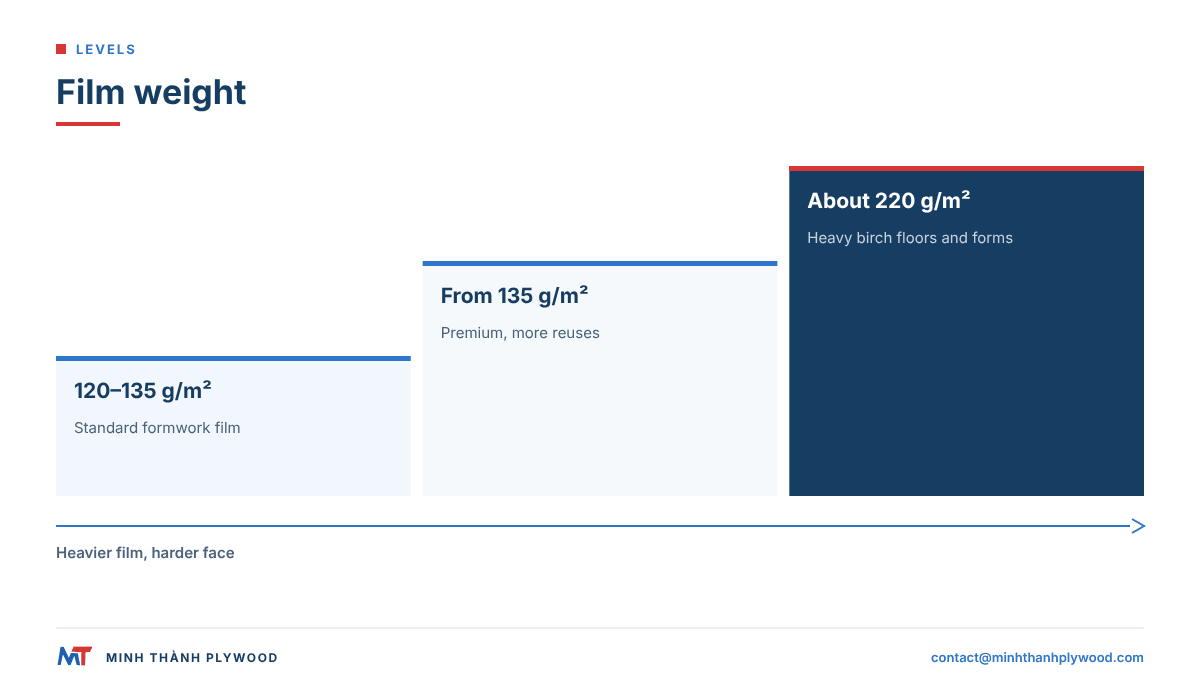
Film weight: what 120, 135 and 220 g/m² mean
Film weight is the mass of the resin film per square metre, and a heavier film gives a thicker, harder face that lasts more pours. Standard black film is 120–135 g/m²; premium film starts from 135 g/m²; heavy films of about 220 g/m² are used on birch phenolic panels for vehicle floors and repeated system formwork.
- 120–135 g/m²: standard formwork panels for general slab and wall work.
- From 135 g/m²: premium film for more reuses and a cleaner concrete finish.
- About 220 g/m²: heavy-duty film on birch panels for floors and long-life forms.
Film weight is one line; the glue is another. A heavy film on an MR glue line still fails early if water reaches the core. Buyers who compare two quotations for black ply should check that both name the film weight in g/m², the glue class, the core species and the thickness tolerance; a low price with no film weight stated usually means the lightest film.
Uses of black ply beyond formwork
Black ply is used wherever a panel must be hard-faced, wipe-clean and dark: concrete formwork is the main use, but vehicle, event and display work buy black film-faced and black phenolic panels too.
- Concrete formwork: slab soffits, walls and columns.
- Trailer and van floors: often with an anti-slip mesh face on top.
- Staging and event floors: black is the theatre and stage standard because it does not reflect light.
- Signs and hoardings: black phenolic panels take vinyl lettering.
- Workshop benches and jigs: a hard face that resists glue and oil.
- Flight cases and crates: a tough black skin.
For a textured, slip-resistant floor face, our anti-slip plywood is the panel to specify.
Black ply board sizes and thicknesses
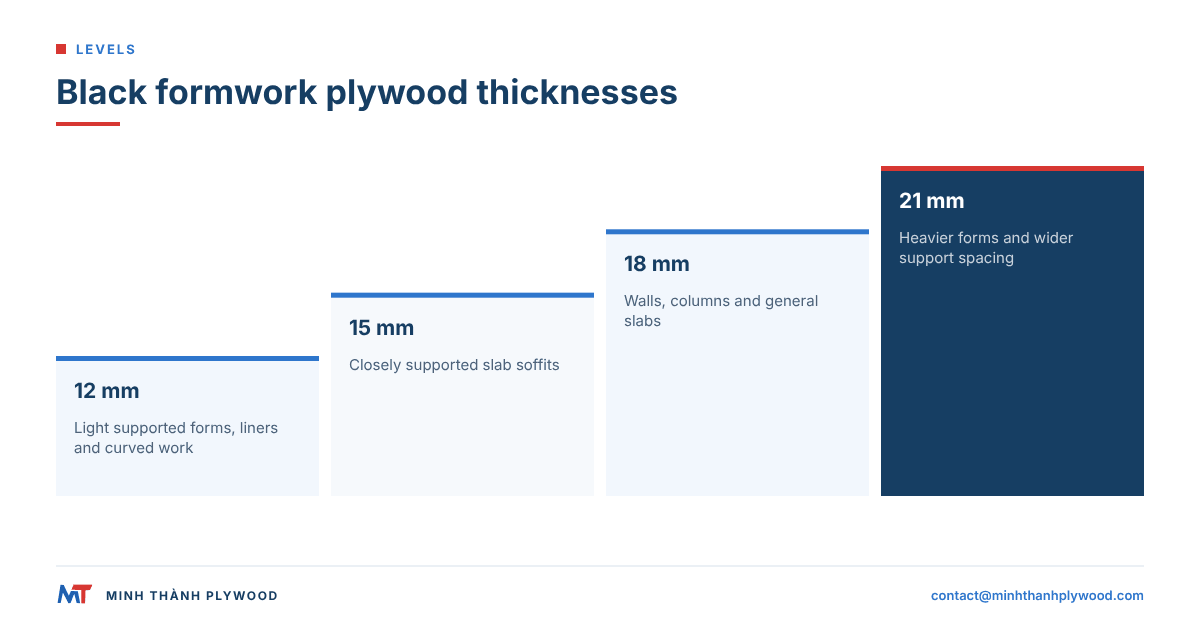
Black ply board for formwork is most often 18 mm thick in 1220 × 2440 mm (4 × 8 ft) or 1250 × 2500 mm. The table gives the common thicknesses and their usual jobs.
| Thickness | Usual use |
|---|---|
| 12 mm | Light supported forms, liners, curved work |
| 15 mm | Closely supported slab soffits |
| 18 mm | Walls, columns and general slabs |
| 21 mm | Heavier forms, wider support spacing |
An 18 mm black film-faced sheet of 1220 × 2440 mm weighs about 31.1 kg on an Acacia core and about 34.8 kg on Eucalyptus, which matters for crane lifts and hand handling. Black phenolic birch for signs and staging also comes thinner, from about 6.5 mm.
Black melamine and black laminate plywood
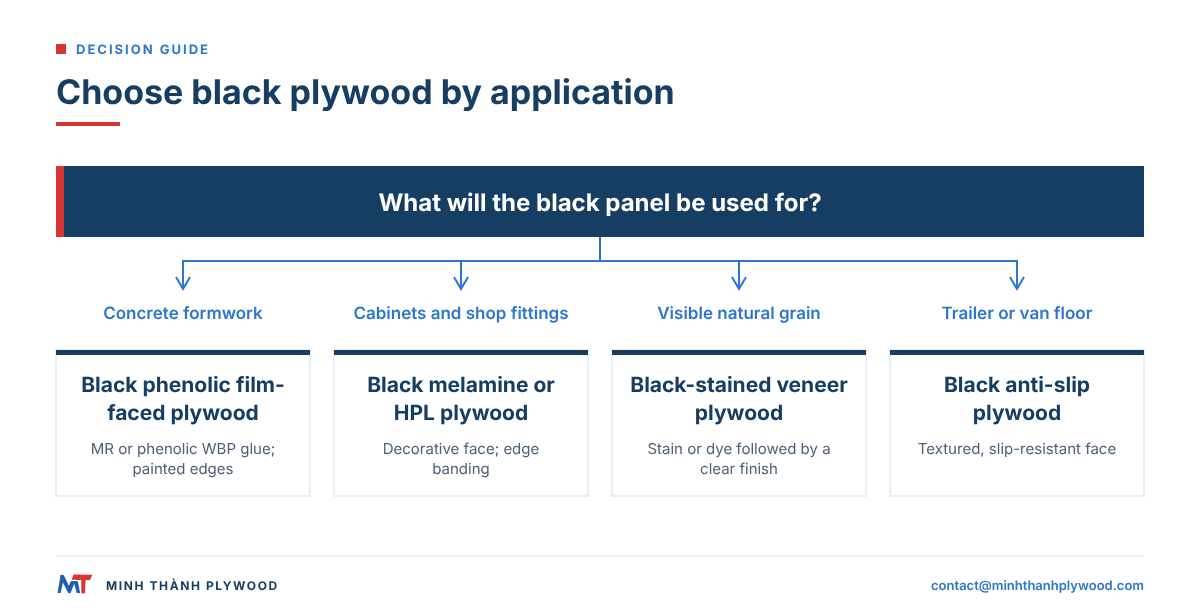
Black melamine or black laminate plywood is a decorative panel: plywood faced with a black melamine paper or a black high-pressure laminate, used for cabinets, retail fittings and furniture, not for formwork. It is the panel Canadian and US cabinet makers usually mean by “black plywood”.
| Point | Black film-faced | Black melamine or HPL plywood |
|---|---|---|
| Purpose | Formwork, floors, staging | Furniture, cabinets, shop fittings |
| Surface | Phenolic film, smooth and hard | Decorative paper or laminate, matt or gloss |
| Glue | MR or phenolic WBP | Usually UF at E0 emission for interiors |
| Edges | Painted seal | Edge banding |
| Look | Industrial, uniform | Furniture-grade colour and texture |
For decorative black faces, see our guide what is HPL, which explains laminating HPL onto plywood, and the laminate sheets guide.
Stained and dyed black plywood
Stained black plywood is a natural veneer face, often birch or poplar, coloured black with a stain or dye so the grain still shows through. It suits furniture, wall panels and displays where a black colour with visible wood texture is wanted.
- Sand the face to 180 grit and remove dust.
- Condition the face with a pre-stain conditioner for even take-up.
- Apply black stain or dye in thin coats along the grain; wipe off the excess.
- Let it dry fully between coats.
- Seal with a clear lacquer, oil or UV coat.
Fine, even faces such as birch take black stain most evenly; our Sande plywood vs birch guide compares two common face species.
Is black ply waterproof?
Black film-faced ply is water-resistant: the phenolic film sheds water, the glue line is MR or phenolic WBP, and the edges are sealed with paint. It stays usable on wet building sites and outdoors, but water enters through fresh cuts and holes that are left unsealed.
- Seal every cut the same day with edge paint.
- Fill bolt and tie holes or seal them.
- Store flat and covered, off the ground.
- Clean concrete off after stripping and apply release agent before the next pour.
With proper handling, release agent and edge sealing, melamine-fortified panels give about 12–15 uses and phenolic WBP panels up to about 25.
Black mould on plywood: what it looks like and how to treat it
Black mould on plywood shows as black or dark green spots and patches, often fuzzy, with a musty smell, on plywood that has stayed damp; it is not the same as dark grain, a black film face or water stains. It grows when plywood sits wet with no air movement.
- Find and stop the water source, then dry the plywood fully.
- Wear a mask and gloves and ventilate the area.
- Scrub the surface with detergent and water, or a diluted bleach solution on unfinished faces.
- Rinse and dry the panel quickly.
- Sand out remaining stains and seal the face.
- Replace plywood that is soft, crumbling or delaminated.
Plywood leaves a well-run mill at 8–12 % moisture; mould starts when it is later stored or installed wet, so dry, ventilated storage is the best prevention.
Black film-faced plywood from Vietnam
We make black film-faced plywood for concrete formwork on Eucalyptus or Acacia cores, with MR or phenolic WBP glue, in 12–21 mm and 1220 × 2440 or 1250 × 2500 mm. Thickness tolerance is ±0.5 mm, and every shipment is photographed and filmed before loading, with the photos and video sent to the buyer.
| Line | Our black film-faced plywood |
|---|---|
| Film | 120–135 g/m² standard; from 135 g/m² premium |
| Core | Eucalyptus or Acacia |
| Glue | MR (melamine-fortified) or phenolic WBP |
| Thickness | 12–21 mm, ±0.5 mm |
| Sizes | 1220 × 2440 or 1250 × 2500 mm |
| Order | From one 40HC; mixed specifications by agreement |
Sea time from Hai Phong is typically 5–12 days to South-East Asia, including Indonesia, Malaysia and Brunei, and 15–25 days to the Middle East, by carrier and route.
Black ply for Australia, New Zealand, Ireland and Canada
Buyers in Australia and New Zealand looking for black ply usually need formply to a structural formwork grade; buyers in Ireland and the UK usually want black phenolic birch; Canadian cabinet buyers usually want black melamine plywood. The supplier you choose should make the construction your market means.
- Australia and New Zealand: for formwork, ask for the stress grade (F14 or F17) and AS 6669 data the engineer uses; for joinery, ask for the 2400 × 1200 or 2440 × 1220 mm size and the E0 class.
- Ireland and the UK: name the face species, film weight and thickness.
- Canada and the US: for cabinets, name the décor, the core and the CARB P2 / TSCA Title VI status.
- South-East Asia: plywood hitam is ordered by thickness, film and number of reuses.
For black melamine cabinet panels sold in the United States, the plywood core falls under the TSCA Title VI composite wood rules, which set a 0.05 ppm limit for hardwood plywood with a veneer core under 40 CFR 770.10. Formwork panels bonded with phenolic WBP glue are a separate case. In the US, formwork for cast-in-place concrete is covered by OSHA standard 1926.703. Formwork buyers look first at film weight, glue class, core species and reuse count, and ask for the shipment photos and test records that go with the order.
Our black vs brown film-faced plywood guide explains the film colour choice in more detail.
What to write on a black ply order
A black ply order that can be quoted fairly names the face, the core, the glue and the size, not only “black plywood 18 mm”. Send these lines:
- Application: slab, wall or column formwork; floor; staging; signs.
- Face: black phenolic film, film weight in g/m².
- Core: Eucalyptus or Acacia.
- Glue: MR or phenolic WBP.
- Size and thickness: for example 1220 × 2440 × 18 mm.
- Packing and quantity: from one 40HC; the destination port.
Plywood itself is processed wood and is not subject to ISPM 15, the international standard for wood packaging.
Production is 15–45 days after the 30% deposit, FOB Hai Phong, CFR or CIF, with free samples. See the film-faced plywood page for the full specification.
Buyer questions, answered
What is black ply?
Black ply is plywood with a black face. In most markets it means black film-faced plywood, a panel with a black phenolic film on both faces used for formwork, floors, staging and signs.
Is black ply the same as formply?
Often, yes. In Australia and New Zealand, black formply is film-faced plywood made for concrete formwork, and many people call it black ply. Formply sold for structural formwork is graded to a stress grade.
Is black ply waterproof?
The black film is water-resistant and the panel is bonded with water-resistant glue, so black film-faced ply survives wet sites and outdoor use. Cut edges and holes must be sealed, or water enters the core.
What thickness does black ply come in?
Black film-faced plywood for formwork is usually 12–21 mm, with 18 mm the common thickness. Thinner black phenolic birch is sold for signs and display work.
What size is a sheet of black ply?
The common sizes are 1220 × 2440 mm (4 × 8 ft) and 1250 × 2500 mm. Custom sizes are cut to order.
What does black mould look like on plywood?
Black mould shows as black or dark green spots or patches, often fuzzy, usually where the plywood has stayed damp. It smells musty, unlike dark grain or a black film face.
How do you remove black mould from plywood?
Dry the area, wear a mask and gloves, scrub the surface with a detergent or a diluted bleach solution, rinse, dry fully and sand stains that remain. Plywood that is soft or delaminated should be replaced.
How do you stain plywood black?
Sand the face to 180 grit, apply a pre-stain conditioner, wipe on a black stain or dye in thin coats with the grain, then seal with a clear coat. Thin birch and poplar faces take an even black best.
What is plywood hitam?
Plywood hitam is Indonesian and Malay for black plywood. In Indonesia, Malaysia and Brunei it usually means black film-faced plywood for formwork, also sold as triplek hitam or multiplek hitam.
How many times can black film-faced plywood be reused?
Melamine-fortified film-faced panels give about 12–15 uses and phenolic WBP panels up to about 25, with proper handling, release agent and edge sealing.