
Cheap plywood is a sheet built with less: a loose-laid core with gaps, fewer and thicker plies, thinner faces, a lower-cost glue and a higher emission class. For crates, pallets and site hoarding that build is the right buy. For furniture, cabinets and flooring it costs more in waste and claims than it saves. Minh Thanh Plywood shows which grade fits which use.
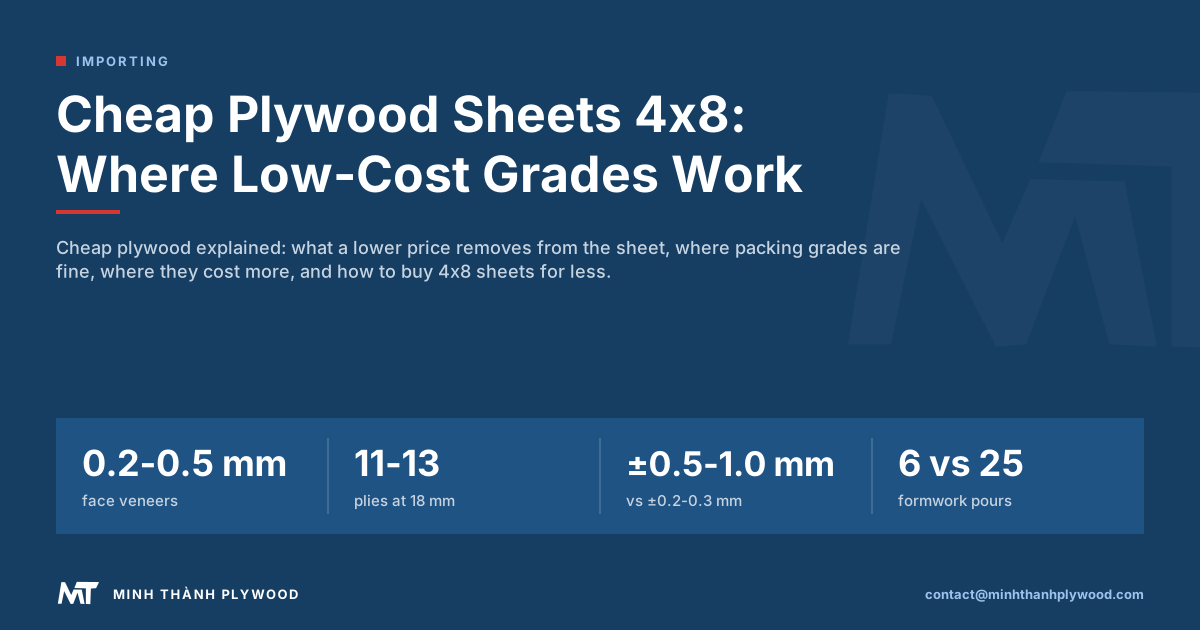
What is cheap plywood?
Cheap plywood is plywood built at the lowest cost per cubic metre: a lower-grade core laid loose, fewer and thicker plies, thin faces, urea glue and often E2 emission. Mills make it on purpose for packing, crates, pallets and temporary site work, where nobody sees the panel and it is used once.
The word “cheap” covers two very different sheets. One is an honest packing or commercial grade sold at its price. The other is a lower-cost build sold under a better name, such as “furniture grade” or “marine grade”. The first saves money. The second moves the cost to the buyer.
The question is never “is this plywood cheap?” but “is this the build my use needs?” The rest of this guide shows what each saving removes from the sheet.
Is plywood expensive?
Plywood is expensive per sheet compared with OSB, particleboard and most MDF, and often cheaper per year of service. It is built from whole peeled veneers, laid with the grain crossing in each layer and glued under heat, which takes more wood and more work than a board pressed from chips or fibres.
One UAE price guide lists standard MDF at AED 40–120 a sheet, particleboard at AED 25–60 and plywood at AED 45–220, depending on grade (Yellow Pages UAE, retrieved 20 October 2026). The plywood range is wide because “plywood” runs from packing grade to decorative veneer faces.
Plywood earns its price where strength and life matter: carcasses that carry hinges, shelves that must not sag, formwork used many times, floors and roofs that get wet. In those uses a lower-cost board fails sooner, and the replacement costs more than the saving.
How much does cheap plywood cost per sheet in the UK?
Cheap plywood in the UK costs about £22 to £38 for a full 8x4 sheet (1220 × 2440 mm) in a high-street merchant, rising with thickness. The table shows what one national merchant listed, VAT included (Wickes plywood range). The prices were read on 21 October 2026.
| Sheet (1220 × 2440 mm) | Price per sheet inc. VAT | Per m² |
|---|---|---|
| 5.5 mm non-structural hardwood | £22.50 | £7.56 |
| 9 mm non-structural hardwood | £25.60 | £8.60 |
| 12 mm non-structural hardwood | £29.00 | £9.74 |
| 18 mm non-structural hardwood | £37.50 | £12.60 |
| 18 mm CE 2+ structural softwood | £37.50 | £12.60 |
Specialist wholesalers sell thin and special sheets with prices shown ex-VAT and inc-VAT. One wholesaler lists a 3 mm flexible 8x4 sheet at £17.59 ex-VAT (£21.11 inc-VAT), with delivery in 1–3 working days (Sheet Materials Wholesale). The page was read on 21 October 2026. A cut-to-size seller quotes hardwood sheets from 3.6 mm to 25 mm up to 3050 × 1220 mm, flat-rate delivery of £25 + VAT, free delivery above £500 and 3–4 working days in England and Wales (MDF Direct, retrieved 21 October 2026).
One UK sheet is 2.98 m². At 18 mm that is 0.0536 m³, so £37.50 inc. VAT is about £583 per m³ before VAT. A container buyer pays for the same volume at mill prices: Minh Thanh packing and commercial plywood start from US$250/m³ FOB (October 2026), and freight, duty and VAT come on top. The retail sheet pays for a small lot, a shelf and a van; a container pays for the plywood itself.
Which EN 636 class is the cheap UK sheet?
A cheap UK sheet is usually sold for dry interior use, so check the service class of EN 636 before buying. EN 636 Class 1 is for dry conditions, Class 2 for humid conditions under cover and Class 3 for exterior use; a fully exterior board needs EN 636-3, which requires an EN 314-2 Class 3 bond, while EN 636-2 suits humid or covered conditions only (Sheet Materials Wholesale guide). The guide was read on 21 October 2026.
“Non-structural” on a label means the sheet carries no load and has no CE 2+ mark; “CE 2+” marks a sheet declared for structural use, with its factory production control certified by a notified body. For hoarding, crates and hidden parts a non-structural dry-use sheet is the cheapest correct choice; for a roof or a damp floor pay for the class.
What does a lower price remove from the sheet?
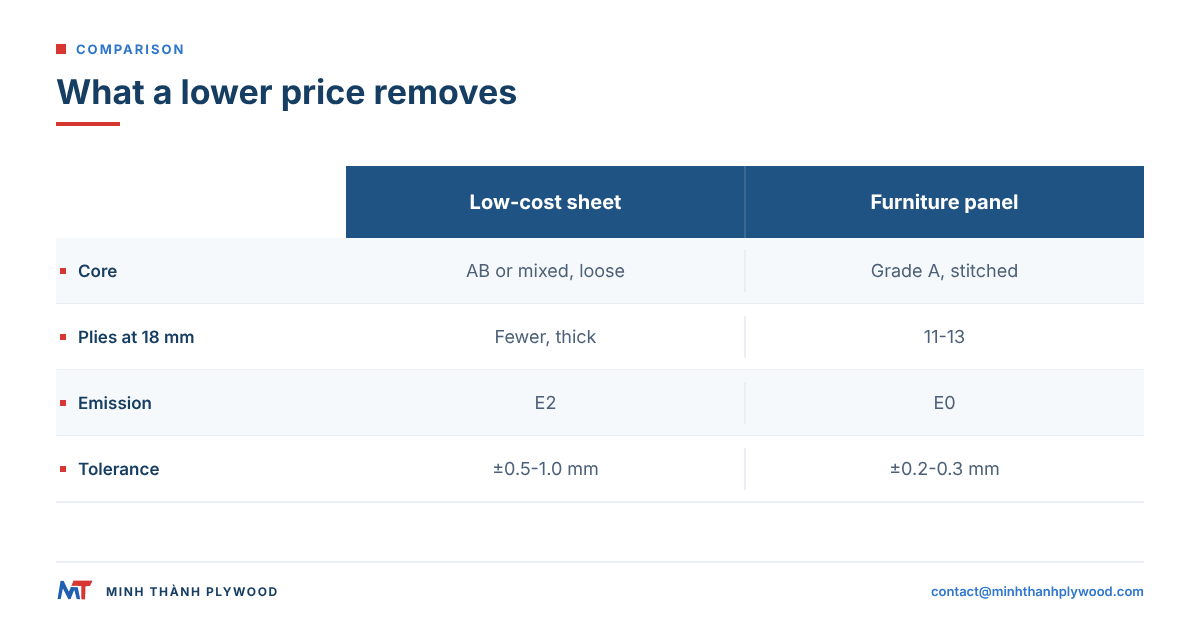
A lower price removes wood quality, labour and glue from inside the sheet, where the buyer cannot see it on a photo. These are the six usual savings, from the largest to the smallest effect on cost.
| Saving | What changes | What the buyer sees later |
|---|---|---|
| Core grade | AB or mixed core veneers, laid loose with gaps and overlaps | Screws that miss, dips that telegraph through veneer or paint |
| Ply count | Fewer, thicker core veneers | Warping, weaker screw holding, rough edges |
| Face veneer | Thinner faces, lower grade, patches | Sand-through, splits, visible core colour |
| Glue | Less glue or a lower-cost resin | Delamination in damp storage or humid climates |
| Emission class | E2 instead of E1 or E0 | Fails emission rules for furniture and interiors |
| Pressing and sanding | Single pressing, no calibration, no sanding | Uneven thickness from sheet to sheet |
Faces on Vietnamese plywood are usually 0.2–0.5 mm thick, and European buyers usually ask for about 0.3 mm. Core veneers are usually 1.4–2.0 mm. A low-cost 18 mm sheet uses the thickest core veneers and the fewest plies; a furniture panel uses more, thinner plies, usually 11–13 at 18 mm.
Core voids and ply count: the first two savings
Core voids and a low ply count are where most of the price difference sits, because the core is most of the panel’s volume. A loose-laid core is quicker to lay and accepts lower-grade veneer; gaps between veneer strips stay inside the sheet after pressing.
Voids matter as soon as the panel is cut or fixed. A screw that lands in a void holds nothing. An edge cut through a void shows a gap that needs filler. A gap under a thin face shows as a dip when light falls across a painted or lacquered surface.
Stitched cores remove most of that risk. At Minh Thanh Plywood, core layers are stitched both horizontally and vertically on furniture panels, and the core board is pressed and calibrated before the faces go on. Packing plywood keeps the loose-laid core, because a crate does not need it.
Count the plies at the edge of a sample and compare with the quote. An 18 mm sheet with far fewer than 11 plies is built from thick, lower-cost veneers.
Thin faces, short glue and E2: the hidden savings
Thin faces, less glue and a higher emission class are the savings a buyer finds last. A thin face looks the same as a thick one on arrival; it shows when the sheet is sanded, lacquered or edged, and the core colour comes through.
Glue is a cost line too. Less glue spread, or a lower-cost resin, still bonds in a dry warehouse and lets go in a humid one. A panel for humid or outdoor use needs a melamine-fortified or phenolic (WBP) bond, written on the quote as its own line.
Emission class is a separate line from glue type. E2 panels release more formaldehyde than E1 or E0 and are normal for packing. They do not meet furniture rules in the main markets: in the EU, Regulation (EU) 2023/1464 limits furniture and wood-based articles to 0.062 mg/m³ from 6 August 2026.
The US limit for hardwood plywood under TSCA Title VI is 0.05 ppm in 40 CFR 770.10. Our furniture panels use UF glue at E0 emission; six ASTM D6007 chamber tests between April 2025 and June 2026 averaged 0.014–0.032 ppm against that 0.05 ppm limit.
Where are low-cost plywood grades fine?
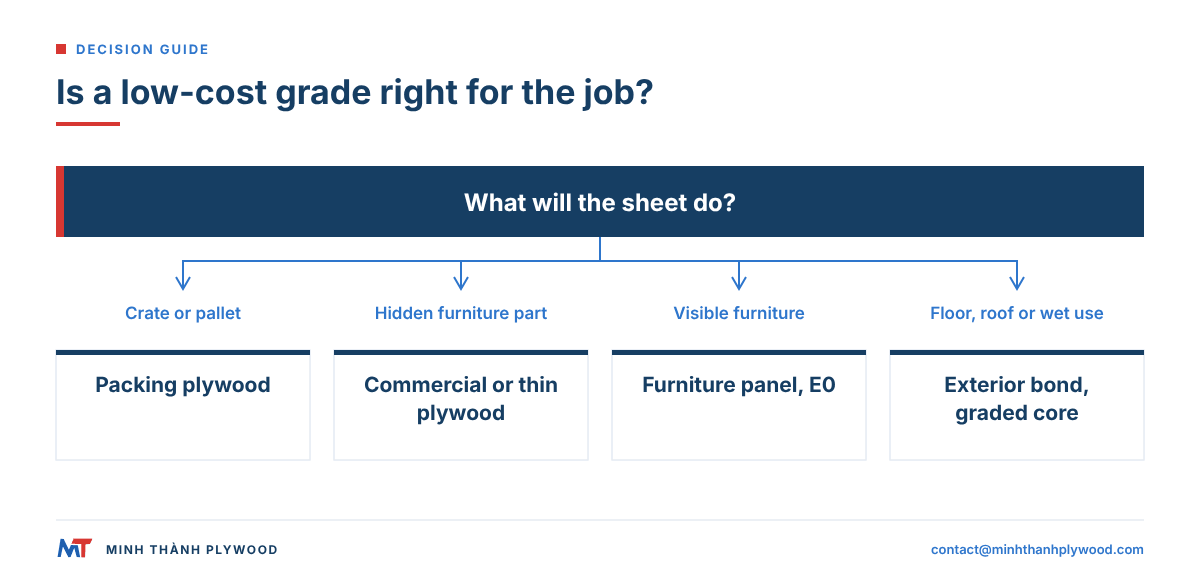
Low-cost plywood grades are fine wherever the panel is hidden, used once or used briefly, and carries light loads. In those uses, paying for a furniture core or a decorative face buys nothing.
| Use | Grade that fits | Why it is enough |
|---|---|---|
| Crates, boxes, pallet tops | Packing plywood, E2 | Single trip, nobody sees the core |
| Site hoarding, temporary walls | Packing or commercial, painted | Short life, outdoors only for months |
| Concrete formwork, few pours | Film-faced, melamine bond | Film protects the face for the planned pours |
| Hidden furniture parts (backs, drawer bottoms) | Commercial or thin plywood | No exposed edges, light loads |
| Sheds and garden structures | Exterior, WBP bond, painted | Rain resistance matters more than face |
| Removal and moving boxes, shop displays | Commercial, utility faces | Short use, painted or covered |
For packaging makers, the deciding numbers are thickness tolerance and weight per cubic metre. Packing plywood is made to ±0.5–1.0 mm; commercial and film-faced to ±0.5 mm. The packing plywood price in Vietnam guide covers that grade in detail.
Where does cheap plywood cost more than it saves?
Cheap plywood costs more than it saves wherever the panel is seen, machined, loaded or kept for years. The saving per sheet is small next to the cost of one rejected batch of cabinets.
- Furniture and cabinets. Voids under the face, sand-through and uneven thickness raise reject rates on CNC lines and edge banders; E2 emission does not meet furniture rules.
- Kitchens and bathrooms. Humidity finds short glue lines; delamination shows months after installation.
- Shelving and worktops. Few, thick plies sag and hold screws poorly.
- Floors and roofs. Voids under a load point crack; a wet floor needs an exterior bond.
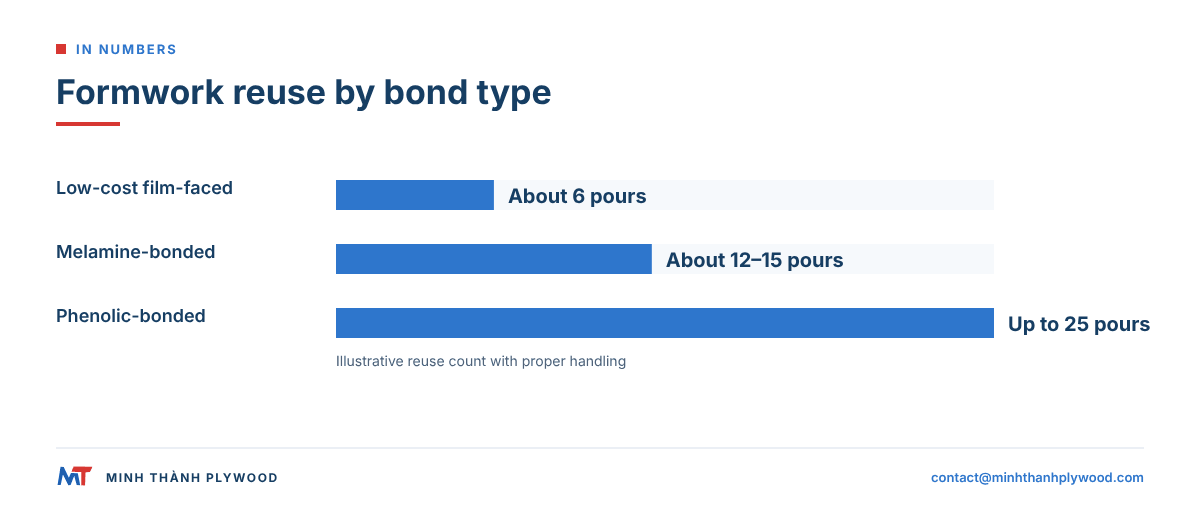
- Formwork with many pours. A low-cost film-faced sheet lasts about 6 pours; a melamine-bonded sheet about 12–15 and a phenolic one up to about 25, with proper handling, release agent and edge sealing.
The test is cost per use, not cost per sheet. A formwork sheet that costs 30% more and lasts twice the pours costs less per pour.
Cheap 8x4 plywood sheets: what to check before you buy
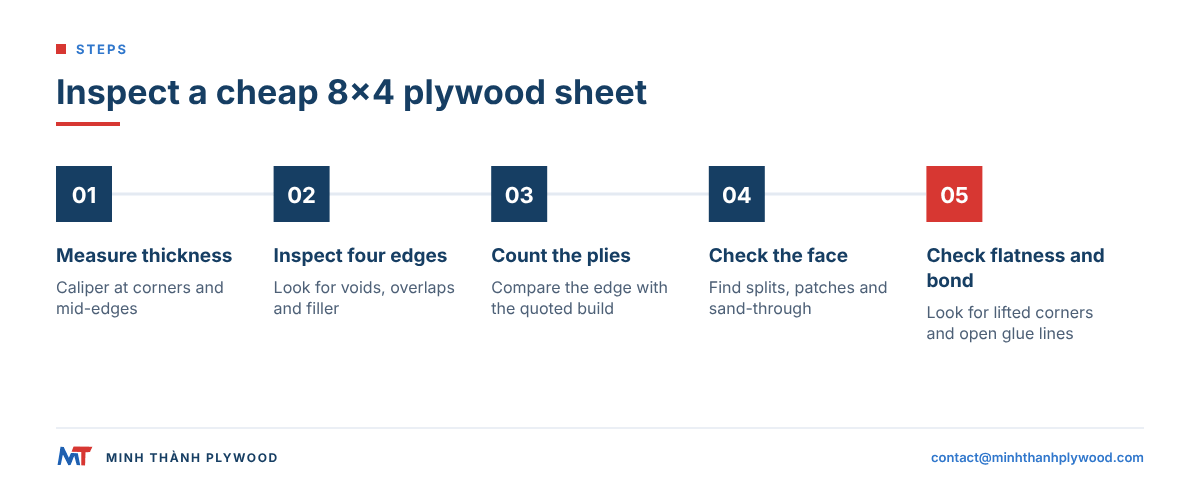
Before you buy cheap 8x4 plywood sheets, the same cheap plywood sheets 4x8 that US buyers search for (1220 × 2440 mm), check five things on a real sheet, not on a photo:
- Thickness. Measure with a caliper at the four corners and mid-edges. A sheet sold as 18 mm that measures 16.5 mm has less wood than you paid for.
- Edges. Look along all four edges for gaps, overlaps and soft filler in the core.
- Ply count. Count the plies and compare with the thickness.
- Face. Check for splits, patches, sand-through and core colour showing.
- Flatness and bond. Lay the sheet flat; check corners for lift and edges for open glue lines.
The 3 mm 8x4 sheets sold cheaply for backs and drawer bottoms deserve the same check. At Minh Thanh, thin panels from 3 to 5 mm are always 5-ply: 3 mm uses one core veneer, two cross-band veneers and two faces. A 3-ply 3 mm sheet is a lower-cost build. See 4x8 plywood price for sheet prices by thickness.
Is OSB, MDF or drywall cheaper than plywood?
OSB, MDF and drywall are all usually cheaper than plywood per sheet, and each is cheaper because it does less. Choose by what the board has to do.
| Board | Price vs plywood | Where it wins | Where plywood wins |
|---|---|---|---|
| OSB | Usually lower per sheet | Wall and roof sheathing, subfloor in dry builds | Stiffness for its weight, edge fixing, wet recovery |
| MDF | Usually lower per sheet (UAE guide: AED 40–120 vs AED 45–220) | Painted doors, mouldings, CNC-routed shapes | Screw holding, weight, moisture, shelf spans |
| Particleboard | Lower (UAE guide: AED 25–60) | Flat-pack carcasses with melamine faces | Strength, moisture, repairs |
| Drywall (gypsum) | Lower per sheet | Wall lining and fire-rated partitions | Any fixing or load |
Our comparisons of plywood vs OSB and plywood vs MDF go through strength, weight and moisture in detail.
Is plywood cheaper in Vietnam or China?
Whether plywood is cheaper in Vietnam or China depends on the build more than the country: the gap between two quotes almost always comes from what is inside the sheet. Core species, core grade, ply count, glue, emission class and thickness tolerance change the cost far more than the country.
Vietnamese mills build on plantation hardwood: acacia, eucalyptus and white Styrax cores. In Ha Hoa, Phu Tho, locally grown plantation timber supplies the cores, which keeps high-grade panels at a better price than comparable mills. Chinese mills often use poplar and mixed hardwood cores.
Compare written specifications line by line, and ask every supplier the same questions. Our guide to Vietnam plywood price covers FOB ranges and what drives them.
Used, second-grade and offcut plywood
Used, second-grade and offcut plywood is the lowest-cost plywood a buyer can find, and it fits only uses where the unknowns do not matter. A merchant’s seconds are sheets with face defects, damaged corners or wrong sizes; offcuts are what is left after cutting.
For crates, temporary floors, site hoarding, workshop jigs and hobby work, seconds and offcuts are good value. For anything structural, visible or sold on, they are not: you cannot see the core, the glue or the emission class, and nobody stands behind the sheet.
Used formwork panels are a special case. They can still serve as hoarding or crating, but their bond has been through many wet pours; do not use them as flooring or shelving.
How to buy plywood for less without buying worse
The way to buy plywood for less is to buy exactly the build your use needs, in the largest quantity you can use, on the right terms.
- Start from the use. Write what the sheet does: packing, hidden parts, painted furniture, formwork or exterior.
- Drop what the use does not need. No decorative face on a crate, no E0 on outdoor hoarding, no stitched core on a single-trip box.
- Keep what it does need. Bond for humidity, tolerance for CNC, emission class for the market.
- Buy by the pack or container. The UAE guide shows 18 mm commercial sheets falling from AED 78–110 retail to AED 48–68 for 500+ sheets.
- Fill the container. One 40HC usually carries 1–2 specifications and 3–6 by agreement, so several thicknesses can share one load.
- Pick the core for freight. A Styrax core fits 990 sheets of 18 mm in a 40HC against 795 on eucalyptus, so freight per sheet falls.
- Compare per cubic metre and per sheet. Per cubic metre compares material; per sheet is what you use.
The plywood price guide explains how mills build a price from these lines.
What drives the price of low-cost plywood?
The price of low-cost plywood moves with the same seven lines as any plywood. Write each one on the quote; two “cheap 18 mm” quotes can differ on all seven.
| Price driver | Low-cost choice | Higher-cost choice |
|---|---|---|
| Face | Utility face, patches allowed | Graded face, sanded, matched to sample |
| Core | AB or mixed, loose-laid | Grade A, stitched, calibrated |
| Glue and emission | UF, E2 | UF at E0, melamine-fortified or phenolic |
| Thickness and tolerance | ±0.5–1.0 mm | ±0.2–0.3 mm sanded |
| Size | 1220 × 2440 mm standard | Custom size or cut-to-size |
| Quantity | Full 40HC | Single packs |
| Delivery term | FOB Hai Phong | CIF with insurance |
Minh Thanh Plywood’s indicative starting prices in October 2026 are commercial plywood from US$250/m³ and furniture/interior plywood from US$350/m³; the final price follows these seven lines.
Cost-effective packing and commercial plywood from Minh Thanh
Minh Thanh Plywood makes packing and commercial plywood alongside its furniture and interior panels, in Ha Hoa, Phu Tho, Vietnam, with 50,000+ m³ of annual capacity. Packaging makers, pallet plants and distributors buy them by the container.
- Packing plywood: loose-laid plantation core, utility faces, thickness tolerance ±0.5–1.0 mm.
- Commercial plywood: graded core, utility or better faces, ±0.5 mm.
- Film-faced and exterior panels: acacia or eucalyptus cores, melamine-fortified or phenolic WBP bonds to your specification.
- Sizes: 1220 × 2440 and 1250 × 2500 mm, custom sizes and cut-to-size.
- Terms: MOQ one 40HC with mixed specifications by agreement; production 15–45 days after the 30% deposit; 70% against the scanned B/L or an irrevocable L/C at sight; FOB Hai Phong, CFR or CIF; free samples.
Send your RFQ with the use, core, glue and emission class, face, size and thickness, packing and quantity, and destination port to [email protected] or WhatsApp +84 988 586 601. We reply within hours. See packing plywood and the commercial plywood price guide.
Buyer questions, answered
What is cheap plywood?
Cheap plywood is plywood built at the lowest cost: a loose-laid, lower-grade core, fewer and thicker plies, thin faces, urea glue and often E2 emission. It is made for packing, crates and temporary site work, where appearance and long life do not matter.
How much is a sheet of cheap plywood in the UK?
A full 8x4 non-structural hardwood sheet listed from £22.50 at 5.5 mm to £37.50 at 18 mm including VAT at one national merchant on 21 October 2026. That is about £583 per m³ before VAT at 18 mm, against US$250/m³ FOB for packing and commercial grades from Vietnam (October 2026), before freight, duty and VAT.
Is plywood expensive?
Plywood costs more per sheet than OSB, particleboard or most MDF, because it is built from whole veneers glued in crossed layers. Per year of service in furniture, cabinets or formwork it is often the lower-cost choice, because it holds screws, resists moisture better and lasts longer.
What is the cheapest plywood?
Packing plywood is the lowest-priced plywood: a loose-laid core, utility faces, E2 emission and a wider thickness tolerance of ±0.5–1.0 mm. It is the right sheet for crates, pallets and boxes, not for furniture.
Is OSB cheaper than plywood?
Usually yes, sheet for sheet, for sheathing and subfloor thicknesses. Plywood is lighter for its stiffness, holds fasteners near edges better and recovers better from wetting, which is why it is still chosen for many floors, roofs and formwork.
Is MDF cheaper than plywood?
Usually yes per sheet. One UAE price guide lists standard MDF at AED 40–120 and plywood at AED 45–220 a sheet. MDF machines and paints well but is heavy, weak at screws near edges and swells when wet, so plywood stays the choice for carcasses and shelves.
Is drywall cheaper than plywood?
Yes, for wall lining. Gypsum board costs less per sheet than plywood, but it carries no load and holds no screws without anchors. Plywood is used behind it where shelves, cabinets or TVs will be fixed.
Where can I get cheap plywood sheets?
For a few sheets, local merchants sell packing grade, seconds and offcuts. For a container, buy direct from a mill and pick the grade by use. Packing and commercial grades from Vietnam are priced from about US$250/m³ FOB (October 2026).
Is plywood cheaper in Vietnam than in China?
It depends on the build more than the country. The gap between two quotes usually comes from different core species, ply count, glue and thickness tolerance, so compare written specifications, not origins.
Who supplies cheap packing plywood from Vietnam?
Vietnamese plywood mills supply packing plywood by the container. Minh Thanh Plywood makes packing plywood on plantation cores, from US$250/m³ FOB (October 2026), MOQ one 40HC with mixed thicknesses by agreement.
Can cheap plywood be used for furniture?
Only for hidden parts. Core gaps show through veneer and paint, screws miss in voids, and E2 emission does not meet most furniture markets. Use a furniture panel with a graded, stitched core and E0 emission for visible parts.
Is it worth buying used or second-grade plywood?
For crates, temporary floors or hoarding, often yes. For anything structural or visible, no: you cannot see the core, the bond or the emission class, and the saving disappears in rejects.