
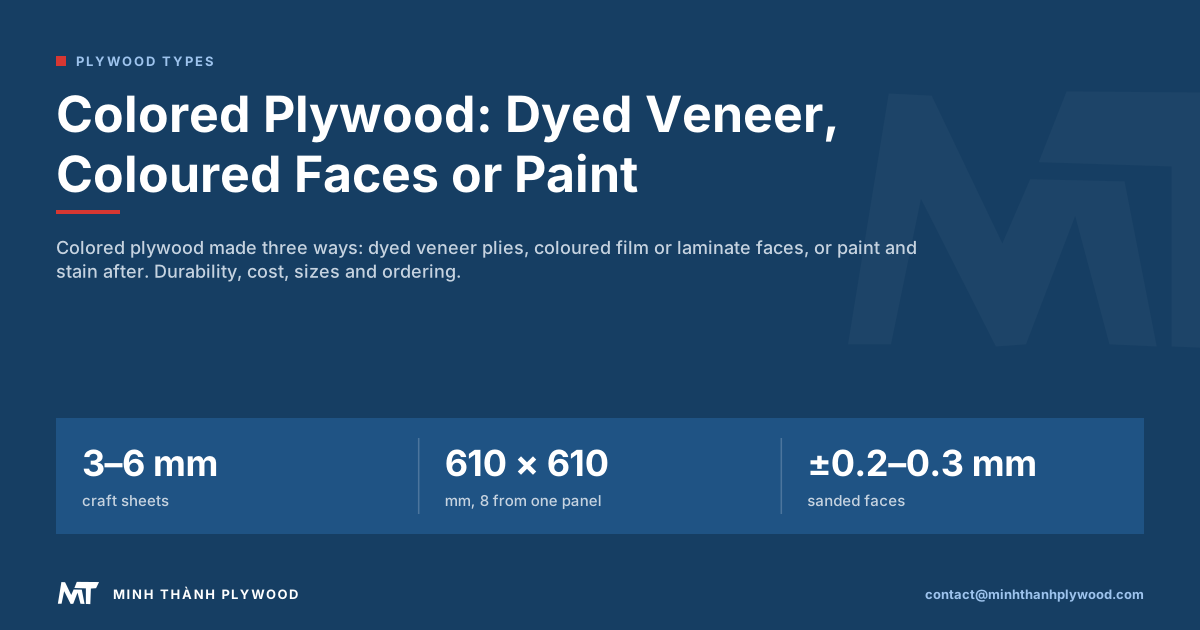
Colored plywood gets its colour in one of three ways: dyed veneers pressed into the panel, a coloured film, laminate or overlay pressed onto the face, or paint and stain applied after. Each method changes durability, cost, the look of the edge and the order size. This guide explains all three, the natural colours of plywood species, and the checks for colour on delivery. Minh Thanh Plywood makes sanded, UV-ready plywood in Vietnam for buyers who colour their own panels.
What is colored plywood?
Colored plywood is plywood whose colour comes from dyed veneers, a coloured face overlay or a finish applied after pressing, rather than only from the natural wood. The method decides how long the colour lasts, whether the edges show it, and what the panel costs.
- Dyed veneer plywood: veneers are dyed before pressing; colour runs through the plies and shows on the edge.
- Overlaid plywood: a coloured film, laminate or paper overlay is pressed onto the face; the core stays natural.
- Finished plywood: plain plywood painted, stained or lacquered after pressing.
Coloured plywood and colored plywood are the same product: the spelling follows British or American English.
Three ways plywood gets its colour
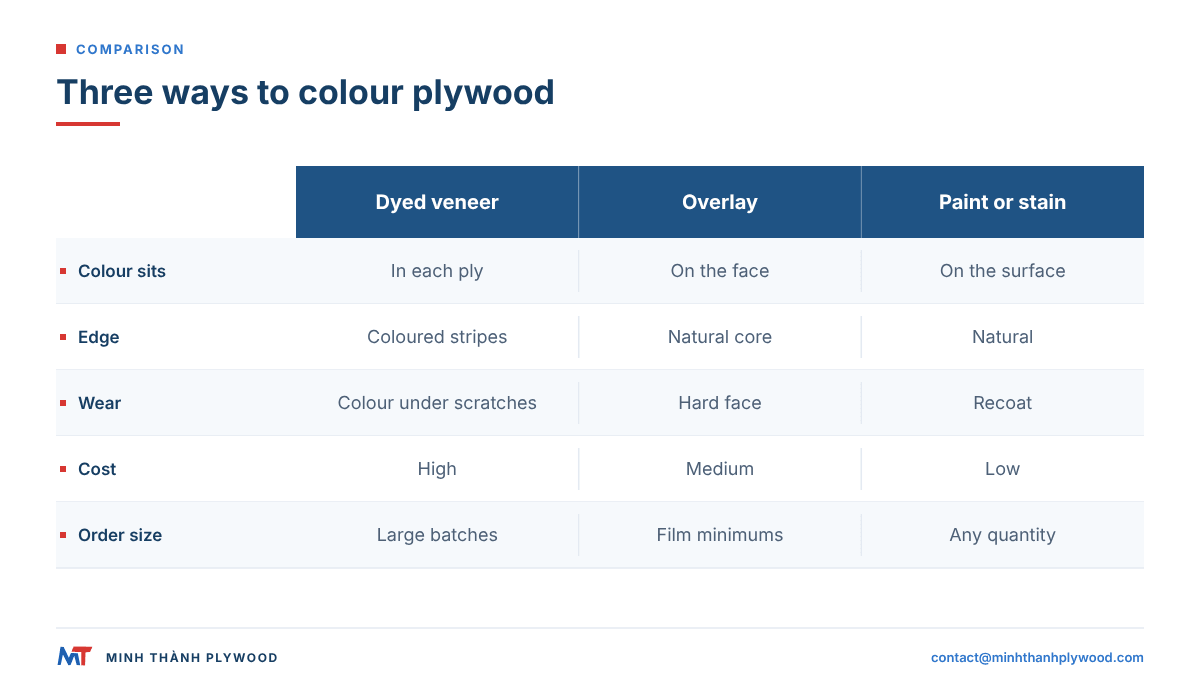
The three methods compare on durability, cost, edge look and order size. The table gives one property per row.
| Property | Dyed veneer | Coloured overlay | Paint or stain after |
|---|---|---|---|
| Where the colour sits | In each dyed ply | On the face only | On the surface |
| Edge look | Coloured stripes | Natural core, coloured face | Natural, unless painted |
| Grain visible | Yes | Only with wood-print laminates | With stain; no with paint |
| Wear and scratch | Colour shows wood under scratches | Hard, wear-resistant face | Recoat as it wears |
| Fade in sunlight | Fades over time | Holds colour well | Depends on paint |
| Cost | High | Medium | Low panel cost, plus labour |
| Order size | Large dye batches | Film or laminate minimums | Any quantity |
| Best for | Craft, laser, design edges | Furniture, shopfitting, formwork | Any project, site work |
For most buyers, colour on the face with a natural core is the cost-effective choice, and dyed plies are kept for designs that show the edge.
Dyed veneer plywood: colour through the plies
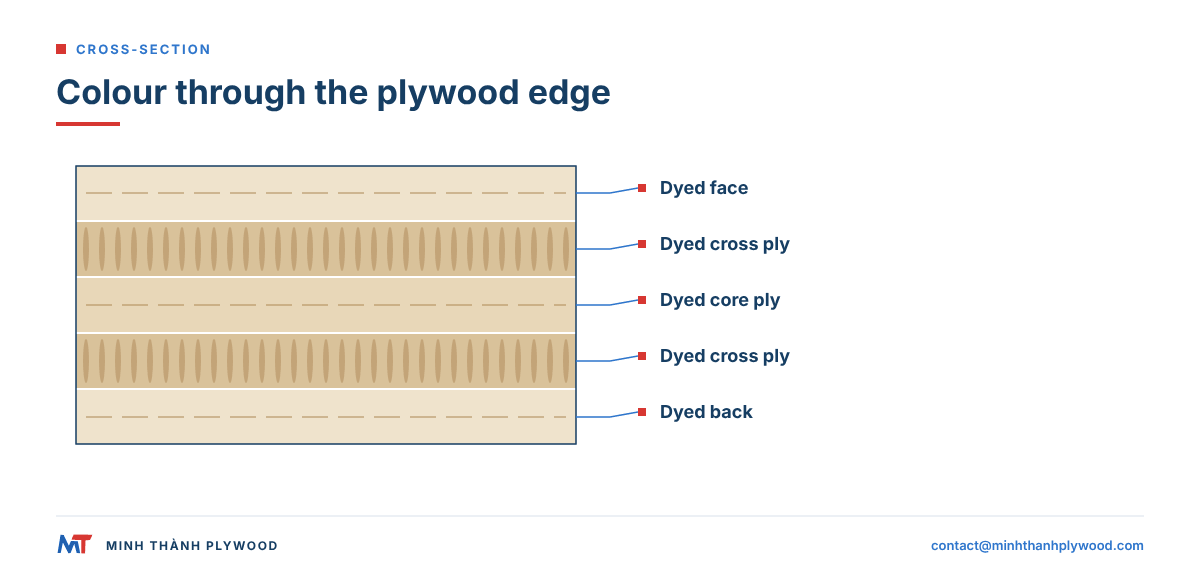
Dyed veneer plywood is made by soaking or pressure-dyeing thin veneers before lay-up, so the colour goes through each ply. When the panel is cut or engraved, the colour shows in the cut, and alternating colours make striped, colorful edges.
- Species: pale, even veneers such as birch and poplar take dye most evenly.
- Colours: any colour the dye allows; one colour throughout or several colours in turns.
- Edge: each ply shows as a coloured line on the cut edge.
- Uses: laser-cut signs, toys, jewellery, design furniture, wall art.
- Limits: dye fades in sunlight; scratches show the same colour, not raw wood.
Dyed birch sheets are popular for laser craft because the engraving cuts through to a contrasting ply.
How to make multi colored plywood: step by step
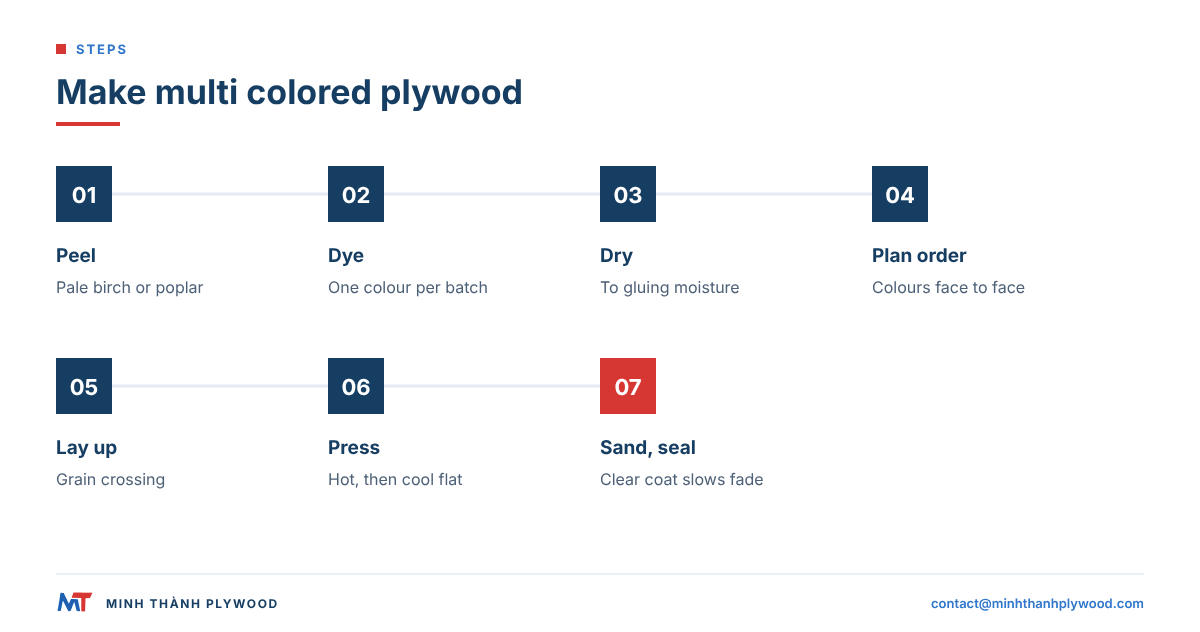
Multi colored plywood is made by dyeing veneers in several colours and pressing them in a chosen order, with the grain of each ply crossing the one before. The steps are the same as for normal plywood, with dyeing added before drying.
- Peel or slice thin veneers of a pale species such as birch or poplar.
- Dye each batch of veneers in one colour, by soaking or under pressure, until the colour goes through.
- Dry the dyed veneers to the moisture content needed for gluing.
- Plan the order of colours from face to face; the edge will show them in that order.
- Spread glue and lay up the veneers with the grain crossing at each ply.
- Press the stack hot, then cool it flat.
- Sand and trim the panel to size; seal it with a clear coat that slows fading.
At small scale, makers glue dyed veneers or thin coloured sheets in a vacuum bag. For laser work, each sheet stays thin, often 3–6 mm.
Coloured faces: film, laminate and overlays
A coloured overlay pressed onto plywood gives the most even and durable colour, because the colour sits in a pigmented film or laminate rather than in the wood. The core and edges stay natural unless they are edged or painted.
| Overlay | Look | Wear | Typical use |
|---|---|---|---|
| Phenolic film | Brown, black and other solid colours | High; water resistant | Formwork, trailers, stages |
| High-pressure laminate (HPL) | Any solid colour or print | Very high | Counters, shop fittings, lab furniture |
| Melamine paper | Solid colours and wood prints | High | Cabinets, wardrobes |
| Coloured lacquer | Solid colour, grain hidden | Medium | Furniture, display |
Laminate faces follow the EN 438 series, described in the BSI record for BS EN 438-1.
Film-faced plywood is the best-known coloured plywood: brown and black films for formwork, and other colours for stages, signs and vehicle floors. Our guide to black vs brown film-faced plywood compares the film colours.
Paint and stain after: colorful plywood from any sheet
Painting or staining after pressing turns any plywood into colorful plywood, in any colour and any quantity, at the lowest panel cost. The finish lasts as long as the surface preparation and the coating.
- Choose the face: birch, poplar or EV for an even painted face; okoume or pine where stain should show grain.
- Sand with fine paper; a sanded factory face needs only a light pass.
- Seal knots and edges; edges absorb paint and stain fastest.
- Prime with a primer for wood panels before solid colours.
- Apply colour in two thin coats; stain in one coat, then a clear topcoat.
- Protect outdoor panels with exterior paint and sealed edges.
Our guides to how to paint plywood and how to stain plywood cover finishes in detail.
What color paint is best for plywood?
The best paint colour for plywood is any colour in a paint made for the use, applied over a primer; light colours are the safer choice outdoors. Dark colours absorb heat in the sun, which moves the wood more and shows checks sooner.
- White and off-white: hide grain best after priming; the most common painted plywood colour.
- Grey: hides marks and dust; popular in shopfitting and modern interiors.
- Black: strong look for displays and stages; shows dust and scratches.
- Bright colours: for children’s rooms, play equipment and signs; need a good primer for even colour.
On birch, a pale stain such as natural or grey wash looks more even than dark stains.
Colored wood: the natural colours of plywood species
The natural colour of plywood is the colour of its face species, so choosing the face is the first colour decision. Each species also changes colour as it ages in light.
| Face species | Natural colour | Ageing |
|---|---|---|
| Birch | Cream to pale yellow | Light amber |
| Poplar | White to cream, some green streaks | Warm cream |
| Pine | Yellow with brown knots | Deeper yellow |
| Okoume | Pinkish brown | Warm brown |
| Eucalyptus | Pinkish to reddish brown | Darker brown |
| Bintangor and gurjan | Reddish brown | Darker red-brown |
| Sapele | Reddish brown with stripe figure | Deeper red |
| Engineered veneer (EV) | Chosen wood tone, even sheet to sheet | By tone |
Coloured wood from natural species stays truer to the grain than any dye. Our guide to types of wood and the hardwood plywood guide describe each species.
Grey, black and white plywood
Grey, black and white are the most-asked plywood colours, and each is made by any of the three methods. The method decides whether the grain shows and how the edge looks.
- White plywood: white laminate or melamine for an even face; white paint over a primed birch or poplar face; white wash stain to keep grain.
- Grey plywood: grey laminate for shop fittings; grey wash stain on birch; grey dyed plies for craft.
- Black plywood: black film for formwork and stages; black laminate or lacquer for furniture; black dyed plies for laser contrast.
For a matching set of parts, choose one method for all of them. A painted part never matches a laminated one exactly.
Colored plywood sheets for laser cutting and crafts
Colored plywood sheets for laser cutting are usually thin, 3–6 mm, with a pale, even face and a void-free core, cut into sizes that fit the laser bed. Coloured faces engrave to a contrasting colour; dyed plies show colour on every cut.
- Thickness: 3, 4, 5 and 6 mm are the usual craft sheets.
- Build: thin plywood made 5-ply, with even core veneers, keeps the laser cutting through cleanly.
- Face: birch or poplar, sanded, so colour or paint goes on evenly.
- Size: one 1220 × 2440 mm panel cut into 4 pieces gives 610 × 1220 mm sheets; into 8 pieces, 610 × 610 mm sheets.
See our thin plywood and cut-to-size plywood pages for the base sheets that buyers colour themselves.
Durability and cost by method
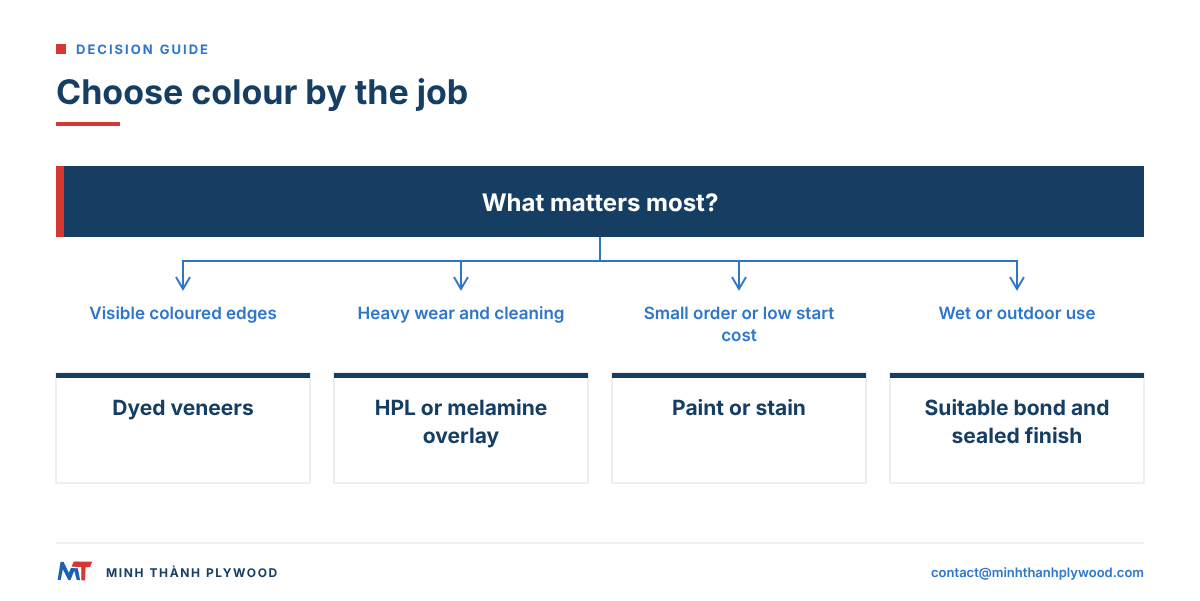
Coloured overlays last longest, paint costs least to start and dyed veneers cost most to make. Choose by where the panel lives and whether the edge shows.
| Need | Best method | Reason |
|---|---|---|
| Heavy wear, cleaning | HPL or melamine overlay | Hard, sealed face |
| Wet and outdoor use | Film over a phenolic (WBP) bond, or exterior paint | Water-resistant face and glue |
| Visible coloured edges | Dyed veneer | Colour in every ply |
| Small quantities | Paint or stain | No minimum order |
| Grain visible in colour | Stain or dyed face | Wood shows through |
| Lowest start cost | Paint on site | Plain panel price |
Colour does not add water resistance by itself. The glue line, sealed edges and the topcoat decide how coloured plywood survives damp.
Why factory-coloured faces need a minimum order
Factory-dyed veneers and coloured overlays need a minimum order because colour is made in batches: one dye bath, one film run or one laminate lot per colour. Small orders pay the full set-up cost of a batch for a few sheets.
- Dyed veneers: one dye batch per colour; mixing batches risks shade differences.
- Films and laminates: suppliers sell by roll or lot, often far more than a small order needs.
- Colour matching: every new batch is checked against the approved colour sample.
- Mixed loads: our MOQ is one 40HC, with mixed specifications by agreement, so one container can carry several thicknesses of the same base panel.
For small runs, ordering a sanded, UV-ready base panel and colouring it locally is usually cheaper and faster.
EV plywood: an even wood colour sheet after sheet
Engineered veneer (EV) plywood gives a wood colour and grain that repeat almost exactly from sheet to sheet, which natural veneers cannot do. It suits furniture and interiors where many panels must match.
- What EV is: an engineered veneer: plantation wood peeled, dyed to a target colour, glued into a block and re-sliced.
- Colour range: straight grain, crown and oak-look patterns in pale, walnut, red and white colours, chosen from an approved sample.
- Consistency: little shade difference between sheets of one order.
- Use: furniture, doors, wall panels and shopfitting with a natural wood look.
EV is one of the faces we make most. See our EV plywood page.
Colour checks on delivery
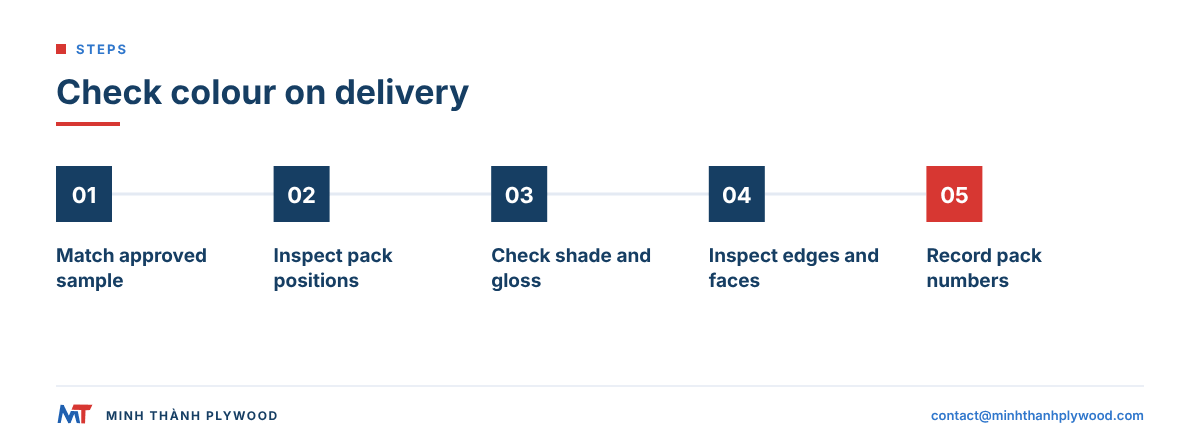
Check coloured plywood on delivery against the approved sample, in daylight, before cutting any sheet. Colour faults are cheap to settle before machining and expensive after.
- Compare a sheet from the top, middle and bottom of each pack with the sample.
- Look at an angle to find gloss and shade differences.
- Check edges on dyed panels for even colour in every ply.
- Inspect the face for scratches, film bubbles or lifted laminate edges.
- Record batch or pack numbers so any replacement matches the same batch.
Where gloss matters, a gloss value measured at 20°, 60° or 85° under ISO 2813:2014 turns “looks shinier” into a number both sides can compare.
Every Minh Thanh shipment is photographed and filmed before loading, and buyers receive the photos and video.
UV-ready faces for your own coating
Our plywood faces are sanded and UV-ready on both sides, so buyers can apply their own UV lacquer, paint, stain or laminate in their own colour. This keeps colour decisions close to the market and the order size flexible.
- Faces: EV, poplar, birch, okoume and pine, among 10+ face veneers.
- Core: white Styrax for a light, pale panel or Eucalyptus for a harder one.
- Flatness: pressed twice and calibrated; sanded furniture panels within ±0.2–0.3 mm.
- Emission: UF glue at E0 emission, CARB P2 / TSCA Title VI certified (ICTT mill no. 23024), with chamber results of 0.014–0.032 ppm. The US limit for veneer-core hardwood plywood is 0.05 ppm under the EPA formaldehyde emission standards.
Our guides to prefinished plywood and UV-coated plywood explain factory-finished faces.
What to put in your request
For a base panel to colour, or a quote for a coloured project, send these lines:
- Application: furniture, shopfitting, laser craft, signs or another use, and the colour method you plan.
- Core: white Styrax or Eucalyptus.
- Glue and emission: UF glue at E0 emission, MR or melamine-fortified, or phenolic (WBP) for wet use.
- Face: EV tone, poplar, birch, okoume or pine, with the grade pair or an approved sample.
- Size and thickness: 1220 × 2440 or 1250 × 2500 mm, 3–40 mm, or cut-to-size pieces.
- Packing and quantity: from one 40HC, mixed specifications by agreement.
Production takes 15–45 days after the 30% deposit, and free samples are available to test your colour on our face.
Buyer questions, answered
Does plywood come in colors?
Yes. Plywood comes coloured through dyed veneer plies, with a coloured film, laminate or overlay on the face, or painted and stained after pressing. Plain plywood shows the natural colour of its face species.
What is the color of plywood?
Plain plywood takes the colour of its face veneer: cream for birch and poplar, yellow for pine, pinkish brown for okoume and reddish brown for meranti or sapele. The core shows only on the edges.
How do you make multi colored plywood?
Dye thin veneers in different colours, dry them, then lay them up with the grain crossing and press them with glue, as in normal plywood. The colours show as stripes on every cut edge.
What color paint is best for plywood?
Any exterior or interior paint works over a primer. Light colours show less heat movement outdoors; white and grey hide the grain best when the face is sealed and primed first.
What is the best stain color for birch plywood?
Light and medium tones such as natural, honey or grey wash look most even on birch. Birch blotches with dark stains, so use a wood conditioner or a gel stain.
Is colored plywood waterproof?
The colour does not decide water resistance; the glue does. A coloured film over a phenolic (WBP) bond is made for wet use, while dyed or painted interior plywood with UF glue is for dry use.
Does dyed plywood fade?
Dyed veneers fade in direct sunlight over time, as most wood dyes do. A clear coat with UV absorbers slows fading; pigmented films, laminates and paints hold their colour longer.
What is grey plywood?
Grey plywood is plywood with a grey dyed face, a grey film or laminate overlay, or a grey wash stain. Grey laminate and paint are the most even; grey wash keeps the wood grain visible.
Can I order plywood ready to colour?
Yes. Our faces are sanded and UV-ready on both sides, so buyers can apply their own UV lacquer, paint or stain without extra sanding.