
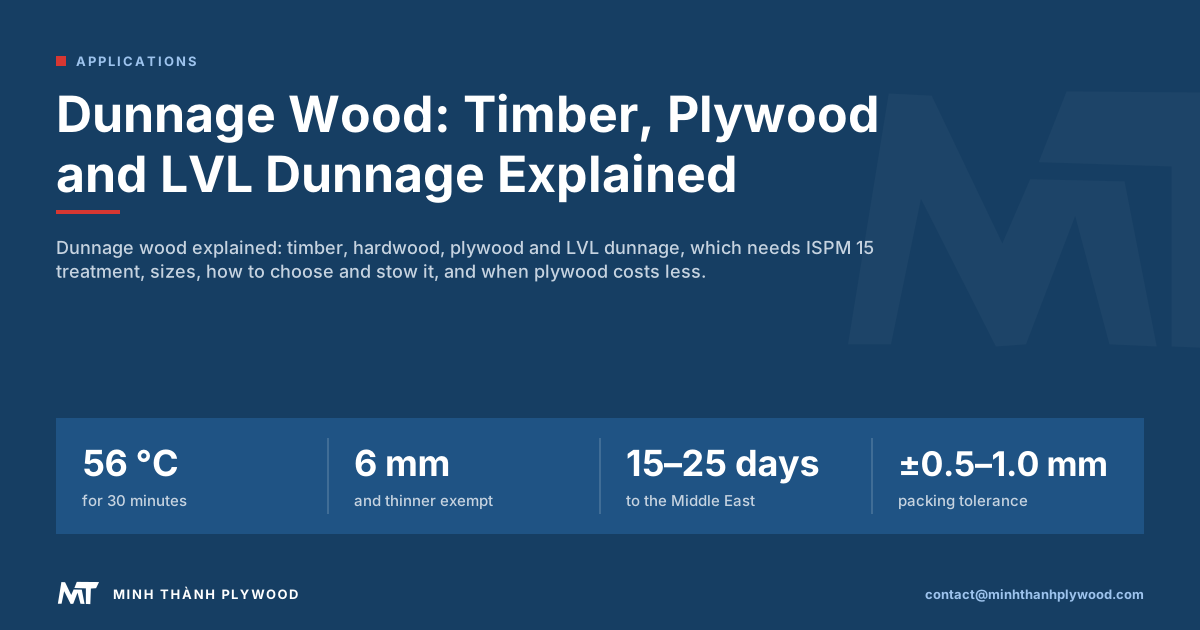
Dunnage wood is the loose timber, plywood or LVL used to lift, separate, brace and protect cargo in containers, holds and trucks. Solid timber dunnage must be heat-treated and marked under ISPM 15; plywood and LVL are processed wood and fall outside it. Minh Thanh Plywood explains each type, the sizes, how to choose and stow dunnage step by step, and when packing plywood or LVL is the cheaper choice.
What is dunnage wood?
Dunnage wood is the loose timber, plywood or LVL placed under, between and around cargo to lift it, separate it, brace it and protect it during transport. It is not fixed to the goods: a pallet or crate travels with the product, while dunnage stays with the load or the hold and is usually discarded or reused at the destination.
The word covers anything from a thin batten laid on a container floor to a heavy hardwood bearer under a steel coil. What makes a piece of wood dunnage is its job, not its size.
Dunnage sizes and rules for buyers in Canada and the United States
In Canada and the US, dunnage is bought by nominal inch size: 2×4, 2×6, 3×3, 3×4, 4×4, 4×6 and up to 12×12 for cribbing, plus plywood in 3/8, 1/2, 5/8 and 3/4 in. Troymill, an Ohio hardwood supplier, lists blocking from 2×2 to 12×12, oak cribbing, 7×9 in railroad ties and 3×3 peeler cores. Golden Spike Lumber in Alberta stocks blocking, dunnage and de-grade plywood in 3/8, 1/2, 5/8 and 3/4 in.
| Nominal size | Dressed size | Typical dunnage use |
|---|---|---|
| 2×2 | 38 × 38 mm | Light blocking, spacers |
| 2×4 | 38 × 89 mm | Bracing, door-end frames, battens |
| 2×6 | 38 × 140 mm | Floor bearers for light and medium loads |
| 3×3 | 64 × 64 mm | Blocking, peeler-core spacers |
| 3×4 | 64 × 89 mm | Blocking and light bearers |
| 4×4 | 89 × 89 mm | Bearers under crates and machinery, forklift lift-off |
| 4×6 | 89 × 140 mm | Heavy bearers, steel and coils |
| 6×6 to 12×12 | 140 × 140 mm and larger | Cribbing under heavy equipment, oak or mixed hardwood |
| Plywood 3/8, 1/2, 5/8, 3/4 in | 9.5, 12.5, 15.5, 18.5 mm | Floor cover, layer separators, bracing panels |
A nominal 4×4 measures 3.5 in square, so the dressed column is the true section; hardwood cribbing is often sold rough, at close to the nominal size. For load notes, size bearers by the weight on each bearing point: a 4×4 under a crate edge, a 4×6 or 6×6 under a coil cradle, 12×12 only for presses and transformers.
Two rules differ in North America. Canadian-made solid dunnage for export is heat treated and marked under the Canadian Food Inspection Agency’s heat-treated wood certification, and the CFIA exempts wood packaging, dunnage included, that moves directly between the continental US and Canada when the wood is of US or Canadian origin.
Dunnage from Vietnam, like any overseas wood, needs the ISPM 15 mark if it is solid timber, and plywood and LVL need none. Home Depot Canada lists 1/2 in sheathing plywood at about C$69 per 4 × 8 ft sheet (listing read October 2026), the retail yardstick against which a container of packing plywood is priced.
What does dunnage do?
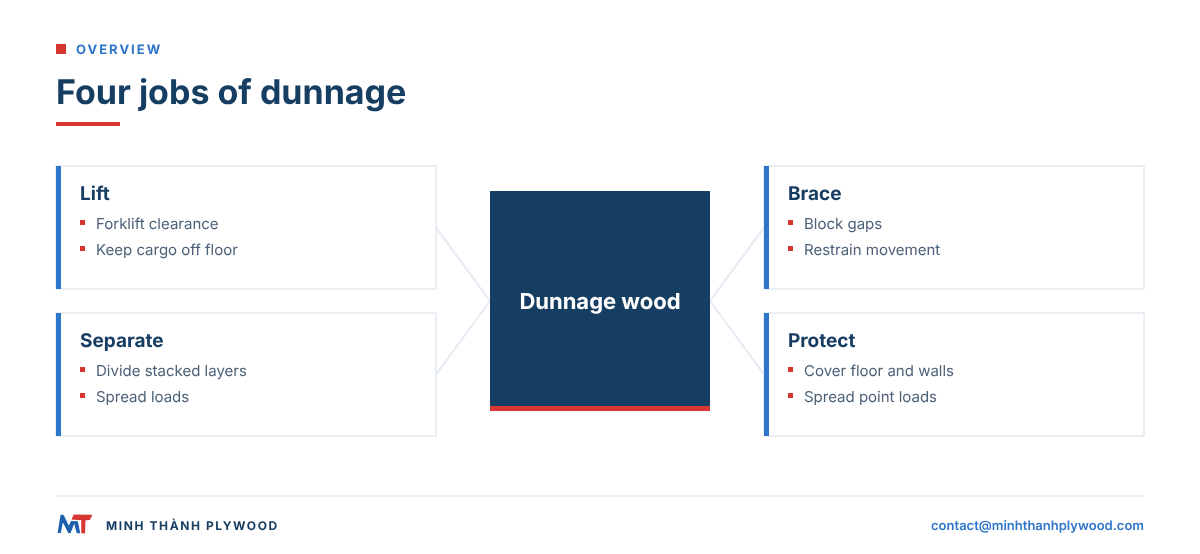
Dunnage does four jobs: it lifts, separates, braces and protects.
- Lifts: raises cargo off the floor so forklift tines and slings can get under it, and keeps it out of condensation that pools on the floor.
- Separates: divides layers of stacked cargo so the load spreads evenly and the upper layer does not crush the lower one.
- Braces: fills gaps and blocks cargo against the walls and doors so it cannot slide when the ship rolls or the truck brakes.
- Protects: covers floors and walls, and spreads point loads so heavy items do not dent the container floor.
One piece often does two jobs. A plywood sheet laid on the floor protects it and spreads the load at the same time.
Types of wooden dunnage
Wooden dunnage comes in four main types: softwood timber, hardwood timber, plywood and LVL. Each fits a different load.
| Type | Typical form | Best for |
|---|---|---|
| Softwood timber | Battens, boards, blocks | General cargo, bracing, light separators |
| Hardwood timber | Heavy bearers, wedges, chocks | Steel coils, slabs, machinery, heavy point loads |
| Plywood | Sheets, strips, cut panels | Floor protection, layer separators, bracing panels |
| LVL | Beams, runners, blocks | Straight bearers, long runners, repeated handling |
Non-wood dunnage, such as inflatable air bags, foam and corrugated board, does part of the same work. Wood remains the standard where loads are heavy, pieces must be cut on site or the dunnage must bear weight.
Timber dunnage: species, grade and sizes
Timber dunnage is usually low-grade softwood or hardwood, sawn to simple sections and used once. Grade matters less than soundness: the piece must not be rotten, split through or full of bark.
- Softwood dunnage: pine, spruce and fir battens and boards. Light, easy to cut and nail, used for bracing and light separators.
- Hardwood dunnage: oak, mixed tropical and other dense hardwoods. Heavier and crushes less under load, used under steel coils, slabs, pipes and machinery.
- Sizes: from thin battens to bearers of about 100 × 100 mm and larger. Bearers under heavy cargo are sized for the load per bearing point and for forklift clearance.
Hardwood dunnage has one drawback: weight. A container full of heavy bearers loses payload to the dunnage itself. Where the load allows, plywood or LVL bearers carry the same weight with less timber.
Can plywood be used as dunnage?
Yes. Plywood is used as dunnage for floor protection, layer separators, bracing panels and load-spreading boards. It is flat, stable, free of bark and splits, and comes in large sheets that cover a floor or a layer in one piece.
Dunnage plywood is usually packing-grade plywood: a utility face, a hardwood core and a lower-cost glue, cut to the size the load needs. It does the same work as boards nailed side by side, with fewer pieces and no gaps.
The second reason shippers choose plywood is compliance. Plywood is made with glue, heat and pressure, so it falls outside ISPM 15 and needs no heat-treatment stamp. A load braced only with plywood and LVL avoids treatment, marking and inspection questions at the destination.
Minh Thanh Plywood makes packing plywood for crates, pallets and dunnage, with a thickness tolerance of ±0.5–1.0 mm, in 1220 × 2440 mm sheets or cut to size.
LVL dunnage and bearers
LVL, laminated veneer lumber, makes straight, strong dunnage bearers and runners. Its veneers all run along the length, so it is stiff and strong as a beam and has no large knots that could break under load.
LVL suits dunnage where a long, straight piece must carry weight: bearers under machinery, runners under crates and pallet blocks. Packing-grade LVL is made for this use, with lower-cost faces and a glue matched to the job. Like plywood, it is processed wood and outside ISPM 15. Minh Thanh supplies LVL for packing and pallet uses; the packing LVL guide covers runners and chip blocks in detail.
Dunnage and ISPM 15: which wood needs treatment?
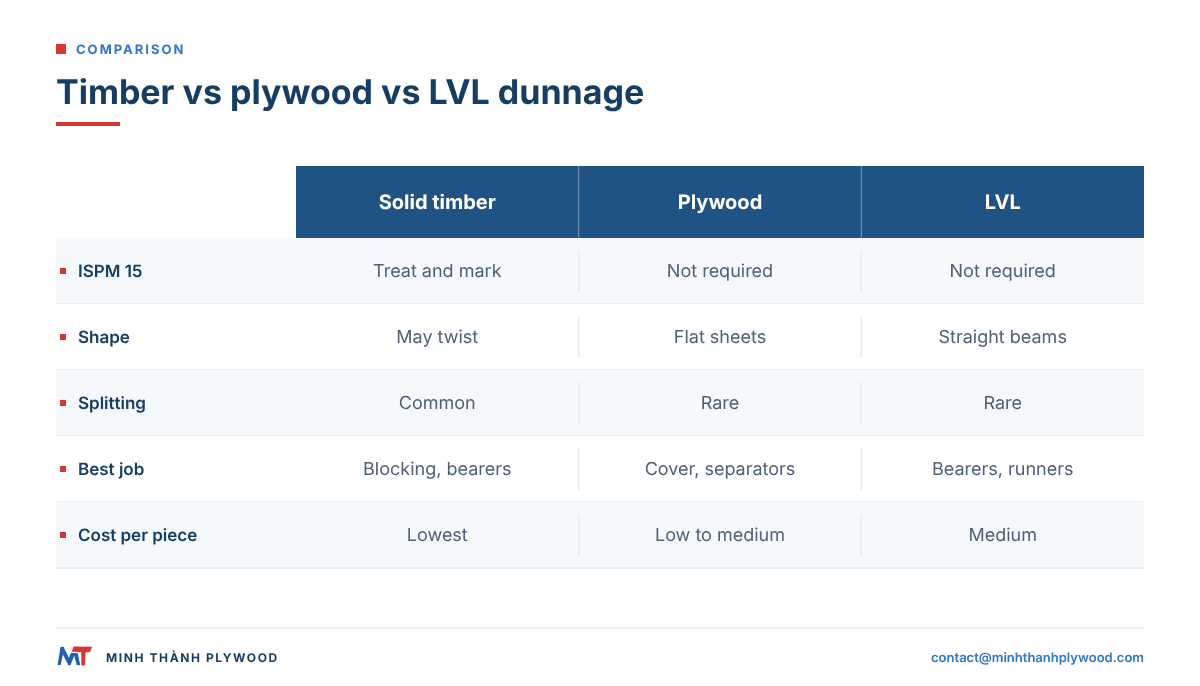
Solid wood dunnage needs ISPM 15 treatment and marking; plywood and LVL dunnage does not. The IPPC summary of ISPM 15 states that wood packaging covered by the standard “includes dunnage but excludes wood packaging made from wood processed in such a way that it is free from pests (e.g. plywood)”.
For solid timber dunnage, ISPM 15 requires:
- Debarked wood: bark removed, apart from small pieces the standard allows.
- An approved treatment: heat treatment to a core temperature of 56 °C for at least 30 continuous minutes, or methyl bromide fumigation where the importing country still accepts it.
- The ISPM 15 mark: the IPPC symbol, the country code, the producer number and the treatment code (HT or MB), on the wood.
Dunnage loaded at the port of origin with the cargo must meet these rules like any other wood packaging. Importing countries can refuse, treat or destroy non-compliant dunnage at the shipper’s cost. Raw wood 6 mm thick or less is also exempt, as is processed, non solid wood packaging like plywood, according to GOV.UK guidance on wood packaging material.
Plywood itself is not ISPM 15 wood; the IPPC list of ISPMs carries the standard. When an inspector asks, the bill of materials and the panel make that plain: veneer layers, glue lines, a pressed sheet.
Timber vs plywood vs LVL dunnage: comparison
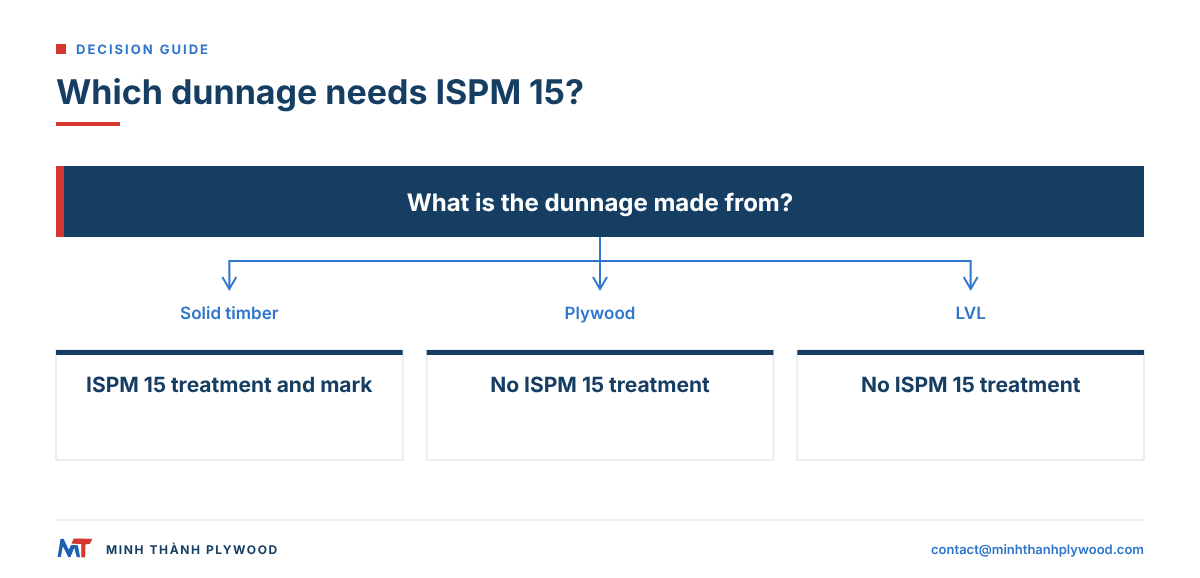
Timber is the lowest-cost dunnage per piece; plywood is the best for flat cover and separators; LVL is the best for straight, load-bearing runners. Plywood and LVL avoid ISPM 15 treatment.
| Metric | Solid timber | Plywood | LVL |
|---|---|---|---|
| ISPM 15 treatment and mark | Required | Not required | Not required |
| Shape | Sawn sections, may twist | Flat sheets, cut to any panel | Straight beams and blocks |
| Strength | Varies with knots and grain | Even in both directions | High along the length |
| Splitting under nails | Common at ends | Rare, cross-laminated | Rare along the length |
| Covering a floor or layer | Many boards, gaps between | One sheet, no gaps | Not used for cover |
| Bearers under heavy loads | Hardwood bearers | Not used alone | LVL beams |
| Weight for the job | Heavy in hardwood | Light for the area covered | Light for its strength |
| Cost per piece | Lowest | Low to medium | Medium |
Choose by job, not by habit. Many loads use all three: LVL or hardwood bearers under the cargo, plywood sheets as separators, timber battens as blocking.
How to choose dunnage for a load, step by step
Choosing dunnage takes six steps, from the cargo to the paperwork.
- Describe the cargo: weight, footprint, how it can be lifted, and whether it can be stacked.
- List the jobs: lift, separate, brace, protect. Each job may need a different piece.
- Size the bearers: from the weight per bearing point and the forklift clearance under the load.
- Pick the material per job: hardwood or LVL for heavy bearers, plywood for floors and separators, softwood for blocking.
- Check the destination rules: solid wood needs ISPM 15 treatment and marks; plywood and LVL do not.
- Order cut to size: pieces that arrive at the right length save sawing at the loading bay.
The answer is written into a stow plan: what goes under, between and around the cargo, and how many pieces of each.
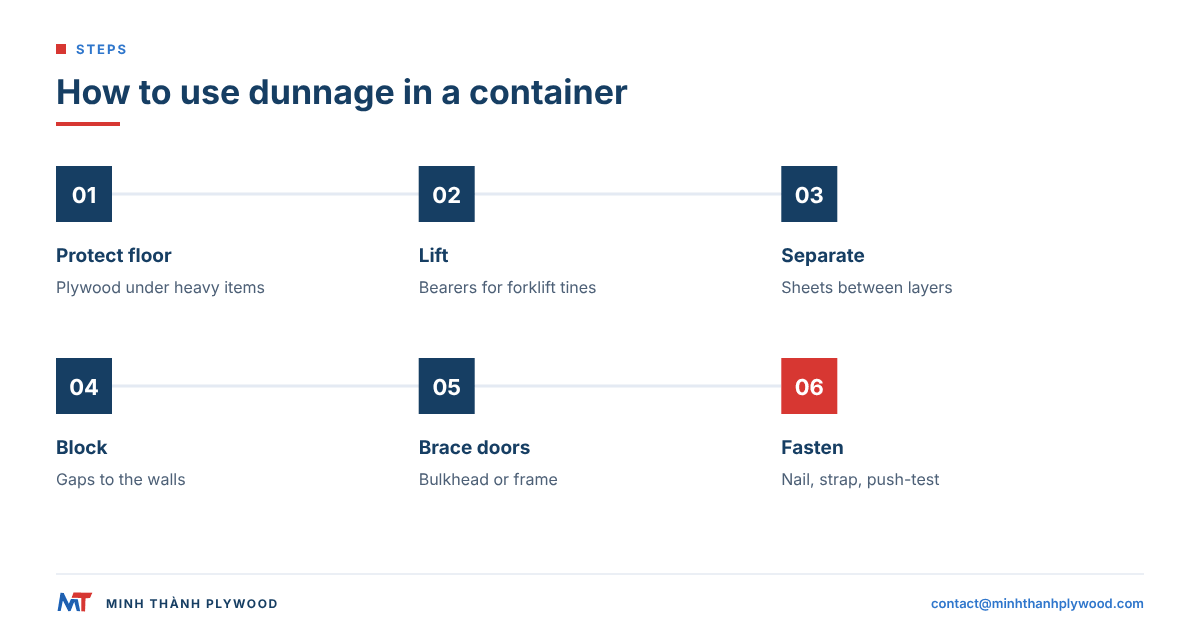
How to use dunnage in a container
Using dunnage in a container follows the cargo from the floor up.
- Protect the floor: lay plywood or bearers where heavy items stand, so point loads spread.
- Lift the load: place bearers so forklift tines or slings fit under each unit.
- Separate the layers: a plywood sheet or battens between stacked layers, aligned over the bearers below.
- Block the gaps: timber or LVL blocking between cargo and walls, and at the door end.
- Brace the door end: a braced frame or plywood bulkhead so nothing leans on the doors.
- Fasten and check: nail or strap blocking to bearers, then push-test each unit before closing.
Keep dunnage dry before loading. Wet timber in a closed container raises the humidity and causes condensation, which can damage the cargo more than any movement. Plywood and LVL dried at the mill arrive at a known moisture; Minh Thanh dries panels to 8–12 % moisture content at dispatch.
When packing plywood or LVL offcuts are cheaper
Plywood and LVL dunnage cost less than timber in three cases: when ISPM 15 treatment and marking would add cost, when the load needs flat cover over a large area, and when pieces must arrive cut to size.
- No treatment cost: heat treatment, marking and certificates add cost to every timber piece; plywood and LVL skip them.
- Fewer pieces: one plywood sheet replaces many boards, with less handling and no gaps.
- Cut to size at the mill: panels cut from full sheets arrive ready to place, with no sawing at the loading bay.
- Offcuts and lower faces: packing plywood with utility faces costs less than furniture grades and suits work where nobody sees the face.
Minh Thanh’s indicative starting price for commercial plywood is from US$250/m³ (October 2026); the final price depends on core, glue, thickness, size, quantity and delivery term. Cut-to-size panels are made by dividing a full sheet into 4, 6 or 8 pieces.
Other markets: the UAE and the Middle East
Buyers in Dubai and Abu Dhabi import packing plywood by the container and cut it locally or order it cut to size. Typical sea transit from Hai Phong to the Middle East is 15–25 days, by carrier and route. Plywood and LVL dunnage avoid ISPM 15 questions at each onward border, which matters for cargo that crosses several countries.
Minh Thanh ships packing plywood in full 40HC loads, with mixed thicknesses in one container by agreement. Orders start at one 40HC, production takes 15–45 days after deposit, and terms are FOB Hai Phong, CFR or CIF.
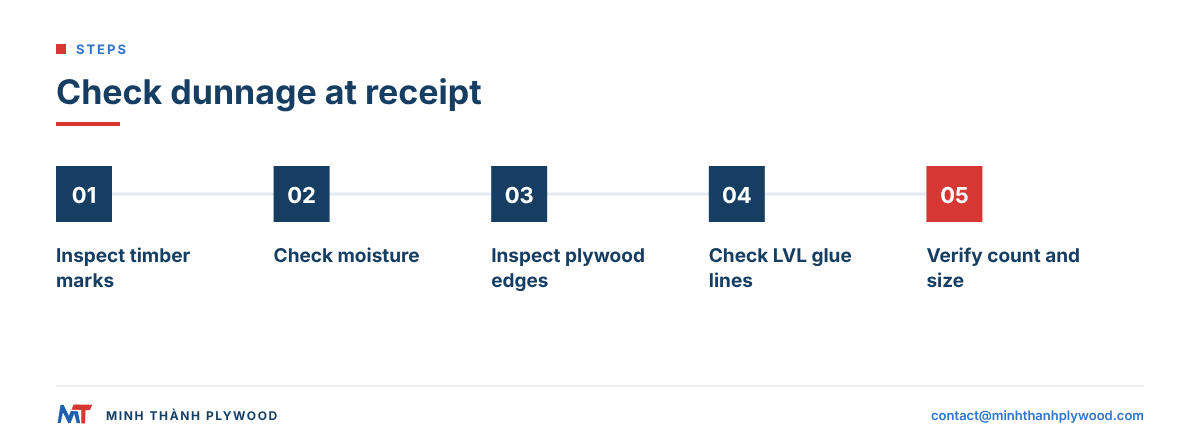
Checks on receipt
Check dunnage on arrival before it reaches the loading bay. Five checks cover most problems.
- Solid timber: ISPM 15 mark legible on each piece, no bark patches, no live insects or bore holes.
- Moisture: no wet or mouldy pieces; wet dunnage goes in last or not at all.
- Plywood: thickness within the stated tolerance, no delaminated edges, sheets flat in the pack.
- LVL: straight, no open glue lines at the ends.
- Count and size: pieces match the stow plan and the cut list.
Rejecting a bad piece at receipt costs one piece; finding it at the destination can cost the whole load’s clearance.
What to order for plywood and LVL dunnage
For plywood dunnage, order packing plywood with a utility face, a hardwood core, a stated glue and thickness tolerance, in full sheets or cut to the size the stow plan needs. For LVL dunnage, order packing LVL by section and length.
A specification line for plywood dunnage reads: packing plywood, eucalyptus core, utility faces, MR glue, 15 mm ±0.5–1.0 mm, 1220 × 2440 mm or cut to size, one 40HC, CIF Jebel Ali. Send yours with quantities through the quotation form, or ask for free samples. For the wider family of wood packaging, start at the wood packaging guide; for crates and pallets, see plywood for crates and pallets and wooden shipping crates.
Buyer questions, answered
What is dunnage wood?
Dunnage wood is loose timber, plywood or LVL placed under, between or around cargo to lift it off the floor, separate layers, stop it moving and protect it from damage and moisture. It is not fixed to the goods, unlike a pallet or crate.
Can plywood be used as dunnage?
Yes. Plywood is used as floor protection, layer separators, bracing panels and load-spreading boards. Because it is processed wood made with glue, heat and pressure, plywood falls outside ISPM 15 and needs no heat treatment stamp.
Does dunnage need ISPM 15 treatment?
Solid wood dunnage does: it must be debarked, heat-treated or fumigated, and marked like any other wood packaging. Dunnage made only of plywood, LVL or other processed wood is excluded from ISPM 15.
What wood is used for dunnage?
Low-grade softwood and hardwood timber for most cargo, dense hardwood for steel coils and heavy machinery, and plywood or LVL where a flat, stable, treatment-free piece is needed.
What size is timber dunnage?
Common sizes run from thin battens to heavy bearers of about 100 × 100 mm and larger for steel and machinery. The size is set by the load, the bearing area and the forklift clearance under the cargo.
Is hardwood dunnage better than softwood?
For heavy, point-loaded cargo such as steel coils, slabs and machinery, yes: hardwood crushes less under load. For light cargo and bracing, softwood is lighter and costs less.
Is LVL good for dunnage?
Yes. LVL is straight, strong along its length and free of large knots, so it makes reliable bearers and runners. Like plywood, it is processed wood and outside ISPM 15.
How much dunnage does a container need?
Enough to lift the load clear of the floor for forklift tines, separate every layer that can shift, and block every gap that would let cargo slide. The amount comes from the stow plan, not a fixed ratio.
Where can I buy dunnage plywood in the UAE?
Importers in Dubai and Abu Dhabi buy packing plywood by the container from Asian mills and cut it locally, or order it cut to size. Sea transit from Hai Phong to the Middle East is typically 15 to 25 days.