
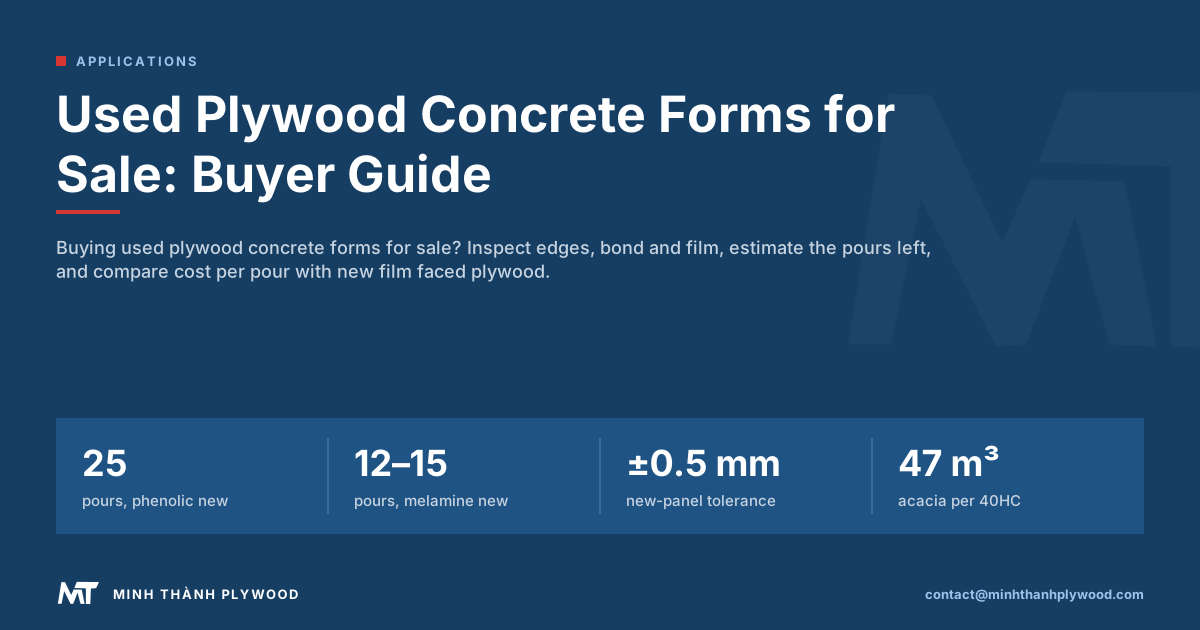
Used plywood concrete forms for sale are worth buying when they are flat, still bonded, sealed at the edges and cheap enough per remaining pour, which usually means hidden concrete, footings, short projects or hoardings. Panels with swollen edges, blistered film or mixed thicknesses cost more than they save. Minh Thanh Plywood, a maker of new film-faced plywood in Vietnam, sets out how to inspect used panels and when new ones are the better buy.
Are used plywood concrete forms for sale worth buying?
Used plywood concrete forms are worth buying when the panels are flat, still bonded, sealed at the edges and priced low enough per remaining pour. That usually fits footings, hidden walls, short projects and temporary works, not fair-faced concrete or long high-rise cycles.
The value of a used panel is the pours it has left, not its size or its original price. Three questions decide it:
- How many pours are left? That depends on the build (glue, film, core) and how the panel was treated.
- What finish does the job need? Worn film is fine for concrete that will be clad or buried, and visible on exposed faces.
- What does each remaining pour cost? A cheap panel with three pours left can cost more per pour than a new one.
The rest of this guide shows how to inspect used panels, estimate what is left and compare the result with new film faced plywood.
Where to find used formply for sale
Used formply for sale comes mainly from contractors at the end of a project, formwork rental companies retiring part of their fleet, salvage yards, online marketplaces and plant auctions. The source tells you a lot about the condition.
| Source | What you usually get | Watch for |
|---|---|---|
| Contractor finishing a project | A lot of one size and thickness, known pour count | Panels cut to that project’s sizes |
| Rental company retiring panels | Consistent build, panels at the end of rental life | Few pours left for exposed work |
| Salvage and demolition yards | Mixed lots, low price | Unknown history, mixed thicknesses |
| Online marketplaces | Small lots near you | Photos that hide edges and backs |
| Plant and equipment auctions | Large lots, sold as seen | No chance to return a bad lot |
In the US the channels have names. Forming contractors’ yards sell used plywood by the bundle: Forming America sells used HDO or European birch panels from yards in Illinois, Tennessee and Pennsylvania. Marketplaces such as eBay and Facebook Marketplace carry small lots near you, and equipment auctions such as Ritchie Bros (RB Global) and BIC Auctions sell contractor forming equipment as seen.
Ask every seller the same questions: what build the panels are (glue and film), how many pours they have done, what they were used on, how they were stored, and whether you can see the whole lot before paying.
Used form plywood for sale: what condition grades to expect
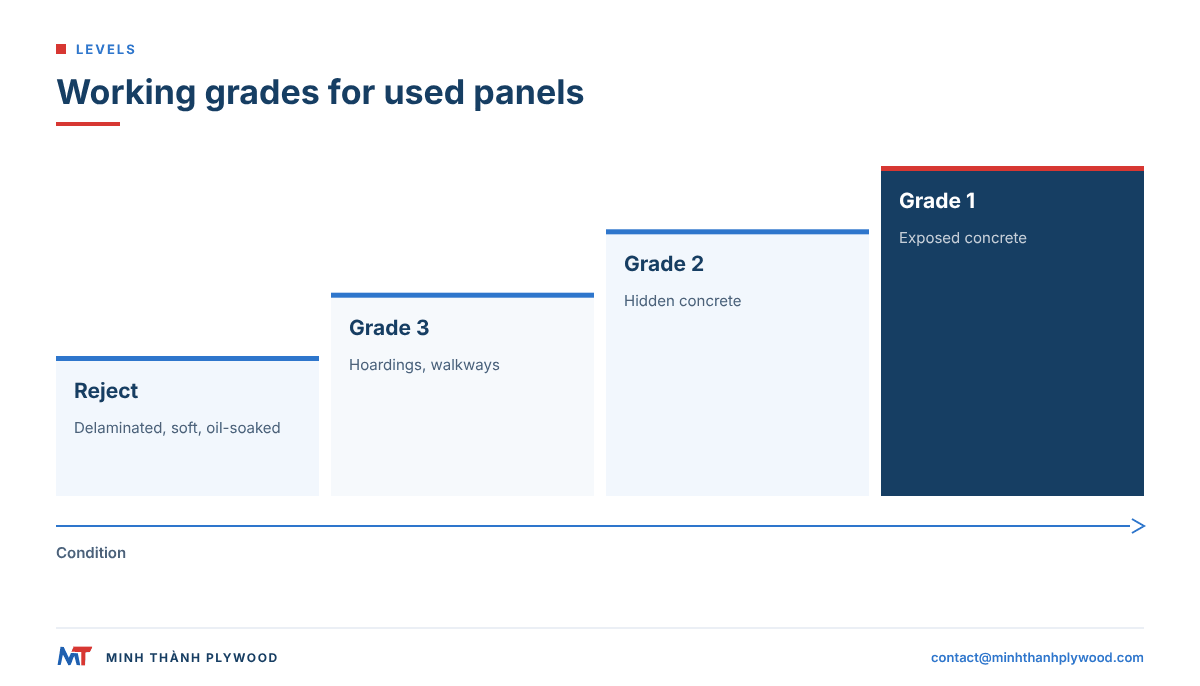
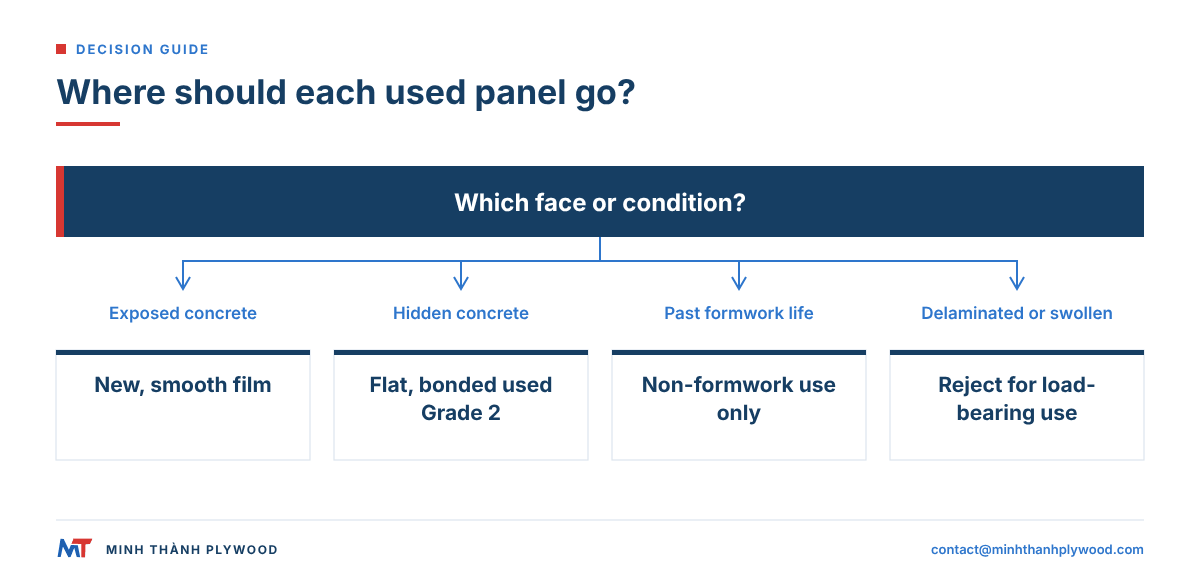
Used form plywood for sale is easiest to buy when you sort it into three working grades: panels that can still face exposed concrete, panels for hidden concrete, and panels only fit for non-formwork uses. Sellers rarely grade this way, so do it yourself during inspection.
| Working grade | Condition | Use |
|---|---|---|
| Grade 1: exposed work | Film intact and smooth, edges sealed and flat, few holes | Walls and slabs where the face matters |
| Grade 2: hidden work | Film scratched or dull, edges sound, panel flat and bonded | Footings, walls to be clad, slabs with a topping |
| Grade 3: non-formwork | Film worn through, damaged edges, holes, slight warp | Hoardings, walkways, protection boards, packing |
| Reject | Delamination, swollen soft edges, oil-soaked core, strong warp | Not for any load-bearing use |
Price each working grade separately. A mixed lot priced as if it were all Grade 1 is a poor buy even when the sheet price looks low.
US formats you will see. Used US form plywood is mostly 1/2 in and 3/4 in Plyform or high density overlay (HDO), cut for modular systems. Forming America’s most common stock is 1/2 in thick in 2 ft wide panels (23-1/4 in) of 2 × 3, 2 × 4, 2 × 5, 2 × 6 and 2 × 8 ft, packed in bundles of 100, with mixed “filler” bundles of 12-22 in widths; it also lists 15 mm (about 5/8 in) and metric 100 × 300 cm (about 39 × 118 in) sheets.
Residential foundation systems use 1-1/8 in “Resi Ply” form panels (SureBuilt, Owens Supply). Check the thickness against your waler and stud spacing before buying: a 1/2 in panel needs closer supports than 3/4 in.
Used vs new film faced plywood: the comparison
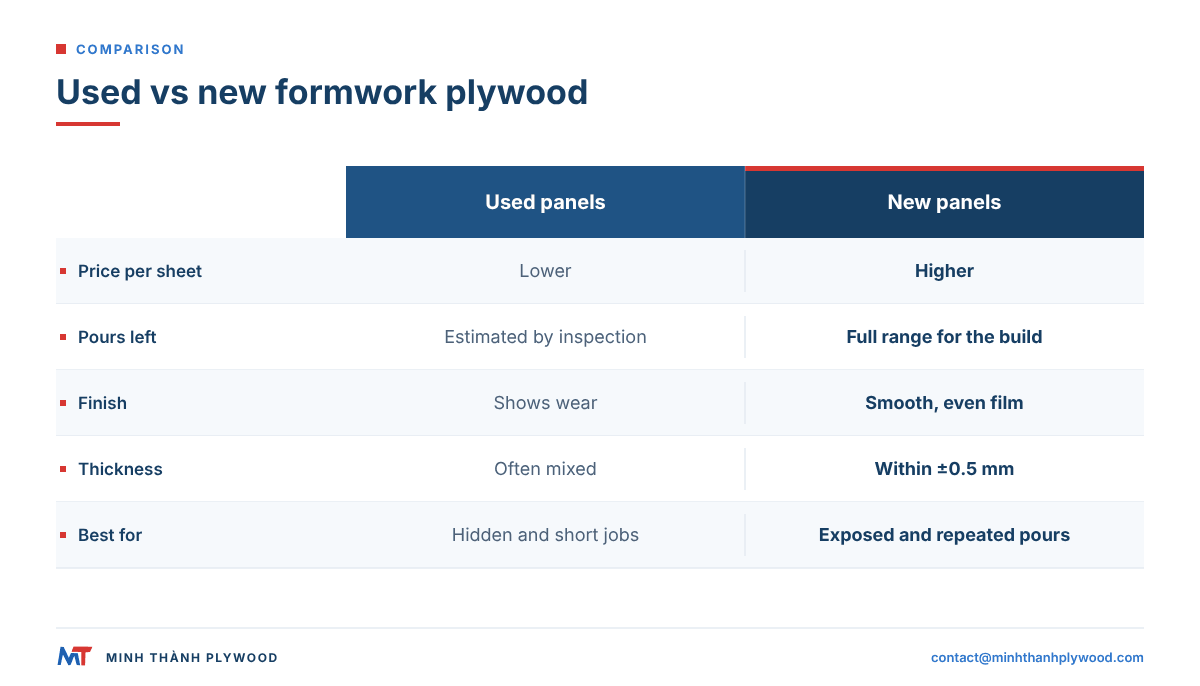
New film faced plywood costs more per sheet and less per pour over a long job; used panels cost less per sheet and suit short or hidden work. The table compares them on the points that decide a formwork purchase.
| Metric | Used formwork plywood | New film faced plywood |
|---|---|---|
| Price per sheet | Lower | Higher |
| Pours remaining | Unknown, estimated by inspection | Full range for the build: up to about 25 with phenolic glue, about 12 to 15 with melamine glue |
| Concrete finish | Shows wear, scratches, plugged holes | Smooth, even film |
| Thickness consistency | Often mixed across a lot | Within the ordered tolerance, for example ±0.5 mm |
| Sizes | Whatever the last project cut | Full sheets or a cut list to your design |
| Build known | Often not | Glue, film and core on the order |
| Documents | Rarely | Specification, packing list, loading photos |
| Risk | Hidden delamination, short life | Low when the build is specified and checked |
| Best for | Footings, hidden concrete, short projects, hoardings | Exposed concrete, repeated cycles, long projects |
How to inspect used shuttering plywood before you buy
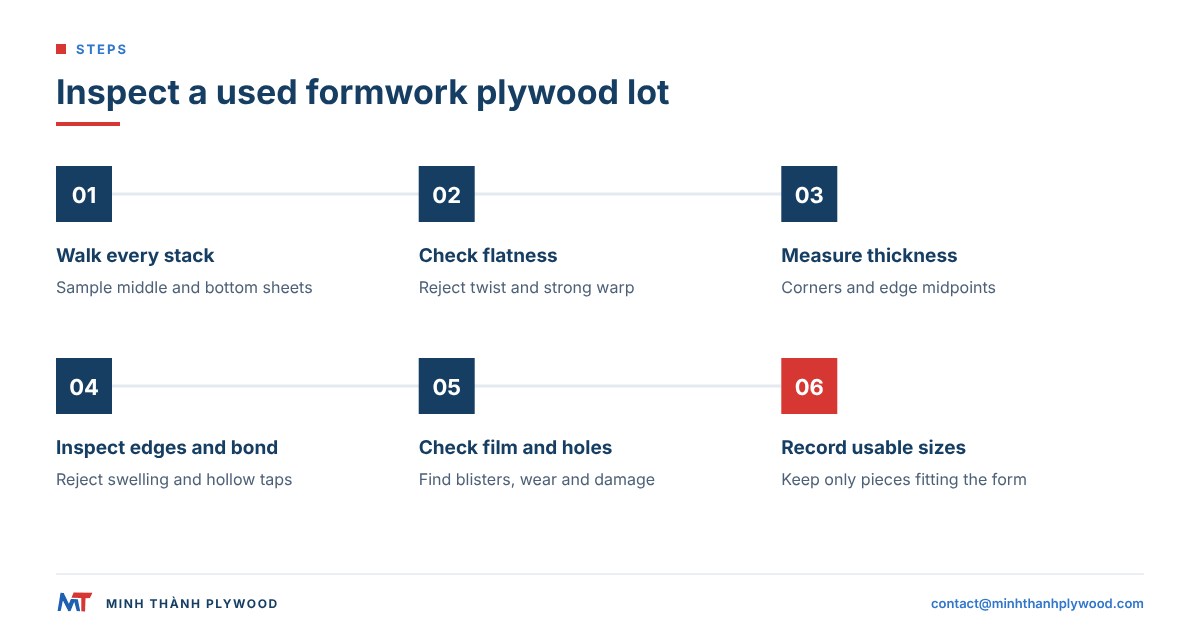
Inspect used shuttering plywood sheet by sheet on a sample from every stack, with a tape, a caliper, a straightedge and a coin for tapping. Fifteen minutes of checks saves buying a lot that fails in the first pour.
- See the whole lot: walk round every stack and look at the edges of the packs before choosing sheets to check.
- Pull sheets from the middle and bottom, not only the top, where the best sheets are often placed.
- Check flatness: lay a sheet on a flat surface; reject twist and pronounced warp.
- Measure thickness with a caliper at the corners and the middle of each edge; note the spread across sheets.
- Check edges: soft, swollen or flaking edges mean water has entered the core.
- Tap the face across the sheet; a dull or hollow sound marks delamination or voids.
- Read the film: count worn-through patches, blisters and deep scratches.
- Count holes: many holes, or large ones near the edges, shorten the remaining life.
- Smell and look for oil: diesel or heavy oil soaked into the core weakens it and stains concrete.
- Record sizes: cut pieces only help if they fit your formwork.
A sheet that taps hollow has lost the bond that BS EN 314-2 sets requirements for.
Our guide to film faced plywood defects shows what each fault looks like and how it starts.
How to estimate the pours left in used panels
Estimate the pours left by starting from the build’s range, subtracting the pours already done and adjusting for condition. The result is a working estimate, good enough to price a lot.
- Find the build: a phenolic (WBP, water and boil proof) glue panel starts with up to about 25 pours; a melamine-fortified (MR) glue panel about 12 to 15, with proper handling, release agent and edge sealing.
- Subtract the pours done: from the seller’s records, or estimate from the project they came from.
- Adjust for condition: reduce the estimate for open edges, many holes and worn film; keep it for sealed, flat, clean panels.
- Set the use: count only the pours you need at the finish you need. A panel past its exposed-work life may still have several hidden-work pours left.
| Condition on inspection | Adjustment to the estimate |
|---|---|
| Sealed edges, smooth film, flat | Keep the estimate |
| Light scratches, a few holes | Reduce slightly; hidden work only for the rest |
| Chipped edges, many holes | Reduce strongly; cut back damaged strips |
| Film worn through in patches | Hidden or non-formwork use only |
| Delamination or swollen edges | No pours left for formwork |
Our article on how many times film faced plywood can be reused explains the factors behind each range.
Cost per pour: used vs new
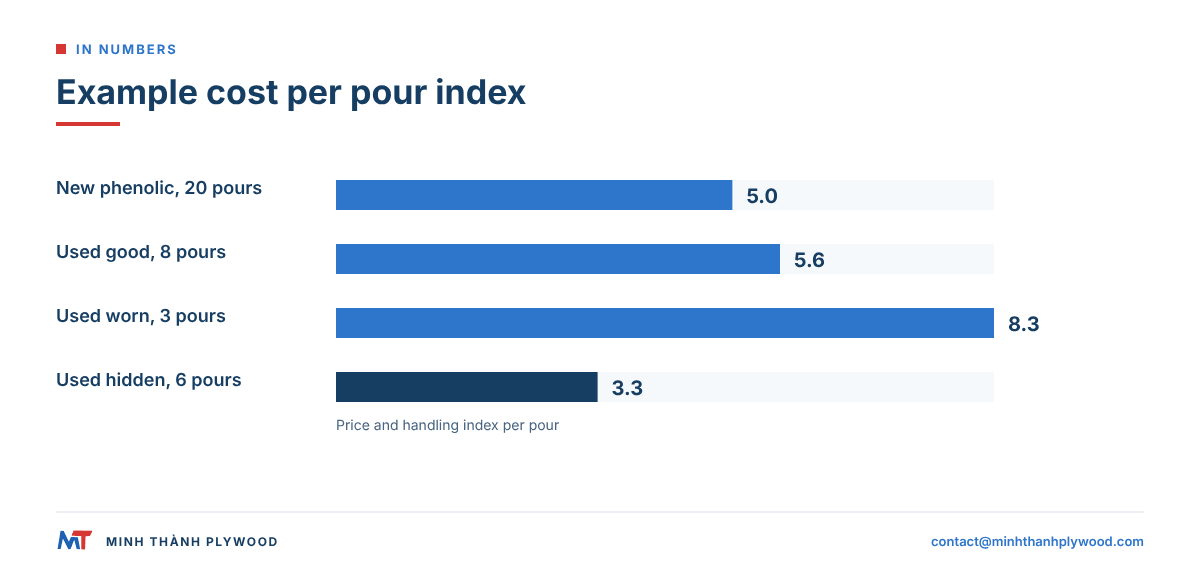
Cost per pour is the price of a panel divided by the pours it will deliver at the finish you need. It is the only fair way to compare a used lot with new panels, because the sheet price hides how long each panel lasts.
Cost per pour = (price per panel + cleaning, repair and handling) ÷ pours delivered
The example uses a price index so it works for any currency: a new phenolic-glue panel is index 100.
| Panel | Price index incl. handling | Pours delivered | Cost per pour (index) |
|---|---|---|---|
| New phenolic-glue panel | 100 | 20 | 5.0 |
| Used panel, good condition | 45 | 8 | 5.6 |
| Used panel, worn | 25 | 3 | 8.3 |
| Used panel, hidden work only | 20 | 6 | 3.3 |
In this example, used panels win only where the job accepts a worn face and the pours delivered stay high. Put your own prices and pour estimates in the same table before buying.
A dated US$ break-even. Vietnamese maker Fomex publishes its Promax Form panel at US$40 per sheet, good for up to 20 uses. We read the page in October 2026. Take that new phenolic-glue panel delivering 20 pours: US$2.00 per sheet per pour. A used sheet is only a bargain if its price is below that rate times the pours it will deliver:
| Used sheet | Pours left | Break-even price against the new sheet |
|---|---|---|
| Good condition | 8 | US$16.00 |
| Hidden work only | 6 | US$12.00 |
| Worn | 3 | US$6.00 |
Any used sheet priced above its break-even is dearer per pour than the new one, before you count the labour of cleaning and sorting a mixed lot.
Used plywood against modular steel-ply forms. Steel-framed modular forms in the Symons Steel-Ply style are another way to buy repeat use, with a steel frame around a replaceable plywood face. Sandbaggy lists its Symons-style panels at US$152.64 each in 20-piece lots, US$139.84 in 30-piece lots and US$134.47 in 40-piece lots for 3 to 10 in wide panels 4 ft long, and US$3,816.12 for 20 pieces in 14 to 22 in widths (Sandbaggy). Prices read in October 2026.
An 8 in × 4 ft panel covers 0.25 m², so the steel panel costs about US$540-616 per m² of face, against about US$13 per m² for a new US$40 plywood sheet. Steel-ply earns that price only over many pours and on repetitive wall layouts; for a short or one-off job, plywood on a timber frame, new or used, costs far less.
Old shuttering plywood and second hand formply: uses beyond formwork
Old shuttering plywood that is past formwork life still makes good boards for jobs where stiffness and water resistance matter more than the face. Second hand formply is often bought for these uses at a low price.
- Site hoardings: film faced panels shed rain and take paint once the film is cleaned, sanded and primed.
- Temporary walkways and ramps: over mud or finished floors, with an anti-slip treatment.
- Floor and finish protection: laid over new screeds, tiles or stairs during fit-out.
- Packing and crates: for heavy equipment on site.
- Shelving and storage racks in site stores and workshops.
- Edge protection and barriers where the panel only needs to stand, not carry concrete.
The guide on cutting and painting film faced plywood explains how to prepare the film so paint stays on.
Are second hand formwork panels safe for structural use?
Second hand formwork panels are safe only if they are still flat, bonded and stiff enough for the support spacing in the formwork design. Formwork must carry the full pressure of wet concrete and the construction loads without failing, whatever the age of the panels.
In the US, the Occupational Safety and Health Administration rule for cast-in-place concrete requires formwork to be designed, built and maintained to support all vertical and lateral loads that may reasonably be anticipated (OSHA standard 1926.703). In Europe, BS EN 12812 sets performance requirements and general design rules for falsework. Other countries have equivalent rules.
- Reject delaminated panels: a separated ply loses most of its stiffness.
- Reject soft or swollen panels: a wet core is weaker and deflects more.
- Check thickness against the design: a panel thinner than designed needs closer supports.
- Do not use used panels near their limit for heavy pours such as tall walls placed quickly.
When in doubt, use used panels for low pours and hidden faces, and keep new panels for the heavy and exposed work.
Red flags when buying used shutterply boards
Walk away from used shutterply boards that show delamination, soft edges, oil-soaked cores, mixed thicknesses or a seller who will not show the whole lot. Each of these turns a low price into a poor buy.
| Red flag | Why it matters |
|---|---|
| Plies separating at the edges | Delamination spreads; the panel will fail under load |
| Soft, swollen or flaking edges | Water is in the core; strength and flatness are going |
| Strong smell of diesel or oil | Oil-soaked cores stain concrete and lose strength |
| Mixed thicknesses in one lot | Steps in the concrete; sorting work and waste |
| Many small cut pieces | Little use unless they fit your design |
| Warped or twisted sheets | Will not close up in the form |
| No access to the whole stack | Best sheets on top, worst hidden below |
| Unknown build and history | No way to estimate the pours left |
When is new film faced plywood the better buy?
New film faced plywood is the better buy for exposed concrete, long pour cycles, large projects and any job where panel failure would delay the programme. In those cases the lower cost per pour and the known build outweigh the higher sheet price.
- Fair-faced or exposed concrete: only a smooth, unmarked film gives an even face.
- Repeated cycles: a new phenolic panel delivers its full range on your site.
- Large projects: one specification across thousands of sheets keeps thickness and finish even.
- Tight programmes: panels that fail mid-cycle cost crane time, labour and days.
- Export or compliance requirements: new panels come with a specification and shipping documents.
A full container of new film faced plywood is often cheaper per pour than buying and sorting several used lots. For an 18 mm build, a 40HC holds about 43 m³ on a eucalyptus core or about 47 m³ on an acacia core.
Can you mix used and new panels on one job?
Yes, mixing used and new panels on one job is a sensible way to cut cost, as long as the thicknesses match and each panel goes where its condition fits. Plan the split before ordering.
- New panels on exposed faces, where the finish is judged.
- Used Grade 2 panels on hidden faces, footings and walls to be clad.
- Same thickness in one face: mixed thicknesses print steps into the concrete.
- Move new panels down the grades as they wear, so every panel delivers all its pours.
Our new film-faced panels are made to ±0.5 mm thickness tolerance, so they sit level with each other in a form. Check used panels against the same thickness before placing them beside new ones.
Buying new film faced plywood from Minh Thanh
We make new film-faced plywood to the buyer’s specification, for contractors and distributors who want a known build and a full reuse range. The order states the glue, film, core, size and tolerance.
| Item | Our offer |
|---|---|
| Glue | MR (melamine-fortified) or phenolic (WBP) |
| Cores | Hardwood: eucalyptus or acacia; core layers stitched both horizontally and vertically |
| Film | Weight, brand and colour as ordered |
| Thickness | Within 3–40 mm, tolerance ±0.5 mm; ±2 mm on length and width |
| Sizes | 1220 × 2440 mm and 1250 × 2500 mm; cut to size on request |
| Order | MOQ one 40HC, mixed specifications by agreement; production 15–45 days after the deposit |
| Loading | Every shipment photographed and filmed before loading |
| Samples | Free samples |
Send the use, thickness and quantity through the film-faced plywood page and we reply within hours. The concrete form plywood buying guide covers grades and cores, and our comparison of HDO plywood vs MDO plywood explains the overlays used on premium forms.
Buyer questions, answered
Is it worth buying used plywood concrete forms?
Yes, for footings, hidden concrete, short projects and hoardings, when the panels are flat, bonded and priced well per remaining pour. For fair-faced concrete or long pour cycles, new panels usually cost less per pour.
Where can I find used formply for sale?
From contractors finishing a project, formwork rental companies retiring part of their fleet, salvage and demolition yards, online marketplaces and plant auctions. Contractors and rental fleets usually offer the most consistent lots.
How many pours are left in used form plywood?
Estimate it from the build and the condition: phenolic-glue panels start with up to about 25 pours and melamine-glue panels about 12 to 15. Subtract the seller's pour count, then judge the film and edges.
What should I check before buying used shuttering plywood?
Flatness, edge swelling, delamination by tapping, film wear, the number and size of holes, thickness spread across the lot, panel sizes, and any smell or stain of oil or diesel soaked into the core.
Can old shuttering plywood be used for anything else?
Yes: site hoardings, temporary walkways, protection boards, packing, storage shelving and crates. Film faced panels paint well once the film is cleaned, sanded and primed.
Are second hand formply sheets safe for formwork?
Only if they are still flat, bonded and stiff enough for the support spacing in the formwork design. Delaminated or swollen panels can deflect or break under wet concrete and should not be used.
Can I mix used and new panels in the same form?
Yes, if the thicknesses match. Use new panels on exposed faces and used ones on hidden faces, and never mix panels of different thickness in one face, because they leave steps in the concrete.
How much cheaper is used formwork plywood?
It depends on the condition and the local market. Compare it by cost per remaining pour, not per sheet: a used panel at a low price with few pours left can cost more per pour than a new panel.
What are used shutterply boards?
Shutterply is the UK and Irish name for shuttering plywood. Used shutterply boards are formwork panels sold on after one or more projects, usually film faced and in standard sheet sizes or cut pieces.