
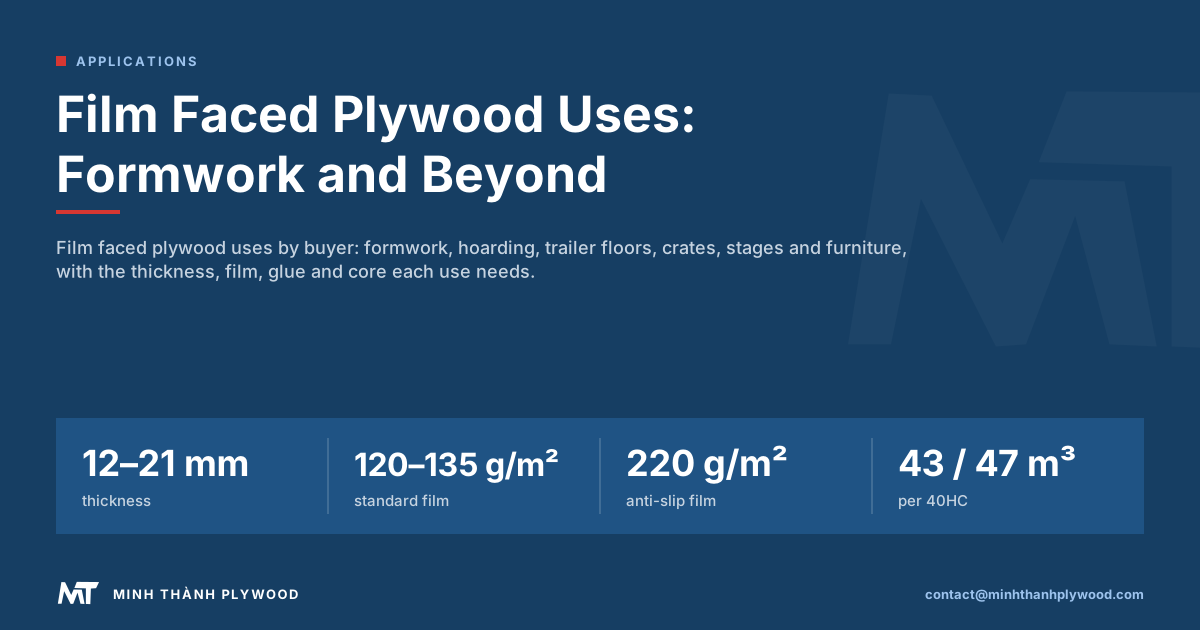
Film faced plywood is plywood pressed with a resin film on both faces, made first for concrete formwork and now used wherever a hard, wipe-clean, water-resistant surface helps. Its main uses are wall, slab and column formwork, site hoarding, trailer and stage floors, crates and some furniture. Minh Thanh Plywood sets out the specification each use needs.
What is film faced plywood?
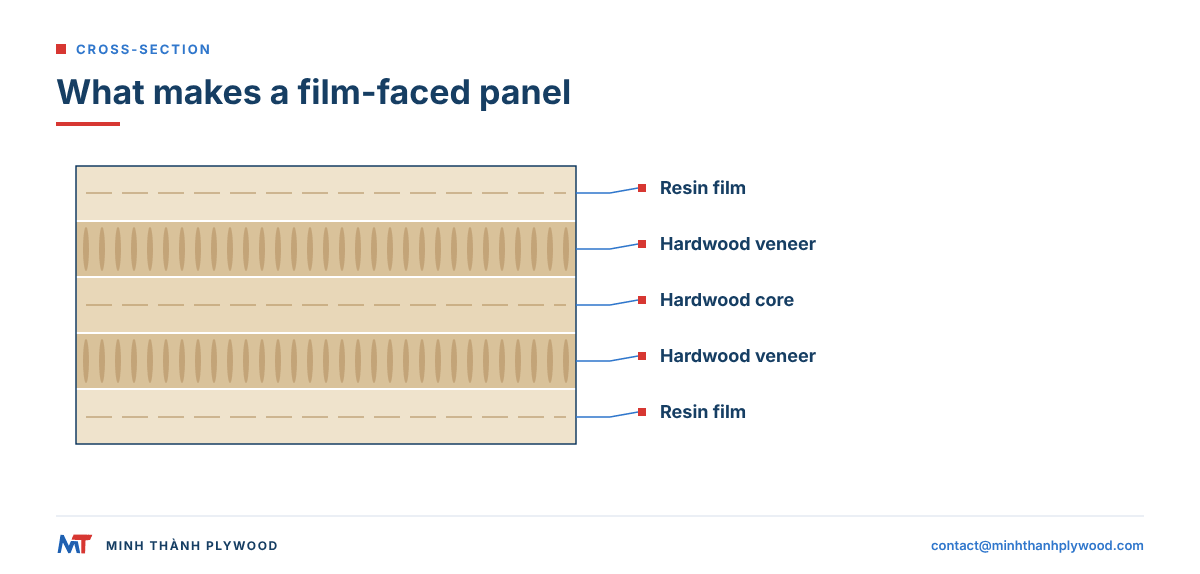
Film faced plywood is plywood with a phenolic or melamine resin film pressed onto both faces, giving a hard, smooth, water-resistant surface over a cross-laminated veneer core. It was developed for concrete formwork, where the film moulds a clean concrete face and releases easily, and its uses have spread to any job that needs a durable, wipe-clean board.
A sheet has three parts, and each one serves the uses below:
- Film. Paper impregnated with resin, usually brown or black, bonded to the faces under heat. Its weight in g/m² decides how long the face resists wear.
- Core. Hardwood veneers in crossed layers. In Vietnam the cores are Eucalyptus or Acacia, which are dense and stiff.
- Glue. A water-resistant bond, melamine-fortified or phenolic WBP, that holds the plies together when wet.
The same product goes by several names: film-faced plywood, shuttering plywood, formwork plywood, concrete form plywood, and formply in Australia. Our film-faced plywood page has Minh Thanh’s full specification.
What is film faced plywood used for?
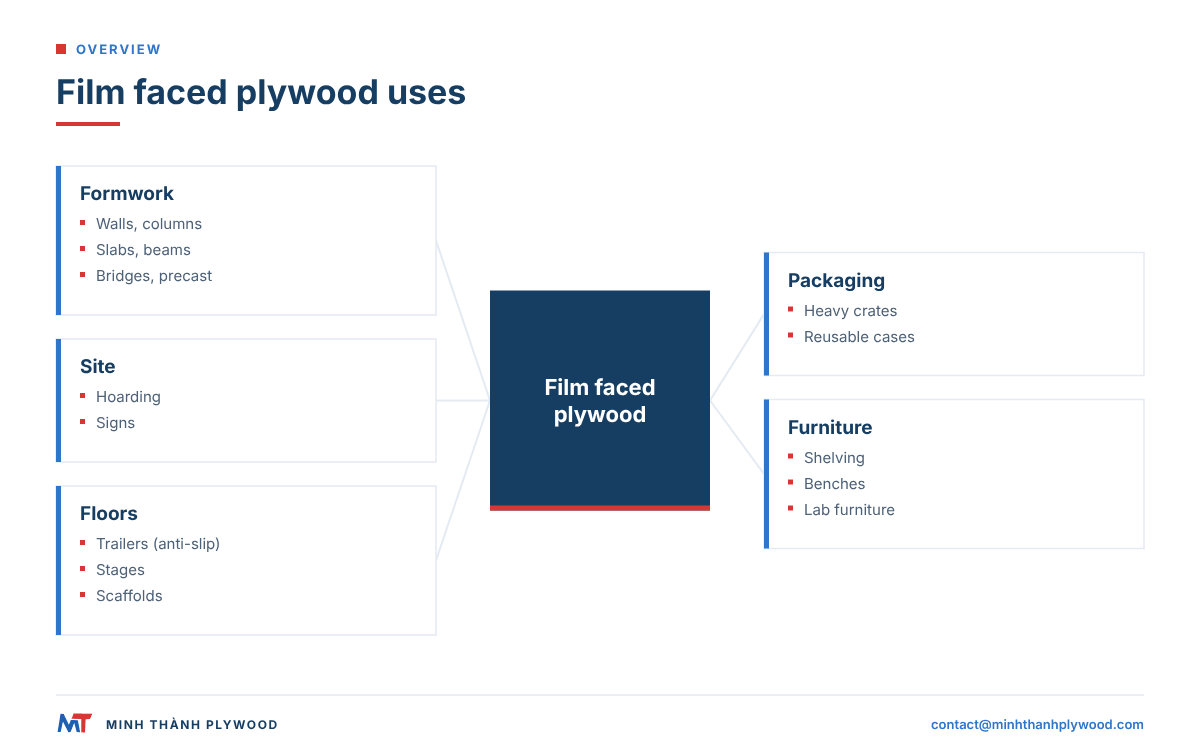
Film faced plywood is used first for concrete formwork, and then for site hoarding, transport and stage floors, crates, shelving and furniture. Each use asks something different of the panel, so the thickness, film, glue and core change with the job.
| Use | Who buys it | Typical thickness | Film | Glue | Why film-faced |
|---|---|---|---|---|---|
| Wall and column formwork | Contractors, formwork hire | 18 mm, 21 mm | Standard or premium | Phenolic WBP | Smooth concrete, many reuses |
| Slab and beam formwork | Contractors, formwork hire | 15 mm, 18 mm, 21 mm | Standard or premium | Melamine-fortified or phenolic WBP | Flat soffit, easy release |
| Site hoarding and fencing | Contractors, sign makers | 12 mm, 18 mm | Standard | Melamine-fortified or phenolic WBP | Weather-resistant, printable |
| Trailer, truck and scaffold floors | Body builders, scaffold firms | 18 mm, 21 mm | Anti-slip textured | Phenolic WBP | Wear and grip |
| Stage and event floors | Event and staging firms | 18 mm | Smooth or anti-slip | Phenolic WBP | Hard, wipe-clean, black |
| Heavy-goods crates and pallets | Packaging and export firms | 12 mm, 15 mm, 18 mm | Standard | Melamine-fortified | Moisture-resistant, reusable |
| Shelving, benches, school and lab furniture | Furniture and fit-out firms | 15 mm, 18 mm | Standard, sanded edges | Specified with emission class | Wipe-clean, industrial look |
| Agricultural stalls and horse boxes | Farm and trailer builders | 15 mm, 18 mm | Standard or anti-slip | Phenolic WBP | Cleanable, impact-resistant |
The rest of this guide takes these uses in turn, starting with the largest: film faced plywood for construction.
Film faced plywood uses in the UAE and the Gulf
In the UAE and the Gulf, film faced plywood is the standard skin for tower cores, podium slabs, basements and villa compounds, and the usual order is 18 mm in 1220 × 2440 mm sheets for walls and columns. Heat is the buyer’s problem: summer air passes 45 °C, hot wet-dry cycles attack the glue line and edges, and wind-blown sand wears the film.
| Gulf use | Usual build | Reason |
|---|---|---|
| Tower cores and shear walls | 18 mm, phenolic WBP, premium film from 135 g/m² | Many pours per sheet, visible faces |
| Podium and flat slabs | 15 or 18 mm on H20 beams | Flat soffit, quick strip |
| Villa compounds and low-rise | 18 mm, melamine-fortified, standard film | Fewer pours per sheet |
| Rental yards | Phenolic WBP, premium film | Highest reuse count |
Local shelf prices give an importer the margin to beat. A UAE price guide puts an 18 mm brown film faced sheet at about AED 80 to AED 115, and a Dubai retailer lists a marine film faced 18 mm sheet at AED 145.44 with tax. Our sibling guide on film faced plywood for the Middle East covers storage on hot sites, phenolic against melamine glue and Gulf shipping, about 15 to 25 days at sea from Hai Phong.
Film faced plywood for construction: concrete formwork
Film faced plywood for construction is overwhelmingly a formwork panel: the contact skin that moulds walls, slabs, columns, beams, stairs, bridges and tunnels. It is fixed to timber beams, steel frames or aluminium systems, which carry the concrete pressure; the plywood spans between them and gives the concrete its surface.
Wall formwork. Panels of 18 or 21 mm are fixed to H20 timber beams or steel walers and tied through the wall. The smooth film gives an even face and keeps release simple. Our guide to on building concrete wall forms with plywood covers the build.
Slab formwork. 15, 18 or 21 mm sheets lie on joists and bearers and form the soffit, the underside of the slab. A flat, smooth soffit can be left exposed or painted with little preparation.
Columns and beams. Square and rectangular columns use 18 or 21 mm boxes clamped at close spacing; beams combine side panels and a soffit panel.
Bridges, tunnels and civil works. Heavier sections, curved faces and high pressures use 21 mm panels, heavier film and phenolic glue.
Precast yards. Moulds for precast elements use film-faced plywood for the sides and bases, where reuse count and face quality decide the cost per element.
Why film faced plywood is used in formwork
Film faced plywood is used in formwork because it gives a smooth concrete face, releases cleanly, survives wet pours and comes back flat for the next one. A board without film absorbs water, swells and prints its grain on the concrete; steel is heavier and costs more to cut to non-standard shapes.
Four properties explain its place on site:
- Smooth, non-absorbent face. The resin film keeps water in the concrete at the surface, which gives an even colour and fewer surface defects.
- Water-resistant bond. Melamine-fortified or phenolic WBP glue holds the plies through repeated wetting.
- Stiffness for its weight. Crossed veneers carry concrete pressure in both directions between supports; an 18 mm sheet of 1220 × 2440 mm with an Acacia core weighs about 31.1 kg, light enough for two workers to handle.
- Reuse. About 12–15 pours with melamine-fortified glue and up to about 25 with phenolic glue, with proper handling, release agent and edge sealing.
The film also protects the face from scratches and concrete adhesion, which is why the film weight is one of the first lines of a formwork order.
Film faced plywood vs steel, aluminium and plastic formwork
Film faced plywood is the lightest and the cheapest to buy and to cut to shape; steel, aluminium and plastic forms last more pours on repeated layouts. Teconform, a Chinese formwork maker, says film faced plywood demoulds with about one seventh of the effort of steel formwork, and that a fair-faced concrete finish cuts the construction period by 30%, because walls need no second plastering.
| Formwork type | Weight per m² | Reuses (published ranges) | Cut to shape | Best for |
|---|---|---|---|---|
| Film faced plywood, 18 mm skin | About 11.7 kg | 12–15 melamine-fortified, up to about 25 phenolic WBP | On site with a saw | Irregular plans, short runs, fair-faced walls |
| Aluminium panels | 19–25 kg | 200–300 | Fixed modules | Repeated floors and walls |
| Steel-framed panel systems | About 65 kg with accessories | 100–150 | Fixed modules, plywood fillers | Heavy civil work, many repeats |
| Plastic panels | Light | 30–50 | Fixed modules | Small repeated slabs and walls |
Calculation for the plywood weight: a 1220 × 2440 mm sheet of 18 mm on a Eucalyptus core weighs about 34.8 kg over 2.98 m², which is 11.7 kg/m². The other rows come from published system data. Aluminium wall systems average 23 kg/m² according to Kitsen. Steel-framed clamp panels weigh about 65 kg/m² including accessories according to Aluma. A formwork comparison lists aluminium at 250 to 300 cycles. Systems cost more to buy, so they pay back only when the same layout repeats. Many sites use a system frame with a plywood skin, which gets both.
How film faced plywood is made
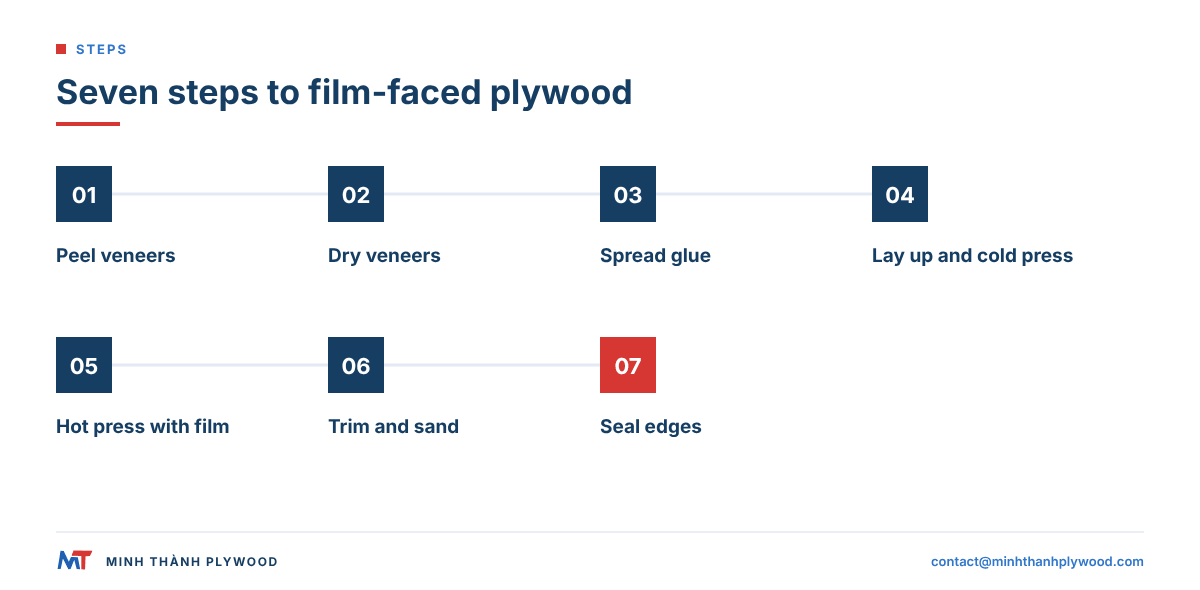
A sheet of film faced plywood is made in seven steps, and each one shows up in how the panel behaves on site.
- Peel: logs are rotary-peeled into thin veneers.
- Dry: veneers are dried to a stable moisture, and the factory checks it before gluing.
- Spread glue: melamine-fortified or phenolic WBP resin is spread on the veneers.
- Lay up and cold press: veneers are crossed layer by layer and cold-pressed to set the stack.
- Hot press with the film: the stack is pressed under heat with a resin-impregnated paper film on each face, which bonds the film and cures the glue.
- Trim and sand: the sheet is squared to size, 1220 × 2440 mm or 1250 × 2500 mm, and checked for thickness to ±0.5 mm.
- Seal the edges: water-resistant paint on the four edges keeps water out of the core.
What types of film faced plywood are there?
Film faced plywood comes in types set by film, core, glue and thickness. Market makers list thicknesses from 4 mm to 50 mm and sheets up to 2000 × 6000 mm; Minh Thanh presses 12 to 21 mm in the two standard sheet sizes, which cover almost all formwork.
| Type | Variants |
|---|---|
| Film colour | Brown or black; the colour is a market preference |
| Film weight | Standard 120–135 g/m², premium from 135 g/m², anti-slip about 220 g/m² |
| Core | Eucalyptus or Acacia hardwood; some makers use poplar or birch |
| Glue | MR (interior only), melamine-fortified WBP, phenolic WBP |
| Surface | Smooth for formwork, textured anti-slip for floors |
| Thickness | 4–50 mm on the wider market; 12, 15, 18 and 21 mm from Minh Thanh |
Ask for bond-class proof with any order. Bonding-quality requirements for plywood are set in BS EN 314-2. Third-party testing to the buyer’s method, for example the bond test EN 314-2 Class 3 for exterior use, is arranged through SGS on request.
Hoarding, site fencing and signage
Film faced plywood makes durable site hoarding and signage because its film resists rain and dirt and takes paint or printed graphics. Contractors use 12 mm or 18 mm sheets fixed to timber or steel posts around building sites, and sign makers use it for temporary site boards.
For hoarding, the specification points that matter are the glue, which must be water-resistant, and the edges, which must be sealed after cutting. Painted or printed hoarding needs a light-coloured film or a primer; black and brown films are usually painted over.
Hoarding panels are often reused from site to site. Storing them flat and dry between jobs, with edges resealed after recutting, keeps them serviceable.
Trailer, truck and scaffold floors
Trailer, truck and scaffold floors use the anti-slip version of film faced plywood, with a textured film pressed onto the top face for grip and a smooth film underneath. Body builders and scaffold firms buy it in 18 mm and 21 mm with phenolic glue.
The anti-slip film is heavier than smooth formwork film, about 220 g/m², with a wire-mesh, hexagonal or rice-grain pattern. It resists the wear of wheels, pallet trucks and boots. Floor specifications also include the support spacing, wheel loads and fixing detail.
Our anti-slip plywood page lists the patterns and the order details.
Stage, event and workshop floors
Stage and event companies use film faced plywood for platform and floor decks because the film is hard, cleans easily and gives the even black surface theatres and studios prefer. 18 mm sheets with phenolic glue are standard, smooth for stage tops and anti-slip where people move fast or surfaces get wet.
Workshops and warehouses use the same sheets for mezzanine decks, workbench tops and wall linings. Exposed edges on such decks are usually sealed and painted, or protected with an aluminium edge.
Crates, pallets and heavy packaging
Film faced plywood is used for crates and reusable packaging when the contents are heavy, the transport is long or the packaging must survive rain. Its film resists moisture and handling marks, and the crate can be cleaned and reused.
Machine builders, steel product exporters and project cargo firms use 12, 15 and 18 mm sheets for crate sides and bases. Where packaging goes to the European Union, the EU packaging regulation (PPWR) applies to the crate; plywood is processed wood and needs no ISPM 15 treatment. Minh Thanh also makes packing plywood without film, which is the cost-effective choice for one-way crates.
Furniture, shelving and interiors
Film faced plywood is used in furniture where a hard, wipe-clean surface and an industrial look are wanted: shelving, workbenches, school and lab furniture, retail fixtures and cabinets with exposed plywood edges. Designers choose black or brown film and leave the layered edge visible.
For furniture, three points differ from formwork:
- Emission class. Interior furniture needs a stated formaldehyde emission class; write it on the order separately from the glue type. In the US, veneer-core hardwood plywood is limited to 0.05 ppm formaldehyde under 40 CFR 770.10.
- Edges. Visible edges are sanded and lacquered rather than painted.
- Flatness and tolerance. Furniture needs flatter panels and a tighter tolerance than formwork.
For furniture with a decorative face, Minh Thanh’s furniture plywood with sanded faces and UF glue at E0 emission is usually the better base; film faced plywood is the choice where the surface takes hard wear.
Agriculture, marine and other uses
Farm and trailer builders use film faced plywood for animal stalls, horse box walls, and livestock trailer linings, because the film is easy to wash down and resists impact. Phenolic glue and sealed edges are standard for these wet, hard-wearing uses.
Other uses include container and van linings, wall panels in cold rooms with an additional coating, playground equipment with painted film, and moulds for fibreglass and precast products. Each one depends on the same three properties: the film, the water-resistant glue and the stiff core.
Film faced plywood vs marine plywood: which for which use?
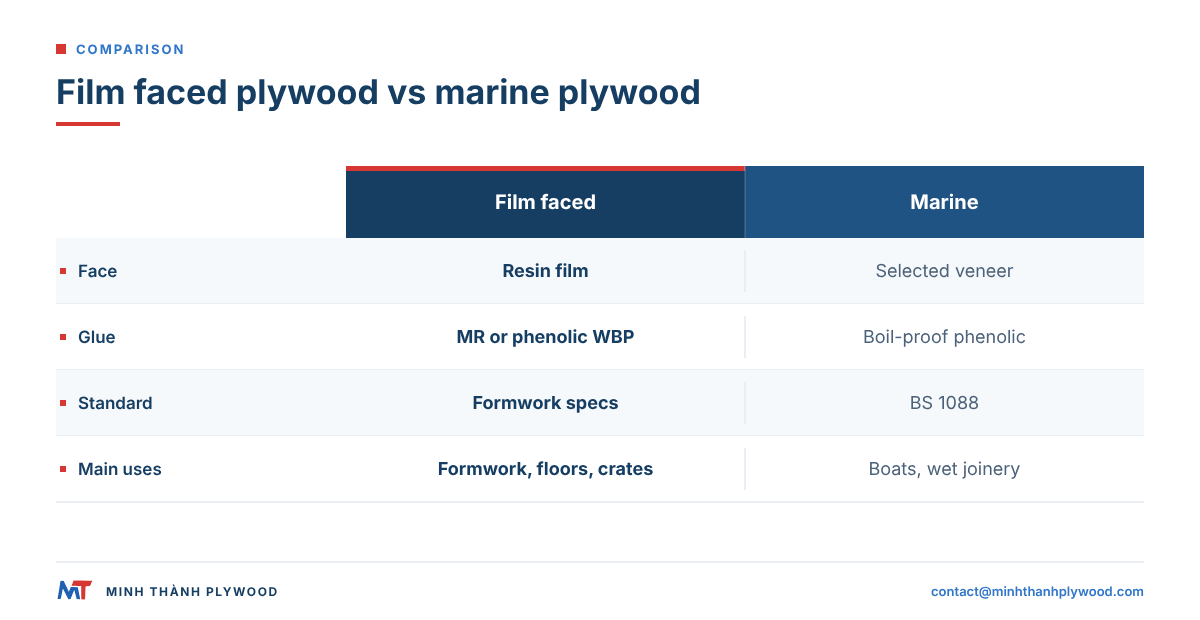
Film faced plywood and marine plywood serve different uses: film faced plywood for formwork and wear surfaces, marine plywood for boats and high-grade wet joinery. The table compares them on the points buyers ask about.
| Point | Film faced plywood | Marine plywood |
|---|---|---|
| Face | Resin film, brown or black | Selected hardwood veneer, no film |
| Core | Eucalyptus or Acacia hardwood | Selected hardwood with very few gaps |
| Glue | Melamine-fortified or phenolic WBP | Boil-proof phenolic |
| Typical standard | Formwork and market specifications | BS 1088 for marine use |
| Main uses | Formwork, hoarding, floors, crates | Boat building, wet joinery |
| Surface | Smooth or anti-slip, ready to use | Sanded, for painting or varnishing |
Use film faced plywood where the surface takes concrete, wheels or washing. Use marine plywood where the whole panel lives in water and must be finished by hand. Marine plywood is specified in BS 1088:2018, the British Standard for marine plywood, which sets standard and lightweight classes made from untreated tropical hardwood veneers.
Film faced plywood uses and their specification: how to choose
Choose the specification in the order the panel works: the thickness from the support spacing, the film from the wear, the glue from the wetting, and the core from the weight and stiffness. Minh Thanh presses film faced plywood from 12 to 21 mm with standard film of 120–135 g/m² or premium film from 135 g/m².
| Choice | Options | Pick by |
|---|---|---|
| Thickness | 12, 15, 18, 21 mm | Support spacing and load; 18 mm for most formwork |
| Film | Standard 120–135 g/m², premium from 135 g/m², anti-slip about 220 g/m² | Number of reuses, wear, grip |
| Glue | Melamine-fortified (about 12–15 formwork uses) or phenolic WBP (up to about 25) | Wetting and reuse target |
| Core | Eucalyptus 650–750 kg/m³ or Acacia about 580 kg/m³ | Stiffness against weight per sheet |
| Size | 1220 × 2440 mm or 1250 × 2500 mm | The formwork system and market |
Reuse counts assume proper handling, release agent and edge sealing. Our guide to film-faced plywood vs 3-ply shuttering panels helps with the choice between panel types.
What film faced plywood is not suited for
Film faced plywood is not suited to uses where it stands permanently in water, where a decorative wood face is wanted, or where a structural grade is required by a code it was not tested against. Knowing these limits avoids most claims.
- Permanent immersion, such as boat hulls: use marine plywood.
- Decorative interiors, where veneer grain is wanted: use a veneered furniture panel.
- Structural use under a stress grade, such as F17 in Australia or a structural class elsewhere, unless the order names that grade and its test evidence.
- Long sun exposure without paint, where the film slowly fades and checks.
How a buyer orders film faced plywood for a use
A buyer orders film faced plywood by describing the use first, then the thickness, film, glue, core, size and quantity. Minh Thanh’s minimum order is one 40HC, with mixed thicknesses and specifications in it by agreement, and production takes 15–45 days after the 30% deposit.
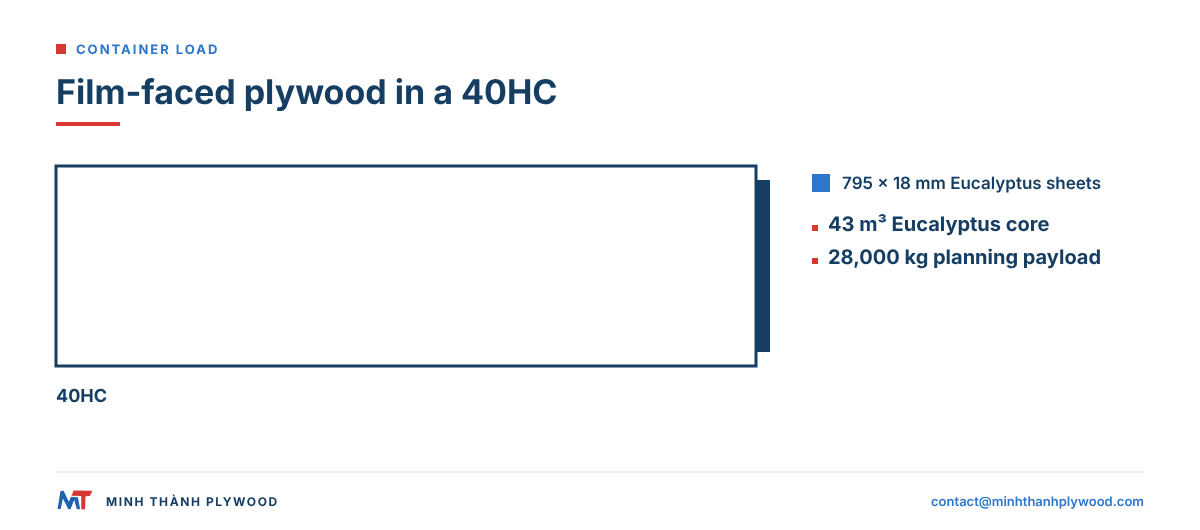
A container holds about 43 m³ of film faced plywood on a Eucalyptus core and about 47 m³ on Acacia, depending on the thickness mix. At 18 mm and 1220 × 2440 mm that is 795 sheets on Eucalyptus, 880 sheets on Acacia, planned against a 28,000 kg payload. Every shipment is photographed and filmed before loading, and buyers receive the photos and video.
Film faced plywood for wall formwork: 18 mm, premium film 135 g/m² brown, phenolic WBP glue, Eucalyptus core, 1220 × 2440 mm, thickness ±0.5 mm, edges sealed; 1×40HC CIF your port.
Minh Thanh sends free samples and replies within hours: contact@minhthanhplywood.com or WhatsApp +84 988 586 601.
Buyer questions, answered
What is film faced plywood used for?
Mainly concrete formwork for walls, slabs, columns, beams and bridges. It is also used for site hoarding, trailer and truck floors (in its anti-slip version), stage and event floors, crates for heavy goods, shelving and some furniture.
Why is film faced plywood used in formwork?
Its smooth film gives a clean concrete face and releases easily, its water-resistant glue survives wet pours, and the cross-laminated core stays flat and strong. One sheet is reused for many pours with proper care.
Is film faced plywood waterproof?
The film and a phenolic or melamine-fortified glue make it highly water-resistant, not waterproof. Cut edges and holes are bare wood and must be sealed; panels should not stand in water.
What is the difference between film faced plywood and marine plywood?
Film faced plywood has a resin film on its faces for formwork and wear surfaces. Marine plywood has no film; it is a high-grade panel with selected veneers and a boil-proof glue for boats and wet joinery, usually made to BS 1088.
Can film faced plywood be used outdoors?
Yes, for hoarding, signs, sheds and temporary works, when the glue is phenolic or melamine-fortified and every cut edge is sealed. Its film weathers slowly in sun, so long-term exterior use benefits from a painted finish.
Can film faced plywood be used for flooring?
Smooth film faced plywood suits floors that need a wipe-clean surface, such as stages and workshops. Trailer, truck and scaffold floors use the anti-slip version with a textured film.
Can you use film faced plywood for furniture?
Yes, it is used for shelving, workbenches, school and lab furniture and industrial-style cabinets with exposed edges. Specify the emission class separately and sanded edges if they stay visible.
What thickness of film faced plywood is used for formwork?
18 mm is the most common thickness for walls, columns and slabs; 12 and 15 mm suit liners and closely supported soffits, and 21 mm heavier formwork. The formwork design sets the support spacing.
How many times can film faced plywood be reused?
About 12–15 times with melamine-fortified glue and up to about 25 times with phenolic WBP glue, with proper handling, release agent and edge sealing.
Is brown or black film faced plywood better?
Neither colour is better on its own; colour is a choice of the buyer's market. Compare the film weight, glue and core, which decide how long the face lasts.
What is the minimum order for film faced plywood from Vietnam?
At Minh Thanh the minimum order is one 40HC, with mixed thicknesses and specifications in it by agreement. Production takes 15–45 days after the deposit.