
Magnesium oxide board is a mineral sheet made from magnesia cement and fibre mesh. It does not burn, resists mould and suits fire-rated walls and wet-room linings, but it is heavy, brittle at the edges, and some chloride-based boards absorb moisture and corrode fixings. Plywood stays the lighter, stronger choice for floors, roofs and sheathing. Minh Thanh Plywood makes plywood in Vietnam for construction and furniture.
Magnesium oxide board: the short answer
Magnesium oxide board beats plywood on fire and mould resistance, and plywood beats MgO board on strength, stiffness, fixing and weight. Use MgO board for fire-rated walls, linings and some tile backing; use plywood for floors, roofs, structural sheathing, furniture and anything that must carry load or hold screws.
- MgO board: mineral, non-combustible, mould-resistant; heavy and brittle; chloride-based boards can attract moisture.
- Plywood: cross-laid wood veneers; strong, stiff, light, easy to fix; combustible and needs a water-resistant bond outdoors.
- Cement board: mineral, proven in showers; heavier and harder to cut.
The rest of this guide compares them point by point and gives a verdict by job.
What is MgO board?
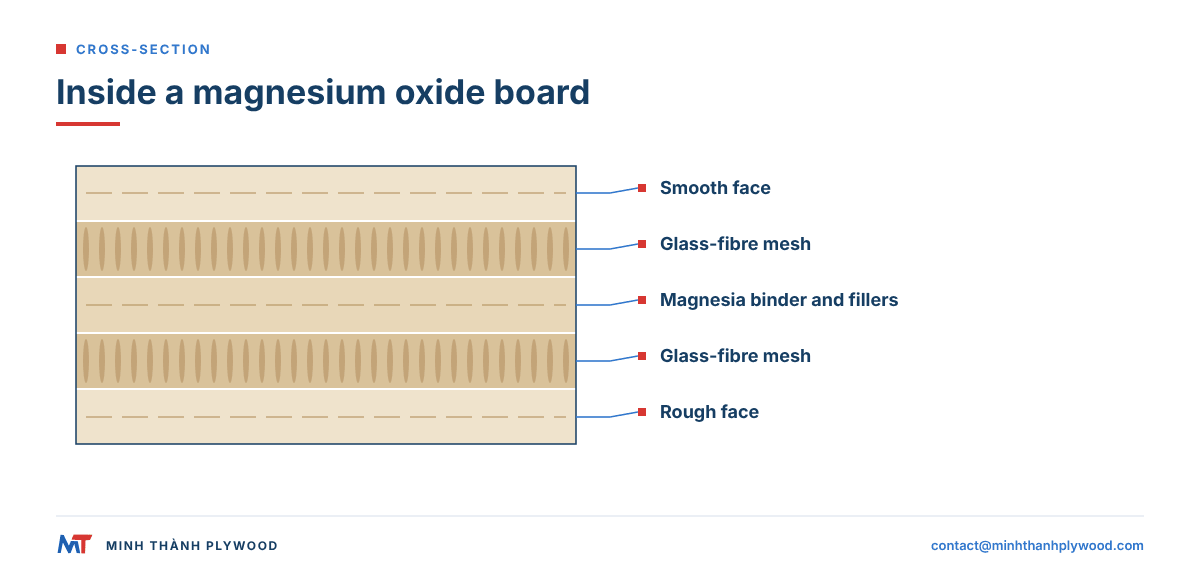
MgO board is a cement-like building sheet made from magnesium oxide bound with magnesium chloride or magnesium sulphate, reinforced with glass-fibre mesh and filled with perlite, wood fibre or other fillers. It is sold as wall board, ceiling board, tile backer, fire board and sheathing.
- Binder: magnesium oxide (magnesia) with magnesium chloride or magnesium sulphate.
- Reinforcement: one or more layers of glass-fibre mesh near the faces.
- Fillers: perlite, wood flour or fibre, to lower weight and help fixing.
- Faces: one smooth face for paint or tiles, one rough face; some boards are pre-laminated.
Magnesia cement boards were approved for construction use in the US around 2003, and the material is used on all 101 storeys of Taipei 101 (Wikipedia, checked on 21 October 2026). Magnesium board is also called magnesia board or MgO sheathing. The binder chemistry, chloride or sulphate, is the most important point in any comparison.
How magnesium board is made
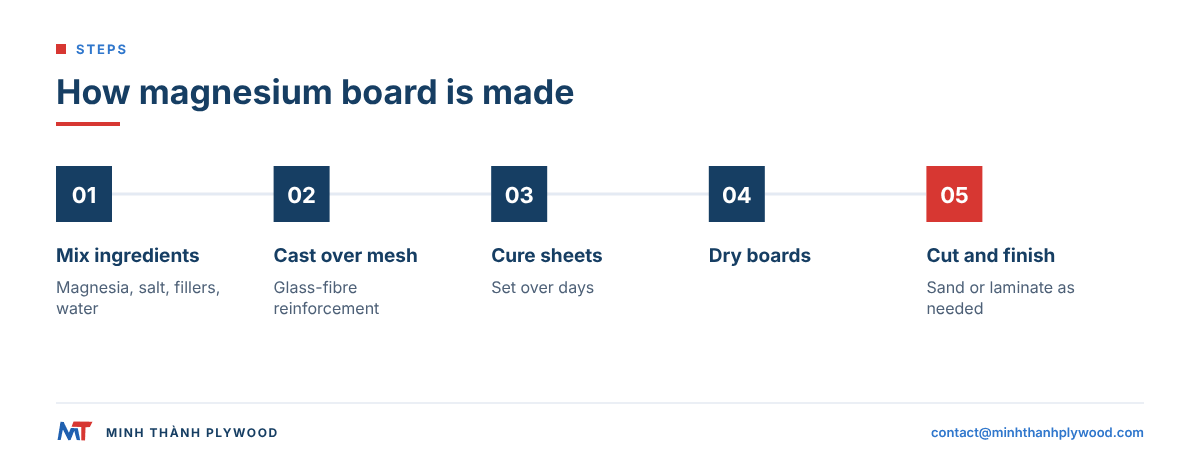
Magnesium board is made by mixing magnesium oxide with a salt solution and fillers, casting the slurry over glass-fibre mesh in moulds, then curing and finishing the sheets.
- Mixing: magnesium oxide powder, magnesium chloride or sulphate solution, fillers and water.
- Casting: the slurry is spread in layers with glass-fibre mesh near each face.
- Curing: the sheets set and cure over days, often stacked between moulds.
- Drying: the boards dry to their delivery moisture.
- Finishing: sanding, cutting to size and, for some products, laminating a decorative face.
Magnesite ore is calcined at about 780 °C to make the magnesia, against more than 1,400 °C for Portland cement clinker, which is the main energy argument for MgO (Wikipedia, checked on 21 October 2026). Process control decides quality. Boards with too much free salt or poor curing are the ones that later absorb moisture.
MgO board properties: fire, moisture, weight and strength
MgO board is non-combustible, mould-resistant and dimensionally steady when dry, but it is heavier and weaker in bending than plywood of the same thickness. The properties that matter for a building are fire class, moisture behaviour, weight and fixing.
- Fire: many MgO boards are declared Euroclass A1 or A2-s1,d0 under BS EN 13501-1:2018, the reaction-to-fire classification used for CE marking under Regulation (EU) No 305/2011 (EUR-Lex, read 20 October 2026).
- Mould and rot: the mineral binder gives mould nothing to feed on.
- Moisture: water-resistant, but chloride boards can draw moisture from humid air.
- Weight and strength: denser and weaker in bending than plywood; edges crack if fixed too close.
- Emission: no formaldehyde resin in the binder.
The table sets published values from one MgO maker’s data page (MagPanel, checked on 21 October 2026) beside our plywood. Treat the MgO column as that maker’s claims, not a property of every board.
| Property | MgO board (one maker’s published values) | Plywood (Minh Thanh) |
|---|---|---|
| Fire | ASTM E84 Class A, flame spread 0, smoke developed 5; EN 13501-1 A1 | Combustible unless fire-retardant treated |
| Moisture movement | 0.08 % (EN 12467) | Depends on the bond: UF for dry, MR or WBP for damp |
| Nail head pull-through | 1,817 N, against a 560 N ASTM D1037 requirement | Holds nails and screws close to the edge |
| Freeze-thaw and heat-rain | 25 cycles of each under EN 12467 | Exterior WBP bond for outdoor use |
| Formaldehyde | below 0.005 ppm (ASTM D6007) | Six ASTM D6007 chamber tests averaged 0.014–0.032 ppm |
| Dissolvable chloride | about 1 % (sulphate binder) against about 5 % in typical chloride boards | Not applicable |
| Density | about 1,000 kg/m³ or more for exterior sheathing grades (DuPont, checked on 21 October 2026) | About 500 kg/m³ (Styrax core) to 650–750 kg/m³ (Eucalyptus); 18 mm Styrax sheet about 26.8 kg |
| Stocked sheet | 4 ft × 8 ft, 1/8, 1/4, 1/2 and 3/4 in | 1220 × 2440 mm, 3–40 mm |
Check each product’s data sheet: two boards both called MgO can perform very differently.
The data sheet should give the binder type, density, bending strength, water absorption, the declared reaction-to-fire class with the test report behind it, and the fixings and edge distances the maker approves. A board sold without these values is hard to compare and hard to defend on a project. For fire-rated walls (in England, the guidance is Approved Document B), the rating belongs to the tested wall build: board type and thickness, stud spacing, insulation and joint treatment together. Replacing one board with another in a tested system needs the new board’s own test evidence.
Plywood buyers ask the same kind of questions of a panel: bond class, emission class, core species, thickness tolerance and moisture content. Our panels are dried to 8–12 % moisture content at dispatch, and commercial and film-faced panels hold ±0.5 mm in thickness.
Chloride vs sulphate MgO boards: the moisture problem
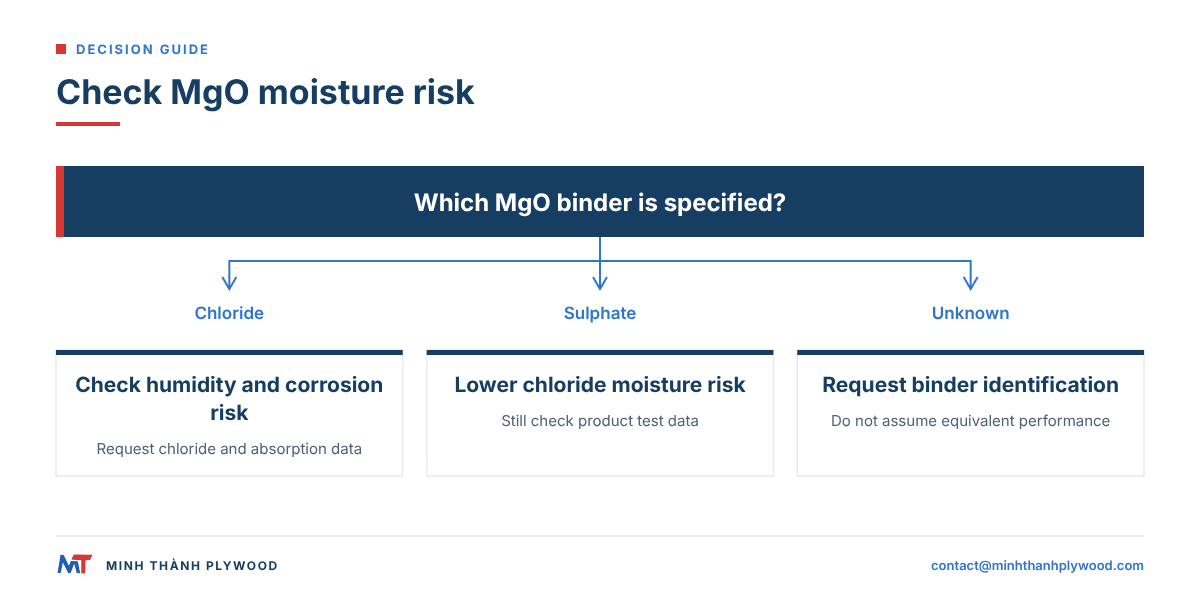
Chloride-based MgO boards can absorb moisture from humid air and release salty water that corrodes fixings and wets the wall; sulphate-based boards are much less prone to this. The difference became widely known after problems with MgO wall sheathing in Denmark in the mid-2010s.
- What happened: boards used as exterior wall sheathing behind cladding absorbed moisture in damp weather, released water containing chloride, and corroded screws, nails and metal parts.
- Why: free magnesium chloride in the board attracts water from the air.
- Lesson 1: specify the binder chemistry and ask for test data on water absorption and chloride content.
- Lesson 2: in damp climates and behind cladding, use sulphate boards or another sheathing.
- Lesson 3: use corrosion-resistant fixings in any MgO board.
This is why many specifiers in cool, damp climates use MgO boards only inside the building envelope, and keep plywood, OSB or cement board for exterior sheathing.
Can you use MgO board in the UK?
In the UK, MgO board has been hard to insure on new homes since spring 2020, when NHBC, LABC and other warranty providers said they would no longer accept it on schemes they cover, according to RICS (checked on 21 October 2026). A board that fails an insurer’s warranty check can stall a site sign-off, so check the warranty provider before you order.
- Why insurers stepped back: moisture and corrosion failures found in Denmark, reports of similar problems in Australia and Canada, and test methods written for other boards that do not cover long humid exposure.
- The earlier NHBC position: from 1 January 2019, NHBC required MgO boards to hold independent third-party certification referring to its standards, stainless-steel fixings, no use below damp-proof course level, and a breathable membrane over sheathing, as recorded in a High Court of Northern Ireland judgment (checked on 21 October 2026).
- The standards gap: there is no British Standard for MgO board. BSI began a publicly available specification, PAS 670:2021, with the MOBBTA trade association in May 2020, as a first step towards a standard.
- What to do: for UK sheathing and floors, specify plywood or OSB, the materials the warranty bodies accept without extra paperwork, and keep MgO to interior fire-rated linings where the insurer and the building control officer have agreed it in writing.
For a UK importer, plywood to EN 636 with a stated bond class and a low-emission declaration is the warranty-safe sheathing default. Send us the thickness, bond class and sheet count and we will quote it FOB from Vietnam.
MgO board vs plywood: comparison table
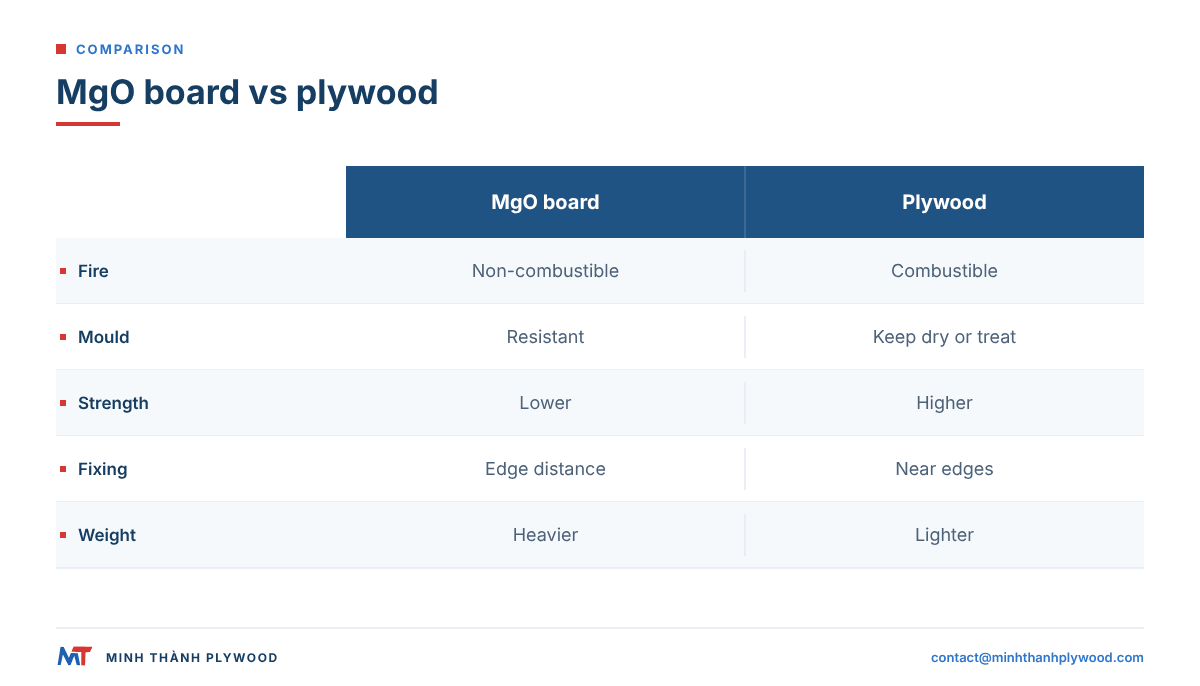
MgO board wins on fire, mould and surface hardness; plywood wins on strength, stiffness, weight, fixing and toughness. The table compares them on one property per row.
| Property | MgO board | Plywood |
|---|---|---|
| Material | Magnesia cement, mesh, fillers | Cross-laid wood veneers and glue |
| Reaction to fire | Non-combustible, often A1 or A2 | Combustible unless fire-retardant treated |
| Mould and rot | Resistant | Needs dry service or treatment |
| Moisture | Water-resistant; chloride boards can absorb from air | Depends on the bond: UF for dry, MR or WBP for damp |
| Weight | Heavier | Lighter; 18 mm Styrax-core sheet about 26.8 kg |
| Bending strength | Lower | Higher, in both directions |
| Impact and edges | Brittle edges and corners | Tough, does not crack |
| Nail and screw holding | Fair, needs edge distance | Very good, also near edges |
| Cutting | Score and snap or dust-extracted saw | Any wood saw |
| Structural sheathing | Limited, product-specific | Standard for floors, roofs and walls |
| Furniture and joinery | Not used | Standard |
Our 18 mm plywood on a Styrax core (about 500 kg/m³) weighs about 26.8 kg per 1220 × 2440 mm sheet; on Eucalyptus (650–750 kg/m³) about 34.8 kg.
MgO board vs cement board
MgO board is lighter, easier to cut and better in fire than most cement boards, while cement board is the longer-proven tile backer in showers and carries no chloride moisture risk. Both are mineral boards that do not rot.
| Property | MgO board | Cement board |
|---|---|---|
| Weight | Lighter | Heavier |
| Cutting | Score and snap, easier | Harder, more dust |
| Fire | Non-combustible | Non-combustible |
| Wet rooms | Good when sulphate-based and sealed | Proven tile backer |
| Humid-air risk | Chloride boards absorb moisture | Low |
| Fixings | Corrosion-resistant screws | Corrosion-resistant screws |
For showers, cement board or a waterproofed backer is still the common choice. For dry fire-rated walls, MgO board is often lighter to install.
Is MgO board better than plywood for sheathing?
For structural wall, roof and floor sheathing, plywood is usually the better choice because it is stiffer, stronger, lighter and holds fixings well, and its behaviour is well known. MgO board can be used as sheathing where its product approval allows it and fire resistance is the priority.
- Walls: plywood and OSB give racking resistance; check whether an MgO product is approved for it.
- Roofs: plywood spans between rafters and holds roofing nails; see plywood roof sheathing.
- Floors: plywood takes point loads without cracking; see plywood for subfloors.
- Behind cladding: avoid chloride MgO boards in damp climates.
A common hybrid is plywood or OSB sheathing for strength, with an MgO or gypsum board inside for fire rating.
Fixings and corrosion in MgO board
MgO board needs corrosion-resistant fixings set back from the edges, because plain steel can corrode in chloride-based boards and the board can crack at the edges.
- Use approved screws: stainless steel or coated, with self-countersinking heads.
- Keep edge distances given by the board maker.
- Pre-drill near edges and corners of brittle boards.
- Do not overdrive screws through the face.
- Seal joints with the system’s tape and compound.
Plywood takes standard nails, screws and staples close to the edge without cracking, which is one reason carpenters prefer it for sheathing and furniture.
Cutting, finishing and safety
MgO board is cut by scoring and snapping or with a saw that has dust extraction, and finished with tiles, paint or plaster on its smooth face. Plywood is cut with any wood saw and finished with paint, lacquer, veneer or laminate.
- Dust: cutting mineral boards makes fine dust; use extraction and a mask.
- Finishing: tiles with suitable adhesive; paint or skim on the smooth face.
- Edges: support edges on studs or battens.
- Storage: keep boards flat and dry, off the ground.
Plywood dust is ordinary wood dust. For indoor use, check the panel’s formaldehyde emission; our furniture and interior plywood uses UF glue at E0 emission.
Where plywood stays the better choice
Plywood stays the better choice wherever a board must carry load, hold fixings, resist impact, stay light or be machined: floors, roofs, structural walls, furniture, cabinets, packaging, formwork and vehicle floors.
- Floors and roofs: stiff and nail-holding; exterior or WBP bond where wetting is possible.
- Furniture and joinery: MgO board is not used.
- Packaging and crates: light and tough.
- Formwork: film-faced plywood; see film-faced plywood.
- Wall linings that must look like wood: veneered plywood.
For outdoor use, specify a phenolic WBP bond; our exterior plywood grades guide explains the faces and bonds.
Which board for which job?
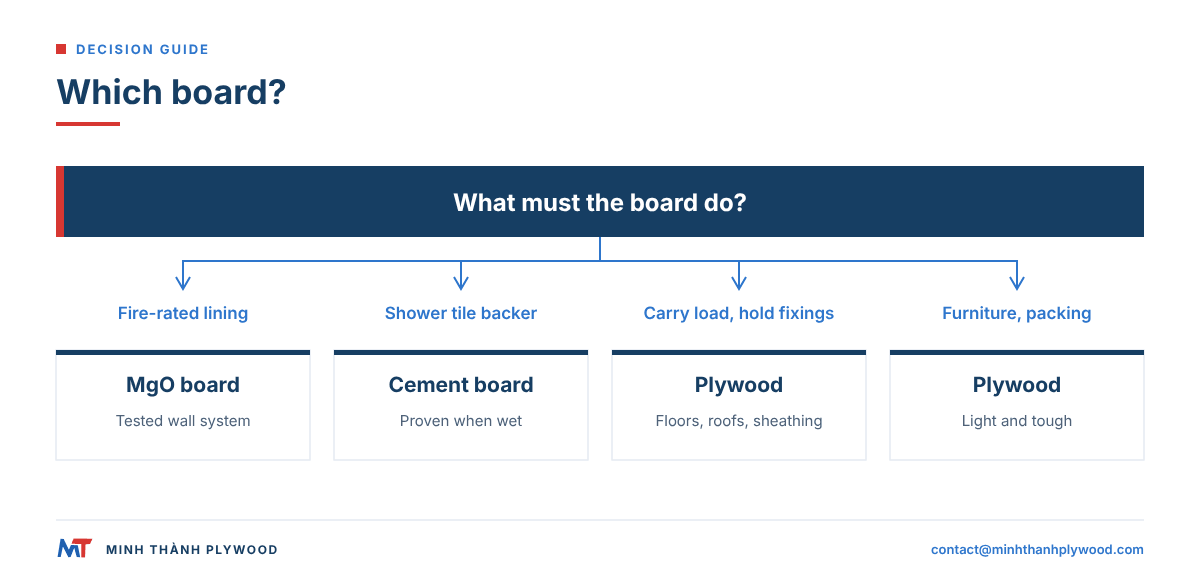
Choose MgO board for fire-rated and mould-prone linings, cement board for shower tile backing, and plywood for anything structural, load-bearing, light or machined. The matrix gives the verdict.
| Job | Choose | Why |
|---|---|---|
| Fire-rated internal wall | MgO board (tested system) | Non-combustible lining |
| Shower tile backer | Cement board or waterproofed backer | Proven in constant wetting |
| Bathroom ceiling or wall lining | Sulphate MgO board | Mould-resistant |
| Exterior wall sheathing, damp climate | Plywood or OSB | No chloride risk, racking strength |
| Roof deck | Plywood | Spans and holds nails |
| Subfloor | Plywood | Stiff under point loads |
| Furniture and cabinets | Plywood | Machined, holds screws |
| Packing and crates | Packing plywood | Light and tough |
What this means for your plywood order
Where plywood is the right board, the bond and core decide how it performs in the building, so send the full line with your enquiry:
- Application: sheathing, floor, roof, wall lining, furniture or packing.
- Bond: phenolic WBP for exterior, MR or melamine-fortified for humid uses, UF glue at E0 emission for dry interiors.
- Core: Styrax for light panels, Eucalyptus for dense panels.
- Face: C/D utility faces for sheathing, or a decorative face for linings.
- Size and thickness: 1220 × 2440 or 1250 × 2500 mm, 3–40 mm.
- Quantity and packing: from one 40HC.
Commercial plywood starts from US$250/m³ (October 2026), production takes 15–45 days after the deposit, and free samples are available. See commercial plywood from Vietnam, or compare boards in CDX plywood vs OSB and the pillar on types of wood boards.
Buyer questions, answered
Is MgO board better than plywood?
MgO board is better than plywood where fire resistance, mould resistance and a mineral surface matter, such as fire-rated walls and tile backing. Plywood is better for strength, stiffness, nail holding and light weight, so it stays the normal choice for floors, roofs and structural sheathing.
What is magnesium oxide board made of?
Magnesium oxide board is made from magnesium oxide mixed with magnesium chloride or magnesium sulphate solution, fillers such as perlite or wood fibre, and glass-fibre mesh, cast into sheets and cured.
Is MgO board waterproof?
MgO board is water-resistant and does not rot, but it is not fully waterproof. Chloride-based boards can absorb moisture from humid air, so sulphate-based boards and good detailing are preferred in damp climates.
Is magnesium board fireproof?
Magnesium board is non-combustible: many boards are declared Euroclass A1 or A2 for reaction to fire. A fire-rated wall still depends on the tested wall build, not the board alone.
Can you use MgO board in the UK?
It is legal to buy, but hard to insure on new homes: in spring 2020 NHBC, LABC and other warranty providers said they would no longer accept MgO boards on schemes they cover. For UK sheathing, plywood or OSB is the warranty-safe choice.
Why did MgO boards fail in Denmark?
In Denmark in the mid-2010s, chloride-based MgO boards used as wall sheathing absorbed moisture from the air, released salty water and corroded fixings, which led to large repair projects. Board chemistry and moisture control were the lessons.
Can MgO board be used as roof or floor sheathing?
Some MgO products are sold for floors and roofs, but most are linings and wall boards. Plywood and OSB remain the common structural sheathing for floors and roofs because they are stiffer per kilo and hold fixings better.
Is MgO board heavier than plywood?
Yes. MgO board is a mineral board and is clearly denser than plywood, so a sheet of the same size weighs more. Our 18 mm Styrax-core plywood weighs about 26.8 kg per 1220 × 2440 mm sheet.
What screws do you use for MgO board?
Use corrosion-resistant screws, such as stainless steel or coated screws approved by the board maker, with countersinking heads. Plain steel fixings can corrode in chloride-based boards.
Is MgO board better than cement board?
MgO board is lighter than most cement boards, easier to cut and resists fire well. Cement board is the more proven tile backer in showers and does not carry the chloride moisture risk.
Does MgO board contain asbestos or formaldehyde?
Modern MgO boards do not use asbestos, and the mineral binder has no formaldehyde resin. Ask the supplier for the product data sheet and test reports.