
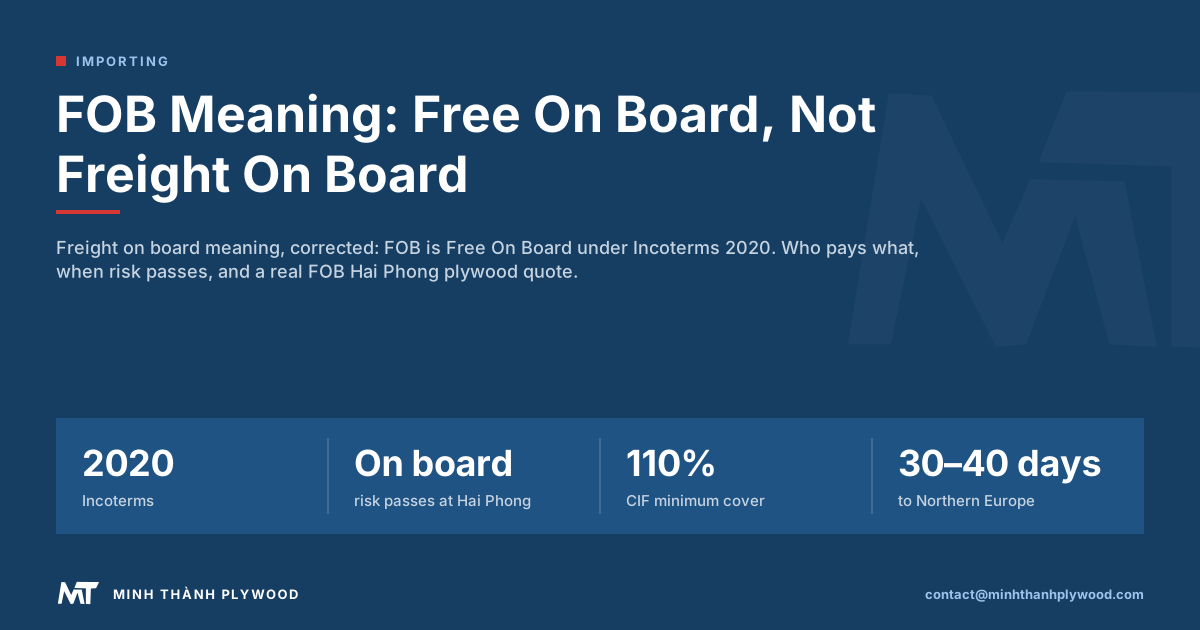
FOB means Free On Board, the Incoterms 2020 rule under which the seller clears goods for export and delivers them on board the vessel the buyer has nominated at the named port; risk and further costs pass to the buyer from that moment. "Freight on board" is a common mix-up of the same letters. Minh Thanh Plywood, a plywood factory that sells FOB Hai Phong, explains the rule with a real quote line.
What does freight on board mean in shipping?
FOB means Free On Board. It is an Incoterms 2020 rule, published by the International Chamber of Commerce (ICC), under which the seller delivers the goods on board the vessel nominated by the buyer at the named port of shipment, cleared for export (ICC Incoterms 2020).
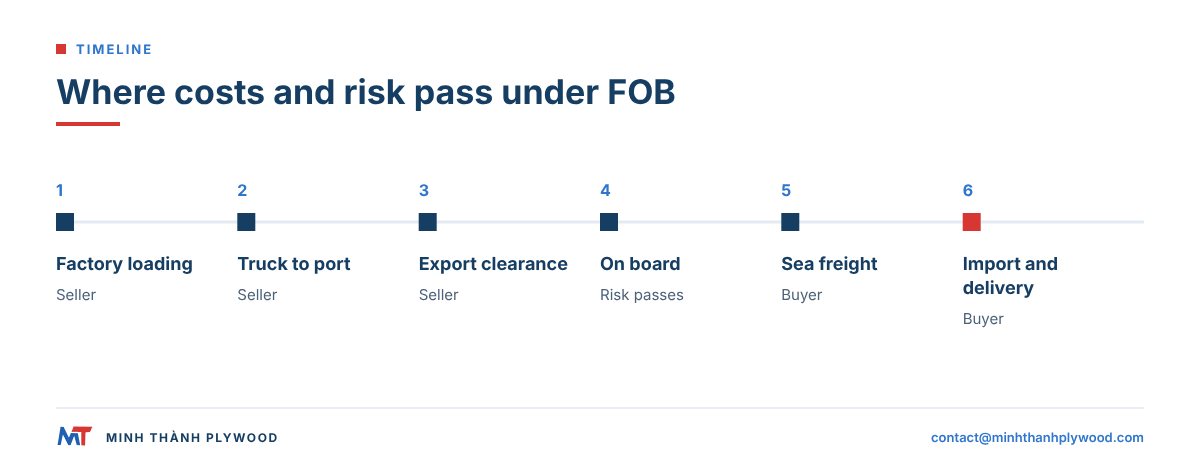
From the moment the goods are on board, the risk of loss or damage passes to the buyer, and the buyer pays all further costs: the sea freight, insurance if wanted, unloading, import clearance, duties and delivery inland.
A complete FOB term always names a port: “FOB Hai Phong, Incoterms 2020”. Without the port and the edition year, the term is incomplete and open to dispute.
In one line for an importer:
- The seller makes, packs, trucks to port, clears export and loads on board.
- The buyer books the ship, pays freight and insurance, and takes the risk at sea.
Freight on board meaning vs free on board: which is right?
Free on board is right. The free on board meaning is the ICC definition above; “freight on board” is a misreading of the letters FOB, and it is common enough that many buyers ask what freight on board means.
The confusion is understandable. FOB is a shipping term, freight is what is shipped, and in US domestic trade “FOB” often appears beside freight charges on invoices. But no Incoterms rule called “freight on board” exists, and a contract that writes it out that way invites an argument about who pays the freight.
| What you see | What it means | Where it comes from |
|---|---|---|
| FOB Hai Phong, Incoterms 2020 | Free On Board at Hai Phong under ICC rules | ICC Incoterms 2020 |
| Freight on board | Usually a mistaken expansion of FOB | No official definition |
| FOB shipping point / FOB destination | US domestic terms for title and risk | US Uniform Commercial Code |
Write “FOB [named port], Incoterms 2020” in your purchase order and pro-forma invoice, and the question disappears.
Incoterms free on board: the seller’s and buyer’s duties
Under Incoterms free on board, the duties split at the ship’s rail, or more exactly at the moment the goods are on board. Each party has ten numbered obligations in the rule; the table gives the ones that matter on a plywood order.
| Task | Seller under FOB | Buyer under FOB |
|---|---|---|
| Make and pack the goods | Yes | — |
| Truck to the port of shipment | Yes | — |
| Export customs clearance | Yes | — |
| Load on board the nominated vessel | Yes | — |
| Book the vessel and pay sea freight | — | Yes |
| Nominate the vessel and tell the seller | — | Yes |
| Insure the sea voyage | Not required | Advisable |
| Unload, import clearance, duties | — | Yes |
| Proof of delivery to the buyer | Yes, usually the on-board B/L | — |
| Risk after loading | — | Yes |
The buyer must give the seller enough notice of the vessel name, the loading point and the delivery date. If the buyer’s vessel fails to arrive on time, the costs and risk of waiting shift to the buyer under the rule.
When does risk pass under FOB?
Risk passes when the goods are on board the vessel at the named port. Before that, loss or damage is the seller’s problem; after it, the buyer’s.
On a container shipment that line is drawn in practice by the shipping documents:
- The seller loads the container at the factory, seals it and records the seal number.
- The container is trucked to port and handed to the terminal.
- The container is loaded on board the buyer’s nominated vessel.
- The carrier issues the bill of lading stating the goods are shipped on board.
Because a container is handed to the terminal before it is loaded, ICC notes that FCA (Free Carrier) fits containers more exactly. Many plywood buyers still prefer FOB, because their forwarders, banks and freight contracts are built around it. Both work when the contract names the port and the edition.
Freight on board pricing: what an FOB price includes
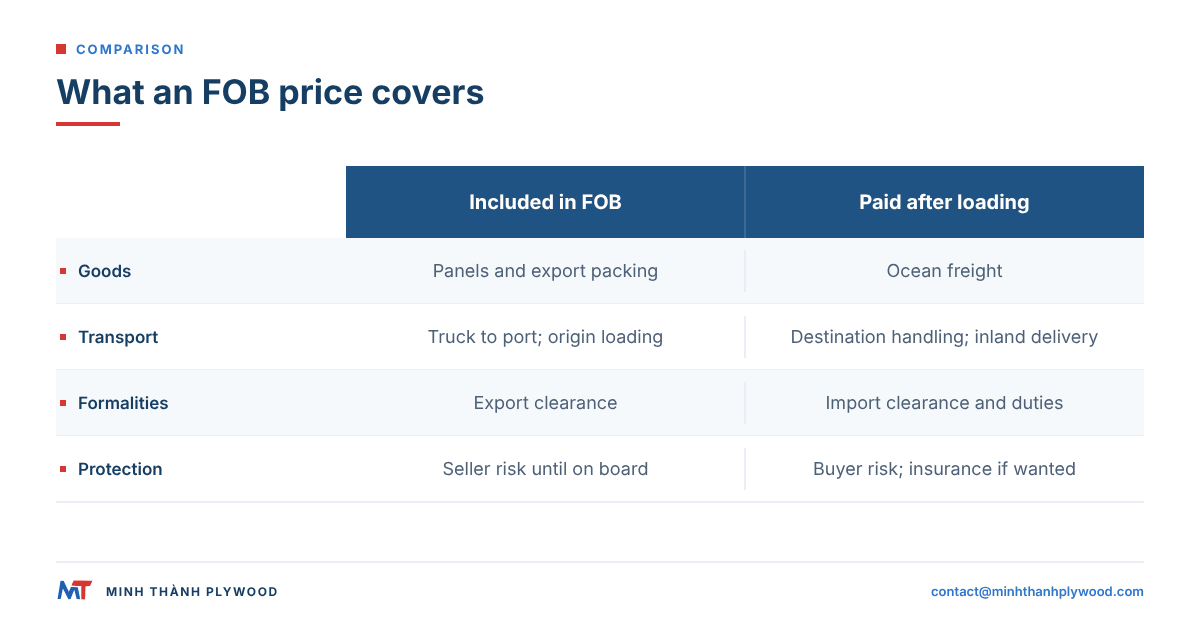
An FOB price, the “freight on board pricing” buyers ask about, includes everything the seller does up to loading, and nothing after. For plywood from Vietnam, the FOB price covers:
- The panels, built to the agreed specification.
- Packing: export packs, pallets or bearers, strapping, wrapping and labels.
- Inland transport from the factory to the port.
- Export customs clearance and export documents.
- Origin port handling up to loading on board, as agreed in the contract.
It does not include the ocean freight, the bunker and currency surcharges on that freight, cargo insurance, destination port charges, import duties or delivery to the buyer’s warehouse.
Origin terminal charges are where most FOB disputes start. Write in the contract who pays them. On our quotes, everything up to loading at Hai Phong sits in the FOB price.
A real FOB Hai Phong quote line for plywood
This is how an FOB Hai Phong line looks on a plywood quotation from our factory, using a common furniture specification:
| Field | Example entry |
|---|---|
| Product | Furniture plywood, poplar face A/B, sanded and polished, UV-ready |
| Core and build | Styrax core, stitched both ways, double pressed |
| Glue and emission | UF glue at E0 emission; CARB P2 / TSCA Title VI |
| Size and thickness | 1220 × 2440 × 18 mm, ±0.2–0.3 mm |
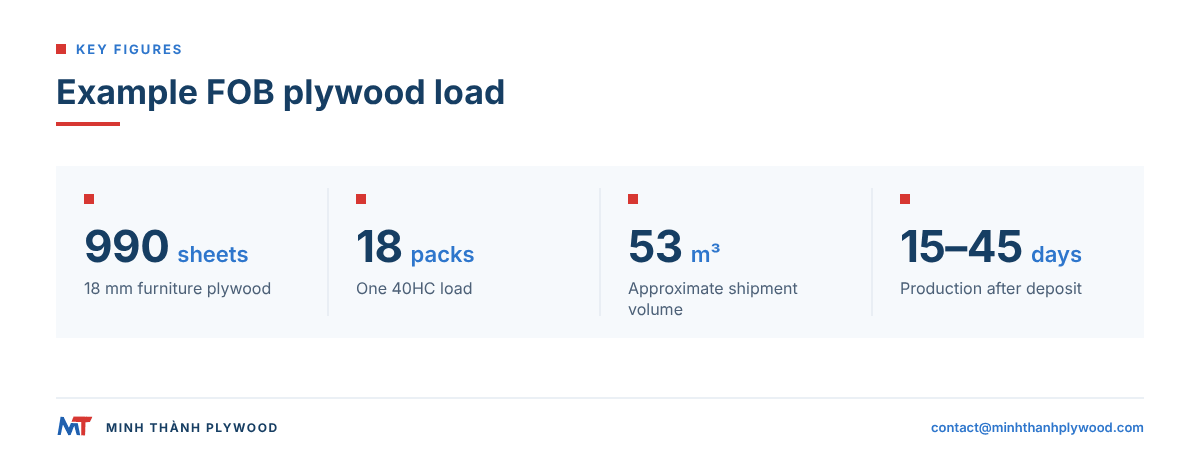
| Quantity | 990 sheets in 18 packs, one 40HC, about 53 m³ |
| Price basis | US$ per m³, FOB Hai Phong, Incoterms 2020 |
| Production | 15–45 days after the 30% deposit |
| Payment | 30% deposit; 70% against the scanned B/L, or irrevocable L/C at sight |
The price on such a line is quoted per cubic metre, because cubic metres convert cleanly between thicknesses; the container total follows from the volume. Our indicative starting prices in October 2026 are from US$350/m³ for furniture and interior plywood and from US$250/m³ for commercial plywood; the final price depends on face, core, glue, thickness, size, quantity and delivery term.
With an FOB line, the buyer adds the freight their forwarder quotes from Hai Phong to the destination port to compare landed costs.
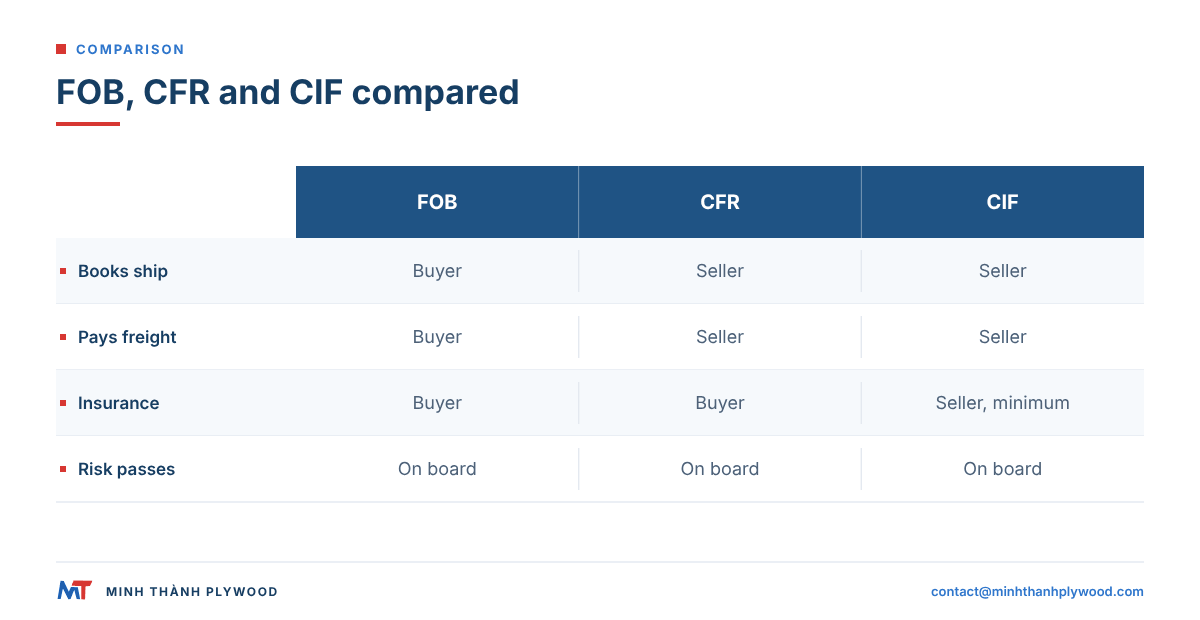
FOB vs CFR vs CIF: which term should a plywood buyer use?
Use FOB if you have a forwarder and good freight rates; use CFR or CIF if you want the seller to book the ship. Under all three, risk passes at loading in Hai Phong.
| Point | FOB Hai Phong | CFR (destination port) | CIF (destination port) |
|---|---|---|---|
| Who books the ship | Buyer | Seller | Seller |
| Who pays sea freight | Buyer | Seller | Seller |
| Who buys cargo insurance | Buyer, if wanted | Buyer, if wanted | Seller, minimum cover |
| Where risk passes | On board at Hai Phong | On board at Hai Phong | On board at Hai Phong |
| Best for | Buyers with a forwarder and contract rates | Buyers who insure under an annual policy | Buyers who want one price to port with insurance |
Under CIF, Incoterms 2020 requires the seller to buy at least the minimum cover of Institute Cargo Clauses (C) for 110% of the contract value. Buyers who want all-risks cover should ask for Clauses (A) or insure themselves.
We quote FOB Hai Phong, CFR or CIF. Our guide to plywood Incoterms compares these with EXW and DDP.
FOB freight prepaid, collect, allowed and charged back
FOB says where the seller’s duty to deliver ends; the freight terms added to it say who pays the carrier and who ends up bearing the cost. In US domestic invoices the combinations read like this (Corporate Finance Institute):
| Written on the invoice | Who pays the carrier | Who bears the freight cost |
|---|---|---|
| FOB shipping point, freight collect | Buyer | Buyer |
| FOB shipping point, freight prepaid | Seller | Seller |
| FOB shipping point, freight prepaid and charged back | Seller pays first | Buyer, the seller adds it to the invoice |
| FOB destination, freight prepaid | Seller | Seller |
| FOB destination, freight collect and allowed | Buyer | Seller; the buyer deducts it from the invoice |
CFI also advises that the Incoterms edition be written whenever a contract uses FOB, to avoid confusion with the North American meaning, for example “FOB Vancouver (Incoterms 2020)”. An export contract for plywood needs none of the combinations above: “FOB Hai Phong, Incoterms 2020” already tells both sides that the buyer pays the sea freight.
Does FOB transfer ownership of the goods?
No. Incoterms 2020 FOB sets delivery, risk and costs; it does not transfer ownership. When title passes depends on the sales contract and the law that governs it, which is why a contract can tie title to payment of the balance against the B/L.
Old English cases show why the point matters. In Browne v Hare (1858) the court treated delivery over the ship’s side as the point where the buyer took the goods; later decisions such as Mirabita v Imperial Ottoman Bank (1878) accepted that a seller could hold back title until paid, so long as the aim was to secure payment (Wikipedia, FOB (shipping)). The practical rule for a buyer is short: risk follows FOB, title follows the contract. If you pay by L/C, the bank holds the B/L as security until the balance is met.
FOB history: from the ship’s rail to “on board”
FOB is older than the Incoterms. English courts used it in the nineteenth century, and the International Chamber of Commerce published its first Incoterms in 1936. For decades the rule said that risk passed when the goods crossed the ship’s rail. Incoterms 1990 and 2000 kept that wording; the 2010 revision dropped “passing the ship’s rail” and says risk passes when the goods are on board (Wikipedia, FOB (shipping)).
The change fits containers. A sealed container is lifted aboard at the terminal, and nobody can say whether damage happened before or after it crossed a rail. Incoterms 2020 therefore keeps FOB for sea and inland waterway transport and suggests FCA when the goods are handed to a carrier before loading.
FOB in US domestic trade: shipping point and destination
In the United States, “FOB” also appears in domestic sales under the Uniform Commercial Code, as FOB shipping point or FOB destination. These are not Incoterms.
- FOB shipping point: title and risk pass to the buyer when the goods leave the seller’s premises or are handed to the carrier.
- FOB destination: title and risk pass when the goods arrive at the buyer’s location.
Freight charges are agreed separately, as “freight prepaid” or “freight collect”. This is where the “freight on board” idea often comes from: an invoice line that combines FOB with freight terms.
For an import from Vietnam, use Incoterms. A US buyer of our panels writes “FOB Hai Phong, Incoterms 2020” and handles domestic delivery terms with its own customers separately.
What documents does the buyer get under FOB?
Under FOB the seller provides the commercial documents and the proof of delivery; the buyer’s forwarder and carrier provide the transport contract. For plywood from our factory, every shipment comes with:
| Document | Purpose |
|---|---|
| Commercial invoice | Value and terms for customs |
| Packing list | Packs, sheets, volumes and weights |
| Bill of lading (B/L) | Proof that the goods were shipped on board; title to the cargo |
| Certificate of origin (EUR.1 for the EU) | Origin for tariff purposes |
| Phytosanitary and fumigation certificates | Plant health of the shipment and its packing |
| Certificate files on order | CARB P2 / TSCA Title VI, test reports, EUDR dossier, PPWR test |
The certificate files follow the rules of each market: formaldehyde emission under CARB and TSCA Title VI, origin under the EU Deforestation Regulation, Regulation (EU) 2023/1115, and packaging under the Packaging and Packaging Waste Regulation, Regulation (EU) 2025/40. Under FOB they travel with the commercial documents, not with the freight.
The balance of 70% is paid against the scanned B/L, which is why the on-board date on the B/L matters under FOB: it is both the moment risk passed and the trigger for payment.
Every shipment is photographed and filmed before loading, and the buyer receives the photos and video. Under FOB, those images show the condition of the goods at the point the seller’s risk ends.
How long does an FOB plywood shipment take?
An FOB plywood order from Vietnam takes production time plus sea time. Production at our factory is 15–45 days after the 30% deposit. Typical days at sea from Hai Phong are:
| Destination | Typical days at sea |
|---|---|
| South-East Asia | 5–12 |
| Japan and Korea | About 2–3 weeks |
| Middle East | 15–25 |
| US West Coast | 20–30 |
| Mediterranean | 25–35 |
| Northern Europe | 30–40 |
| US East Coast | 35–45 |
| West Africa | 35–50 |
These are by carrier and route. Under FOB, the buyer’s forwarder chooses the carrier, so the buyer controls the transit time and can trade speed against price.
Common FOB mistakes on plywood orders
Five mistakes cause most FOB problems on plywood orders. Each has a simple fix.
- No named port. “FOB Vietnam” is not a delivery point. Write “FOB Hai Phong, Incoterms 2020”.
- No vessel nomination. The seller cannot load without the buyer’s booking. Send the booking as soon as the deposit is paid and production starts.
- Origin charges left open. Agree in writing who pays each origin port charge.
- No insurance. Risk at sea is the buyer’s under FOB. Insure the cargo or use CIF.
- Overloaded container. Ask for the packing plan. Our 40HC plan for 18 mm panels on a Styrax core is 18 packs, 990 sheets, at a planning payload of 28,000 kg unless the booking is lower.
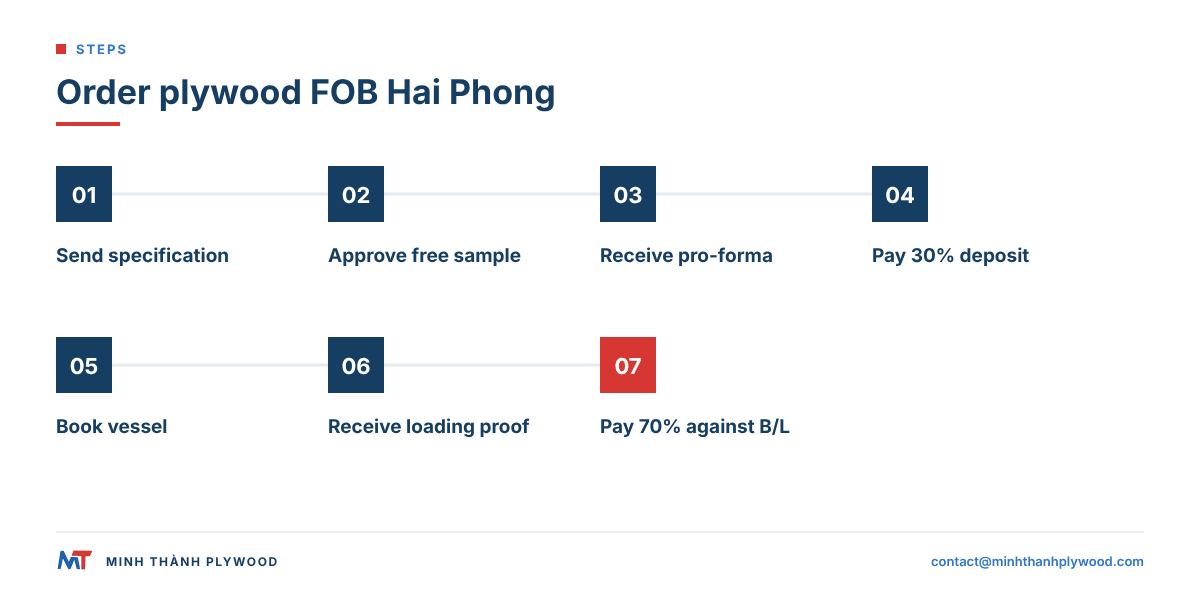
How to buy plywood FOB Hai Phong from Minh Thanh Plywood
To buy FOB Hai Phong from us, follow these steps:
- Send the specification: application, core, glue and emission class, face, size, packing and quantity.
- Approve a free sample of the build.
- Receive the pro-forma invoice with the FOB Hai Phong price per cubic metre.
- Pay the 30% deposit; production runs 15–45 days.
- Book the vessel through your forwarder and send us the booking.
- Receive loading photos and video, then the documents.
- Pay the 70% balance against the scanned B/L, or use an irrevocable L/C at sight.
Our minimum order is one 40HC, with mixed specifications by agreement. Our factory in Ha Hoa, Phu Tho, is built for top-grade furniture and interior plywood, with Europe as its main market. Send your specification through the furniture plywood page or read our trade terms. We reply within hours.
Buyer questions, answered
Is FOB free on board or freight on board?
FOB stands for Free On Board. It is one of the eleven Incoterms 2020 rules published by the International Chamber of Commerce. "Freight on board" is a common misreading of the same letters, not a defined trade term.
What does freight on board mean in shipping?
When people say freight on board in shipping, they almost always mean FOB, Free On Board: the seller loads the goods on the buyer's vessel at the port of shipment, and the buyer pays the sea freight and carries the risk from then on.
Who pays the freight under FOB?
The buyer pays the main sea freight under FOB. The seller pays every cost up to loading the goods on board at the named port, including export clearance.
When does risk pass under FOB?
Risk passes from seller to buyer when the goods are on board the vessel at the named port of shipment. Damage before loading is the seller's risk; damage after is the buyer's.
Does FOB include insurance?
No. Under FOB neither party must insure the sea voyage. The buyer, who carries the risk at sea, normally buys cargo insurance; under CIF the seller must buy it.
What does FOB Hai Phong mean?
FOB Hai Phong means the seller delivers the goods on board the buyer's nominated vessel at the port of Hai Phong in northern Vietnam, cleared for export. The buyer arranges and pays the voyage from Hai Phong.
What is the difference between FOB and CIF?
Under FOB the buyer books and pays the sea freight and insurance. Under CIF the seller pays freight and minimum insurance to the destination port, but risk still passes when the goods are loaded at the origin port.
Is FOB the same as FCA?
No. FOB delivery is on board the vessel and is meant for sea and inland waterway transport. FCA delivery is to the carrier, for example at a container terminal, and works for any mode; ICC suggests FCA when containers are handed over before loading.
What does FOB shipping point mean in the US?
In US domestic trade, FOB shipping point and FOB destination come from the Uniform Commercial Code, not Incoterms. They set where title and risk pass in a domestic sale and should not be mixed with Incoterms FOB in an export contract.
Does FOB transfer ownership of the goods?
No. FOB under Incoterms 2020 sets delivery, risk and costs, not title. Ownership passes as the sales contract and its governing law say, and plywood contracts commonly tie it to payment of the balance against the bill of lading.
What does FOB freight prepaid mean?
FOB freight prepaid means the seller pays the carrier and bears the freight cost, or in the variant prepaid and charged back, pays first and bills the buyer. FOB freight collect means the buyer pays the carrier. These combinations come from US domestic trade, not from Incoterms.
When did FOB stop using the ship's rail?
The 2010 revision of the Incoterms dropped the phrase passing the ship's rail from FOB. Since then risk passes when the goods are on board the vessel, which suits sealed containers.
Can I buy plywood FOB from Minh Thanh Plywood?
Yes. We sell FOB Hai Phong, CFR or CIF. The minimum order is one 40HC, with mixed specifications by agreement, and production takes 15–45 days after the 30% deposit.