
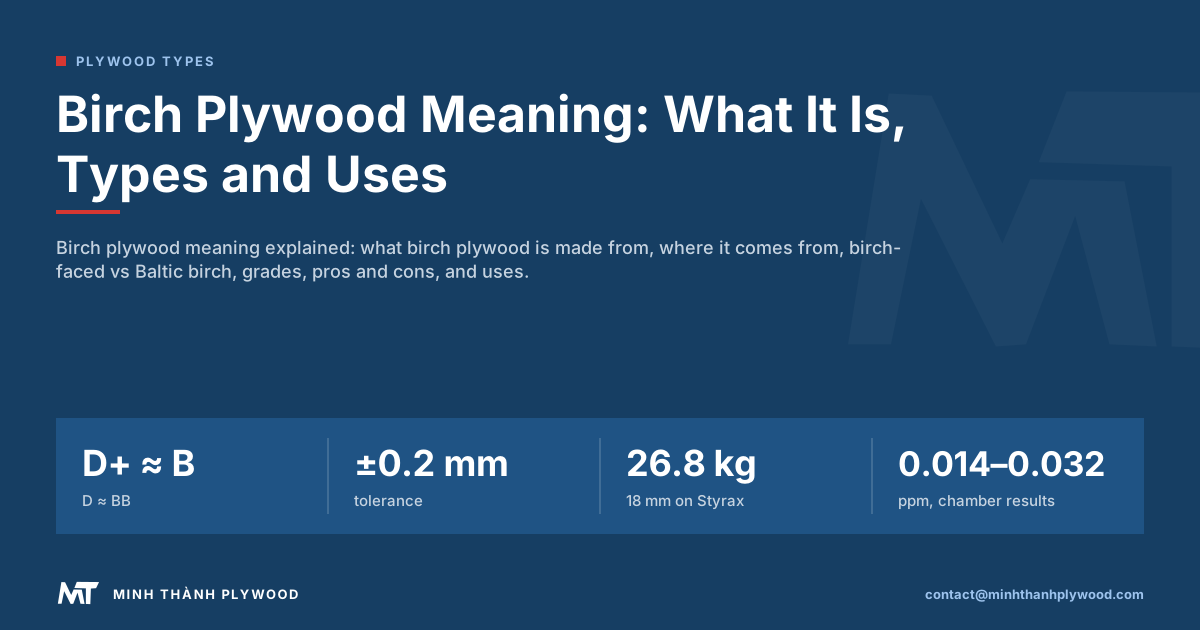
Birch plywood is plywood with birch veneer on the outside: either birch in every ply, as in Baltic birch, or a birch face and back over a core of another species, as in birch-faced plywood. The name tells you the face; the core, glue and grade need their own lines. Minh Thanh Plywood makes birch-faced panels on white Styrax or Eucalyptus cores for furniture and interiors.
Birch plywood meaning: what is birch plywood?
Birch plywood is plywood whose outer veneers are birch. That is the whole meaning of the name: it describes the face you see, and says nothing on its own about the core, the glue or the grade, which you confirm separately in the specification.
Two products share the name:
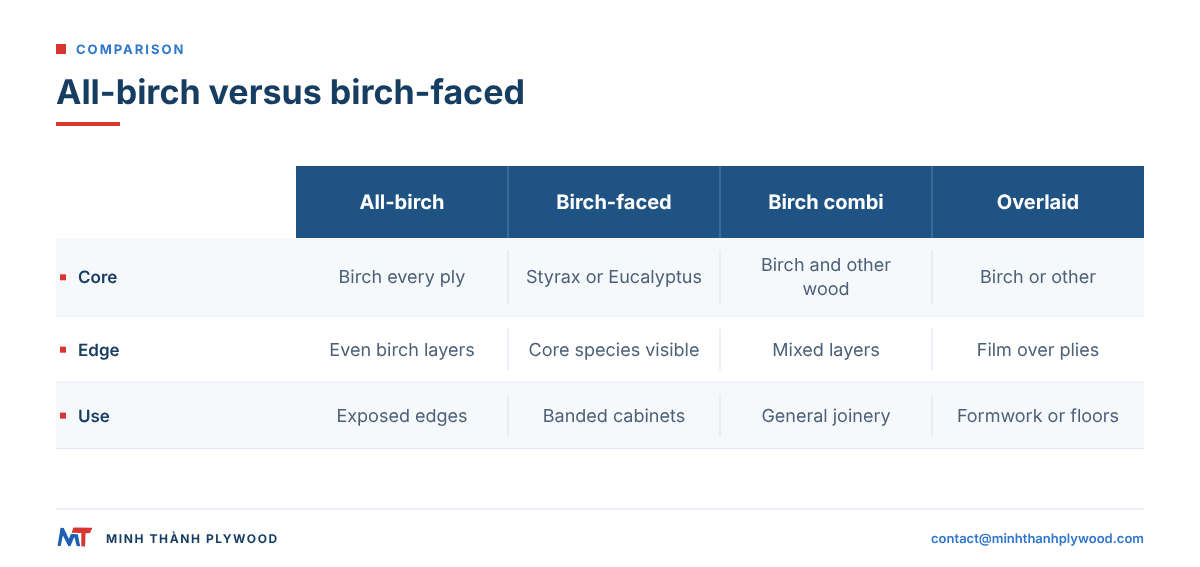
- All-birch plywood, often called Baltic birch, has birch in every ply. Its edge shows thin, even birch layers.
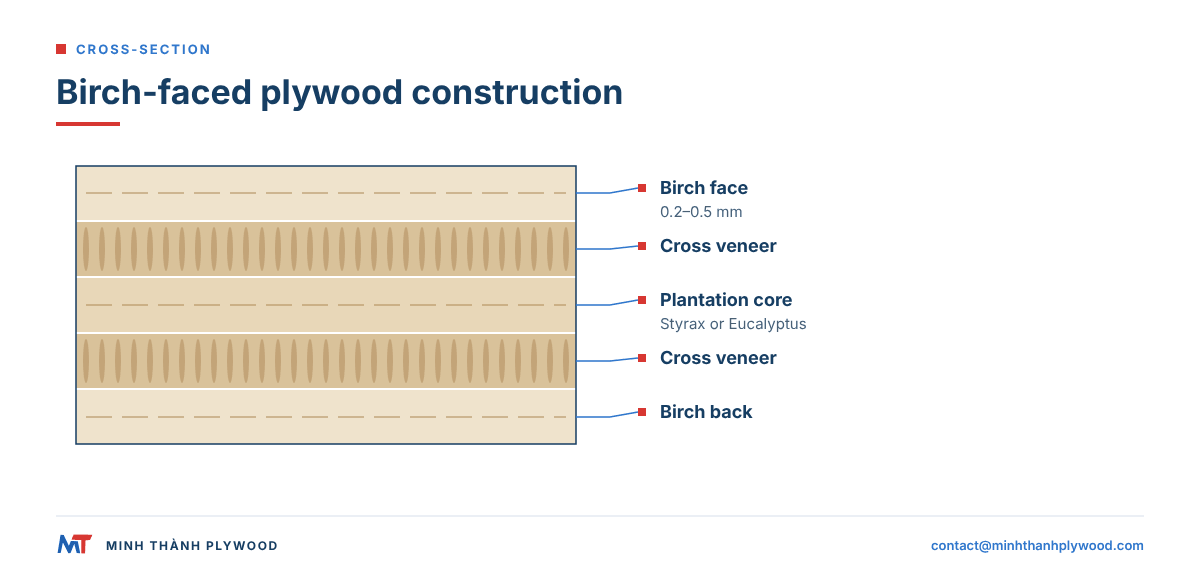
- Birch-faced plywood has a birch face and back over a core of another species. In Vietnam that core is plantation hardwood such as white Styrax or Eucalyptus.
Both have the pale, fine-grained birch face that furniture makers want. They differ in weight, edge appearance, price and where they come from. A buyer who writes “birch plywood” on an order without naming the core can receive either, so the core belongs in the first line of the specification. Minh Thanh’s birch plywood is birch-faced, on white Styrax or Eucalyptus cores.
What does birch ply mean on a quotation?
On a quotation, “birch ply” usually means birch plywood, and the lines around it tell you which kind. Read four fields before you compare prices.
| Field on the quotation | What it tells you | Example |
|---|---|---|
| Face/back | Species and grade of the outer veneers | Birch D+/D |
| Core | Species of the inner veneers | Styrax, Eucalyptus or birch |
| Glue and emission | Bond type and formaldehyde class | UF glue at E0 emission |
| Size and thickness | Sheet format and thickness tolerance | 1220 × 2440 × 18 mm, ±0.2 mm |
“Birch ply 18 mm” from a Baltic mill means birch throughout. “Birch ply 18 mm” from a Vietnamese or Chinese mill means a birch face on another core. Both are honest names; they are different panels at different prices. Our guide to birch plywood vs Baltic birch compares the two in detail.
What is birch plywood made from?
Birch plywood is made from thin veneers peeled from logs, laid with the grain crossing at right angles and bonded with glue under heat and pressure. In all-birch plywood every veneer is birch; in birch-faced plywood only the face and back are birch.
The birch faces are thin. Face veneers on furniture plywood are usually 0.2–0.5 mm, and European buyers often ask for about 0.3 mm. The core veneers are thicker, usually 1.4–2.0 mm, and a typical 18 mm panel has 11–13 plies.
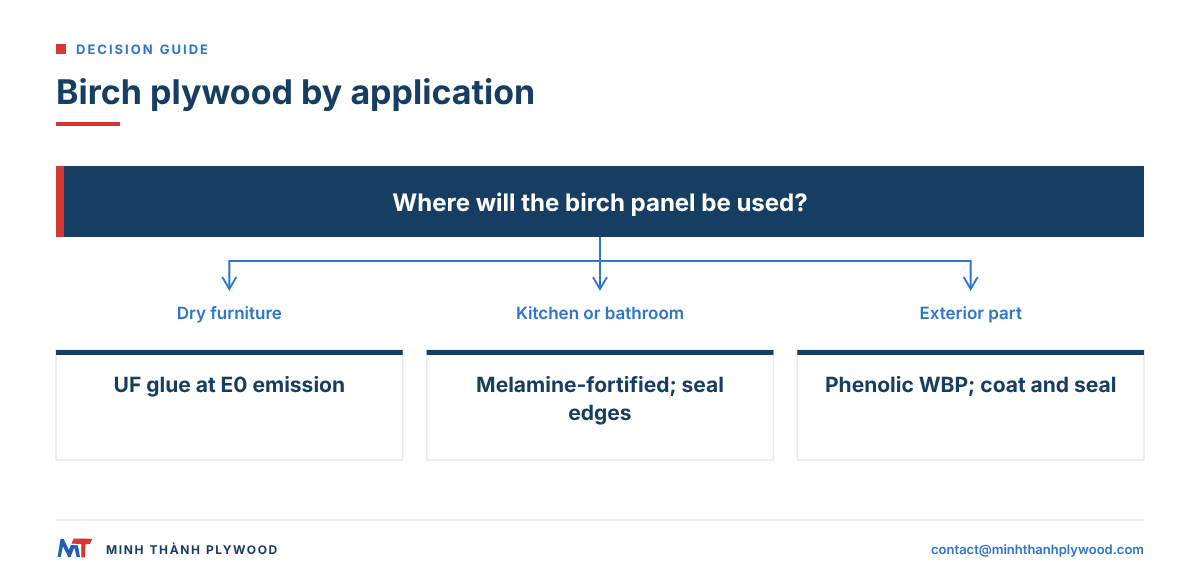
The glue joins them. Furniture and interior panels use UF glue at an emission class such as E0; kitchens and bathrooms use melamine-fortified glue; exterior parts use phenolic WBP glue. The face species does not change water resistance; the glue does.
Where does birch plywood come from?
All-birch plywood comes from countries where birch grows, mainly in northern and eastern Europe and northern Asia. Birch-faced plywood is also made far from birch forests, in Vietnam and China, by pressing imported birch face veneers onto local cores.
Vietnam grows no birch. A Vietnamese birch plywood panel therefore has an imported birch face and back over a Vietnamese plantation core. At Minh Thanh in Ha Hoa, Phu Tho, that core is white Styrax or Eucalyptus, grown around the factory.
Supply routes changed in 2022. The EU banned imports of wood products, including plywood, from Belarus under Council Regulation (EU) 2022/355 of 2 March 2022 (EUR-Lex). The Russian ban, under Council Regulation (EU) 2022/576, took effect on 9 April 2022 (checked October 2026). Many European buyers now combine all-birch panels from other origins with birch-faced panels for furniture. See Russian birch plywood alternatives for the options.
Birch plywood types: all-birch, birch-faced, combi and overlaid
Birch plywood types differ by what is under the birch face and what is on top of it. Four types cover almost every order.
| Type | Face and back | Core | Edge looks like | Typical use |
|---|---|---|---|---|
| All-birch (Baltic birch) | Birch | Birch in every ply | Thin, even pale birch layers | Exposed-edge furniture, jigs, drawer boxes |
| Birch-faced | Birch | Another hardwood, e.g. Styrax or Eucalyptus | Core species between birch faces | Cabinets, wardrobes, banded furniture, shop fittings |
| Birch combi | Birch | Birch alternating with another species | Mixed layers | General joinery, lighter panels |
| Film-faced or laminated birch | Phenolic or decorative film | Birch or other | Film over plies | Formwork, vehicle floors, laminated furniture |
The choice comes down to the edge. If the edge is part of the design and stays exposed, choose all-birch. If the edge is banded, painted or hidden, birch-faced gives the same face for less. Our Baltic birch plywood guide covers the all-birch type.
Birch plywood vs regular plywood: what is the difference?
Birch plywood differs from regular plywood, meaning poplar-, eucalyptus- or mixed-hardwood-faced panels, mainly in the face: birch is paler, harder and finer-grained, and it costs more. The core can be the same under either, so compare the face and the core as two separate lines.
| Point | Birch-faced plywood | Regular plywood (poplar, eucalyptus or mixed hardwood face) |
|---|---|---|
| Face colour | Pale cream, fine even grain | Poplar pale and plain; eucalyptus warm reddish-brown |
| Hardness | Hard face, resists dents | Poplar softer; eucalyptus hard |
| Finish quality | Takes clear lacquer, paint and UV coating evenly | Good on poplar for paint; eucalyptus deepens under clear coats |
| Edge | Shows the core species between pale faces | Same, tone depends on face and core |
| 18 mm sheet, 1220 × 2440 mm | About 26.8 kg on a white Styrax core | About 34.8 kg with a Eucalyptus core |
| Price step | Higher: imported birch face | Lower: local poplar or eucalyptus face |
| Best use | Visible furniture and modern interiors | Painted, laminated and load-bearing parts |
The weight row shows that the core decides the weight, not the face: a birch face on a Eucalyptus core weighs the same as any other face on that core. See eucalyptus vs birch plywood for the full comparison.
How are birch plywood grades named?
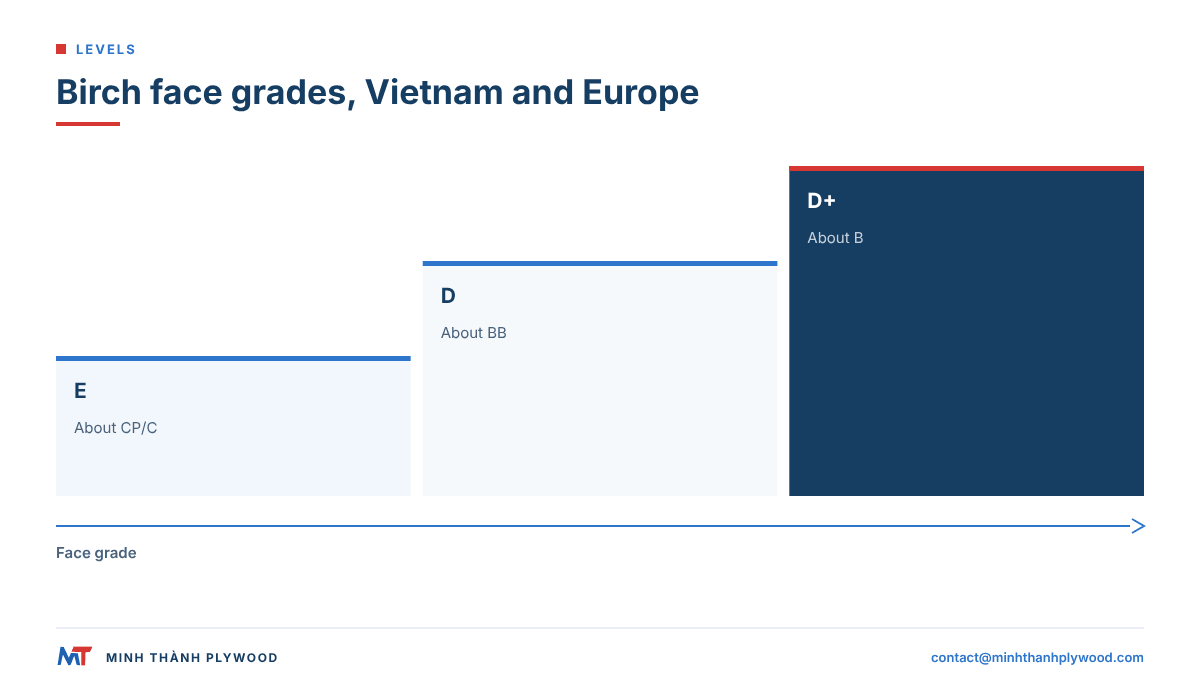
Birch plywood grades name the face and back as a pair, best side first. European all-birch uses B, BB, CP and C; Vietnamese birch-faced plywood uses D+, D and E, from the top grade down.
| Vietnamese face grade | Close European grade | What it looks like |
|---|---|---|
| D+ | About B | Clean face, few small sound knots, no patches visible at a glance |
| D | About BB | Small patches and sound knots, even colour |
| E | About CP/C | More patches and colour variation, for painted or covered parts |
Two more names turn up on quotations. A is used by some suppliers for a near-flawless face for luxury furniture fronts and visible doors, and C2 for a lower face with knots, patches and colour variation, for hidden parts such as cabinet backs and substructures where appearance does not matter. They come from other grading systems, not the European B/BB/CP/C ladder, so match them to an approved sample.
The pairs follow from the single grades: D+/D is about B/BB, and D/D is about BB/BB. Grade names describe a range, so the reliable reference is a sample. At Minh Thanh the buyer approves a face and back sample, and every production sheet is graded against it before packing.
Common mistakes when choosing a grade:
- Paying for A on parts nobody sees; B/BB or D/E is enough behind a door.
- Judging by the grade name instead of the approved sample.
- Ignoring the core, which sets the weight, stiffness and edge.
- Ignoring the glue, which sets where the panel can be used.
How is a birch face laid at the mill?
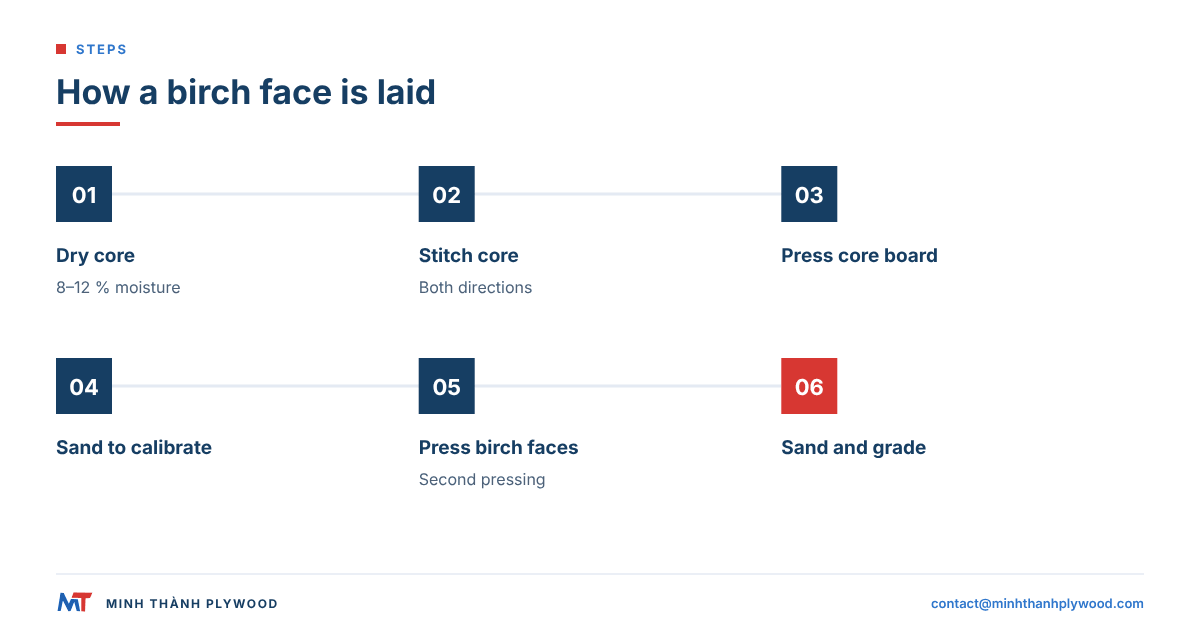
At Minh Thanh a birch face is laid in a second pressing, on a core board that has already been pressed and calibrated. That two-step build is why a birch-faced panel can be flat to ±0.2 mm.
- Dry the core veneers of white Styrax or Eucalyptus to 8–12 % moisture.
- Stitch the core veneers both horizontally and vertically so they cannot open or overlap.
- Lay up and press the core veneers crosswise with glue into a core board.
- Sand the core board to a calibrated thickness, so the faces lie on a flat base.
- Press the birch face and back onto the calibrated board in a second press.
- Sand and polish both faces, leaving them UV-ready for the customer’s own coating.
- Grade each sheet against the approved face/back sample and caliper the thickness.
A thin birch face shows every bump of the core beneath it. Pressing twice on a calibrated core is how a mill prevents telegraphing, the waviness that shows under lacquer and gloss coatings.
Is birch plywood good? Advantages and disadvantages
Yes, birch plywood is good for furniture, interiors and shop fitting: its face is pale, fine-grained and hard, it takes coatings well and it machines cleanly. Its disadvantages are price, weight on all-birch panels, staining on some finishes and water resistance that depends only on the glue.
| Advantages | Disadvantages |
|---|---|
| Pale, even, fine-grained face that suits light, modern interiors | Costs more than poplar or eucalyptus faces |
| Takes clear lacquer, paint, UV coating, HPL and laminates | Can stain unevenly with some pigmented stains: test first |
| Hard face resists dents better than softer faces | All-birch panels are heavy to handle and ship |
| Clean CNC cuts and crisp machined edges | No water resistance without melamine or phenolic glue |
| All-birch: attractive, even layered edge | Birch-faced: the edge shows the core species |
Two of these disadvantages have an easy answer. Weight drops on a white Styrax core at about 500 kg/m³: an 18 mm sheet of 1220 × 2440 mm calculates to about 26.8 kg. Price drops with birch only on the faces. The edge is the trade-off: band it, paint it, or pay for all-birch.
What is birch plywood used for?
Birch plywood is used for furniture and interiors where the face is seen: kitchen and bathroom cabinets, wardrobes, drawers, shelving, store fixtures, CNC-cut parts and wall panels. All-birch adds uses where the edge or the strength is the point, such as exposed-edge furniture, drawer boxes, jigs and templates.
| Use | Usual thickness | Face grade | Glue |
|---|---|---|---|
| Kitchen and bathroom cabinet carcasses | 15–18 mm | D or D+ on visible sides | Melamine-fortified |
| Wardrobes and bedroom furniture | 15–18 mm | D+/D | UF glue at E0 emission |
| Drawer fronts and doors | 18 mm | D+ | UF glue at E0 emission |
| Shelving and store fixtures | 18 mm and up | D/D | UF glue at E0 emission |
| Wall panels and linings | 9–12 mm | D+/D | UF glue at E0 emission |
| Painted parts and backs | 3–6 mm | D/E or E/E | UF glue at E0 emission |
Thin backs and liners from 3 to 5 mm are always built in 5 plies at Minh Thanh, which keeps them flat. For a fuller furniture view, see birch plywood for furniture.
Vietnamese birch plywood characteristics
Vietnamese birch plywood is birch-faced plywood: imported birch face and back on a Vietnamese plantation core, sanded, calibrated and built for furniture. Its character comes from the core under the face.
What a buyer can expect from a furniture mill in Vietnam:
- Core: white Styrax, light at about 500 kg/m³, with a pale edge; or Eucalyptus at 650–750 kg/m³ for a denser panel. See which core is best for birch plywood.
- Build: stitched core veneers, pressed twice, sanded and polished faces.
- Tolerance: down to ±0.2 mm on sanded furniture panels.
- Glue and emission: UF glue at E0 emission as standard; melamine-fortified and phenolic WBP on order.
- Sizes: 1220 × 2440 mm and 1250 × 2500 mm, with custom sizes such as 1220 × 2500 mm and 1220 × 2280 mm.
- Thickness: 3–40 mm.
Minh Thanh’s furniture panels are certified to CARB P2 / TSCA Title VI (ICTT mill no. 23024), for formaldehyde emissions. Six ASTM D6007 chamber tests between April 2025 and June 2026 on 9, 15 and 18 mm panels averaged 0.014–0.032 ppm. The limit for veneer-core hardwood plywood is 0.05 ppm under 40 CFR 770.10.
Is birch plywood waterproof?
No, birch plywood is not waterproof: the birch face does not stop water, and water resistance comes only from the glue line and sealed edges. Choose the glue by the room.
- Dry rooms: UF glue at E0 emission, the standard for furniture.
- Kitchens and bathrooms: melamine-fortified glue, with sealed or banded edges.
- Exterior: phenolic WBP glue, coated faces and sealed edges.
For a kitchen or bathroom cabinet, the usual build is a birch-faced panel with melamine-fortified glue, edges banded or sealed, and faces lacquered or laminated. For a garden bench or an exterior sign, choose phenolic WBP glue and an exterior coating, and plan to recoat; a birch face left bare outdoors greys and checks within a season.
For Gulf buyers, air-conditioned interiors are dry in the room but humid at the coast and in kitchens, so use melamine-fortified glue for kitchen and wet-room joinery and UF glue at E0 emission for wardrobes, ceilings and fit-out panels in the dry parts of hotels, offices and villas.
Birch also moves with moisture like any wood. Panels dried to 8–12 % moisture at dispatch should be stored flat and acclimatised in the workshop before machining, so parts stay flat after assembly.
Why is birch plywood more expensive than other plywood?
Birch plywood costs more than poplar- or eucalyptus-faced plywood because birch face veneer is imported into Vietnam and sorted by grade, while poplar and eucalyptus faces come from cheaper local wood. All-birch plywood costs more again, because every ply is birch.
On a birch-faced sheet, five lines move the price:
- Face grade: a D+/D pair costs more than D/E, because fewer veneer sheets reach the top grade.
- Core species: white Styrax and Eucalyptus are priced differently, and Eucalyptus adds weight to freight.
- Glue and emission: UF glue at E0 emission, melamine-fortified and phenolic WBP glue are separate price steps.
- Thickness and size: thin panels need more veneer layers per millimetre; 1250 × 2500 mm uses more face than 1220 × 2440 mm.
- Quantity and delivery term: a full 40HC of one specification costs less per sheet than a mixed load, and FOB Hai Phong, CFR or CIF change the total.
In October 2026 furniture and interior plywood at Minh Thanh started from US$350/m³; birch-faced panels are quoted on the exact grade, core and glue. A birch-faced panel gives the birch look for less than all-birch, which is why European cabinet makers use it for banded and painted parts.
What this means for your order
For your order, decide first whether you need birch in every ply or only on the faces, then write the core, grade pair, glue and size. That turns “birch plywood” into a panel two mills can quote the same way.
A spec line for cabinet carcasses reads: Birch-faced plywood, birch D+/D, white Styrax core stitched, pressed twice, UF glue at E0 emission, sanded and polished, 18 mm, 1220 × 2440 mm, ±0.2 mm. Change the core to Eucalyptus for a denser panel, or the glue to melamine-fortified for kitchens.
Minh Thanh Plywood makes birch-faced plywood in Ha Hoa, Phu Tho, alongside poplar, engineered veneer, pine and other faces. The minimum order is one 40HC with mixed specifications by agreement, production runs 15–45 days after the deposit, and free samples go out with the quotation. Send your spec line to contact@minhthanhplywood.com, or compare Baltic birch plywood suppliers if you need all-birch.
Buyer questions, answered
What is birch plywood?
Birch plywood is plywood faced with birch veneer. Baltic birch has birch in every ply; birch-faced plywood has a birch face and back over a core of another species, such as Styrax or Eucalyptus in Vietnam.
What does birch ply mean?
Birch ply is short for birch plywood. On a quotation it can mean all-birch or birch-faced plywood, so ask what the core is made of.
What is birch plywood made from?
Thin birch veneers peeled from birch logs, cross-laid and glued. In birch-faced plywood only the outer veneers are birch and the inner veneers are another hardwood.
Where does birch plywood come from?
All-birch plywood comes from birch-growing countries in northern and eastern Europe and northern Asia. Birch-faced plywood is also made in Vietnam and China with imported birch face veneers on local cores.
Is birch plywood good for furniture?
Yes. Its pale, fine-grained face takes clear lacquer, paint, UV coating and laminates well, and a calibrated panel machines cleanly on CNC routers for cabinets, wardrobes and shop fittings.
Is birch plywood waterproof?
No. Water resistance depends on the glue. UF glue is for dry interiors, melamine-fortified glue suits kitchens and bathrooms, and phenolic WBP glue suits exterior exposure.
What do birch plywood grades B/BB and D+/D mean?
They name the face and the back. In Vietnam birch faces are graded D+, D and E; D+ is about European B, D about BB and E about CP/C, so D+/D is about B/BB.
Is birch-faced plywood the same as Baltic birch?
No. Baltic birch has birch in every ply and shows even birch layers at the edge. Birch-faced plywood has birch on the faces only and costs less for the same face.
Why is birch plywood expensive?
Birch face veneer is imported in Vietnam and sorted by grade, and all-birch panels use birch in every ply. Price then follows face grade, core, glue and thickness.
What are the disadvantages of birch plywood?
Higher price than poplar or eucalyptus faces, blotchy staining with some stains, no water resistance without the right glue, and on birch-faced panels an edge that shows the core species.
Can Vietnam make full birch plywood?
No. Vietnam grows no birch, so Vietnamese birch plywood uses imported birch for the face and back over a local plantation core.