
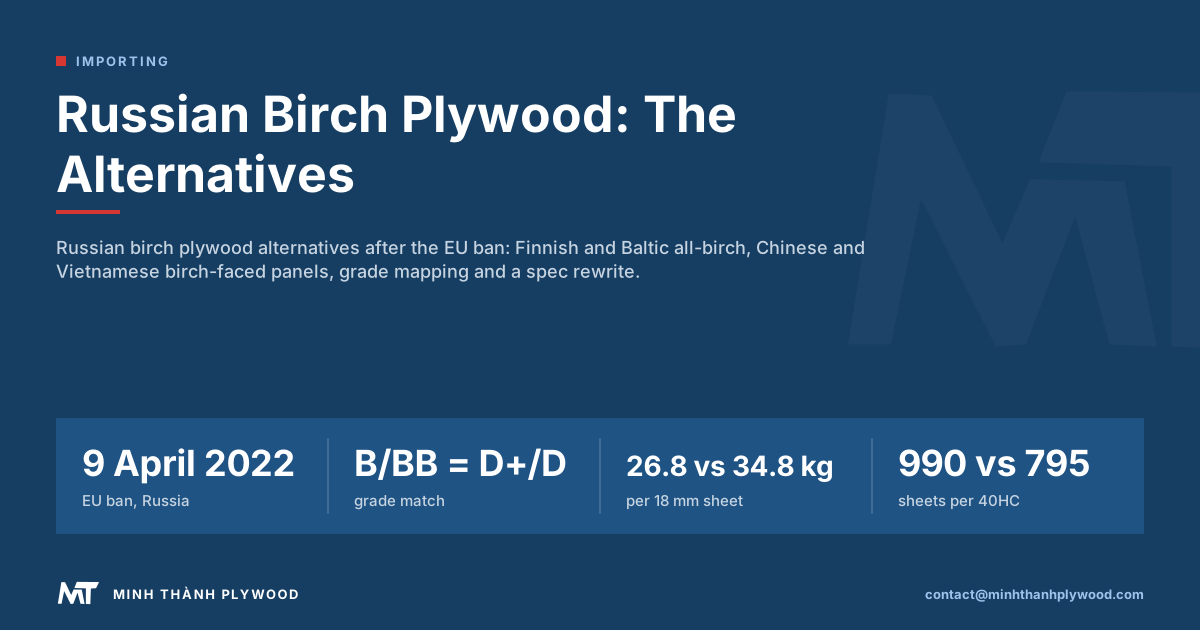
Russian birch plywood left the EU market in 2022, when the EU banned wood products from Russia and Belarus, so buyers who built products on it now choose between all-birch panels from Finland and the Baltic states and birch-faced plywood from Asia. All-birch keeps the exact spec and the visible birch edge; birch-faced panels on a Vietnamese Styrax or Eucalyptus core keep the birch face at a lower cost per cubic metre. This guide maps Russian grades and sizes onto each alternative, from Minh Thanh Plywood, a Vietnamese manufacturer of birch-faced furniture plywood.
Russian birch plywood alternatives: the short answer
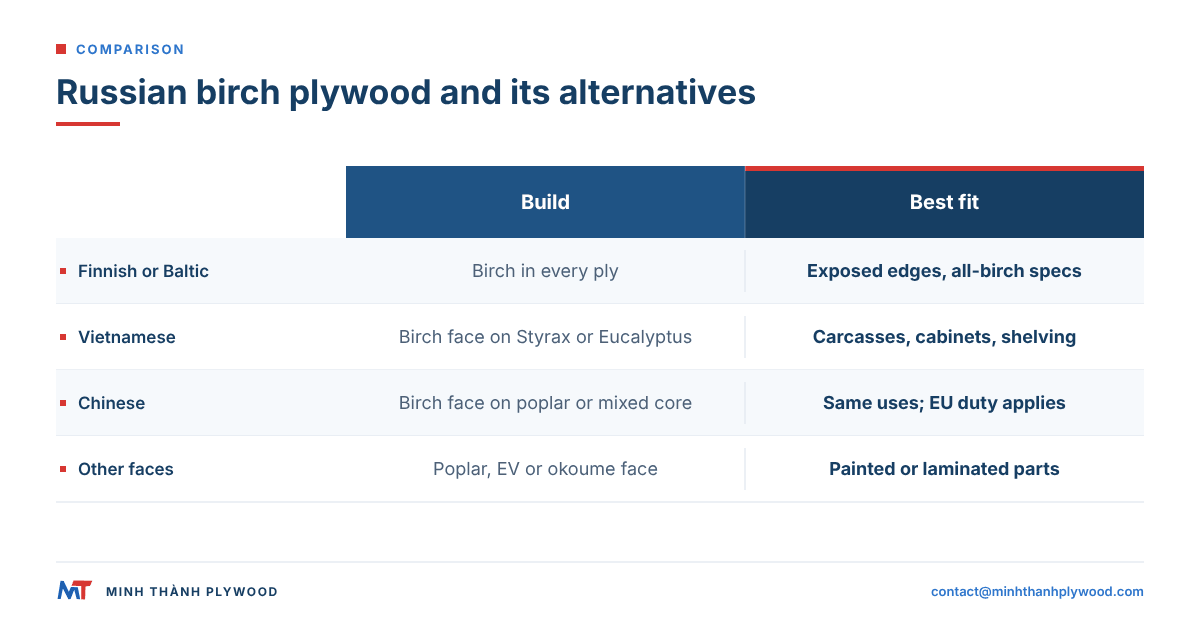
The alternatives to Russian birch plywood are all-birch panels from Finland, Latvia and Estonia, and birch-faced panels from China and Vietnam. Pick the all-birch panel when the edge is visible or the specification names birch in every ply; pick birch-faced plywood when the face matters and the core does not.
| Alternative | Build | Best fit | Watch |
|---|---|---|---|
| Finnish or Baltic all-birch | Birch veneer in every ply | Exposed edges, flooring, vehicle floors, specs that name all-birch | Highest cost per m³, heavier sheet |
| Vietnamese birch-faced | Birch face and back on a Styrax or Eucalyptus core | Furniture carcasses, cabinets, shelving, painted and veneered panels | Core shows in the edge |
| Chinese birch-faced | Birch face and back on a poplar or mixed core | Same uses as Vietnamese birch-faced | EU anti-dumping duty on hardwood plywood from China |
| Other faces on the same core | Poplar, EV or okoume face | Painted or laminated parts | No birch look |
The rest of this guide explains what Russian birch was, what the law now says, how grades and sizes map across, and how to rewrite a Russian birch order for each alternative.
What is Russian birch plywood?
Russian birch plywood is plywood made in Russia from birch veneer in every layer. Face, back and core are all birch, cross-laminated into a dense, evenly layered hardwood panel and bonded with urea-formaldehyde glue for interior grades or phenolic glue for exterior and film-faced grades.
Buyers chose it for three reasons:
- Edge and machining. Thin birch plies give a clean, even edge that can be left visible and lacquered.
- Strength and screw holding. Birch is a dense hardwood, so the sheet carries load well and holds fixings.
- Supply and price. Before 2022, Russian mills shipped large volumes at a lower price than Finnish mills.
The traditional format was 1525 × 1525 mm, the “5 × 5” sheet many European workshops cut from. Mills also shipped 1220 × 2440 and 1250 × 2500 mm sheets for furniture and construction. Faces were graded B, BB, CP and C, quoted as face/back pairs such as B/BB or BB/CP.
“Russian plywood” in a buyer’s file usually means this all-birch panel. Some buyers also used it for Russian softwood plywood, a different construction product.
Can you still buy birch plywood from Russia?
EU importers cannot buy birch plywood from Russia or Belarus. Since 2022 the EU has banned the import of wood products of CN chapter 44, which includes plywood under heading 4412, when they originate in or are exported from either country.
- Russia: Council Regulation (EU) 2022/576 inserted Article 3i and Annex XXI into Regulation 833/2014. The ban applies from 9 April 2022; contracts signed before that date could be executed until 10 July 2022.
- Belarus: Council Regulation (EU) 2022/355 inserted Article 1o and Annex X into Regulation 765/2006; contracts concluded before 2 March 2022 could run until 4 June 2022. The ban applies from the day after publication on 2 March 2022.
Both acts cover the whole of chapter 44, so they apply to plywood as part of “wood and articles of wood”. Re-routing does not change the answer: the ban covers goods that originate in Russia, wherever they ship from.
The EU’s deforestation rules point the same way. In the country benchmark of Implementing Regulation (EU) 2025/1093, Russia and Belarus are listed as high risk, while Vietnam is low risk. An EU importer of birch plywood therefore needs a source outside Russia and Belarus, with origin records that show it.
Can a US buyer still buy Russian birch plywood, and what does it cost?
A US buyer can still find Russian birch plywood on shelves, but it is not the low-duty product it was. The United States did not ban it; it suspended normal trade relations with Russia in April 2022, which moved Russian hardwood plywood onto the high column 2 duty rates of 40 to 50 percent, up from 0 to 8 percent (USITC executive briefing, June 2024). Check the current rate for your tariff line in the HTSUS before you order, and file a Lacey Act declaration as for any plywood under heading 4412.
Stock on US shelves is what importers bought earlier, and the prices below were read from the retailers’ pages in October 2026:
| US retailer (October 2026) | Sheet | Price per sheet | Build |
|---|---|---|---|
| Plywood Company | “Russian birch” BB/CP, 12 mm, 4x8 | US$73.85 | 9 plies, TSCA Title VI |
| Georgia Hardwoods | Russian birch BB/CP, 12 mm, 5x5 | US$43.87 | freight shipping |
| Minh Thanh, factory starting reference | Birch-faced D/E, 12 mm, 1220 × 2440 mm, FOB Hai Phong | about US$12.50 (US$350/m³ × 0.0357 m³) | Styrax or Eucalyptus core, E0, CARB P2 / TSCA Title VI |
The shelf price carries the importer’s duty, freight and margin and is for a single sheet; the factory figure is a raw FOB example for a full container, not a sheet price, and sea freight, US duty on Vietnamese origin and your own costs come on top. What the table shows is the room an importer has between a Russian-stock shelf price and a Vietnamese birch-faced panel built to the same face grade.
What the grades mean on a US spec sheet: BB is a one-piece face, generally light and even in colour, with pin knots and mineral streaking allowed and open defects patched with matching veneer. CP is nearly BB quality, with more streaking and more patches, and is the usual back. The BB/CP pair maps to a Vietnamese D/E panel.
Why did buyers have to look for a Russian plywood replacement?
Russian plywood was the largest single source of birch plywood for European buyers, so the 2022 ban left a gap that the remaining all-birch mills could not fill at the old price. Finnish, Latvian and Estonian mills kept supplying, but at higher prices and with longer waits for some grades and sizes.
Buyers responded in three ways:
- Paid more for all-birch from mills in the EU, where the design needs birch in every ply.
- Moved to birch-faced plywood for parts where only the face is seen, which covers most furniture carcasses and cabinet sides.
- Changed the face to poplar, engineered veneer (EV) or okoume for painted, laminated or wrapped parts.
Most furniture and cabinet makers combine the second and third options. They keep all-birch for the few parts with an exposed edge and move the rest of the bill of materials to birch-faced or other-faced panels.
How does Vietnamese birch-faced plywood compare with Russian birch?
Russian birch is birch through the whole panel; Vietnamese birch-faced plywood is birch only on the face and back, over a lighter plantation-hardwood core. The table compares the two on the lines a buyer specifies.
| Line | Russian birch (all-birch) | Vietnamese birch-faced (Minh Thanh) |
|---|---|---|
| Face and back | Birch | Imported birch veneer |
| Core | Birch veneers | White Styrax or Eucalyptus veneers |
| Face grades | B, BB, CP, C | D+, D, E (D+ ≈ B, D ≈ BB, E ≈ CP/C) |
| Glue for furniture | UF, E1 or E0 class | UF glue at E0 emission as standard |
| Emission proof | Mill test reports | CARB P2 / TSCA Title VI, ICTT mill no. 23024 |
| Thickness range | Thin to thick sheets | 3–40 mm |
| Thickness tolerance | Mill standard | Down to ±0.2 mm on sanded furniture panels |
| Sizes | 1525 × 1525 mm, 1220 × 2440 mm, 1250 × 2500 mm | 1220 × 2440 mm, 1250 × 2500 mm, custom sizes |
| Edge appearance | Uniform birch plies | Birch face lines over a pale Styrax or darker Eucalyptus core |
| Weight | Heavier | Styrax core about 500 kg/m³ |
| EU access | Banned since 2022 | Open; Vietnam low risk under EUDR benchmarking |
The face is the same species and is graded on a comparable ladder, so a cabinet side, a shelf or a door panel looks the same once it is built. The difference shows in the cut edge and in the weight of the sheet.
How is Vietnamese birch-faced plywood built?
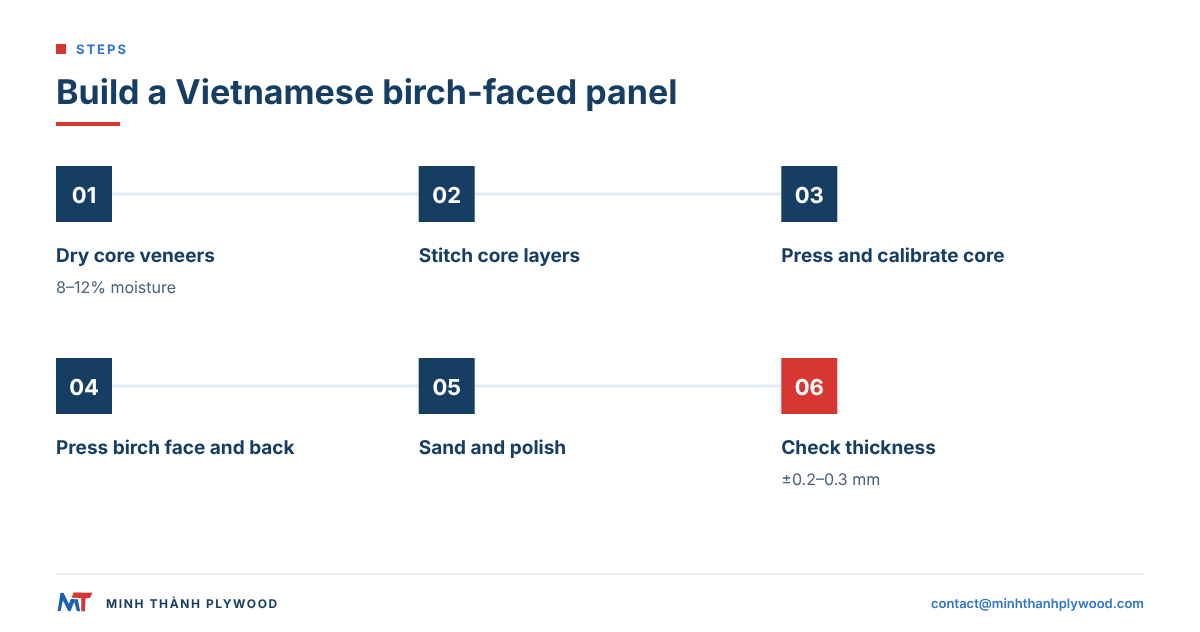
Vietnamese birch-faced plywood is built from an imported birch face and back pressed on a core of plantation-grown Vietnamese hardwood veneer. At Minh Thanh Plywood the furniture build follows these steps:
- Core veneers of white Styrax or Eucalyptus are dried to 8–12 % moisture content.
- Core layers are stitched both horizontally and vertically, so the veneers stay tight without gaps or overlaps.
- The core board is pressed and calibrated to an even thickness.
- Birch face and back are pressed on in a second press cycle. Double pressing is our standard for furniture-grade panels.
- Both faces are sanded and polished and left UV-ready, so a buyer can apply their own UV coating.
- Thickness is held to ±0.2–0.3 mm on sanded furniture panels, down to ±0.2 mm.
An 18 mm furniture panel usually has 11–13 plies. The core is the main change from Russian birch, and many European furniture buyers choose Styrax because it is light and pale.
Which alternative to Russian birch plywood fits each use?
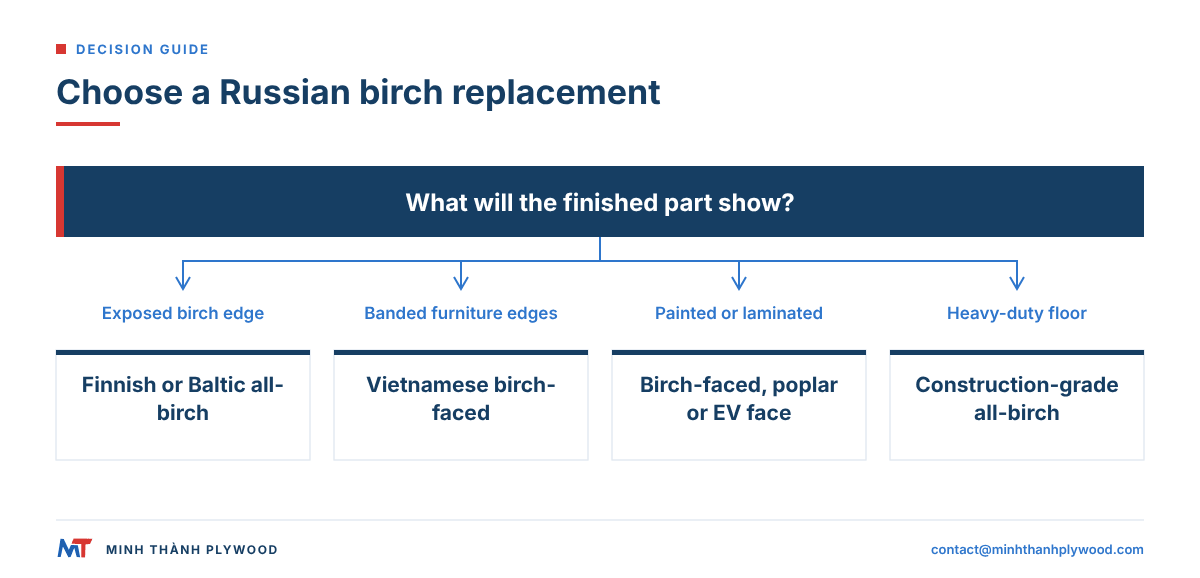
Choose by what the finished part shows and carries. The decision follows the edge first, then the load, then the face.
| Use | All-birch (Finnish or Baltic) | Birch-faced (Vietnamese) | Note |
|---|---|---|---|
| Kitchen and wardrobe carcasses | Possible | Recommended | Edges are banded, the face is what shows |
| Shelving and interior fit-out | Possible | Recommended | Light Styrax core eases handling on site |
| Drawer boxes with lacquered edges | Recommended | Only if the core edge is acceptable | The edge is the design |
| Visible-edge furniture and display | Recommended | Use with a solid-wood lipping | Birch plies are the look |
| CNC parts with banded edges | Possible | Recommended | Stitched core and tight tolerance machine cleanly |
| Painted or laminated parts | Overspecified | Birch-faced, or poplar or EV face | Face species hardly matters under paint |
| Vehicle floors and heavy-duty floors | Recommended | Not the right panel | Ask for a construction-grade build |
| Specs that name all-birch | Required | Not compliant with the spec | Change the spec only with the designer |
For most cabinet and furniture plants, the volume sits in the “birch-faced recommended” rows. That is where switching from Russian birch saves money without a visible change in the product.
How do Russian birch grades map to Vietnamese grades?
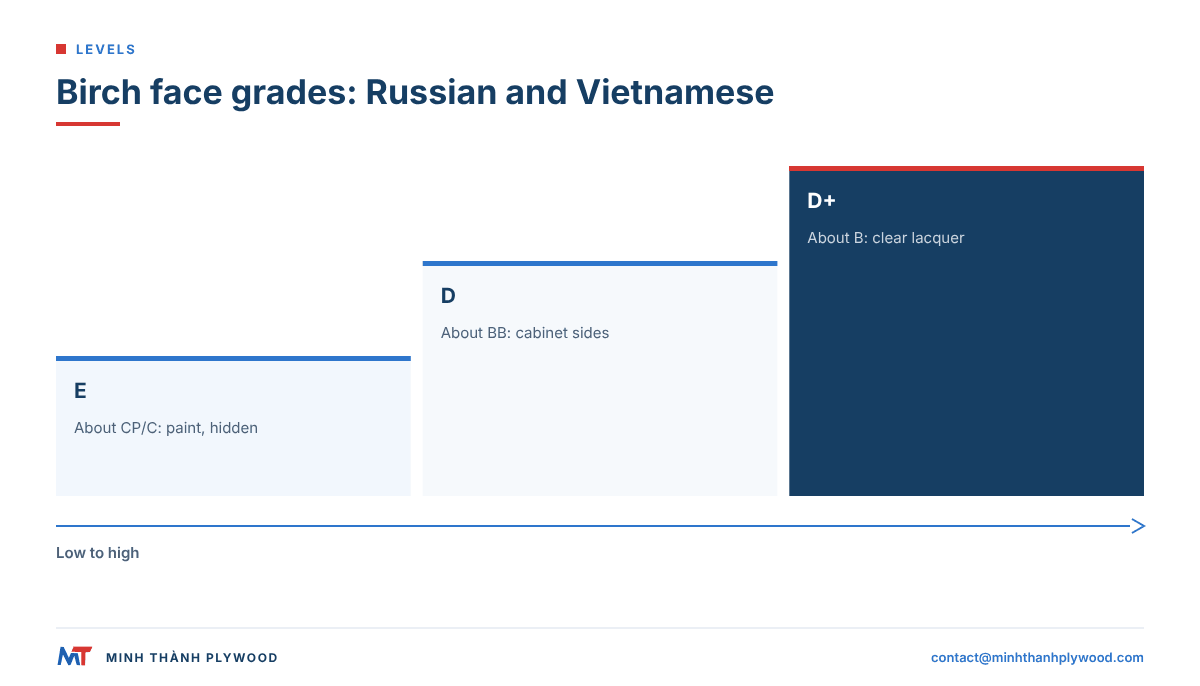
Russian and Baltic birch grades map to Vietnamese birch grades one step at a time: B ≈ D+, BB ≈ D and CP or C ≈ E. Vietnamese mills name birch faces D+, D and E, from highest to lowest, and quote them as face/back pairs.
| Russian or Baltic pair | Vietnamese pair | Typical use |
|---|---|---|
| B/BB | D+/D | Clear-lacquered furniture faces, one show side |
| BB/BB | D/D | Cabinet sides, shelving, most furniture parts |
| BB/CP | D/E | One good face, one hidden face |
| CP/C | E/E | Painted parts and hidden panels |
The match is close, not exact, because each grading system describes defects in its own way. The order appearance is fixed by an approved sample: you approve a face at the sample stage, and production is matched to that sample.
How do you switch a Russian birch order to birch-faced plywood?
Rewrite the Russian birch order line by line, then confirm it with a sample. These seven steps cover what changes:
- Keep the face species: birch face and back.
- Map the grade: B/BB becomes D+/D, BB/BB becomes D/D, BB/CP becomes D/E.
- Choose the core: white Styrax for light, pale furniture panels; Eucalyptus where a denser core is preferred.
- Set glue and emission: UF glue at E0 emission for furniture; MR (melamine-fortified) or phenolic (WBP) for humid or exterior uses.
- Keep the thickness, change the format: the same metric thickness, on 1220 × 2440 or 1250 × 2500 mm, or cut-to-size.
- Write the tolerance: ±0.2–0.3 mm for sanded furniture panels, so CNC programmes and hinge borings stay as they were.
- Approve a sample and carry it into the order: the approved sample reference goes on the proforma invoice.
A typical rewritten line reads: “18 mm birch-faced plywood, Styrax core stitched, UF glue at E0 emission, D/D, sanded, ±0.2 mm, 1220 × 2440 mm, export packs”.
What changes when you move from 1525 × 1525 mm sheets?
Moving from 1525 × 1525 mm sheets changes the cutting plan, not the parts. The usual replacements are 1220 × 2440 mm, 1250 × 2500 mm and cut-to-size panels.
- 1220 × 2440 mm suits carcasses and shelving cut to imperial or 600 mm module plans.
- 1250 × 2500 mm gives a wider metric sheet for European furniture lines.
- Custom sizes such as 1220 × 2500 and 1220 × 2280 mm cut waste on parts that repeat in one length.
- Cut-to-size splits one panel into 4, 6 or 8 pieces at the mill, a format we ship regularly to Italy and other European markets.
Run your parts list through the new sheet before you order. Many workshops find the longer sheet gives a better yield on tall cabinet sides than the square format did.
How does the core change weight and container load?
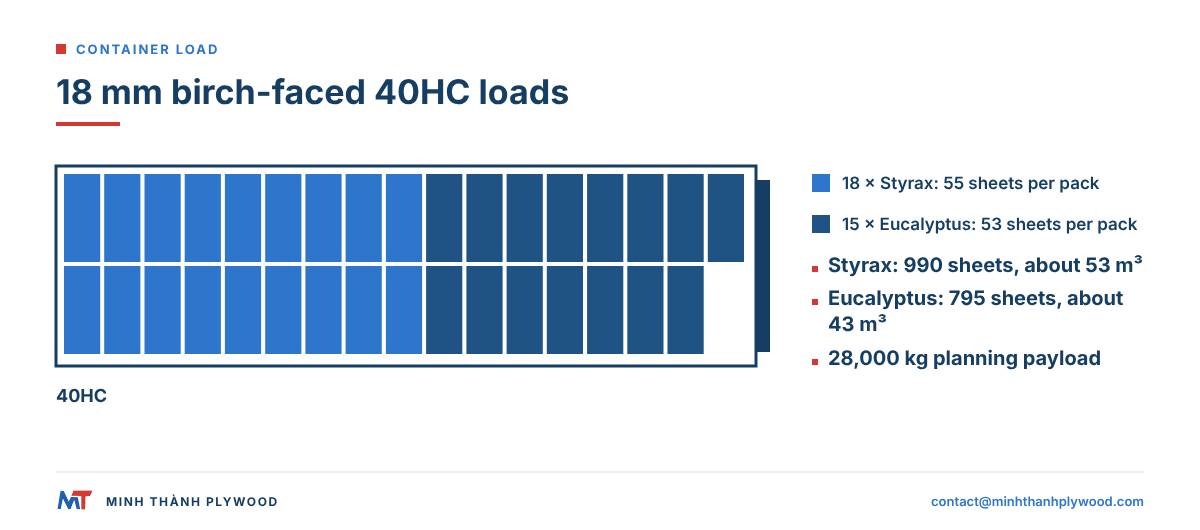
A birch-faced panel on a Styrax core is lighter than an all-birch panel, so more sheets fit in a container before it reaches its weight limit. Reference densities for Vietnamese cores are about 500 kg/m³ for Styrax and 650 kg/m³ for Eucalyptus.
| 18 mm, 1220 × 2440 mm | Styrax core | Eucalyptus core |
|---|---|---|
| Weight per sheet | 26.8 kg | 34.8 kg |
| Sheets per pack | 55 | 53 |
| Packs per 40HC | 18 | 15 |
| Sheets per 40HC | 990 | 795 |
| Volume per 40HC | about 53 m³ | about 43 m³ |
These loads are planned against a 28,000 kg payload, with packs about 1,000 mm high. A lighter core also helps your own plant: a 26.8 kg sheet is easier to lift onto a saw or CNC table than a heavier all-birch sheet of the same size.
How do you make sure birch plywood is not Russian origin?
Ask for documents that tie the panel to one mill and one country of production. A seller who can name the mill, show it on video and supply its records is the first filter.
- Certificate of origin for the shipment, issued in the exporting country.
- Mill identity: the factory’s name and location, a live video of production and the press line.
- EUDR dossier for EU orders: origin records and geolocation files for the timber in the panel.
- Emission certificate in the mill’s name, such as CARB P2 / TSCA Title VI with its mill number.
- Consistent paperwork: the seller on the invoice, the exporter on the B/L and the bank account holder should match.
At Minh Thanh Plywood we supply the EUDR compliance dossier (origin records and geolocation files) with orders. Every shipment is photographed and filmed before loading, and buyers receive the photos and video.
What documents does an EU or UK buyer need for birch-faced plywood?
An EU or UK buyer of birch-faced plywood from Vietnam receives the standard export set with every shipment, plus the compliance files the market asks for.
| Document | What it proves |
|---|---|
| Commercial invoice and packing list | What was sold, in sheets and m³ |
| Bill of lading | Shipment and title to the goods |
| Certificate of origin (EUR.1 for the EU) | Vietnamese origin for customs |
| Phytosanitary and fumigation certificates | Plant-health status where required |
| Insurance certificate (CIF orders) | Cover during the sea voyage |
| EUDR compliance dossier | Origin records and geolocation files |
| CARB P2 / TSCA Title VI certificate and test reports | Formaldehyde emission of the furniture build |
| PPWR packaging test (SGS, September 2026) | Lead, cadmium, mercury and hexavalent chromium not detected in four packing materials |
Our guide to birch plywood import and export requirements explains each file in more detail, including EU timber rules and US emission labels.
Which Vietnamese factories make birch plywood as an alternative to Baltic birch?
We make birch-faced furniture plywood for buyers who used to order Russian birch. The factory in Ha Hoa, Phu Tho is built for top-grade furniture and interior plywood, with Europe as its main market, and has a capacity of 50,000+ m³ per year.
- Build: birch face and back on a stitched white Styrax or Eucalyptus core, pressed twice, sanded and polished, UV-ready.
- Grades: D+/D, D/D and D/E, matched to your approved sample.
- Glue and emission: UF glue at E0 emission; MR or phenolic (WBP) bonds on request.
- Formats: 3–40 mm, 1220 × 2440 and 1250 × 2500 mm, custom sizes and cut-to-size.
- Proof: CARB P2 / TSCA Title VI (ICTT mill no. 23024), ISO 9001:2015, six ASTM D6007 chamber tests between April 2025 and June 2026 averaging 0.014–0.032 ppm.
- Terms: MOQ 1×40HC, mixed specifications by agreement, 15–45 days after deposit, FOB Hai Phong, CFR or CIF. Free samples.
FSC and CE are available*. *Supplied directly or through qualified partner mills.
For the full product range, see birch-faced plywood from Vietnam. For a plain explanation of the all-birch product, read our guide to Baltic birch plywood, and compare mills with our list of Baltic birch plywood suppliers.
How should you specify your replacement panel?
Send the replacement specification in the same order the mill builds it: application, core, glue and emission, face, sheet, packing and quantity. A complete request gets a firm price in one reply.
Application: kitchen carcasses, banded edges · Core: white Styrax, stitched · Glue: UF glue at E0 emission, CARB P2 / TSCA Title VI · Face: birch D/D, sanded, UV-ready · Sheet: 18 mm, ±0.2 mm, 1220 × 2440 mm · Packing: export packs, 1×40HC, CIF your port
Email the specification to [email protected], or message Lisa on WhatsApp at +84 988 586 601. We reply within hours, Monday to Friday, 08:00–17:00 Vietnam time (UTC+7).
Buyer questions, answered
What is Russian birch plywood?
Russian birch plywood is plywood made in Russia with birch veneer in every layer, face, core and back. It was sold in the 1525 × 1525 mm format and in 4 × 8 ft sheets, graded B, BB, CP and C on the face, and used for furniture, flooring, vehicle floors and formwork.
Can I still import Russian birch plywood into the EU?
No. Since 9 April 2022 Regulation (EU) 2022/576 bans the import of wood products of CN chapter 44, which includes plywood, that originate in or are exported from Russia. Regulation (EU) 2022/355 does the same for Belarus from 3 March 2022.
What is the best alternative to Russian birch plywood?
For an exact all-birch specification, Finnish or Baltic birch from the EU. For furniture carcasses, cabinets, shelving and painted or veneered panels, birch-faced plywood on a light hardwood core is the cost-effective alternative, with the same birch look on the face.
Is Vietnamese birch plywood the same as Russian birch?
No. Vietnamese birch plywood is birch-faced: imported birch face and back veneers pressed on a Vietnamese Styrax or Eucalyptus core. Russian birch is birch in every layer. The face looks the same; the edge, weight and core differ.
How do Russian birch grades compare with Vietnamese birch grades?
Russian and Baltic birch faces are graded B, BB, CP and C. Vietnamese mills name birch faces D+, D and E: D+ is about B, D about BB and E about CP/C. So a B/BB order maps to D+/D and BB/BB to D/D, fixed by an approved sample.
Why is Vietnamese birch-faced plywood cheaper than Baltic birch?
Birch is used only for the two outer veneers, while the core is plantation-grown Styrax or Eucalyptus from northern Vietnam. That costs less than a core made entirely of birch veneer, and a Styrax core is also lighter, so more cubic metres fit in a container.
Does Vietnamese birch plywood meet CARB P2 and E0?
Minh Thanh birch-faced furniture panels use UF glue at E0 emission and are certified CARB P2 / TSCA Title VI under ICTT mill no. 23024. Six ASTM D6007 chamber tests averaged 0.014–0.032 ppm against the 0.05 ppm limit.
Can birch-faced plywood replace Russian birch for visible edges?
Only where a non-birch core in the edge is acceptable. Exposed-edge designs, such as drawer boxes with clear-lacquered edges, keep an all-birch panel. Edges that are banded, painted or hidden take birch-faced plywood without any change.
What sheet sizes replace the 1525 × 1525 mm Russian format?
Vietnamese birch-faced plywood comes in 1220 × 2440 and 1250 × 2500 mm, plus sizes such as 1220 × 2500 and 1220 × 2280 mm. Cut-to-size orders split one panel into 4, 6 or 8 pieces for buyers who worked to the square format.
How do I check that birch plywood is not Russian origin?
Ask for the certificate of origin, the mill's production records and, for the EU, an EUDR dossier with origin records and geolocation files. Under Implementing Regulation (EU) 2025/1093 Russia and Belarus are high-risk countries and Vietnam is low risk.