
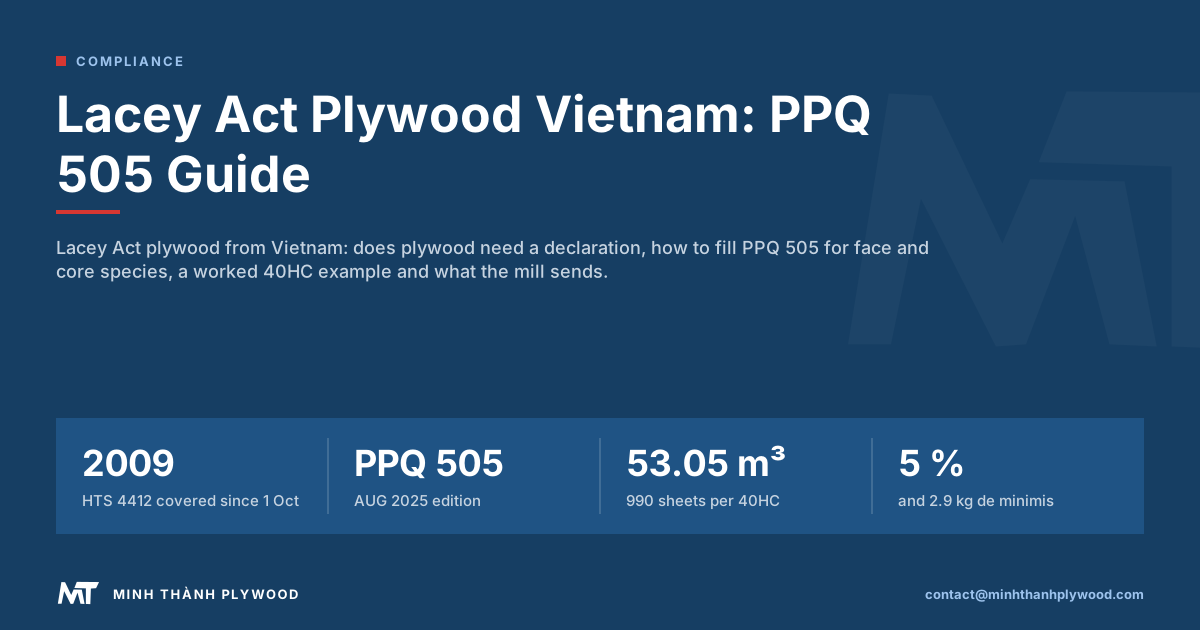
For a covered US formal entry of plywood under HTS 4412, the importer files a Lacey Act declaration naming the wood species in the face and core, their harvest countries and quantities. The declaration applies to covered CBP entry types; an informal entry does not normally require it. Minh Thanh supplies species and harvest data for US orders. This guide explains PPQ 505 data and a worked 40HC example.
What is the Lacey Act and does it apply to plywood from Vietnam?
The Lacey Act prohibits trade in illegally sourced plants and plant products, including plywood imported from Vietnam. A 2008 amendment added declaration requirements for imported plants and plant products.
Two separate obligations matter to a plywood importer:
- Legality and due care. The importer is expected to take reasonable steps to know the wood was harvested and traded legally where it grew, whether or not a declaration is required.
- The import declaration. For a covered formal entry, 16 U.S.C. 3372(f) requires scientific name, value, quantity and country of harvest.
No country is pre-cleared. What matters is whether each species in the panel was legal where it was cut, and whether the declaration matches what is in the container.
Lacey Act plywood from Vietnam: does it need a declaration?
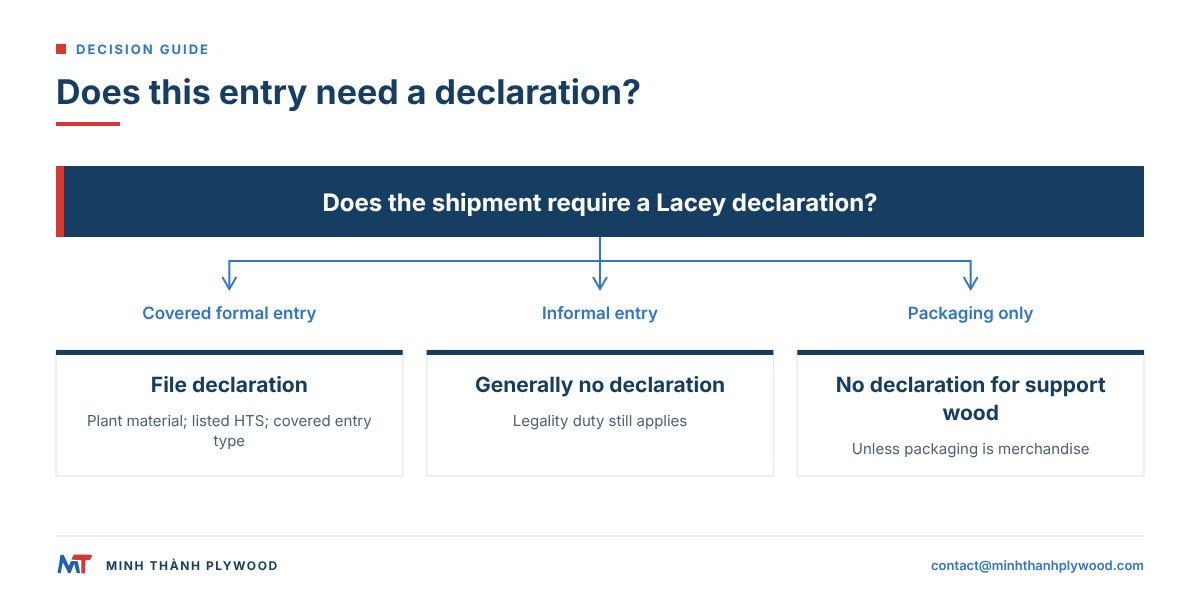
Yes, for covered formal entries. Plywood classified under HTS heading 4412 is on the APHIS declaration schedule, but filing depends on all four conditions: the product contains plant material, its HTS code is listed, CBP treats the shipment as a formal entry, and its entry type is covered. A small shipment entered informally generally does not require this declaration; the separate prohibition on illegally sourced wood still applies. APHIS states the formal-entry and entry-type conditions.
APHIS began Phase VII on December 1, 2024, extending declaration coverage to remaining plant-product categories that are not made entirely from composite materials (APHIS filing guidance, checked on 3 November 2026).
Three scope checks are worth knowing:
- Formal versus informal entry. A listed HTS code alone does not trigger filing for a CBP informal entry; check the entry type before declaring a courier sample exempt.
- Packaging. Wood used only as packaging to support, protect or carry another item, such as pallets and pack covers, is outside the declaration, unless the packaging is itself the imported goods.
- De minimis. Products with plant material of no more than 5 % of the unit’s weight, and no more than 2.9 kg per HTS line per entry, are exempt. A plywood container never qualifies.
APHIS’s declaration FAQ sets out both exceptions (checked on 3 November 2026).
What goes on PPQ Form 505
PPQ Form 505, Plant and Plant Product Declaration, has a shipment section and a compliance section; the compliance section is filled for each article or component made from plants. The PPQ 505 form and instructions use the AUG 2025 edition. The table below explains its fields for plywood.
| PPQ 505 field | What it means for plywood |
|---|---|
| 11. HTS number | The 10-digit code for the plywood, without dashes |
| 12. Entered value | The value of the merchandise in US dollars |
| 13. Article/component of article | Each component made from wood: face veneer, back veneer, core |
| 14. Plant scientific name | Genus and species of each component, for example Styrax tonkinensis; not a trade name |
| 15. Country of harvest | Where the trees were cut, not where the panel was pressed |
| 16. Quantity of plant material | The amount for each species and country-of-harvest pair |
| 17. Unit | A metric unit, usually m3 or kg |
| 18. Percent recycled | Only for paper and paperboard; left blank for plywood |
The shipment section adds the estimated arrival date, CBP entry number, container numbers, bill of lading, the manufacturer identification code (MID), importer and consignee, and a description of the merchandise and its use. The preparer signs a certification under penalty of perjury.
How is the PPQ 505 declaration filled for multi-species plywood?
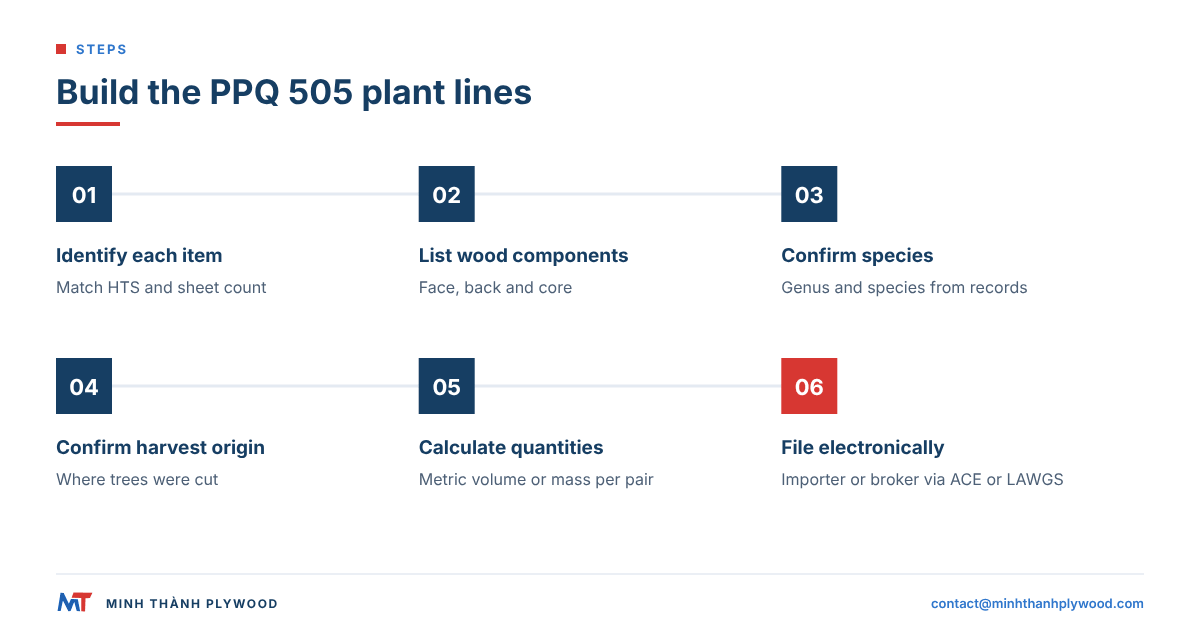
For multi-species plywood, fill PPQ 505 with one line per species and country-of-harvest pair, using the genus, species, plant-material quantity and metric unit. A birch-faced panel with a Styrax core needs separate lines for the birch veneers and the Styrax core; take the species and harvest origins from the supplier’s records.
The PPQ 505 instructions settle the three questions importers ask most:
- Species varies. “If the species of plant used to produce the product varies, and the species used to produce the product is unknown, enter each species that may have been used.”
- Country varies. If the country of harvest varies or is unknown, enter every country from which the plant material may have been harvested.
- Quantity. Enter the quantity “for every line that contains a different country of harvest and species pair”.
The instructions also warn that the scientific name is not the trade name. “White core”, “hardwood”, “EV” and “D+/D birch” are trade terms; the form wants a genus and a species. Plywood is not a composite material in APHIS’s sense, because its veneers are sliced or peeled, not broken down and re-formed, so the composite special use designation does not apply.
Lacey Act declaration for plywood: a worked 40HC example
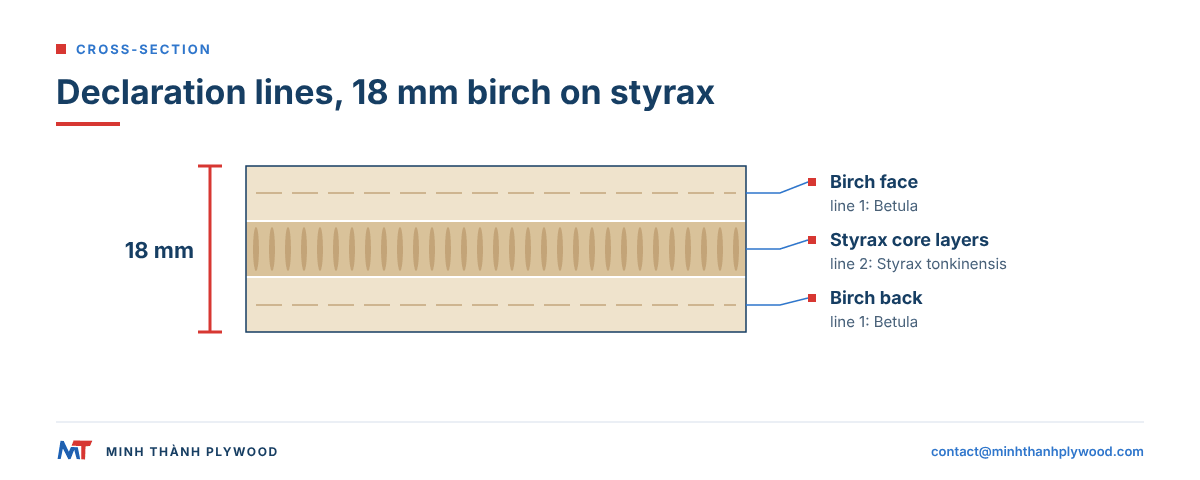
Here is how an importer fills the plant lines for one 40HC of 18 mm birch face styrax core plywood, 1220 × 2440 mm, loaded at 990 sheets.
Step 1: total volume. 990 sheets × 2.977 m² × 0.018 m = 53.05 m³.
Step 2: split by layer. Take the face and back thickness from the mill’s lay-up sheet. With a 0.3 mm birch face and a 0.3 mm birch back, the birch share per sheet is 2.977 m² × 0.0006 m; over 990 sheets that is about 1.77 m³. The Styrax core takes the rest, about 51.28 m³.
Step 3: fill one line per pair.
| 13. Component | 14. Genus | 14. Species | 15. Country of harvest | 16. Quantity | 17. Unit |
|---|---|---|---|---|---|
| Face and back veneer | Betula | as the veneer records state | as the veneer records state | 1.77 | m3 |
| Core veneer | Styrax | tonkinensis | Vietnam | 51.28 | m3 |
The split is by nominal layer thickness; glue lines and sanding are ignored. Agree the method with your broker and keep the calculation in the shipment file. For a single-species panel whose veneers share one country of harvest, enter one line with that item’s actual quantity. Calculate its shipment volume from its own sheet count and dimensions.
How to declare a mixed container of plywood
A mixed container is declared item by item: each plywood specification gets its own species lines, and the quantities are summed per species and country-of-harvest pair. Minh Thanh loads usually 1–2 specifications per container, 3–6 by agreement. The number of declaration lines follows the species and harvest-country pairs in those items.
Take a container with two items: 18 mm birch face on a Styrax core, and 12 mm poplar face on a Eucalyptus core. The declaration needs:
- Birch face and back veneer from the first item, with the birch’s country of harvest.
- Styrax core veneer from the first item, Vietnam.
- Poplar face and back veneer from the second item, with the poplar’s country of harvest.
- Eucalyptus core veneer from the second item, Vietnam.
If two items share a species and a country of harvest, for example two thicknesses on the same Styrax core, their quantities can sit on one line. Ask the mill for a packing list that gives sheets and cubic metres per item; the species volumes follow from it with the same layer split as the worked example.
Keep the HTS code per item as well. Panels of different construction can fall under different 4412 subheadings, and each subheading is its own line on the entry.
Does engineered veneer (EV) change the declaration?
EV (engineered veneer) is declared under the species it was made from, because it is real wood veneer, sliced, dyed and re-sliced into a new pattern, not a fibre or particle product. The face line names the genus and species of the source veneer, from the veneer supplier’s records, and the country where that timber was harvested.
The same rule covers any decorative face sold under a pattern or colour name: “walnut look”, “oak look” or a catalogue code is a trade name, not a species. Ask the mill which species the face veneer is made from and write that on the order, so the face line is settled before the panel is pressed.
Melamine paper, overlays and films are not plant-based veneers in this sense; a melamine-faced panel still has a wood core, and the core species are declared as usual.
Scientific names for common plywood species from Vietnam
These are the species found in Minh Thanh panels and the genus to enter on PPQ 505. Take the exact species from the mill’s species statement for your order.
| Component | Trade name | Genus | Typical country of harvest |
|---|---|---|---|
| Core | Styrax, white core | Styrax (S. tonkinensis) | Vietnam |
| Core | Eucalyptus | Eucalyptus | Vietnam |
| Core (on order) | Acacia | Acacia | Vietnam |
| Face | Birch | Betula | Imported: from the veneer records |
| Face | Okoume | Aucoumea (A. klaineana) | Imported: from the veneer records |
| Face | Poplar | Populus | From the veneer records |
| Face | Pine | Pinus | From the veneer records |
| Face | EV (engineered veneer) | The species of the source veneer | From the veneer records |
Minh Thanh’s cores are Vietnamese plantation timber, locally grown around Ha Hoa, Phu Tho. Faces are chosen for the look the buyer orders, including imported birch and okoume, so a face line can carry a different country of harvest from the core line.
Country of harvest vs country of origin
Country of harvest is where the trees were cut; country of origin is where the panel was made. On PPQ 505 the form says it plainly: country of harvest “is NOT the country of manufacture/origin”.
For plywood from Vietnam:
- Vietnamese cores (Styrax, Eucalyptus, Acacia): country of harvest Vietnam.
- Imported faces (birch, okoume): the country where the face logs were harvested, from the veneer records.
- Certificate of origin: Vietnam, for the finished panel. This is a customs document, not the Lacey field.
Writing “Vietnam” on every line of a birch-faced panel is one of the most common errors. There is no special use designation for the country of harvest field, so it must always be filled.
Who files the declaration, and how
The importer of record files the Lacey Act declaration, usually through its customs broker. The foreign mill has no filing role.
Two electronic routes are available:
- ACE: CBP’s Automated Commercial Environment, used with the customs entry.
- LAWGS: APHIS’s Lacey Act Web Governance System, an alternative electronic filing route.
APHIS stopped accepting paper submissions of PPQ 505 and 505B on January 1, 2026; its filing guidance directs filers to ACE or LAWGS. The published form remains a guide to the declaration data, which is why this article walks through its fields.
The preparer certifies the content is true and correct. A knowingly false statement can bring criminal penalties under 16 U.S.C. 3373(d), so the species and quantities must come from the supplier’s records, not from a guess.
What the mill supplies for a US plywood order
Minh Thanh supplies the data the importer needs to file and to show due care, with every US order:
| Document or data | What it gives the importer |
|---|---|
| Species statement | Face and core species for each item on the order |
| Harvest origin | Vietnamese harvest origin for the cores; veneer records for imported faces |
| EUDR compliance dossier | Origin records and geolocation files for the timber |
| Commercial invoice and B/L | TSCA Title VI compliance stated |
| TSCA Title VI label on panels | Producer, lot, certifier number TPC-43, “TSCA Title VI compliant” |
| Packing list | Sheets and volume per item, for the quantity field |
| Photos and video before loading | Proof of what went into the container |
The geolocation files of the EUDR dossier answer a question the Lacey Act asks too: where the timber grew. One record set serves a buyer selling into the US and the EU.
Due care: records to keep for each shipment
Due care means taking the steps a careful importer would take to know the wood is legal, and being able to show them later. Keep one file per shipment:
- The purchase order with species written for face and core.
- The mill’s species statement and harvest origin for that order.
- The origin records (for Minh Thanh, the EUDR dossier with geolocation files).
- The commercial invoice, packing list and bill of lading.
- Your quantity calculation for each species line.
- The filed declaration or ACE entry data.
- The pre-loading photos and video.
A supplier saying the wood is legal is not enough on its own. Records tied to the order, the species and the harvest location are what show care when CBP or APHIS asks months later.
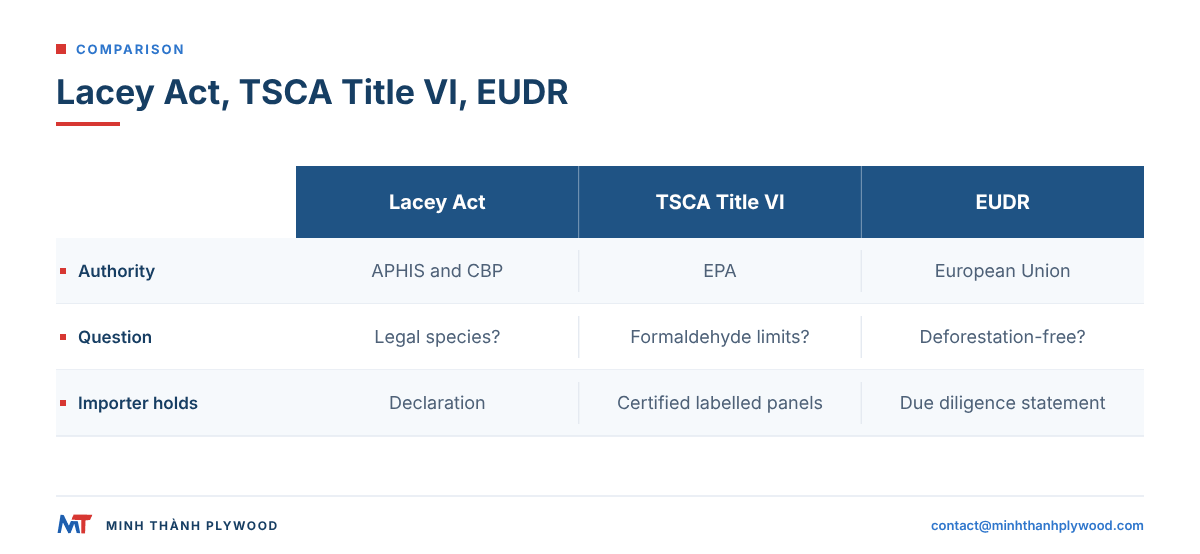
Lacey Act vs TSCA Title VI vs EUDR
The Lacey Act, TSCA Title VI and the EUDR are three separate rules that often meet on one plywood order; each asks a different question. A fourth regime, anti-dumping and countervailing duty (AD/CVD), is about price and subsidy rather than species, and sits beside them.
| Rule | Authority | Question it asks | What the importer files or holds |
|---|---|---|---|
| Lacey Act | United States, APHIS and CBP | Was each species legally harvested, and what is in the panel? | Declaration (PPQ 505 data in ACE or LAWGS) |
| AD/CVD | United States, Commerce and ITC | Is the plywood sold below fair value or subsidised? | Entry-level duty deposits on in-scope hardwood and decorative plywood |
| TSCA Title VI | United States, EPA | Do the panels meet the formaldehyde emission limits? | Certified, labelled panels; import certification |
| EUDR | European Union | Is the timber deforestation-free and legal, with plot geolocation? | Due diligence statement |
Minh Thanh holds CARB P2 / TSCA Title VI certification (ICTT mill no. 23024); six ASTM D6007 chamber tests between April 2025 and June 2026 averaged 0.014–0.032 ppm against the 0.05 ppm limit. The emission rules are set out in the EPA formaldehyde standards for composite wood products; the EUDR is Regulation (EU) 2023/1115 (both checked 20 October 2026). CARB P2 and TSCA Title VI and EUDR traceability explain the documents.
On AD/CVD: Commerce’s final determinations of July 2026 set an anti-dumping rate of 90.12 % for most Vietnamese exporters of hardwood and decorative plywood, with countervailing duties on top, and the ITC voted on 19 August 2026 that US industry is injured, which paves the way for orders. Structural plywood certified to US building standards is outside the scope. Check the scope language and your supplier’s rate in the Commerce notice before you price a US order, because these duties are charged at entry whatever the Lacey declaration says.
Common Lacey Act filing mistakes with plywood
Most Lacey Act problems with plywood come from five habits, and each is avoided at the order stage.
- A trade name in the species field. “Hardwood”, “white core” or “birch D+/D” instead of a genus and species.
- Only the face declared. The core is usually more than 90 % of the panel’s volume; leaving it out misdeclares almost the whole quantity.
- One country for every line. Imported faces carry their own country of harvest.
- Sheets as the unit. The unit must be metric: m3 or kg.
- No records after entry. The calculation and the supplier’s data must be on file when questions come.
A wrong HTS code is the sixth: it can pull a line in or out of the schedule. Check the code with your broker whenever you add a product line.
What happens if a plywood declaration is wrong?
A wrong declaration costs money first and freedom last. The civil penalty for a declaration violation is up to US$250; for a knowing violation or knowingly false labelling it is up to US$10,000 per violation, and the plywood itself can be forfeited. A criminal case for a knowing violation carries up to 5 years in prison and a fine of up to US$250,000 or twice the gross gain or loss for an individual, and up to US$500,000 or twice the gross gain or loss for a corporation (Forest Policy Lacey Act summary, checked on 21 October 2026).
Plywood is already a case study. In February 2024 a Florida couple, Noel and Kelsy Hernandez Quintana, were sentenced to 57 months in prison each for importing and selling up to US$65 million of plywood with false species and origin declarations; they were ordered to pay more than US$42.4 million in forfeitures and more than US$1.6 million in storage costs for the seized wood (HSI case summary at IPR Center). Other cases on record: Lumber Liquidators (2016, flooring from illegally harvested Russian wood) and Tip the Scale LLC (June 2024, cabinets and vanities with false species and country of harvest).
The cases share one pattern: the declaration did not match the panel. A species list that comes from the mill’s own records and a calculation kept with the shipment file is what turns a question from CBP into a closed file.
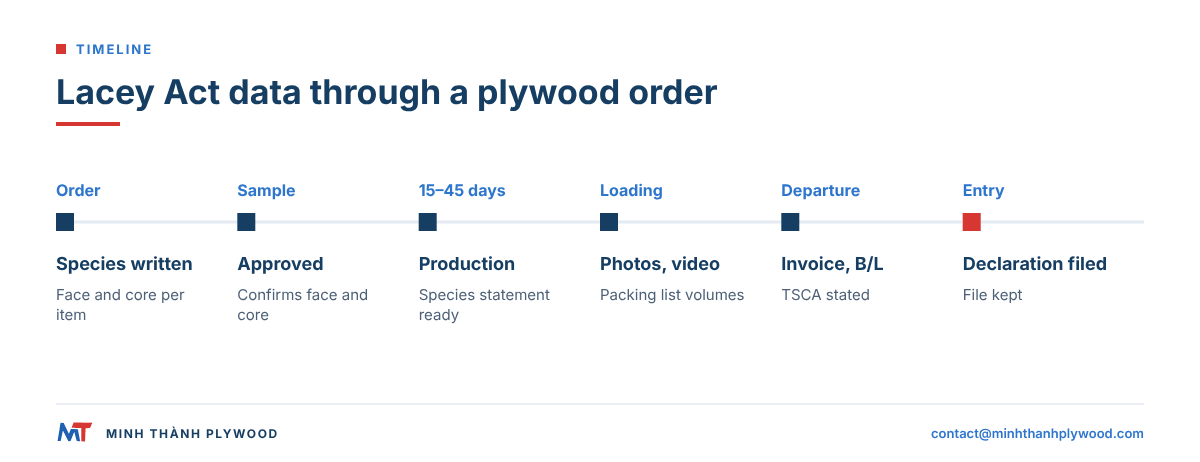
When each piece of declaration data is produced
The data for a Lacey Act declaration builds up through the order, and the importer has everything before the vessel arrives if the species are fixed at the start.
- Quotation and order: face and core species written on each item.
- Sample approval: the approved sample confirms face and core.
- Production: 15–45 days after the deposit; the species statement and harvest origin are prepared.
- Before loading: the shipment is photographed and filmed; the packing list gives sheets and volume.
- Departure: commercial invoice and bill of lading, with TSCA Title VI compliance stated.
- Before arrival: the broker prepares the declaration from the mill’s data.
- Entry: the declaration is filed with the entry; the shipment file is kept.
What to write in your RFQ for a US plywood order
Put the species and the documents in the RFQ, so the declaration data is part of the contract. A complete line reads:
18 mm × 1220 × 2440 mm; face/back: birch D+/D; core: Styrax (Styrax tonkinensis), all layers; UF glue at E0 emission, CARB P2 / TSCA Title VI labelled; 1×40HC CIF your US port; species statement, harvest origin and EUDR dossier with the shipping documents.
Minh Thanh sends free samples of the specified panel and replies within hours. Send the specification to [email protected] or WhatsApp +84 988 586 601.
Buyer questions, answered
Does plywood from Vietnam need a Lacey Act declaration?
Yes for a covered formal entry. Plywood under HTS heading 4412 is on the APHIS schedule, but the shipment must enter through a CBP formal entry type covered by the rule. The importer supplies species, harvest country and quantity; an informal entry generally does not require this declaration.
What is the Lacey Act?
The Lacey Act is a US law (16 U.S.C. 3371–3378) that prohibits trade in illegally taken plants and wood products. Its 2008 amendment added an import declaration for covered plant products entering the United States under eligible formal entry types.
How is the PPQ 505 declaration filled for multi-species plywood?
Enter one line per species and country-of-harvest pair: the face veneer, the back veneer if different, and each core species, each with its genus and species, country of harvest, quantity and unit. If the species varies, enter every species that may have been used.
Who files the Lacey Act declaration?
The importer of record or its customs broker files it, electronically through CBP's ACE or APHIS's LAWGS system; APHIS stopped accepting paper PPQ 505 forms from 1 January 2026. The Vietnamese mill does not file; it supplies the species and harvest data.
What is the scientific name of styrax for the Lacey Act?
Styrax used for plywood cores in Vietnam is Styrax tonkinensis. Enter Styrax as the genus and tonkinensis as the species, not the trade name white core.
Is country of harvest the same as country of origin?
No. Country of harvest is where the trees were cut. A Vietnamese panel with a Styrax core and imported birch faces has Vietnam as harvest country for the core and the birch's harvest country for the faces.
What unit should I use for plywood on PPQ 505?
A metric unit from the APHIS list, usually cubic metres (m3) or kilograms (kg). Sheets, pieces and board feet are not accepted units.
Does pallet and packing wood need a Lacey Act declaration?
No. The Lacey Act declaration does not apply to plant material used only as packaging to support, protect or carry another item, unless the packaging is itself the imported goods.
What does the mill provide for the Lacey Act?
Minh Thanh supplies the face and core species and their harvest origin for each US order, the EUDR compliance dossier with origin records and geolocation files, TSCA Title VI labels, and photos and video of the shipment before loading.
How is engineered veneer (EV) declared under the Lacey Act?
Declare EV under the genus and species of the timber it was sliced from, with that timber's country of harvest, taken from the veneer supplier's records. Pattern names such as walnut look are trade names, not species.
Does each plywood item in a mixed container need its own lines?
Yes. Each specification adds its face and core species; lines with the same species and country of harvest can be combined, with quantities taken from the packing list.
Do I need the Lacey Act declaration for a plywood sample shipment?
A courier sample entered as an informal CBP entry generally needs no Lacey Act declaration; a covered formal entry does. Check the HTS code and entry type with your broker. A commercial 40HC plywood shipment ordinarily enters formally and requires filing.
Can I declare plywood quantity in kilograms instead of cubic metres?
Yes. Kilograms is an accepted unit on PPQ 505. Use the same method for every line and keep the calculation with the shipment file.
Is the Lacey Act the same as TSCA Title VI?
No. The Lacey Act covers wood legality and species declarations for covered formal entries; TSCA Title VI covers formaldehyde emissions from regulated composite wood products. A commercial US plywood entry can involve both sets of requirements.