
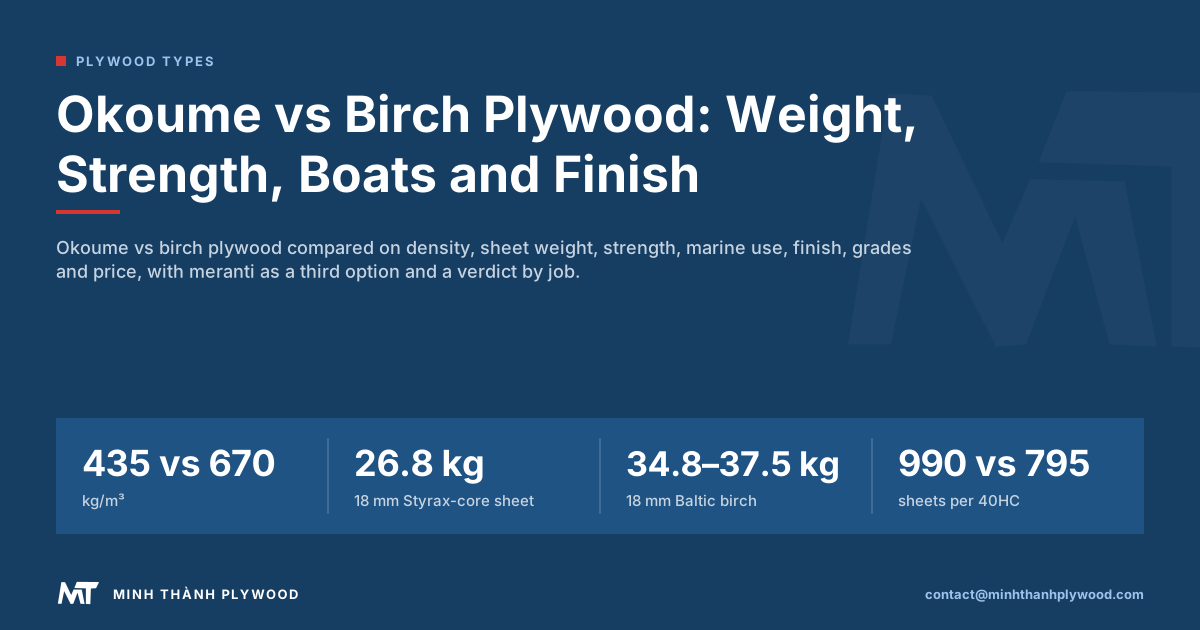
Okoume vs birch plywood is a trade between weight and strength. Okoume is light, soft and easy to bend, the classic face and core for boats and vans; birch is dense, hard and stiff, the standard for furniture edges, jigs and laser parts. This guide compares both on numbers, adds meranti as a third option and gives a verdict by job. Minh Thanh Plywood makes okoume-faced and birch-faced panels on hardwood cores in Vietnam.
Okoume vs birch plywood: the short answer
In okoume vs birch plywood, choose okoume when weight and bending matter and birch when strength, hardness and clean edges matter. Okoume (Aucoumea klaineana) is a light African hardwood; birch is a dense northern hardwood with a fine, pale face.
- Okoume plywood: light, soft, bends easily, pinkish-brown face. The classic marine panel under BS 1088.
- Birch plywood: heavy, hard, stiff, cream face, many thin plies. The classic furniture, jig and laser panel.
- Okoume-faced or birch-faced plywood: the face species on a core of another wood. The face sets the look; the core sets weight and strength.
That last point decides most real orders. A buyer who wants the okoume colour on a flat furniture panel does not need an all-okoume board, and a buyer who wants birch faces does not always need all-birch weight.
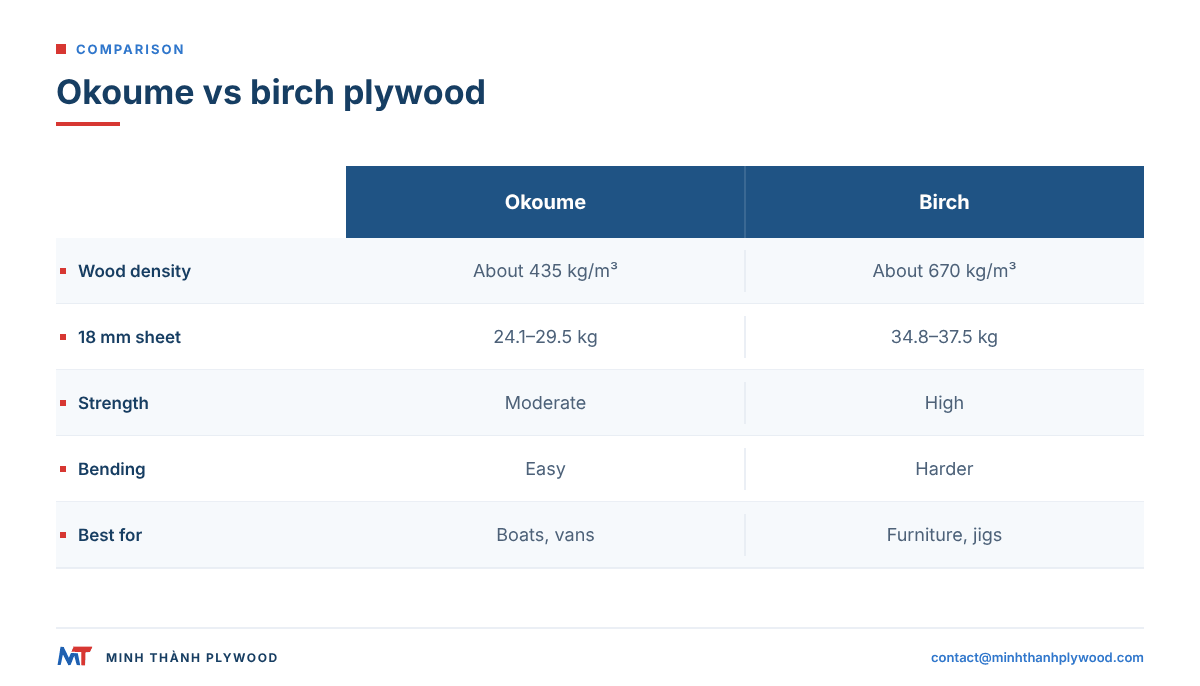
Okoume vs birch plywood compared row by row
The table compares all-okoume and all-birch panels, one property per row. Ratings are relative between the two.
| Property | Okoume plywood | Birch plywood |
|---|---|---|
| Wood density | About 435 kg/m³ | About 670 kg/m³ |
| 18 mm sheet, 1220 × 2440 mm | About 24.1–29.5 kg | About 34.8–37.5 kg |
| Bending strength and stiffness | Moderate | High |
| Surface hardness and dent resistance | Soft, dents easily | Hard |
| Screw holding | Fair; pre-drill and use wide threads | Good, also near edges |
| Bending to a curve | Easy | Harder; thin sheets only |
| Face colour | Pinkish brown, darkens | Cream to pale yellow |
| Visible edge | Few thicker plies | Many thin, even plies |
| Marine standard | BS 1088 grades are common | Mostly WBP exterior, rarely BS 1088 |
| Natural decay resistance | Low | Low |
| Typical use | Boats, vans, light doors, wall panels | Furniture, cabinets, jigs, laser parts, flooring |
Neither panel is better in general. Okoume wins on weight per square metre; birch wins on strength and wear per millimetre.
What is okoume plywood?
Okoume plywood is plywood with okoume face veneers, and in marine grades okoume plies all the way through. Okoume grows in the rainforests of Gabon and neighbouring countries in Central Africa; its large, straight logs peel into wide, clean veneer sheets.
- Wood: low density, even texture, interlocked grain in places, pinkish-brown colour.
- All-okoume panels: every ply is okoume; used for boats, kayaks and lightweight builds.
- Okoume-faced panels: okoume face and back on a core of another species; used for furniture, doors and interiors.
- Glue: phenolic (WBP) for marine and exterior grades, UF for interior grades.
Okoume is a face veneer in Vietnamese plywood, never a core. At our mill the okoume face goes onto a white Styrax or Eucalyptus core, which keeps the okoume look and adds a flat, calibrated base.
What is birch plywood?
Birch plywood is plywood with birch face veneers, and in Baltic birch every ply is birch. Birch grows across Finland, the Baltic states and Russia; its small logs peel into thin, fine-grained veneers, so an all-birch panel has many plies for its thickness.
- Wood: dense, hard, fine and even grain, pale cream colour.
- Baltic birch (all-birch): many thin birch plies, almost free of core voids; known for clean, striped edges.
- Birch-faced panels: birch face and back on a core of another species, often lighter and more cost-effective.
- Common sizes: 1525 × 1525 mm for Baltic birch, and 1220 × 2440 or 1250 × 2500 mm for birch-faced panels.
Our panels are birch-faced, with imported birch veneers pressed onto a Vietnamese core. The face grades are named D+, D and E and quoted as pairs such as D+/D, as our guide to birch plywood grades explains.
Is okoume lighter than birch? Density and sheet weight
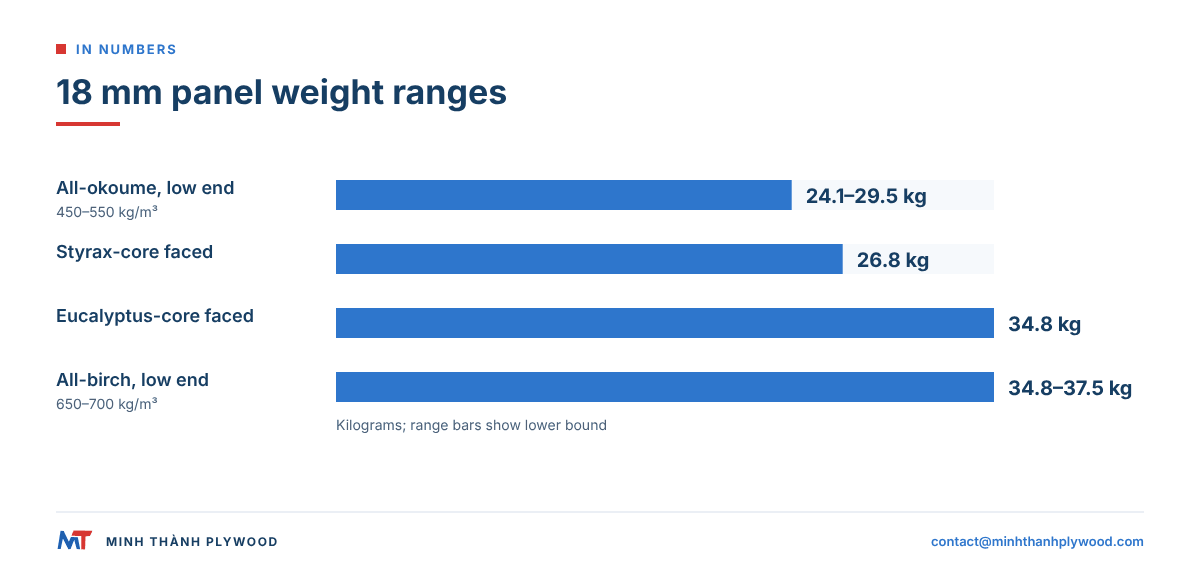
Yes, okoume is much lighter than birch: okoume wood weighs about 435 kg/m³ and European birch about 670 kg/m³, so an all-okoume panel is roughly a third lighter. In a panel, the core decides most of the weight, because face veneers are only 0.2–0.5 mm thick.
Sheet weight is panel density times volume. An 18 mm sheet of 1220 × 2440 mm holds about 0.0536 m³ of plywood.
| 18 mm panel, 1220 × 2440 mm | Panel density | Sheet weight |
|---|---|---|
| All-okoume plywood | 450–550 kg/m³ | About 24.1–29.5 kg |
| Okoume-faced on Styrax core | 500 kg/m³ | About 26.8 kg |
| Okoume-faced on Eucalyptus core | 650 kg/m³ | About 34.8 kg |
| Baltic birch (all-birch) | 650–700 kg/m³ | About 34.8–37.5 kg |
Calculation: 1.22 m × 2.44 m × 0.018 m = 0.0536 m³; 0.0536 × 500 = 26.8 kg. An okoume-faced panel on our Styrax core is close to all-okoume weight; on Eucalyptus it weighs about the same as birch.
Weight drives freight too. The board-only planning references for 18 mm panels are 990 Styrax-core sheets at 26.8 kg each and 795 Eucalyptus-core sheets at 34.8 kg each. The shipped quantity uses weighed packs, including packaging, within the booked payload and container layout.
Strength, stiffness and screw holding
Birch plywood is stronger and stiffer than okoume plywood of the same thickness, and it holds screws better. Denser wood with more, thinner plies spreads loads and resists crushing around fasteners.
- Bending strength and stiffness: birch is higher, so a birch shelf sags less over the same span.
- Strength for weight: okoume is competitive; a slightly thicker okoume panel can match birch stiffness and still weigh less.
- Screw holding: birch holds well, even close to edges; okoume needs pilot holes, wider threads or inserts.
- Dent and wear: birch resists knocks and foot traffic; okoume dents easily without a hard coating.
- Edges: birch edges stay crisp after machining; okoume edges can fuzz and need sealing.
Our guide to hardwood vs softwood plywood explains how species density changes the same comparison across other panels.
Okoume vs birch marine plywood: which is better for boats?
For boats, okoume marine plywood is the standard choice because it is light, bends to hull curves and takes epoxy sheathing well. Birch marine plywood is heavier and stiffer, and builders use it where hardness matters more than weight.
| Boat part | Better choice | Why |
|---|---|---|
| Hull planking and stitch-and-glue kits | Okoume | Light, bends, takes epoxy |
| Decks on small craft | Okoume, sheathed | Low weight high in the boat |
| Bulkheads and frames | Either | Stiffness vs weight |
| Floors, soles and steps | Birch or meranti | Hard surface, screw holding |
| Transom | Okoume or meranti | Thickness and fastener holding |
| Cabinets on board | Okoume or birch | Weight vs edge finish |
Marine plywood is defined by its standard, not its species. BS 1088 sets the veneer quality, core gaps and bond for marine use; our guide to the BS 1088 marine plywood standard covers what it requires. For deck, floor and transom thicknesses, see plywood for boat floors and decks.
Our okoume-faced panels are made for furniture and interiors, not as BS 1088 marine plywood.
Water, rot and glue: what decides outdoor life
The glue line decides whether okoume or birch plywood survives water, and neither wood resists rot well on its own. Both species are rated low in natural durability, so wet use needs a phenolic (WBP) bond, sealed edges and a coating.
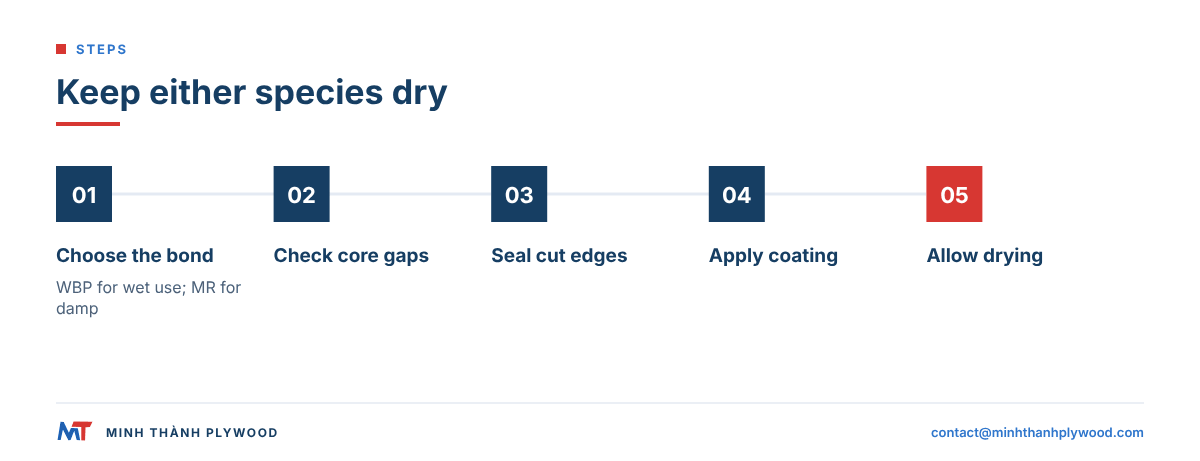
- Bond: phenolic (WBP) glue for boats, outdoor use and wet rooms; MR or melamine-fortified for damp interiors; UF for dry interiors.
- Core quality: few or no core gaps, so water cannot travel inside the panel.
- Edges: seal every cut edge with epoxy or primer before assembly.
- Coating: epoxy and varnish on boats; paint or film on outdoor parts.
- Ventilation: let panels dry out between wet periods; trapped water rots any species.
Our guide to whether plywood is waterproof explains the bond classes and boil tests in more depth. The bonding-quality classes for plywood are set in EN 314-2.
Face, colour and finish: stain, paint or clear coat
Birch gives the paler, finer face for clear finishes and paint; okoume gives a warmer, pinkish-brown face that suits stain, varnish and wood-look interiors. The two faces finish differently because of grain and density.
| Finish point | Okoume face | Birch face |
|---|---|---|
| Natural colour | Pinkish brown, ageing to warm brown | Cream, ageing to light amber |
| Grain | Soft, open, slight ribbon figure | Fine, closed, mild figure |
| Clear finish | Warm, rich look | Light, Scandinavian look |
| Stain | Takes stain; seal first to avoid blotches | Blotches easily; use gel stain or conditioner |
| Paint | Good after a sealer coat | Very good; smooth base |
| Sanding | Fuzzes if over-sanded | Sands smooth |
Both faces arrive sanded on our panels, and both faces are UV-ready for buyers who apply their own UV lacquer.
Machining, bending and laser cutting
Okoume bends and cuts with less effort, while birch machines to sharper detail. The choice follows the part: curves and light parts favour okoume, fine joinery and engraving favour birch.
- Bending: thin okoume sheets bend to tighter curves without kerfing; our guide on how to bend plywood covers kerfing, steaming and lamination.
- Routing and joinery: birch holds crisp profiles, dados and finger joints; okoume can tear out at edges.
- Laser cutting: birch is the usual laser sheet for its even, pale face; okoume cuts cleanly and is used for model aircraft and light parts.
- Tool wear: both are gentle on tools compared with dense tropical hardwoods.
Okoume vs meranti plywood: the third option
In okoume vs meranti plywood, okoume is lighter and easier to bend, while meranti is heavier, harder and more resistant to decay. Meranti (Shorea species) grows in South-East Asia and is often sold as BS 1088 marine plywood or as lauan in the Philippines and North America.
| Property | Okoume | Meranti (dark red) | Birch |
|---|---|---|---|
| Wood density | About 435 kg/m³ | About 675 kg/m³ | About 670 kg/m³ |
| Natural decay resistance | Low | Moderate | Low |
| Bending | Easy | Moderate | Harder |
| Face colour | Pinkish brown | Red to reddish brown | Cream |
| Typical use | Hulls, kayaks, vans | Decks, docks, joinery | Furniture, jigs, floors |
Meranti sits between the two: close to birch in weight, with a red face and better decay resistance than either. Our guides to meranti plywood and lauan plywood cover its grades and names.
Grades: how okoume and birch faces are sorted
Okoume and birch faces are graded by the size and number of knots, patches, colour streaks and splits, and the grade is quoted as a face/back pair. The names differ by species and by origin.
- Okoume marine: BS 1088 sets one high face quality for marine use; non-marine okoume is sorted by appearance, face and back.
- Baltic birch: graded B, BB, CP and C, best to lowest, quoted as pairs such as B/BB.
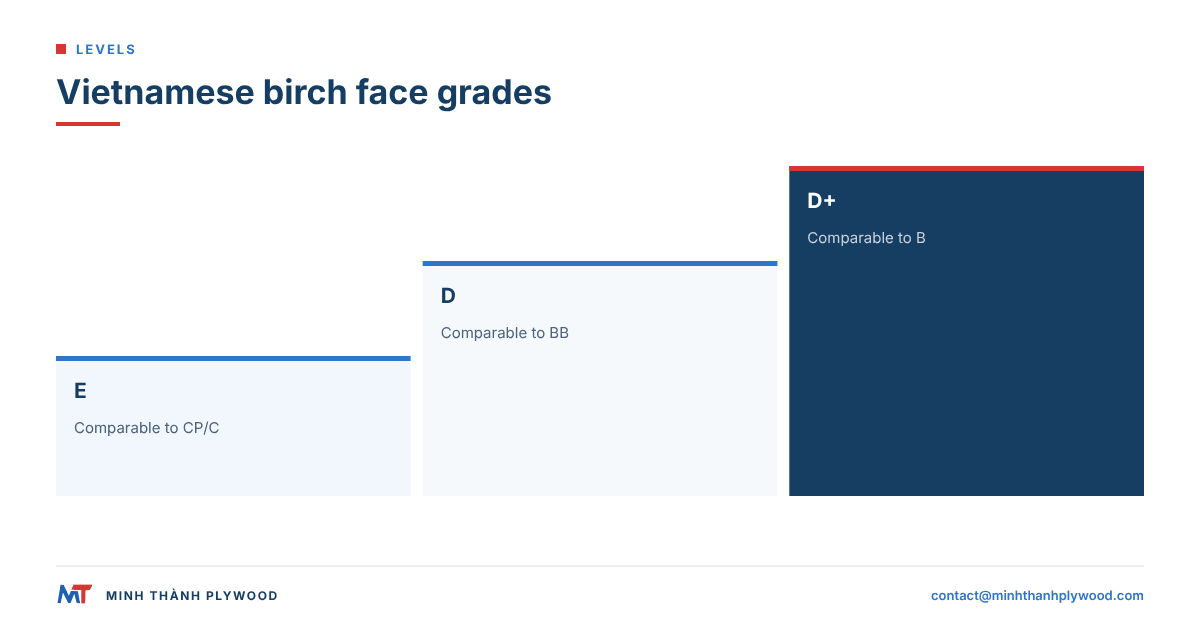
- Birch-faced from Vietnam: graded D+, D and E, low to high E, D, D+; D+ is comparable to B, D to BB and E to CP/C, so D+/D is comparable to B/BB.
- Order rule: the appearance of every order is fixed by an approved sample.
Ask for the grade pair, not only the top face. A B/BB panel and a B/CP panel look the same on the stack and very different when the back is visible.
Price and availability
All-okoume BS 1088 marine plywood is the most expensive of the three, because it needs large okoume logs, full marine veneers and phenolic glue. Birch-faced and okoume-faced panels on plantation cores cost much less, and the core species sets most of the price.
- Marine okoume: priced for boats; buy it only where marine use needs it.
- Baltic birch: priced by grade and size; supply shifted after 2022 sanctions on Russian wood, which moved buyers to other birch sources.
- Furniture and interior plywood: from US$350/m³ (October 2026), depending on face, core, glue, thickness, size and quantity.
For a full price breakdown by face grade, see our Baltic birch plywood price guide.
Which plywood for which job?
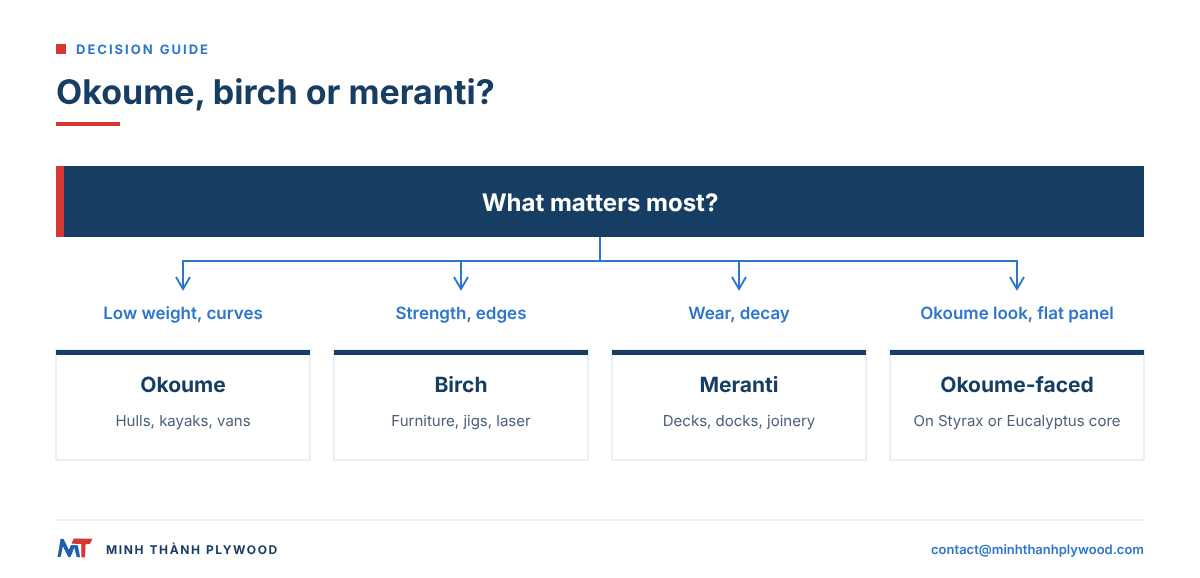
Choose okoume where weight, curves or a warm wood colour lead, and birch where strength, edges and wear lead. The matrix gives the verdict for common jobs.
| Job | Choose | Why |
|---|---|---|
| Boat hulls, kayaks, canoes | Okoume marine | Light, bends, takes epoxy |
| Camper vans and caravans | Okoume or okoume-faced on Styrax | Low weight per sheet |
| Kitchen and bathroom cabinets | Birch or birch-faced | Hard face, screw holding |
| Visible-edge furniture | Baltic birch | Even striped edge |
| Wall panels and large doors | Okoume-faced | Warm face, light panel |
| Jigs, fixtures, workshop tops | Birch | Stiff, wear-resistant |
| Laser-cut parts and engraving | Birch | Pale, even face |
| Model aircraft and light parts | Okoume | Strength for weight |
| Boat floors and docks | Meranti or birch | Hard surfaces; dark red meranti adds decay resistance |
Okoume-faced plywood on a hardwood core: what we make
Minh Thanh Plywood makes okoume-faced and birch-faced panels on white Styrax or Eucalyptus cores for furniture and interiors. The okoume or birch face gives the look; the core and the press give a flat, calibrated panel.
- Cores: white Styrax, light at about 500 kg/m³, or Eucalyptus at 650–750 kg/m³ for a harder, stiffer panel.
- Pressing: furniture-grade panels are pressed twice: the core board is pressed and calibrated, then face and back are pressed on.
- Tolerance: sanded furniture panels hold ±0.2–0.3 mm, down to ±0.2 mm.
- Glue and emission: UF glue at E0 emission for interiors; MR or melamine-fortified and phenolic (WBP) bonds to order.
- Proof: CARB P2 / TSCA Title VI certified (ICTT mill no. 23024); six ASTM D6007 chamber tests on 9, 15 and 18 mm panels between April 2025 and June 2026 averaged 0.014–0.032 ppm. The limit for veneer-core hardwood plywood is 0.05 ppm under EPA’s TSCA Title VI guidance.
- Sizes: 1220 × 2440 and 1250 × 2500 mm, thickness 3–40 mm.
These panels are not sold as marine plywood. See our okoume plywood and birch-faced plywood pages, or the wider hardwood plywood guide.
What to put in your request
A quotation for okoume-faced or birch-faced plywood needs six lines. Send these and we reply with a price and a production date:
- Application: furniture, doors, wall panels, van interiors or another use.
- Face: okoume or birch, with the face/back grade pair or an approved sample.
- Core: white Styrax for light panels, Eucalyptus for harder ones.
- Glue and emission: UF glue at E0 emission, MR or melamine-fortified, or phenolic (WBP).
- Size and thickness: 1220 × 2440 or 1250 × 2500 mm, 3–40 mm.
- Packing and quantity: from one 40HC, mixed specifications by agreement.
Production takes 15–45 days after the 30% deposit, and free samples are available to check face and weight before you order.
Buyer questions, answered
Is okoume lighter than birch?
Yes. Okoume wood weighs about 435 kg/m³ against about 670 kg/m³ for European birch, so an all-okoume panel is roughly a third lighter than an all-birch panel of the same size and thickness.
Is okoume plywood stronger than birch plywood?
No. Birch plywood has higher bending strength, stiffness and screw holding because the wood is denser and harder. Okoume wins on strength for its weight, which is why boat and van builders choose it.
Which is better for boats, okoume or birch?
Okoume, in a marine grade made to BS 1088. It is the classic boat-building panel because it is light, bends well and takes epoxy sheathing. Birch is used in boats mainly for parts where hardness matters more than weight.
Is birch plywood waterproof?
No plywood is waterproof by species alone. A birch panel with a phenolic (WBP) bond survives wet and dry cycles; with an interior UF bond it does not. The glue line decides outdoor life, then the edges and the coating.
Is okoume or birch better for furniture?
Birch, when edges stay visible or the part carries screws and wear. Okoume-faced panels suit large light doors, wall panels and mobile furniture where every kilogram counts and the face is painted or lacquered.
Is okoume better than meranti plywood?
Okoume is lighter and easier to bend; meranti is heavier, harder and more resistant to decay. For a lightweight hull okoume is preferred, for decks, docks and joinery that see wear many builders choose meranti.
Can you stain okoume plywood?
Yes. Okoume takes stain and clear finishes well and has a pinkish-brown colour that darkens to a warm brown. Seal it first or use a gel stain, because its soft, open grain can absorb stain unevenly.
Which is better for laser cutting, okoume or birch?
Birch is the usual laser plywood because its pale, fine face gives sharp, even cuts and engraving. Okoume also cuts cleanly and is lighter, so it is used for model aircraft and light parts.
What is okoume-faced plywood?
It is a panel with okoume face and back veneers pressed onto a core of another species. At Minh Thanh the core is white Styrax or Eucalyptus, which gives the okoume look with a flat, calibrated panel for furniture and interiors.