
Plywood has more names than almost any building material: ply, plyboard, multiplex, contrachapado, contreplaqué, Sperrholz, sklejka, kontrplak, triplay and dozens more. Minh Thanh Plywood quotes buyers in many of these languages every week. This glossary lists the plywood synonyms and local names, the words that sound alike but are not plywood, the trade abbreviations on a quote, and an A to Z of the terms an importer meets.
Plywood synonyms: the other names buyers use
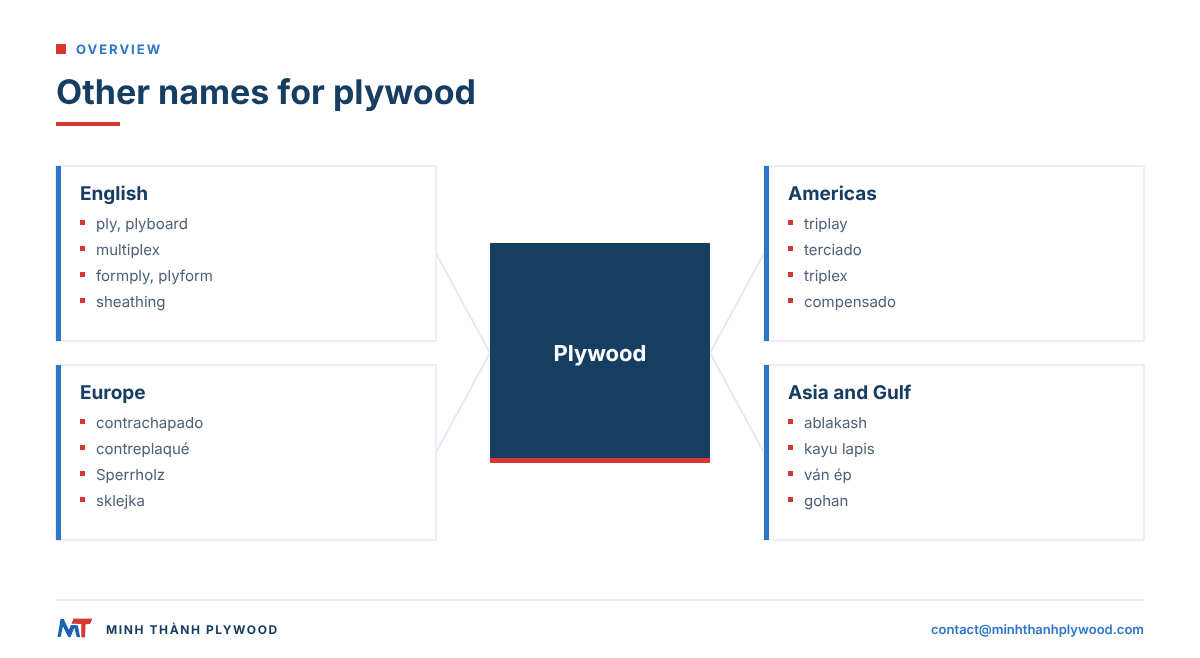
The main plywood synonyms in English are ply, plyboard, ply board and plywood sheet. Trade names add more: multiplex for thick multi-ply panels, shuttering ply, formply and plyform for formwork, sheathing for structural panels, and Baltic birch for one family of birch plywood. Every language then has its own word, from contrachapado to sklejka.
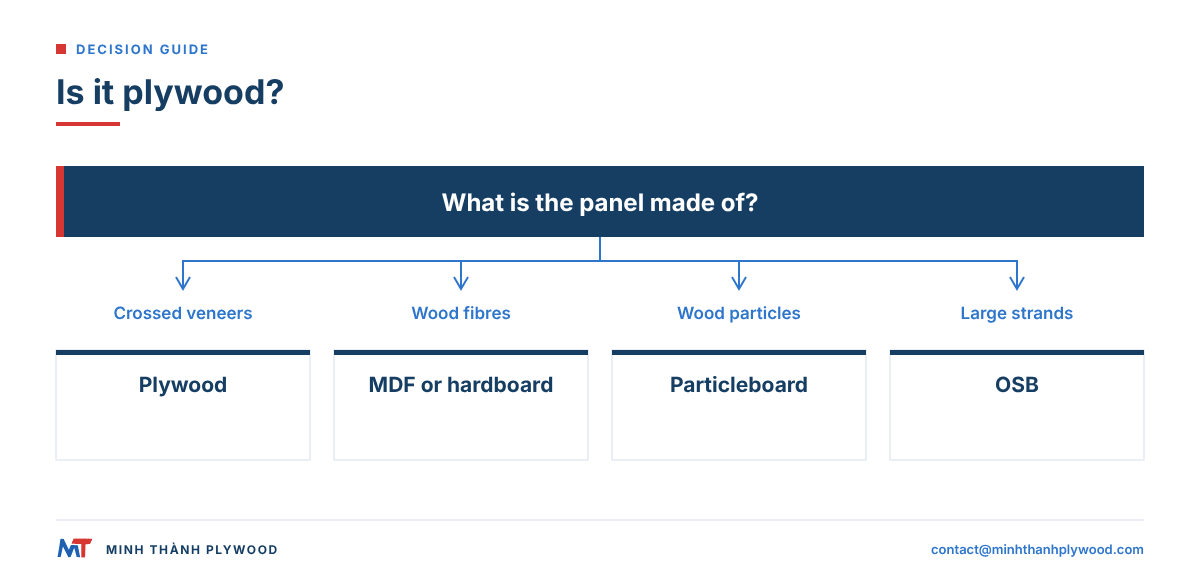
Plywood is a panel made of thin wood veneers glued in layers, with the grain of each layer at right angles to the next. That definition holds whatever the name. It is what separates plywood from MDF, particleboard and OSB, which are made of fibres, particles or strands.
For an importer the name matters because search, customs papers and supplier catalogues all use different words for the same panel. A Polish buyer asks for sklejka, a Dutch buyer for multiplex, a Mexican buyer for triplay: all three want plywood.
What is another name for plywood?
Another name for plywood in everyday English is ply or plyboard. The names below are used in specific markets or trades, such as multiplex, formply, marine ply and veneer board, and each points to a type of plywood rather than to a different material.
| English name | Where it is used | What it means |
|---|---|---|
| Ply, plyboard | UK, Ireland, India, Australia | Plywood in general |
| Plywood sheet, sheet material | Retail and builders’ merchants | One panel of plywood |
| Multiplex, multi-ply | Europe | Thick plywood with many thin plies |
| Baltic birch | North America | Birch plywood with birch veneers throughout |
| Shuttering ply | UK | Plywood for concrete formwork |
| Formply | Australia | Film-faced formwork plywood |
| Plyform | US | Structural plywood graded for formwork |
| Film-faced plywood | Worldwide | Plywood with a phenolic film on the faces |
| Sheathing | US, Canada | Structural plywood for walls and roofs |
| Marine ply | Worldwide | Plywood made for boats and wet use |
| Luan, lauan | US | Thin tropical hardwood plywood for underlayment |
| Veneer board | Some Asian markets | Plywood, or a veneered panel of another core |
“Laminated board” and “veneer board” are loose names: they can mean plywood, but also a melamine-laminated particleboard or a veneered MDF. Ask what the core is before you compare quotes.
Plywood other names around Europe
Plywood other names in Europe follow two roots: words built from “against” and “plate” (contrachapado, contreplaqué, kontrplak) and words built from “cross”, “lock” or “many” (krydsfiner, Sperrholz, multiplex). The table gives the word a buyer types into a search engine in each language.
| Language | Word for plywood | Notes |
|---|---|---|
| Spanish (Spain) | contrachapado | Also tablero contrachapado |
| French | contreplaqué | Contreplaqué filmé for film-faced |
| German | Sperrholz | Multiplex for thick multi-ply, Furniersperrholz in standards |
| Dutch | multiplex | Triplex for thin 3-ply panels |
| Italian | compensato | Multistrato for thick panels |
| Portuguese (Portugal) | contraplacado | |
| Polish | sklejka | |
| Czech | překližka | |
| Danish | krydsfiner | |
| Norwegian | kryssfiner | |
| Swedish | plywood, kryssfaner | Plywood is the everyday word |
| Finnish | vaneri | Koivuvaneri for birch plywood |
| Greek | κόντρα πλακέ (kontra plake) | |
| Turkish | kontrplak | |
| Romanian | placaj | |
| Hungarian | rétegelt lemez | |
| Lithuanian, Latvian, Russian, Ukrainian | fanera, saplāksnis, фанера | Fanera also means veneer in some uses; Latvian finieris means veneer |
Plywood in Dutch is multiplex for almost every panel; the English word plywood is understood but rarely used in Dutch shops.
Plywood en español, em português, in Arabic and in Asia
Plywood en español has four names depending on the country, plywood em português has two, and Arabic and the Asian languages each have their own. Many importers in Latin America, the Gulf and South-East Asia also use the English word.
| Language and market | Word for plywood | Notes |
|---|---|---|
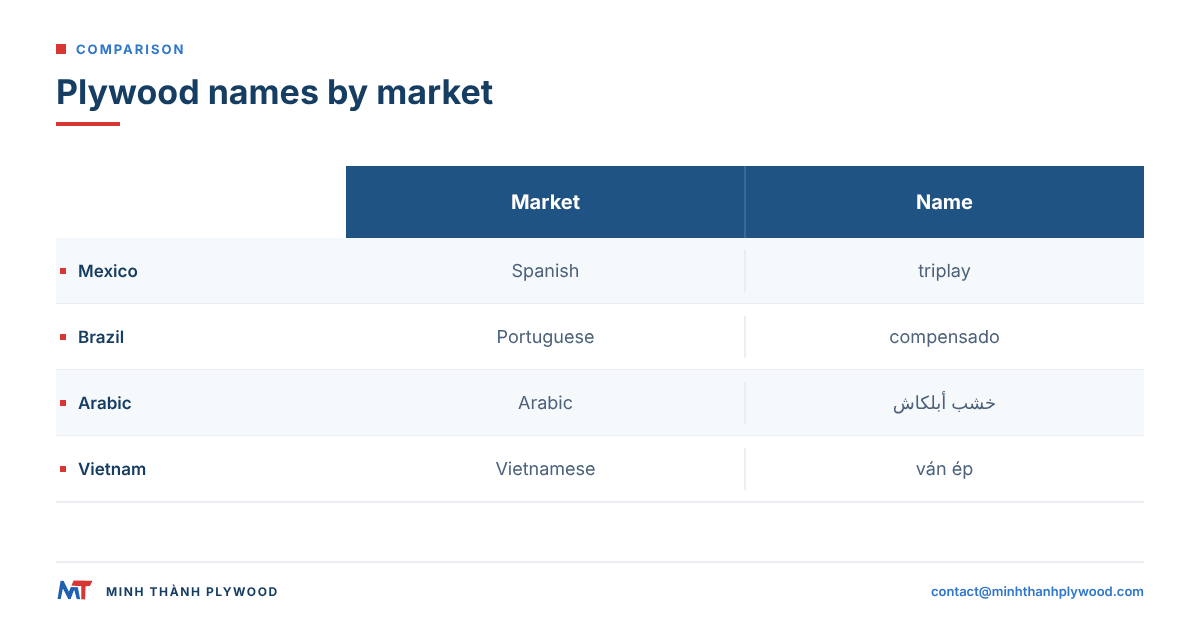
| Spanish, Mexico and Central America | triplay | Also plywood |
| Spanish, Chile and Argentina | terciado, madera terciada | Fenólico for film-faced in Argentina |
| Spanish, Colombia and Venezuela | triplex | |
| Spanish, Dominican Republic and Caribbean | plywood, plywood decorativo | |
| Portuguese, Brazil | compensado, madeira compensada | |
| Arabic | خشب أبلكاش (khashab ablakash) | Khashab raqaiqi in technical texts |
| Hebrew | דיקט (dikt) | |
| Persian | تخته چندلایی (takhte chand-layi) | |
| Hindi and Indian English | प्लाईवुड, ply | |
| Vietnamese | ván ép, gỗ dán | |
| Indonesian and Malay | kayu lapis, triplek | Multipleks for thick panels |
| Thai | ไม้อัด (mai at) | |
| Chinese | 胶合板 (jiaoheban) | 多层板 (duocengban) for multi-ply |
| Japanese | 合板 (gohan) | ベニヤ (beniya), from veneer, for thin plywood |
| Korean | 합판 (hapan) |
Plywood en français is contreplaqué in France, Belgium and Switzerland, and the same word is used in French-speaking Africa and Canada.
What does multiplex mean?
Multiplex means plywood made of many thin plies, usually 12 mm and thicker. In Dutch it is the normal word for plywood (in German the general word is Sperrholz, and Multiplex means thick multi-ply panels); in English it is used for premium multi-ply panels, often birch, where the many layers show as fine stripes on the edge.
A multiplex panel is not a different product from plywood: it is plywood with a high ply count. An 18 mm furniture panel usually has 11–13 plies, most often 11, and is sold as multiplex in the Netherlands without any change in its build. Triplex, by contrast, is a 3-layer panel in Dutch and in several other languages.
What is the synonym of ply?
Ply has two meanings, and the synonym depends on which one is meant. As a material, ply is short for plywood: “a sheet of 18 mm ply”. As a count, a ply is one layer of veneer: a 5-ply panel has five layers, and its synonyms are layer, sheet or veneer.
The count is part of the specification. Thin plywood of 3–5 mm at Minh Thanh is always 5-ply: a 3 mm panel has one core veneer, two cross-band veneers and two face veneers. “3-ply” and “5-ply” in a quote mean the number of layers, not a grade.
Names that are not plywood
Several panel names are used as if they meant plywood, but they are different materials with different strength, moisture behaviour and price. Check the name against the build before you accept a quote.
- MDF (medium-density fibreboard): wood fibres and resin pressed into a uniform board, no layers. See plywood vs MDF.
- Particleboard, chipboard: wood particles and resin. See particle board vs plywood.
- OSB (oriented strand board): large wood strands in crossed layers. See plywood vs OSB.
- Hardboard, Masonite, lawanit: thin, dense fibreboard. Lawanit is the Philippine name, Masonite an old brand name.
- Blockboard: a core of solid wood strips between veneers. It is related to plywood but is a separate product.
- LVL (laminated veneer lumber): veneers glued with the grain in one direction, used as beams, not as sheets.
- Melamine board: usually particleboard with a melamine paper face, unless it is sold as melamine-faced plywood.
Wood terminology: plywood glossary A to E
The glossary below defines the wood terminology an importer meets on quotes, test reports and packing lists, one line per term, with a link to the page that covers it in depth.
- A/A, A/B, B/B: face/back grade pairs; the first letter is the face, the second the back.
- Acacia: a plantation hardwood used for plywood cores, made on order at Minh Thanh.
- Anti-slip plywood: film-faced plywood with a pressed pattern for floors. See anti-slip plywood.
- Back: the face on the hidden side of a panel, usually a lower grade than the face.
- Baltic birch: North American name for birch plywood with birch veneers in every ply.
- BB, CP, C: European birch face grades, from fewer to more defects.
- Bintangor: a red-brown tropical face veneer. See bintangor plywood.
- Book match: veneer leaves turned like book pages so neighbours mirror each other.
- Calibration: sanding a panel to an exact thickness before or after the faces go on.
- CARB P2: the California Phase 2 formaldehyde limit for composite wood, now matched by US TSCA Title VI. See CARB P2 and TSCA Title VI.
- CDX: US structural plywood with C and D faces and exterior glue, used for sheathing.
- Core: the inner plies between face and back.
- Core gap, overlap: a defect where core veneers do not meet or ride over each other.
- Cross-band: the veneer just under the face, laid at right angles to it.
- Cut-to-size: panels cut into smaller pieces before shipping. See cut-to-size plywood.
- D+, D, E: the birch face grades used in Vietnam, low to high E, D, D+.
- Delamination: plies coming apart because of a weak glue bond.
- Double pressing: pressing the core first, calibrating it, then pressing on the faces.
- E0, E1, E2: formaldehyde emission classes; the method of test belongs with the number.
- EN 314-2: the European standard for plywood bond quality, with Classes 1, 2 and 3.
- EN 636: the European plywood specification for dry (636-1), humid (636-2) and exterior (636-3) use.
- EUDR: the EU regulation on deforestation-free products, which asks for origin and geolocation data.
- EV, engineered veneer: real veneer dyed, re-glued and re-sliced for a repeatable face. See EV plywood.
Plywood glossary F to L
- Face: the visible side of the panel, graded higher than the back.
- Film-faced plywood: plywood with phenolic resin film on both faces, for formwork. See film-faced plywood.
- Flitch: a bundle of sliced veneer leaves kept in the order they came off the log.
- FSC: the Forest Stewardship Council certification of forest origin and chain of custody (see fsc.org).
- Gurjan: a tropical hardwood face veneer used for commercial and marine-type panels.
- Hardwood plywood: plywood with a hardwood face, in US law and trade the class of decorative and furniture plywood.
- HPL: high-pressure laminate, a resin-paper sheet glued on a panel; compact HPL is solid.
- Joint: where two face veneer pieces meet; jointed faces are normal on wide panels.
- Knot, pin knot: a branch mark in the veneer; grades limit their size and number.
- Lacey Act: US law that asks importers to declare the species and harvest country of wood products.
- Layer, ply: one veneer in the stack.
- LVL: laminated veneer lumber, all plies in one grain direction. See LVL.
Plywood glossary M to R
- Marine plywood: plywood to BS 1088 or a similar standard, with durable veneers, no core gaps and WBP glue.
- Melamine-faced plywood: plywood with a melamine decor paper pressed on the face.
- Moisture content: the water in the wood as a percentage of dry weight; furniture plywood ships at 8–12 %.
- MOQ: minimum order quantity; for container plywood usually one 40HC.
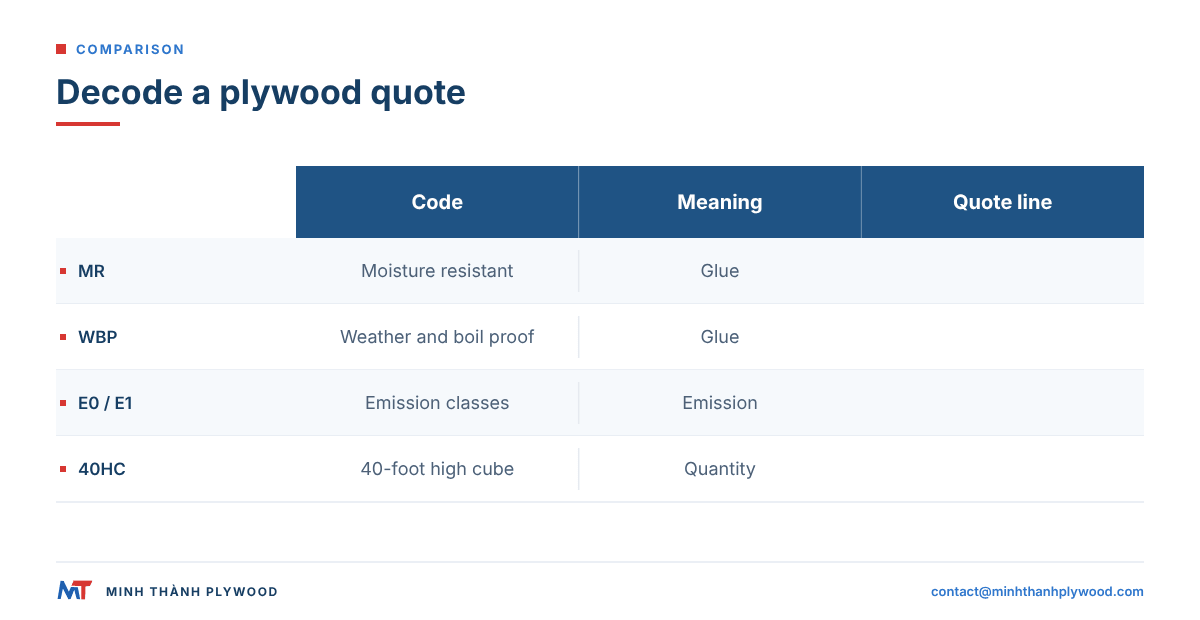
- MR glue: moisture-resistant glue, usually melamine-fortified UF.
- MUF: melamine-urea-formaldehyde, the resin behind most MR bonds.
- Multiplex: thick plywood with many plies; the Dutch word for plywood; in German, Multiplex means thick multi-ply panels.
- Okoume: a pink-brown African face veneer. See okoume plywood.
- Packing plywood: low-grade plywood for crates and pallets. See packing plywood.
- Patch: a repair in a face veneer where a defect was cut out.
- PF, phenolic glue: phenol-formaldehyde, the dark, boil-resistant exterior glue.
- Pine plywood: plywood with a pine face. See pine plywood.
- Poplar plywood: plywood with a pale poplar face. See poplar plywood.
- PS 1: the US Voluntary Product Standard for structural plywood.
- Rotary cut: veneer peeled from a turning log as one continuous sheet.
Plywood glossary S to Z
- Sanded: both faces sanded smooth and to thickness, ready for finishing.
- Sapele: a red-brown African hardwood with a ribbon figure, supplied as a face on request.
- Sliced veneer: veneer cut from a log or half log by a moving knife, as crown, quarter or rift cut.
- Stitched core: core veneers joined by stitching across and along the panel before pressing.
- Styrax: a light, white plantation hardwood used for plywood cores in northern Vietnam.
- Telegraphing: core joints or gaps showing through a thin face after finishing.
- Thin plywood: panels of 3–6 mm; 3–5 mm panels are always 5-ply. See thin plywood.
- Tolerance: the allowed difference from the nominal size or thickness, for example ±0.2 mm.
- TSCA Title VI: the US federal formaldehyde rule for composite wood products, matching CARB P2.
- UF glue: urea-formaldehyde, the standard interior glue for furniture plywood.
- UV-ready: faces sanded and prepared for the buyer’s own UV coating line.
- Veneer: a thin sheet of wood peeled or sliced from a log.
- Void: a hollow inside the panel where core veneers do not meet.
- WBP: weather and boil proof, the exterior glue class, usually phenolic.
Trade abbreviations on a plywood quote
Plywood quotes are written in abbreviations, and one line can hold six of them. The list gives the ones Minh Thanh sees most on enquiries from Europe, the Americas, Asia and Africa.
| Abbreviation | Stands for | Where it appears |
|---|---|---|
| BB/CC, BB/BB, CP | Face/back grade codes | Birch and poplar plywood |
| FF, FFP | Film-faced, film-faced plywood | Formwork offers |
| WBP | Weather and boil proof glue | Glue line |
| MR | Moisture resistant glue | Glue line |
| BWR, BWP | Boiling water resistant, boiling water proof | Indian plywood grades |
| MLH | Mixed light hardwood | Core or face species |
| UF, MUF, PF | Urea, melamine-urea, phenol formaldehyde | Resin |
| E0, E1, CARB P2 | Emission classes and limits | Emission line |
| 4x8 | 4 × 8 feet, sold as 1220 × 2440 mm | Size |
| 40HC | 40-foot high-cube container | Quantity |
| FOB, CFR, CIF | Incoterms for the delivery point | Price basis |
| B/L | Bill of lading | Payment terms |
| T/T, L/C | Bank transfer, letter of credit | Payment terms |
| MOQ | Minimum order quantity | Order terms |
US and UK buyers also write thickness in inches: 3/4 inch is sold as 18 mm, 1/2 inch as 12 mm, in metric plywood markets.
Grade codes in different markets
The same appearance has a different code in each market, and that is where most misunderstandings on a quote start. The table maps the grades Minh Thanh quotes onto the codes buyers send.
| Face | Minh Thanh grade pairs | Codes buyers use |
|---|---|---|
| Birch | D+/D, D/D, D/E | D+ close to B, D close to BB, E close to CP/C |
| Poplar | A/A, A/B, B/B | Chinese codes B/BB, BB/CC and CP |
| Pine | A/A, A/B, B/B, B/C | European classes I to IV, US A to D |
| Eucalyptus | A/A, A/B, B/B | A/A two faces seen, B/B for paint or overlay |
| Exterior and CDX type | C/D | Utility appearance |
Every grade is fixed by the buyer’s approved sample. Letters travel badly between markets; a sample does not. The face veneer grading page shows how faces are sorted.
Size, thickness and quantity terms
Size terms mix feet, millimetres and local habits. A 4x8 sheet is 1220 × 2440 mm in the metric trade; Europe also buys 1250 × 2500 mm. Thickness is nominal: an “18 mm” panel is made to 18 mm within its tolerance, ±0.2–0.3 mm for sanded furniture panels.
- Full sheet: 1220 × 2440 mm or 1250 × 2500 mm at Minh Thanh, plus custom sizes such as 1220 × 2500 mm.
- Cut-to-size: one panel cut into 4, 6 or 8 pieces.
- Thickness range: 3–40 mm.
- Pack: a strapped stack of sheets on a pallet base.
- m³: the volume unit plywood is priced in; one 40HC of 18 mm Styrax-core panels holds about 53 m³.
- Sheets per pack, packs per container: set by thickness and weight, planned on a load plan.
What these terms mean for your order
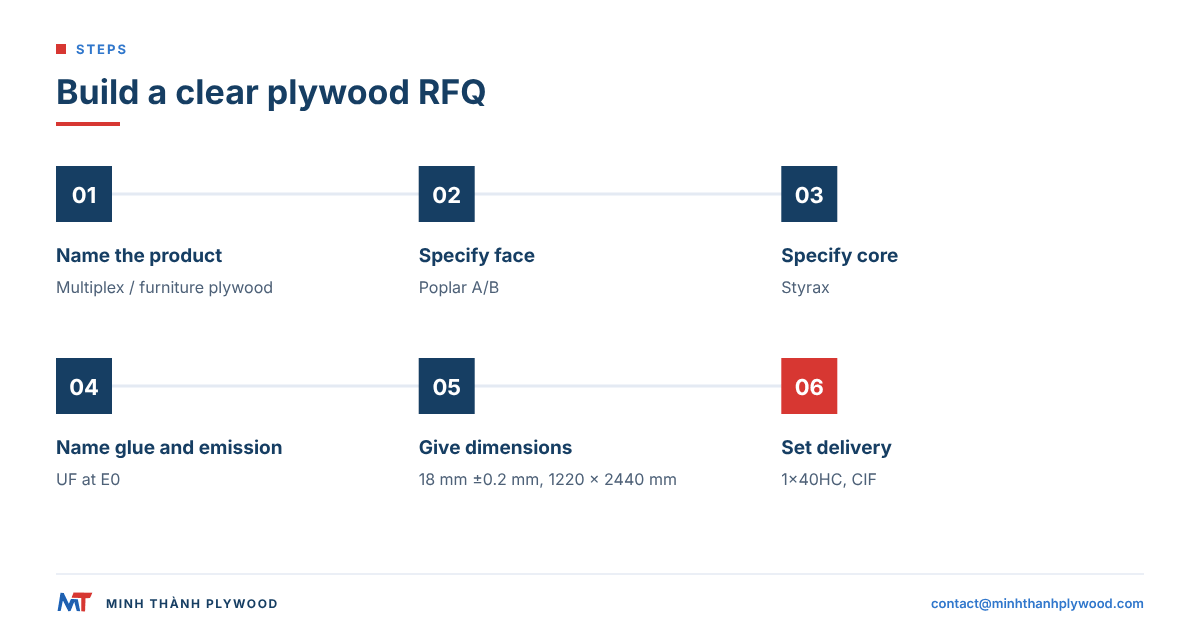
A supplier who uses the same words as you quotes the panel you want. Put every term from this glossary that applies into one line, and attach a sample for the face.
- Product name in your language and in English: multiplex / furniture plywood.
- Face species and grade pair: poplar A/B.
- Core: Styrax.
- Glue and emission: UF at E0.
- Thickness, tolerance and size: 18 mm ±0.2 mm, 1220 × 2440 mm.
- Quantity and delivery: 1×40HC, CIF.
The finished line reads: 18 mm furniture plywood (multiplex), poplar A/B, Styrax core, UF glue at E0, sanded ±0.2 mm, 1220 × 2440 mm, 1×40HC, CIF. Send it in your own language to contact@minhthanhplywood.com or ask for a quotation; free samples go out before an order.
US enquiries can also ask for the CARB P2 / TSCA Title VI documents; the limits are on the EPA composite wood page.
Buyer questions, answered
What is another name for plywood?
The common English synonyms are ply, plyboard, ply board and plywood sheet. In the trade, multiplex means a thick plywood with many plies, and shuttering ply, formply and plyform are names for concrete formwork plywood.
What is the synonym of ply?
As a material, ply is short for plywood. As a word, a ply is one layer, so a 5-ply panel has five veneer layers; layer, sheet and veneer are its synonyms in that sense.
What does multiplex mean?
Multiplex is the European name for plywood with many thin plies, usually 12 mm and thicker, often birch. In Dutch, multiplex is the everyday word for plywood; in German the general word is Sperrholz, and Multiplex means thick multi-ply panels.
What is plywood called in Spanish?
Contrachapado in Spain, triplay in Mexico, terciado or madera terciada in Chile and Argentina, and triplex in Colombia. Many Latin American buyers also simply say plywood.
What is plywood called in French?
Contreplaqué. Thick multi-ply panels are sometimes called multiplis, and film-faced formwork plywood is contreplaqué filmé.
What is plywood called in Arabic?
Khashab ablakash (خشب أبلكاش), often shortened to ablakash. Khashab raqaiqi (خشب رقائقي), laminated wood, is also used in technical writing.
Is MDF another name for plywood?
No. MDF is medium-density fibreboard, pressed from wood fibres and glue, with no veneer layers. Particleboard, chipboard, OSB and hardboard are also different panels.
What does BB/CC mean on plywood?
BB/CC is a face/back grade pair: a BB face with small patches and colour variation, and a CC back with more defects. Chinese and Vietnamese poplar plywood is often ordered by these codes.
What do WBP and MR mean?
WBP means weather and boil proof, a phenolic exterior glue. MR means moisture resistant, usually a melamine-fortified glue for humid interiors.
What is lawanit?
In the Philippines lawanit is the everyday word for hardboard, a thin fibreboard panel. It is not plywood, although it is used for similar jobs such as ceilings and partitions.