
The best types of wood for furniture depend on the part: dense hardwoods such as oak, ash and maple for frames and tops that take wear, stable plywood for carcasses, shelves and drawer boxes, and lighter woods such as poplar and pine for hidden parts and painted work. This guide sorts the main species and panels by furniture part. Minh Thanh Plywood makes furniture plywood in Vietnam.
What is the best wood for furniture?
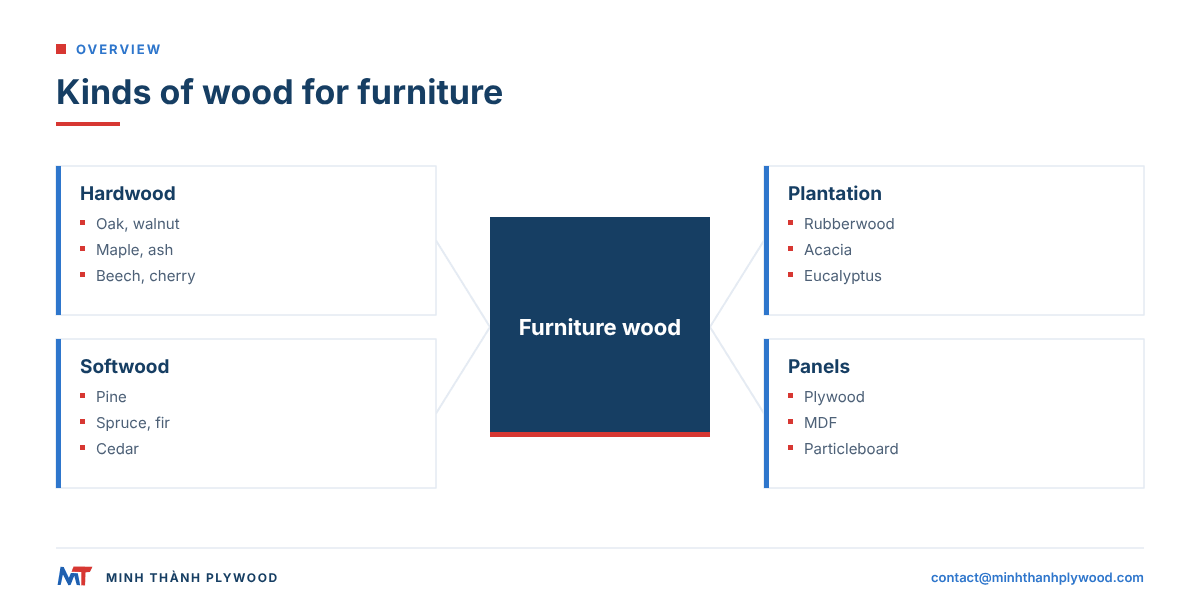
The main types of wood for furniture are hardwoods for visible solid parts, softwoods for affordable and painted pieces, and engineered panels such as plywood and MDF for carcasses, shelves and backs. Most furniture today mixes them: a solid oak top on a plywood cabinet is normal practice.
- Hardwoods: oak, walnut, maple, cherry, ash, beech, teak, acacia, rubberwood. Dense, hard, attractive grain.
- Softwoods: pine, spruce, fir, cedar. Light, cheaper, softer, good for paint and rustic looks.
- Engineered panels: plywood, MDF, particleboard, blockboard. Flat, stable, wide, and faced with veneer, paint or melamine.
The rest of this guide covers each group, then matches woods to furniture parts and explains why export furniture is built on plywood carcasses.
Kinds of wood for furniture: hardwood, softwood and engineered panels
Furniture woods fall into three kinds: hardwood from broadleaf trees, softwood from conifers, and engineered panels made from veneers, fibres or particles. The names describe botany, not hardness: balsa is a hardwood and yew is a softwood, so judge a species by its hardness and stability.
Types of wood for furniture compared
| Kind | Where it comes from | Typical furniture uses | Strength for furniture |
|---|---|---|---|
| Hardwood | Broadleaf trees: oak, maple, walnut, acacia | Frames, legs, tops, doors, chairs | Hard, dense, takes wear |
| Softwood | Conifers: pine, spruce, fir | Painted and rustic furniture, hidden frames | Light, soft, dents easily |
| Plywood | Cross-laid wood veneers glued under pressure | Carcasses, shelves, drawer boxes, backs, curved parts | Stable, holds screws, stiff across both directions |
| MDF | Wood fibres and resin pressed into a board | Painted doors, routed panels | Smooth, heavy, weak at screws and in damp |
| Particleboard | Wood chips and resin | Melamine-faced flat-pack furniture | Cost-effective, weakest in damp and at fixings |
Solid wood moves with humidity across its grain. Plywood barely moves because each veneer is glued at right angles to the next, which is why wide flat parts are usually panels.
Hardwood types for furniture: oak, walnut, maple, cherry, ash and beech
The classic hardwood types for furniture are oak, walnut, maple, cherry, ash and beech: hard enough for tops and legs, with grain worth showing under a clear finish. Janka side hardness, the force needed to press a steel ball into the wood, ranks them for wear.
| Hardwood | Janka hardness (lbf) | Look | Best furniture uses |
|---|---|---|---|
| Hickory (pecan) | about 1,820 | Pale to tan with strong colour contrast | Chairs, rustic tables, tool-handle toughness |
| Hard maple | about 1,450 | Pale, fine, even | Tops, drawer sides, kitchen furniture |
| Sapele | about 1,360 | Red-brown, ribbon figure | Cabinets, doors, veneered panels, mahogany look |
| White oak | about 1,360 | Light brown, rays on quartersawn faces | Tables, chairs, cabinets, outdoor-grade pieces |
| White ash | about 1,320 | Light, open grain like oak | Chairs, bent parts, tables |
| American beech | about 1,300 | Pale pink-brown, tight grain | Chairs, bentwood, painted or stained frames |
| Red oak | about 1,290 | Pinkish brown, open pores | Indoor tables, cabinets, flooring-style tops |
| Teak | about 1,070 | Golden brown, oily | Outdoor and indoor tables, chairs |
| Black walnut | about 1,010 | Chocolate brown | Premium tables, cabinets, veneered panels |
| Rubberwood | about 960 | Pale, fine, even | Solid parts and edge-glued panels in mass-market furniture |
| Black cherry | about 950 | Red-brown, darkens with light | Fine cabinets, beds, desks |
| African mahogany | about 850 | Pink to red-brown, darkens | Cabinets, beds, mouldings |
| Yellow poplar | about 540 | Pale with green streaks | Painted furniture, hidden parts |
Hardness values are typical published side-hardness figures for wood at about 12 % moisture, based on the USDA Forest Products Laboratory Wood Handbook (read 20 October 2026); hickory, sapele, teak, rubberwood and African mahogany follow The Wood Database species pages (pecan, sapele, teak, rubberwood, African mahogany, checked on 21 October 2026). Shagbark hickory reads higher, about 1,880 lbf. Higher is harder; a difference under about 100 lbf is not noticeable in use.
Most of these woods also come as face veneers on plywood. A walnut-faced or oak-faced panel gives the hardwood look on a stable, cost-effective sheet.
Is poplar good for furniture?
Poplar is good for furniture parts that are painted, hidden or light, and it is one of the most used woods for furniture plywood. It is soft (about 540 lbf Janka), so it is a poor choice for a bare tabletop or a chair arm that takes knocks.
Where poplar works well:
- Painted furniture: closed, even grain takes primer and paint smoothly.
- Drawer sides and backs: light and easy to machine.
- Hidden frames and rails inside upholstered furniture.
- Plywood faces and cores: poplar-faced plywood is a common furniture and interior panel.
Where to avoid it: unprotected tops, flooring-style surfaces and anything outdoors. Our poplar-faced plywood is quoted as face/back grade pairs A/A, A/B and B/B, matched to the buyer’s approved sample; see the poplar plywood page.
Softwoods in furniture: pine, spruce and fir
Softwoods such as pine, spruce and fir are used for affordable, rustic, painted and children’s furniture because they are light, cheap and easy to work. They dent more easily than hardwoods, which some buyers accept as part of the look.
- Pine: the most common softwood for furniture; knotty pine for rustic pieces, clear pine for painted work and edge-glued panels.
- Spruce: pale and light, used for frames and slats; see our spruce wood guide.
- Fir and larch: straighter and harder, used for frames and some solid furniture; see larch wood.
- Cedar: aromatic, used for chest linings and some outdoor furniture.
Pine also comes as plywood. Our pine-faced panels are quoted as A/A, A/B and B/B face/back grades against an approved sample, for furniture that shows the pine grain on a stable sheet.
Tropical and plantation woods: teak, rubberwood, acacia and eucalyptus
Tropical and plantation hardwoods such as teak, rubberwood, acacia and eucalyptus supply much of the furniture made in South-East Asia. They are dense, available in steady volumes, and suit both solid parts and panels.
- Teak: oily, very durable, the benchmark for outdoor and boat furniture.
- Rubberwood (hevea): pale, fine-textured hardwood from latex plantations, widely used for solid furniture parts and edge-glued panels.
- Acacia: hard, with strong dark grain, used for tables, chairs and outdoor furniture, and as a plywood core; see our acacia plywood guide.
- Eucalyptus: dense, fast-growing plantation wood used for solid parts, plywood faces and cores.
- Styrax: a light, pale plantation wood that makes a flat, light plywood core.
At our mill, furniture panels use white Styrax or Eucalyptus cores as standard, and Acacia and Pine cores are made on order. Reference densities are about 500 kg/m³ for Styrax, 580 kg/m³ for Acacia and 650–750 kg/m³ for Eucalyptus.
Which wood for which furniture part?
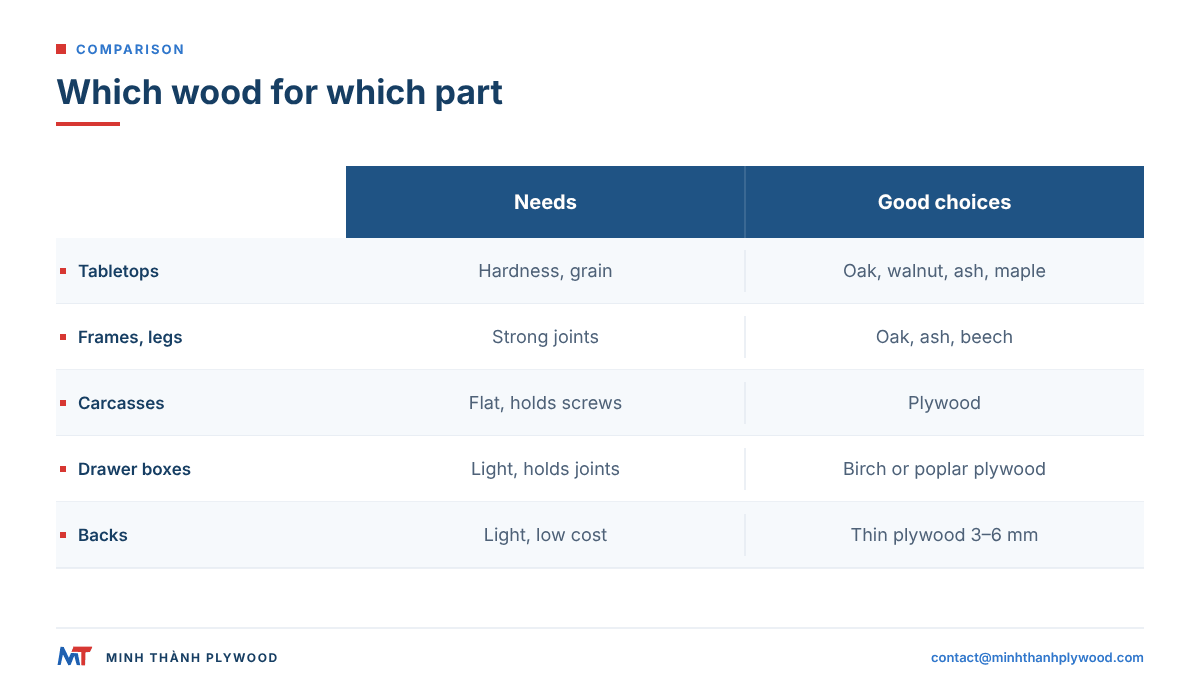
Each furniture part needs a different property: tops need hardness, frames need strength at joints, carcasses need flatness and screw holding, and backs need low cost and low weight. The table matches common woods and panels to the part.
| Furniture part | What it needs | Good choices | Avoid |
|---|---|---|---|
| Tabletops and worktops | Hardness, good grain, stability | Oak, walnut, ash, maple; veneered plywood | Soft woods left bare |
| Legs, rails and chair frames | Strength at joints | Oak, ash, beech, maple, rubberwood | MDF, particleboard |
| Cabinet carcasses | Flat, stiff, holds screws | Plywood; veneered or melamine plywood | Particleboard in damp rooms |
| Shelves | Stiffness over the span | Plywood 18 mm or thicker, solid hardwood | Thin MDF on long spans |
| Drawer boxes | Light, holds joints | Birch or poplar plywood, maple, poplar | MDF at the joints |
| Doors and fronts | Flat, good face | Veneered plywood, solid hardwood frames, painted MDF | Wide solid boards without a frame |
| Backs and drawer bottoms | Light, cost-effective | Thin plywood 3–6 mm | Fibreboard in damp areas |
| Curved parts | Bendability | Thin plywood laminated in a mould, steam-bent ash or beech | Particleboard |
For shelves, plywood stiffness depends on thickness and span; our plywood thickness guide gives the common sizes. For drawer boxes, many makers use thin multi-ply birch or poplar plywood for its clean edges.
Solid wood vs plywood vs MDF vs particleboard
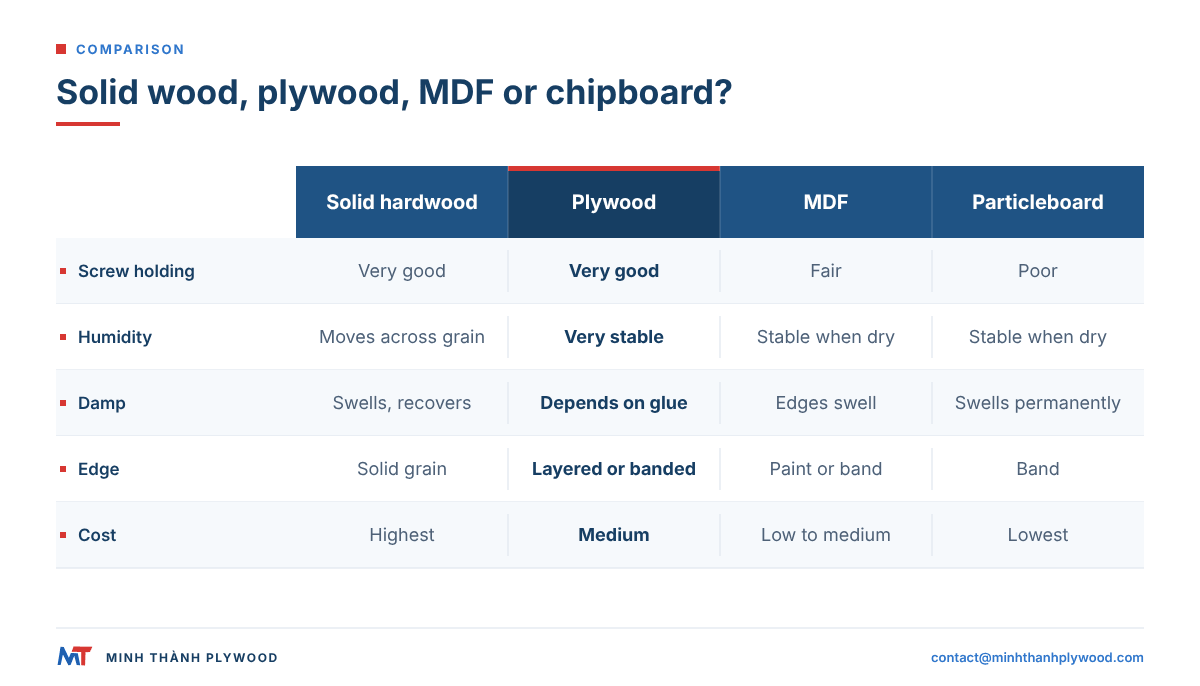
Solid wood gives the richest look and can be refinished, plywood gives the best mix of strength, stability and cost, MDF gives the smoothest paint surface, and particleboard gives the lowest cost. The table compares them on one property per row.
| Property | Solid hardwood | Plywood | MDF | Particleboard |
|---|---|---|---|---|
| Screw holding | Very good | Very good, also in edges | Fair, poor in edges | Poor |
| Stability in humidity | Moves across the grain | Very stable | Stable when dry | Stable when dry |
| Behaviour in damp | Swells, recovers | Resists better, depends on glue | Swells at edges | Swells, does not recover |
| Weight | Medium to heavy | Light to medium | Heavy | Medium |
| Wide flat parts | Needs joining and framing | 1220 × 2440 or 1250 × 2500 mm in one piece | Large sheets | Large sheets |
| Edge look | Solid grain | Layered edge, banded or shown | Must be banded or painted | Must be banded |
| Cost | Highest | Medium | Low to medium | Lowest |
The table explains the common split in good furniture: solid wood where the hand touches, plywood where strength and flatness matter. Our plywood vs MDF and particle board vs plywood guides go further.
How to identify the wood in a piece of furniture
To identify the wood in a piece of furniture, look at three things in this order: the end grain and pores, the rays and colour, and the edge that shows whether the part is solid wood, veneer or a panel. Ten minutes with a torch and a damp cloth settles most pieces.
- Open pores and rays, oak. Oak has large open pores and a coarse texture. Small dark horizontal lines on a quartersawn face are rays: white oak rays are usually at least an inch long, red oak rays about 1/2 in. Quartersawn oak shows the bright cat-eye flecks sold as tiger oak (Kray Custom Refinish identification guide, checked on 21 October 2026).
- Colour and figure. Walnut is chocolate brown with a straight or wavy grain; cherry is red-brown and darkens with light; maple is pale with a fine, even grain; sapele and mahogany are red-brown with ribbon stripes; rubberwood is pale, even and bland, and turns up in mass-market furniture made after the 1980s.
- Weight and dent test. Hickory and maple feel heavy for their size; poplar, pine and spruce feel light and dent under a fingernail.
- Solid or veneer. Look at the edge of a tabletop or door. Grain that runs continuously over the top and down the edge is solid wood. A thin line where the face grain stops, or a separate edge strip, means veneer on a core.
- Plywood, MDF or particleboard. Plywood shows thin layers with grain alternating at right angles. MDF is uniform, fine-grained brown fibre with no pattern. Particleboard shows visible wood chips of mixed size.
If you buy rather than restore, the same checks tell you what the maker used: a dense hardwood on the visible, touched parts and plywood in the carcass is the normal good build, and our furniture plywood is made for that carcass.
Why plywood carcasses dominate export furniture
Export furniture is built on plywood carcasses because plywood holds screws and knock-down fittings, survives sea freight and humid climates better than particleboard, and is lighter than MDF. A cabinet that leaves Asia in a container has to arrive flat, square and with its fittings tight.
- Shipping: furniture spends weeks at sea; typical transit from Hai Phong to Northern Europe is 30–40 days.
- Knock-down fittings: cam locks and dowels hold in plywood and pull out of weak particleboard.
- Weight: lighter carcasses cut freight cost per piece.
- Emission rules: European and US buyers require low-formaldehyde panels; furniture plywood with UF glue at E0 emission meets this.
Our furniture panels are pressed twice as standard: the core board is pressed and calibrated, then face and back are pressed on. That gives the flat, even sheet a furniture line needs, with sanded panel tolerance down to ±0.2 mm.
What wood do Vietnamese furniture factories use?
Vietnamese furniture factories mostly use plantation rubberwood and acacia for solid parts, imported hardwoods such as oak and ash for premium lines, pine for some ranges, and plywood, MDF and particleboard for panels. Plywood carcasses with veneered or laminated faces are standard for export cabinets.
- Solid parts: rubberwood and acacia from Vietnamese plantations; oak, ash and walnut imported for premium furniture.
- Panels: plywood on Styrax, Eucalyptus or Acacia cores, faced with birch, poplar, EV (engineered veneer), okoume, pine or other veneers.
- Faces: real-wood veneers for the look buyers order, or a paper or melamine face for cost-effective lines.
We supply furniture and interior plywood with more than ten face veneers, mostly EV, poplar, birch, okoume and pine, in 1220 × 2440 and 1250 × 2500 mm and cut-to-size pieces. Europe is our main market.
How to choose the right wood for a furniture project
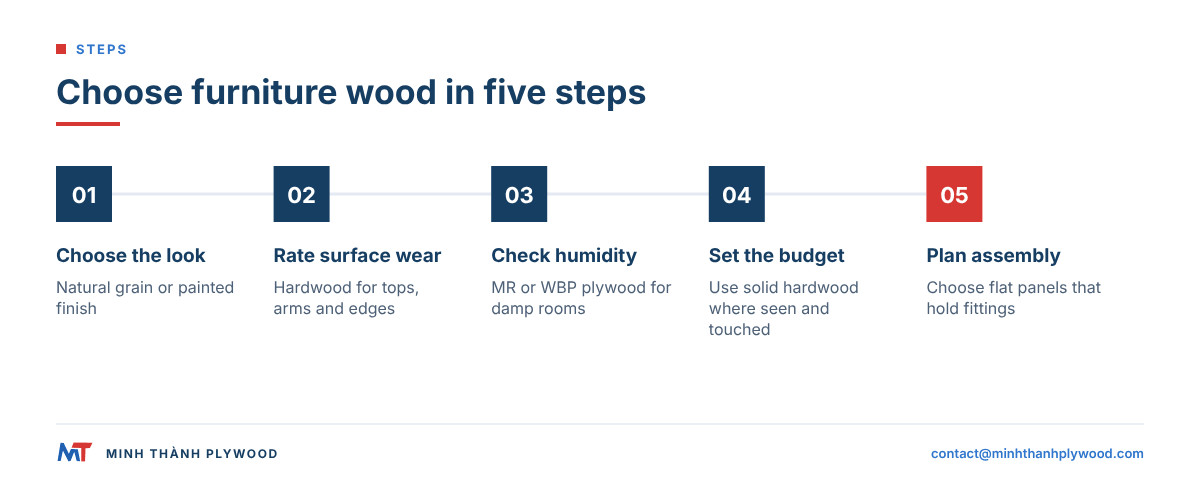
Choose furniture wood in five steps: decide the look, the wear each part takes, the room’s humidity, the budget, and how the piece will be shipped and assembled.
- Set the look: natural grain under clear finish calls for a hardwood or a veneered panel; paint allows poplar, pine or MDF.
- Rate the wear: tops, arms and edges need hard woods; hidden parts do not.
- Check the room: kitchens and bathrooms need panels with a water-resistant bond, such as MR or WBP plywood; dry rooms take standard furniture panels.
- Set the budget: put solid hardwood only where it is seen and touched.
- Plan shipping and assembly: flat-pack and export furniture need panels that hold fittings and stay flat.
For many projects the answer is a plywood body with a hardwood face, edge or frame. Our plywood for kitchen cabinets guide applies this to kitchens.
Hardness, stability and moisture: what to check
Check three numbers before you choose furniture wood: hardness for wear, moisture content for stability, and, for panels, thickness tolerance for joints and fittings. Wood that is too wet when it is made will shrink and crack in a heated room.
- Hardness: Janka side hardness, as in the hardwood table above.
- Moisture content: furniture wood and panels are normally dried to 8–12 % at dispatch; our veneers and panels are dried to this range.
- Thickness tolerance: our sanded furniture panels hold ±0.2–0.3 mm, down to ±0.2 mm, so dados, hinges and fittings line up.
- Emission: furniture panels for Europe and the US should meet the buyer’s formaldehyde limit. Our six ASTM D6007 chamber tests averaged 0.014–0.032 ppm. The CARB composite wood products programme regulates formaldehyde emissions. The US limit for veneer-core hardwood plywood is 0.05 ppm under EPA’s TSCA Title VI guidance.
These checks matter more than the species name. A well-dried poplar panel beats a wet oak board in a cabinet door.
Best wood for outdoor furniture vs indoor furniture
Outdoor furniture needs naturally durable woods such as teak, white oak, acacia, eucalyptus or larch, or thermally modified timber; indoor furniture can use almost any hardwood, softwood or panel. Standard furniture plywood and MDF are for indoor use.
- Outdoor solid wood: teak, acacia, eucalyptus, white oak, larch; oiled or finished, with water able to drain.
- Outdoor panels: exterior plywood with a phenolic WBP bond and sealed edges, for sheltered or finished parts.
- Indoor: oak, walnut, maple, cherry, beech, pine and plywood with UF glue at E0 emission.
Read best wood for outdoor furniture for garden furniture, and thermally modified wood for heat-treated timber.
What this means for your furniture plywood order
For export furniture, the plywood specification sets how the carcass, shelves and drawers perform, so send the full line with your enquiry:
- Application: carcasses, shelves, drawer boxes, doors or curved parts.
- Core: white Styrax or Eucalyptus as standard; Acacia or Pine on order.
- Glue and emission: UF glue at E0 emission for indoor furniture; MR or WBP for damp areas.
- Face and grade: birch D+/D, poplar or pine A/B, EV, okoume or other veneer, to the approved sample.
- Size and thickness: 1220 × 2440 or 1250 × 2500 mm, 3–40 mm, or cut-to-size pieces.
- Packing and quantity: from one 40HC, mixed specifications by agreement.
Production takes 15–45 days after the 30% deposit, and free samples are available. See furniture plywood from Vietnam, compare species in wood species compared, or read the pillar guide to types of wood.
Buyer questions, answered
What is the best wood for furniture?
There is no single best wood: oak, walnut, maple and ash are the best all-round hardwoods for visible solid parts, and good plywood is the best material for carcasses, shelves and drawer boxes because it stays flat and holds screws.
Is poplar good for furniture?
Yes, for painted furniture, drawer sides, hidden frames and as plywood. Poplar is light, straight-grained and machines cleanly, but it is soft, so it dents more easily than oak or maple on tops and edges.
What is the strongest wood for furniture?
Among common furniture hardwoods, hard maple, white oak and ash are among the hardest and stiffest. For panels, multi-ply hardwood plywood is the strongest common sheet material for carcasses and shelves.
Is pine good for furniture?
Pine is good for affordable, rustic and painted furniture and for children's furniture. It is soft and dents easily, so it suits pieces where a worn look is acceptable.
Is plywood real wood?
Yes. Plywood is made from real wood veneers glued in cross-laid layers, so it has wood grain on its faces and is stronger and more stable across its width than a solid board of the same thickness.
Which wood is best for a dining table?
A dining table top is usually made in a dense hardwood such as oak, walnut, ash or maple, as solid wood or as a veneered panel. The base takes the same hardwood or a cheaper painted one.
What wood is used for cheap furniture?
Cost-effective furniture usually uses particleboard or MDF with a melamine or foil face, pine, rubberwood or commercial plywood. Plywood costs more than particleboard but holds screws and resists moisture far better.
What is the best wood for kitchen cabinets?
Plywood is the preferred carcass material for good kitchen cabinets, with doors in solid hardwood, veneered panels or painted MDF. Plywood resists the damp under sinks better than particleboard.
Which wood lasts longest for furniture?
Dense hardwoods such as oak, teak and walnut last longest in solid furniture when kept dry and finished. Well-glued plywood carcasses also last for decades indoors.
Is acacia wood good for furniture?
Yes. Acacia is a dense, hard plantation wood with a strong grain pattern, used for tables, chairs, chopping boards and outdoor pieces, and as a plywood core.