
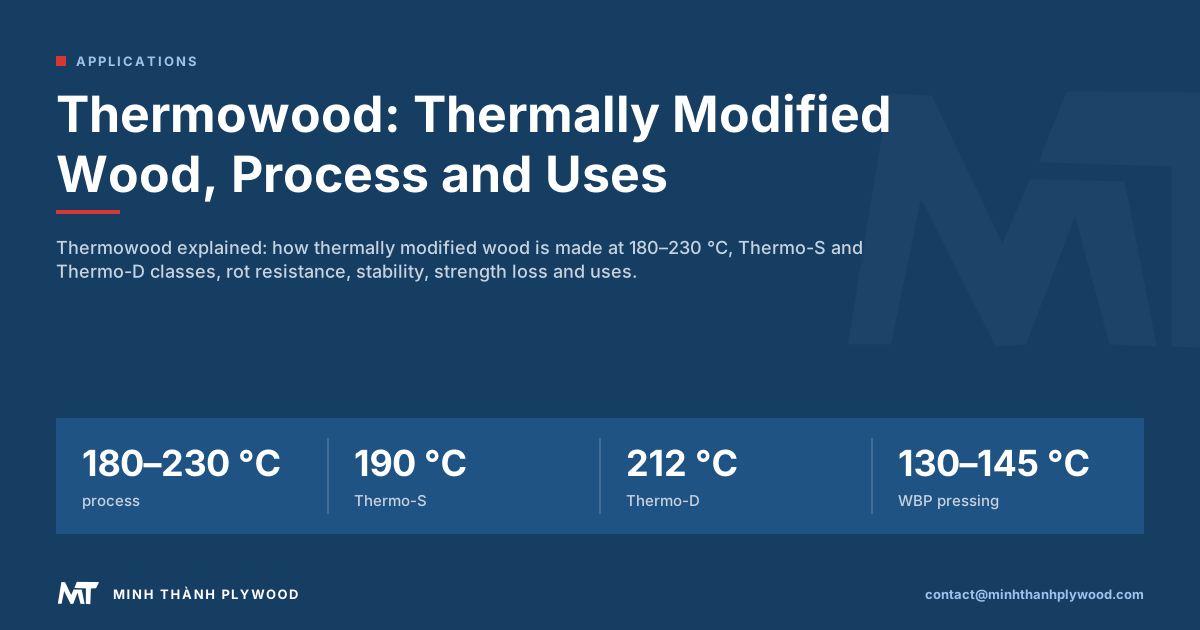
Thermowood is wood heated to about 180–230 °C in steam, without chemicals and with almost no oxygen, so it turns brown right through, absorbs less water, moves less and resists rot better. It also loses some strength and becomes more brittle. That makes it a cladding, decking and sauna material rather than a structural one. Minh Thanh Plywood makes plywood in Vietnam, including exterior panels.
Thermowood: the short answer
Thermowood is timber made more durable and stable by heat and steam alone, used for cladding, decking, saunas, windows and outdoor furniture. Heating to about 180–230 °C changes the wood’s sugars and resins, so it takes up less water and fungi cannot feed on it as easily.
- Gains: better rot resistance, less swelling and shrinking, no chemicals, an even brown colour right through.
- Losses: lower bending strength, more brittle, darker colour that greys in sunlight.
- Best uses: above-ground cladding, decking, sauna interiors, window and door parts, garden furniture.
The sections below explain how thermally modified timber is made, how it performs and where exterior plywood fits instead.
What is thermally modified wood?
Thermally modified wood is wood whose cell-wall chemistry has been changed permanently by heating it to high temperature in a low-oxygen kiln with steam or another protective gas. Nothing is added: the change comes from breaking down part of the hemicellulose that holds water and feeds decay fungi.
- Thermowood is the best-known process name, used by members of the International ThermoWood Association.
- Thermally modified timber (TMT) is the general term for heat-treated wood made by any of the industrial processes.
- Modified wood is the wider family: heat treatment, acetylation, furfurylation and resin impregnation.
The result looks like a dark tropical wood but is often pine, spruce or ash. It is lighter than before, because water and some wood substance leave the wood during treatment.
How thermowood is made, step by step
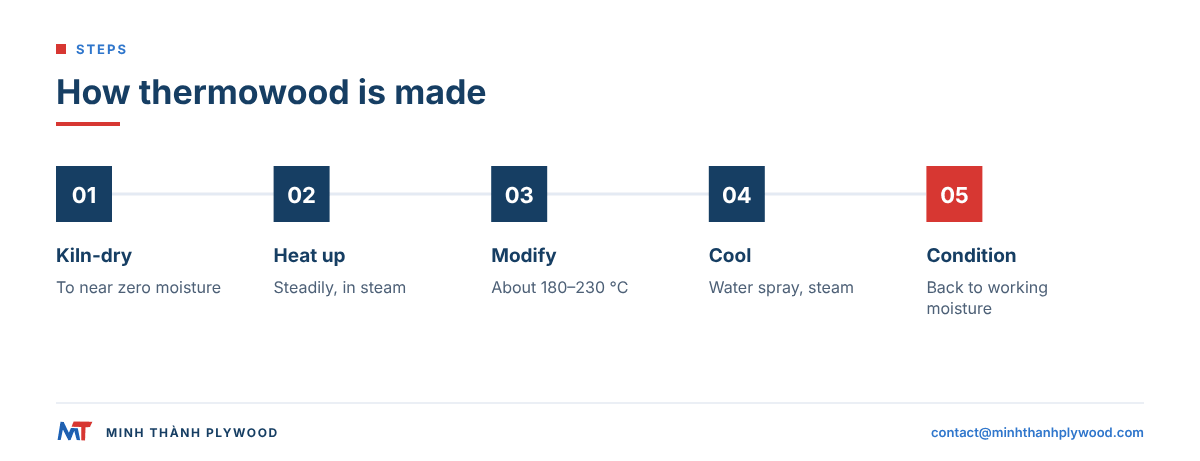
Thermowood is made in five steps: kiln-drying, heating up, the modification stage at the peak temperature, cooling, and conditioning back to a working moisture content. Steam protects the wood from burning and carries the released gases away.
- Kiln-drying: sawn timber is dried to near zero moisture inside the treatment kiln.
- Heating up: the temperature rises steadily in steam, avoiding cracks.
- Modification: the wood is held at the treatment temperature, about 180–230 °C, for a few hours; for pine and spruce, the ThermoWood process uses 190 °C for Thermo-S and 212 °C for Thermo-D.
- Cooling: water spray and steam bring the temperature down slowly.
- Conditioning: the wood is re-wetted to a moisture content suitable for machining and use.
The process is described in the ThermoWood Handbook of the International ThermoWood Association (checked on 3 November 2026). Other industrial processes use oil, vacuum or nitrogen instead of steam, at similar temperatures.
Thermo-S and Thermo-D: the two treatment classes
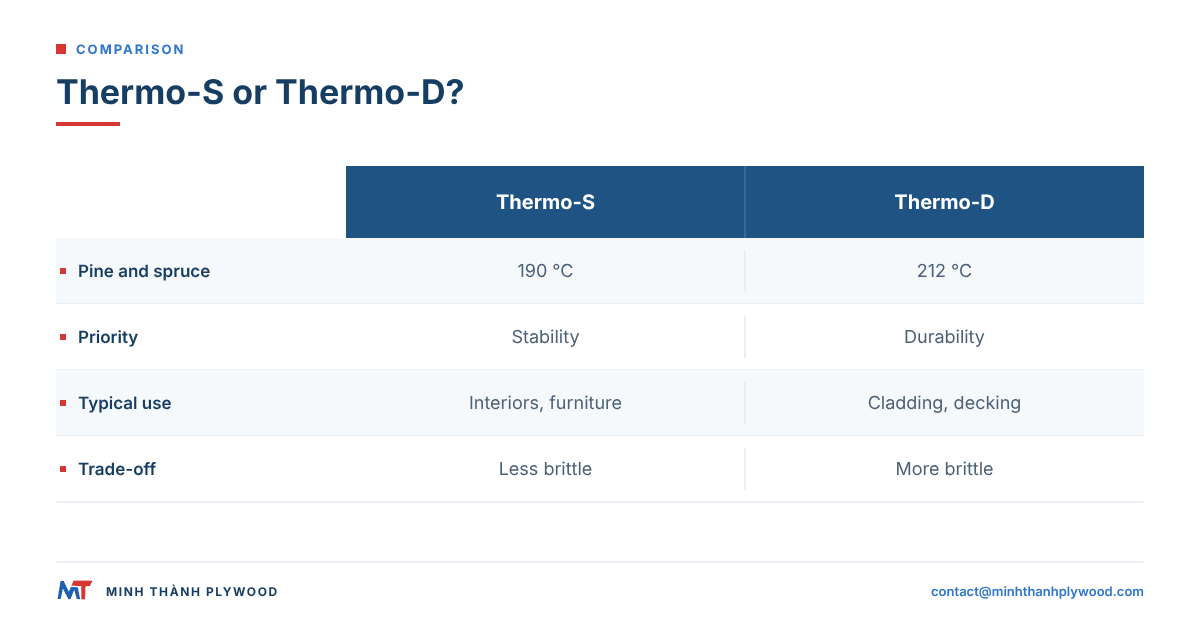
Thermo-S (stability) is treated at a lower temperature for stable indoor wood, and Thermo-D (durability) is treated hotter for decay resistance outdoors. For pine and spruce the ThermoWood process uses 190 °C for Thermo-S and 212 °C for Thermo-D. Hardwood treatment schedules vary by species.
| Class | Pine and spruce temperature | Hardwood temperature | Main property | Typical uses |
|---|---|---|---|---|
| Thermo-S | 190 °C | By species and treatment schedule | Stability | Furniture, interior panelling, doors, sauna benches |
| Thermo-D | 212 °C | By species and treatment schedule | Durability | Cladding, decking, garden structures, windows |
Thermo-D wood is darker, more stable and more decay-resistant than Thermo-S, and also more brittle. Ask which class a supplier delivers, because the same species can be either.
The class decides where the wood can go. Thermo-S pine is a good interior and furniture timber: it stays flat, does not bleed resin and machines cleanly, but it is not meant for exposed outdoor use. Thermo-D pine or spruce is the outdoor product for cladding and decking above ground. Hardwood treatment schedules vary by species; use the producer’s declared class and treatment schedule.
Other industrial heat-treatment processes use their own names and temperature steps, and some publish their results by a durability class rather than a treatment class. Compare them on the same questions: the peak temperature, the species, the durability class claimed and the test behind it, and the moisture content at delivery. A supplier that can answer all five is selling a controlled product.
Is thermowood rot resistant?
Thermowood is rot resistant above ground: Thermo-D pine and spruce are rated durable against decay fungi, close to the durability of naturally durable woods. It is not intended for ground contact, buried posts or permanently wet structures.
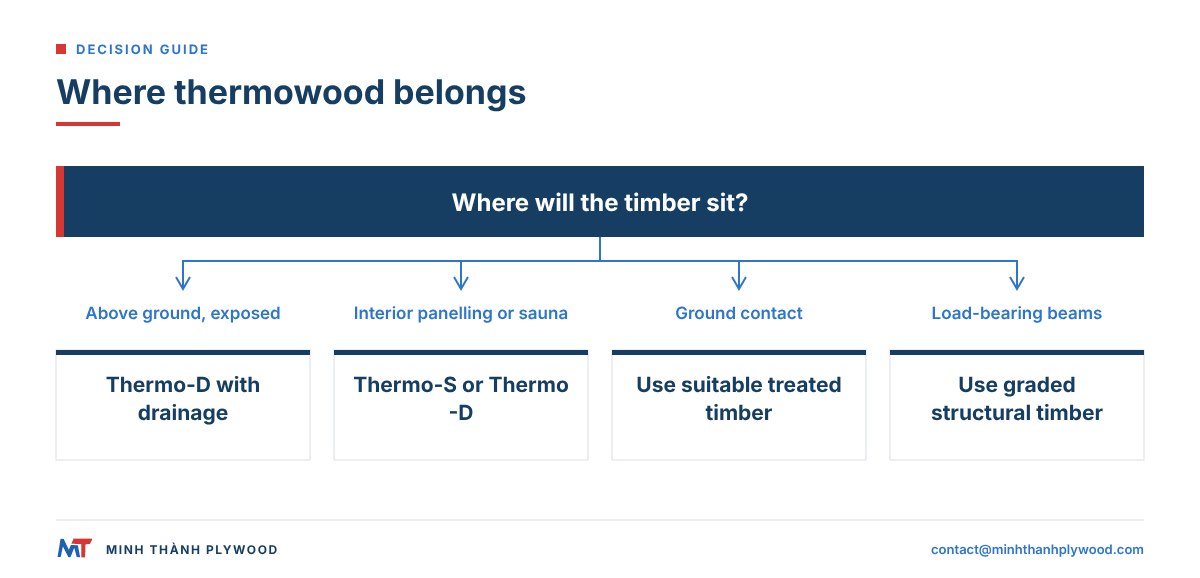
- Above ground, exposed: cladding, decking, fences, window frames.
- Not for ground contact: use pressure-treated timber or durable hardwood posts in the ground.
- Insects: heat treatment does not give reliable protection against termites.
- Detailing still matters: ventilate behind cladding and let water drain off decking.
Stora Enso’s ThermoWood factsheet classes its Thermo-D products as durability class 2 under EN 350 and suitable for use class 3 under EN 335, which is outdoor above ground (Stora Enso, checked on 21 October 2026). The BSI listing for BS EN 350:2016 gives guidance on classifying the durability of wood against wood-destroying agents, and BS EN 335:2013 defines five use classes. Decay resistance is tested in the laboratory to EN 113, whose earlier edition BS EN 113:1997 sets the test method against wood-destroying basidiomycetes. Buyers should ask for the mill’s ITWA membership and the class on the delivery paper.
Rot resistance comes from the changed chemistry, not a surface coating, so cut ends keep the same resistance as the face.
Dimensional stability and moisture
Thermally modified wood takes up much less water from the air than untreated wood, so it swells and shrinks less, cups less and holds its shape on wide boards. This is the main reason it is used for cladding and decking boards.
- Equilibrium moisture: roughly half that of untreated wood in the same climate, by the ThermoWood Handbook data.
- Swelling and shrinkage: much lower, so boards stay flatter.
- Resin: heat removes most resin, so pine stops bleeding resin; useful in saunas.
- Finishes: oils and paints stay on longer on stable wood.
Plywood gets its stability a different way: cross-laid veneers lock each other in place. Our plywood is dried to 8–12 % moisture content at dispatch, and its cross-laid structure keeps wide sheets flat.
Strength and what heat takes away
Heat treatment lowers strength: thermally modified timber has lower bending strength and is more brittle, and the loss grows with the treatment temperature. That is why thermowood is not graded for load-bearing beams, joists or rafters.
- Bending strength: reduced, more so for Thermo-D than Thermo-S.
- Brittleness: edges chip, and screws near ends can split the wood.
- Stiffness: changes less than strength.
- Hardness: similar or slightly lower.
- Weight: lower density than the original wood.
For structural members, use graded solid timber, glulam or LVL. For outdoor panels that must carry load, such as stair treads or sheathing, exterior plywood with a phenolic WBP bond is the panel option.
Which species are made into thermowood?
The main thermowood species are Scots pine and Norway spruce in Europe, plus hardwoods such as ash, birch, poplar, beech and some tropical species. The species sets the look, the hardness and the price.
- Pine (Scots pine): the volume species for cladding and decking.
- Spruce: cladding and interior panelling; see spruce wood.
- Ash: hard, attractive grain for decking and furniture.
- Birch and poplar: interior panelling and furniture; see birch wood.
- Radiata pine: a plantation softwood from New Zealand and Chile, sold in the UK as thermally modified cladding.
- Ayous (obeche): a pale West African hardwood sold as Thermo Ayous cladding, in 18 and 19 mm boards.
- Tropical hardwoods: some plantation species are treated for a darker look.
Heat treatment evens the colour, so a light softwood looks like a dark hardwood. In sunlight all thermowood turns silver-grey unless it is finished.
Uses: cladding, decking, saunas, windows and furniture
Thermowood is used where stability and durability matter more than strength: exterior cladding, decking, sauna interiors, window and door parts, garden furniture and wet-room panelling.
| Use | Class | Why thermowood works |
|---|---|---|
| Exterior cladding | Thermo-D | Stable boards, decay-resistant, no preservative |
| Decking | Thermo-D | Stays flatter, decay-resistant above ground |
| Sauna interiors | Thermo-S or Thermo-D | No resin bleed, stable in heat and steam |
| Window and door parts | Thermo-S or Thermo-D | Stable sections |
| Garden furniture | Thermo-D | Durable, chemical-free |
| Interior panelling and furniture | Thermo-S | Stable, even brown colour |
For outdoor furniture species more broadly, see best wood for outdoor furniture.
Thermowood cladding profiles and sizes
Thermowood cladding is sold in a small set of profiles, mostly 95 or 145 mm wide and 18 or 19 mm thick, in redwood (Scots pine), radiata pine and Thermo Ayous. The sizes below are the ones a UK cladding merchant lists (Ruby Timber, checked on 3 November 2026).
| Profile | Redwood (Scots pine) Thermo-D | Radiata pine | Thermo Ayous |
|---|---|---|---|
| Tongue and groove | 145 × 19 mm | 145 × 19 mm | 95 × 19 mm; 145 × 19 mm |
| Shiplap | 145 × 19 mm | 145 × 19 mm | 145 × 19 mm |
| Shadow gap | 145 × 19 mm | 145 × 19 mm | 95 × 19 mm; 145 × 19 mm |
| Planed square edge | 145 × 19 mm; 45 × 19 mm | 145 × 19 mm | 95 × 19 mm; 145 × 19 mm |
| Loglap | 95 × 19 mm | not listed | 95 × 18 mm |
| Rainscreen or slatted | 145 × 19 mm | not listed | 95 × 19 mm; 145 × 18 mm |
Widths are the cover or face width of the board. Shadow-gap and slatted profiles leave an open joint for ventilated rainscreen walls, and tongue and groove or shiplap close the joint for a continuous face.
- Order extra: add 8 to 10 % for off-cuts and site waste (Exterior Timber, checked on 21 October 2026).
- Pick the class: Thermo-D for any exterior board; Thermo-S only inside.
- Fixings: stainless-steel screws or nails, the norm for exterior timber cladding.
Thermally modified timber vs pressure-treated timber vs exterior plywood
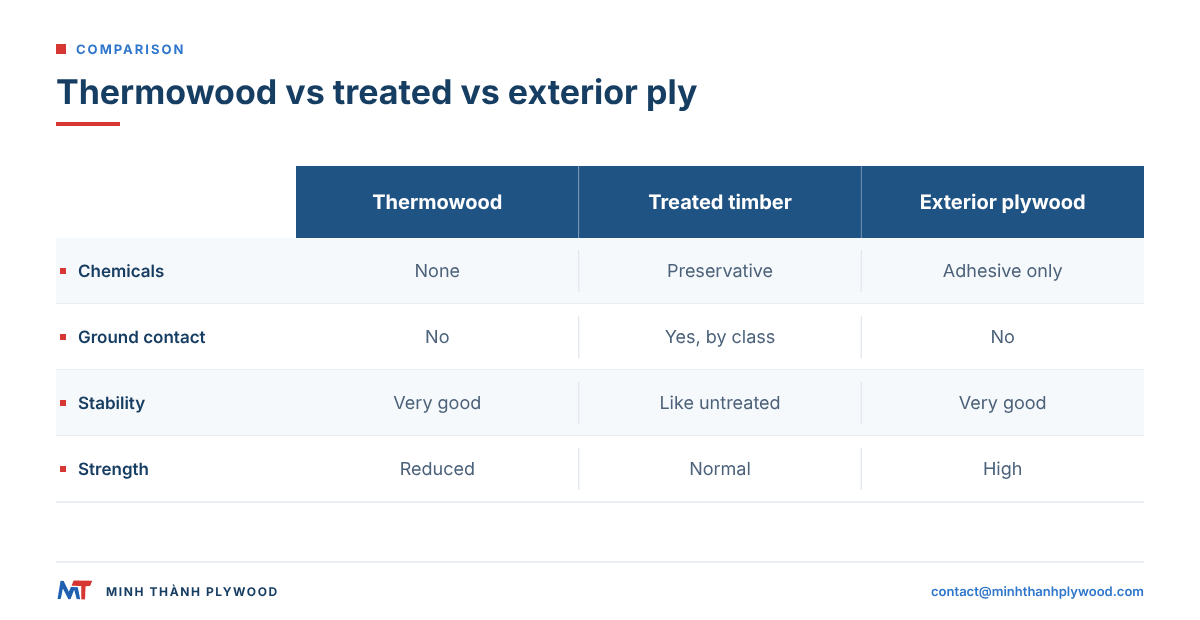
Thermally modified timber is stable and chemical-free but brittle and above-ground only; pressure-treated timber is strong and can go in the ground; exterior plywood gives wide, strong, flat panels with a weather-resistant bond. The table compares them on one property per row.
| Property | Thermally modified timber | Pressure-treated timber | Exterior plywood |
|---|---|---|---|
| How it is made | Heat and steam | Preservative forced into the wood | Cross-laid veneers with phenolic WBP or melamine glue |
| Chemicals added | None | Preservative | Adhesive only |
| Decay resistance | Good above ground | Good, incl. ground contact by class | Needs finish and sealed edges |
| Stability | Very good | Moves like untreated wood | Very good across the sheet |
| Strength | Reduced, brittle | Like untreated wood | High, in both directions |
| Format | Boards and profiles | Boards, posts, beams | Sheets 1220 × 2440 or 1250 × 2500 mm |
| Best uses | Cladding, decking, saunas | Posts, framing, fences | Sheathing, stair treads, signs, sheltered panels |
Our exterior panels use phenolic WBP glue pressed at 130–145 °C, or melamine-fortified glue pressed at 110–120 °C for humid uses. See exterior plywood for the faces and cores.
Other modified wood: acetylated and furfurylated timber
Modified wood also includes acetylated wood, treated with acetic anhydride, and furfurylated wood, impregnated with furfuryl alcohol from plant waste and cured. Both keep more strength than heat-treated wood and reach higher durability, at a higher price.
- Acetylated wood: very stable and very durable, used for windows, doors and cladding.
- Furfurylated wood: hard, dark and durable, used for decking and cladding.
- Resin-impregnated wood: hardened surfaces for floors and furniture.
- Thermally modified wood: the most widely available and usually the most cost-effective.
All modified woods aim at the same thing: durable timber from fast-growing species instead of slow-grown tropical hardwoods.
How to check a thermowood delivery
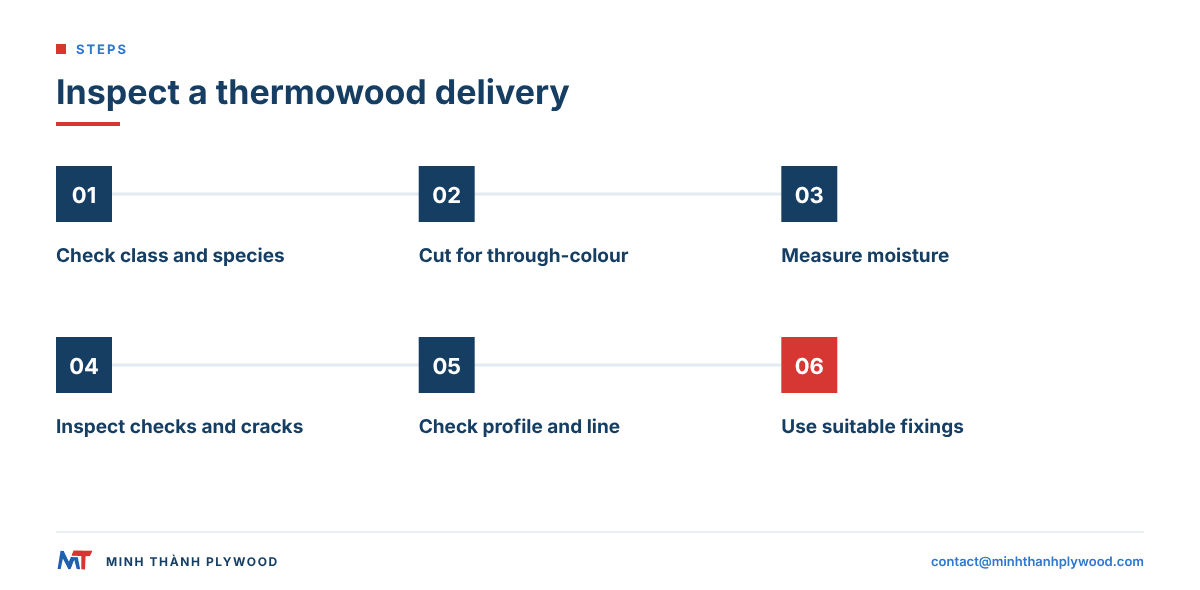
Check a thermowood delivery for treatment class, colour through the section, moisture, cracks and straightness before the boards go up.
- Class and species: Thermo-S or Thermo-D, and the species, on the delivery note.
- Colour through the section: cut a sample; the brown should go right through.
- Moisture: measure with a meter set for modified wood.
- Cracks and checks: end and surface checks from the process.
- Straightness and profile: compare with the ordered profile.
- Fixings: stainless steel screws, pre-drilled near ends.
Store boards under cover and off the ground until fitting.
What is thermo ply used for?
Thermo-ply is a trade name for thin laminated sheathing boards used in timber framing and behind insulation, not a thermally modified wood or a plywood. The name causes confusion with thermowood and with insulated plywood.
- Thermo-ply boards: thin pressure-laminated sheathing for wall bracing and as a facing behind siding.
- Insulated panels: plywood or OSB bonded to a foam core, sold as insulated or sandwich panels; see plywood thermal insulation.
- Exterior plywood: a veneer panel with a weather-resistant bond.
If the drawing or quotation names thermo ply, ask for the product data sheet to see which of these it means.
What this means for your exterior panel order
Where an outdoor job needs flat, strong sheets rather than boards, exterior plywood is the panel to specify, and the bond decides its life outdoors. Send these lines with your enquiry:
- Application: sheathing, stair treads, signs, sheltered cladding panels or packing.
- Bond: phenolic WBP for exterior exposure, melamine-fortified for humid uses.
- Faces: C/D utility faces for sheathing, selected to the approved sample.
- Core: Styrax or Eucalyptus.
- Size and thickness: 1220 × 2440 or 1250 × 2500 mm, 3–40 mm.
- Quantity and packing: from one 40HC, mixed specifications by agreement.
Production takes 15–45 days after the deposit, and free samples are available. See exterior plywood, compare woods in types of hardwood, or start at the pillar on types of wood.
Buyer questions, answered
What is thermally modified wood?
Thermally modified wood is timber heated to about 180–230 °C in a low-oxygen, steam-filled kiln, which changes the wood's chemistry so it absorbs less water, moves less and resists decay better. No chemicals are added.
Is thermowood rot resistant?
Yes, Thermo-D grade thermowood is rated durable against fungal decay above ground, which suits cladding and decking. It is not made for ground contact or for constantly wet uses.
Is thermowood stronger than normal wood?
No. Heat treatment lowers bending strength and makes the wood more brittle, so thermowood is not used for load-bearing beams. Its gains are durability and stability.
Does thermowood need treatment or finishing?
Thermowood needs no preservative. Left bare, it weathers to silver-grey in sunlight; an oil or UV-protective finish keeps the brown colour longer.
How long does thermowood last?
Well-detailed Thermo-D cladding above ground can last for decades. Life depends on detailing, ventilation behind the boards and keeping the wood off the ground.
What wood is used for thermowood?
Common species are Scots pine and Norway spruce among softwoods, and ash, birch, poplar and some tropical hardwoods among hardwoods.
What is the difference between Thermo-S and Thermo-D?
Thermo-S is treated at a lower temperature for stability, mainly for interiors and furniture. Thermo-D is treated hotter for durability, mainly for cladding, decking and other outdoor uses.
Is thermally modified wood the same as pressure-treated wood?
No. Pressure-treated wood is impregnated with preservative chemicals; thermally modified wood is changed by heat and steam only. Pressure-treated timber is stronger and can go in the ground; thermowood is more stable and chemical-free.
What is thermo ply used for?
Thermo-ply is a trade name for thin laminated sheathing and insulation-facing boards used in timber framing, not thermally modified wood. For an outdoor wood panel, exterior plywood with a phenolic WBP bond is the usual product.
Can thermowood be used for decking?
Yes. Thermo-D pine and ash are widely used for decking because they are stable and decay-resistant. Use hidden fixings or pre-drilled stainless screws, because the wood is more brittle.