
The best plywood is the panel whose face, core, glue and grade match the job, not one brand or species that wins everywhere. Furniture needs a flat, calibrated panel with a fine face and low emission; formwork needs a film face and a water-resistant bond; packing needs a cost-effective sound core. This guide gives the best choice by use, a quality test any buyer can run on a sample, and the order lines to send. Minh Thanh Plywood makes furniture, commercial and construction plywood in Vietnam.
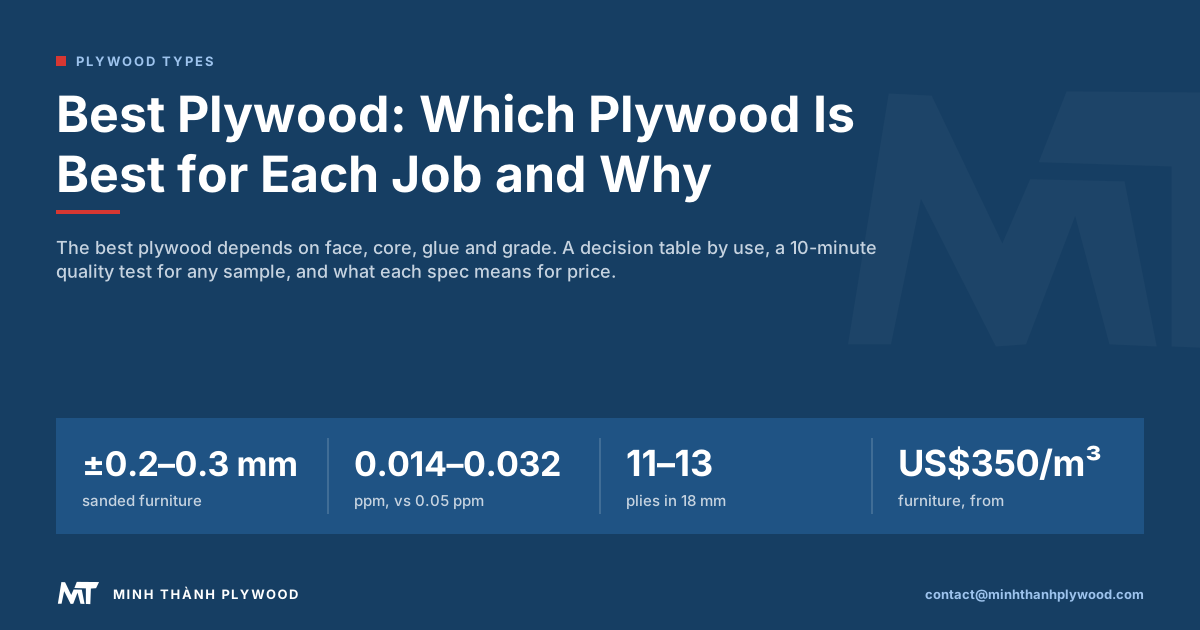
What is the best plywood?
The best plywood is the panel whose face, core, glue and grade match the job it will do. There is no single best plywood: the panel that is best for a kitchen cabinet is the wrong choice for concrete formwork, and the best formwork panel is the wrong choice for a wardrobe.
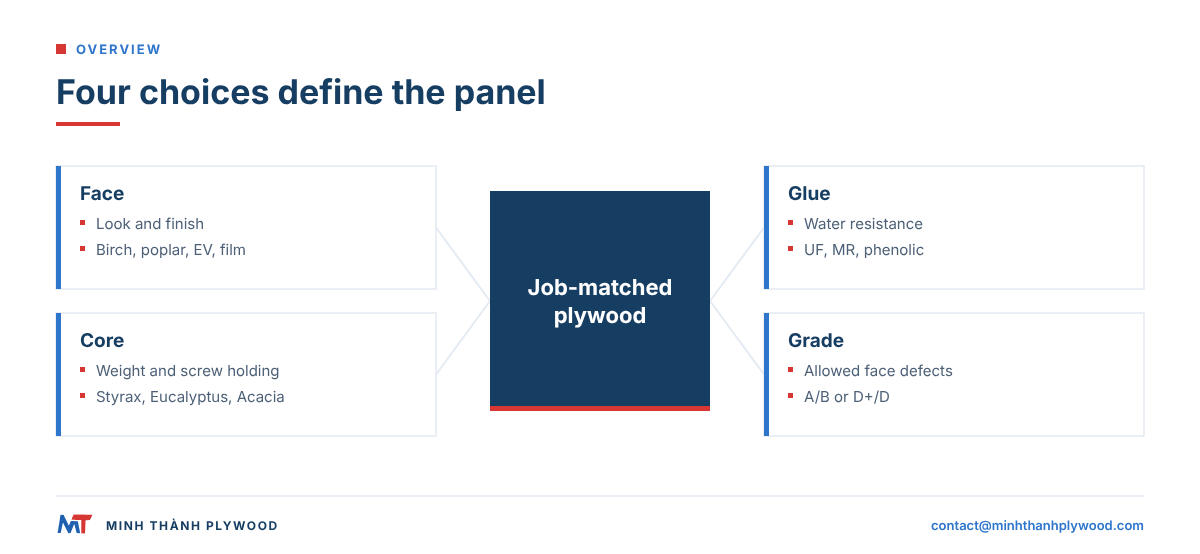
Every plywood is built from four choices:
- Face: the veneer you see, which sets the look and the finish.
- Core: the inner plies, which set weight, flatness and screw holding.
- Glue: the bond, which sets water resistance and emission.
- Grade: the allowed defects on face and back, quoted as a pair.
Ask “best for what?” first. The answer to that question fixes the four choices, and the four choices fix the price.
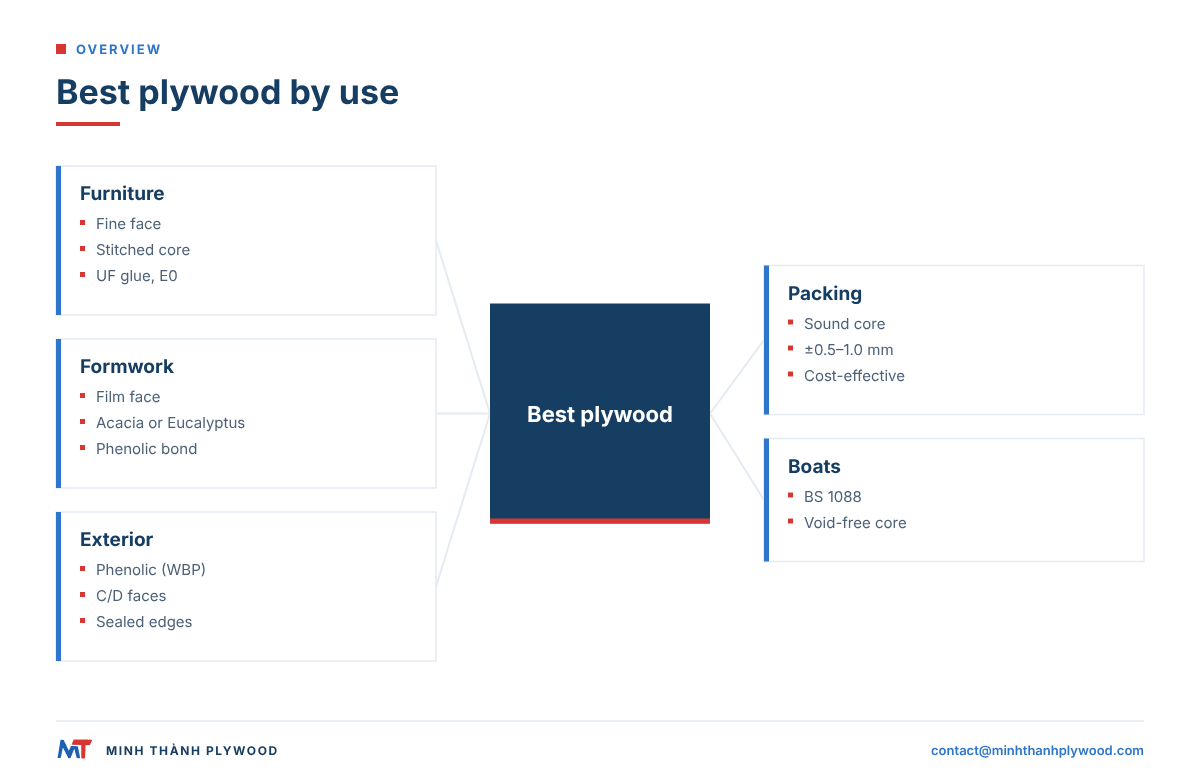
Best plywood by use: the decision table
The table gives the best plywood for the most common jobs, with the reason. Each row links to a deeper guide where one exists.
| Use | Best plywood | Thickness | Why |
|---|---|---|---|
| Furniture and cabinets | Hardwood plywood, fine face, E0 | 12–18 mm | Flat, calibrated, low emission |
| Kitchen cabinets | Hardwood plywood, MR bond; phenolic BWP-type bond near the sink and hob | 16–18 mm | Damp-resistant, holds hinges |
| Wardrobes and closets | Hardwood plywood | 16–18 mm | Stiff shelves, clean carcass, holds heavy shutters |
| Backs, drawer bottoms, light jobs | Thin hardwood plywood | 6 mm | Light, flat |
| Painted furniture | Birch, poplar or EV face | 12–18 mm | Smooth, closed face |
| Concrete formwork | Film-faced, Acacia or Eucalyptus core | 12, 15 or 18 mm | Smooth pour face, reuse |
| Roof and wall sheathing | Exterior plywood, phenolic (WBP) | By span | Holds in wet and dry cycles |
| Trailer and truck floors | Anti-slip film-faced | 18–21 mm | Wear face, grip |
| Packing and crates | Packing plywood | By load | Cost-effective, sound core |
| Boats | BS 1088 marine plywood | By hull plan | Void-free core, marine bond |
| Laser cutting and crafts | Thin birch or poplar plywood | 3–6 mm | Even face, few voids |
Thicknesses follow what Indian and international plywood makers recommend: 6 mm for light jobs, 12 to 18 mm for cabinets and wardrobes, and 16 or 18 mm for kitchens and wardrobes that carry weight (Greenply, checked 21 October 2026).
Deeper guides: best plywood for furniture, plywood for kitchen cabinets, plywood for wardrobes and closets, plywood for trailer and truck floors and best plywood for laser cutting.
Face, core, glue and grade: what makes plywood best
Plywood is best when each of its four parts is chosen for the job and made to a tight tolerance. A fine face on a hollow core still fails; a perfect core with the wrong glue still delaminates outdoors.
| Part | Choices | What it changes |
|---|---|---|
| Face | Birch, poplar, okoume, pine, engineered veneer (EV), film | Look, finish, hardness |
| Core | Styrax, Eucalyptus, Acacia, Pine | Weight, flatness, screw holding |
| Glue | UF at E0, MR or melamine-fortified, phenolic (WBP) | Water resistance, emission |
| Grade | Face/back pairs such as A/B or D+/D | Allowed knots, patches, colour |
| Build | Stitched core, double pressing, calibration | Flatness, voids, thickness |
The build row is where good and average panels part ways. A stitched, calibrated core pressed twice gives a flat panel with an even thickness; a loose core pressed once gives waves, gaps and thickness steps you only see after sanding or lacquer.
Best ply for furniture, cabinets and wardrobes
The best ply for furniture is a hardwood plywood with a fine face, a stitched and calibrated core, double pressing and UF glue at E0 emission. It stays flat, sands evenly and takes lacquer, paint, veneer or laminate.
- Face: birch, poplar, okoume or engineered veneer (EV) for visible faces; poplar under laminate or paint.
- Core: white Styrax for a light panel, Eucalyptus for a harder, stiffer one.
- Thickness: 18 mm for carcasses, shelves and wardrobe sides; thin 3–6 mm for backs and drawer bottoms.
- Plies: 18 mm furniture plywood usually has 11–13 plies.
- Tolerance: sanded panels within ±0.2–0.3 mm, so edges line up and hinges fit.
- Moisture: 8–12 % at dispatch, the normal range for furniture plywood.
- Bond for kitchens and bathrooms: MR or melamine-fortified where steam and splashes reach the carcass.
For which ply is best for a wardrobe: 18 mm hardwood plywood for the carcass and shelves, a back of 4–6 mm, and an MR bond in humid climates. Our guide to best plywood for furniture compares faces in more depth.
Best plywood for construction and shuttering
The best plywood for concrete shuttering is film-faced plywood on a dense Acacia or Eucalyptus core with a water-resistant melamine or phenolic bond. The film gives a smooth concrete face and protects the panel through repeated pours.
- Film: a phenolic film, brown or black, pressed onto both faces.
- Core: Acacia or Eucalyptus, dense enough to resist nail and tie damage.
- Bond: melamine-fortified or phenolic; phenolic gives more reuses.
- Tolerance: film-faced panels within ±0.5 mm.
- Edges: sealed with paint to keep water out.
Reuse depends on handling as much as on the panel: release agent, edge sealing, cleaning and storage decide how many pours a panel lasts. Our film-faced plywood page lists the build, and types of plywood places it among other construction panels.
Best plywood for exterior and wet areas
The best plywood for outdoor and wet use has a phenolic (WBP) bond, sealed edges and a coating; the face species matters less than the glue. Exterior plywood with C/D faces is the cost-effective choice for sheathing, stair treads and hidden outdoor parts.
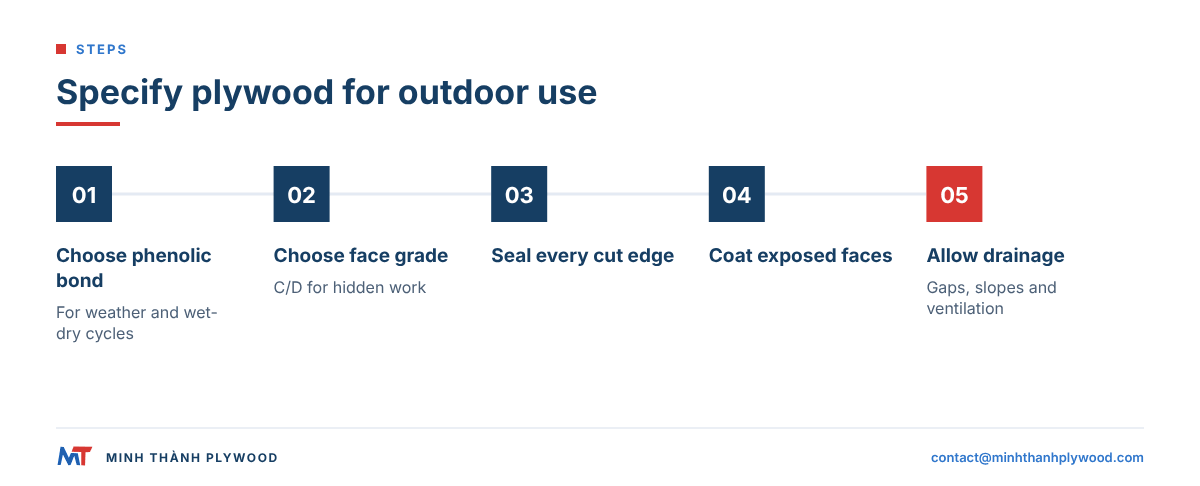
- Pick the bond: phenolic (WBP) for weather and wet-dry cycles; MR for damp interiors only.
- Pick the face: utility C/D faces for hidden work; a better face only where it shows.
- Seal the edges: primer or paint on every cut edge before fixing.
- Coat the faces: paint, stain or film for parts in the weather.
- Detail for drainage: gaps, slopes and ventilation so water does not sit on the panel.
Marine plywood is for boats and parts that stay wet; for most outdoor building work exterior plywood is enough. Our guide to whether plywood is waterproof explains the bond classes. The standard for plywood bonding quality is EN 314-2, and EN 636 covers plywood for dry, humid or exterior conditions.
Best plywood for trailer floors, packing and crates
For trailer and truck floors the best plywood is anti-slip film-faced plywood or a phenolic-bonded hardwood plywood with sealed edges; for packing and crates it is a cost-effective packing plywood with a sound core. Both jobs need strength, not looks.
| Job | Best panel | Key spec |
|---|---|---|
| Trailer and truck floors | Anti-slip film-faced | Wear face, phenolic or melamine bond |
| Van floors | Film-faced or anti-slip | Light core, grip face |
| Export crates | Packing plywood | Sound core, tolerance ±0.5–1.0 mm |
| Pallet tops and skids | Packing plywood | Cost-effective, heat-treated not needed for plywood |
| Heavy machine crates | Commercial plywood, thicker | Stiffness, screw holding |
Packing plywood is a manufactured panel, so it does not need the heat treatment that solid-wood packing requires under the ISPM 15 standard. See our packing plywood and anti-slip plywood pages.
Best ply board for laser cutting, crafts and thin parts
The best ply board for laser cutting and crafts is a thin hardwood plywood with an even face, a void-free core and a glue that the laser cuts cleanly, usually birch or poplar in 3–6 mm. Voids in the core leave uncut spots; a dense glue line leaves dark edges.
- Thickness: 3, 4, 5 and 6 mm are the common laser sheets.
- Build: our thin plywood is always 5-ply; 3 mm has one core veneer, two cross-band veneers and two faces.
- Face: birch for a pale engraving contrast; poplar for a lighter, cost-effective sheet.
- Flatness: a flat sheet keeps the focus height constant across the bed.
- Size: cut-to-size pieces from one panel into 4, 6 or 8 parts fit smaller laser beds.
See our thin plywood and cut-to-size plywood pages.
What is the best quality plywood? Signs of a good panel
Good-quality plywood is flat, even in thickness, free of core voids, firmly bonded and true to its approved face sample. These five signs show on any sheet in a few minutes, before any test report.
| Sign | Good panel | Poor panel |
|---|---|---|
| Thickness | Within ±0.2–0.3 mm on sanded furniture panels | Steps of a millimetre across the sheet |
| Edge | Tight plies, no gaps or overlaps | Holes, gaps, overlapped core veneers |
| Face | Even colour, sanded, grade as sample | Patches, sanding through, open splits |
| Flatness | Lies flat on a level stack | Bows, twists or waves |
| Bond | Plies hold when levered with a chisel | Plies split along the glue line |
These signs come from how the panel was built. Core veneers laid tight and stitched, a calibrated core and a second pressing for face and back remove most of the faults in the right-hand column.
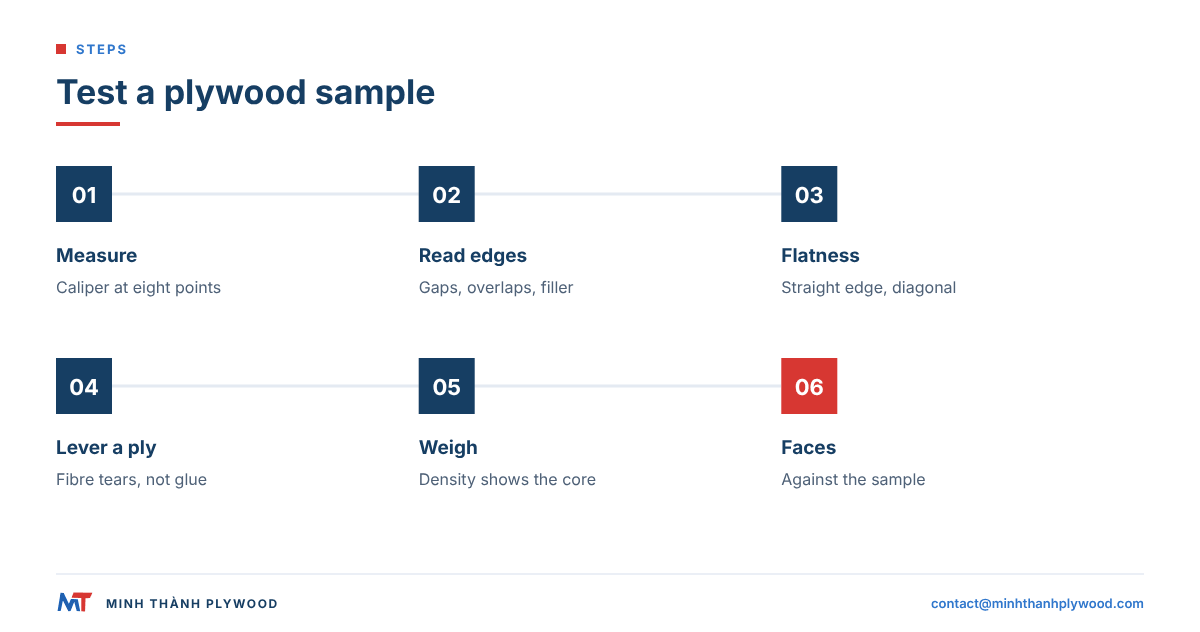
Quality checklist: test any plywood sample in 10 minutes
Any buyer can check a plywood sample with a caliper, a straight edge, a chisel and a scale. Run these steps on every sample and on the first pallet of every order.
- Measure thickness with a caliper at eight points around the sheet; the spread shows the tolerance.
- Read the edges on all four sides; count the plies and look for gaps, overlaps and filler.
- Check flatness with a straight edge across the diagonal and on a level surface.
- Lever a ply at the edge with a chisel; wood fibre should tear, not a clean glue line.
- Weigh the sheet and divide by its volume; a density far from the core species points to a different core.
- Inspect both faces against the approved sample in daylight: knots, patches, colour, sanding.
- Soak or boil a strip to the bond class you ordered when the panel is for damp or outdoor use.
- Ask for papers: the emission report, the glue type and the grade pair on the invoice.
For a whole-order inspection, our guide to exterior plywood grades shows how face grades are accepted or rejected.
What is the best type of plywood: hardwood, softwood or engineered face?
Hardwood plywood is the best type for furniture, cabinets and interiors; softwood plywood is the cost-effective type for sheathing, roofing and packing; film-faced plywood is the best type for formwork. Each type follows from its face and core.
- Hardwood plywood: birch, poplar, okoume, eucalyptus or engineered veneer (EV) faces on hardwood cores; flat and fine-faced.
- Softwood plywood: pine faces, often on pine or mixed cores; lighter, more knots, good for building.
- Engineered veneer (EV): reconstituted veneer with an even colour and grain, sheet after sheet.
- Film-faced: a phenolic film over a hardwood core, made for concrete.
Our guides to hardwood vs softwood plywood and what wood plywood is made from cover the species in detail.
Glue and emission: E0, CARB P2 and WBP
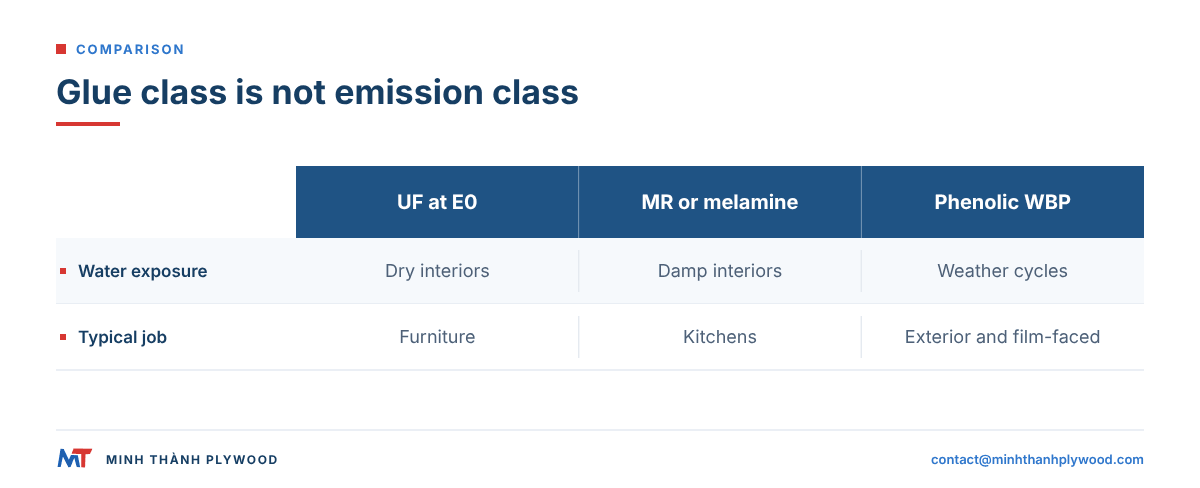
Glue type and emission class are two separate specifications, and the best plywood names both. The glue sets water resistance; the emission class sets how much formaldehyde the panel releases indoors.
| Glue | Water resistance | Typical use |
|---|---|---|
| UF at E0 emission | Dry interiors | Furniture, cabinets, wall panels |
| MR or melamine-fortified | Damp interiors | Kitchens, bathrooms, formwork |
| Phenolic (WBP) | Weather, wet and dry cycles | Exterior, film-faced, marine |
For indoor panels sold in the United States, the limit for veneer-core hardwood plywood is 0.05 ppm under CARB Phase 2 and TSCA Title VI (EPA formaldehyde emission standards). Our panels are CARB P2 / TSCA Title VI certified (ICTT mill no. 23024), and six ASTM D6007 chamber tests between April 2025 and June 2026 averaged 0.014–0.032 ppm.
Best plywood in India: grades and marks to check
For the best plywood in India, judge the panel by its Indian Standard grade, its glue class and the checks above, not by brand advertising. The Bureau of Indian Standards publishes the grades that Indian buyers ask for.
- IS 303: general-purpose plywood, covering the MR (moisture-resistant) and BWR (boiling water resistant) grades.
- IS 710: marine plywood, the BWP (boiling water proof) grade for boats and wet use.
- MR: urea-formaldehyde bond for dry and slightly damp interiors.
- BWR: the budget choice for kitchens and bathrooms. Makers’ guides describe an 8 hour boiling test for BWR and 72 hours for BWP, so BWR suits splash zones and BWP suits permanent wet.
- BWP: phenolic bond for kitchens near the sink, bathrooms, exterior and marine use.
- Gurjan: a dense Southeast Asian hardwood used for cores in Indian plywood, sold as “Gurjan plywood”. Ask whether a panel has a 100% Gurjan core or a mixed hardwood core, because the price should match the claim.
- Calibrated plywood: sanded to an even thickness for modular furniture.
Vietnamese panels make the same choices with different cores: white Styrax and Eucalyptus for furniture, Acacia and Eucalyptus for film-faced, phenolic (WBP) glue for BWP-type performance and melamine-fortified (MR) glue for the moisture-resistant grade. Ask for the core species and the bond test in writing.
The same rule holds everywhere: compare offers on one specification, ask for test reports, and check a sample with the 10-minute test.
Best plywood brands: what to compare
A plywood brand is worth choosing when its published specification beats the others on the same six lines, not when it has the most advertising. Top-brand lists compare reputation; a buyer should compare the panel. Whatever brands are on your shortlist, put each through this table.
| Criterion | What to ask | A good answer |
|---|---|---|
| Core species | Which species, and is it pure or mixed? | Named species in writing, such as Styrax, Eucalyptus, Acacia or Gurjan, with “100%” or “mixed” stated |
| Standard mark | Which grade and mark? | IS 303 (MR, BWR), IS 710 (BWP marine), EN 636 or BS 1088 as the order needs |
| Emission | E0 or E1, with a report? | A chamber test report: our CARB P2 / TSCA Title VI file, ICTT mill no. 23024 |
| Calibration | Thickness tolerance by line? | ±0.2–0.3 mm sanded furniture; ±0.5 mm film-faced |
| Bond test | Boil or soak test result for the grade ordered? | A report for the build you are buying, not a generic leaflet |
| Warranty and samples | What is covered, and do samples ship free? | Written terms and a free sample you can test with the checklist above |
Brands that publish every line are rare. A brand that answers four of the six is a safe shortlist; one that answers two is selling a name.
Who sells the best plywood? How to choose a manufacturer
The best plywood comes from a manufacturer that publishes its specification and backs it with tests, samples and photos of real production. Price comparisons only mean something once two offers describe the same panel.
Questions to ask any plywood manufacturer, in Vietnam or elsewhere:
- Do you make the panel yourselves? Ask for factory photos and video of your order.
- What is the thickness tolerance by line? Furniture, commercial, film-faced and packing differ.
- Which glue and which emission class? Two lines, each with a test report.
- How is the core built? Stitched, calibrated, pressed once or twice.
- Which certificates do you hold? Numbers you can check, not logos.
- Will you send free samples? A sample is a low-cost test of a supplier.
Minh Thanh Plywood answers these on every quote: 50,000+ m³ per year of our own production, CARB P2 / TSCA Title VI and ISO 9001:2015 held, and every shipment photographed and filmed before loading.
Price vs quality: when the best is too much
Plywood is good value when it is the cheapest panel that meets the job’s specification, not the most expensive panel on offer. Paying for marine glue, top face grades or ±0.2 mm calibration where the job does not need them only raises the cost.
| Spec choice | Pay for it when | Skip it when |
|---|---|---|
| Top face grade (A/A, D+/D) | Both faces show | One face is hidden or laminated |
| Phenolic (WBP) bond | Outdoor or wet use | Dry interior furniture |
| Calibration to ±0.2 mm | Modular furniture, CNC | Packing and hidden parts |
| Double pressing | Lacquered or laminated faces | Packing crates |
| Marine grade | Boats and permanently wet parts | Any dry or covered use |
As a guide, commercial plywood starts from US$250/m³ and furniture and interior plywood from US$350/m³ (October 2026); face, core, glue, thickness, size, quantity and delivery term set the final price.
Mistakes that make good plywood fail
Most plywood failures come from using the right panel the wrong way. These mistakes ruin even the best plywood.
- Interior glue outdoors: a UF-bonded panel left in the rain delaminates.
- Unsealed edges: water enters through cut edges first.
- Wrong storage: panels stacked on a wet floor or in sun bow and stain.
- Ordering by top face only: the back grade decides how half of your parts look.
- Comparing prices on different specs: a cheaper offer is often a different core, glue or tolerance.
- Skipping the sample: the first pallet should match a sample you approved.
What to put in your request
To get the best plywood for your job quoted correctly, send these six lines with your enquiry:
- Application: furniture, cabinets, formwork, exterior, packing or another use.
- Core: white Styrax, Eucalyptus, Acacia or Pine.
- Glue and emission: UF glue at E0 emission, MR or melamine-fortified, or phenolic (WBP).
- Face and grade: species and face/back grade pair, or an approved sample.
- Size and thickness: 1220 × 2440 or 1250 × 2500 mm, 3–40 mm, tolerance needed.
- Packing and quantity: from one 40HC, mixed specifications by agreement, and the destination port.
We reply within hours, production takes 15–45 days after the 30% deposit, and samples are free. See our furniture and interior plywood range to start.
Buyer questions, answered
Which plywood is best?
The best plywood is the one built for your job: a fine-faced, calibrated E0 panel for furniture, a film-faced panel with a water-resistant bond for formwork, a phenolic (WBP) panel for exterior use, and a sound, cost-effective core for packing.
What is the best quality plywood?
Good-quality plywood has a tight thickness tolerance, no core voids at the edges, a glue bond that passes its test, a flat panel and an even face that matches the approved sample. For furniture, look for ±0.2–0.3 mm on sanded panels.
Which plywood is best for furniture?
A hardwood plywood with a fine face such as birch, poplar, okoume or engineered veneer, a stitched and calibrated core, double pressing and UF glue at E0 emission. It stays flat, sands evenly and takes paint, lacquer or laminate.
Which ply is best for a wardrobe?
An 18 mm hardwood plywood for carcasses and shelves, with a moisture-resistant (MR) bond in humid climates and a face that suits the finish: birch or engineered veneer for clear or painted faces, poplar under laminate.
What is the best plywood for construction?
For concrete formwork, film-faced plywood on an Acacia or Eucalyptus core with a melamine or phenolic bond. For sheathing, roofs and outdoor parts, exterior plywood with a phenolic (WBP) bond and C/D faces.
What is the best plywood for shuttering?
Film-faced shuttering plywood with a dense hardwood core and a phenolic or melamine bond gives the most reuses. The number of reuses depends on film weight, edge sealing, release agent and handling on site.
What is the best plywood for trailer floors?
Anti-slip film-faced plywood or a phenolic-bonded hardwood plywood, usually 18–21 mm, with sealed edges. The dense core holds fixings and the wear face resists forklift wheels and wet loads.
Is hardwood plywood better than softwood plywood?
For furniture and cabinets, yes: hardwood plywood is flatter, harder and finishes better. Softwood plywood such as pine is lighter and cost-effective for sheathing, roofing and packing, where appearance matters less.
Is the most expensive plywood the best?
No. Marine plywood costs most but is wasted inside a dry wardrobe. Pay for the face, glue and tolerance the job needs; a commercial panel is the right choice for hidden parts and packing.
Who sells the best plywood?
A manufacturer that publishes its tolerances, glue types, emission tests and grade rules and sends free samples. Ask for the test reports and a sample before price, then compare offers on the same specification.