
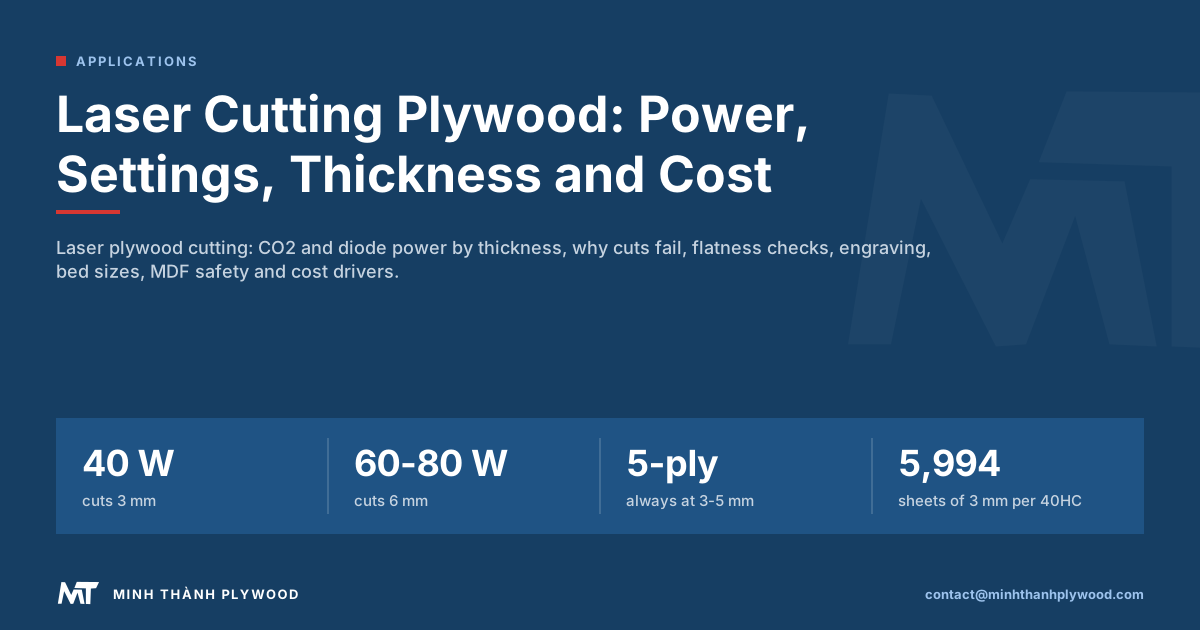
Laser cutting plywood works best with a CO2 laser: 40 W cuts 3 mm in one pass, 60-80 W cuts 6 mm, and 100-150 W reaches 9-12 mm. Diode lasers cut thin plywood in several passes. Most failed cuts come from the sheet, not the machine: glue lines, core gaps and warped panels stop the beam. Minh Thanh Plywood explains the power, the settings and the panel to order.
What laser power cuts plywood, by thickness?
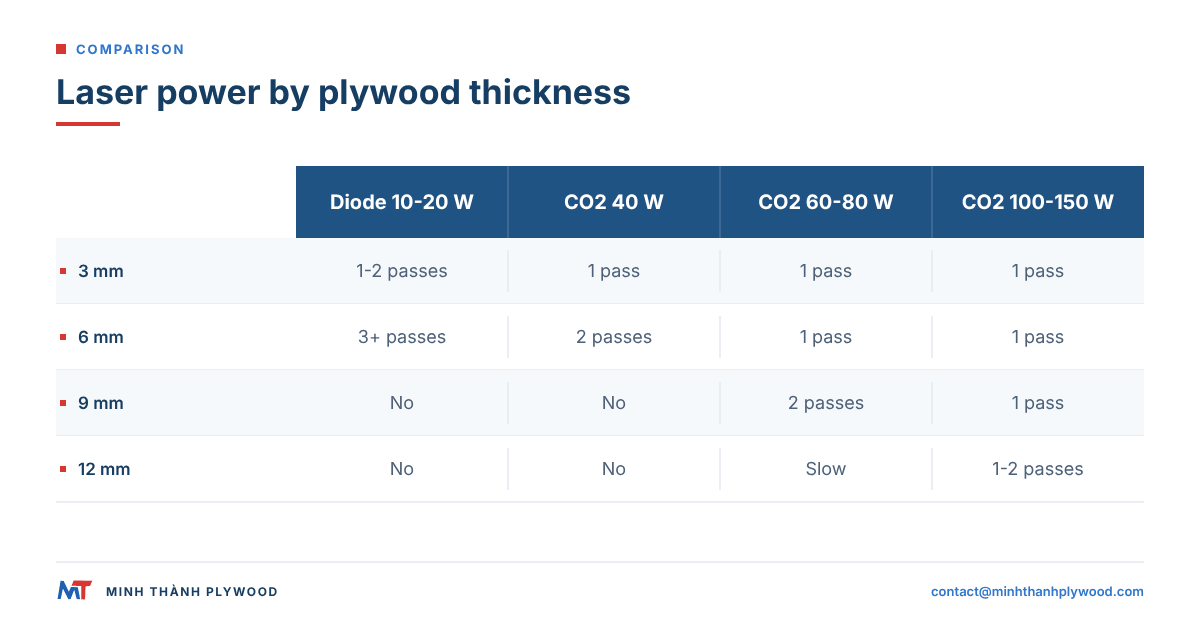
A 40 W CO2 laser cuts 3 mm plywood in one pass, a 60-80 W CO2 laser cuts 6 mm, and a 100-150 W CO2 laser reaches 9-12 mm. Diode lasers, rated by optical output, cut the same sheets in several slower passes and are practical up to about 6 mm.
| Plywood thickness | Diode laser (optical output) | CO2 40 W | CO2 60-80 W | CO2 100-150 W |
|---|---|---|---|---|
| 3 mm | 1-2 passes at 10-20 W | 1 pass | 1 pass, fast | 1 pass, very fast |
| 4-5 mm | 2-3 passes at 10-20 W | 1-2 passes | 1 pass | 1 pass |
| 6 mm | 3+ passes at 20 W | 2 passes | 1 pass | 1 pass |
| 9 mm | Not practical | Not practical | 2 passes | 1 pass |
| 12 mm | Not practical | Not practical | Slow, multiple passes | 1-2 passes |
| 15-18 mm | Not practical | Not practical | Not practical | Slow; CNC router is better |
These are typical starting points from laser makers’ material libraries for good laser-grade plywood; a panel with voids or hard glue lines needs more power or more passes. Above 12 mm, a CNC router cuts faster and with square edges.
Which laser cutter is best for plywood: CO2, diode or fibre?
A CO2 laser is the best laser cutter for plywood. Its 10.6 micron wavelength is absorbed strongly by wood, so it cuts thicker sheets in one pass with a narrow kerf.
- CO2 (glass or RF tube). Cuts and engraves plywood, MDF, acrylic and paper. The standard for laser studios and product makers.
- Diode. Low cost and compact; excellent for engraving and thin sheets, slow on anything over 3 mm.
- Fibre. Built for marking and cutting metals; its wavelength is poorly absorbed by wood, so it is the wrong tool for cutting plywood.
For a business cutting plywood every day, a 60-100 W CO2 machine with a bed that takes the sheet size you buy is the usual choice.
Why does plywood char or not cut through?
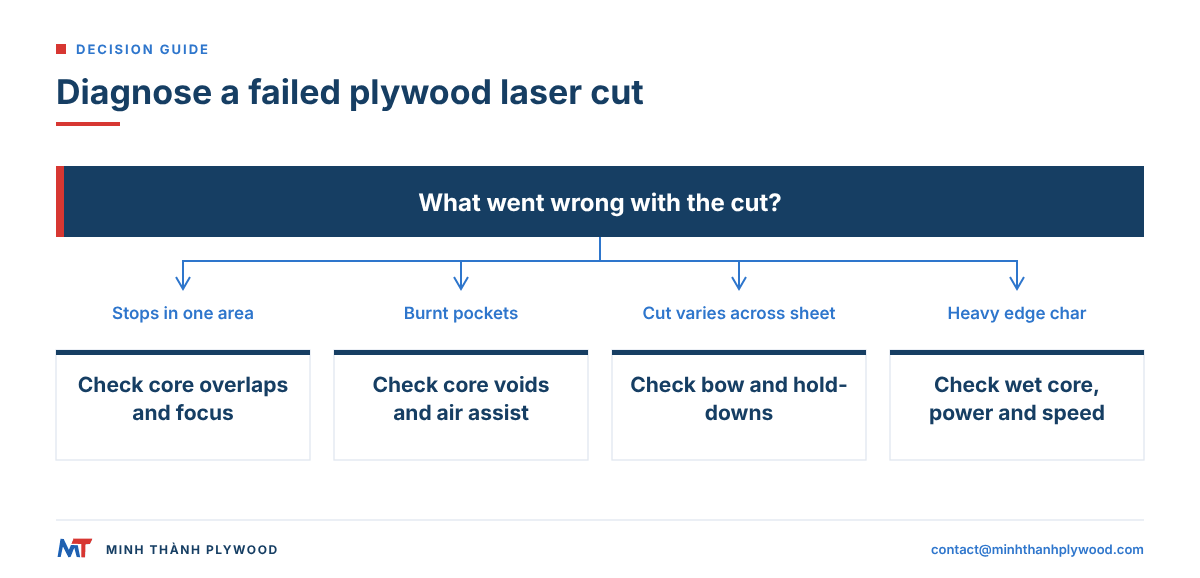
Most incomplete cuts and heavy charring come from the sheet, not from the laser. A plywood panel is layers of veneer and glue, and the beam has to clear every one of them evenly.
| Problem | Cause in the sheet | Cause in the setup |
|---|---|---|
| Cut stops in one area | Core veneers overlap there, doubling the wood | Focus set for a different thickness |
| Cut stops along a line | Hard glue line, such as phenolic glue | Speed too high for the power |
| Flare-ups, burnt pockets | Gaps (voids) in the core fill with flame | Air assist too weak |
| Back face scorched | Sheet lying on a dirty bed | Bed not cleaned; no honeycomb |
| Cut wanders in and out | Panel bowed, out of focus in places | No hold-downs |
| Heavy char on edges | Resin-rich or wet core | Too much power, too slow |
Glue type matters most. UF glue, used for interior furniture panels, cuts cleanly. Phenolic (WBP) and melamine-fortified glues in exterior plywood resist the beam and leave dark, hard edges, so exterior panels are a poor choice for laser work.
Core quality matters next. At Minh Thanh, core layers are stitched both horizontally and vertically, so the veneers in each layer butt tightly without the overlaps and gaps that stop a cut or catch fire.
How do glue lines and core voids affect laser cuts?
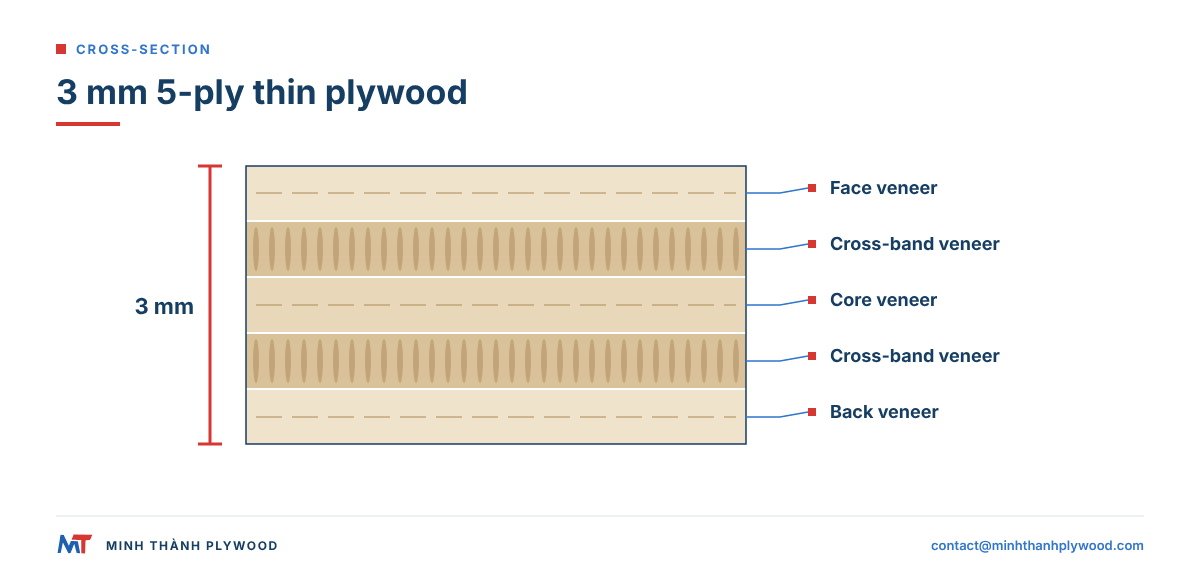
Every glue line is a thin layer the laser must burn through, and each one absorbs more energy than wood. A 3 mm panel has four glue lines between its five plies; a 5 mm five-ply panel has the same four lines between thicker plies. That is why thin 5-ply panels cut cleaner per millimetre than thick ones.
Minh Thanh’s thin plywood from 3 to 5 mm is always 5-ply. A 3 mm panel is one core veneer, two cross-band veneers and two face veneers; 4 and 5 mm panels have three core veneers and two faces, with the core veneer thickness adjusted to the panel. A balanced 5-ply build stays flatter on the bed than a 3-ply sheet of the same thickness.
A void, a gap in a core layer, lets the beam pass through air and then hit the layer below at the wrong focus; it also lets flame form inside the sheet. Overlaps work the other way, doubling the wood the beam meets. Both show as islands of uncut sheet after the job.
How do you check flatness and moisture before cutting?
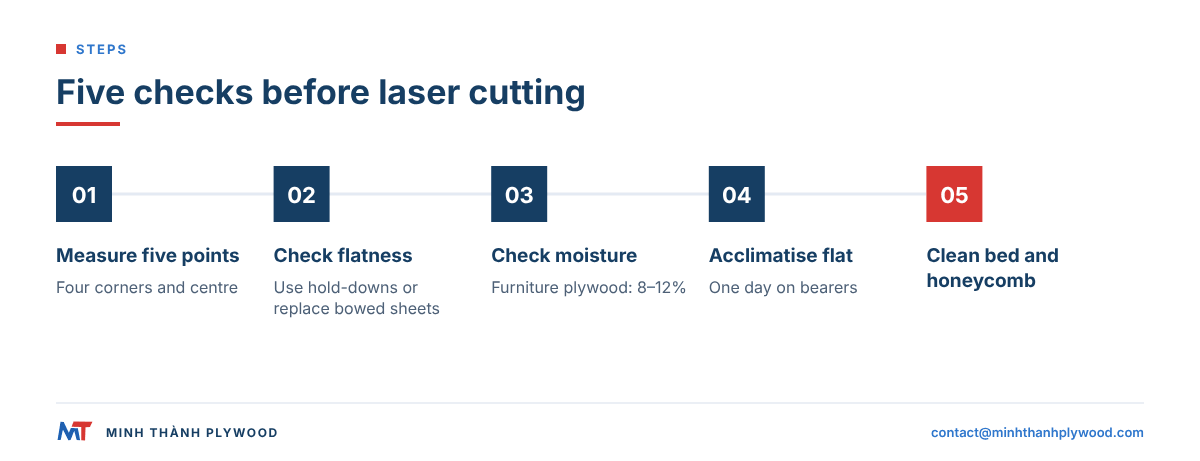
Check every sheet before it goes on the bed; it is cheaper than recutting a failed job.
- Measure thickness at all four corners and the centre with a calliper. Set focus to the average; a spread over a few tenths of a millimetre will show in the cut.
- Check flatness by laying the sheet on the bed: a sheet that rocks or lifts more than a few millimetres needs hold-downs or replacing.
- Check moisture with a pin meter. Furniture plywood leaves the factory at 8-12 % moisture content; a wet sheet chars more and cuts slower.
- Acclimatise new sheets in the cutting room for a day, flat on bearers.
- Clean the bed and honeycomb, so the back face does not pick up scorch marks.
Our sanded furniture panels are held to ±0.2-0.3 mm, down to ±0.2 mm, and pressed twice: the core board is pressed and calibrated, then face and back go on. That combination gives the even focus distance a laser needs across the whole sheet.
What are good settings for laser cutting plywood?
Start from your machine maker’s material library, then run a test grid on an offcut of the same batch. A test grid is a row of small squares cut at rising power and falling speed; the cleanest square that drops out freely gives your settings.
Plywood laser cut settings by thickness
Published starting points, to be confirmed on your own test grid because lens, tube age and glue lines move them:
| Plywood | Laser | Starting power and speed | Passes |
|---|---|---|---|
| 3 mm | 40–50 W CO2 | 70–95% power, 10–25 mm/s | 1 |
| 3 mm | 10 W diode | 90–100% power, 200–600 mm/min | 2–3 |
| 6 mm | 60 W CO2 | about 80% power, 6 mm/s | 1 |
| 6 mm | 80 W CO2 | about 90% power, 10 mm/s | 1–2 |
| 6 mm | 10 W diode | 100–150 mm/min | many; not ideal |
Diode engraving heads quote speeds up to 4,000 mm/s, but that is for marking the surface, not for cutting. A simple 3 mm door-hanger sign, from choosing the sheet to the finished piece, takes about half an hour on a hobby machine.
Practical rules for plywood:
- Focus on the surface for thin sheets and slightly into the material for thicker ones.
- Use strong air assist for cutting; it clears smoke, cools the edge and cuts down charring.
- Prefer one pass at the right power over several fast passes; each extra pass heats the edge again.
- Cut inside shapes first, then the outer outline, so parts do not shift.
- Mask the face with low-tack paper tape to stop smoke staining around the cut.
- Re-run the test grid for each new batch of sheets, even of the same product.
How do you engrave plywood with a laser?
Engrave plywood in raster mode at high speed and low power, so the beam darkens the face veneer without burning into the glue line below.
- Choose a pale, even face. Birch and poplar give the most contrast; a resinous or patched face engraves unevenly.
- Stay in the face veneer for photo and shade work; once the beam reaches the glue line, the depth and colour change.
- Mask with paper tape for crisp edges and no smoke halo; peel it after the job.
- Seal after engraving with a clear finish to keep the burnt area from smudging.
Engraving pairs well with print: a UV-printed image with laser-engraved text or a cut outline is a common product. Our guide to printing on plywood covers the print side.
What bed size fits a 1220 x 2440 mm sheet?
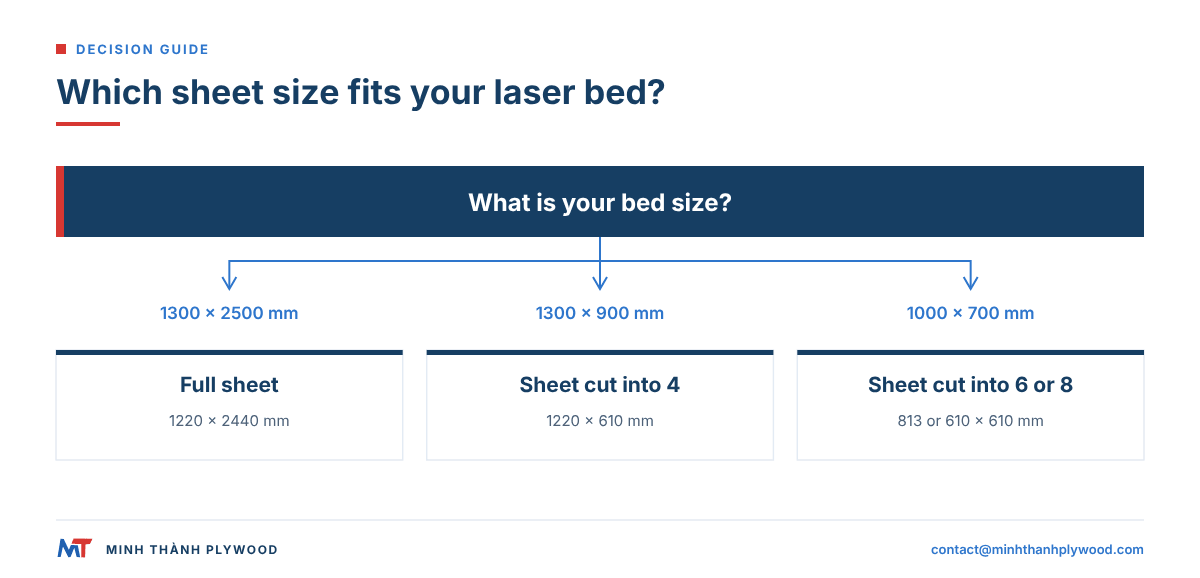
A full 1220 x 2440 mm sheet needs a bed of about 1300 x 2500 mm. Smaller machines need cut-down sheets, and buying them already cut saves a saw step and the dust that comes with it.
| Machine bed | Sheet that fits | How to supply it |
|---|---|---|
| 1300 x 2500 mm | Full 1220 x 2440 mm sheet | Full sheets |
| 1300 x 900 mm | 1220 x 610 mm | One sheet cut into 4 |
| 1000 x 700 mm | 813 x 610 mm or 610 x 610 mm | One sheet cut into 6 or 8 |
| 600 x 400 mm or smaller | Small blanks | Cut 610 x 610 pieces down again |
| A4 hobby machines | A4 210 x 297 mm sheets | Cut-down blanks; thin 0.5, 1 and 2 mm sheets are aircraft plywood, a different product |
Minh Thanh cuts one panel into 4, 6 or 8 pieces before packing: from a 1220 x 2440 mm sheet that gives blanks of about 1220 x 610 mm, 813 x 610 mm or 610 x 610 mm, less the saw kerf. See cut-to-size plywood for formats.
Can you laser cut MDF safely, and is it better than plywood?
You can laser cut MDF safely in an enclosed machine with fume extraction vented outside. MDF is wood fibre bonded with a high share of resin, so it makes more smoke than plywood and its fumes must not reach the room. For workplace laser hazards, see the US Occupational Safety and Health Administration’s laser hazards page.
MDF cuts with a smooth, dark edge and no grain, and it is cheaper per sheet. Plywood is lighter, stronger and stiffer at the same thickness, holds screws and joints better, and has a real wood face that takes stain and finish. For parts that carry load, flex or are handled often, such as toys, furniture and kits, plywood is the stronger choice.
Never laser cut PVC, vinyl or any panel with a PVC face or edge band: they release chlorine gas that harms people and corrodes the machine.
What does a wood laser cutter cost?
The cost of laser plywood cutting is the machine time, the sheet and the waste. What drives each:
| Cost driver | What raises it | What lowers it |
|---|---|---|
| Machine | Higher power, bigger bed, RF tube | Diode or desktop CO2 for thin work |
| Cutting time | Thick sheets, many passes, slow speeds | Thin 5-ply sheets cut in one pass |
| Failed cuts | Core voids, glue lines, warped sheets | Calibrated, void-free panels |
| Material | Premium faces, small lots | Buying by the container, faces matched to the job |
| Waste | Poor nesting on full sheets | Nesting software; cut-to-size blanks |
| Fumes and upkeep | Resin-rich boards, dirty optics | Clean optics, good extraction |
As typical 2026 retail ranges, a hobby diode laser costs about US$300-1,500, a desktop 40-60 W CO2 machine US$2,000-6,000, and a full-sheet 1300 x 2500 mm CO2 machine US$10,000-30,000. Furniture-grade plywood from Minh Thanh starts from US$350/m³ (October 2026), roughly £270/m³ FOB at about US$1.30 to the pound; the final price depends on face, core, glue, thickness, size and quantity.
UK buyers get a CIF quote to their port on request, with 30–40 days at sea to Northern Europe, so the landed price is compared on the same terms as a UK merchant’s.
Sourcing papers for laser plywood
Minh Thanh plywood is made from plantation-grown timber and ships with the EUDR compliance dossier (origin records and geolocation files), which also serves a UK importer’s due-diligence file under the UK Timber Regulation.
Emission proof is CARB P2 / TSCA Title VI certification (ICTT mill no. 23024), with six ASTM D6007 chamber tests averaging 0.014–0.032 ppm against the US limit. That limit is 0.05 ppm for hardwood plywood with a veneer core under 40 CFR 770.10. FSC® material is available*, and a buyer who needs volume also gets the dossier and the test reports from us. *Supplied directly or through qualified partner mills.
Where should you buy plywood for laser cutting?
Buy small lots from a local distributor or a laser-material shop; buy by the container from a mill once your volume is steady. Direct mill supply fixes the face, core, glue and thickness for every order, which keeps your laser settings the same from batch to batch.
A 40HC container of 1220 x 2440 mm thin plywood on Styrax core holds 18 packs. At 3 mm that is 5,994 sheets (333 per pack, about 4.5 kg each); at 6 mm, 2,988 sheets (166 per pack, about 8.9 kg each). Our guide to the best plywood for laser cutting compares laser-grade faces and cores, and birch plywood vs basswood covers the hobby favourite.
What should you put on a laser plywood order?
Send the job and the machine, and the mill can match the panel to both:
- Thickness: for example 3 mm for models and puzzles, 6 mm for boxes and signs; 3-5 mm thin panels are always 5-ply.
- Face: poplar for light weight and price, birch D+/D for a premium face, or an EV pattern for a uniform look.
- Core and glue: white Styrax core, UF glue at E0 emission; no phenolic glue for laser work.
- Tolerance and flatness: sanded panels held to ±0.2 mm.
- Size: full 1220 x 2440 mm sheets, or panels cut into 4, 6 or 8 pieces for your bed.
- Quantity: from one 40HC container, with mixed thicknesses by agreement.
Our thin plywood page lists the 3-6 mm builds, and the how to cut plywood guide covers saws and routers. The US rule for formaldehyde in composite wood is set out on the US EPA formaldehyde standards page. Panels for the US carry CARB P2 / TSCA Title VI certification (ICTT mill no. 23024). Ask for free samples to run your test grid, and send the specification to contact@minhthanhplywood.com for a quote within hours.
Buyer questions, answered
What laser power do I need to cut 6 mm plywood?
A 60-80 W CO2 laser cuts 6 mm plywood in one pass at moderate speed. A 40 W CO2 laser usually needs two passes, and a 10-20 W diode laser needs several slow passes.
Is a CO2 or a diode laser better for plywood?
CO2 is better for cutting: its 10.6 micron beam is absorbed well by wood and cuts thicker sheets in one pass. Diode lasers are cheaper and good for engraving and thin sheets up to about 3-6 mm.
Why does plywood char or not cut through?
The usual causes are a glue line or core overlap the beam cannot clear, a sheet that bows out of focus, too little air assist, or a speed too high for the power. Charring comes from too much power at too low a speed.
Can you laser cut MDF safely?
Yes, with a sealed machine and good fume extraction to the outside. MDF contains more resin than plywood, so it makes more smoke, and the fumes must not be breathed.
What is the best plywood for laser cutting?
Thin poplar or birch-faced plywood with a void-free core, UF glue and a flat, even thickness. Avoid exterior phenolic plywood and any panel with vinyl or PVC faces.
What bed size fits a full 1220 x 2440 mm sheet?
A full-sheet machine with a bed of about 1300 x 2500 mm. Smaller machines use cut-down sheets; a mill can cut one 1220 x 2440 panel into 4, 6 or 8 pieces before shipping.
How much does a laser cutter for wood cost?
As typical 2026 retail ranges, hobby diode lasers cost about US$300-1,500, desktop 40-60 W CO2 machines US$2,000-6,000, and full-sheet 1300 x 2500 mm CO2 machines US$10,000-30,000.
How do you flatten plywood for laser cutting?
Store sheets flat on bearers in the cutting room, use hold-down pins or magnets on a honeycomb bed, and buy calibrated panels with tight thickness tolerance. A bowed sheet cannot be fully flattened by clamping.
Can you engrave plywood with a laser?
Yes. Engrave with high speed and low power, raster the image, and mask the face with paper tape to keep smoke stains off. Birch and poplar faces give the clearest contrast.
Where can I buy plywood for laser cutting?
Local distributors sell by the sheet. Laser studios and product makers buying by the container order direct from a mill: Minh Thanh makes 3-5 mm thin plywood, always 5-ply, from one 40HC container.