
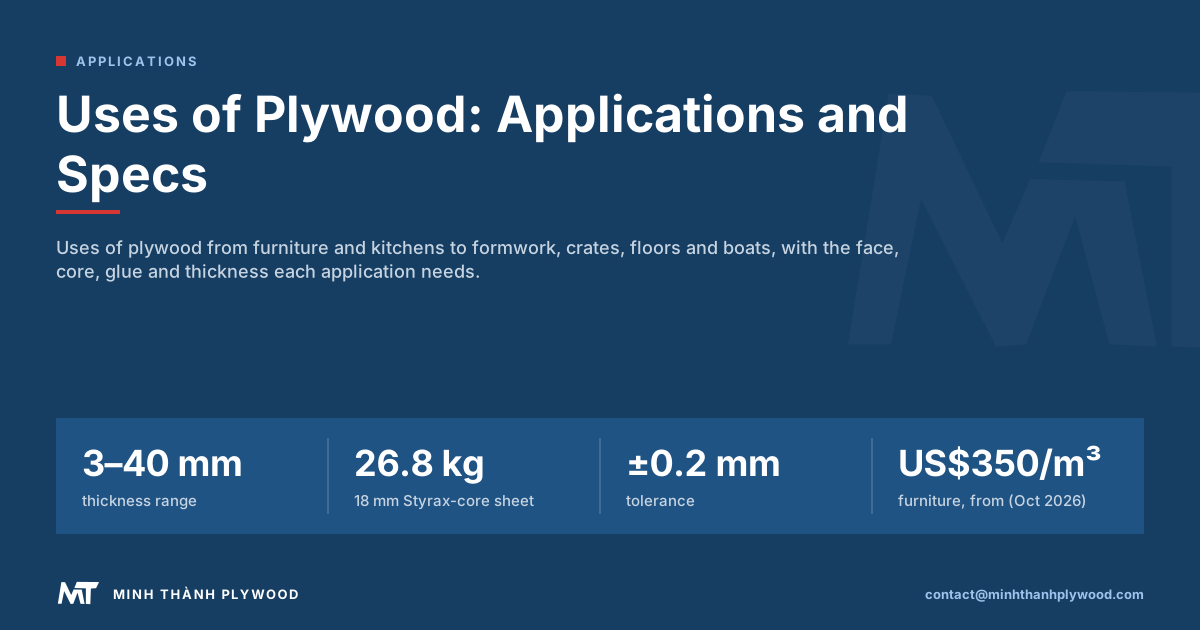
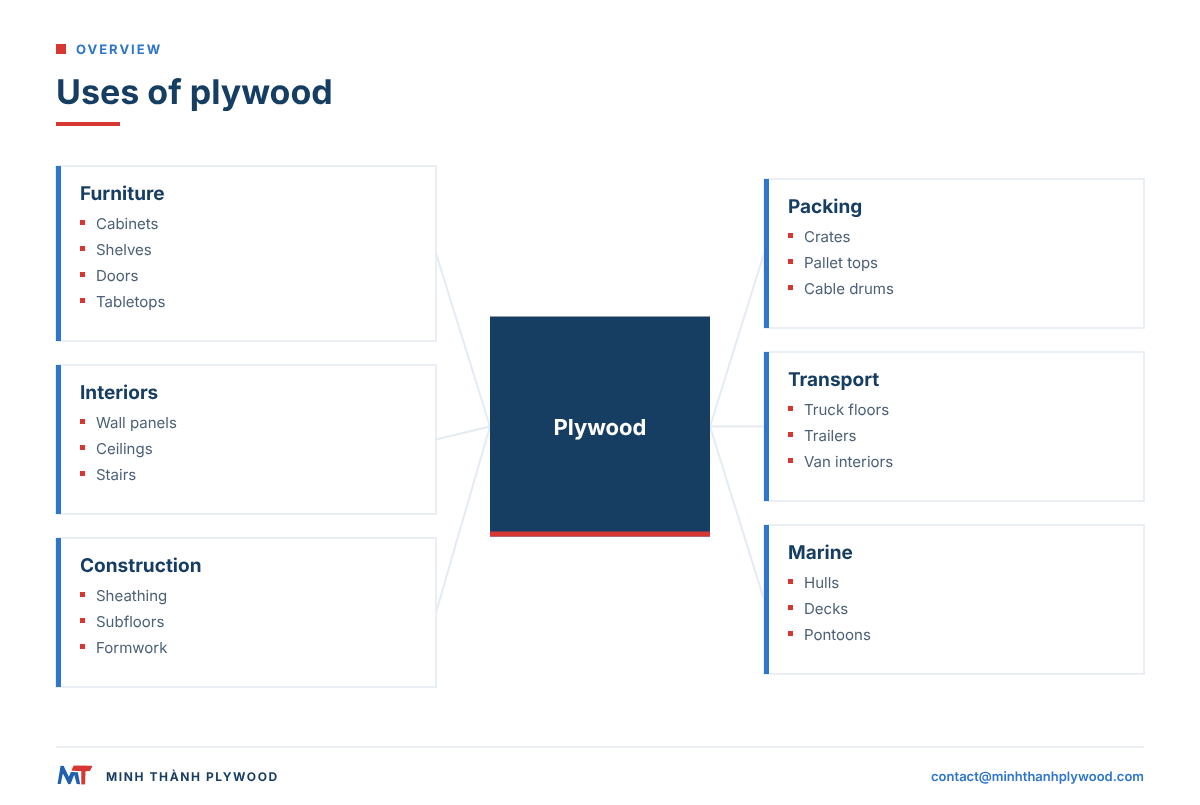
Plywood is a panel of thin wood veneers glued with the grain of each layer crossed, which makes it strong, stable and light for its size. Its main uses are furniture and cabinets, wall and ceiling panels, floors, roof and wall sheathing, concrete formwork, packing crates, vehicle floors and boats. Minh Thanh Plywood makes panels for each of these, and this guide matches every use to its specification.
What is plywood, and why is it used so widely?
Plywood is a wood panel made of thin veneers glued together with the grain of each layer at right angles to the next. That cross-lamination makes the sheet strong in both directions, hard to split and stable when humidity changes. It is why plywood is used for everything from kitchen cabinets to concrete formwork.
The answer to “plywood: what is it used for?” is long because the same build can be tuned in four ways. The face sets the look, the core sets the weight and screw holding, the glue sets the water resistance, and the thickness sets the stiffness. Change one and the panel moves to a different job.
Most panels have an odd number of plies, three, five, seven or more, so the sheet is balanced around its centre and stays flat. Thin panels from 3 mm suit linings and drawer bottoms; thick panels to 40 mm carry floors and workbenches.
At Minh Thanh Plywood we make furniture, commercial, packing, film-faced and exterior plywood in Vietnam, on white Styrax or Eucalyptus cores with 10+ face veneers. This guide uses that range to show how each use translates into a specification.
What is plywood used for?
Plywood is used for furniture, kitchens, wall and ceiling panels, concrete formwork, roof and floor sheathing, packing crates, truck and trailer floors, and beams. Each use calls for a matching face, core, glue and thickness. This table is the quick reference: find the application, read across, and you have the first draft of a purchase line.
| Use | Face | Core | Glue | Usual thickness | Panel | Standard or test to ask for |
|---|---|---|---|---|---|---|
| Furniture and cabinets | Birch, poplar, EV, okoume, pine | White Styrax or Eucalyptus | UF glue at E0 emission | 12, 15, 18 mm | Furniture plywood | E1 emission under EN 13986, or CARB P2 / TSCA Title VI; EN 636-1 dry-use class |
| Kitchens and bathrooms | Birch, EV, or ready for laminate | Styrax or Eucalyptus | Melamine-fortified (MR) | 15, 18 mm | Furniture plywood, MR bond | EN 636-2 humid-use class; E1 or CARB P2 |
| Wall and ceiling panels | Decorative veneer | Styrax | UF glue at E0 emission | 6 to 12 mm | Thin plywood | Reaction-to-fire class to EN 13501-1 on the declaration; E1 |
| Concrete formwork | Phenolic film | Eucalyptus or hardwood | Phenolic WBP | 12, 15, 18 mm | Film-faced plywood | EN 636-3 exterior class; CE to EN 13986 |
| Roof and wall sheathing | Utility C/D | Mixed hardwood | Phenolic WBP or MR | 9 to 18 mm | Exterior plywood | EN 636-2 or 636-3; CE or UKCA to EN 13986; design values to EN 12369-2 |
| Floors and subfloors | Utility or sanded | Eucalyptus | Phenolic WBP or MR | 18 to 25 mm | Exterior plywood | EN 636-2 or 636-3; Dfl-s1 floor fire class untreated (Bfl-s1 only with a tested fire-retardant product); anti-slip R10 to R13 (DIN 51130) where walked on |
| Packing crates and pallets | Utility | Mixed hardwood | UF or MR | 9 to 18 mm | Packing plywood | Exempt from ISPM 15 as processed wood; EN 636-1 |
| Truck and trailer floors | Anti-slip film | Eucalyptus or hardwood | Phenolic WBP | 18 to 30 mm | Anti-slip plywood | EN 636-3; anti-slip R11 to R13 (DIN 51130); abrasion-rated film |
| Beams, door cores, stair parts | Parallel veneers | Hardwood | Phenolic or MR | To order | LVL | EN 14374 for structural LVL |
The last column is the proof a buyer can ask a supplier for, use by use:
- Service class. EN 636 sorts plywood into dry (class 1), humid (class 2) and exterior (class 3) use, and EN 12369-2 gives the design values for each class.
- Construction marking. Plywood sold for building work in the UK and EU carries a CE mark, or UKCA in Great Britain, under EN 13986, with a declared reaction-to-fire class (TRADA guidance via Hanson Plywood).
- Furniture emission. E1 under EN 13986 for Europe; CARB Phase 2 / TSCA Title VI for the US, where our six ASTM D6007 chamber tests averaged 0.014–0.032 ppm against the 0.05 ppm limit.
- Floors and transport. Slip resistance R10 to R13 is tested to DIN 51130, and Dfl-s1 is the floor fire class of untreated plywood (Bfl-s1 only with a tested fire-retardant product). Film-faced makers such as Paged quote slip-resistant film for trailer and walkway panels.
- Rail interiors. EN 45545-2 sets hazard levels HL1 to HL3 for rail vehicles and needs a fire-retardant panel, which is a separate product from the plywood in this table.
- Packing. Plywood is processed wood and falls outside ISPM 15, the heat-treatment rule for solid wood packaging (IPPC ISPM 15), so a crate made wholly of plywood needs no ISPM 15 stamp.
Read the table as a starting point, not a rule. A furniture maker who sells into humid coastal markets moves from UF to a melamine-fortified bond; a packer shipping heavy machinery moves from 12 mm to 18 mm. Our types of plywood guide explains each panel family in more depth.
Plywood used in furniture and kitchen cabinets
Plywood used in furniture is a flat, calibrated panel with sanded decorative faces, made for carcasses, shelves, drawers, doors and tabletops. It holds screws and dowels well, keeps its shape over long spans and takes paint, lacquer, laminate or veneer. This is the largest single use of high-grade plywood.
Three things separate furniture plywood from general panels:
- Flatness and thickness tolerance. CNC lines and edge banders need a sheet that is the same thickness everywhere. Our furniture panels are pressed twice as standard: the core board is pressed and calibrated, then face and back are pressed on, with thickness held down to ±0.2 mm.
- The face. Birch for hard-wearing natural finishes, poplar and EV (engineered veneer) for even colour, okoume and pine for warm tones, and faces ready for paint or laminate. Both faces are sanded, polished and UV-ready.
- Emission. UF glue at E0 emission is our standard for furniture. Six ASTM D6007 chamber tests between April 2025 and June 2026 on 9, 15 and 18 mm panels averaged 0.014–0.032 ppm, against the 0.05 ppm CARB Phase 2 limit. We hold CARB P2 / TSCA Title VI certification. The limit for veneer-core hardwood plywood is 0.05 ppm under 40 CFR 770.10.
Kitchen and bathroom cabinets add moisture to the brief. A melamine-fortified bond keeps glue lines sound in steam and splashes. Our kitchen cabinet plywood guide and best plywood for furniture cover the component-by-component choice.
Ply wood uses at home: walls, floors, shelves and DIY
Around the home, plywood is used for wall and ceiling panels, floors and subfloors, shelving, built-in wardrobes, stair parts, garden sheds and DIY projects. Home uses split into two groups: visible panels that need a good face, and hidden panels that need strength and the right glue.
Visible home uses:
- Wall and ceiling panelling in 6 to 12 mm decorative plywood, clear-finished or painted. Our plywood wall panels guide covers fixing and finishing.
- Shelving and built-ins in 18 mm sanded plywood, which spans further than particleboard without sagging.
- Stair treads and risers in thicker panels with a hard face, or with a water-resistant glue near entrances.
Hidden home uses:
- Subfloors under tile, timber or vinyl, in 18 mm or thicker tongue-and-groove panels. Our subfloor plywood guide explains grades and spans.
- Roof and wall sheathing in exterior-glue panels under shingles or cladding.
- Garden structures such as sheds and workshops; see our guide to plywood for sheds.
For DIY, the common cuts and finishes are covered in our planned guides on how to cut plywood and how to finish plywood.
Plywood in construction: sheathing, subfloors and formwork
In construction, plywood is used for roof and wall sheathing, subfloors, concrete formwork, hoardings and temporary works. These panels are chosen for strength, glue durability and price rather than appearance, so faces are utility grade and the glue is water-resistant or fully weatherproof.
Sheathing ties the frame of a building together and carries the roof covering or cladding. Exterior or CDX-type plywood with utility C/D faces and a melamine-fortified or phenolic (WBP) bond is the usual panel. Thickness follows the spacing of rafters and studs.
Formwork is the most demanding construction use. The panel is wetted with fresh concrete, stripped, cleaned and reused. Film-faced plywood, with a phenolic film pressed onto each face and a phenolic WBP glue, gives a smooth concrete surface and releases cleanly. Our formwork panel guide covers film weights, cores and edge sealing.
Subfloors and stage floors close the list: thick panels with tongue-and-groove edges, laid across joists and glued and screwed.
Packing, crates and pallets: industrial plywood uses
Packing plywood is used for export crates, machine cases, pallet tops, cable drums and protective boards. It is strong for its weight, does not split at nails near the edge, and is exempt from the bark and heat-treatment rules that apply to solid wood packaging under ISPM 15.
The exemption matters for exporters. Solid wood crates must be heat-treated or fumigated and stamped before crossing most borders; crates made from plywood, a processed wood product, do not need that stamp. The IPPC page on ISPM 15, checked on 20 October 2026, lists the standard; its scope excludes wood packaging made wholly of processed wood such as plywood.
Packing plywood uses utility faces and a lower-cost core, often with UF or MR glue, in 9 to 18 mm. Our plywood for crates and packaging guide and the packing plywood page give the grades. For trailer, truck and container floors, see our guide to plywood for trailer and truck floors.
Marine plywood uses and other wet applications
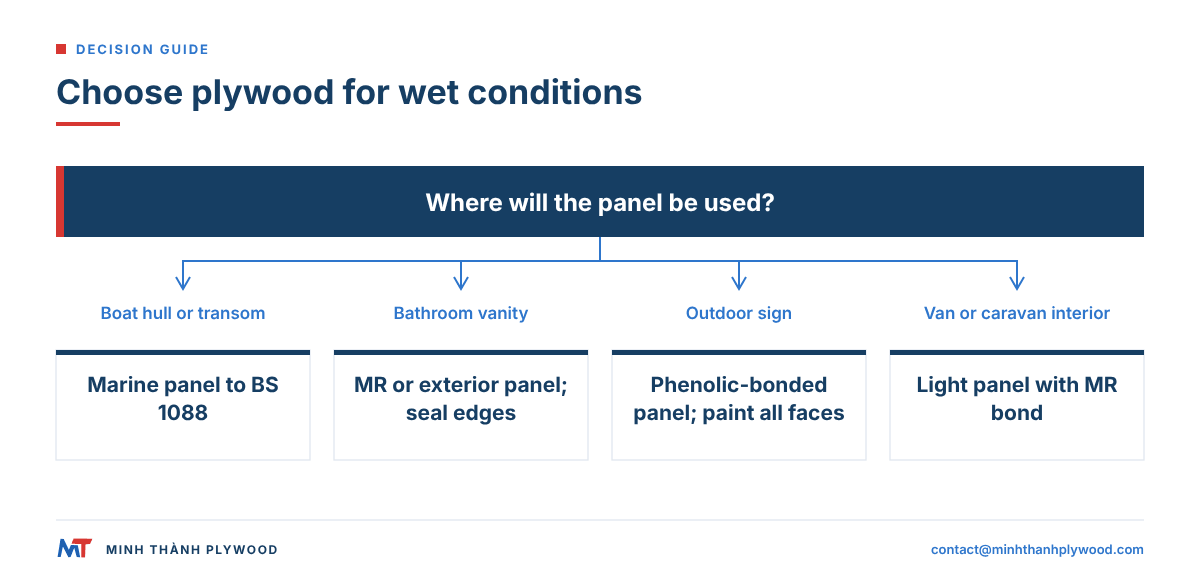
Marine plywood is used for boat hulls, decks, transoms, bulkheads, docks and pontoons: structures that stay wet for long periods. It is built to a marine standard such as BS 1088, with a boil-proof bond and selected veneers in every ply, so the panel has no hidden core gaps where water can sit.
Marine plywood is often over-specified. A bathroom vanity, a van interior or an outdoor sign does not need a marine panel; an exterior or melamine-fortified panel with sealed edges does the job for less. Keep marine plywood for parts that carry load while wet.
Other wet and outdoor uses:
- Exterior signs and hoardings, in phenolic-bonded plywood, painted on all faces.
- Van, camper and caravan interiors, in light panels with a melamine-fortified bond.
- Outdoor furniture and planters, in exterior plywood with a full coating.
Our marine plywood buying guide explains the standard; Minh Thanh Plywood makes okoume-faced and exterior panels and does not sell BS 1088 marine plywood.
What are the main uses of plywood by thickness?
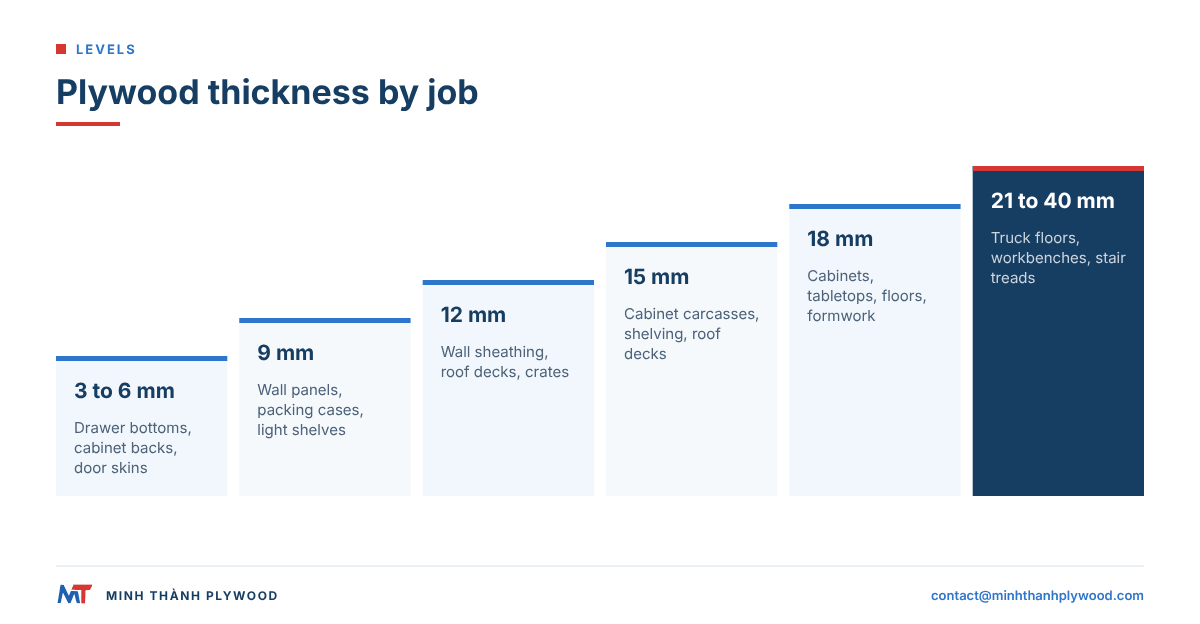
The main uses of plywood follow its thickness: thin panels line and back, middle thicknesses build furniture and sheathing, and thick panels carry floors and loads. This table answers the common question of what a 12 mm or 18 mm sheet is used for.
| Thickness | Typical uses |
|---|---|
| 3 to 6 mm | Drawer bottoms, cabinet backs, door skins, curved linings, model making |
| 9 mm | Wall panels, packing cases, light shelving, cabinet backs in heavy furniture |
| 12 mm | Wall sheathing, roof decks on close rafters, crates, drawer sides |
| 15 mm | Cabinet carcasses, shelving, roof decks on wider rafters |
| 18 mm | Cabinet carcasses, tabletops, worktop substrates, floors, formwork |
| 21 to 40 mm | Truck floors, workbenches, stage floors, stair treads, heavy shelving |
Our thin plywood from 3 to 5 mm is always 5-ply: at 3 mm, one core veneer, two cross-band veneers and two faces; at 4 and 5 mm, three core veneers and two faces. See the plywood thickness guide for sheet weights and tolerances.
Plywood usage in transport: trucks, trailers, vans and caravans
Plywood usage in transport covers truck and trailer floors, container floors, van linings, caravan and camper interiors, and bus and rail fit-outs. Vehicles need panels that are stiff for their weight, hold fixings under vibration and tolerate wet boots, spilled loads and washing. Plywood does all three better than particleboard or MDF.
Floors take the heaviest work. A trailer or truck floor carries forklift wheels and pallet loads, so it uses thick panels, often 18 to 30 mm, with a phenolic WBP bond and a film or anti-slip face that sheds water and gives grip. Our anti-slip plywood is made on order for these decks, and our guide to plywood for trailer and truck floors covers face weights and fixings.
Interiors take lighter panels. Van and caravan builders want every kilogram back, so they choose thin panels and light cores: a 12 mm sheet of 1220 × 2440 mm weighs about 17.9 kg on a white Styrax core against about 23.2 kg on Eucalyptus. A melamine-fortified bond copes with condensation in a closed vehicle, and decorative faces such as birch, poplar or okoume take a clear finish. Our planned guide to plywood for campervan conversions covers wall, floor and furniture panels for vans.
How the core and glue change what plywood can do
The core decides weight, screw holding and price; the glue decides where the panel can live. Two sheets with the same face can be built for a dry living room or for a construction site, and only the core and glue lines on the order show the difference.
Our standard furniture cores are white Styrax, light and even, and Eucalyptus, denser and harder, with Acacia and Pine cores made on order. An 18 mm sheet of 1220 × 2440 mm weighs about 26.8 kg on Styrax and about 34.8 kg on Eucalyptus. Core layers are stitched both horizontally and vertically so the core has no open gaps.
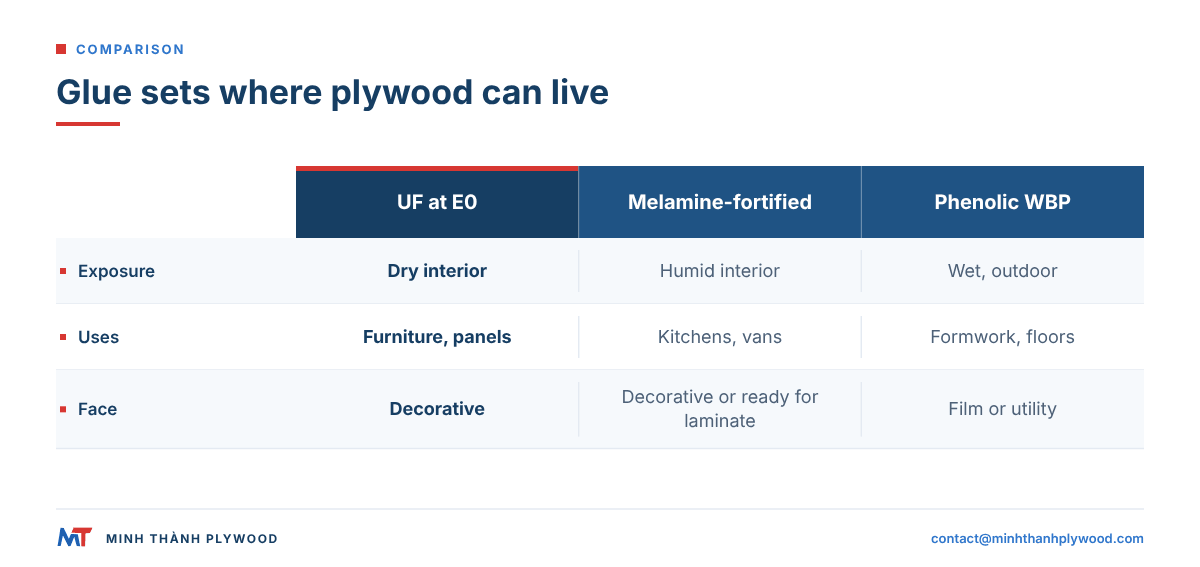
| Glue | Where the panel can live | Typical uses |
|---|---|---|
| UF glue at E0 emission | Dry interiors | Furniture, wall panels, doors, shelving |
| Melamine-fortified (MR) | Humid interiors, covered exterior during building | Kitchens, bathrooms, vans, sheathing covered fast |
| Phenolic (WBP) | Wet and outdoor exposure | Formwork, exterior sheathing, trailer floors |
Glue and emission class are separate lines: E0 describes formaldehyde emission, not the resin. Our guide to whether plywood is waterproof shows how glue, core and coating share the job.
Uses of plywood around the world: how buyers order it
Buyers in each market order plywood for the same uses under different names. North American builders ask for CDX sheathing and ACX or BCX for visible faces; European furniture makers ask by face species and grade with an E1 or lower emission; buyers in India often ask by MR, BWR or BWP glue grades. The uses are the same; the vocabulary changes.
Sheet sizes follow the market too. Most of the world uses 1220 × 2440 mm (4 × 8 ft); many European furniture lines prefer 1250 × 2500 mm; and we cut custom sizes such as 1220 × 2500 and 1220 × 2280 mm, or cut one panel into 4, 6 or 8 pieces for cut-to-size orders shipped regularly to Italy and other European markets.
Write the use on the enquiry. A supplier who knows the panel is for kitchen carcasses rather than pallet tops can match the face, core and glue without guessing.
Plywood vs MDF, particleboard and OSB: which use suits which board?
Plywood is the better choice where strength, screw holding, light weight or moisture tolerance matter; MDF wins for smooth painted fronts and fine routing; particleboard is the lowest-cost carcass board for dry, light furniture; OSB is a low-cost structural sheathing. Many products use two boards together.
| Need | Plywood | MDF | Particleboard | OSB |
|---|---|---|---|---|
| Screw holding at edges | Good | Fair | Poor | Fair |
| Span without sag | Good | Fair | Poor | Good |
| Painted, routed fronts | Good with a smooth face | Best | Not used | Not used |
| Moisture at cut edges | Good with MR or WBP glue | Swells | Swells | Swells at edges |
| Weight for stiffness | Light | Heavy | Heavy | Medium |
A common combination is a plywood carcass with MDF or laminate doors. Our plywood vs MDF comparison and plywood vs OSB comparison give the full tables.
Specifying plywood for your use: the order line
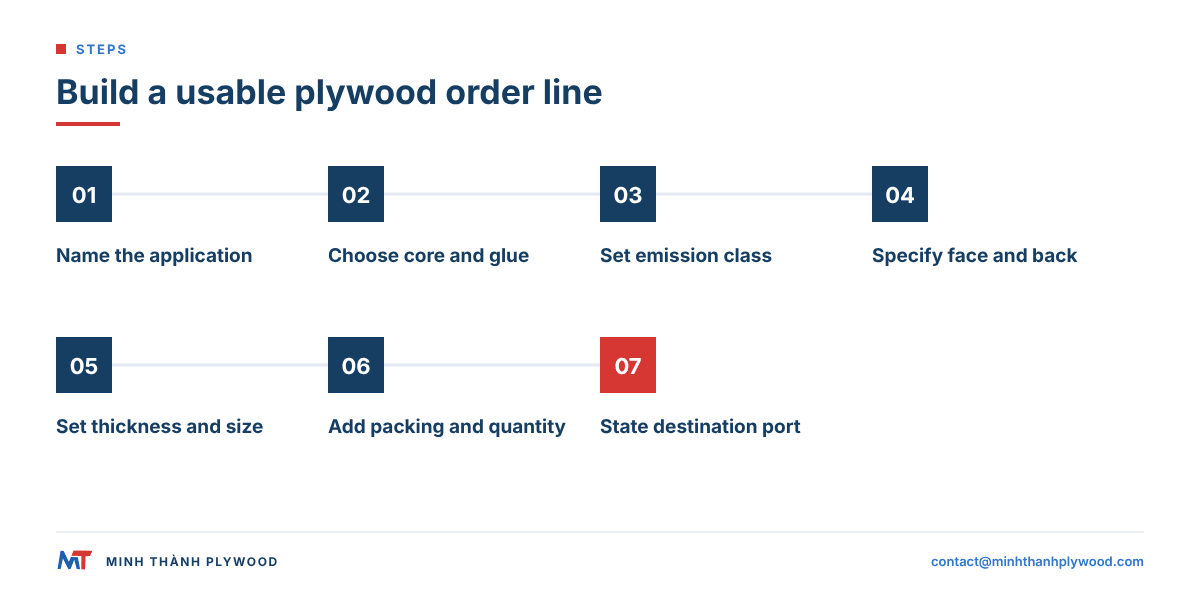
Write the use first, then the core, glue and emission, face and back grade, thickness, size, packing and quantity. A complete line for a furniture use from Minh Thanh Plywood looks like this:
Furniture plywood, 18 mm, 1220 × 2440 mm, white Styrax core, UF glue at E0 emission, birch face and back D/D matched to the approved sample, sanded both sides, thickness ±0.2 mm, for cabinet carcasses and shelves, one 40HC, CIF destination port.
For other uses, change one line at a time: Eucalyptus core and melamine-fortified glue for kitchen parts, phenolic film and WBP glue for formwork, utility faces for packing. Production takes 15–45 days after the 30% deposit, with the 70% balance against the scanned B/L or by irrevocable L/C at sight. Furniture and interior plywood starts from US$350/m³ and commercial plywood from US$250/m³ (October 2026).
Free samples are available. Send your specification through the furniture plywood page or browse the plywood catalogue; we reply within hours.
Buyer questions, answered
What is plywood used for?
Plywood is used for furniture, kitchen cabinets, wall panels, floors and subfloors, roof and wall sheathing, concrete formwork, packing crates, truck and trailer floors, boats and many DIY projects. The face, core, glue and thickness change with the use.
What are five common uses for plywood?
Five common uses are furniture and cabinets, floors and subfloors, roof and wall sheathing, concrete formwork, and packing crates and pallets.
What is 12mm plywood used for?
12 mm plywood is used for cabinet backs and drawer bottoms in heavy furniture, wall sheathing, roof decks on rafters at 16 in centres, shelving, packing crates and wall panels. For cabinet sides and floors, most makers step up to 15 mm or 18 mm.
What is 18mm plywood used for?
18 mm plywood is the standard thickness for cabinet carcasses, shelves, tabletops, worktops under laminate, floors on joists at 16 in centres, concrete formwork and stage floors. It is the most traded furniture plywood thickness.
What are the uses of film faced plywood?
Film-faced plywood is used mainly for concrete formwork for walls, slabs and columns, because its phenolic film gives a smooth concrete finish and releases cleanly. It is also used for truck floors, stage floors and hoardings; with an anti-slip face it suits walkways and trailer decks.
What are the uses of marine plywood?
Marine plywood is used for boat hulls, decks and transoms, docks and pontoons, and other structures that stay wet. It is built to a marine standard such as BS 1088 with a boil-proof bond and selected veneers throughout.
Is plywood used in construction?
Yes. Construction uses plywood for roof and wall sheathing, subfloors, concrete formwork, hoardings and site fit-out. These panels use exterior or water-resistant glue and utility faces, because they are covered or used for strength rather than looks.
Why is plywood used instead of solid wood?
Plywood is used instead of solid wood because its cross-laminated veneers resist splitting and keep the panel flat and dimensionally stable in large sheets. It also uses more of each log and costs less per square metre than wide solid boards.
What is plywood used for in furniture?
In furniture, plywood is used for cabinet carcasses, shelves, drawer boxes, doors, tabletops, bed frames and curved parts. Furniture plywood has sanded decorative faces, a flat calibrated core and UF glue at E0 emission for low formaldehyde.
What should I send for a plywood quote?
Send the use, the core, the glue and emission class, the face and back grade, thickness, sheet size, packing and quantity, and the destination port. We reply within hours.