
Sperrholz is the German word for plywood; Multiplex is a Sperrholz with many thin plies, and Siebdruckplatte is film-faced plywood with a textured face. Every market has words like these, and each one carries a specification. Minh Thanh Plywood, a Vietnamese mill exporting to Europe, keeps this list of plywood names in 38 languages for buyers writing a purchase order.
Plywood auf Deutsch: Sperrholz, Multiplex or Furniersperrholz?
Plywood in German is Sperrholz. The word comes from “sperren”, to lock: crossed veneers lock each other against movement. Furniersperrholz (veneer plywood) is the full technical term, and German standards and catalogues use it for the panel most English speakers simply call plywood.
German buyers then name the type of panel, and each name carries a specification:
| German term | What it means | Closest English term |
|---|---|---|
| Sperrholz | Plywood, the general term | Plywood |
| Furniersperrholz | Veneer plywood, every layer a veneer | Veneer-core plywood |
| Multiplex, Multiplexplatte | Plywood with many thin, even plies, usually birch or beech | Multi-ply plywood, Baltic-type birch |
| Birkensperrholz | Birch plywood | Birch plywood |
| Pappelsperrholz | Poplar plywood | Poplar plywood |
| Tischlerplatte | Core of solid wood strips between veneers | Blockboard |
| Siebdruckplatte | Film-faced plywood with a textured anti-slip face | Anti-slip film-faced plywood |
| Schalungsplatte | Plywood for concrete formwork, usually film-faced | Formwork or shuttering plywood |
| Bootsbausperrholz | Plywood for boat building | Marine plywood |
| Bausperrholz | Plywood for construction | Structural or construction plywood |
In a German order, “Sperrholz 18 mm” alone is not a specification. A Tischler (joiner) means a sanded furniture panel; a Bauunternehmer (building contractor) may mean a site panel. Add the face, the core and the bond, and the word becomes an order.
Which German standards and codes sit behind the word Sperrholz?
German buyers order Sperrholz by standard, not by adjective. The European product standard is DIN EN 636, in three parts by service class: EN 636-1 for dry conditions, EN 636-2 for humid conditions and EN 636-3 for exterior use. The UK edition is BS EN 636:2012+A1:2015. The older German building-plywood classes still appear in tenders and dealer lists: BFU 20 (interior bond), BFU 100 (weather-resistant, boil-proof bond) and BFU 100 G (BFU 100 with added protection against wood-destroying fungi), from DIN 68705.
Other German words that change what arrives:
| German term | What it means | Note for the order |
|---|---|---|
| Schichtholz | Dictionary word for plywood in PONS and Linguee; in the timber trade it also means laminated timber | Use Sperrholz in a specification so nothing is read as beams |
| Stabsperrholz, Stäbchensperrholz | Plywood with a core of glued solid strips or rods, a blockboard family | Not the same as veneer-core Furniersperrholz; say which core |
| Seekiefersperrholz | Maritime-pine plywood, the low-cost ply many German dealers stock for crates, floors and hobby work | A softwood utility panel, not a furniture panel |
| Birken-Multiplex, Buchen-Multiplex | Birch or beech Multiplex, sold by dealers from 6.5 mm (birch) and 9 mm (beech) | Ask for the ply count at the thickness ordered |
| Sperrholzfabrik | Plywood factory | The word to use when searching for a mill |
A German order that names EN 636-2 or EN 636-3 and the face grade is a specification a Vietnamese mill can price at once. Our furniture panels are made for the European interior market, and third-party testing to the buyer’s method, for example EN 717-1, is arranged through SGS on request.
Is Multiplex plywood in German, or a different panel?
Multiplex is a type of plywood, not a different material. German, Dutch and Swiss buyers use Multiplex for plywood built from many thin, even plies with a clean, solid edge, typically birch, sometimes beech.
A German woodworking forum thread on exactly this question summed it up: plywood is any board of cross-glued veneer layers, usually an odd number, and Multiplex is a Sperrholz with many plies. Members also corrected a common belief that Multiplex starts at 12 mm: dealers sell birch Multiplex from 6.5 mm.
What makes a panel “Multiplex” in practice:
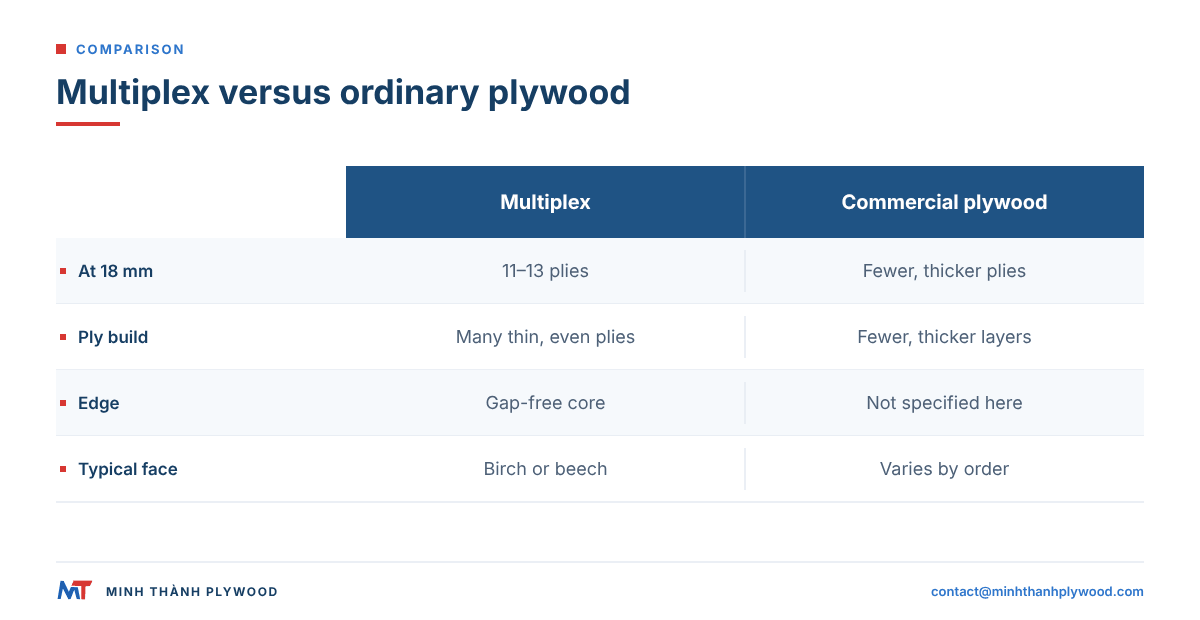
- Many plies. At 18 mm, a birch Multiplex panel has 11–13 plies; an ordinary commercial panel at the same thickness has fewer, thicker layers.
- Even ply thickness. All plies roughly the same, so the edge shows even stripes.
- A gap-free core. No voids visible on the edge after cutting.
- A hardwood face. Birch is the classic; beech is the alternative.
When an English-speaking supplier quotes “birch plywood”, a German buyer should ask for the ply count at the thickness ordered. That one number tells whether the panel is Multiplex in the German sense.
What is a Siebdruckplatte and how is it different from Phenolfilm?
A Siebdruckplatte is film-faced plywood whose face carries a textured, anti-slip pattern, pressed in from a wire mesh during hot pressing. The name means “screen-print board”, after the mesh texture. It is the standard floor for trailers, vans, scaffolding platforms and stage decks.
The smooth version has other names in German: Phenolfilmplatte, Filmplatte or Schalungsplatte when it is used for concrete formwork. Buyers in Germany also search for “farbige Siebdruckplatten”, coloured anti-slip panels for shopfitting and vehicle floors; the colour is part of the film specification.
| Term | Face | Main use |
|---|---|---|
| Siebdruckplatte | Film with textured anti-slip pattern, one side; smooth film the other | Vehicle floors, platforms, stages |
| Phenolfilmplatte, Filmplatte | Smooth phenolic film both sides | Formwork, shelving, displays |
| Schalungsplatte | Smooth film, sealed edges, for concrete | Concrete formwork |
We make film-faced plywood with a phenolic bond, and anti-slip plywood is accepted on order. Commercial and film-faced panels are held to ±0.5 mm in thickness.
Plywood in 38 languages: the buyer’s table
The table lists the common word for plywood in 38 languages, with a transliteration where the script is not Latin, and the related words that name a type of panel. Use it to read a local quote, a tender or a supplier’s catalogue.
| Language | Plywood | Related terms a buyer meets |
|---|---|---|
| German | Sperrholz | Multiplex, Siebdruckplatte, Tischlerplatte, Schalungsplatte |
| Dutch | multiplex, triplex | betonplex (formwork), watervast multiplex (water-resistant) |
| French | contreplaqué | contreplaqué filmé (film-faced), CTBX (exterior bond), contreplaqué marine |
| Spanish (Spain) | contrachapado, tablero contrachapado | tablero fenólico (film-faced), contrachapado marino |
| Spanish (Mexico) | triplay | triplay fenólico, plywood fenólico (film-faced) |
| Spanish (Argentina) | compensado | fenólico (film-faced formwork panel) |
| Spanish (Chile) | terciado | terciado estructural, terciado moldaje (formwork) |
| Portuguese (Brazil) | compensado | compensado naval (marine), compensado plastificado (film-faced) |
| Portuguese (Portugal) | contraplacado | contraplacado marítimo, contraplacado filmado |
| Italian | compensato | multistrato (multi-ply), compensato marino, pannello fenolico |
| Polish | sklejka | sklejka brzozowa (birch), sklejka szalunkowa (formwork), sklejka wodoodporna |
| Czech | překližka | vodovzdorná překližka (water-resistant) |
| Slovak | preglejka | protišmyková preglejka (anti-slip) |
| Hungarian | rétegelt lemez | zsalulemez (formwork panel) |
| Romanian | placaj | placaj filmat (film-faced), placaj marin |
| Bulgarian | шперплат (shperplat) | шперплат с филм (film-faced) |
| Croatian, Serbian | šperploča | vodootporna šperploča (water-resistant) |
| Slovenian | vezana plošča | — |
| Greek | κόντρα πλακέ (kontra plake) | κόντρα πλακέ θαλάσσης (marine) |
| Danish | krydsfiner | birkekrydsfiner (birch), filmbelagt krydsfiner |
| Norwegian | kryssfiner | filmkryssfiner (film-faced) |
| Swedish | plywood, kryssfaner | björkplywood (birch), filmplywood |
| Finnish | vaneri | koivuvaneri (birch), filmivaneri (film-faced) |
| Estonian | vineer | kasevineer (birch) |
| Latvian | saplāksnis | bērza saplāksnis (birch) |
| Lithuanian | fanera | beržinė fanera (birch) |
| Russian | фанера (fanera) | ФК (urea glue, interior), ФСФ (phenolic glue, exterior), ламинированная фанера (film-faced) |
| Ukrainian | фанера (fanera) | ламінована фанера (film-faced) |
| Turkish | kontrplak | plywood, filmli kontrplak (film-faced) |
| Arabic | خشب أبلكاش (khashab ablakash), خشب رقائقي (khashab raqaiqi) | أبلكاش بحري (marine) |
| Hebrew | דיקט (dikt) | דיקט ימי (marine) |
| Persian | تخته چندلایی (takhte chand-laye) | — |
| Hindi | प्लाईवुड (plywood) | marine plywood, BWP (boiling water proof) |
| Chinese | 胶合板 (jiāohébǎn) | 多层板 (multi-layer board), 覆膜板 (film-faced), 建筑模板 (formwork) |
| Japanese | 合板 (gōhan), ベニヤ板 (beniya-ita) | コンパネ (konpane, formwork), 構造用合板 (structural) |
| Korean | 합판 (happan) | 코팅합판 (coated, film-faced) |
| Thai | ไม้อัด (mai at) | — |
| Vietnamese | ván ép, gỗ dán | ván phủ phim (film-faced), ván coppha (formwork) |
| Indonesian | kayu lapis, triplek | multipleks (thicker multi-ply), film face |
| Malay | papan lapis | — |
| Afrikaans | laaghout | — |
English also has its own regional words. In the UK and Ireland, “ply” is the trade short form; in the US, “CDX” names exterior sheathing grade; in India and the Gulf, “BWP” and “MR” name the bond; in the Philippines, “marine plywood” and “ordinary plywood” divide the market.
What does triplek mean in Indonesian and Dutch?
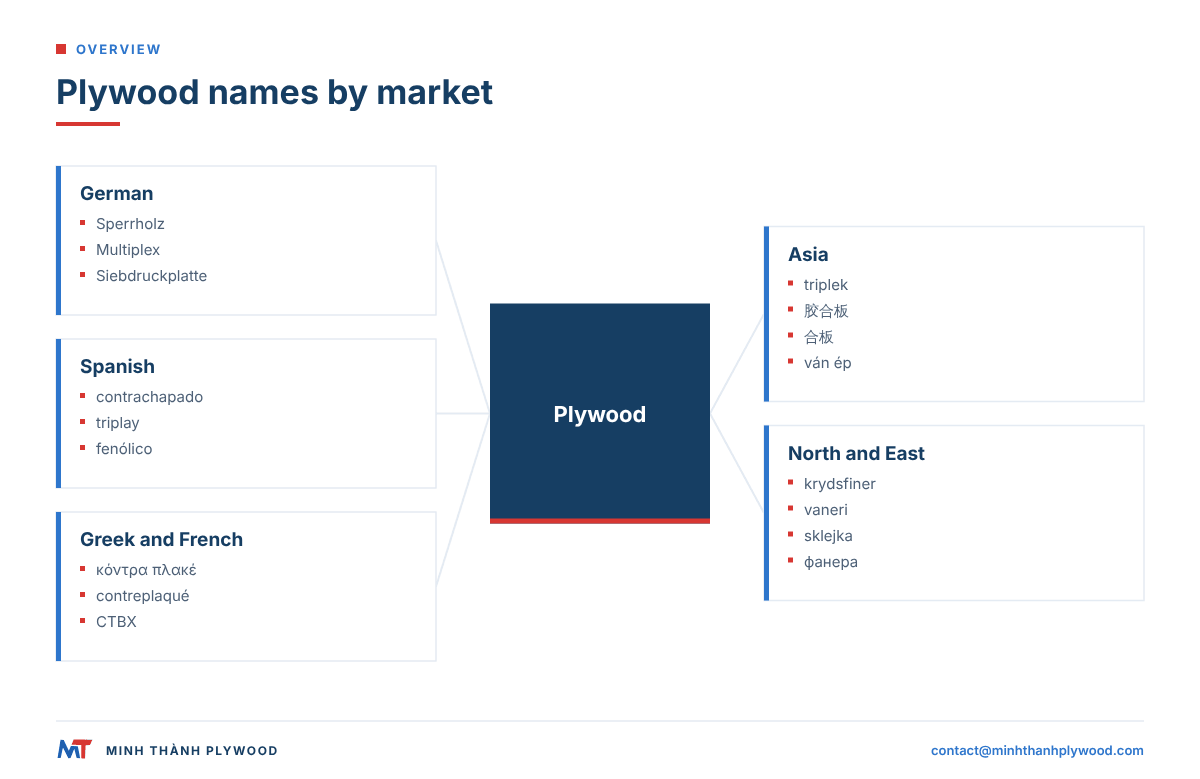
Triplek is the everyday Indonesian word for plywood. It comes from the Dutch “triplex”, the name for thin three-ply panels, which Dutch traders carried into Indonesian in the colonial era. Today “triplek” covers any plywood in Indonesian shops, whatever its ply count.
Indonesian buyers also use two more precise words:
- Kayu lapis, literally “layered wood”, the formal term used in standards, trade statistics and company names.
- Multipleks, again from Dutch, for thicker multi-ply panels, usually 9 mm and up.
In Dutch itself, triplex still means thin plywood, typically 3 to 6 mm, and multiplex means the thicker, many-ply panel. A Dutch order for “triplex 4 mm” and an Indonesian order for “triplek 18 mm” use the same root for different things.
For thin panels, a precise specification matters more than the word. Our thin plywood of 3–5 mm is always 5-ply: at 3 mm one core veneer, two cross-band veneers and two face veneers; at 4 and 5 mm three core veneers and two faces.
What do the Spanish words mean: contrachapado, triplay, fenólico?
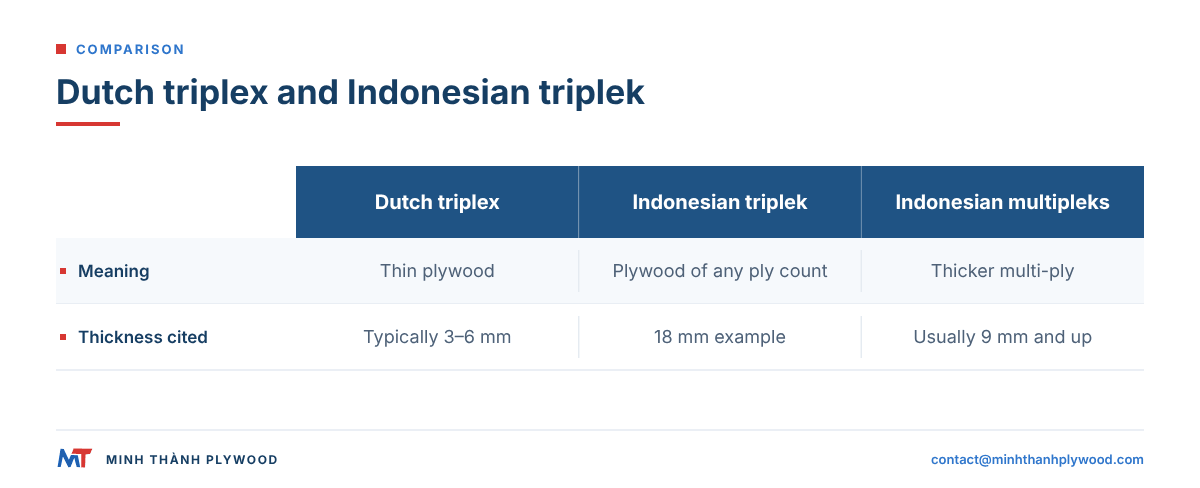
Spanish has the widest spread of plywood words, because each country kept its own. A buyer asking for “Spanish plywood” or writing a tender in Spanish needs to know which country’s word the reader uses.
| Country | Plywood | Film-faced formwork plywood |
|---|---|---|
| Spain | contrachapado | tablero fenólico |
| Mexico | triplay | triplay fenólico, plywood fenólico |
| Argentina, Uruguay | compensado | fenólico |
| Chile | terciado | terciado moldaje |
| Colombia, Venezuela | triplex | triplex fenólico |
| Peru | triplay | triplay fenólico |
“Plywood fenólico” is the Mexican construction trade’s own term: the English word “plywood” and the Spanish “fenólico” for the phenolic glue and film. A Mexican contractor asking for “plywood fenólico 18 mm” means a film-faced formwork panel, not a furniture panel with phenolic glue.
“Fenólico” alone, in Argentina, is the formwork panel itself. The phenolic bond is the common thread: the word in every Spanish-speaking market points to a phenolic (WBP) glue, and our film-faced plywood is made with it.
What is plywood in Greek, French and Italian?
Plywood in Greek is κόντρα πλακέ (kontra plake), borrowed from the French contreplaqué, “plated against”: layers glued across each other. Marine plywood in Greek is κόντρα πλακέ θαλάσσης, “sea plywood”.
French adds a bond class to the word. CTBX on a French panel marks an exterior bond, the plywood a French buyer specifies for humid or outdoor use. Contreplaqué filmé is film-faced plywood, and contreplaqué marine marine plywood.
Italian has two words with different meanings:
- Compensato, the general word for plywood.
- Multistrato, multi-ply plywood, usually birch or poplar, used for furniture, kitchens and shopfitting.
Italian buyers order cut-to-size pieces often: one panel cut into 4, 6 or 8 pieces is a format we ship regularly to Italy and other European markets.
What do the Russian, Polish and Nordic terms tell a buyer?
Russian-language specifications put the bond class into the name, which makes them easy to read once the code is known:
| Russian code | Meaning | Use |
|---|---|---|
| ФК (FK) | Urea-formaldehyde glue | Interior, furniture |
| ФСФ (FSF) | Phenol-formaldehyde glue | Exterior, construction |
| Ламинированная фанера | Film-faced plywood | Formwork, transport floors |
Polish sklejka and the Nordic words (Danish krydsfiner, Norwegian kryssfiner, Finnish vaneri) all describe the cross-layered build. Estonian “vineer” comes from the same European word as English “veneer” and German “Furnier”. Swedish uses “plywood” in daily trade, with “kryssfaner” as the older term.
In these markets, “birch” is usually written into the word (sklejka brzozowa, koivuvaneri, birkekrydsfiner). Birch face grades are named differently in each origin. In Vietnam we name them D+, D and E and quote them as face/back pairs such as D+/D. The ladder is comparable to the European birch grades, with D+ close to B, D close to BB and E close to CP/C.
What is plywood in Arabic, Hindi and the Gulf markets?
Plywood in Arabic is خشب أبلكاش (khashab ablakash), or خشب رقائقي (khashab raqaiqi), “laminated wood”, in formal writing. In the Gulf, English trade words sit beside the Arabic: “marine plywood”, “commercial plywood”, “MR” and “BWP”.
Hindi uses प्लाईवुड, simply “plywood” in Devanagari script, and Indian specifications add the bond class:
- MR (moisture resistant), for interior furniture.
- BWR (boiling water resistant) and BWP (boiling water proof), for kitchens, bathrooms and exterior use.
Buyers in Saudi Arabia, the UAE and India often use these classes in English even in Arabic or Hindi tenders. Our bond options map onto them: UF glue at E0 emission for interior furniture, MR or melamine-fortified for humid interiors, phenolic (WBP) for exterior and formwork.
What is plywood in Chinese, Japanese, Korean and Southeast Asian languages?
East Asian plywood words are built from “glue” and “board” or “layer” and “board”:
- Chinese 胶合板 (jiāohébǎn), “glued board”. 多层板 (duōcéngbǎn), “multi-layer board”, is the furniture trade’s word; 覆膜板 is film-faced and 建筑模板 is formwork.
- Japanese 合板 (gōhan), “combined board”. ベニヤ板 (beniya-ita), “veneer board”, is the everyday word, and コンパネ (konpane), from “concrete panel”, names formwork plywood.
- Korean 합판 (happan), from the same characters as the Japanese gōhan.
- Thai ไม้อัด (mai at), “pressed wood”.
- Vietnamese ván ép, “pressed board”, or gỗ dán, “glued wood”; ván phủ phim is film-faced plywood.
Chinese grade codes travel with the words. Buyers of poplar-faced panels order by the codes B/BB, BB/CC and CP, which map onto the face/back grade pairs A/A, A/B and B/B that we quote for poplar faces, matched to the approved sample.
Why does the word in a purchase order matter?
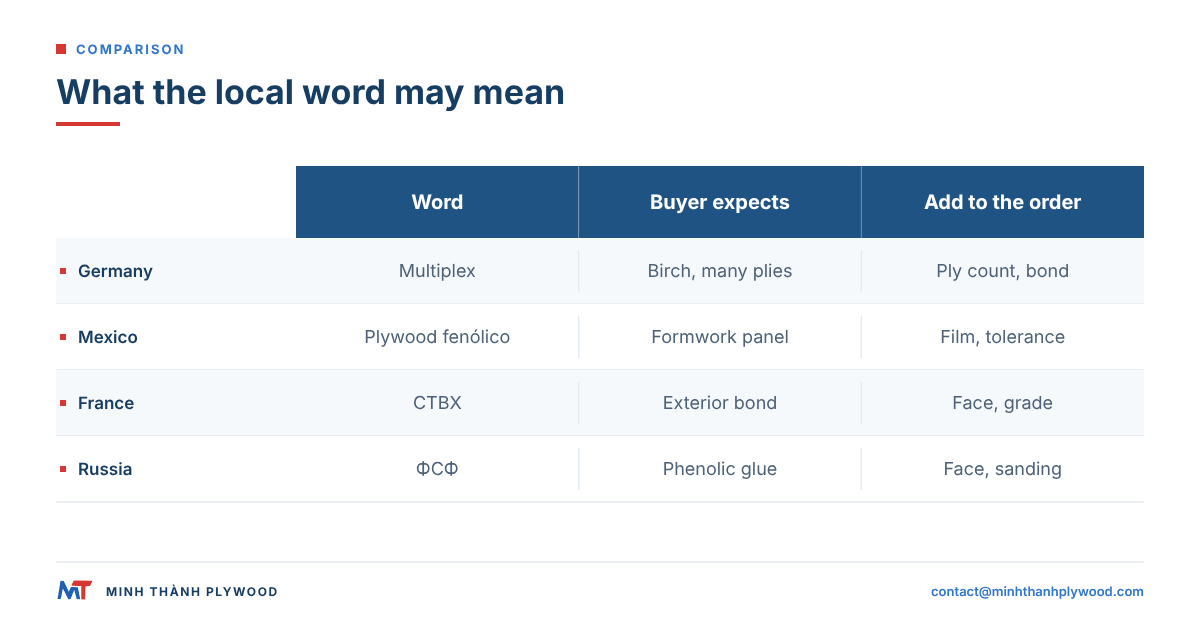
A plywood word carries an assumption about the panel, and the assumption differs by market. “Multiplex” in Germany means birch with many plies; “plywood fenólico” in Mexico means a formwork panel; “BWP” in India means an exterior bond. If the purchase order uses the word without the specification, the mill and the buyer can both be right and still disagree on arrival.
| Word in the order | What the buyer may expect | What to add |
|---|---|---|
| Multiplex 18 mm | Birch, 11–13 plies, gap-free | Face species, ply count, bond |
| Siebdruckplatte | Textured film one side, smooth the other | Film weight or colour, edge sealing |
| Contreplaqué CTBX | Exterior bond | Face species and grade |
| Plywood fenólico | Film-faced formwork panel | Film, thickness tolerance |
| ФСФ | Phenolic glue | Face grade, sanding |
| Marine plywood | BS 1088 build | Standard named, species, bond |
The safest purchase order uses the local word for the reader and the specification for the mill: application, core, glue and emission, face grade, thickness and size, packing and quantity.
How do you write a plywood specification any mill understands?
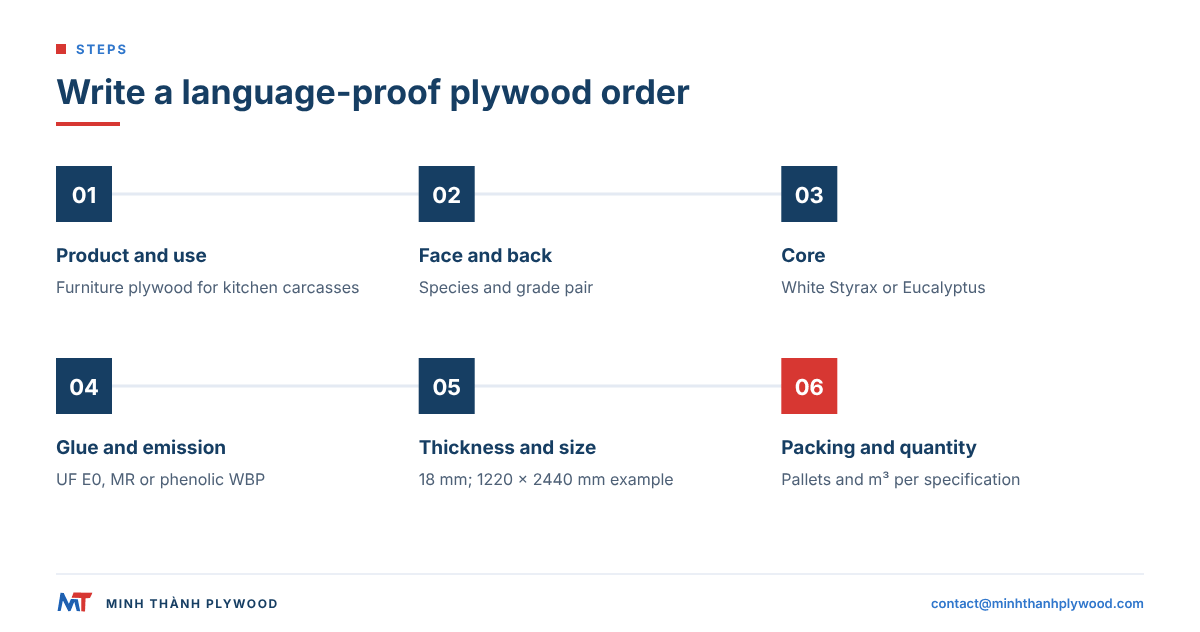
Write the specification in figures and named standards, and the language of the word stops mattering. A mill in Vietnam, a merchant in Germany and a customs broker in Mexico all read the same lines:
- Product and use: furniture plywood for kitchen carcasses.
- Face and back: species and grade pair, for example poplar A/B or birch D+/D.
- Core: species, for example white Styrax or Eucalyptus.
- Glue and emission: UF glue at E0 emission; MR; or phenolic (WBP), with the bond class from BS EN 314-2:1993.
- Thickness and tolerance: for example 18 mm, ±0.2–0.3 mm sanded.
- Size: 1220 × 2440 mm, 1250 × 2500 mm or custom.
- Packing and quantity: pallets, covers, m³ per specification.
Add the local word at the top, Sperrholz, contrachapado or sklejka, so your own team recognises the line. Numbers carry the order across the language border; the word only labels it.
What this means for your order from Minh Thanh
We export from Vietnam to buyers who write their orders in German, Italian, Spanish, Polish, Arabic and many other languages, and we read every one of them against the specification.
What we make, in any of those words:
- Furniture and interior plywood (Sperrholz, compensato, contrachapado): poplar, birch, EV, okoume, pine and eucalyptus faces on white Styrax or Eucalyptus cores, pressed twice as standard, UF glue at E0 emission, tolerance down to ±0.2 mm.
- Commercial and packing plywood.
- Film-faced plywood (Schalungsplatte, betonplex, fenólico, ván phủ phim), with anti-slip faces accepted on order.
- Thin plywood 3–5 mm, always 5-ply.
Every furniture panel is backed by our CARB P2 / TSCA Title VI certification (ICTT mill no. 23024), whatever the language of the order. The US emission rules are in 40 CFR Part 770.
Send the specification in your language to contact@minhthanhplywood.com or WhatsApp +84 988 586 601 (Lisa). We reply within hours, free samples go out with the first quote, and the minimum order is one 40HC with mixed specifications by agreement. For prices, see the plywood price guide.
Buyer questions, answered
What is plywood in German?
Sperrholz. Furniersperrholz is the full technical name for veneer plywood, and Multiplex or Multiplexplatte is plywood with many thin plies, usually birch or beech, used for furniture and workbenches.
Is Multiplex the same as plywood?
Multiplex is a type of plywood. German and Dutch buyers use it for panels with many thin, even plies and solid edges, typically birch; ordinary Sperrholz with fewer, thicker plies is not called Multiplex.
What is a Siebdruckplatte?
Film-faced plywood with a textured, anti-slip face pressed into the film, used for vehicle floors, platforms and stage decks. The smooth version for concrete formwork is a Schalungsplatte or Betoplan-type panel.
What does triplek mean?
Triplek is the everyday Indonesian word for plywood, from the Dutch triplex. The formal Indonesian term is kayu lapis, and thicker multi-ply panels are often called multipleks.
What is plywood in Greek?
κόντρα πλακέ (kontra plake), from the French contreplaqué. Marine plywood is κόντρα πλακέ θαλάσσης.
What is plywood fenólico?
In Mexico and much of Latin America, plywood fenólico or triplay fenólico means film-faced plywood bonded with phenolic glue, used for concrete formwork.
What is plywood in Spanish?
Contrachapado in Spain, triplay in Mexico, terciado in Chile and compensado in Argentina. Film-faced formwork plywood is tablero fenólico in Spain and fenólico in Argentina.
What is plywood in French and Italian?
Contreplaqué in French, with CTBX marking an exterior bond, and compensato or multistrato in Italian. Contreplaqué filmé and pannello fenolico are the film-faced versions.
What is plywood in Russian?
Фанера (fanera). ФК marks an interior panel with urea glue and ФСФ an exterior panel with phenolic glue, the two grades most Russian-language specifications name.
What is plywood called in Vietnamese?
Ván ép or gỗ dán. Film-faced plywood is ván phủ phim, and formwork plywood is ván coppha.